Evolution of anisotropic magnetostriction in LaMn1-xCoxO3 (x= 0.1-0.9)
Pith reviewed 2026-06-26 10:48 UTC · model grok-4.3
The pith
Anisotropic magnetostriction in LaMn1-xCoxO3 peaks at x=0.5 because that composition maximizes high-spin Co2+ ions with non-zero orbital moment.
A machine-rendered reading of the paper's core claim, the machinery that carries it, and where it could break.
Core claim
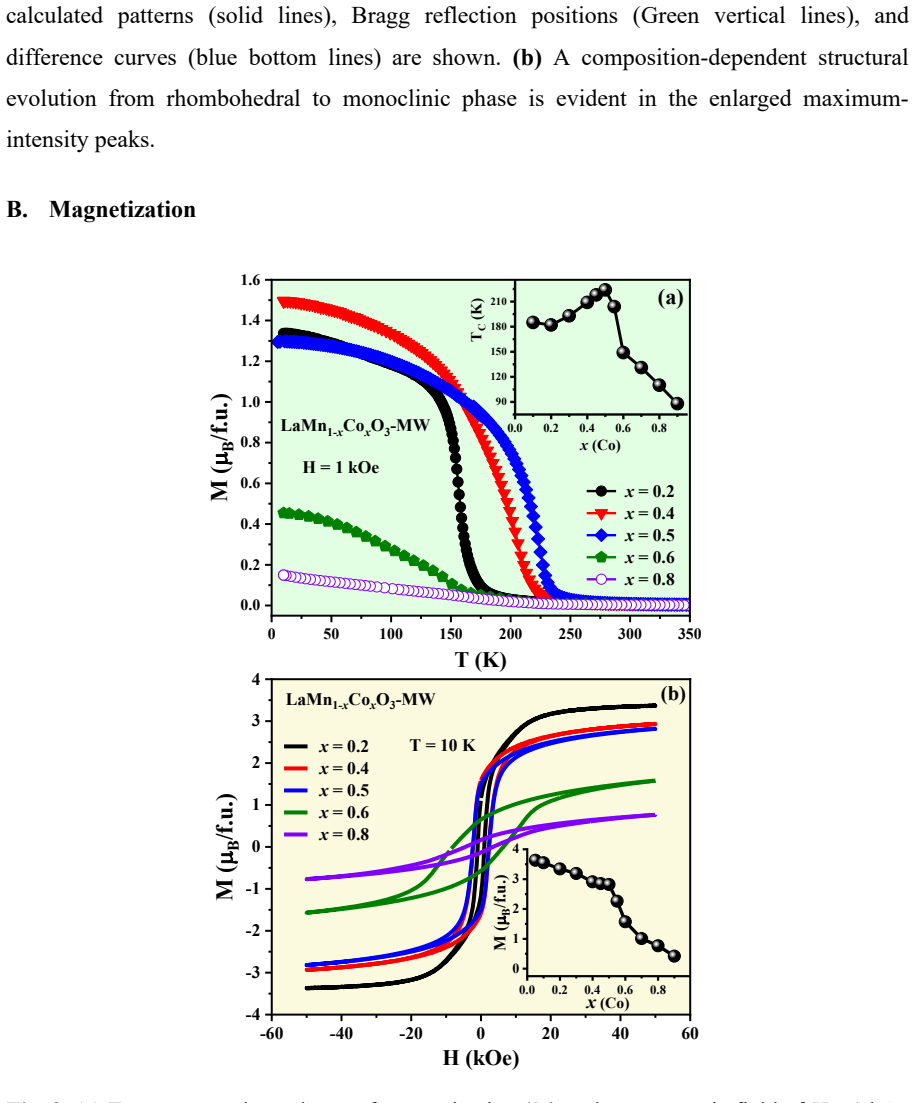
In the LaMn1-xCoxO3 series the anisotropic magnetostriction reaches a maximum of 1221 ppm at x=0.5 for a 50 kOe field at 10 K and then decreases more steeply for x>0.5, while the saturation magnetization falls monotonically except for an abrupt change at x=0.6. This peak is attributed to the largest fraction of high-spin Co2+ ions that carry a non-zero orbital moment, whereas Mn3+/Mn4+ and Co3+ ions play only minor roles. The overall composition dependence is ascribed to concomitant changes in crystal structure, the valence states of the transition-metal ions, and the magnetic interactions among them.
What carries the argument
The composition-dependent fraction of high-spin Co2+ ions possessing a non-zero orbital moment, which reaches its maximum at x=0.5 and produces the dominant anisotropic lattice distortion.
If this is right
- l_par is negative and l_per positive in every composition, with l_anis much larger than l_vol.
- The magnetostriction composition curve is asymmetric, with a steeper drop for x>0.5 than for x<0.5.
- Saturation magnetization decreases with increasing x except for an abrupt change at x=0.6.
- The magnetostriction variation is produced by changes in structure, valence states of Mn and Co, and magnetic interactions among the ions.
Where Pith is reading between the lines
- If the orbital-moment contribution of Co2+ is confirmed as the controlling factor, similar peaks should appear in other cobalt-substituted perovskites when the Co2+ fraction is maximized by appropriate doping or oxygen stoichiometry.
- Replacing manganese with a non-magnetic ion while keeping the Co2+ fraction fixed would test whether manganese ions are truly minor contributors.
- Temperature-dependent magnetostriction and local-probe measurements could show whether the orbital contribution persists or freezes out above 10 K.
- keywords
Load-bearing premise
The valence states, spin states, and orbital moments assigned to the Mn and Co ions are correct across the series and are the dominant cause of the observed magnetostriction peak rather than unaccounted structural or impurity effects.
What would settle it
X-ray absorption or neutron diffraction data that showed the orbital moment per cobalt ion at x=0.5 is not larger than at neighboring compositions, or that the Co2+ fraction does not reach a maximum there, would falsify the central attribution.
Figures
read the original abstract
Polycrystalline samples of LaMn1-xCoxO3 series over a wide compositional range (x = 0.1 - 0.9) were synthesized by microwave irradiation of oxide precursors and their magnetic and magnetostrictive properties were investigated. Magnetostrictions parallel (l_par) and perpendicular (l_per) to the applied magnetic field were measured to estimate anisotropic(l_anis) and volume magnetostrictions(l_vol). In all the compositions, l-par (l_per) is negative (positive) and (l_anis) >> (l_vol), suggesting dominance of anisotropic lattice distortion under a magnetic field. The value of l_anis at 10 K for H = 50 kOe initially increases with x from 178 ppm for x = 0.1 to a maximum of 1221 ppm at x = 0.5 before decreasing for higher x. The composition dependence of magnetostriction is asymmetric about x = 0.5, the decrease for x > 0.5 is more steeper than for x < 0.5 whereas saturation magnetization decreases monotonically with increasing x except for an abrupt change at x = 0.6. The largest anisotropic magnetostriction observed for x = 0.5 is attributed to the presence of high-spin Co2+ ions with a non-zero orbital moment in the maximum fraction whereas Mn3+/4+ or Co3+ ions play minor roles. The composition dependence of magnetostriction is suggested to arise from changes in the structure, valence states of Mn and Co ions and magnetic interactions among them.
Editorial analysis
A structured set of objections, weighed in public.
Referee Report
Summary. The manuscript reports synthesis of polycrystalline LaMn_{1-x}Co_xO_3 (x=0.1-0.9) via microwave irradiation and measurements of anisotropic (λ_anis) and volume (λ_vol) magnetostriction at 10 K up to 50 kOe. λ_anis is found to be much larger than λ_vol in all samples, with λ_anis peaking at 1221 ppm for x=0.5 before decreasing asymmetrically; saturation magnetization decreases monotonically except for an abrupt change at x=0.6. The peak at x=0.5 is attributed to the maximum fraction of high-spin Co^{2+} ions carrying a non-zero orbital moment, while Mn^{3+/4+} and Co^{3+} are said to play minor roles; the overall composition dependence is linked to changes in structure, valence states, and magnetic interactions.
Significance. If the ion-state attribution is substantiated, the work would provide a clear experimental map of how Co substitution tunes anisotropic magnetostriction in the LaMnO_3 family, highlighting the role of orbital moments in perovskite oxides. The observation that λ_anis ≫ λ_vol across the series and the asymmetric composition dependence are potentially useful for identifying compositions with large field-induced lattice responses.
major comments (2)
- [Abstract and Discussion] The central claim that the λ_anis maximum at x=0.5 arises from the highest fraction of high-spin Co^{2+} (with orbital moment) while Mn^{3+/4+} and Co^{3+} contribute negligibly is not supported by any direct valence or spin-state data. No XPS, XANES, Mössbauer, or charge-balance calculation is presented to establish the Co^{2+} fraction versus x, nor is there a decomposition of the magnetization curves into individual-ion contributions that would independently confirm the proposed maximum at x=0.5.
- [Results and Discussion] The abrupt magnetization jump at x=0.6 and the steeper drop in λ_anis for x>0.5 are noted but not quantitatively connected to the proposed changes in valence states or magnetic interactions. Without a model or additional structural data (e.g., XRD refinement showing phase boundaries or bond-length changes), it remains possible that unaccounted structural transitions or impurity phases dominate the observed composition dependence.
minor comments (2)
- [Experimental] The synthesis method (microwave irradiation of oxide precursors) is stated without details on phase purity, oxygen stoichiometry, or grain-size characterization that would be needed to rule out extrinsic contributions to magnetostriction.
- [Results] Error bars or repeatability information for the λ_anis values (especially the 1221 ppm maximum) are not mentioned, making it difficult to assess the statistical significance of the peak at x=0.5 versus neighboring compositions.
Simulated Author's Rebuttal
We thank the referee for the careful reading and constructive comments on our manuscript. We address each major comment below, acknowledging the limitations of the current data set while clarifying the basis for our interpretations.
read point-by-point responses
-
Referee: [Abstract and Discussion] The central claim that the λ_anis maximum at x=0.5 arises from the highest fraction of high-spin Co^{2+} (with orbital moment) while Mn^{3+/4+} and Co^{3+} contribute negligibly is not supported by any direct valence or spin-state data. No XPS, XANES, Mössbauer, or charge-balance calculation is presented to establish the Co^{2+} fraction versus x, nor is there a decomposition of the magnetization curves into individual-ion contributions that would independently confirm the proposed maximum at x=0.5.
Authors: We agree that the absence of direct valence or spin-state measurements (XPS, XANES, or Mössbauer) means the attribution to maximum high-spin Co^{2+} fraction at x=0.5 rests on indirect evidence from the composition dependence of λ_anis and consistency with nominal charge balance in the substitution series. No explicit charge-balance calculation or magnetization decomposition was performed. We will revise the discussion section to state these assumptions explicitly, cite relevant literature on valence states in LaMn1-xCoxO3, and add a caveat noting the lack of direct confirmation. This will temper the central claim without altering the reported data. revision: partial
-
Referee: [Results and Discussion] The abrupt magnetization jump at x=0.6 and the steeper drop in λ_anis for x>0.5 are noted but not quantitatively connected to the proposed changes in valence states or magnetic interactions. Without a model or additional structural data (e.g., XRD refinement showing phase boundaries or bond-length changes), it remains possible that unaccounted structural transitions or impurity phases dominate the observed composition dependence.
Authors: The jump at x=0.6 appears in both magnetization and λ_anis data and is noted in the manuscript, but we did not provide a quantitative model linking it to valence or interaction changes. Detailed Rietveld refinement of XRD data for bond lengths or phase boundaries is not included. We will expand the discussion to reference known structural and magnetic transitions in the LaMn1-xCoxO3 literature around this composition and note that impurity phases cannot be fully excluded without further characterization. No new structural measurements will be added in this revision. revision: partial
- Direct experimental valence/spin-state data (XPS, XANES, Mössbauer) or full magnetization decomposition are not available in the present study and would require new experiments.
- A quantitative microscopic model connecting the x=0.6 feature to specific valence or interaction changes is beyond the scope of this experimental report.
Circularity Check
No circularity: purely experimental report with no derivations or self-referential steps
full rationale
The manuscript describes sample synthesis by microwave irradiation, measurements of parallel and perpendicular magnetostriction (l_par, l_per) to compute anisotropic (l_anis) and volume (l_vol) components, and magnetization curves across x = 0.1-0.9. The largest l_anis at x = 0.5 is attributed to high-spin Co2+ ions, but this is an interpretive statement following the data presentation; no equations, parameter fits, predictions, or derivation chains exist that could reduce to inputs by construction. No self-citations, uniqueness theorems, or ansatzes are invoked. The work is self-contained as raw experimental observations and does not rely on any load-bearing mathematical reduction.
Axiom & Free-Parameter Ledger
axioms (1)
- domain assumption Strain gauges and field application yield accurate parallel and perpendicular length changes without significant artifacts from sample shape or temperature control.
Reference graph
Works this paper leans on
-
[1]
G. H. Jonker, Magnetic and Semiconducting Properties of Perovskites Containing Manganese and Cobalt, J. Appl. Phys. 37, 1424 (1966)
1966
-
[2]
Blasse, Ferromagnetic interactions in non-metallic perovskites, J
G. Blasse, Ferromagnetic interactions in non-metallic perovskites, J. Phys. Chem. Solids 26, 1969 (1965)
1969
-
[3]
Vasala and M
S. Vasala and M. Karppinen, A 2B′B″O6 perovskites: A review, Prog. Solid State Chem. 43, 1 (2015)
2015
-
[4]
Burnus, Z
T. Burnus, Z. Hu, H. H. Hsieh, V. L. J. Joly, P .A. Joy, M. W. Haverkort, H. Wu, A. Tanaka, H. J. Lin, C. T. Chen, and L. H. Tjeng, Local electronic structure and magnetic properties of LaMn0.5Co0.5O3 studied by X-ray absorption and magnetic circular dichroism spectroscopy, Phys. Rev. B 77, 125124 (2008)
2008
-
[5]
Viswanathan, H
M. Viswanathan, H. H. Hsieh, H. J. Lin, C. T. Chen, and P. S Anilkumar, Investigation on the magnetic anomaly and the role of orbital moment on the magnetic properties of LaMn0.5Co0.5O3, J. Phys. Chem. C 115, 4851 (2011)
2011
-
[6]
Blasco , J
J. Blasco , J. García , G. Subías , J. Stankiewicz , S. Lafuerza , J. A. Rodríguez -Velamazán, C, Ritter, and J. L. García-Muñoz, Effects of A-site disorder in the properties of A 2CoMnO6 (A = La, Tb), J. Phys: Cond. Mater. 26, 386001 (2014). 13
2014
-
[7]
R. I. Dass and J. B. Goodenough, Multiple magnetic phases of La2CoMnO6−δ (0 < δ ≤ 0.05), Phys. Rev. B 67, 014401 (2003)
2003
-
[8]
F. Liu, Y. Gao, H. Chang, Y. Liu, and Y. Yun, Control of magnetic properties and band gap by Co/Mn ordering and oxygen distributions of La2CoMnO6, J. Mag. Mag. Mater. 435, 217 (2017)
2017
-
[9]
M. K. Kim, J. Y. Moon, H. Y. Choi, S. H. Oh, N. Lee, and Y. J. Choi, Effects of different annealing atmospheres on magnetic properties in La2CoMnO6 single crystals, Curr. Appl. Phys. 15, 776 (2015)
2015
-
[10]
Kyomen, R
T. Kyomen, R. Yamazaki, and M. Itoh, Correlation between Magnetic Properties and Mn/Co Atomic Order in LaMn 0.5Co0.5O3+d. I. Second -Order Nature in Mn/Co Atomic Ordering and Valence State, Chem. Mater. 15, 4798 (2003)
2003
-
[11]
A. J. Barón-González, C. Frontera, J. L. García-Muñoz, J. Blasco, and C. Ritter. Cation order and structural transition in La2MnCoO6, Journal of Physics: Conference Series 325, 012007 (2011)
2011
-
[12]
I. O. Troyanchuk, L. S. Lobanovsky, D. D. Khalyavin, S. N. Pastushonok, and H. Szymczak, Magnetic and magnetotransport properties of Co-doped manganites with perovskite structure, J. Magn. Magn. Mater. 210, 63(2000)
2000
-
[13]
M. P. Singh, K. D. Truong, and P. Fournier, Magnetodielectric effect in La 2CoMnO6 double perovskite thin films, Appl. Phys. Lett. 91, 042504 (2007)
2007
-
[14]
Y. Q. Lin and X. M. Chen, Dielectric, ferromagnetic characteristics, and room temperature magnetodielectric effects in double perovskite La 2CoMnO6 ceramics, J. Am. Ceram. Soc. 94, 782 (2011)
2011
-
[15]
Krishnamurthy, and J
J. Krishnamurthy, and J. Venimadhav, Magnetodielectric behavior in La2CoMnO6 nanoparticles, J. Appl. Phys. 111, 024102 (2012)
2012
-
[16]
Manna, R
K. Manna, R. S. Joshi, S. Elizabeth, and P. S. A. Kumar, Evaluation of the intrinsic magneto - dielectric coupling in LaMn0.5Co0.5O3 single crystals, Appl. Phys. Lett. 104, 202905 (2014)
2014
-
[17]
R. N. Mahato, K. Setupati, and V. Sankaranayanan, Colossal magnetoresistance in the double perovskite oxide La2CoMnO6, J. Appl. Phys. 107, 09D714 (2010)
2010
-
[18]
Galceran, L
R. Galceran, L. López-Mir, B. Bozzo, J. Cisneros-Fernández, J. Santiso, L. Balcells, C. Frontera, and B. Martínez, Strain-induced perpendicular magnetic anisotropy in La2CoMnO6−ɛ thin films and its dependence on film thickness, Phys. Rev. B 93, 144417 (2016)
2016
-
[19]
Manikandan, A
M. Manikandan, A. Gosh, and R. Mahendiran, Giant magnetostriction in La 2CoMnO6 synthesized by microwave irradiation, Appl. Phys. Lett. 123, 022403 (2023)
2023
-
[20]
Our unpublished results indicate that λpar = -20 ppm for H = 50 kOe and at 10 K in polycrystalline CoFe2O4
-
[21]
Boldrin, A
M. Boldrin, A. Bagri, D. Barlettani, E. Teather, L. Squillante, M. de Souza, R. B. Pontes, A. G. Silva, T. J. A. Mori, R. Perry, R. Lora-Serrano, E. Granado, E. M. Bittar, L. S. I. Veiga, and L. Bufaiçal, Magnetostriction as the origin of the magnetodie lectric effect in La 2CoMnO6, Phys. Rev. Mat. 9, 094403 (2025)
2025
-
[22]
Rotter, Z
M. Rotter, Z. S. Wang, A. T. Boothroyd, D. Prabhakaran, A. Tanaka and M. Doer, Mechanism of spin crossover in LaCoO 3 resolved by shape magnetostriction in pulsed magnetic fields, Sci. Rep. 4, 7003 (2014)
2014
-
[23]
M. R. Ibarra, R. Mahendiran, C. Marquina, B. Garica -Landa, and J. Blasco, High anisotropic magnetostriction in La 1-xSrxCoO3 (x > 0.3): field -induced orbital instability, Phys. Rev. B 57, R3217 (1998)
1998
-
[24]
Y.-S. Chai, J. -Z. Cong, J. -C. He, Dax Su, X. -X. Ding, J. Singleton, V. Zapf, and Y. Sun, Giant magnetostriction and non -saturating electric polarization up to 60T in the polar magnet CaBaCo4O7, Phys. Rev. B 103, 174433 (2021)
2021
-
[25]
J. H. Park, S. W. Cheong, and C. T. Chen, Double -exchange ferromagnetism in LaMn1-xCoxO3, Phys. Rev. B, 55, 11072 (1997)
1997
-
[26]
Sikora, K
M. Sikora, K. Knizek, Cz. Kaputsa, and P. Glatzel, Evolution of charge and spin state of transition metals in the LaMn1−xCoxO3 perovskite series, J. Appl. Phys. 103, 07C907 (2008)
2008
-
[27]
López -Mir, R
L. López -Mir, R. Galceran , J. Herrero -Martín, B. Bozzo , J. Cisneros -Fernández, E. V. Pannunzio Miner, A. Pomar, L. Balcells, B. Martínez, and C. Frontera. Magnetic anisotropy and valence states in La2Co1-xMn1+xO6 (x ≈ 0.23) thin films studied by x-ray absorption spectroscopy techniques. Phys. Rev B 95, 22 (2017). 14
2017
-
[28]
F. H. Bhat , G. Anjum, R. Kumar, M. A. Malik, R. J. Choudhary , and D. K. Shukla, XAS and XPS analysis of double magnetic transition, canonical spin glass behavior and magnetoresistance in LaMn1-xCoxO3 (0.1 ≤ x ≤ 0.5) system. Ceram. Int. 47, 6753 (2021)
2021
-
[29]
Sikora, Cz
M. Sikora, Cz. Kapusta, K. Knížek, Z. Jirák, C. Autret, M. Borowiec, C. J. Oates, V. Procházka, D. Rybicki and D. Zajac, X-ray absorption near-edge spectroscopy study of Mn and Co valence states in LaMn1−𝑥Co𝑥O3 (𝑥 = 0–1), Phys. Rev. B 73, 094426 (2006)
2006
-
[30]
Ghiasi, M
M. Ghiasi, M. U. Delgado-Jaime, A. Malekzadeh, R. P. Wang, P. S. Miedema, M. Beye, F. M. F. de Groot, Mn and Co Charge and Spin Evolutions in LaMn 1–xCoxO3 Nanoparticles, J. Phys. Chem. C 120, 8167 (2016)
2016
-
[31]
H. J. Kitchen, S. R. Vallance, J. L. Kennedy, N. Tapia -Ruiz, L. Carassiti, A. Harrison, A. G. Whittaker, T. D. Drysdale, S. W. King, D. H. Gregory, Modern Microwave methods in solid state inorganic materials chemistry: from fundamental to manufacturing, Ch em. Rev. 114, 1170 (2014)
2014
-
[32]
K. E. Gibbons, M. O. Jones, S. J. Blundell, A. I. Mihut, I. Gameson, P. P. Edwards, Y. Miyazaki, N. C. Hyatt, and A. Porch, Rapid synthesis of colossal magnetoresistive manganites by microwave dielectric heating, Chem. Comm. 159 (2000)
2000
-
[33]
Prado-Gronjal, R
J. Prado-Gronjal, R. Schimidt, and E. Moran, Microwave-assisted routes for synthesis of complex functional oxides, Inorganics, 3, 101 (2015)
2015
-
[34]
Autret, J
C. Autret, J. Hejtmanek, K. Knizek, M. Marysko, Z. Jirak, M. Dlouha, and S. Vratislav 2005 Electric transport and magnetic properties of perovskites LaMn 1−xCoxO3 up to 900 K, J. Phys.: Condens. Matter. 17, 1601 (2005)
2005
-
[35]
C. L. Bull, H. Y. Playford, K. S. Knight, G. B. G. Stenning, and M. G. Tucker, Magnetic and structural phase diagram of the solid solution LaCoxMn1−xO3, Phys. Rev. B 94, 014102 (2016)
2016
-
[36]
R. I. Dass and J. B. Goodenough, Multiple magnetic phases of La2CoMnO6-δ (0 ≤ δ ≤ 0.05), Phys. Rev. B 67, 014401 (2003)
2003
-
[37]
M. Manikandan, A. Gosh, and R. Mahendiran, Microwave-assisted synthesis of LaMnO 3+ d: Tuning physical properties with microwave power. preprint arXiv:2401.04087, (2024)
arXiv 2024
-
[38]
Arulraj, R
A. Arulraj, R. Mahesh, G.N. Subbanna, R. Mahendiran, A. K. Raychaudhuri, C. N. R. Rao, Insulator–Metal Transitions, Giant Magnetoresistance, and Related Aspects of the Cation - Deficient LaMnO 3 Compositions La 1− δMnO3 and LaMn 1− δ′O3, J, Solid State Chem, 127, 87 (1996)
1996
-
[39]
M. R. Ibarra, P. A. Algarabel, C. Marquina, J. Balsco, and J. Garcia, Large magnetovoulme effect in Yttrium doped La-Ca-MnO perovskite, Phys. Rev. Lett, 75, 3541 (1995)
1995
discussion (0)
Sign in with ORCID, Apple, or X to comment. Anyone can read and Pith papers without signing in.