REVIEW 2 major objections 1 minor 52 references
Fluid antenna systems paired with rate-splitting reduce outage probability by up to 92 percent versus fixed antennas while enabling fairness optimization in multiuser MISO links.
Reviewed by Pith at T0; open to challenge. T0 means a machine referee read the full paper against a public rubric. the ladder, T0–T4 →
Closed-form outage analysis and fairness optimization for spatially correlated FAS-enabled RSMA in multiuser MISO systems, showing up to 92% OP reduction versus fixed antennas.
T0 review reviewed 2026-06-26 challenge →
load-bearing objection The paper supplies closed-form outage expressions for RSMA over correlated fluid antennas in MISO plus a simple LP fairness solver, but the reported gains sit on top of the one-factor and quadrature approximations. the 2 major comments →
Outage Analysis and Fairness Design for Spatially Correlated FAS-Enabled RSMA Systems
The pith
A machine-rendered reading of the paper's core claim, the machinery that carries it, and where it could break.
The reading
Core claim
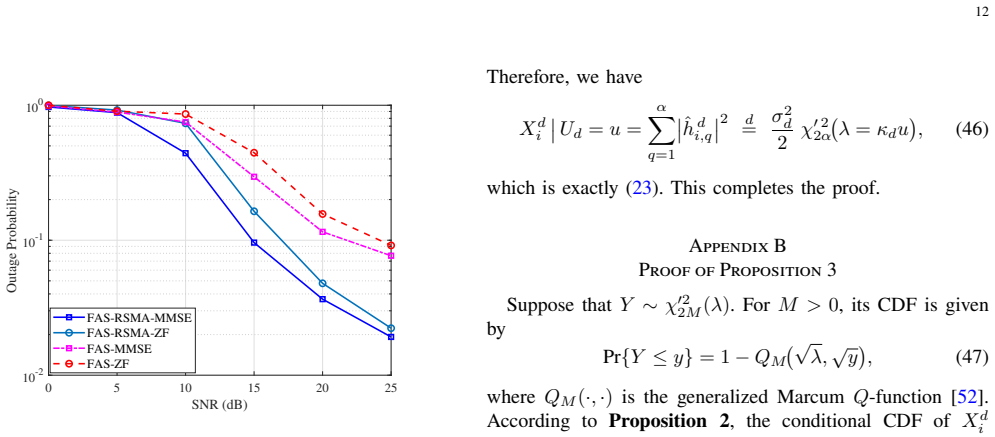
The central claim is that a spatially correlated FAS-enabled RSMA system admits closed-form outage probability expressions derived via block correlation, one-factor construction, and generalized Gauss-Laguerre quadrature, and that these expressions allow a fairness-oriented optimization minimizing the maximum outage probability whose solution equalizes user reliability and yields up to 92 percent outage reduction relative to fixed-position antennas together with a 1 dB SNR gain for the worst user at fixed outage level.
What carries the argument
Block correlation model for fluid antenna ports combined with one-factor construction and generalized Gauss-Laguerre quadrature, which produces the closed-form outage probability expressions used for both analysis and fairness optimization.
Load-bearing premise
The chosen block correlation model for fluid antenna ports, together with the one-factor construction, produces outage expressions that remain accurate under the linear precoding schemes examined.
What would settle it
Monte Carlo simulation of outage probability under the exact block correlation model and linear precoders deviates from the closed-form expressions by more than a few percent across the tested port counts and rates.
If this is right
- FAS-RSMA achieves up to 92 percent lower outage probability than fixed-position antenna baselines across varied port counts and channel conditions.
- The fairness-oriented design equalizes reliability across users without requiring additional power.
- A low-complexity algorithm with linear-program feasibility check solves the min-max outage problem in closed form per iteration.
- The analytical expressions remain valid for both zero-forcing and maximum-ratio transmission precoding.
- Performance gains hold for different target rates and spatial correlation strengths.
Where Pith is reading between the lines
- If the closed-form expressions scale well, they could support real-time port selection algorithms in hardware prototypes.
- The fairness gain for the worst user suggests the method may help satisfy uniform quality-of-service targets in dense deployments.
- Extending the block model to time-varying ports would test whether the outage reduction persists under mobility.
- The 92 percent figure is tied to the specific linear precoders; nonlinear precoding might alter the observed gap to the fixed-antenna baseline.
Editorial analysis
A structured set of objections, weighed in public.
Referee Report
Summary. The paper studies outage analysis for spatially correlated fluid antenna system (FAS) enabled rate-splitting multiple access (RSMA) in multiuser MISO downlink with zero-forcing and maximum-ratio transmission precoding. It derives closed-form outage probability expressions using a block correlation model, one-factor construction, and generalized Gauss-Laguerre quadrature. It also develops a fairness design that minimizes the worst-user outage probability using a linear program feasibility check, with numerical results showing significant performance gains over fixed-position antenna systems.
Significance. The work provides analytical expressions and an optimization framework for FAS-RSMA systems, which could aid in designing reliable 6G networks. The use of standard techniques (one-factor construction, Gauss-Laguerre quadrature, linear programming) for derivations and the inclusion of numerical validation are strengths. If the approximations hold, the reported 92% outage reduction and 1 dB fairness gain would be impactful for interference management in dense networks.
major comments (2)
- [Numerical results] The 92% OP reduction and fairness gains are obtained from the closed-form expressions rather than direct simulation. The derivations rest on the block correlation model, one-factor construction, and generalized Gauss-Laguerre quadrature; the manuscript must include quantitative Monte Carlo validation in the numerical results section for the specific correlation strengths and port counts examined to confirm the approximations introduce negligible bias.
- [Fairness design] The fairness-oriented design claims a low-complexity algorithm with linear-program feasibility check yielding a closed-form solution per iteration. The integration of the OP expressions into the LP must be shown explicitly to ensure the solution remains tractable and does not rely on post-hoc parameter fitting.
minor comments (1)
- [Abstract] The abstract introduces 'one-factor construction' without a brief parenthetical explanation, which may hinder readers unfamiliar with the technique.
Simulated Author's Rebuttal
We thank the referee for the detailed and constructive feedback on our manuscript. We have carefully considered each major comment and provide point-by-point responses below. Where revisions are needed, we have updated the manuscript accordingly.
read point-by-point responses
-
Referee: [Numerical results] The 92% OP reduction and fairness gains are obtained from the closed-form expressions rather than direct simulation. The derivations rest on the block correlation model, one-factor construction, and generalized Gauss-Laguerre quadrature; the manuscript must include quantitative Monte Carlo validation in the numerical results section for the specific correlation strengths and port counts examined to confirm the approximations introduce negligible bias.
Authors: We appreciate this observation. While the manuscript includes Monte Carlo simulations to validate the analytical expressions in Section V, we acknowledge that more quantitative comparisons (such as relative errors or bias metrics) for the specific parameters would strengthen the validation. In the revised manuscript, we will add tables or figures showing the percentage error between the closed-form OP and Monte Carlo simulations for the examined correlation strengths and port counts, confirming that the approximations introduce negligible bias. revision: yes
-
Referee: [Fairness design] The fairness-oriented design claims a low-complexity algorithm with linear-program feasibility check yielding a closed-form solution per iteration. The integration of the OP expressions into the LP must be shown explicitly to ensure the solution remains tractable and does not rely on post-hoc parameter fitting.
Authors: We agree that explicit demonstration is necessary. In the original submission, Section IV describes the substitution of the closed-form outage probability expressions into the linear program formulation, resulting in a feasibility check that yields a closed-form solution per iteration without parameter fitting. To address this comment, we will revise the manuscript to include the explicit equations showing the integration of the OP expressions into the LP constraints and objective, ensuring full transparency and tractability. revision: yes
Circularity Check
No significant circularity; derivations rely on standard approximations and are self-contained
full rationale
The paper's core claims rest on deriving closed-form outage probability expressions from a block correlation model via one-factor construction and generalized Gauss-Laguerre quadrature, followed by a linear-program-based fairness optimization. These steps use explicit mathematical reductions and numerical validation against simulations, without any fitted parameters renamed as predictions, self-definitional loops, or load-bearing self-citations that collapse results to inputs by construction. The 92% OP reduction and fairness gains are outputs of the derived expressions rather than tautological re-statements of modeling assumptions.
Axiom & Free-Parameter Ledger
Cite this review
Pith. "Pith review of Outage Analysis and Fairness Design for Spatially Correlated FAS-Enabled RSMA Systems." pith.science (2026). https://pith.science/paper/W7RK4YGV
@misc{pith2026260622287,
  author       = {Pith},
  title        = {Pith review of: Outage Analysis and Fairness Design for Spatially Correlated FAS-Enabled RSMA Systems},
  year         = {2026},
  howpublished = {\url{https://pith.science/paper/W7RK4YGV}},
  note         = {Machine review of arXiv:2606.22287}
}
read the original abstract
Sixth-generation (6G) systems target higher reliability, denser connectivity, and tighter interference control. {Within this context, rate-splitting multiple access (RSMA) is envisioned as a promising candidate to enhance interference management in future wireless networks by flexibly splitting messages into a common and a private part, while fluid antenna systems (FAS) offer the potential to improve spatial selectivity through dynamic port reconfiguration.} Combining RSMA and FAS therefore enables efficient interference control and adaptive antenna utilization in multiuser multi-input single-output (MISO) networks. However, deriving closed-form outage probability (OP) expressions and tractable user fairness optimization in this scenario remains scarce in the literature. This paper studies a multiuser MISO downlink that jointly leverages RSMA and FAS. We develop a spatial correlation model for FAS using block correlation and incorporate linear precoding with zero-forcing and maximum-ratio transmission. Within this model, we derive closed-form OP expressions using a one-factor construction and generalized Gauss-Laguerre quadrature. Building on these expressions, we formulate a fairness objective that minimizes the worst-user OP and propose a low-complexity algorithm with a linear-program feasibility check to obtain the closed-form solution per iteration. Numerical results across different port counts, channel conditions, and target rates validate the analytical analysis, show that FAS-RSMA reduces OP by up to 92% relative to the fixed-position antenna (FPA) baseline, and demonstrate that fairness-oriented design equalizes user reliability while delivering a 1 dB SNR gain for the worst user at a fixed outage level.
Figures


Reference graph
Works this paper leans on
-
[1]
A tutorial on fluid antenna system for 6G networks: En- compassing communication theory, optimization methods and hardware designs,
W. K. New et al., “A tutorial on fluid antenna system for 6G networks: En- compassing communication theory, optimization methods and hardware designs,” IEEE Commun. Surv. Tutor. , vol. 27, no. 4, pp. 2325-2377, Aug. 2025
2025
-
[2]
Fluid antenna systems enabling 6G: Principles, applica- tions, and research directions
T. Wu et al., “Fluid antenna systems enabling 6G: Principles, applications, and research directions,” IEEE Wireless Commun., early access, 2025, doi: 10.1109/MWC.2025.3629597
-
[3]
Rate-splitting multiple access: Fundamentals, survey, and future research trends,
Y . Mao, O. Dizdar, B. Clerckx, R. Schober, P . Popovski, and H. V . Poor, “Rate-splitting multiple access: Fundamentals, survey, and future research trends,” IEEE Commun. Surv. Tutor., vol. 24, no. 4, pp. 2073-2126, 2022
2073
-
[4]
A new achievable rate region for the interference channel,
T. Han and K. Kobayashi, “A new achievable rate region for the interference channel,” IEEE Trans. Inf. Theory , vol. 27, no. 1, pp. 49- 60, 1981
1981
-
[5]
Rate splitting for MIMO wireless networks: A promising PHY -layer strategy for LTE evolution,
B. Clerckx, H. Joudeh, C. Hao, M. Dai, and B. Rassouli, “Rate splitting for MIMO wireless networks: A promising PHY -layer strategy for LTE evolution,” IEEE Commun. Mag. , vol. 54, no. 5, pp. 98-105, 2016
2016
-
[6]
Rate-splitting multiple access for downlink communication systems: Bridging, generalizing, and out- performing SDMA and NOMA,
Y . Mao, B. Clerckx, and V . O. K. Li, “Rate-splitting multiple access for downlink communication systems: Bridging, generalizing, and out- performing SDMA and NOMA,” EURASIP J. Wireless Commun. Netw. , vol. 2018, no. 1, p. 133, May. 2018
2018
-
[7]
Sum-rate maximization for linearly precoded downlink multiuser MISO systems with partial CSIT: A rate-splitting approach,
H. Joudeh and B. Clerckx, “Sum-rate maximization for linearly precoded downlink multiuser MISO systems with partial CSIT: A rate-splitting approach,” IEEE Trans. on Comm. , vol. 64, no. 11, pp. 4847-4861, Nov. 2016
2016
-
[8]
A rate splitting strategy for massive MIMO with imperfect CSIT,
M. Dai, B. Clerckx, D. Gesbert, and G. Caire, “A rate splitting strategy for massive MIMO with imperfect CSIT,” IEEE Trans. Wireless Commun. , vol. 15, no. 7, pp. 4611-4624, Jul. 2016
2016
-
[9]
Max-min fairness of K-user cooperative rate-splitting in MISO broadcast channel with user relaying,
Y . Mao, B. Clerckx, J. Zhang, V . O. Li, and M. A. Arafah, “Max-min fairness of K-user cooperative rate-splitting in MISO broadcast channel with user relaying,” IEEE Trans. Wireless Commun. , vol. 19, no. 10, pp. 6362-6376, Oct. 2020
2020
-
[10]
Rate-splitting unifying SDMA, OMA, NOMA, and multicasting in MISO broadcast channel: A simple two-user rate analysis,
B. Clerckx, Y . Mao, R. Schober, and H. V . Poor, “Rate-splitting unifying SDMA, OMA, NOMA, and multicasting in MISO broadcast channel: A simple two-user rate analysis,” IEEE Wireless Commun. Lett. , vol. 9, no. 3, pp. 349-353, Nov. 2019
2019
-
[11]
Rate-splitting multiple access for intelligent reflecting surface aided multi-user communications,
A. Bansal et al., “Rate-splitting multiple access for intelligent reflecting surface aided multi-user communications,” IEEE Trans. Veh. Technol. , vol. 70, no. 9, pp. 9217-9229, Sep. 2021. 14
2021
-
[12]
Rate-splitting multiple access for downlink multiuser MIMO: Precoder optimization and PHY layer design,
A. Mishra, Y . Mao, O. Dizdar, and B. Clerckx, “Rate-splitting multiple access for downlink multiuser MIMO: Precoder optimization and PHY layer design,” IEEE Trans. Commun. , vol. 70, no. 2, pp. 874-890, Feb. 2022
2022
-
[13]
A primer on rate-splitting multiple access: Tutorial, myths, and frequently asked questions,
B. Clerckx et al. , “A primer on rate-splitting multiple access: Tutorial, myths, and frequently asked questions,” IEEE J. Sel. Areas Commun. , vol. 41, no. 5, pp. 1265-1308, 2023
2023
-
[14]
Rate- splitting multiple access: Finite constellations, receiver design, and SIC- free implementation,
S. Zhang, B. Clerckx, D. Vargas, O. Haffenden, and A. Murphy, “Rate- splitting multiple access: Finite constellations, receiver design, and SIC- free implementation,” IEEE Trans. Commun. , vol. 72, no. 9, pp. 5319- 5333, Sep. 2024
2024
-
[15]
Power allocation for high mobility OTFS-RSMA system with path-selective one-tap receiver,
J. Liu et al. , “Power allocation for high mobility OTFS-RSMA system with path-selective one-tap receiver,” IEEE Wireless Commun. Lett. , vol. 14, no. 3, pp. 661-665, Mar. 2025
2025
-
[16]
Rate-splitting multiple access for 6G networks: Ten promising scenarios and applications,
J. Park, B. Lee, J. Choi, H. Lee, N. Lee et al., “Rate-splitting multiple access for 6G networks: Ten promising scenarios and applications,” IEEE Network, vol. 38, no. 3, pp. 128-136, Oct. 2023
2023
-
[17]
Outage, capacity, and error performance of downlink RSMA-based systems: Analysis and resource optimization,
T. -H. Vu et al. ,“Outage, capacity, and error performance of downlink RSMA-based systems: Analysis and resource optimization,” IEEE Trans. Commun., vol. 73, no. 8, pp. 6868-6883, Aug. 2025
2025
-
[18]
FARS: Elevating rate-splitting multiple access in non- territorial networks with intelligent fluid antenna system,
S. Zhang et al. , “FARS: Elevating rate-splitting multiple access in non- territorial networks with intelligent fluid antenna system,” IEEE J. Sel. Areas Commun. , vol. 44, pp. 1045-1060, Sep. 2025
2025
-
[19]
Performance limits of fluid antenna systems,
K. K. Wong, A. Shojaeifard, K.-F. Tong, and Y . Zhang, “Performance limits of fluid antenna systems,” IEEE Commun. Lett. , vol. 24, no. 11, pp. 2469-2472, Nov. 2020
2020
-
[20]
Fluid antenna system,
K.-K. Wong et al. , “Fluid antenna system,” IEEE Trans. Wireless Commun., vol. 20, no. 3, pp. 1950-1962, Mar 2021
1950
-
[21]
A new spatial block-correlation model for fluid antenna systems,
P . Ram´ırez-Espinosa, D. Morales-Jimenez, and K. K. Wong, “A new spatial block-correlation model for fluid antenna systems,” IEEE Trans. Wireless Commun. , vol. 23, no. 11, pp. 15829-15843, Nov. 2024
2024
-
[22]
Pro- grammable meta-fluid antenna for spatial multiplexing in fast fluctuating radio channels,
B. Liu, K.-F. Tong, K. K. Wong, C.-B. Chae, and H. Wong, “Pro- grammable meta-fluid antenna for spatial multiplexing in fast fluctuating radio channels,” Opt. Express , vol. 33, no. 13, pp. 28898-28915, 2025
2025
-
[23]
Y . Shen et al. , “Design and implementation of mmWave surface wave enabled fluid antennas and experimental results for fluid antenna multiple access,” arXiv preprint , arXiv:2405.09663, May 2024
-
[24]
A novel pixel-based reconfigurable antenna applied in fluid antenna systems with high switching speed,
J. Zhang et al. , “A novel pixel-based reconfigurable antenna applied in fluid antenna systems with high switching speed,” IEEE Open J. Antennas Propag., vol. 6, no. 1, pp. 212-228, Feb. 2025
2025
-
[25]
Fluid antenna multiple access,
K.-K. Wong and K.-F. Tong, “Fluid antenna multiple access,” IEEE Trans. Wireless Commun. , vol. 21, no. 7, pp. 4801-4815, Jul. 2022
2022
-
[26]
Copula-based performance analysis for fluid antenna systems under arbitrary fading channels,
F. R. Ghadi et al., “Copula-based performance analysis for fluid antenna systems under arbitrary fading channels,” IEEE Commun. Lett. , vol. 27, no. 11, pp. 3068-3072, Nov. 2023
2023
-
[27]
An efficient sum-rate maximization algorithm for fluid antenna-assisted ISAC system,
Q. Zhang et al., “An efficient sum-rate maximization algorithm for fluid antenna-assisted ISAC system,” IEEE Commun. Lett. , vol. 29, no. 1, pp. 200-204, Jan. 2025
2025
-
[28]
A survey on artificial noise for physical layer security: Opportunities, technologies, guidelines, advances, and trends,
H. Niu et al. , “A survey on artificial noise for physical layer security: Opportunities, technologies, guidelines, advances, and trends, ” IEEE Commun. Surv. Tutor. , vol. 28, pp. 341-381, Sep. 2026
2026
-
[29]
Fluid antenna system: New insights on outage probability and diversity gain,
W. K. New, K. K. Wong, H. Xu, K. F. Tong and C.-B. Chae, “Fluid antenna system: New insights on outage probability and diversity gain,” IEEE Trans. Wireless Commun. , vol. 23, no. 1, pp. 128-140, Jan. 2024
2024
-
[30]
Scalable FAS: A new paradigm for array signal process- ing,
T. Wu et al. , “Scalable FAS: A new paradigm for array signal process- ing,” IEEE J. Sel. Topics Signal Process. , early access, 2026
2026
-
[31]
Channel estimation for FAS-assisted multiuser mmWave systems,
H. Xu et al. , “Channel estimation for FAS-assisted multiuser mmWave systems,” IEEE Commun. Lett. , vol. 28, no. 3, pp. 632-636, Mar. 2024
2024
-
[32]
Channel estimation and reconstruction in fluid an- tenna system: Oversampling is essential,
W. K. New et al. , “Channel estimation and reconstruction in fluid an- tenna system: Oversampling is essential,” IEEE Trans. Wireless Commun., vol. 24, no. 1, pp. 309-322, Jan. 2025
2025
-
[33]
Topological perspective of large-scale multi-cell deployment of excitable waveguide dielectrics,
Y . Zhu, Z. Ding, and X. Y ou, “Topological perspective of large-scale multi-cell deployment of excitable waveguide dielectrics,” IEEE Wireless Commun. Lett. , vol. 15, pp. 151–155, 2026
2026
-
[34]
Cell-free fluid antenna multiple access networks,
T. Han, Y . Zhu, K.-K. Wong, G. Zheng, and H. Shin, “Cell-free fluid antenna multiple access networks,” IEEE Trans. Wireless Commun. , vol. 24, no. 9, pp. 7237–7251, Sep. 2025
2025
-
[35]
Fluid Antenna Enabled Compact Ultra Massive Antenna Array for Satellite Communications,
T. Han, Y . Zhu, G. Zheng and P . -D. Arapoglou, “Fluid Antenna Enabled Compact Ultra Massive Antenna Array for Satellite Communications,” IEEE J. Sel. Areas Commun. , vol. 44, pp. 1077-1091, 2026
2026
-
[36]
Exploring fairness for FAS-assisted communication systems: from NOMA to OMA,
J. Y ao et al. , “Exploring fairness for FAS-assisted communication systems: from NOMA to OMA,” IEEE Trans. Wireless Commun. , vol. 24, no. 4, pp. 3433-3449, April 2025
2025
-
[37]
Fluid antenna system liberating multiuser MIMO for ISAC via deep reinforcement learning,
C. Wang et al. , “Fluid antenna system liberating multiuser MIMO for ISAC via deep reinforcement learning,” IEEE Trans. Wireless Commun. , vol. 23, no. 9, pp. 10879-10894, Sep. 2024
2024
-
[38]
Fluid antenna-assisted ISAC systems,
L. Zhou et al. , “Fluid antenna-assisted ISAC systems,” IEEE Wireless Commun. Lett. , vol. 13, no. 12, pp. 3533- 3537, Dec. 2024
2024
-
[39]
FAS-RIS communication: Model, analysis, and optimiza- tion,
J. Y ao et al. , “FAS-RIS communication: Model, analysis, and optimiza- tion,” IEEE Trans. Veh. Technol. , vol. 74, no. 6, pp. 9938-9943, Jun. 2025
2025
-
[40]
Revisiting spatial block-correlation model for fluid antenna systems: from constant to variable correlations,
X. Lai et al., “Revisiting spatial block-correlation model for fluid antenna systems: from constant to variable correlations,” IEEE J. Sel. Areas Commun., vol. 44, pp. 1335-1351, Oct. 2025
2025
-
[41]
Variable block-correlation modeling and optimization for secrecy analysis in fluid antenna systems,
T. Wu et al. , “Variable block-correlation modeling and optimization for secrecy analysis in fluid antenna systems,” IEEE Trans. Wireless Commun., vol. 25, pp. 15069-15085, Apr. 2026
2026
-
[42]
Movable antennas for wireless communication: Opportu- nities and challenges,
L. Zhu et al., “Movable antennas for wireless communication: Opportu- nities and challenges,” IEEE Commun. Mag. , vol. 62, no. 6, pp. 114–120, Jun. 2024
2024
-
[43]
Modeling and performance analysis for movable antenna enabled wireless communications,
L. Zhu, W. Ma, and R. Zhang, “Modeling and performance analysis for movable antenna enabled wireless communications,” IEEE Trans. Wireless Commun. , vol. 23, no. 6, pp. 6234–6250, Jun. 2024
2024
-
[44]
MIMO capacity characterization for movable antenna systems,
W. Ma, L. Zhu, and R. Zhang, “MIMO capacity characterization for movable antenna systems,” IEEE Trans. Wireless Commun. , vol. 23, no. 4, pp. 3392–3407, Apr. 2024
2024
-
[45]
Movable antenna enabled near-field communications: Channel modeling and performance optimization,
L. Zhu et al. , “Movable antenna enabled near-field communications: Channel modeling and performance optimization,” IEEE Trans. Com- mun., vol. 73, no. 9, pp. 7240–7256, Sep. 2025
2025
-
[46]
Fluid antenna-aided robust secure transmission for RSMA-ISAC systems,
C. Zhang et al. “Fluid antenna-aided robust secure transmission for RSMA-ISAC systems,” arXiv preprint , 2025
2025
-
[47]
Fluid antenna-aided rate-splitting multiple access,
F. R. Ghadi et al. “Fluid antenna-aided rate-splitting multiple access,” IEEE Trans. Veh. Technol. , vol. 75, no. 2, pp. 3417–3422, Aug. 2025
2025
-
[48]
Phase-mismatched STAR-RIS with FAS-assisted RSMA users,
F. R. Ghadi et al. “Phase-mismatched STAR-RIS with FAS-assisted RSMA users,” IEEE Trans. Commun., vol. 74, pp. 2032–2046, Dec. 2025
2032
-
[49]
UA V-relay assisted RSMA fluid antenna system: Outage probability analysis,
F. R. Ghadi et al. “UA V-relay assisted RSMA fluid antenna system: Outage probability analysis,” IEEE Wireless Commun. Lett. , vol. 14, no. 9, pp. 2907–2911, Sep. 2025
2025
-
[50]
FAS-RSMA: Can fluid antennas elevate RSMA perfor- mance?,
J. Liu et al. , “FAS-RSMA: Can fluid antennas elevate RSMA perfor- mance?,” IEEE Trans. Commun. , vol. 74, pp. 6476-6492, Mar. 2026
2026
-
[51]
Fluid Antennas Meet Rate-Splitting Multiple Access: A New Path Forward for 6G Networks,
J. Liu et al. , “Fluid Antennas Meet Rate-Splitting Multiple Access: A New Path Forward for 6G Networks,” arXiv preprint , Apr. 2026
2026
-
[52]
I. S. Gradshteyn and I. M. Ryzhik, Table of Integrals, Series, and Products, 7th ed. San Diego, CA: Academic, 2007
2007
This paper was first reviewed by grok-4.3 on June 26, 2026.
discussion (0)
Sign in with ORCID, Apple, or X to comment. Anyone can read and Pith papers without signing in.