Insights of Ammonia Decomposition on W--B Nanoclusters by Computational Simulations
Pith reviewed 2026-06-26 10:11 UTC · model grok-4.3
The pith
Tungsten-boride nanoclusters adsorb ammonia on tungsten sites with energies from -0.54 to -1.78 eV and break the first N-H bond with barriers of 1.1 to 1.4 eV.
A machine-rendered reading of the paper's core claim, the machinery that carries it, and where it could break.
Core claim
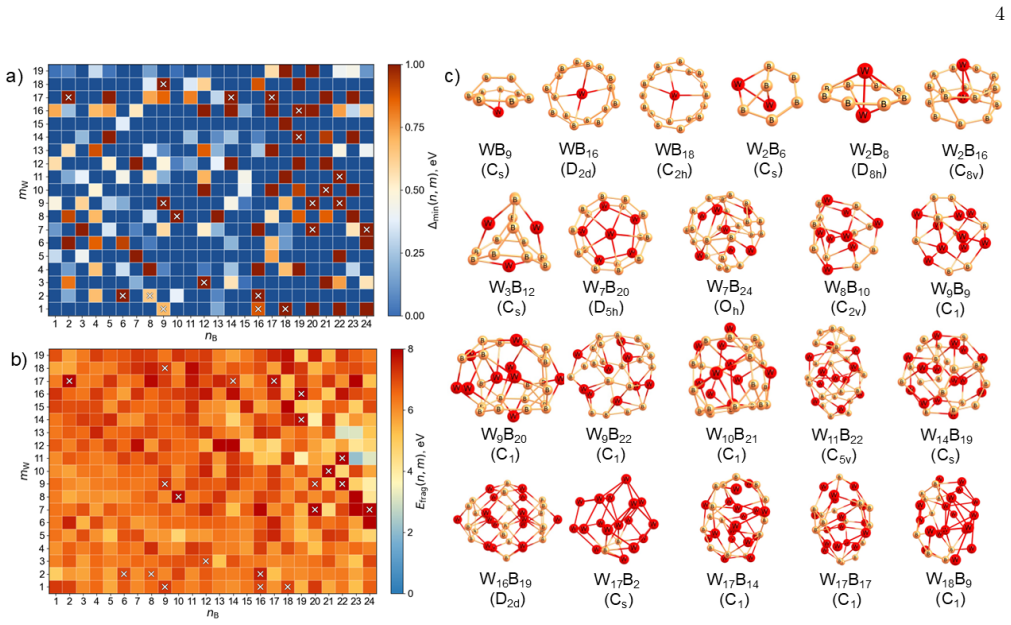
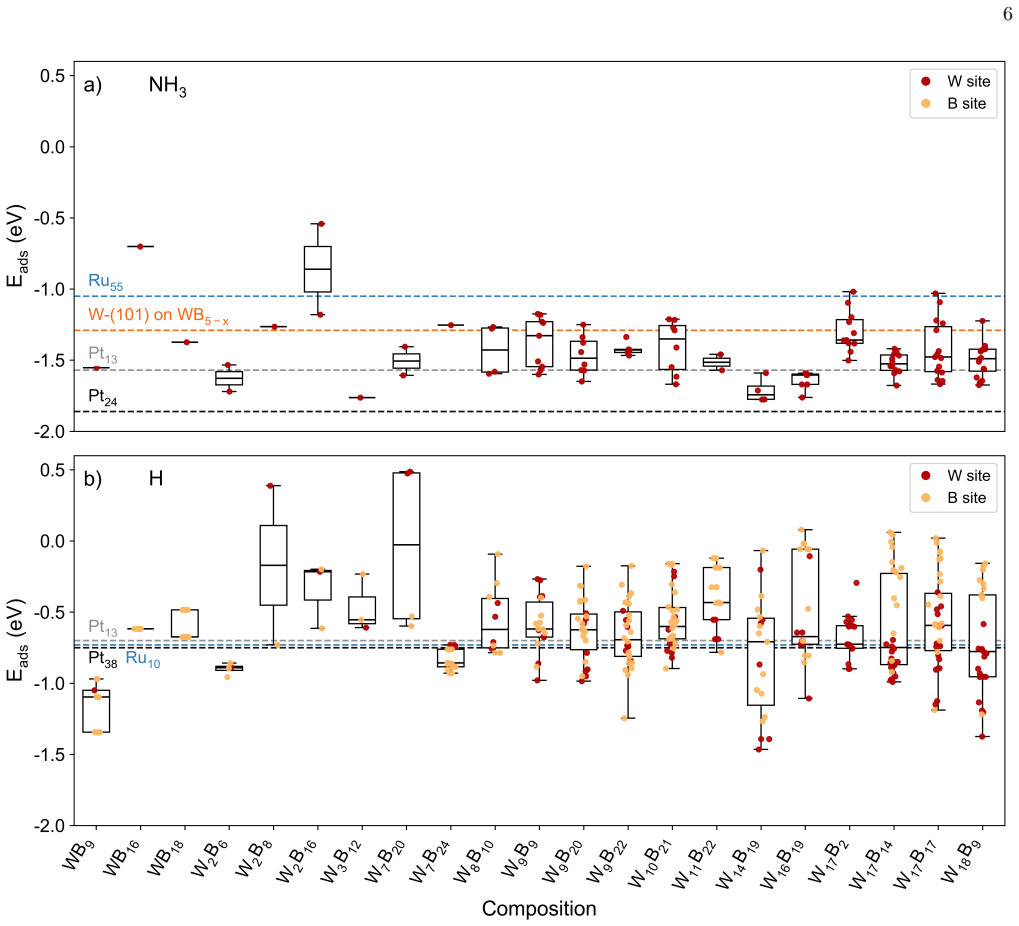
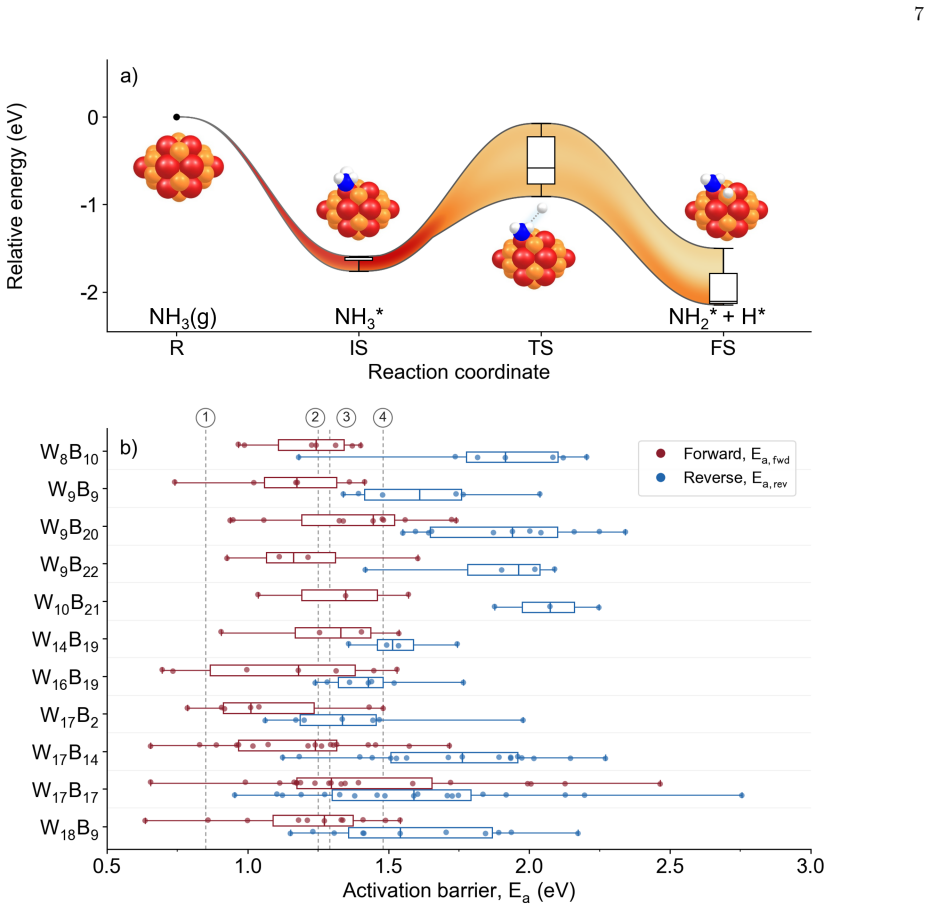
The evolutionary algorithm combined with density functional theory reveals magic compositions such as WB16, W2B8, W7B24, and W11B22 that exhibit pronounced local stability maxima. Ammonia adsorbs molecularly on tungsten sites with energies ranging from -0.54 to -1.78 eV. Nudged elastic band calculations show forward barriers for the first N-H bond cleavage of 1.1-1.4 eV, with the dissociated state often more stable, and the barrier depending on the local environment available to stabilize the detached hydrogen atom. These results position W-B nanoclusters as tunable catalysts for ammonia decomposition.
What carries the argument
The stability maps of WmBn nanoclusters that identify magic compositions, combined with site-specific adsorption calculations and nudged elastic band paths that link the barrier height to the local tungsten environment for hydrogen stabilization.
If this is right
- Several specific compositions display local stability maxima and are therefore the most practical starting points for catalyst design.
- Adsorption energies are comparable to those on platinum and iron clusters, suggesting competitive performance.
- The activation barrier is sensitive to the local atomic arrangement around the adsorption site, allowing compositional tuning.
- The dissociated NH2 plus H state lies below the molecular state for most compositions, favoring the forward reaction.
Where Pith is reading between the lines
- Supporting these clusters on a substrate could preserve the magic compositions while enabling practical use in reactors.
- Similar computational screening might identify W-B clusters active for other small-molecule activations beyond ammonia.
- Experimental synthesis focused on the magic ratios would provide the first test of whether the predicted stabilities translate to real materials.
Load-bearing premise
The evolutionary algorithm combined with density functional theory reliably locates the true ground-state structures of the clusters and the nudged elastic band method with the chosen functional accurately predicts the adsorption energies and reaction barriers.
What would settle it
Measuring ammonia adsorption energies or the rate of the first decomposition step on experimentally prepared W-B nanoclusters of the predicted magic compositions and finding values outside the computed ranges would falsify the catalytic promise.
Figures
read the original abstract
Tungsten-boride nanoclusters represent a promising class of materials for catalytic applications, yet their structural stability and reactivity remain poorly understood. The evolutionary algorithm combined with density functional theory (DFT) are used to systematically explore the ground-state structures and stability landscape of W$_m$B$_n$ nanoclusters with up to 43 atoms. The resulting stability maps reveal a highly non-monotonic landscape characterized by isolated "magic" compositions, including WB$_{16}$, W$_2$B$_8$, W$_7$B$_{24}$, and W$_{11}$B$_{22}$, which exhibit pronounced local stability maxima. We further investigate the adsorption and initial decomposition step of ammonia on these clusters as a probe of their catalytic potential. Molecular NH$_3$ adsorption occurs exclusively on tungsten sites with energies ranging from -0.54 to -1.78 eV (average -1.43 eV), comparable to Pt$_n$ and Fe$_n$ clusters. Atomic hydrogen adsorption spans a broader range from +0.49 to -1.46 eV, reflecting high site sensitivity. Nudged elastic band calculations for the first N--H bond cleavage reveal forward barriers of 1.1-1.4 eV, with the dissociated NH$_2^*$ + H$^*$ state lying below the molecular adsorption state for most compositions. Notably, the activation barrier depends critically on the local environment available for stabilizing the detached hydrogen atom. These findings establish W--B nanoclusters as tunable catalysts for ammonia decomposition and provide a structural foundation for their rational design.
Editorial analysis
A structured set of objections, weighed in public.
Referee Report
Summary. The manuscript uses an evolutionary algorithm combined with DFT to explore ground-state structures of W_m B_n nanoclusters (up to 43 atoms), identifying magic compositions WB_{16}, W_2B_8, W_7B_{24}, and W_{11}B_{22} with pronounced stability maxima. It then computes molecular NH_3 adsorption energies on W sites (-0.54 to -1.78 eV) and forward barriers for the first N-H cleavage (1.1-1.4 eV) via NEB, concluding that these clusters are tunable catalysts for ammonia decomposition with site-sensitive reactivity.
Significance. If the reported structures are the true global minima, the work maps a non-monotonic stability landscape and provides concrete adsorption and barrier ranges that could inform rational design of W-B nanocluster catalysts. The direct comparison of energies to Pt_n and Fe_n clusters is a useful benchmark. However, the absence of any validation for the global optimization or functional benchmarking means the central tunability claim rests on unverified assumptions about structure accuracy.
major comments (3)
- [Methods (evolutionary algorithm description)] The central claim that the identified magic compositions (WB_{16}, W_2B_8, W_7B_{24}, W_{11}B_{22}) establish tunability depends on these being the true ground states. The abstract and methods description of the evolutionary algorithm provide no benchmarks against known small-cluster structures, no multiple independent runs with varied seeds, and no cross-validation with alternative global optimizers or higher-level theory; this is load-bearing for the stability map and the quoted energy ranges.
- [Abstract] Abstract: the reported adsorption energy range (-0.54 to -1.78 eV) and barrier range (1.1-1.4 eV) are presented without error bars, convergence tests for the NEB calculations, or sensitivity analysis to the exchange-correlation functional; these omissions directly affect the reliability of the site-sensitivity and tunability conclusions.
- [Results (adsorption and decomposition)] The claim that NH_3 adsorbs exclusively on tungsten sites and that the barrier depends critically on the local environment for H stabilization is presented as a general result, but the manuscript does not specify how many clusters or adsorption sites were sampled to generate the ranges, undermining the representativeness for rational design.
minor comments (2)
- [Title and Abstract] Notation inconsistency: the title uses W--B while the abstract uses W_m B_n; standardize throughout.
- [Abstract] The abstract states specific numerical ranges but provides no indication of how many independent clusters contribute to the averages or ranges; this should be clarified for reproducibility.
Simulated Author's Rebuttal
We thank the referee for the constructive feedback, which highlights important aspects of validation and clarity. We address each major comment below and indicate the revisions planned for the manuscript.
read point-by-point responses
-
Referee: [Methods (evolutionary algorithm description)] The central claim that the identified magic compositions (WB_{16}, W_2B_8, W_7B_{24}, and W_{11}B_{22}) establish tunability depends on these being the true ground states. The abstract and methods description of the evolutionary algorithm provide no benchmarks against known small-cluster structures, no multiple independent runs with varied seeds, and no cross-validation with alternative global optimizers or higher-level theory; this is load-bearing for the stability map and the quoted energy ranges.
Authors: We agree that explicit validation strengthens confidence in the global minima. In the revised manuscript we will add benchmarks comparing our results for small W-B clusters (such as WB and W2B2) against available literature structures, and we will report outcomes from multiple independent evolutionary algorithm runs using different random seeds. Cross-validation against alternative global optimizers or higher-level theory remains computationally prohibitive for the largest clusters; we will therefore discuss this limitation explicitly while noting that the identified magic compositions are robust within the chosen DFT framework. revision: partial
-
Referee: [Abstract] Abstract: the reported adsorption energy range (-0.54 to -1.78 eV) and barrier range (1.1-1.4 eV) are presented without error bars, convergence tests for the NEB calculations, or sensitivity analysis to the exchange-correlation functional; these omissions directly affect the reliability of the site-sensitivity and tunability conclusions.
Authors: The quoted ranges capture variation across cluster compositions and sites rather than statistical uncertainty. We will revise the abstract and methods to report the NEB convergence criteria (force threshold 0.02 eV/Å) and to include a brief sensitivity test using an alternative functional (PBE versus RPBE) on a representative subset of clusters. Where multiple symmetry-equivalent sites were sampled, we will add the observed standard deviation as error bars on the reported ranges. revision: yes
-
Referee: [Results (adsorption and decomposition)] The claim that NH_3 adsorbs exclusively on tungsten sites and that the barrier depends critically on the local environment for H stabilization is presented as a general result, but the manuscript does not specify how many clusters or adsorption sites were sampled to generate the ranges, undermining the representativeness for rational design.
Authors: We will expand the results section to state explicitly that NH3 adsorption and N-H cleavage were examined on all four magic compositions (WB16, W2B8, W7B24, W11B22). For each cluster we sampled 6–12 distinct tungsten sites chosen by coordination number and Bader charge; the full set of site-specific energies will be tabulated in the revised supplementary information. This sampling directly supports the reported ranges and the site-sensitivity conclusion. revision: yes
Circularity Check
No circularity; direct DFT outputs on EA-searched structures
full rationale
The paper reports ground-state structures located via evolutionary algorithm + DFT, followed by direct computation of NH3 adsorption energies (-0.54 to -1.78 eV) and NEB barriers (1.1-1.4 eV) on those structures. These quantities are outputs of the calculations rather than parameters fitted to the target observables and then renamed as predictions. No self-citations are used to justify uniqueness theorems, ansatzes, or load-bearing premises. The stability map and magic compositions (WB16 etc.) are likewise direct results of the energy evaluations. The workflow is self-contained against external benchmarks and contains no self-definitional, fitted-input, or citation-chain reductions.
Axiom & Free-Parameter Ledger
free parameters (2)
- DFT exchange-correlation functional
- Evolutionary algorithm population and mutation parameters
axioms (2)
- domain assumption DFT with the chosen functional accurately describes W-B bonding and ammonia adsorption energetics
- domain assumption Nudged elastic band method locates the minimum-energy reaction path for N-H cleavage
Reference graph
Works this paper leans on
-
[1]
It is also close to the adsorption en- ergy reported for the W-terminated WB 5−x(101) surface (Eads ≈ −1.29 eV) [53]
(Figure 2a). It is also close to the adsorption en- ergy reported for the W-terminated WB 5−x(101) surface (Eads ≈ −1.29 eV) [53]. Several W–B nanoclusters bind NH3 more strongly than the corresponding extended W– B surface model, suggesting that undercoordinated W sites in finite clusters can enhance ammonia adsorption. Calculated adsorption energies of ...
-
[2]
and Pt 13 and Pt38 clusters [56]. For each pathway, the forward activation barrier is de- fined as Ea,fwd =E TS −E IS,(5) while the reverse barrier is calculated as Ea,rev =E TS −E FS.(6) The reaction energy is evaluated as ∆E=E FS −E IS.(7) Here, IS corresponds to molecularly adsorbed NH 3, TS is the climbing-image configuration, and FS corresponds to co...
-
[3]
Staffell, D
I. Staffell, D. Scamman, A. V. Abad, P. Balcombe, P. E. Dodds, P. Ekins, N. Shah, and K. R. Ward,The role of hydrogen and fuel cells in the global energy system, Energy & Environmental Science12, 463–491 (2019)
2019
-
[4]
M. Yue, H. Lambert, E. Pahon, R. Roche, S. Jemei, and D. Hissel,Hydrogen energy systems: A critical re- view of technologies, applications, trends and challenges, Renewable and Sustainable Energy Reviews146, 111180 (2021)
2021
-
[5]
A. K. Sarker, A. K. Azad, M. G. Rasul, and A. T. Doppalapudi,Prospect of green hydrogen generation from hybrid renewable energy sources: A review, Energies16, 1556 (2023)
2023
-
[6]
International Energy Agency,Global Hydrogen Review 2025, Tech. Rep. (International Energy Agency, Paris,
2025
-
[7]
Zhang, J
T. Zhang, J. Uratani, Y. Huang, L. Xu, S. Griffiths, and Y. Ding,Hydrogen liquefaction and storage: Recent progress and perspectives, Renewable and Sustainable En- ergy Reviews176, 113204 (2023)
2023
-
[8]
A. S. Mekonnin, K. Wac lawiak, M. Humayun, S. Zhang, and H. Ullah,Hydrogen storage technology, and its chal- lenges: a review, Catalysts15, 260 (2025)
2025
-
[9]
Calabrese, M
M. Calabrese, M. Portarapillo, A. Di Nardo, V. Venezia, M. Turco, G. Luciani, and A. Di Benedetto,Hydrogen safety challenges: a comprehensive review on production, storage, transport, utilization, and cfd-based consequence and risk assessment, Energies17, 1350 (2024)
2024
-
[10]
Mulky, S
L. Mulky, S. Srivastava, T. Lakshmi, E. R. Sandadi, S. Gour, N. A. Thomas, S. Shanmuga Priya, and K. Sud- hakar,An overview of hydrogen storage technologies – key challenges and opportunities, Materials Chemistry and 9 Physics325, 129710 (2024)
2024
-
[11]
Portarapillo, A
M. Portarapillo, A. Bellucci Sessa, D. Russo, and A. di Benedetto,Ammonia as a hydrogen carrier: Ener- getic assessment of processes integrated with fuel cells for power generation, Energy & Fuels39, 2843–2853 (2025)
2025
-
[12]
Chatterjee, R
S. Chatterjee, R. K. Parsapur, and K.-W. Huang,Limi- tations of ammonia as a hydrogen energy carrier for the transportation sector, ACS Energy Letters6, 4390–4394 (2021)
2021
-
[13]
European Environment Agency, Ammonia emissions from agriculture and other sources, European zero pollu- tion dashboards (2025), accessed 16 June 2026
2025
-
[14]
R. Ma, K. Li, Y. Guo, B. Zhang, X. Zhao, S. Linder, C. Guan, G. Chen, Y. Gan, and J. Meng,Mitigation potential of global ammonia emissions and related health impacts in the trade network, Nature Communications 12, 6308 (2021)
2021
-
[15]
M. A. Sutton, J. W. Erisman, F. Dentener, and D. M¨ oller,Ammonia in the environment: From ancient times to the present, Environmental Pollution156, 583– 604 (2008)
2008
-
[16]
V. P. Aneja, W. H. Schlesinger, and J. W. Erisman,Ef- fects of agriculture upon the air quality and climate: Re- search, policy, and regulations, Environmental Science & Technology43, 4234–4240 (2009)
2009
-
[17]
J. W. Erisman, A. Bleeker, J. Galloway, and M. A. Sut- ton,Reduced nitrogen in ecology and the environment, Environmental Pollution150, 140–149 (2007)
2007
-
[18]
P. A. J. Moore, H. Li, R. Burns, D. Miles, R. Maguire, J. Ogejo, M. S. Reiter, M. D. Buser, and S. Trabue,De- velopment and testing of the ARS air scrubber: A de- vice for reducing ammonia emissions from animal rear- ing facilities, Frontiers in Sustainable Food Systems2, 23 (2018)
2018
-
[19]
Lucentini, X
I. Lucentini, X. Garcia, X. Vendrell, and J. Llorca,Re- view of the decomposition of ammonia to generate hydro- gen, Industrial & Engineering Chemistry Research60, 18560–18611 (2021)
2021
-
[20]
Sch¨ uth, R
F. Sch¨ uth, R. Palkovits, R. Schl¨ ogl, and D. S. Su,Am- monia as a possible element in an energy infrastructure: catalysts for ammonia decomposition, Energy & Environ- mental Science5, 6278–6289 (2012)
2012
-
[21]
K. E. Lamb, M. D. Dolan, and D. F. Kennedy,Ammo- nia for hydrogen storage; a review of catalytic ammonia decomposition and hydrogen separation and purification, International Journal of Hydrogen Energy44, 3580–3593 (2019)
2019
-
[22]
T. Han, L. Wei, S. Xie, Y. Liu, H. Dai, and J. Deng,Cat- alyst design for ammonia decomposition: an overview, Industrial Chemistry & Materials (2025)
2025
-
[23]
Bell and L
T. Bell and L. Torrente-Murciano,H2 production via am- monia decomposition using non-noble metal catalysts: a review, Topics in Catalysis59, 1438–1457 (2016)
2016
-
[24]
J. C. Ganley, F. Thomas, E. Seebauer, and R. I. Masel, A priori catalytic activity correlations: the difficult case of hydrogen production from ammonia, Catalysis Letters 96, 117–122 (2004)
2004
-
[25]
Boisen, S
A. Boisen, S. Dahl, J. K. Nørskov, and C. H. Chris- tensen,Why the optimal ammonia synthesis catalyst is not the optimal ammonia decomposition catalyst, Jour- nal of Catalysis230, 309–312 (2005)
2005
-
[26]
T. Su, B. Guan, J. Zhou, C. Zheng, J. Guo, J. Chen, Y. Zhang, Y. Yuan, W. Xie, N. Zhou,et al.,Review on ru-based and ni-based catalysts for ammonia decomposi- tion: research status, reaction mechanism, and perspec- tives, Energy & Fuels37, 8099–8127 (2023)
2023
-
[27]
S. M. Ghoreishian, M. Norouzi, and J. Lauterbach,Re- cent progress in the decomposition of ammonia as a po- tential hydrogen-carrier using green technologies, Chem- ical Communications61, 8969–8983 (2025)
2025
-
[28]
S. S. Pansare, W. Torres, and J. G. Goodwin Jr,Ammo- nia decomposition on tungsten carbide, Catalysis Com- munications8, 649–654 (2007)
2007
-
[29]
S. S. Pansare and J. G. Goodwin Jr,Ammonia decom- position on tungsten-based catalysts in the absence and presence of syngas, Industrial & engineering chemistry research47, 4063–4070 (2008)
2008
-
[30]
Z. Pu, T. Liu, G. Zhang, X. Liu, M. A. Gauthier, Z. Chen, and S. Sun,Nanostructured metal borides for energy- related electrocatalysis: recent progress, challenges, and perspectives, Small Methods5, 2100699 (2021)
2021
-
[31]
Carenco, D
S. Carenco, D. Portehault, C. Boissiere, N. Mezailles, and C. Sanchez,Nanoscaled metal borides and phosphides: recent developments and perspectives, Chemical reviews 113, 7981–8065 (2013)
2013
-
[32]
Baletto and R
F. Baletto and R. Ferrando,Structural properties of nan- oclusters: Energetic, thermodynamic, and kinetic effects, Reviews of modern physics77, 371–423 (2005)
2005
-
[33]
A. Y. Kurenkova, A. D. Radina, V. S. Baidyshev, P. V. Povalyaev, E. E. Aidakov, E. Y. Gerasimov, D. D. Mishchenko, A. V. Zhurenok, A. Y. Pak, E. A. Kozlova, et al.,Photocatalytic h2 generation and co2 reduction by wb5-x cocatalyst of tio2 catalyst, Applied Surface Science 661, 160095 (2024)
2024
-
[34]
Tantardini, M
C. Tantardini, M. Azizi, T. A. Altalhi, A. G. Kvashnin, A. Filippetti, C. Gatti, B. I. Yakobson, and X. C. Gonze, SbIV, an unusual player in 2d spintronic devices, ACS Nano19, 26562–26571 (2025)
2025
-
[35]
C. W. Glass, A. R. Oganov, and N. Hansen,Us- pex—evolutionary crystal structure prediction, Computer physics communications175, 713–720 (2006)
2006
-
[36]
A. O. Lyakhov, A. R. Oganov, H. T. Stokes, and Q. Zhu,New developments in evolutionary structure pre- diction algorithm uspex, Computer Physics Communica- tions184, 1172–1182 (2013)
2013
-
[37]
VASP Software GmbH, NEW RELEASE: VASP.6.5.0, VASP official release announcement (2024), accessed 16 June 2026
2024
-
[38]
Kresse and J
G. Kresse and J. Hafner,Ab initio molecular dynamics for liquid metals, Physical Review B47, 558–561 (1993)
1993
-
[39]
Kresse and J
G. Kresse and J. Hafner,Ab initio molecular-dynamics simulation of the liquid-metal–amorphous-semiconductor transition in germanium, Physical Review B49, 14251– 14269 (1994)
1994
-
[40]
Kresse and J
G. Kresse and J. Furthm¨ uller,Efficiency of ab-initio total energy calculations for metals and semiconductors using a plane-wave basis set, Computational Materials Science 6, 15–50 (1996)
1996
-
[41]
Kresse and J
G. Kresse and J. Furthm¨ uller,Efficient iterative schemes for ab initio total-energy calculations using a plane-wave basis set, Physical Review B54, 11169–11186 (1996)
1996
-
[42]
Lepeshkin, V
S. Lepeshkin, V. Baturin, Y. A. Uspenskii, and A. R. Oganov,Method for simultaneous prediction of atomic structure and stability of nanoclusters in a wide area of compositions, The journal of physical chemistry letters 10, 102–106 (2018)
2018
-
[43]
S. V. Lepeshkin, V. S. Baturin, A. S. Naumova, and A. R. Oganov,“magic” molecules and a new look at chemical 10 diversity of hydrocarbons, The Journal of Physical Chem- istry Letters13, 7600–7606 (2022)
2022
-
[44]
Bushlanova, V
N. Bushlanova, V. Baturin, S. Lepeshkin, and Y. Uspen- skii,The amorphous-crystalline transition in si n h 2m nanoclusters, Nanoscale13, 19181–19189 (2021)
2021
-
[45]
Baturin, S
V. Baturin, S. Lepeshkin, N. Bushlanova, and Y. Uspen- skii,Atomistic origins of charge traps in cdse nanoclus- ters, Physical Chemistry Chemical Physics22, 26299– 26305 (2020)
2020
-
[46]
E. E. Vaneeva, S. V. Lepeshkin, and A. R. Oganov,Pre- diction and rationalization of abundant c–n–h molecules in different environments, The Journal of Physical Chem- istry Letters14, 8367–8375 (2023)
2023
-
[47]
P. E. Bl¨ ochl,Projector augmented-wave method, Physical Review B50, 17953–17979 (1994)
1994
-
[48]
Kresse and D
G. Kresse and D. Joubert,From ultrasoft pseudopoten- tials to the projector augmented-wave method, Physical Review B59, 1758–1775 (1999)
1999
-
[49]
Hammer, L
B. Hammer, L. B. Hansen, and J. K. Nørskov,Improved adsorption energetics within density-functional theory us- ing revised perdew–burke–ernzerhof functionals, Physical Review B59, 7413–7421 (1999)
1999
-
[50]
Grimme, J
S. Grimme, J. Antony, S. Ehrlich, and H. Krieg,A con- sistent and accurate ab initio parametrization of den- sity functional dispersion correction (DFT-D) for the 94 elements H-Pu, The Journal of Chemical Physics132, 154104 (2010)
2010
-
[51]
J´ onsson, G
H. J´ onsson, G. Mills, and K. W. Jacobsen, inClassi- cal and Quantum Dynamics in Condensed Phase Simu- lations, edited by B. J. Berne, G. Ciccotti, and D. F. Coker (World Scientific, Singapore, 1998) pp. 385–404
1998
-
[52]
Henkelman and H
G. Henkelman and H. J´ onsson,Improved tangent esti- mate in the nudged elastic band method for finding min- imum energy paths and saddle points, The Journal of Chemical Physics113, 9978–9985 (2000)
2000
-
[53]
Henkelman, B
G. Henkelman, B. P. Uberuaga, and H. J´ onsson,A climb- ing image nudged elastic band method for finding saddle points and minimum energy paths, The Journal of Chem- ical Physics113, 9901–9904 (2000)
2000
-
[54]
Chattaraj and C
D. Chattaraj and C. Majumder,Adsorption and dehy- drogenation of ammonia on ru 55, cu 55 and ru@ cu 54 nanoclusters: role of single atom alloy catalyst, Physical Chemistry Chemical Physics26, 524–532 (2024)
2024
-
[55]
A. D. Radina, V. S. Baidyshev, I. V. Chepkasov, N. A. Matsokin, T. Altalhi, B. I. Yakobson, and A. G. Kvash- nin,Theoretical study of adsorption properties and co ox- idation reaction on surfaces of higher tungsten boride, Scientific Reports14, 12788 (2024)
2024
-
[56]
Kadıoglu, A
Y. Kadıoglu, A. Demirkıran, H. Yaraneri, and O. ¨U. Akt¨ urk,Investigation of nh3 and h2 adsorption on ptn (n= 2–15, 18, 22, 24) clusters by using density functional theory, Journal of alloys and compounds591, 188–200 (2014)
2014
-
[57]
H.-Y. T. Chen, S. Tosoni, and G. Pacchioni,Hydrogen adsorption, dissociation, and spillover on ru10 clusters supported on anatase tio2 and tetragonal zro2 (101) sur- faces, ACS Catalysis5, 5486–5495 (2015)
2015
-
[58]
Okamoto,Comparison of hydrogen atom adsorption on pt clusters with that on pt surfaces: A study from density-functional calculations, Chemical physics letters 429, 209–213 (2006)
Y. Okamoto,Comparison of hydrogen atom adsorption on pt clusters with that on pt surfaces: A study from density-functional calculations, Chemical physics letters 429, 209–213 (2006)
2006
-
[59]
G. S. Otero, B. Pascucci, M. M. Branda, R. Miotto, and P. G. Belelli,Evaluating the size of fe nanoparticles for ammonia adsorption and dehydrogenation, Computa- tional Materials Science124, 220–227 (2016)
2016
-
[60]
S. Zhou, S. Lin, and H. Guo,First-principles insights into ammonia decomposition catalyzed by ru clusters an- chored on carbon nanotubes: size dependence and inter- facial effects, The Journal of Physical Chemistry C122, 9091–9100 (2018)
2018
-
[61]
C. Cui, Z. Luo, and J. Yao,Enhanced catalysis of pt3 clusters supported on graphene for n–h bond dissociation, CCS Chemistry , 215–225 (2019)
2019
-
[62]
M. Miao, X. Gong, S. Lei, L. Wang, M. Sha, and Q. Meng,The graphene-supported non-noble metal cat- alysts activate ammonia decomposition: a dft study, Chemical Physics548, 111249 (2021)
2021
-
[63]
Lanzani and K
G. Lanzani and K. Laasonen,Nh3 adsorption and disso- ciation on a nanosized iron cluster, International journal of hydrogen energy35, 6571–6577 (2010)
2010
-
[64]
P. T. Anastas and J. C. Warner,Green Chemistry: The- ory and Practice(Oxford University Press, New York, 1998)
1998
-
[65]
American Chemical Society, 12 principles of green chem- istry, ACS Green Chemistry Institute (2026), accessed 16 June 2026
2026
-
[66]
United States Environmental Protection Agency, Basics of green chemistry, EPA Green Chemistry (2026), ac- cessed 16 June 2026
2026
discussion (0)
Sign in with ORCID, Apple, or X to comment. Anyone can read and Pith papers without signing in.