Scholarly Production and Public Health Determinants in Context of Funding: The Case of IoMT Research:
Pith reviewed 2026-06-26 09:37 UTC · model grok-4.3
The pith
Funding for Internet of Medical Things research is positively associated with better health determinants across countries.
A machine-rendered reading of the paper's core claim, the machinery that carries it, and where it could break.
Core claim
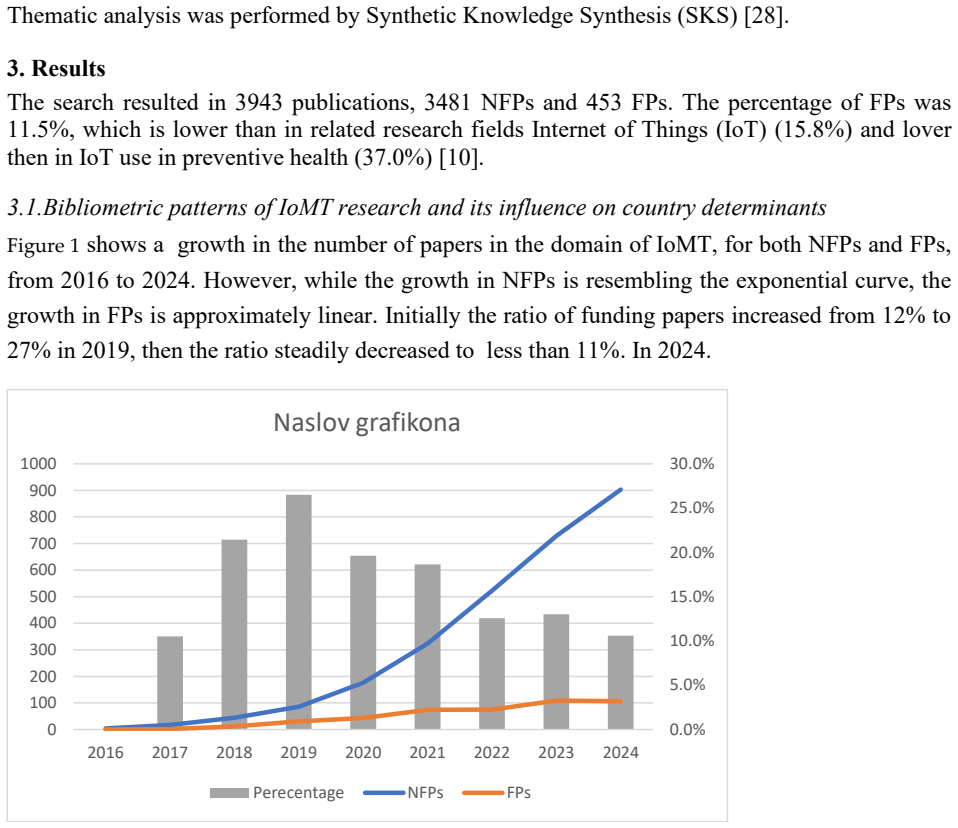
The study reveals a positive trend in IoMT research literature production. Thematic analysis shows that both funded and non-funded research are associated with similar themes; however, funded research is more focused on recent research trends like artificial intelligence applications in healthcare. The study revealed the positive association between the number of funded papers and health determinants, suggesting that IoMT research funding might contribute to improved healthcare delivery.
What carries the argument
Correlation between the count of funded IoMT papers and national health determinants, supported by thematic comparison of funded versus non-funded literature.
If this is right
- Higher numbers of funded IoMT papers correspond with stronger health determinants in the countries producing them.
- Funded IoMT research incorporates more recent topics such as artificial intelligence applications in healthcare.
- Research themes remain broadly consistent between funded and non-funded IoMT papers.
- Increased IoMT research funding may contribute to advancements in healthcare delivery.
Where Pith is reading between the lines
- Policy decisions on medical technology funding could draw on this association to allocate resources toward IoMT projects.
- Similar funding-output-determinant patterns might appear in studies of other digital health technologies.
- Future work that isolates the funding effect from economic confounders would clarify whether the link is causal.
Load-bearing premise
The positive association between funded IoMT papers and health determinants reflects a contribution from the research funding rather than confounding variables such as national wealth or overall research infrastructure.
What would settle it
A re-analysis that controls for GDP per capita or total national research spending and finds the association between funded IoMT papers and health determinants disappears.
Figures
read the original abstract
The Internet of Medical Things (IoMT) represents a transformative technology that connects medical devices, sensors, and healthcare systems to enable real-time monitoring, data sharing, and advanced decision-making in healthcare. While the technical and clinical potential of IoMT has been researched extensively, the scale and scope of research funding and their influence on research literature production patterns and country health determinants remain unknown. The study presented in this paper covers this gap by employing triangulation of quantitative and qualitative approaches. The results reveal a positive trend IoMT in research literature produc-tion. Thematic analysis shows that both funded and non-funded are associated with similar themes; however, founded research is more focused on recent research trends like artificial in-telligence applications in healthcare. Finally, our study revealed the positive association be-tween the number of funded papers and health determinants, suggesting that IoMT research funding might contribute to improved healthcare delivery.
Editorial analysis
A structured set of objections, weighed in public.
Referee Report
Summary. The manuscript examines scholarly production in Internet of Medical Things (IoMT) research in relation to funding and country-level public health determinants. It employs triangulation of quantitative and qualitative methods, reports a positive trend in IoMT literature production, finds thematic overlap between funded and non-funded work (with funded work emphasizing AI applications), and identifies a positive association between the number of funded papers and health determinants, from which it infers that IoMT research funding might contribute to improved healthcare delivery.
Significance. A rigorously controlled demonstration of an association between targeted research funding and health outcomes could inform science policy in emerging medical technologies. The current manuscript, however, presents the association without sufficient methodological detail to evaluate its robustness, limiting its potential contribution.
major comments (2)
- [Abstract] Abstract: the claim of a 'positive association between the number of funded papers and health determinants' is presented without any description of the statistical model, control variables, data sources, sample size, or handling of confounders such as national wealth or research infrastructure; this omission is load-bearing for the central inference that funding 'might contribute to improved healthcare delivery.'
- [Abstract] Abstract: the triangulation of quantitative and qualitative methods is described at a high level but does not indicate any multivariate regression, fixed effects, or instrumental-variable approach that would distinguish the reported association from reverse causation or omitted-variable bias.
minor comments (3)
- [Abstract] Abstract: hyphenation error 'produc-tion' should read 'production'.
- [Abstract] Abstract: 'founded research' should read 'funded research'.
- [Abstract] Abstract: 'in-telligence' should read 'intelligence'.
Simulated Author's Rebuttal
We thank the referee for the comments on methodological transparency. We agree the abstract is too condensed to support evaluation of the reported association and will revise it (and the methods section) to add necessary detail while preserving the exploratory and cautious framing of the study. We address each point below.
read point-by-point responses
-
Referee: [Abstract] Abstract: the claim of a 'positive association between the number of funded papers and health determinants' is presented without any description of the statistical model, control variables, data sources, sample size, or handling of confounders such as national wealth or research infrastructure; this omission is load-bearing for the central inference that funding 'might contribute to improved healthcare delivery.'
Authors: We acknowledge the abstract's brevity omits these elements. The manuscript's quantitative component aggregates country-level counts of funded IoMT papers (drawn from publication databases) and compares them with publicly available health determinant indicators; the association is descriptive rather than the output of a multivariate model with explicit controls. In revision we will expand the abstract to state the data sources, sample (papers and countries), and the correlational nature of the comparison, while retaining the cautious phrasing 'might contribute' and adding an explicit note on the absence of controls for national wealth or infrastructure as a limitation. revision: yes
-
Referee: [Abstract] Abstract: the triangulation of quantitative and qualitative methods is described at a high level but does not indicate any multivariate regression, fixed effects, or instrumental-variable approach that would distinguish the reported association from reverse causation or omitted-variable bias.
Authors: The triangulation consists of (i) quantitative bibliometric counts of publication trends and funding status and (ii) qualitative thematic coding of paper content. The country-level association is obtained by direct comparison of these counts with health indicators and is not derived from regression, fixed effects, or instruments. Because the design is observational and exploratory, it cannot separate the reported pattern from reverse causation or omitted variables; the manuscript therefore uses suggestive language only. We will revise the abstract and methods to name the exact quantitative operations performed and to state the observational limitation explicitly. revision: yes
Circularity Check
No circularity: empirical association reported from data analysis with no derivations or self-referential definitions.
full rationale
The paper reports an empirical finding of positive association between funded IoMT papers and health determinants via triangulation of quantitative and qualitative methods. No equations, mathematical derivations, fitted parameters renamed as predictions, or self-citation chains are present in the provided abstract or described structure. The central claim is a data-driven observation, not a result that reduces to its inputs by construction. The study is self-contained as an observational analysis without load-bearing self-referential steps.
Axiom & Free-Parameter Ledger
Reference graph
Works this paper leans on
-
[1]
Scand J Public Health 50:1062–1070
Heimburg DV, Prilleltensky I, Ness O, Ytterhus B (2022) From public health to public good: Toward universal wellbeing. Scand J Public Health 50:1062–1070. https://doi.org/10.1177/14034948221124670
-
[2]
In: The Elgar Companion to Health and the Sustainable Development Goals
Mayhew SH, Hammer M (2025) Introduction: health as a public good in an uncertain world. In: The Elgar Companion to Health and the Sustainable Development Goals. Edward Elgar Publishing, pp 1– 22
2025
-
[3]
Advanced Drug Delivery Reviews 178:113958
Awad A, Trenfield SJ, Pollard TD, et al (2021) Connected healthcare: Improving patient care using digital health technologies. Advanced Drug Delivery Reviews 178:113958. https://doi.org/10.1016/j.addr.2021.113958
-
[4]
Satam H, Joshi K, Mangrolia U, et al (2023) Next-Generation Sequencing Technology: Current Trends and Advancements. Biology 12:997. https://doi.org/10.3390/biology12070997
-
[5]
Kokol P, Blažun Vošner H, Kokol M, Završnik J (2022) Role of Agile in Digital Public Health Transfor- mation. Front Public Health 10:899874. https://doi.org/10.3389/fpubh.2022.899874
-
[6]
Kokol P (2022) Agile Software Development in Healthcare: A Synthetic Scoping Review. Applied Sci- ences 12:9462. https://doi.org/10.3390/app12199462
-
[7]
Walter de Gruyter GmbH & Co KG
Malviya R, Sundram S, Dhanaraj RK, Kadry S (2024) Digital Transformation in Healthcare 5.0: Volume 1: IoT, AI and Digital Twin. Walter de Gruyter GmbH & Co KG
2024
-
[8]
https://doi.org/10.3390/electronics11162485
Kokol P (2022) Software Quality: How Much Does It Matter? Electronics 11:2485. https://doi.org/10.3390/electronics11162485
-
[9]
CRC Press
Khang A, Rana G, Tailor RK, Abdullayev V (2023) Data -Centric AI Solutions and Emerging Technol- ogies in the Healthcare Ecosystem. CRC Press
2023
-
[10]
Šajnović U, Vošner HB, Završnik J, et al (2024) Internet of Things and Big Data Analytics in Preventive Healthcare: A Synthetic Review. Electronics 13:3642. https://doi.org/10.3390/electronics13183642
-
[11]
El-Saleh AA, Sheikh AM, Albreem MAM, Honnurvali MS (2024) The Internet of Medical Things (IoMT): opportunities and challenges. Wireless Netw. https://doi.org/10.1007/s11276 -024-03764-8
-
[12]
Osama M, Ateya AA, Sayed MS, et al (2023) Internet of Medical Things and Healthcare 4.0: Trends, Requirements, Challenges, and Research Directions. Sensors 23:. https://doi.org/10.3390/s23177435
-
[13]
IETE Technical Review 39:775–788
Razdan S, Sharma S (2022) Internet of Medical Things (IoMT): Overview, Emerging Technologies, and Case Studies. IETE Technical Review 39:775–788. https://doi.org/10.1080/02564602.2021.1927863
-
[14]
IEEE Internet of Things Journal 11:19046 –19069
Adil M, Khan MK, Kumar N, et al (2024) Healthcare Internet of Things: Security Threats, Challenges, and Future Research Directions. IEEE Internet of Things Journal 11:19046 –19069. https://doi.org/10.1109/JIOT.2024.3360289
-
[15]
Manickam P, Mariappan SA, Murugesan SM, et al (2022) Artificial Intelligence (AI) and Internet of Medical Things (IoMT) Assisted Biomedical Systems for Intelligent Healthcare. Biosensors 12:562. https://doi.org/10.3390/bios12080562
-
[16]
In: Data -Centric AI Solutions and Emerging Technologies in the Healthcare Eco- system
Shah V, Khang A (2023) Internet of Medical Things (IoMT) Driving the Digital Transformation of the Healthcare Sector. In: Data -Centric AI Solutions and Emerging Technologies in the Healthcare Eco- system. CRC Press
2023
-
[17]
Journal of Informetrics 18:101592
Ou G, Zhao K, Zuo R, Wu J (2024) Effects of research funding on the academic impact and societal visibility of scientific research. Journal of Informetrics 18:101592. https://doi.org/10.1016/j.joi.2024.101592
-
[18]
Journal of the Medical Library Association 111:703 –709
Kokol P (2023) Discrepancies among Scopus and Web of Science, coverage of funding information in medical journal articles: a follow -up study. Journal of the Medical Library Association 111:703 –709. https://doi.org/10.5195/jmla.2023.1513
-
[19]
Kokol P, Blažun Vošner H (2018) Discrepancies among Scopus, Web of Science, and PubMed coverage of funding information in medical journal articles. J Med Libr Assoc 106:81 –86. https://doi.org/10.5195/jmla.2018.181
-
[20]
Revista de Gestão - RGSA 18:e09479 – e09479
Souza CL de, Kuniyoshi MS, Freitas AB de G (2024) Mapping The Growth of ESG Research: A Biblio- metric Analysis Using Bradford’s, Lotka’s, and Zipf’s Laws. Revista de Gestão - RGSA 18:e09479 – e09479. https://doi.org/10.24857/rgsa.v18n10-309
-
[21]
https://www.scimagojr.com/
(2023) Scimago Journal & Country Rank. https://www.scimagojr.com/. Accessed 26 Jan 2023
2023
-
[22]
Health and health system ranking of countries worldwide in 2023. In: Statista. https://www.sta- tista.com/statistics/1376359/health-and-health-system-ranking-of-countries-worldwide/. Accessed 17 Aug 2024
arXiv 2023
-
[23]
https://databank.worldbank.org/source/world -develop- ment-indicators/Series/GB.XPD.RSDV.GD.ZS#
World Development Indicators | DataBank. https://databank.worldbank.org/source/world -develop- ment-indicators/Series/GB.XPD.RSDV.GD.ZS#. Accessed 17 Aug 2024
2024
-
[24]
https://worldpopulationreview.com/country-rankings/healthiest-countries
Healthiest Countries 2024. https://worldpopulationreview.com/country-rankings/healthiest-countries. Accessed 23 Aug 2024
2024
-
[25]
Journal of Nursing Scholarship 51:590–598
Kokol P, Železnik D, Završnik J, Blažun Vošner H (2019) Nursing Research Literature Production in Terms of the Scope of Country and Health Determinants: A Bibliometric Study. Journal of Nursing Scholarship 51:590–598. https://doi.org/10.1111/jnu.12500
-
[26]
Maritime Policy & Management 52:478 –496
Hayat M, Shang K -C, Lirn T -C (2025) A bibliometric study based on seafarers’ psychological issues: hotspots research and future agenda. Maritime Policy & Management 52:478 –496. https://doi.org/10.1080/03088839.2024.2369600
-
[27]
Kokol P (2021) Meta approaches in knowledge synthesis in nursing: A bibliometric analysis. Nurs Outlook 69:815–825. https://doi.org/10.1016/j.outlook.2021.02.006
-
[28]
Journal of Hospital Librarianship 24:10–17
Kokol P (2024) Synthetic Knowledge Synthesis in Hospital Libraries. Journal of Hospital Librarianship 24:10–17. https://doi.org/10.1080/15323269.2023.2291282
-
[29]
In: OECD
Health. In: OECD. https://www.oecd.org/en/topics/policy-areas/health.html. Accessed 17 Aug 2024
2024
-
[30]
Houghton, Mifflin, Oxford, England
Zipf GK (1935) The psycho-biology of language. Houghton, Mifflin, Oxford, England
1935
-
[32]
Ahila A, Dahan F, Alroobaea R, et al (2023) A smart IoMT based architecture for E -healthcare patient monitoring system using artificial intelligence algorithms. Frontiers in Physiology 14:. https://doi.org/10.3389/fphys.2023.1125952
-
[33]
IEEE Transactions on Computational Social Systems 10:1800 –1809
Ghosh S, Ghosh SK (2023) FEEL: FEderated LEarning Framework for ELderly Healthcare Using Edge- IoMT. IEEE Transactions on Computational Social Systems 10:1800 –1809. https://doi.org/10.1109/TCSS.2022.3233300
-
[34]
Yearbook of Medical Informatics 31:40–46
Haghi M, Benis A, Deserno TM (2022) Accident & Emergency Informatics and One Digital Health. Yearbook of Medical Informatics 31:40–46. https://doi.org/10.1055/s-0042-1742506
-
[35]
Biosensors and Bioelectronics 179:113074
Jain S, Nehra M, Kumar R, et al (2021) Internet of medical things (IoMT) -integrated biosensors for point-of-care testing of infectious diseases. Biosensors and Bioelectronics 179:113074. https://doi.org/10.1016/j.bios.2021.113074
-
[36]
Diabetes & Metabolic Syndrome: Clinical Research & Reviews 14:911 –915
Swayamsiddha S, Mohanty C (2020) Application of cognitive Internet of Medical Things for COVID - 19 pandemic. Diabetes & Metabolic Syndrome: Clinical Research & Reviews 14:911 –915. https://doi.org/10.1016/j.dsx.2020.06.014
-
[37]
Shoeibi A, Khodatars M, Jafari M, et al (2024) Automated detection and forecasting of COVID-19 using deep learning techniques: A review. Neurocomputing 577:127317. https://doi.org/10.1016/j.neu- com.2024.127317
-
[38]
IEEE Journal of Biomedical and Health Informatics 27:823 –834
Samuel O, Omojo AB, Onuja AM, et al (2023) IoMT: A COVID -19 Healthcare System Driven by Fed- erated Learning and Blockchain. IEEE Journal of Biomedical and Health Informatics 27:823 –834. https://doi.org/10.1109/JBHI.2022.3143576
-
[39]
Hossen MN, Panneerselvam V, Koundal D, et al (2023) Federated Machine Learning for Detection of Skin Diseases and Enhancement of Internet of Medical Things (IoMT) Security. IEEE Journal of Bio- medical and Health Informatics 27:835–841. https://doi.org/10.1109/JBHI.2022.3149288
-
[40]
Federated Learning for Smart Healthcare: A Survey
Nguyen DC, Pham Q-V, Pathirana PN, et al (2022) Federated Learning for Smart Healthcare: A Survey. ACM Computing Surveys 55:. https://doi.org/10.1145/3501296
-
[41]
IEEE Transactions on Computational Social Sys- tems 10:1559–1567
Cai W, Gao M, Jiang Y, et al (2023) Hierarchical Domain Adaptation Projective Dictionary Pair Learn- ing Model for EEG Classification in IoMT Systems. IEEE Transactions on Computational Social Sys- tems 10:1559–1567. https://doi.org/10.1109/TCSS.2022.3176656
-
[42]
IEEE Journal of Biomedical and Health In- formatics 27:710–721
Rahmadika S, Astillo PV, Choudhary G, et al (2023) Blockchain -Based Privacy Preservation Scheme for Misbehavior Detection in Lightweight IoMT Devices. IEEE Journal of Biomedical and Health In- formatics 27:710–721. https://doi.org/10.1109/JBHI.2022.3187037
-
[43]
Yaqoob MM, Nazir M, Yousafzai A, et al (2022) Modified Artificial Bee Colony Based Feature Opti- mized Federated Learning for Heart Disease Diagnosis in Healthcare. Applied Sciences 12:12080. https://doi.org/10.3390/app122312080
-
[44]
IEEE Journal of Biomedical and Health Informatics 27:664–672
Lakhan A, Mohammed MA, Nedoma J, et al (2023) Federated -Learning Based Privacy Preservation and Fraud-Enabled Blockchain IoMT System for Healthcare. IEEE Journal of Biomedical and Health Informatics 27:664–672. https://doi.org/10.1109/JBHI.2022.3165945
-
[45]
Federated Learning for Privacy Preservation in Smart Healthcare Systems: A Comprehensive Survey
Ali M, Naeem F, Tariq M, Kaddoum G (2023) Federated Learning for Privacy Preservation in Smart Healthcare Systems: A Comprehensive Survey. IEEE Journal of Biomedical and Health Informatics 27:778–789. https://doi.org/10.1109/JBHI.2022.3181823
-
[46]
Applied Soft Computing 140:110227
Si-Ahmed A, Al-Garadi MA, Boustia N (2023) Survey of Machine Learning based intrusion detection methods for Internet of Medical Things. Applied Soft Computing 140:110227. https://doi.org/10.1016/j.asoc.2023.110227
-
[47]
IEEE Journal of Biomedical and Health Infor- matics 27:790–803
Aouedi O, Sacco A, Piamrat K, Marchetto G (2023) Handling Privacy -Sensitive Medical Data With Federated Learning: Challenges and Future Directions. IEEE Journal of Biomedical and Health Infor- matics 27:790–803. https://doi.org/10.1109/JBHI.2022.3185673
-
[48]
Ali A, Almaiah MA, Hajjej F, et al (2022) An Industrial IoT -Based Blockchain-Enabled Secure Search- able Encryption Approach for Healthcare Systems Using Neural Network. Sensors 22:. https://doi.org/10.3390/s22020572
-
[49]
Almaiah MA, Hajjej F, Ali A, et al (2022) An AI-Enabled Hybrid Lightweight Authentication Model for Digital Healthcare Using Industrial Internet of Things Cyber-Physical Systems. Sensors 22:. https://doi.org/10.3390/s22041448
-
[50]
Future Generation Computer Systems 127:181 –193
Khan IA, Moustafa N, Razzak I, et al (2022) XSRU-IoMT: Explainable simple recurrent units for threat detection in Internet of Medical Things networks. Future Generation Computer Systems 127:181 –193. https://doi.org/10.1016/j.future.2021.09.010
-
[51]
Biosensors and Bioelectronics 220:
Chaudhary V, Khanna V, Ahmed Awan HT, et al (2023) Towards hospital -on-chip supported by 2D MXenes-based 5th generation intelligent biosensors. Biosensors and Bioelectronics 220:. https://doi.org/10.1016/j.bios.2022.114847
-
[52]
Computers in Biology and Medicine 150:106019
Rehman A, Abbas S, Khan MA, et al (2022) A secure healthcare 5.0 system based on blockchain tech- nology entangled with federated learning technique. Computers in Biology and Medicine 150:106019. https://doi.org/10.1016/j.compbiomed.2022.106019
-
[53]
Khan IA, Razzak I, Pi D, et al (2024) Fed -Inforce-Fusion: A federated reinforcement -based fusion model for security and privacy protection of IoMT networks against cyber-attacks. Information Fusion 101:102002. https://doi.org/10.1016/j.inffus.2023.102002
-
[54]
Computers and Electrical Engineering 102:108158
Gupta K, Sharma DK, Datta Gupta K, Kumar A (2022) A tree classifier based network intrusion detec- tion model for Internet of Medical Things. Computers and Electrical Engineering 102:108158. https://doi.org/10.1016/j.compeleceng.2022.108158
-
[55]
Biocy- bernetics and Biomedical Engineering 43:30–41
Firat Kilincer I, Ertam F, Sengur A, et al (2023) Automated detection of cybersecurity attacks in healthcare systems with recursive feature elimination and multilayer perceptron optimization. Biocy- bernetics and Biomedical Engineering 43:30–41. https://doi.org/10.1016/j.bbe.2022.11.005
-
[56]
IET Communications 16:421 –432
Hasan MK, Ghazal TM, Saeed RA, et al (2022) A review on security threats, vulnerabilities, and coun- ter measures of 5G enabled Internet -of-Medical-Things. IET Communications 16:421 –432. https://doi.org/10.1049/cmu2.12301
-
[57]
Personal and Ubiquitous Computing 28:59–72
Abbas A, Alroobaea R, Krichen M, et al (2024) Blockchain -assisted secured data management frame- work for health information analysis based on Internet of Medical Things. Personal and Ubiquitous Computing 28:59–72. https://doi.org/10.1007/s00779-021-01583-8
-
[58]
Applied Sciences (Switzerland) 13:
Mishra P, Singh G (2023) Internet of Medical Things Healthcare for Sustainable Smart Cities: Current Status and Future Prospects. Applied Sciences (Switzerland) 13:. https://doi.org/10.3390/app13158869
-
[59]
Syed L, Jabeen S, S. M, Alsaeedi A (2019) Smart healthcare framework for ambient assisted living using IoMT and big data analytics techniques. Future Generation Computer Systems 101:136 –151. https://doi.org/10.1016/j.future.2019.06.004
-
[60]
Indonesian Journal of Electrical Engineering and Co mputer Science 20:414 –422
AlShorman O, AlShorman B, Al -khassaweneh M, Alkahtani F (2020) A review of internet of medical things (IoMT) - based remote health monitoring through wearable sensors: a case study for diabetic patients. Indonesian Journal of Electrical Engineering and Co mputer Science 20:414 –422. https://doi.org/10.11591/ijeecs.v20.i1.pp414-422
-
[61]
International Journal of Environmental Research and Public Health 18:5058
Khamisy-Farah R, Furstenau LB, Kong JD, et al (2021) Gynecology Meets Big Data in the Disruptive Innovation Medical Era: State -of-Art and Future Prospects. International Journal of Environmental Research and Public Health 18:5058. https://doi.org/10.3390/ ijerph18105058
2021
-
[62]
https://ieeexplore -ieee-org.ezproxy.lib.ukm.si/document/10286815
Big Data-Based Smart Health Monitoring System: Using Deep Ensemble Learning | IEEE Journals & Magazine | IEEE Xplore. https://ieeexplore -ieee-org.ezproxy.lib.ukm.si/document/10286815. Ac- cessed 17 Sept 2024
arXiv 2024
-
[63]
Lin M, Zhang Z, Gao X, et al (2024) A fully integrated wearable ultrasound system to monitor deep tissues in moving subjects. Nat Biotechnol 42:448–457. https://doi.org/10.1038/s41587-023-01800-0
-
[64]
IEEE Journal of Biomedical and Health Informatics 27:854 –865
Wang R, Lai J, Zhang Z, et al (2023) Privacy -Preserving Federated Learning for Internet of Medical Things Under Edge Computing. IEEE Journal of Biomedical and Health Informatics 27:854 –865. https://doi.org/10.1109/JBHI.2022.3157725
-
[65]
IEEE Journal of Biomedical and Health Infor- matics 27:804–813
Han B, Jhaveri RH, Wang H, et al (2023) Application of Robust Zero -Watermarking Scheme Based on Federated Learning for Securing the Healthcare Data. IEEE Journal of Biomedical and Health Infor- matics 27:804–813. https://doi.org/10.1109/JBHI.2021.3123936
-
[66]
IEEE Journal of Biomedical and Health Informatics 27:866 –877
Sun L, Wu J (2023) A Scalable and Transferable Federated Learning System for Classifying Healthcare Sensor Data. IEEE Journal of Biomedical and Health Informatics 27:866 –877. https://doi.org/10.1109/JBHI.2022.3171402
-
[67]
Abidi MH, Umer U, Mian SH, Al -Ahmari A (2023) Big Data-Based Smart Health Monitoring System: Using Deep Ensemble Learning. IEEE Access 11:114880 –114903. https://doi.org/10.1109/AC- CESS.2023.3325323
work page doi:10.1109/ac- 2023
-
[68]
In: AI-Enabled IoT for Smart Health Care Systems
Raj EFI (2022) Data-driven modern health care systems with the internet of medical things combined with big data and machine learning. In: AI-Enabled IoT for Smart Health Care Systems. pp 123–145
2022
-
[69]
Chen Z (2024) Lung Tumor Diagnosis Technology Based on 6G Wireless Network Sensors and Big Data Analysis. Wireless Pers Commun. https://doi.org/10.1007/s11277 -024-11215-y
-
[70]
In: Computational Intelligence and Healthcare Informatics
Chatterjee R, Ray R, Dash SR, Jena OP (2021) Conceptualizing Tomorrow’s Healthcare Through Dig- itization. In: Computational Intelligence and Healthcare Informatics. John Wiley & Sons, Ltd, pp 359– 376
2021
-
[71]
In: Nayyar A, Naved M, Rameshwar R (eds) New Horizons for Industry 4.0 in Modern Business
Singh S, Sharma S, Bhadula S, Mohan S (2023) Industry 4.0 Internet of Medical Things Enabled Cost Effective Secure Smart Patient Care Medicine Pouch. In: Nayyar A, Naved M, Rameshwar R (eds) New Horizons for Industry 4.0 in Modern Business. Springer International Publishing, Cham, pp 149–170
2023
-
[72]
In: Chakraborty C, Khosravi MR (eds) Intel- ligent Healthcare
Ajagbe SA, Awotunde JB, Adesina AO, et al (2022) Internet of Medical Things (IoMT): Applications, Challenges, and Prospects in a Data-Driven Technology. In: Chakraborty C, Khosravi MR (eds) Intel- ligent Healthcare. Springer Nature Singapore, Singapore, pp 299–319
2022
-
[73]
Robles SC (2004) A Public Health Framework for Chronic Disease Prevention and Control. Food Nutr Bull 25:194–199. https://doi.org/10.1177/156482650402500213
-
[74]
The Review of Finan- cial Studies 37:89–118
Abis S, Veldkamp L (2024) The Changing Economics of Knowledge Production. The Review of Finan- cial Studies 37:89–118. https://doi.org/10.1093/rfs/hhad059
discussion (0)
Sign in with ORCID, Apple, or X to comment. Anyone can read and Pith papers without signing in.