Projection-Volume Fidelity Divergence: Diagnosing and Controlling Optimization Drift in Sparse-View 3D Gaussian Tomography
Pith reviewed 2026-06-26 10:34 UTC · model grok-4.3
The pith
Optimizing projections alone in sparse-view 3D Gaussian tomography allows the volume to deteriorate, which LADES prevents with annealed dropout and saturation-based stopping.
A machine-rendered reading of the paper's core claim, the machinery that carries it, and where it could break.
Core claim
Projection-Volume Fidelity Divergence is a representation-level optimization drift in sparse-view Gaussian tomography caused by anisotropic Gaussian deformation and view-specific primitive co-adaptation under sparse Radon constraints. LADES mitigates it by combining Linearly Annealed Dropout, which applies strong stochastic masking early and restores capacity later, with Structure-Aware Early Stopping that terminates densification at saturation of Gaussian population growth rather than validation PSNR.
What carries the argument
LADES, a controller using linearly annealed dropout to disrupt premature primitive co-adaptation and structure-aware early stopping triggered by saturation of Gaussian population growth to preserve volumetric structure.
If this is right
- Volumetric fidelity improves while projection accuracy stays competitive.
- Structural degeneration of Gaussians is suppressed.
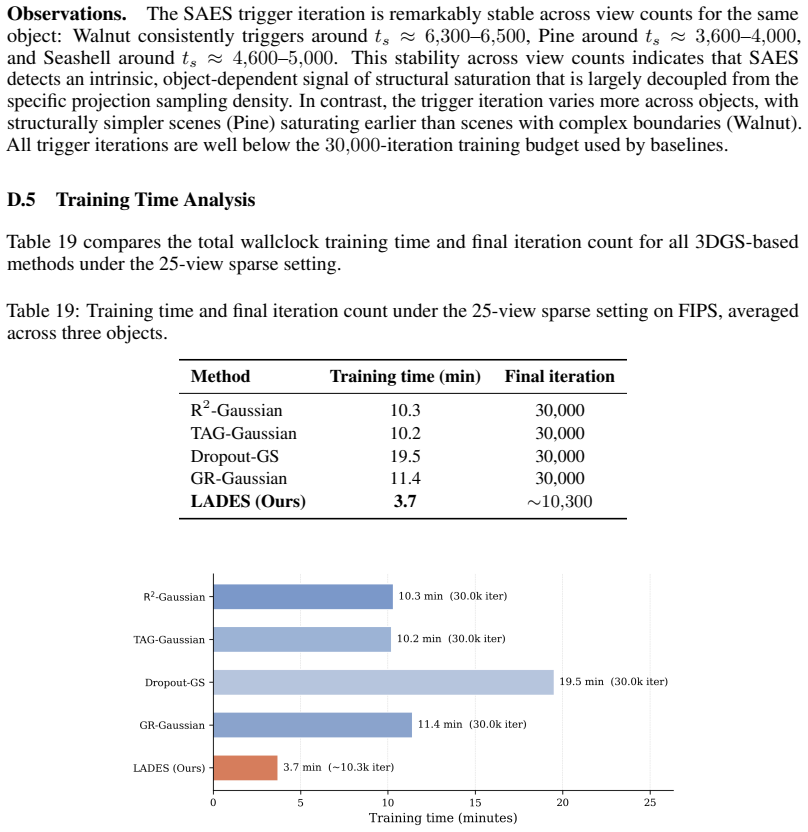
- Training time is substantially reduced.
- The approach works without ground-truth volumes for the stopping decision.
Where Pith is reading between the lines
- Similar projection-volume mismatches could appear in other explicit representations supervised only on 2D projections.
- Population-saturation stopping might be tested as a general heuristic in other densification-driven methods.
- The needle-like degeneration and density stability diagnostics could extend to monitoring other scene representations.
Load-bearing premise
Saturation of Gaussian population growth serves as a reliable ground-truth-free signal for early stopping that prevents volume deterioration.
What would settle it
An experiment where volumes continue to deteriorate or show no fidelity gain after the proposed saturation-based stopping point in multiple sparse-view CT datasets.
Figures
read the original abstract
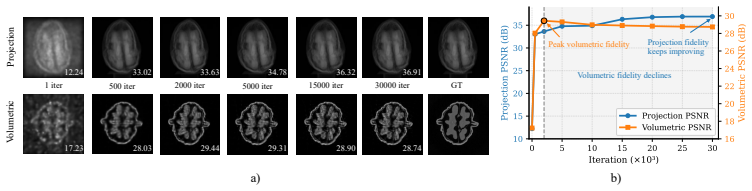
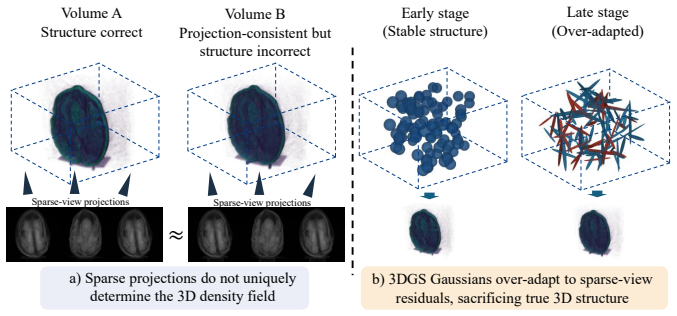
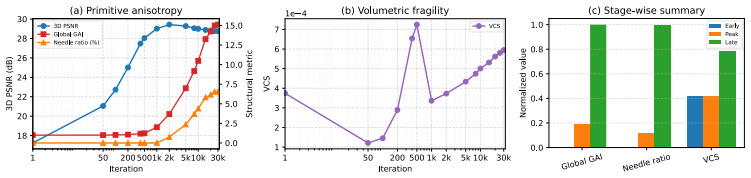
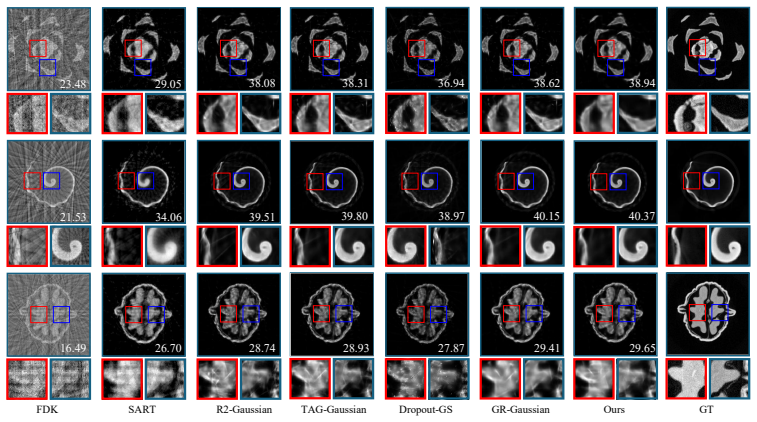
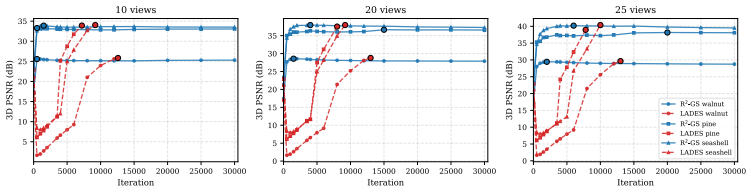
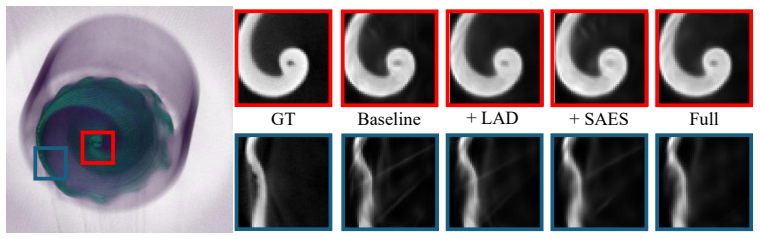
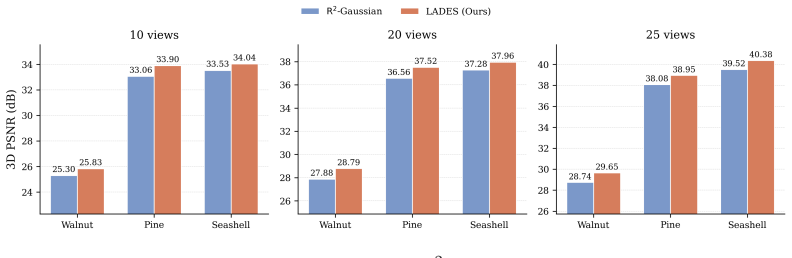
Sparse-view computed tomography is a severely ill-posed inverse problem, where recent 3D Gaussian Splatting methods offer an efficient explicit representation for tomographic reconstruction. However, we find that projection-domain optimization can be misleading in this setting: the rendered projections may continue to improve while the reconstructed volume deteriorates. We identify this failure mode as Projection-Volume Fidelity Divergence (PVFD), a representation-level optimization drift caused by anisotropic Gaussian deformation and view-specific primitive co-adaptation under sparse Radon constraints. To characterize this behavior, we introduce geometry- and volume-level diagnostics that measure needle-like Gaussian degeneration and the stability of the voxelized density field. Based on these observations, we propose LADES, a ground-truth-free optimization controller for sparse-view Gaussian tomography. LADES combines Linearly Annealed Dropout, which applies strong stochastic masking in early training to disrupt premature primitive co-adaptation and gradually restores full capacity for structural consolidation, with Structure-Aware Early Stopping, which terminates densification according to the saturation of Gaussian population growth rather than validation PSNR. Experiments on sparse-view CT reconstruction show that LADES improves volumetric fidelity, suppresses structural degeneration, and substantially reduces training time while maintaining competitive projection accuracy. These results suggest that robust Gaussian-based tomography requires monitoring and controlling volumetric structure, rather than optimizing projection fit alone.
Editorial analysis
A structured set of objections, weighed in public.
Referee Report
Summary. The paper identifies Projection-Volume Fidelity Divergence (PVFD) as an optimization drift in sparse-view 3D Gaussian Splatting for CT, where projection-domain fit improves while the reconstructed volume deteriorates due to anisotropic Gaussian deformation and view-specific co-adaptation. It introduces geometry- and volume-level diagnostics for needle-like degeneration and voxelized density stability, then proposes LADES: Linearly Annealed Dropout to disrupt early co-adaptation plus Structure-Aware Early Stopping triggered by saturation of Gaussian population growth rather than validation PSNR. Experiments claim that LADES improves volumetric fidelity, suppresses structural degeneration, reduces training time, and maintains competitive projection accuracy in a ground-truth-free manner.
Significance. If the quantitative claims hold, the work would be significant for explicit representations in ill-posed inverse problems, demonstrating that projection-only optimization is insufficient and that explicit control of volumetric structure via population dynamics can yield more reliable reconstructions. The ground-truth-free diagnostics and controller could influence other Gaussian-based tomography or reconstruction pipelines.
major comments (2)
- [Structure-Aware Early Stopping] Structure-Aware Early Stopping section: the central claim that saturation of Gaussian population growth reliably proxies volume stability under PVFD is load-bearing but unsupported. No correlation analysis, ablation, or timing comparison is shown between population saturation and the geometry-/volume-level diagnostics (needle-like degeneration or voxelized density stability); if saturation occurs while volume metrics continue to worsen, the early-stopping rule would not achieve the claimed fidelity improvement.
- [Abstract / Experiments] Abstract and Experiments section: the claims of improved volumetric fidelity, suppressed structural degeneration, and substantially reduced training time rest on qualitative observations only. No quantitative metrics (e.g., PSNR/SSIM on voxelized volumes, PVFD magnitude, degeneration scores), baseline comparisons, or statistical details are reported, rendering the improvements unverifiable from the presented evidence.
minor comments (1)
- The definition of PVFD and the precise formulation of the geometry- and volume-level diagnostics should be given explicitly (e.g., as equations) rather than described only at a high level, to allow reproducibility.
Simulated Author's Rebuttal
We thank the referee for the constructive and detailed comments. We agree that additional quantitative evidence and supporting analyses are needed to substantiate the central claims regarding Structure-Aware Early Stopping and the reported improvements. The revised manuscript will incorporate the requested analyses and metrics.
read point-by-point responses
-
Referee: [Structure-Aware Early Stopping] Structure-Aware Early Stopping section: the central claim that saturation of Gaussian population growth reliably proxies volume stability under PVFD is load-bearing but unsupported. No correlation analysis, ablation, or timing comparison is shown between population saturation and the geometry-/volume-level diagnostics (needle-like degeneration or voxelized density stability); if saturation occurs while volume metrics continue to worsen, the early-stopping rule would not achieve the claimed fidelity improvement.
Authors: We acknowledge that the manuscript does not currently include explicit correlation analysis or ablations linking population saturation directly to the geometry- and volume-level diagnostics. In the revision we will add these elements: scatter plots and correlation coefficients between Gaussian population growth curves and the needle-like degeneration / voxelized density stability metrics; an ablation comparing the proposed saturation-based stopping rule against alternatives (e.g., validation PSNR or fixed-epoch stopping); and timing overlays showing when saturation occurs relative to continued worsening of volume diagnostics. These additions will directly test whether the proxy holds under the observed PVFD regime. revision: yes
-
Referee: [Abstract / Experiments] Abstract and Experiments section: the claims of improved volumetric fidelity, suppressed structural degeneration, and substantially reduced training time rest on qualitative observations only. No quantitative metrics (e.g., PSNR/SSIM on voxelized volumes, PVFD magnitude, degeneration scores), baseline comparisons, or statistical details are reported, rendering the improvements unverifiable from the presented evidence.
Authors: We agree that the current evidence for the claimed improvements is insufficiently quantitative. The revised Experiments section will report: (i) PSNR and SSIM computed on the voxelized density volumes against ground-truth CT; (ii) quantitative PVFD magnitude and degeneration scores (needle-like anisotropy and voxel stability) for LADES versus baselines; (iii) wall-clock training time reductions with standard deviations across repeated runs; and (iv) direct baseline comparisons (standard 3DGS, other regularization variants) with statistical significance tests. These metrics will be added both in the main text and in an expanded supplementary table. revision: yes
Circularity Check
No significant circularity detected; derivation is self-contained
full rationale
The paper introduces PVFD as an observed failure mode in projection optimization for sparse-view Gaussian tomography, defines independent geometry- and volume-level diagnostics for needle-like degeneration and voxelized density stability, and proposes LADES (Linearly Annealed Dropout plus Structure-Aware Early Stopping on Gaussian population saturation) as a controller derived from those observations. Claims of improved volumetric fidelity rest on experimental outcomes rather than any reduction of the stopping criterion or diagnostics to fitted parameters, self-referential definitions, or load-bearing self-citations. The derivation chain does not collapse any prediction or uniqueness result to its own inputs by construction.
Axiom & Free-Parameter Ledger
free parameters (2)
- dropout annealing schedule
- Gaussian population saturation threshold
axioms (1)
- domain assumption Gaussian population growth saturation reliably indicates completion of structural consolidation without ground-truth volume data
invented entities (2)
-
PVFD
no independent evidence
-
LADES
no independent evidence
Reference graph
Works this paper leans on
-
[1]
Simultaneous algebraic reconstruction technique (sart): a superior implementation of the art algorithm.Ultrasonic imaging, 6(1):81–94, 1984
Anders H Andersen and Avinash C Kak. Simultaneous algebraic reconstruction technique (sart): a superior implementation of the art algorithm.Ultrasonic imaging, 6(1):81–94, 1984
1984
-
[2]
Radiative gaussian splatting for efficient x-ray novel view synthesis
Yuanhao Cai, Yixun Liang, Jiahao Wang, Angtian Wang, Yulun Zhang, Xiaokang Yang, Zong- wei Zhou, and Alan Yuille. Radiative gaussian splatting for efficient x-ray novel view synthesis. InEuropean Conference on Computer Vision, pages 283–299. Springer, 2024
2024
-
[3]
Learn: Learned experts’ assessment-based reconstruction network for sparse-data ct.IEEE transactions on medical imaging, 37(6):1333–1347, 2018
Hu Chen, Yi Zhang, Yunjin Chen, Junfeng Zhang, Weihua Zhang, Huaiqiang Sun, Yang Lv, Peixi Liao, Jiliu Zhou, and Ge Wang. Learn: Learned experts’ assessment-based reconstruction network for sparse-data ct.IEEE transactions on medical imaging, 37(6):1333–1347, 2018
2018
-
[4]
D. Dai, X. Zou, W. Shi, and Y . Xing. TAG-Splat: Two-stage anisotropic gaussian splatting for CL reconstruction.IEEE Transactions on Computational Imaging, 11:1572–1584, 2025
2025
-
[5]
Distance-driven projection and backprojection in three dimen- sions.Physics in Medicine & Biology, 49(11):2463, 2004
Bruno De Man and Samit Basu. Distance-driven projection and backprojection in three dimen- sions.Physics in Medicine & Biology, 49(11):2463, 2004
2004
-
[6]
Practical cone-beam algorithm.Journal of the Optical Society of America A, 1(6):612–619, 1984
Lee A Feldkamp, Lloyd C Davis, and James W Kress. Practical cone-beam algorithm.Journal of the Optical Society of America A, 1(6):612–619, 1984
1984
-
[7]
Ddgs-ct: Direction-disentangled gaussian splatting for realistic volume rendering.Advances in Neural Information Processing Systems, 37:39281–39302, 2024
Zhongpai Gao, Benjamin Planche, Meng Zheng, Xiao Chen, Terrence Chen, and Ziyan Wu. Ddgs-ct: Direction-disentangled gaussian splatting for realistic volume rendering.Advances in Neural Information Processing Systems, 37:39281–39302, 2024
2024
-
[8]
Computed medical imaging.Science, 210(4465):22–28, 1980
Godfrey N Hounsfield. Computed medical imaging.Science, 210(4465):22–28, 1980
1980
-
[9]
SIAM, 2001
Avinash C Kak and Malcolm Slaney.Principles of computerized tomographic imaging. SIAM, 2001
2001
-
[10]
3d gaussian splatting for real-time radiance field rendering.ACM Trans
Bernhard Kerbl, Georgios Kopanas, Thomas Leimkühler, and George Drettakis. 3d gaussian splatting for real-time radiance field rendering.ACM Trans. Graph., 42(4):139–1, 2023
2023
-
[11]
Deep- neural-network-based sinogram synthesis for sparse-view ct image reconstruction.IEEE Transactions on Radiation and Plasma Medical Sciences, 3(2):109–119, 2018
Hoyeon Lee, Jongha Lee, Hyeongseok Kim, Byungchul Cho, and Seungryong Cho. Deep- neural-network-based sinogram synthesis for sparse-view ct image reconstruction.IEEE Transactions on Radiation and Plasma Medical Sciences, 3(2):109–119, 2018
2018
-
[12]
Nerf: Representing scenes as neural radiance fields for view synthesis
Ben Mildenhall, Pratul P Srinivasan, Matthew Tancik, Jonathan T Barron, Ravi Ramamoor- thi, and Ren Ng. Nerf: Representing scenes as neural radiance fields for view synthesis. Communications of the ACM, 65(1):99–106, 2021
2021
-
[13]
Dropgaussian: Structural regularization for sparse-view gaussian splatting
Hyunwoo Park, Gun Ryu, and Wonjun Kim. Dropgaussian: Structural regularization for sparse-view gaussian splatting. InProceedings of the Computer Vision and Pattern Recognition Conference, pages 21600–21609, 2025
2025
-
[14]
Image reconstruction in circular cone-beam computed tomography by constrained, total-variation minimization.Physics in Medicine & Biology, 53:4777, 2008
Emil Y Sidky and Xiaochuan Pan. Image reconstruction in circular cone-beam computed tomography by constrained, total-variation minimization.Physics in Medicine & Biology, 53:4777, 2008
2008
-
[15]
X-ray tomographic datasets, 2024
The Finnish Inverse Problems Society. X-ray tomographic datasets, 2024
2024
-
[16]
Deep learning for tomographic image reconstruc- tion.Nature machine intelligence, 2(12):737–748, 2020
Ge Wang, Jong Chul Ye, and Bruno De Man. Deep learning for tomographic image reconstruc- tion.Nature machine intelligence, 2(12):737–748, 2020
2020
-
[17]
Haolin Xiong, Sairisheek Muttukuru, Rishi Upadhyay, Pradyumna Chari, and Achuta Kadambi. Sparsegs: Real-time 360 ◦ sparse view synthesis using gaussian splatting.arXiv preprint arXiv:2312.00206, 2023
Pith/arXiv arXiv 2023
-
[18]
Dropoutgs: Dropping out gaussians for better sparse-view rendering
Yexing Xu, Longguang Wang, Minglin Chen, Sheng Ao, Li Li, and Yulan Guo. Dropoutgs: Dropping out gaussians for better sparse-view rendering. InProceedings of the IEEE/CVF Conference on Computer Vision and Pattern Recognition (CVPR), pages 701–710, 2025
2025
-
[19]
Yikuang Yuluo, Yue Ma, Kuan Shen, Tongtong Jin, Wang Liao, Yangpu Ma, and Fuquan Wang. Gr-gaussian: Graph-based radiative gaussian splatting for sparse-view ct reconstruction.arXiv preprint arXiv:2508.02408, 2025. 10
arXiv 2025
-
[20]
Intratomo: self- supervised learning-based tomography via sinogram synthesis and prediction
Guangming Zang, Ramzi Idoughi, Rui Li, Peter Wonka, and Wolfgang Heidrich. Intratomo: self- supervised learning-based tomography via sinogram synthesis and prediction. InProceedings of the IEEE/CVF International Conference on Computer Vision, pages 1960–1970, 2021
1960
-
[21]
Ruyi Zha, Tao Jun Lin, Yuanhao Cai, Jiwen Cao, Yanhao Zhang, and Hongdong Li. R 2- gaussian: Rectifying radiative gaussian splatting for tomographic reconstruction.arXiv preprint arXiv:2405.20693, 2024
arXiv 2024
-
[22]
R2-gaussian: Rectifying radiative gaussian splatting for tomographic reconstruction
Ruyi Zha, Tao Jun Lin, Yuanhao Cai, Jiwen Cao, Yanhao Zhang, and Hongdong Li. R2-gaussian: Rectifying radiative gaussian splatting for tomographic reconstruction. InAdvances in Neural Information Processing Systems (NeurIPS), 2024
2024
-
[23]
Naf: neural attenuation fields for sparse-view cbct reconstruction
Ruyi Zha, Yanhao Zhang, and Hongdong Li. Naf: neural attenuation fields for sparse-view cbct reconstruction. InInternational Conference on Medical Image Computing and Computer- Assisted Intervention, pages 442–452. Springer, 2022
2022
-
[24]
A sparse-view ct reconstruction method based on combination of densenet and deconvolution.IEEE transactions on medical imaging, 37(6):1407–1417, 2018
Zhicheng Zhang, Xiaokun Liang, Xu Dong, Yaoqin Xie, and Guohua Cao. A sparse-view ct reconstruction method based on combination of densenet and deconvolution.IEEE transactions on medical imaging, 37(6):1407–1417, 2018. 11 Appendix Overview The appendix is organized into five sections. Table 5 provides a quick reference for the content of each section, int...
2018
-
[25]
Disable all topology-changing operations (clone, split, prune)
-
[26]
Disable LAD masking by settingp t = 0for all subsequent iterations. 17
-
[27]
Rotation, opacity, and density learning rates are unchanged
Cool down the learning rates of geometry parameters: ηxyz ←γ cool ·η xyz and ηscale ← γcool ·η scale, withγ cool = 0.2. Rotation, opacity, and density learning rates are unchanged
-
[28]
This removes optimization inertia accumulated during the growth stage and stabilizes the transition to fixed-topology refinement
Reset Adam first- and second-moment buffers (mAdam t and vAdam t ) for the position and scale parameters only. This removes optimization inertia accumulated during the growth stage and stabilizes the transition to fixed-topology refinement. Adam moments for rotation, opacity, and density are kept unchanged to preserve their slower, more stable optimizatio...
-
[29]
removing
Set the final iteration toT final = 2ts. What SAES does not access.We emphasize that SAES never accesses the ground-truth volume, 3D PSNR, 3D SSIM, GAI, VCS, or any test-time reconstruction metric. The only signals used to determine ts are (i) the active Gaussian count Nj, which is an intrinsic property of the model, and (ii) the iteration index tj. The v...
-
[30]
Institutional review board (IRB) approvals or equivalent for research with human subjects Question: Does the paper describe potential risks incurred by study participants, whether such risks were disclosed to the subjects, and whether Institutional Review Board (IRB) approvals (or an equivalent approval/review based on the requirements of your country or ...
discussion (0)
Sign in with ORCID, Apple, or X to comment. Anyone can read and Pith papers without signing in.