acoustotreams -- A Python package for acoustic-wave scattering based on the T-matrix method
Pith reviewed 2026-06-26 09:27 UTC · model grok-4.3
The pith
A new open-source Python package adapts the T-matrix method to compute acoustic pressure wave scattering by particle clusters and periodic structures.
A machine-rendered reading of the paper's core claim, the machinery that carries it, and where it could break.
Core claim
The T-matrix method developed for vector electromagnetic waves transfers to scalar acoustic pressure waves through the same basis expansions and coupling rules, enabling efficient computation of scattering responses for isolated clusters as well as periodic and stratified arrangements when implemented in the acoustotreams package.
What carries the argument
T-matrix method using scalar spherical and cylindrical waves as basis sets, together with the S-matrix method in scalar plane-wave basis for stratified media.
If this is right
- Scattering responses become computable for large ensembles of particles both with and without periodic boundary conditions.
- The same code base supports description of pressure-acoustic scattering in metamaterials and metasurfaces.
- Open-source availability on PyPI and GitHub with automated tests allows direct reuse for multiple-scattering studies.
Where Pith is reading between the lines
- The package could serve as a template for porting similar wave-scattering codes to other scalar problems such as quantum mechanics or heat transfer.
- Direct side-by-side runs of acoustotreams and its electromagnetic parent on geometrically identical structures would reveal how vector versus scalar character affects multiple-scattering outcomes.
- Design workflows for acoustic devices could incorporate the tool to iterate on particle arrangements before fabrication.
Load-bearing premise
The electromagnetic T-matrix formalism can be applied to acoustic pressure waves using identical basis expansions and coupling rules without acoustic-specific corrections.
What would settle it
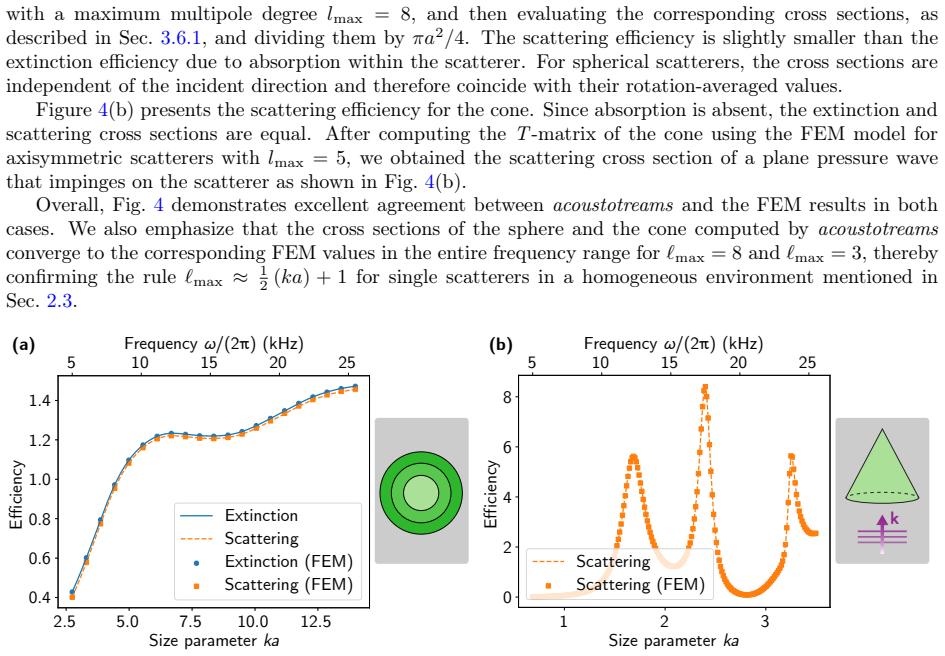
Numerical results from acoustotreams for scattering by a single sphere compared against the known analytical solution for acoustic scattering; mismatch would indicate the transfer does not hold without adjustments.
Figures
read the original abstract
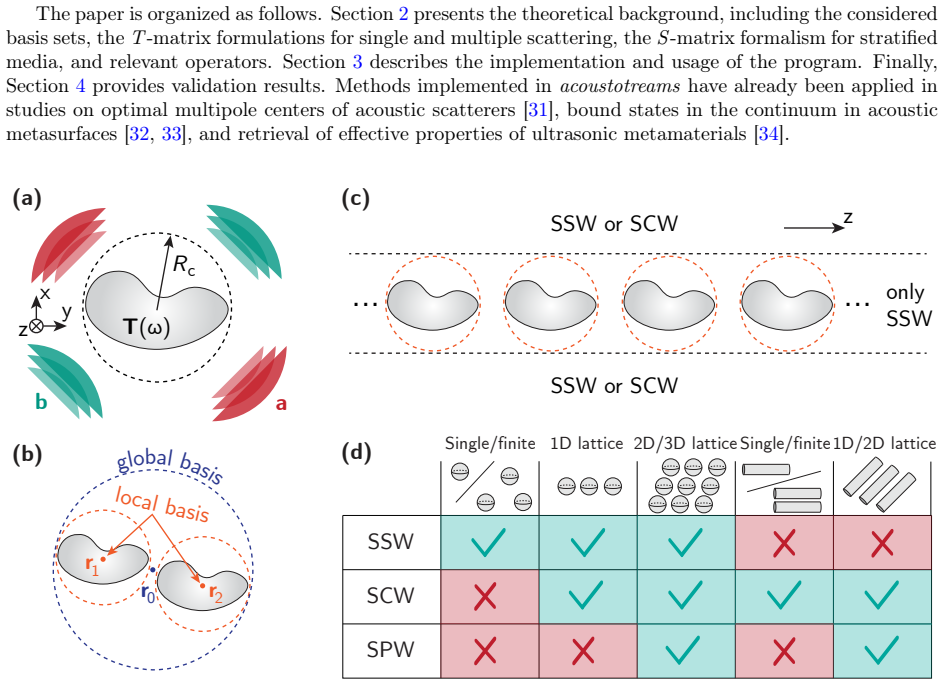
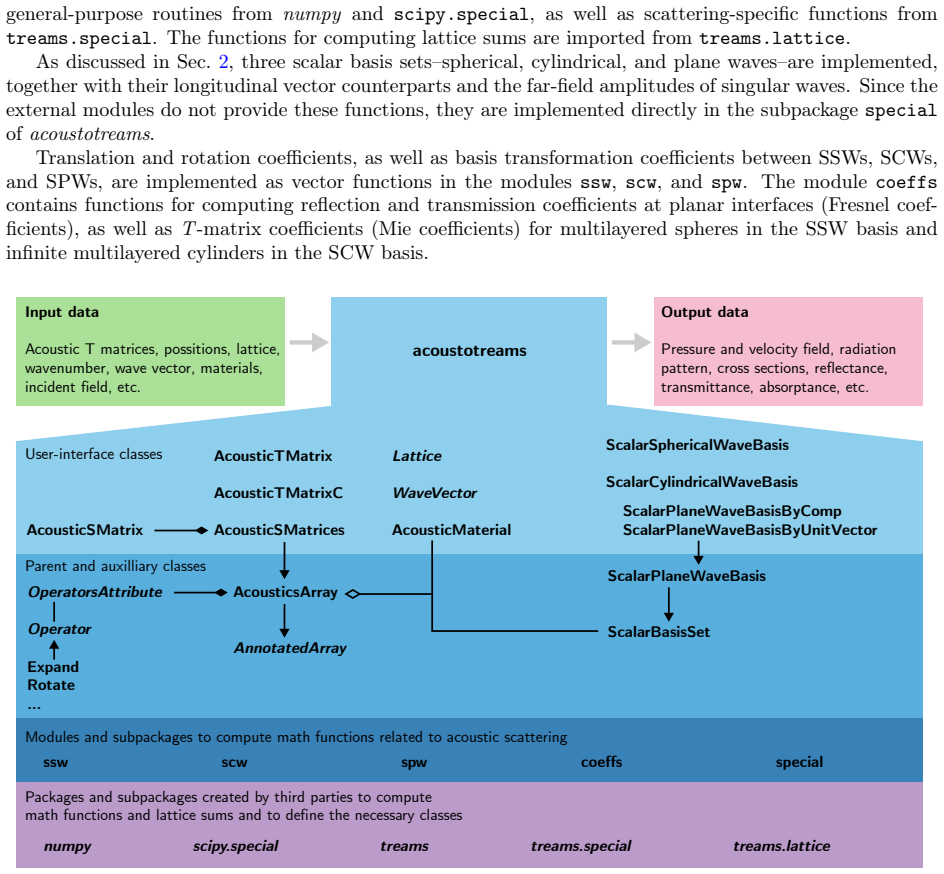
The transition-matrix ($T$-matrix) method has established itself as a prominent technique for computing the scattering response from spatially localized objects. The suitability becomes apparent particularly when considering not just isolated objects but also large ensembles of aperiodically or even periodically arranged objects. A versatile implementation of the method is provided by the treams program, which efficiently computes the electromagnetic response of scatterers in various arrangements [Comput. Phys. Commun. 297, p. 109076 (2024)]. Here, we rely on this framework and present a new program, acoustotreams, dedicated to simulating the acoustic scattering of pressure waves by clusters of particles, both with and without periodic boundary conditions. The computations are performed using the $T$-matrix method with scalar spherical and cylindrical waves as basis sets, and the scattering matrix ($S$-matrix) method in the basis of scalar plane waves for stratified media. The underlying theory is presented alongside the program structure and illustrative examples. The code is open-source and available on the Python Package Index for Linux, Windows, and macOS. Version control is maintained through GitHub, where we also provide automated tests, documentation, and detailed examples. We expect this work to contribute to the field of numerical methods for multiple-scattering problems by offering a computational framework capable of a comprehensive description of pressure-acoustic scattering in artificial media, including well-established metamaterials and metasurfaces.
Editorial analysis
A structured set of objections, weighed in public.
Referee Report
Summary. The paper claims to present acoustotreams, a Python package for simulating the acoustic scattering of pressure waves by clusters of particles (with and without periodic boundary conditions) using the T-matrix method based on scalar spherical and cylindrical waves, together with the S-matrix method in the scalar plane-wave basis for stratified media. The package adapts the existing treams electromagnetic framework, supplies the underlying theory, program structure and illustrative examples, and releases the code as open-source on PyPI (Linux/Windows/macOS) and GitHub with automated tests and documentation.
Significance. If the implementation functions as described, the work supplies a practical, open-source computational framework for multiple acoustic scattering that extends an established T-matrix/S-matrix approach to scalar pressure waves. The provision of reproducible code, automated tests, documentation and GitHub hosting constitutes a concrete strength that directly supports research on acoustic metamaterials and metasurfaces.
minor comments (1)
- [Abstract] Abstract: the statement that the T-matrix method 'can be directly transferred' to acoustics would benefit from a short clause noting that the scalar adaptation follows standard literature results for pressure waves (to preempt questions about additional acoustic-specific corrections).
Simulated Author's Rebuttal
We thank the referee for their positive assessment of the manuscript, recognition of its practical value for acoustic scattering simulations, and recommendation to accept.
Circularity Check
No significant circularity; software implementation of established methods
full rationale
The manuscript presents acoustotreams as an open-source Python package implementing the standard T-matrix and S-matrix methods for acoustic pressure-wave scattering. It explicitly relies on the pre-existing treams framework (cited as an external reference) for the core numerical structure and adapts it to scalar waves using well-documented basis expansions. No new physical quantities, predictions, or derivations are claimed; the load-bearing content is code availability, documentation, and examples. The transfer of the T-matrix formalism from electromagnetics to acoustics is presented as a direct, standard adaptation without fitted parameters or self-referential uniqueness theorems. No steps reduce by construction to inputs, self-citations, or ansatzes. This is a normal, self-contained software release paper.
Axiom & Free-Parameter Ledger
axioms (1)
- domain assumption The T-matrix method with scalar spherical and cylindrical waves is applicable to acoustic pressure-wave scattering in the same formal structure used for electromagnetics.
Reference graph
Works this paper leans on
-
[1]
B. Morvan, A. Tinel, J. O. Vasseur, R. Sainidou, P. Rembert, A.-C. Hladky-Hennion, N. Swinteck, P. A. Deymier, Ultra-directional source of longitudinal acoustic waves based on a two-dimensional solid/solid phononic crystal, J. Appl. Phys. 116 (21) (2014) 214901.doi:10.1063/1.4903076
-
[2]
L. Wei, F. J. Rodríguez-Fortuño, Far-field and Near-field Directionality in Acoustic Scattering, New J. Phys. 22 (8) (2020) 083016.doi:10.1088/1367-2630/ab9fbf
-
[3]
I. A. Timankova, M. V. Smagin, M. V. Kuzmin, A. I. Lutovinov, A. A. Bogdanov, Y. Li, M. I. Petrov, Experimental Investigation of Acoustic Kerker Effect in Labyrinthine Resonators, JETP Lett. (2026) 1–7doi:10.1134/S0021364025609674
-
[4]
Z. Ma, K. Melde, A. G. Athanassiadis, M. Schau, H. Richter, T. Qiu, P. Fischer, Spatial ultrasound modulation by digitally controlling microbubble arrays, Nat. Commun. 11 (4537) (2020) 4537.doi: 10.1038/s41467-020-18347-2
-
[5]
J. Mei, L. Fan, X. Hong, Acoustic metalens with switchable and sharp focusing, Appl. Phys. Express 16 (7) (2023) 077002.doi:10.35848/1882-0786/ace60d
-
[6]
M. Krasikova, S. Krasikov, A. Melnikov, Y. Baloshin, S. Marburg, D. A. Powell, A. Bogdanov, Meta- house: Noise-Insulating Chamber Based on Periodic Structures, Adv. Mater. Technol. 8 (1) (2023) 2200711.doi:10.1002/admt.202200711
-
[7]
R. Sainidou, N. Stefanou, Guided and quasiguided elastic waves in phononic crystal slabs, Phys. Rev. B 73 (18) (2006) 184301.doi:10.1103/PhysRevB.73.184301
-
[8]
Y. Wang, Y. Ge, Y.-J. Lu, S. Gu, Y.-J. Guan, Q.-R. Si, S.-Q. Yuan, Q. Wang, H.-X. Sun, H. Xue, Free-form acoustic topological waveguides enabled by topological lattice defects, Phys. Rev. B 109 (18) (2024) L180101.doi:10.1103/PhysRevB.109.L180101
-
[9]
Marzo, S
A. Marzo, S. A. Seah, B. W. Drinkwater, D. R. Sahoo, B. Long, S. Subramanian, Holographic acoustic elements for manipulation of levitated objects, Nat. Commun. 6 (8661) (2015) 8661.doi:10.1038/ ncomms9661
2015
-
[10]
L. He, S. Sun, R. M. Abraham-Ekeroth, Y. Jin, Y. Xiang, D. Torrent, Theoretical developments and experimental insights of acoustic and elastic bound states in the continuum, npj Acoust. 1 (11) (2025) 11.doi:10.1038/s44384-025-00013-w
-
[11]
S. Kirkup, The Boundary Element Method in Acoustics: A Survey, Applied Sciences 9 (8) (2019). doi:10.3390/app9081642
-
[12]
G. C. Everstine, Finite element formulatons of structural acoustics problems, Comput. & Structures 65 (3) (1997) 307–321.doi:10.1016/S0045-7949(96)00252-0. 28
-
[13]
T. W. Wu, Boundary Element Acoustics: Fundamentals and Computer Codes (Advances in Boundary Elements), WIT Press, Southampton, England, UK, 2015
2015
-
[14]
B. E. Treeby, B. T. Cox, k-Wave: MATLAB toolbox for the simulation and reconstruction of photoa- coustic wave fields, J. Biomed. Opt. 15 (2) (2010) 021314.doi:10.1117/1.3360308
-
[16]
C. F. Bohren, D. R. Huffman, Absorption and Scattering of Light by Small Particles, WILEY-VCH Verlag GmbH & Co. KGaA, Weinheim, Germany, 1998.doi:10.1002/9783527618156
-
[17]
M. I. Mishchenko, Gustav Mie and the fundamental concept of electromagnetic scattering by particles: A perspective, J. Quant. Spectrosc. Radiat. Transfer 110 (14) (2009) 1210–1222.doi:10.1016/j. jqsrt.2009.02.002
work page doi:10.1016/j 2009
-
[18]
P. C. Waterman, Matrix formulation of electromagnetic scattering, Proc. IEEE 53 (8) (1965) 805–812. doi:10.1109/PROC.1965.4058
-
[19]
P. C. Waterman, New Formulation of Acoustic Scattering, J. Acoust. Soc. Am. 45 (6) (1969) 1417–1429. doi:10.1121/1.1911619
-
[20]
P. C. Waterman, T-matrix methods in acoustic scattering, J. Acoust. Soc. Am. 125 (1) (2009) 42–51. doi:10.1121/1.3035839
-
[21]
B. Peterson, S. Ström,TMatrix for Electromagnetic Scattering from an Arbitrary Number of Scatterers and Representations of E(3), Phys. Rev. D 8 (10) (1973) 3661–3678.doi:10.1103/PhysRevD.8.3661
-
[22]
B. Peterson, S. Ström, Matrix formulation of acoustic scattering from an arbitrary number of scatterers, J. Acoust. Soc. Am. 56 (3) (1974) 771–780.doi:10.1121/1.1903325
-
[23]
D. Beutel, I. Fernandez-Corbaton, C. Rockstuhl, treams – a T-matrix-based scattering code for nanophotonics, Comput. Phys. Commun. 297 (2024) 109076.doi:10.1016/j.cpc.2023.109076
-
[24]
D. Beutel, I. Fernandez-Corbaton, C. Rockstuhl, Unified lattice sums accommodating multiple sublat- tices for solutions of the Helmholtz equation in two and three dimensions, Phys. Rev. A 107 (1) (2023) 013508.doi:10.1103/PhysRevA.107.013508
-
[25]
N. Asadova, J. D. Fischbach, R. Vallée, Y. Augenstein, D. Vovchuk, A. Kharchevskii, P. Ginzburg, C. Rockstuhl, Gradient-based optimization of scatterer arrangements based on the T-Matrix method, arXiv (2025).arXiv:2512.08615
Pith/arXiv arXiv 2025
-
[26]
Redheffer, Inequalities for a Matrix Riccati Equation, J
R. Redheffer, Inequalities for a Matrix Riccati Equation, J. Math. Mech. 8 (3) (1959) 349–367. URLhttps://www.jstor.org/stable/24900576
arXiv 1959
-
[27]
Sainidou, N
R. Sainidou, N. Stefanou, I. E. Psarobas, A. Modinos, A Layer-multiple-scattering Method for Phononic Crystals and Heterostructures of Such, Comput. Phys. Commun. 166 (3) (2005) 197–240.doi:10.1016/ j.cpc.2004.11.004
2005
-
[28]
Kleshchenko, AcSmuthi,https://github.com/vsevolodkleshchenko/AcSmuthi(2022)
V. Kleshchenko, AcSmuthi,https://github.com/vsevolodkleshchenko/AcSmuthi(2022)
2022
-
[29]
Stefanou, V
N. Stefanou, V. Yannopapas, A. Modinos, Heterostructures of photonic crystals: frequency bands and transmission coefficients, Comput. Phys. Commun. 113 (1) (1998) 49–77.doi:10.1016/ S0010-4655(98)00060-5. 29
1998
-
[30]
A. Egel, K. M. Czajkowski, D. Theobald, K. Ladutenko, A. S. Kuznetsov, L. Pattelli, SMUTHI: A python package for the simulation of light scattering by multiple particles near or between planar interfaces, J. Quant. Spectrosc. Radiat. Transfer 273 (2021) 107846.doi:10.1016/j.jqsrt.2021. 107846
-
[31]
N. Ustimenko, C. Rockstuhl, A. V. Kildishev, Optimal multipole center for subwavelength acoustic scatterers, Appl. Phys. Lett. 126 (14) (2025).doi:10.1063/5.0257760
-
[32]
N. Ustimenko, A. B. Evlyukhin, V. Kyrimi, A. V. Kildishev, C. Rockstuhl, Lattice-induced sound trapping in biperiodic metasurfaces of acoustic resonators, Phys. Rev. Res. 8 (1) (2026) 013074.doi: 10.1103/wnmk-zhrb
-
[33]
Ustimenko, I
N. Ustimenko, I. Fernandez-Corbaton, C. Rockstuhl, Singular value decomposition to describe bound states in the continuum in periodic metasurfaces, Phys. Rev. B 113 (23) (2026) 235418.doi:10.1103/ gx73-kyj9
2026
-
[34]
O. Demeulenaere, N. Ustimenko, A. G. Athanassiadis, L. Gulati, C. Rockstuhl, P. Fischer, Ultrasonic metamaterial at MHz frequencies using microstructured glass, arXiv (2025).arXiv:2512.20506
arXiv 2025
-
[35]
E. G. Williams, Fourier Acoustics, Elsevier, Academic Press, 1999.doi:10.1016/ B978-0-12-753960-7.X5000-1
1999
-
[36]
H. Bruus, Acoustofluidics 2: Perturbation theory and ultrasound resonance modes, Lab Chip 12 (1) (2011) 20–28.doi:10.1039/C1LC20770A
-
[37]
P. M. Morse, H. Feshbach, Methods of Theoretical Physics, McGraw-Hill, Maidenhead, England, UK, 1953
1953
-
[38]
Auguié, W
B. Auguié, W. R. C. Somerville, S. Roache, E. C. Le Ru, Numerical investigation of the Rayleigh hypothesis for electromagnetic scattering by a particle, J. Opt. 18 (7) (2016) 075007.doi:10.1088/ 2040-8978/18/7/075007
2016
-
[39]
M. Ganesh, S. C. Hawkins, R. Hiptmair, Convergence analysis with parameter estimates for a reduced basis acoustic scattering T-matrix method, IMA J. Numer. Anal. 32 (4) (2012) 1348–1374.doi: 10.1093/imanum/drr041
-
[40]
G. T. Silva, Acoustic Radiation Force and Torque on an Absorbing Compressible Particle in an Inviscid Fluid, J. Acoust. Soc. Am. 136 (5) (2014) 2405–2413.doi:10.1121/1.4895691
-
[41]
I. D. Toftul, K. Y. Bliokh, M. I. Petrov, F. Nori, Acoustic Radiation Force and Torque on Small Particles as Measures of the Canonical Momentum and Spin Densities, Phys. Rev. Lett. 123 (18) (2019) 183901. doi:10.1103/PhysRevLett.123.183901
-
[42]
Y. Long, H. Ge, D. Zhang, X. Xu, J. Ren, M.-H. Lu, M. Bao, H. Chen, Y.-F. Chen, Symmetry Selective Directionality in Near-field Acoustics, Natl. Sci. Rev. 7 (6) (2020) 1024–1035.doi:10.1093/ nsr/nwaa040
2020
-
[43]
D. A. Kovacevich, B.-I. Popa, Transformation acoustics with bulk media composed of polarized sources, Phys. Rev. B 104 (13) (2021) 134304.doi:10.1103/PhysRevB.104.134304
-
[44]
M. Smagin, I. Toftul, K. Y. Bliokh, M. Petrov, Acoustic lateral recoil force and stable lift of anisotropic particles, Phys. Rev. Appl. 22 (6) (2024) 064041.doi:10.1103/PhysRevApplied.22.064041
-
[45]
M. Nečada, P. Törmä, Multiple-ScatteringT-Matrix Simulations for Nanophotonics: Symmetries and Periodic Lattices, Comm. Comput. Phys. 30 (2) (2021) 357–395.doi:10.4208/cicp.OA-2020-0136
-
[46]
P. A. Martin, Multiple Scattering: Interaction of Time-Harmonic Waves withNObstacles, Cambridge University Press, Cambridge, England, UK, 2006. 30
2006
-
[47]
M. Ganesh, S. C. Hawkins, A far field based T-matrix method for three dimensional acoustic scattering, ANZIAM J. 50 (2008) C121–C136.doi:10.21914/anziamj.v50i0.1441
-
[48]
M. Ganesh, S. C. Hawkins, A numerically stable T-matrix method for acoustic scattering by nonspheri- cal particles with large aspect ratios and size parameters, J. Acoust. Soc. Am. 151 (3) (2022) 1978–1988. doi:10.1121/10.0009679
-
[49]
Ustimenko (2026)
N. Ustimenko (2026). [link]. URLhttps://github.com/NikUstimenko/acoustic_tm_comsol
2026
-
[50]
A. Alevizaki, R. Sainidou, P. Rembert, B. Morvan, N. Stefanou, Acoustic properties of double-porosity granular polymers, Phys. Rev. B 95 (21) (2017) 214306.doi:10.1103/PhysRevB.95.214306
-
[51]
M. I. Mishchenko, L. D. Travis, D. W. Mackowski,T-matrix computations of light scattering by nonspherical particles: A review, J. Quant. Spectrosc. Radiat. Transfer 55 (5) (1996) 535–575. doi:10.1016/0022-4073(96)00002-7
-
[52]
P. A. Martin, Quadratic quantities in acoustics: Scattering cross-section and radiation force, Wave Motion 86 (2019) 63–78.doi:10.1016/j.wavemoti.2018.12.009
-
[53]
Z. Li, P. Han, G. Hu, Willis dynamic homogenization method for acoustic metamaterials based on multiple scattering theory, J. Mech. Phys. Solids 189 (2024) 105692.doi:10.1016/j.jmps.2024. 105692
-
[54]
B. Peterson, S. Ström, Matrix formulation of acoustic scattering from multilayered scatterers, J. Acoust. Soc. Am. 57 (1) (1975) 2–13.doi:10.1121/1.380397
-
[55]
M. Kafesaki, E. N. Economou, Multiple-scattering Theory for Three-dimensional Periodic Acoustic Composites, Phys. Rev. B 60 (17) (1999) 11993–12001.doi:10.1103/PhysRevB.60.11993
-
[56]
R. N. S. Suryadharma, M. Fruhnert, I. Fernandez-Corbaton, C. Rockstuhl, Studying plasmonic reso- nance modes of hierarchical self-assembled meta-atoms based on their transfer matrix, Phys. Rev. B 96 (4) (2017) 045406.doi:10.1103/PhysRevB.96.045406
-
[57]
URLhttps://www.jpier.org/PIER/pier.php?paper=0404061
K.Kim, SymmetryRelationsoftheTranslationCoefficientsoftheSphericalScalarandVectorMultipole Fields, Progress in Electromagnetics Research 48 (2004) 45–66. URLhttps://www.jpier.org/PIER/pier.php?paper=0404061
2004
-
[58]
B.Zerulla, R.Venkitakrishnan, D.Beutel, M.Krstić, C.Holzer, C.Rockstuhl, I.Fernandez-Corbaton, A T-Matrix Based Approach to Homogenize Artificial Materials, Adv. Opt. Mater. 11 (3) (2023) 2201564. doi:10.1002/adom.202201564
-
[59]
G. J. Chaplain, S. C. Hawkins, M. A. Peter, L. G. Bennetts, T. A. Starkey, Acoustic lattice res- onances and generalised Rayleigh–Bloch waves, Commun. Phys. 8 (37) (2025) 37.doi:10.1038/ s42005-025-01950-4
2025
-
[60]
E. N. Bulgakov, A. F. Sadreev, Bloch bound states in the radiation continuum in a periodic array of dielectric rods, Phys. Rev. A 90 (5) (2014) 053801.doi:10.1103/PhysRevA.90.053801
-
[61]
D. T. Beutel, A holistic framework for electromagnetic scattering simulations based on the T-matrix method (2024).doi:10.5445/IR/1000167371
-
[62]
D. A. Varshalovich, A. N. Moskalev, V. K. Khersonskii, Quantum Theory Of Angular Momentum, World Scientific Publishing Company, Singapore, 1988.doi:10.1142/0270
-
[63]
M. Ganesh, S. C. Hawkins, A far-field based T-matrix method for two dimensional obstacle scattering, ANZIAM J. 51 (2009) C215–C230.doi:10.21914/anziamj.v51i0.2581. 31
-
[64]
Stein, Addition Theorems for Spherical Wave Functions, Q
S. Stein, Addition Theorems for Spherical Wave Functions, Q. Appl. Math. 19 (1) (1961) 15–24
1961
-
[65]
R. A. Sack, Three-Dimensional Addition Theorem for Arbitrary Functions Involving Expansions in Spherical Harmonics, J. Math. Phys. 5 (2) (1964) 252–259.doi:10.1063/1.1704115
-
[66]
M. Danos, L. C. Maximon, Multipole Matrix Elements of the Translation Operator, J. Math. Phys. 6 (5) (1965) 766–778.doi:10.1063/1.1704333
-
[67]
Gonis, W
A. Gonis, W. H. Butler, Multiple Scattering in Solids, Springer, New York, NY, USA, 2000
2000
-
[68]
R. C. Wittmann, Spherical wave operators and the translation formulas, IEEE Trans. Antennas Propag. 36 (8) (1988) 1078–1087.doi:10.1109/8.7220
-
[69]
G. Cincotti, F. Gori, M. Santarsiero, F. Frezza, F. Furnó, G. Schettini, Plane wave expansion of cylidrical functions, Opt. Commun. 95 (4) (1993) 192–198.doi:10.1016/0030-4018(93)90661-N
-
[70]
J. A. Roumeliotis, A.-G. P. Ziotopoulos, G. C. Kokkorakis, Acoustic scattering by a circular cylinder parallel with another of small radius, J. Acoust. Soc. Am. 109 (3) (2001) 870–877.doi:10.1121/1. 1348296
work page doi:10.1121/1 2001
-
[71]
N. Asadovaet al., T-matrix representation of optical scattering response: Suggestion for a data format, J. Quant. Spectrosc. Radiat. Transfer 333 (2025) 109310.doi:10.1016/j.jqsrt.2024.109310
-
[72]
E. C. Le Ru, W. R. C. Somerville, B. Auguié, Radiative correction in approximate treatments of electromagnetic scattering by point and body scatterers, Phys. Rev. A 87 (1) (2013) 012504.doi: 10.1103/PhysRevA.87.012504
-
[73]
A. D. Pierce, Acoustics: An Introduction to Its Physical Principles and Applications, Springer Inter- national Publishing, Cham, Switzerland, 2019. 32
2019
discussion (0)
Sign in with ORCID, Apple, or X to comment. Anyone can read and Pith papers without signing in.