Scalable Bayesian Additive Models for Stellar Flare Detection via Amortized Gaussian Process Inference and Hidden Markov Models
Pith reviewed 2026-06-26 09:31 UTC · model grok-4.3
The pith
A variational autoencoder learns a compressed surrogate for Celerite kernels that enables fast additive GP plus HMM models for stellar flare detection.
A machine-rendered reading of the paper's core claim, the machinery that carries it, and where it could break.
Core claim
A generative surrogate framework uses a variational autoencoder to learn a compressed isotropic manifold representation of the Celerite prior; this mapping completely bypasses exact covariance operations during sampling. The surrogate is then embedded in an additive model that combines the approximated Gaussian process with a hidden Markov model, and extensive simulations plus empirical evaluations demonstrate that the joint VAE plus HMM architecture reproduces the structural fidelity and inference outcomes of the exact Celerite plus HMM model while delivering substantial reductions in wall-clock time.
What carries the argument
The variational autoencoder generative surrogate that maps highly correlated Celerite dependencies onto a low-dimensional isotropic manifold for amortized likelihood evaluation.
If this is right
- The generative surrogate accurately reproduces the structural fidelity of exact physical kernels like Celerite across simulation studies.
- The VAE plus HMM architecture achieves significant reductions in computational time relative to the exact Celerite plus HMM framework on empirical astrophysical time series.
- The methodology makes rigorous Bayesian characterization of stellar flares tractable across massive data archives.
- Joint inference in the additive model stays valid once the VAE approximation replaces the exact kernel.
Where Pith is reading between the lines
- The same amortized surrogate approach could be retrained on other GP kernels to handle different classes of stellar variability signals.
- The resulting speed-up could support near-real-time flare monitoring pipelines in future wide-field surveys.
- Additional additive components such as deterministic trends or quasi-periodic oscillations could be included without reintroducing the original computational bottleneck.
Load-bearing premise
The variational autoencoder must compress the Celerite kernel into an isotropic manifold while still preserving its covariance structure and likelihood properties well enough that downstream inference in the additive GP plus HMM model remains valid.
What would settle it
A side-by-side run of the exact Celerite plus HMM model and the VAE plus HMM model on the same collection of stellar time series that yields statistically significant differences in posterior flare probabilities or GP hyperparameters would show the surrogate has failed to preserve the necessary properties.
Figures


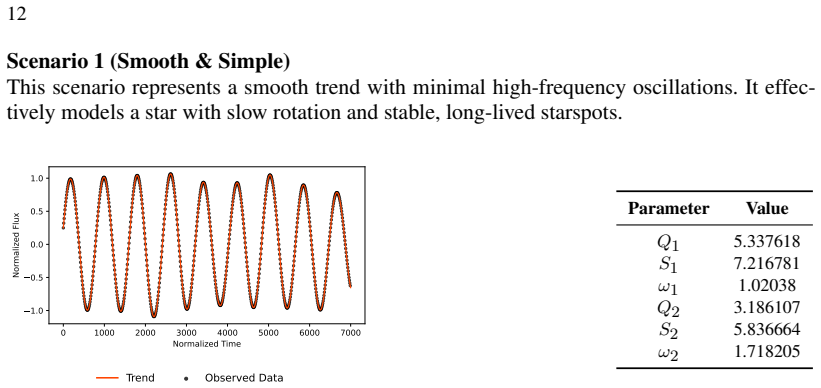

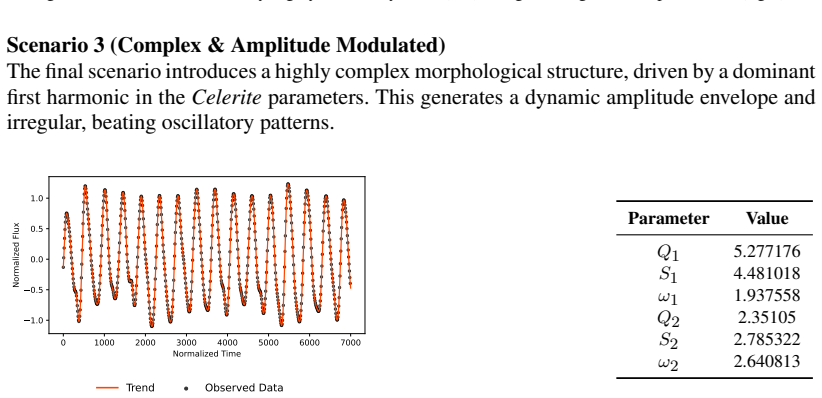


read the original abstract
Gaussian Processes (GPs) are a powerful tool for Bayesian time-series modeling, yet their cubic computational cost remains a severe barrier for application to long, high-cadence datasets in astronomy. While specialized scalable solvers like Celerite elegantly reduce this scaling to linear time, repeatedly evaluating the exact likelihood during iterative Bayesian sampling is a bottleneck for developing more complex models, like hierarchical or additive models in which Celerite is only one component. To make this inference computationally tractable, we introduce a generative surrogate framework. By utilizing a Variational Autoencoder (VAE) to learn a compressed representation of the Celerite prior, we map highly correlated stochastic dependencies into a low-dimensional, isotropic manifold. This transition completely bypasses exact covariance operations, shifting the computational burden to a rapid neural network forward pass. Through an extensive simulation study, we show that the generative surrogate accurately reproduces the structural fidelity of exact physical kernels like Celerite. Finally, we demonstrate embedding our VAE approximation into an additive model that combines Celerite and a hidden Markov model (HMM) for stellar flare detection in time series data of stars. We evaluate the joint VAE+HMM architecture against the exact Celerite+HMM framework on empirical astrophysical time series and demonstrate that the proposed methodology achieves significant reductions in computational time, enabling the rigorous, large-scale characterization of stellar flares across massive data archives.
Editorial analysis
A structured set of objections, weighed in public.
Referee Report
Summary. The manuscript introduces a VAE-based generative surrogate to amortize the Celerite GP prior, mapping it to a low-dimensional isotropic latent space to bypass exact covariance operations. This enables scalable inference in an additive GP+HMM model for stellar flare detection. The authors report an extensive simulation study claiming that the surrogate reproduces the structural fidelity of exact Celerite kernels and demonstrate computational speedups when embedding the approximation into the joint VAE+HMM architecture on empirical astrophysical time series.
Significance. If the surrogate preserves the necessary covariance and likelihood properties, the approach would allow tractable Bayesian inference for complex additive models on long, high-cadence stellar light curves, addressing a key scalability barrier in astronomical time-series analysis and enabling characterization across large data archives.
major comments (2)
- [Abstract] Abstract: the central claim that the VAE surrogate 'accurately reproduces the structural fidelity of exact physical kernels like Celerite' is presented without any reported quantitative metrics (e.g., recovered kernel hyperparameters, marginal likelihood ratios, autocorrelation matching, KL divergence on posteriors, or posterior predictive checks), leaving the load-bearing assumption that downstream GP+HMM inference remains valid unverified.
- [Simulation study] Simulation study (as referenced in abstract): the weakest assumption—that the VAE learns a compressed isotropic manifold preserving Celerite covariance structure and likelihood properties sufficiently for valid additive-model posteriors—requires explicit regime-specific validation; without details on where the approximation degrades or ablation results, the bypass of exact covariance operations risks invalidating the Bayesian guarantees of the combined model.
minor comments (2)
- Clarify the precise VAE architecture, latent dimension selection criterion, and training objective (e.g., whether it includes explicit covariance-matching terms) to allow reproducibility.
- The empirical comparison section should report wall-clock timings and any trade-offs in detection sensitivity or false-positive rates relative to the exact Celerite+HMM baseline.
Simulated Author's Rebuttal
We thank the referee for the constructive feedback. We address each major comment below and agree that additional quantitative details will strengthen the manuscript.
read point-by-point responses
-
Referee: [Abstract] Abstract: the central claim that the VAE surrogate 'accurately reproduces the structural fidelity of exact physical kernels like Celerite' is presented without any reported quantitative metrics (e.g., recovered kernel hyperparameters, marginal likelihood ratios, autocorrelation matching, KL divergence on posteriors, or posterior predictive checks), leaving the load-bearing assumption that downstream GP+HMM inference remains valid unverified.
Authors: We agree the abstract would benefit from explicit metrics. The simulation study section reports quantitative comparisons including autocorrelation function matching, recovered kernel hyperparameters, and posterior predictive checks, but these are not summarized in the abstract. We will revise the abstract to include key numerical results such as average KL divergence on posteriors and hyperparameter recovery accuracy to directly support the claim of structural fidelity and validity for the additive model. revision: yes
-
Referee: [Simulation study] Simulation study (as referenced in abstract): the weakest assumption—that the VAE learns a compressed isotropic manifold preserving Celerite covariance structure and likelihood properties sufficiently for valid additive-model posteriors—requires explicit regime-specific validation; without details on where the approximation degrades or ablation results, the bypass of exact covariance operations risks invalidating the Bayesian guarantees of the combined model.
Authors: The simulation study examines performance across multiple kernel length scales, noise levels, and time-series lengths, with metrics showing preservation of covariance structure in the tested regimes. We acknowledge that explicit identification of degradation boundaries and ablation studies on latent dimension would provide stronger guarantees. We will add a subsection detailing regime-specific results (including where the approximation begins to degrade) and ablation experiments on training data volume and latent dimensionality to clarify the conditions under which the Bayesian properties remain valid. revision: yes
Circularity Check
No circularity; surrogate trained on external Celerite prior with simulation validation
full rationale
The abstract describes a VAE trained to approximate the Celerite prior, followed by an empirical simulation study to check fidelity and an evaluation on real data. No equations are shown that define outputs in terms of themselves, no parameters are fitted to a subset and then relabeled as predictions, and no self-citations are invoked as load-bearing uniqueness theorems. The derivation chain is therefore self-contained against external benchmarks (Celerite kernel and empirical series) rather than reducing to its own inputs by construction.
Axiom & Free-Parameter Ledger
axioms (1)
- domain assumption Celerite kernels provide a valid positive-definite covariance for stellar variability time series
invented entities (1)
-
VAE surrogate for Celerite prior
no independent evidence
Reference graph
Works this paper leans on
-
[1]
AMBIKASARAN, S., FOREMAN-MACKEY, D., GREENGARD, L., HOGG, D. W. and O’NEIL, M. (2015). Fast direct methods for Gaussian processes.IEEE Transactions on Pattern Analysis and Machine Intelligence38 252–265
2015
-
[2]
and RAJPAUL, V
ANGUS, R., MORTON, T., AIGRAIN, S., FOREMAN-MACKEY, D. and RAJPAUL, V. (2018). Inferring proba- bilistic stellar rotation periods using Gaussian processes.Monthly Notices of the Royal Astronomical Society 4742094–2108
2018
-
[3]
and RASMUSSEN, C
BAUER, M.,VAN DERWILK, M. and RASMUSSEN, C. E. (2016). Understanding probabilistic sparse Gaussian process approximations. InAdvances in Neural Information Processing Systems291533–1541
2016
-
[4]
and MANDAL, S
BELKIN, M., HSU, D., MA, S. and MANDAL, S. (2019). Reconciling modern machine-learning practice and the classical bias–variance trade-off.Proceedings of the National Academy of Sciences11615849–15854
2019
-
[5]
and GIROLAMI, M
BETANCOURT, M. and GIROLAMI, M. (2015). Hamiltonian Monte Carlo for hierarchical models. InCurrent trends in Bayesian methodology with applications79–101. CRC Press
2015
-
[6]
J., TAWN, J
DIGGLE, P. J., TAWN, J. A. and MOYEED, R. A. (1998). Model-based geostatistics.Journal of the Royal Statis- tical Society: Series C (Applied Statistics)47299–350
1998
-
[7]
K., NICKISCH, H
DUVENAUD, D. K., NICKISCH, H. and RASMUSSEN, C. E. (2011). Additive Gaussian processes. InAdvances in Neural Information Processing Systems24226–234
2011
-
[8]
A., SHEN, Y., LEOS-BARAJAS, V., EADIE, G., SPEAGLE, J., CRAIU, R
ESQUIVEL, J. A., SHEN, Y., LEOS-BARAJAS, V., EADIE, G., SPEAGLE, J., CRAIU, R. V., MEDINA, A. and DAVENPORT, J. (2024). Detecting stellar flares in photometric data using hidden Markov models.arXiv preprint arXiv:2404.13145
-
[9]
and GIROLAMI, M
FILIPPONE, M., ZHONG, M. and GIROLAMI, M. (2013). A comparative evaluation of stochastic-based inference methods for Gaussian process models.Machine Learning9393–114
2013
-
[10]
and ANGUS, R
FOREMAN-MACKEY, D., AGOL, E., AMBIKASARAN, S. and ANGUS, R. (2017). Fast and scalable Gaussian process modeling with applications to astronomical time series.The Astronomical Journal154220
2017
-
[11]
and COURVILLE, A
GOODFELLOW, I., BENGIO, Y. and COURVILLE, A. (2016).Deep Learning. MIT Press
2016
-
[12]
and LAWRENCE, N
HENSMAN, J., FUSI, N. and LAWRENCE, N. D. (2013). Gaussian processes for big data. InProceedings of the 29th Conference on Uncertainty in Artificial Intelligence (UAI)282–290. AUAI Press
2013
-
[13]
HOFFMAN, M. D. and GELMAN, A. (2014). The No-U-Turn Sampler: Adaptively Setting Path Lengths in Hamil- tonian Monte Carlo.Journal of Machine Learning Research151593–1623
2014
-
[14]
SAMANI, M., GIROUARD, W., TENENBAUM, P., KLAUS, T. et al. (2016). The TESS science processing operations center. InSoftware and Cyberinfrastructure for Astronomy IV991399133E. SPIE
2016
-
[15]
KINGMA, D. P. and WELLING, M. (2013). Auto-encoding variational bayes.arXiv preprint arXiv:1312.6114
work page internal anchor Pith review Pith/arXiv arXiv 2013
-
[16]
Composable Effects for Flexible and Accelerated Probabilistic Programming in NumPyro
PHAN, D., PRADHAN, N. and JANKOWIAK, M. (2019). Composable effects for flexible and accelerated proba- bilistic programming in NumPyro.arXiv preprint arXiv:1912.11554. QUIÑONERO-CANDELA, J. and RASMUSSEN, C. E. (2005). A unifying view of sparse approximate Gaussian process regression.Journal of Machine Learning Research61939–1959. SCALABLE BAYESIAN MODELS...
work page internal anchor Pith review Pith/arXiv arXiv 2019
-
[17]
RASMUSSEN, C. E. and WILLIAMS, C. K. I. (2006).Gaussian Processes for Machine Learning. MIT Press,
2006
-
[18]
K., BROWN, T
THOMPSON, Z. K., BROWN, T. M., BUCHHAVE, L., BUTLER, N. R. et al. (2015). Transiting Exoplanet Survey Satellite (TESS).Journal of Astronomical Telescopes, Instruments, and Systems1014003
2015
-
[19]
and AIGRAIN, S
ROBERTS, S., OSBORNE, M., EBDEN, M., REECE, S., GIBSON, N. and AIGRAIN, S. (2013). Gaussian pro- cesses for time-series modelling.Philosophical Transactions of the Royal Society A: Mathematical, Physical and Engineering Sciences37120110550
2013
-
[20]
and CHOPIN, N
RUE, H., MARTINO, S. and CHOPIN, N. (2009). Approximate Bayesian inference for latent Gaussian models by using integrated nested Laplace approximations.Journal of the Royal Statistical Society: Series B (Statistical Methodology)71319–392
2009
-
[21]
and FLAXMAN, S
SEMENOVA, E., XU, Y., HOWES, A., RASHID, T., BHATT, S., MISHRA, S. and FLAXMAN, S. (2022). Prior- V AE: encoding spatial priors with variational autoencoders for small-area estimation.Journal of The Royal Society Interface1920220094
2022
-
[22]
SEMENOVA, E., VERMA, P., CAIRNEY-LEEMING, M., SOLIN, A., BHATT, S. and FLAXMAN, S. (2023). PriorCV AE: scalable MCMC parameter inference with Bayesian deep generative modelling.arXiv preprint arXiv:2304.04307
-
[23]
and GHAHRAMANI, Z
SNELSON, E. and GHAHRAMANI, Z. (2005). Sparse Gaussian processes using pseudo-inputs. InAdvances in Neural Information Processing Systems18
2005
-
[24]
TITSIAS, M. (2009). Variational learning of inducing variables in sparse Gaussian processes. InArtificial Intelli- gence and Statistics567–574. PMLR
2009
-
[25]
and PILLOW, J
WU, A., KOYEJO, O. and PILLOW, J. (2017). Gaussian process based nonlinear latent structure discovery in multivariate spike train data.Advances in Neural Information Processing Systems30
2017
-
[26]
ZUCCHINI, W., MACDONALD, I. L. and LANGROCK, R. (2016).Hidden Markov Models for Time Series: An Introduction Using R, 2nd ed.Monographs on Statistics and Applied Probability. CRC Press, Boca Raton, FL. 22 APPENDIX A: HMM INFERENCE: FORW ARD AND VITERBI ALGORITHMS Substituting the Gaussian Process (GP) with the variational autoencoder (V AE) decoder only c...
discussion (0)
Sign in with ORCID, Apple, or X to comment. Anyone can read and Pith papers without signing in.