Comparative Study of Two Luminous Red Novae I. Progenitor Modeling and Dust Formation
Pith reviewed 2026-06-26 09:38 UTC · model grok-4.3
The pith
Binary models constrain donor masses in two luminous red novae to 18-23 and 14 solar masses, with dust masses far below ejected gas amounts.
A machine-rendered reading of the paper's core claim, the machinery that carries it, and where it could break.
Core claim
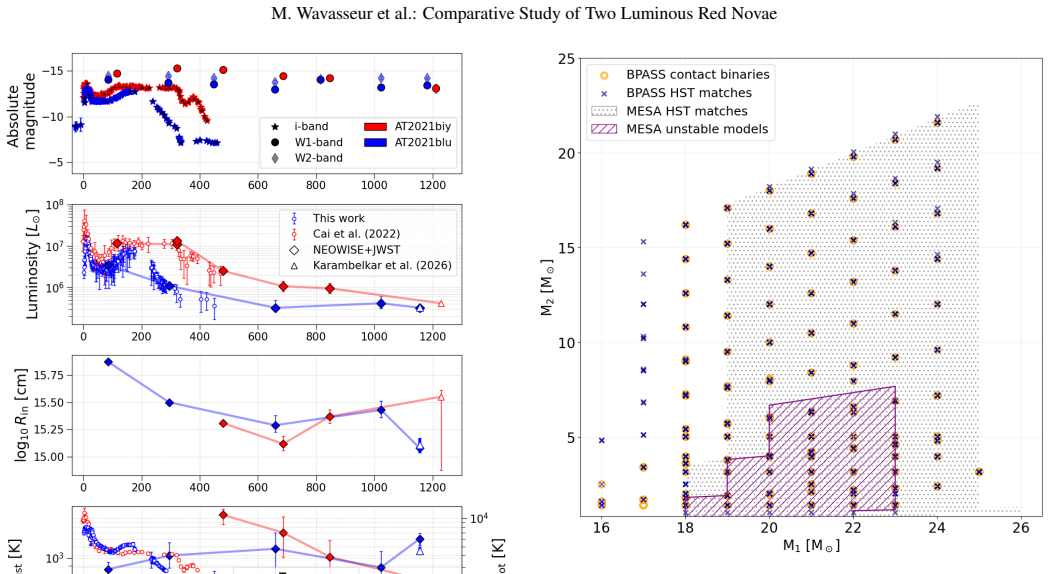
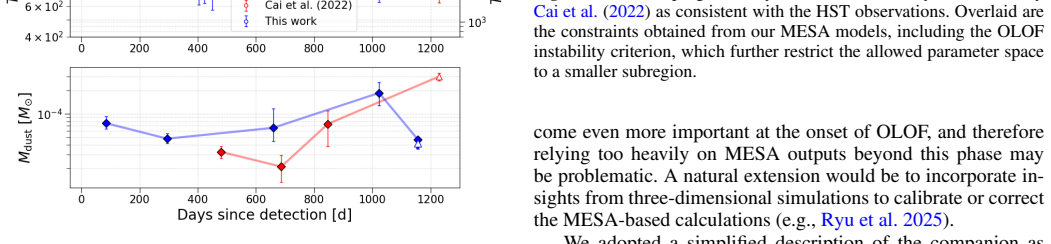
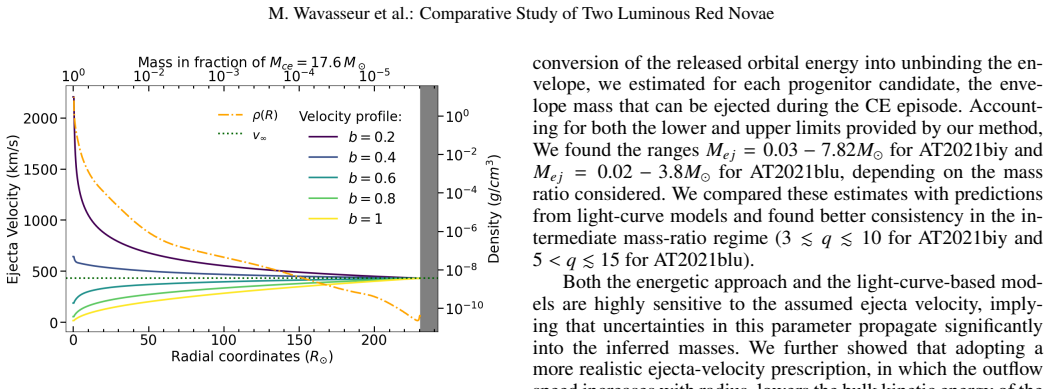
Donor masses are constrained to Md = 18-23 Msun for AT2021biy and Md = 14 +/- 0.5 Msun for AT2021blu. Lower limits on ejected envelope mass are 0.03-2.98 Msun for AT2021biy and 0.02-0.1 Msun for AT2021blu. The inferred dust masses are 1-5 orders of magnitude below the estimated ejected envelope masses, implying that only a small fraction of the gas condenses into dust.
What carries the argument
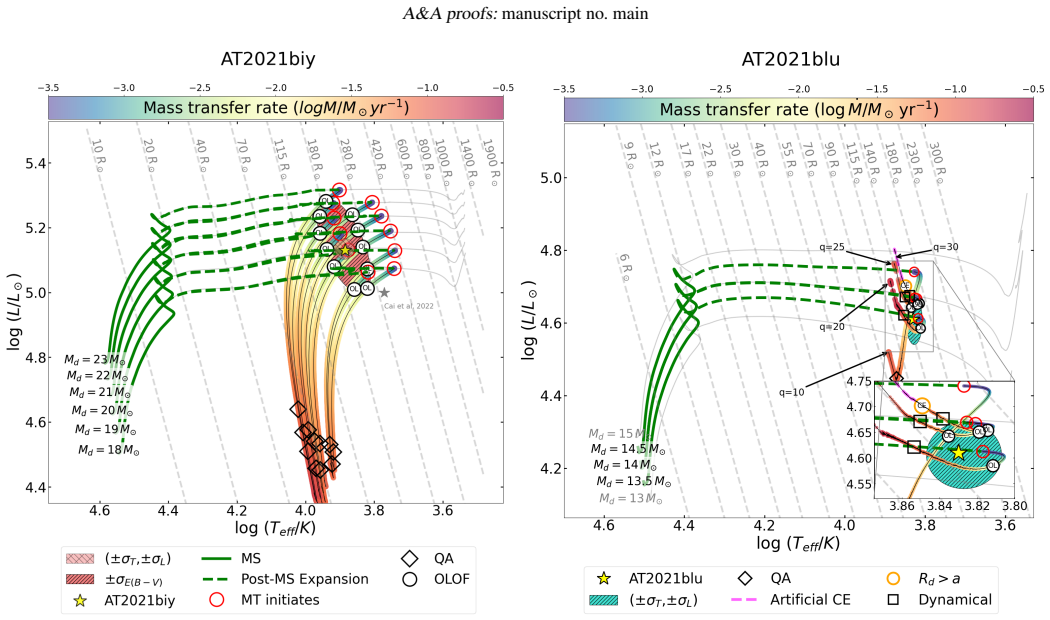
MESA binary evolution tracks selected by mass-transfer instability criteria to identify merging progenitors.
If this is right
- The light-curve models favor intermediate mass ratios q = 3-10 for AT2021biy and q = 5-15 for AT2021blu.
- The evolution is consistent with shock interaction and pre-existing circumstellar material.
- Pre-outburst mass loss is predicted by the models.
- Only a small fraction of the gas condenses into dust in these events.
Where Pith is reading between the lines
- Applying similar progenitor modeling to additional luminous red novae could reveal patterns in binary parameters.
- The inefficiency of dust formation may influence the interpretation of infrared signatures in other stellar mergers.
- Future observations of circumstellar material could test the predicted pre-outburst mass loss rates.
Load-bearing premise
The mass-transfer instability criteria accurately identify which binary systems will merge on timescales matching the observations.
What would settle it
Finding a donor star mass outside the constrained ranges through independent observations or discovering that the merger timescales do not match the models would challenge the progenitor constraints.
Figures
read the original abstract
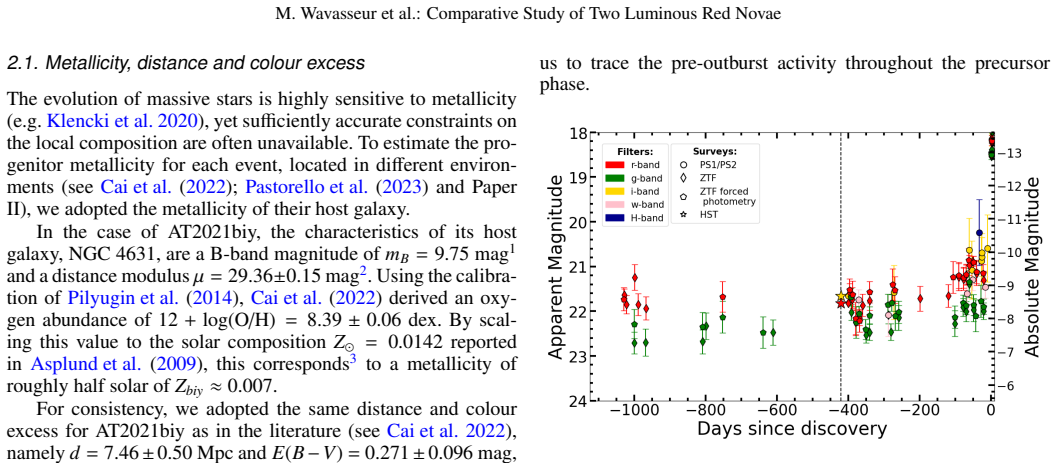
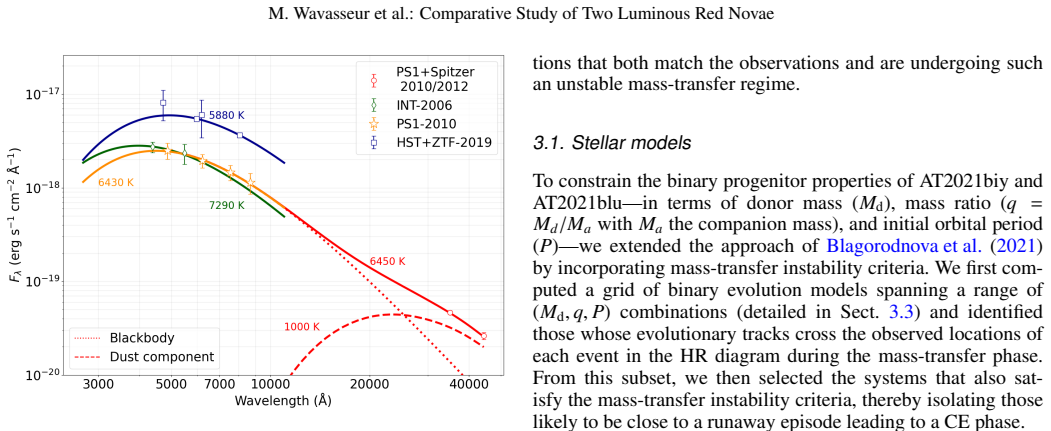
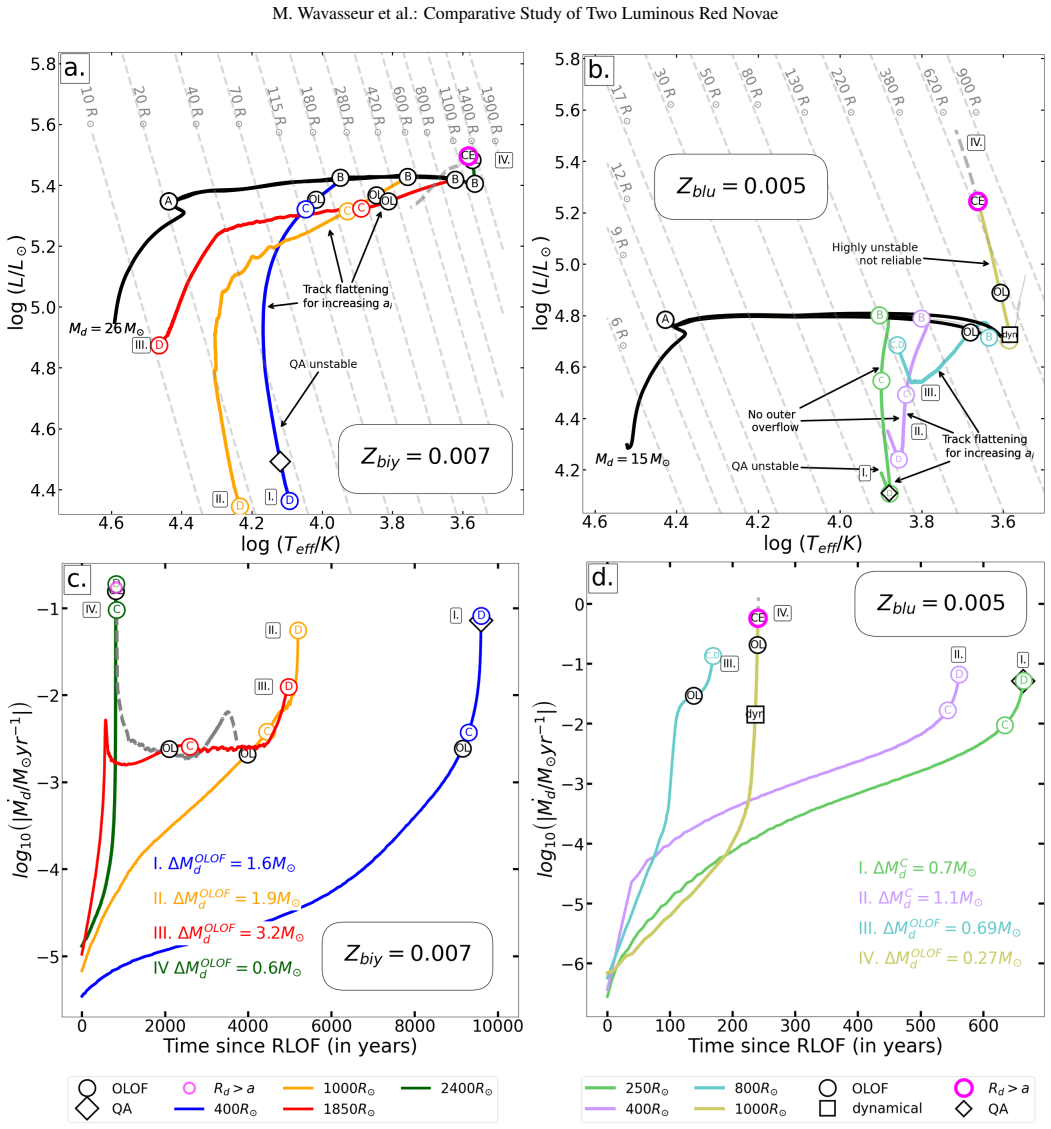
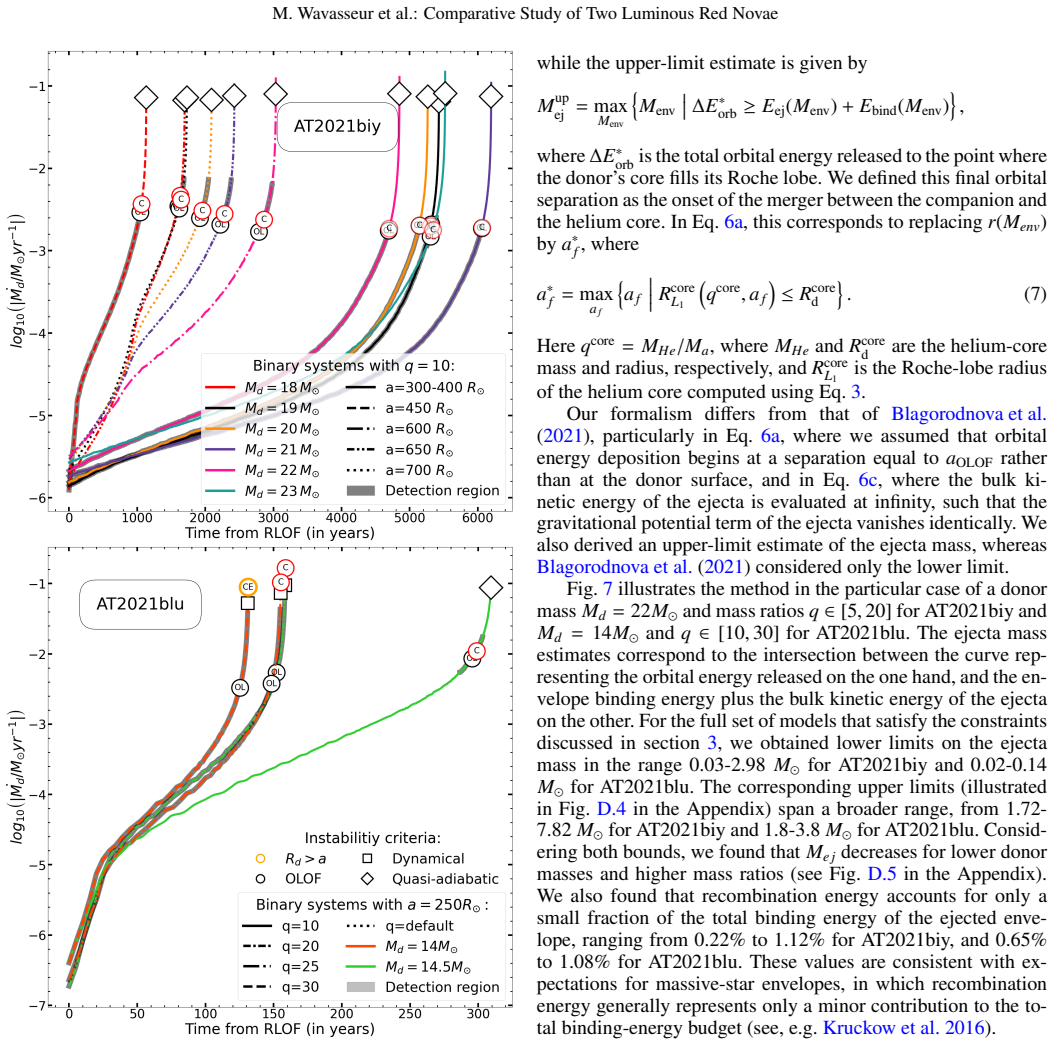
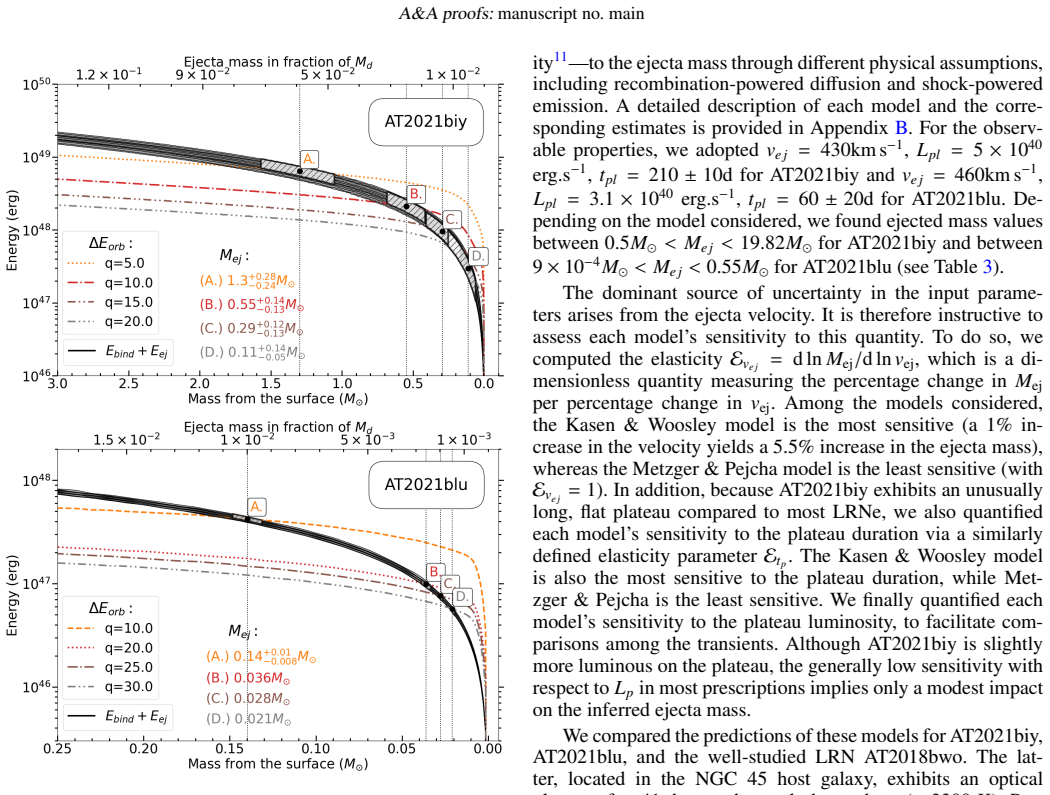
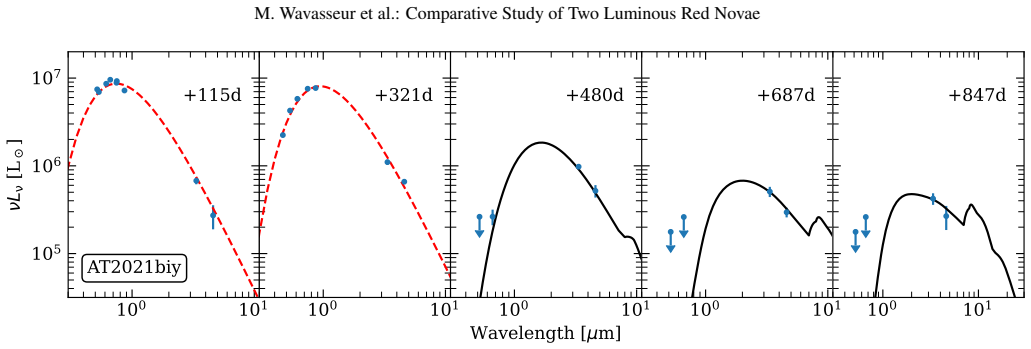
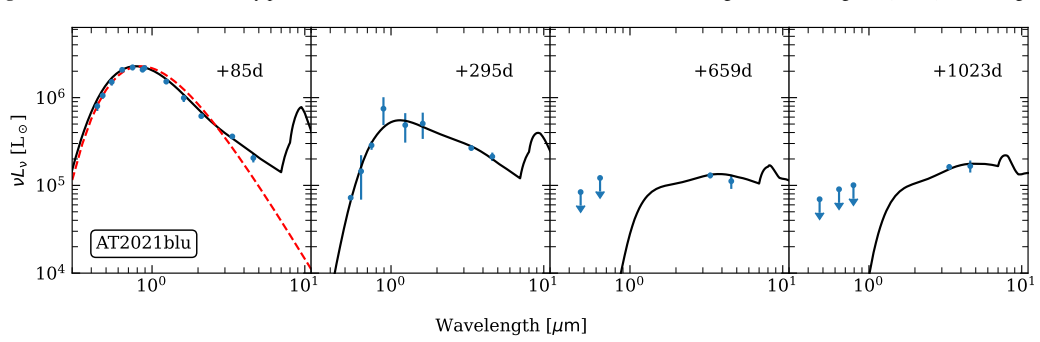
Luminous red novae are astrophysical transients associated with unstable mass transfer in interacting binaries and are commonly interpreted as outcomes of common-envelope evolution, possibly ending in merger. These interactions can liberate large amounts of gas, part of which may later condense into dust. We study the luminous red novae AT2021biy and AT2021blu to constrain their binary progenitors, estimate the mass ejected during the outbursts, and infer the dust mass from the infrared evolution of their remnants. We computed two grids of binary stellar-evolution tracks with the MESA binary module, constrained by pre-outburst photometry. We applied mass-transfer instability criteria to select progenitors able to merge on timescales compatible with archival observations. From these models, we estimated the gas mass lost during the mass-transfer phase and lower and upper bounds on the envelope mass that could be ejected during common-envelope evolution using the available orbital energy. We compared these ejecta-mass estimates with values inferred from light-curve models. Finally, we modeled mid-infrared NEOWISE data to derive dust masses up to ~3 years post-outburst, providing an additional lower limit on the total ejecta mass. We constrained the donor masses to Md = 18-23 Msun for AT2021biy and Md = 14 +/- 0.5 Msun for AT2021blu. Lower limits on the ejected envelope mass are 0.03-2.98 Msun for AT2021biy and 0.02-0.1 Msun for AT2021blu. Comparison with light-curve models favors intermediate mass ratios, q = 3-10 for AT2021biy and q = 5-15 for AT2021blu. The inferred dust masses are 1-5 orders of magnitude below the estimated ejected envelope masses, implying that only a small fraction of the gas condenses into dust. Their evolution is consistent with shock interaction and suggests pre-existing circumstellar material, in line with the pre-outburst mass loss predicted by our MESA models.
Editorial analysis
A structured set of objections, weighed in public.
Referee Report
Summary. The paper models progenitors of luminous red novae AT2021biy and AT2021blu via two grids of MESA binary evolution tracks constrained by pre-outburst photometry. Mass-transfer instability criteria are used to select tracks that merge on timescales matching archival data. From the selected models, gas mass lost during mass transfer and bounds on common-envelope ejecta (using orbital energy) are estimated and compared to light-curve inferences. Mid-IR NEOWISE data are modeled to derive dust masses up to ~3 yr post-outburst. Central results are donor masses Md = 18-23 Msun (AT2021biy) and Md = 14 ± 0.5 Msun (AT2021blu), ejected-envelope lower limits of 0.03-2.98 Msun and 0.02-0.1 Msun respectively, preference for intermediate mass ratios from light-curve comparison, and dust masses 1-5 orders of magnitude below ejecta (implying limited condensation).
Significance. If the progenitor constraints and ejecta-dust comparison hold, the work supplies observationally anchored limits on binary parameters for LRNs and quantifies the small dust fraction in their ejecta, with implications for common-envelope evolution and pre-outburst mass loss in massive binaries. Strengths include photometry-constrained MESA grids, direct comparison to light-curve models, and modeling of NEOWISE mid-IR evolution.
major comments (2)
- [progenitor selection (methods)] § on progenitor selection (methods section describing MESA grid filtering): The quoted donor-mass ranges (Md = 18-23 Msun for AT2021biy; Md = 14 ± 0.5 Msun for AT2021blu) are obtained only after applying mass-transfer instability criteria to retain tracks whose merger timescales match archival observations. The abstract states that this filtering step is performed but supplies neither the explicit mathematical formulation of the criteria (e.g., the precise combination of Roche-lobe overflow stability limits and angular-momentum-loss thresholds) nor any sensitivity tests to variations in those thresholds. Because the final mass windows are defined by this selection, the absence of the formulation and tests makes the reported ranges dependent on unstated modeling choices.
- [results (ejecta comparison)] Comparison of ejecta-mass estimates with light-curve models (results section): The paper states that the comparison 'favors intermediate mass ratios, q = 3-10 for AT2021biy and q = 5-15 for AT2021blu,' yet does not report the quantitative metric (e.g., χ^{2} or overlap fraction) used to establish this preference or the range of q values explored in the light-curve models. This step is load-bearing for the claim that the MESA-derived ejecta bounds are consistent with observations.
minor comments (2)
- The abstract refers to 'lower and upper bounds on the envelope mass that could be ejected during common-envelope evolution using the available orbital energy' without stating the explicit expressions or assumed efficiency factors (α_CE, λ) used to compute them.
- Notation for mass ratio q is introduced in the abstract but its definition (M_donor/M_accretor or inverse) is not restated in the results when the favored ranges are quoted.
Simulated Author's Rebuttal
We thank the referee for their careful reading of the manuscript and constructive comments. We address each major comment below.
read point-by-point responses
-
Referee: The quoted donor-mass ranges (Md = 18-23 Msun for AT2021biy; Md = 14 ± 0.5 Msun for AT2021blu) are obtained only after applying mass-transfer instability criteria to retain tracks whose merger timescales match archival observations. The abstract states that this filtering step is performed but supplies neither the explicit mathematical formulation of the criteria (e.g., the precise combination of Roche-lobe overflow stability limits and angular-momentum-loss thresholds) nor any sensitivity tests to variations in those thresholds. Because the final mass windows are defined by this selection, the absence of the formulation and tests makes the reported ranges dependent on unstated modeling choices.
Authors: We agree that the explicit formulation of the mass-transfer instability criteria and associated sensitivity tests were not presented with sufficient detail. In the revised manuscript we will add the precise mathematical criteria (Roche-lobe overflow stability limits combined with angular-momentum-loss thresholds) used to filter the MESA tracks, together with the resulting sensitivity tests that confirm the robustness of the reported donor-mass windows. revision: yes
-
Referee: The paper states that the comparison 'favors intermediate mass ratios, q = 3-10 for AT2021biy and q = 5-15 for AT2021blu,' yet does not report the quantitative metric (e.g., χ^{2} or overlap fraction) used to establish this preference or the range of q values explored in the light-curve models. This step is load-bearing for the claim that the MESA-derived ejecta bounds are consistent with observations.
Authors: We acknowledge that the quantitative metric and the explored range of mass ratios q were omitted from the results section. The revised manuscript will report the specific metric (χ^{2} or overlap fraction) employed for the comparison and will explicitly state the range of q values tested in the light-curve models, thereby substantiating the stated preference for intermediate mass ratios. revision: yes
Circularity Check
No significant circularity; derivation uses external MESA tracks and separate IR modeling
full rationale
The paper computes MESA binary grids constrained by pre-outburst photometry, applies mass-transfer instability criteria to select merging progenitors matching archival timescales, estimates ejecta masses from orbital energy, and derives dust masses from NEOWISE IR data. None of these steps reduce the reported donor masses (Md = 18-23 Msun, 14 +/- 0.5 Msun) or dust masses to fitted parameters by the paper's own equations; the selection and comparison steps rely on external code and independent light-curve models rather than self-definition or self-citation chains. The derivation remains self-contained against external benchmarks.
Axiom & Free-Parameter Ledger
axioms (2)
- domain assumption MESA binary module and chosen mass-transfer instability criteria correctly identify merging progenitors on observed timescales
- domain assumption Light-curve models provide reliable estimates of ejected envelope mass for comparison
Reference graph
Works this paper leans on
-
[1]
Research in Astronomy and Astrophysics , keywords =
Mass-accreting white dwarfs and type Ia supernovae. Research in Astronomy and Astrophysics , keywords =. doi:10.1088/1674-4527/18/5/49 , archivePrefix =. 1801.04031 , primaryClass =
-
[2]
Mind Your Ps and Qs: The Interrelation between Period (P) and Mass-ratio (Q) Distributions of Binary Stars. , keywords =. doi:10.3847/1538-4365/aa6fb6 , archivePrefix =. 1606.05347 , primaryClass =
work page internal anchor Pith review Pith/arXiv arXiv doi:10.3847/1538-4365/aa6fb6
-
[3]
arXiv e-prints , keywords =
PypeIt: The Python Spectroscopic Data Reduction Pipeline. arXiv e-prints , keywords =
-
[4]
The ambiguous transient ASASSN-17hx. A possible nova impostor. , keywords =. doi:10.1051/0004-6361/201937025 , archivePrefix =. 2001.11747 , primaryClass =
-
[5]
Formation of the Galactic Millisecond Pulsar Triple System PSR J0337+1715 A Neutron Star with Two Orbiting White Dwarfs. , keywords =. doi:10.1088/2041-8205/781/1/L13 , archivePrefix =. 1401.0941 , primaryClass =
work page internal anchor Pith review Pith/arXiv arXiv doi:10.1088/2041-8205/781/1/l13 2041
-
[6]
Evolution of neutron star + He star binaries: an alternative evolutionary channel to intermediate-mass binary pulsars. , keywords =. doi:10.1093/mnrasl/slt043 , archivePrefix =. 1303.6155 , primaryClass =
work page internal anchor Pith review Pith/arXiv arXiv doi:10.1093/mnrasl/slt043
-
[7]
, keywords =
Formation of cataclysmic binaries through common envelope evolution. , keywords =
-
[8]
Evolutionary Origins of Binary Neutron Star Mergers: Effects of Common Envelope Efficiency and Metallicity. arXiv e-prints , keywords =. doi:10.48550/arXiv.2211.15693 , archivePrefix =. 2211.15693 , primaryClass =
-
[9]
Dark energy: A brief review. Frontiers of Physics , keywords =. doi:10.1007/s11467-013-0300-5 , archivePrefix =. 1209.0922 , primaryClass =
work page internal anchor Pith review Pith/arXiv arXiv doi:10.1007/s11467-013-0300-5
-
[10]
The Astronomical Journal 116(3), 1009–1038 (1998)
Observational Evidence from Supernovae for an Accelerating Universe and a Cosmological Constant. , keywords =. doi:10.1086/300499 , archivePrefix =. astro-ph/9805201 , primaryClass =
work page internal anchor Pith review Pith/arXiv arXiv doi:10.1086/300499
-
[11]
Structure and Evolution of Close Binary Systems , year = 1976, editor =
Common Envelope Binaries. Structure and Evolution of Close Binary Systems , year = 1976, editor =
1976
-
[12]
The first gravitational-wave source from the isolated evolution of two 40-100 Msun stars
The first gravitational-wave source from the isolated evolution of two stars in the 40-100 solar mass range. , keywords =. doi:10.1038/nature18322 , archivePrefix =. 1602.04531 , primaryClass =
work page internal anchor Pith review Pith/arXiv arXiv doi:10.1038/nature18322
-
[13]
Bubbles in Planetary Nebulae and Clusters of Galaxies: Jet Properties
Bubbles in planetary nebulae and clusters of galaxies: Jet properties. , keywords =. doi:10.1051/0004-6361:20034120 , archivePrefix =. astro-ph/0309095 , primaryClass =
work page internal anchor Pith review Pith/arXiv arXiv doi:10.1051/0004-6361:20034120
-
[14]
Observational clues to the progenitors of Type-Ia supernovae
Observational Clues to the Progenitors of Type Ia Supernovae. , keywords =. doi:10.1146/annurev-astro-082812-141031 , archivePrefix =. 1312.0628 , primaryClass =
work page internal anchor Pith review Pith/arXiv arXiv doi:10.1146/annurev-astro-082812-141031
-
[15]
The Progenitor of SN 1987A. , keywords =. doi:10.1086/133043 , adsurl =
-
[16]
The Observatory , year = 1879, month = jul, volume =
A tidal theory of the evolution of satellites. The Observatory , year = 1879, month = jul, volume =
-
[17]
The Complete Evolution of a Neutron-star Binary through a Common Envelope Phase Using 1D Hydrodynamic Simulations. , keywords =. doi:10.3847/2041-8213/ab40d1 , archivePrefix =. 1907.12573 , primaryClass =
-
[18]
Compact Stellar X-ray Sources , year = 2006, editor =
Formation and evolution of compact stellar X-ray sources. Compact Stellar X-ray Sources , year = 2006, editor =
2006
-
[19]
Modeling contact binaries. II. Effects of energy transfer. , keywords =. doi:10.1051/0004-6361/202346277 , archivePrefix =. 2303.09328 , primaryClass =
-
[20]
, keywords =
Semiconvective diffusion and energy transport. , keywords =
-
[21]
Vigna-Gómez, Alejandro and MacLeod, Morgan and Neijssel, Coenraad J. and Broekgaarden, Floor S. and Justham, Stephen and Howitt, George and de Mink, Selma E. and Vinciguerra, Serena and Mandel, Ilya , year=. Common envelope episodes that lead to double neutron star formation , volume=. doi:10.1017/pasa.2020.31 , journal=
-
[22]
Dust formation in common envelope binary interaction - I: 3D simulations using the Bowen approximation. , keywords =. doi:10.1093/mnras/stad3748 , archivePrefix =. 2306.16609 , primaryClass =
-
[23]
Science , archivePrefix = "arXiv", eprint =
Binary Interaction Dominates the Evolution of Massive Stars. Science , archivePrefix = "arXiv", eprint =. doi:10.1126/science.1223344 , adsurl =
-
[24]
The VLT-FLAMES Tarantula Survey. VIII. Multiplicity properties of the O-type star population. , keywords =. doi:10.1051/0004-6361/201219621 , archivePrefix =. 1209.4638 , primaryClass =
work page internal anchor Pith review Pith/arXiv arXiv doi:10.1051/0004-6361/201219621
-
[25]
Southern Massive Stars at High Angular Resolution: Observational Campaign and Companion Detection
Southern Massive Stars at High Angular Resolution: Observational Campaign and Companion Detection. , keywords =. doi:10.1088/0067-0049/215/1/15 , archivePrefix =. 1409.6304 , primaryClass =
work page internal anchor Pith review Pith/arXiv arXiv doi:10.1088/0067-0049/215/1/15
-
[26]
The observed multiplicity properties of B-type stars in the Galactic young open cluster NGC 6231. , keywords =. doi:10.1051/0004-6361/202141037 , archivePrefix =. 2108.07814 , primaryClass =
-
[27]
The incidence of stellar mergers and mass gainers among massive stars
The Incidence of Stellar Mergers and Mass Gainers among Massive Stars. , keywords =. doi:10.1088/0004-637X/782/1/7 , archivePrefix =. 1312.3650 , primaryClass =
work page internal anchor Pith review Pith/arXiv arXiv doi:10.1088/0004-637x/782/1/7
-
[28]
Research in Astronomy and Astrophysics , keywords =
The Binarity of Early-type Stars from LAMOST medium-resolution Spectroscopic Survey. Research in Astronomy and Astrophysics , keywords =. doi:10.1088/1674-4527/ac3e5a , archivePrefix =. 2109.09775 , primaryClass =
-
[29]
An AMR Study of the Common Envelope Phase of Binary Evolution
An AMR Study of the Common-envelope Phase of Binary Evolution. , keywords =. doi:10.1088/0004-637X/746/1/74 , archivePrefix =. 1107.3889 , primaryClass =
work page internal anchor Pith review Pith/arXiv arXiv doi:10.1088/0004-637x/746/1/74
-
[30]
Dust formation in common envelope binary interactions - II: 3D simulations with self-consistent dust formation. , keywords =. doi:10.1093/mnras/stae1841 , archivePrefix =. 2401.03644 , primaryClass =
-
[31]
Pre-explosion Spiral Mass Loss of a Binary Star Merger. , keywords =. doi:10.3847/1538-4357/aa95b9 , archivePrefix =. 1710.02533 , primaryClass =
-
[32]
Dusty, Self-obscured Transients from Stellar Coalescence. , keywords =. doi:10.3847/1538-4357/ac8c31 , archivePrefix =. 2205.07929 , primaryClass =
-
[33]
, keywords =
Parametrization of stellar rates of mass loss as functions of the fundamental stellar parameters M, L, and R. , keywords =
-
[34]
, keywords =
Spectral analyses of the Galactic Wolf-Rayet stars: hydrogen-helium abundances and improved stellar parameters for the WN class. , keywords =
-
[35]
, keywords =
The time scale of thermohaline mixing in stars. , keywords =
-
[36]
ATLAS: A High-Cadence All-Sky Survey System
ATLAS: A High-cadence All-sky Survey System. , keywords =. doi:10.1088/1538-3873/aabadf , archivePrefix =. 1802.00879 , primaryClass =
work page internal anchor Pith review Pith/arXiv arXiv doi:10.1088/1538-3873/aabadf
-
[37]
Bound Outflows, Unbound Ejecta, and the Shaping of Bipolar Remnants during Stellar Coalescence
Bound Outflows, Unbound Ejecta, and the Shaping of Bipolar Remnants during Stellar Coalescence. , keywords =. doi:10.3847/1538-4357/aae9eb , archivePrefix =. 1808.05950 , primaryClass =
work page internal anchor Pith review Pith/arXiv arXiv doi:10.3847/1538-4357/aae9eb
-
[38]
Runaway Coalescence at the Onset of Common Envelope Episodes
Runaway Coalescence at the Onset of Common Envelope Episodes. , keywords =. doi:10.3847/1538-4357/aacf08 , archivePrefix =. 1803.03261 , primaryClass =
work page internal anchor Pith review Pith/arXiv arXiv doi:10.3847/1538-4357/aacf08
-
[39]
Pre-common-envelope Mass Loss from Coalescing Binary Systems. , keywords =. doi:10.3847/1538-4357/ab89b6 , archivePrefix =. 2003.01123 , primaryClass =
-
[40]
Runaway Coalescence of Pre-common-envelope Stellar Binaries. , keywords =. doi:10.3847/1538-4357/ab822e , archivePrefix =. 1912.05545 , primaryClass =
-
[41]
Journal of Physics Conference Series , year = 2016, series =
Cool and luminous transients from mass-losing binary stars. Journal of Physics Conference Series , year = 2016, series =. doi:10.1088/1742-6596/728/7/072021 , adsurl =
-
[42]
Cool and Luminous Transients from Mass-Losing Binary Stars
Cool and luminous transients from mass-losing binary stars. , keywords =. doi:10.1093/mnras/stv2592 , archivePrefix =. 1509.02531 , primaryClass =
work page internal anchor Pith review Pith/arXiv arXiv doi:10.1093/mnras/stv2592
-
[43]
American Astronomical Society Meeting Abstracts \#227 , year = 2016, series =
Cool and Luminous Transients from Mass-Losing Binary Stars. American Astronomical Society Meeting Abstracts \#227 , year = 2016, series =
2016
-
[44]
, title =
Dolphin, Andrew E. , title =. PASP , volume =. 2000 , doi =
2000
-
[45]
2016 , publisher =
Dolphin, Andrew , title =. 2016 , publisher =
2016
-
[46]
The Dependence of Convective Core Overshooting on Stellar Mass: Additional Binary Systems and Improved Calibration. , keywords =. doi:10.3847/1538-4357/aabd35 , archivePrefix =. 1804.03148 , primaryClass =
work page internal anchor Pith review Pith/arXiv arXiv doi:10.3847/1538-4357/aabd35
-
[47]
Observation of Gravitational Waves from a Binary Black Hole Merger
Observation of Gravitational Waves from a Binary Black Hole Merger. , keywords =. doi:10.1103/PhysRevLett.116.061102 , archivePrefix =. 1602.03837 , primaryClass =
work page internal anchor Pith review Pith/arXiv arXiv doi:10.1103/physrevlett.116.061102
-
[48]
Multi-messenger Observations of a Binary Neutron Star Merger
Multi-messenger Observations of a Binary Neutron Star Merger. , keywords =. doi:10.3847/2041-8213/aa91c9 , archivePrefix =. 1710.05833 , primaryClass =
work page internal anchor Pith review Pith/arXiv arXiv doi:10.3847/2041-8213/aa91c9 2041
-
[49]
Forbidden hugs in pandemic times. IV. Panchromatic evolution of three luminous red novae. , keywords =. doi:10.1051/0004-6361/202244684 , archivePrefix =. 2208.02782 , primaryClass =
-
[50]
emcee: The MCMC Hammer. , keywords =. doi:10.1086/670067 , archivePrefix =. 1202.3665 , primaryClass =
work page internal anchor Pith review Pith/arXiv arXiv doi:10.1086/670067
-
[51]
, keywords =
On the spin-up of the mass accreting component in a close binary system. , keywords =
-
[52]
2003 , eprint=
Binary evolution models with rotation , author=. 2003 , eprint=
2003
-
[53]
Tout, C. A. and Pols, O. R. and Eggleton, P. P. and Han, Z. , title =. MNRAS , volume =
-
[54]
Hurley, J. R. and Tout, C. A. and Pols, O. R. , title =. MNRAS , volume =
-
[55]
and de Mink, S
Lechien, T. and de Mink, S. E. and Valli, R. and et al. , title =. ApJL , volume =
-
[56]
Forbidden hugs in pandemic times. III. Observations of the luminous red nova AT 2021biy in the nearby galaxy NGC 4631. , keywords =. doi:10.1051/0004-6361/202244393 , archivePrefix =. 2207.00734 , primaryClass =
-
[57]
Lessons from the Onset of a Common Envelope Episode: the Remarkable M31 2015 Luminous Red Nova Outburst. , keywords =. doi:10.3847/1538-4357/835/2/282 , archivePrefix =. 1605.01493 , primaryClass =
work page internal anchor Pith review Pith/arXiv arXiv doi:10.3847/1538-4357/835/2/282 2015
-
[58]
, keywords =
A comparative study of the evolution of a close binary using a standard and an improved technique for computing mass transfer. , keywords =
-
[59]
Hot Springs and Dust Reservoirs: JWST Reveals the Dusty, Molecular Aftermath of Extragalactic Stellar Mergers. , keywords =. doi:10.3847/1538-4357/ae38bf , archivePrefix =. 2508.03932 , primaryClass =
-
[60]
Hydrodynamic Winds from Twin-star Binaries. , keywords =. doi:10.3847/1538-4357/abb313 , archivePrefix =. 2007.07252 , primaryClass =
-
[61]
The Origin of the Mass--Metallicity Relation: Insights from 53,000 Star-Forming Galaxies in the SDSS
The Origin of the Mass-Metallicity Relation: Insights from 53,000 Star-forming Galaxies in the Sloan Digital Sky Survey. , keywords =. doi:10.1086/423264 , archivePrefix =. astro-ph/0405537 , primaryClass =
work page internal anchor Pith review Pith/arXiv arXiv doi:10.1086/423264
-
[62]
The Abundance Properties of Nearby Late-type Galaxies. I. The Data. , keywords =. doi:10.1088/0004-6256/147/6/131 , archivePrefix =. 1403.5461 , primaryClass =
work page internal anchor Pith review Pith/arXiv arXiv doi:10.1088/0004-6256/147/6/131
-
[63]
Nova Sagittarii 1994 1 (V4332 Sagittarii): The Discovery and Evolution of an Unusual Luminous Red Variable Star. , keywords =. doi:10.1086/300951 , archivePrefix =. astro-ph/9905016 , primaryClass =
work page internal anchor Pith review Pith/arXiv arXiv doi:10.1086/300951 1994
-
[64]
Common Envelope Evolution: Where we stand and how we can move forward
Common envelope evolution: where we stand and how we can move forward. , keywords =. doi:10.1007/s00159-013-0059-2 , archivePrefix =. 1209.4302 , primaryClass =
work page internal anchor Pith review Pith/arXiv arXiv doi:10.1007/s00159-013-0059-2
-
[65]
Interacting Binary Stars , year = 1985, editor =
Stellar evolution and binaries. Interacting Binary Stars , year = 1985, editor =
1985
-
[66]
V1309 SCO - Understanding a merger
V1309 Sco Understanding a Merger. , keywords =. doi:10.1088/0004-637X/786/1/39 , archivePrefix =. 1311.6522 , primaryClass =
work page internal anchor Pith review Pith/arXiv arXiv doi:10.1088/0004-637x/786/1/39
-
[67]
Interpretation of observations of the circumbinary disk of SS 433
Interpretation of observations of the circumbinary disk of SS 433. , keywords =. doi:10.1051/0004-6361/201014711 , archivePrefix =. 1004.0119 , primaryClass =
work page internal anchor Pith review Pith/arXiv arXiv doi:10.1051/0004-6361/201014711
-
[68]
Common Envelope Evolution and Double Cores of Planetary Nebulae. , keywords =. doi:10.1086/168974 , adsurl =
-
[69]
doi:10.1088/2514-3433/abb6f0 , adsurl =
Common Envelope Evolution. doi:10.1088/2514-3433/abb6f0 , adsurl =
-
[70]
Common envelope events with low-mass giants: understanding the energy budget
Common envelope events with low-mass giants: understanding the energy budget. , keywords =. doi:10.1093/mnras/stw1266 , archivePrefix =. 1606.04922 , primaryClass =
work page internal anchor Pith review Pith/arXiv arXiv doi:10.1093/mnras/stw1266
-
[71]
Identification of the Long-Sought Common-Envelope Events
Identification of the Long-Sought Common-Envelope Events. Science , keywords =. doi:10.1126/science.1225540 , archivePrefix =. 1301.5897 , primaryClass =
work page internal anchor Pith review Pith/arXiv arXiv doi:10.1126/science.1225540
-
[72]
Type II Supernovae: Model Light Curves and Standard Candle Relationships
Type II Supernovae: Model Light Curves and Standard Candle Relationships. , keywords =. doi:10.1088/0004-637X/703/2/2205 , archivePrefix =. 0910.1590 , primaryClass =
work page internal anchor Pith review Pith/arXiv arXiv doi:10.1088/0004-637x/703/2/2205
-
[73]
Supernova Light Curves Powered by Young Magnetars
Supernova Light Curves Powered by Young Magnetars. , keywords =. doi:10.1088/0004-637X/717/1/245 , archivePrefix =. 0911.0680 , primaryClass =
work page internal anchor Pith review Pith/arXiv arXiv doi:10.1088/0004-637x/717/1/245
-
[74]
Evolutionary Binary Sequences for Low- and Intermediate-Mass X-ray Binaries
Evolutionary Sequences for Low- and Intermediate-Mass X-Ray Binaries. , keywords =. doi:10.1086/324686 , archivePrefix =. astro-ph/0107261 , primaryClass =
work page internal anchor Pith review Pith/arXiv arXiv doi:10.1086/324686
-
[75]
Binary Stars Take What They Get: Evidence for Efficient Mass Transfer from Stripped Stars with Rapidly Rotating Companions. , keywords =. doi:10.3847/2041-8213/adfdd4 , archivePrefix =. 2505.14780 , primaryClass =
-
[76]
Presupernova Evolution of Rotating Massive Stars. I. Numerical Method and Evolution of the Internal Stellar Structure. , keywords =. doi:10.1086/308158 , archivePrefix =. astro-ph/9904132 , primaryClass =
work page internal anchor Pith review Pith/arXiv arXiv doi:10.1086/308158
-
[77]
Presupernova Evolution of Differentially Rotating Massive Stars Including Magnetic Fields
Presupernova Evolution of Differentially Rotating Massive Stars Including Magnetic Fields. , keywords =. doi:10.1086/429868 , archivePrefix =. astro-ph/0409422 , primaryClass =
work page internal anchor Pith review Pith/arXiv arXiv doi:10.1086/429868
-
[78]
Pols , title =
Onno R. Pols , title =. 2011 , publisher =
2011
-
[79]
The luminous red nova AT 2018bwo in NGC 45 and its binary yellow supergiant progenitor. , keywords =. doi:10.1051/0004-6361/202140525 , archivePrefix =. 2102.05662 , primaryClass =
-
[80]
, year = 1997, month = jan, volume =
Optical Spectra of Supernovae. , year = 1997, month = jan, volume =. doi:10.1146/annurev.astro.35.1.309 , adsurl =
discussion (0)
Sign in with ORCID, Apple, or X to comment. Anyone can read and Pith papers without signing in.