Emergence of Gaussian entanglement and non-Gaussianity in high-harmonic generation driven by bright squeezed light
Pith reviewed 2026-06-26 09:49 UTC · model grok-4.3
The pith
Bichromatic driving of high-harmonic generation by a strong coherent field at ω and perturbative bright squeezed vacuum at 2ω produces non-classical multimode Gaussian entanglement in the even harmonics.
A machine-rendered reading of the paper's core claim, the machinery that carries it, and where it could break.
Core claim
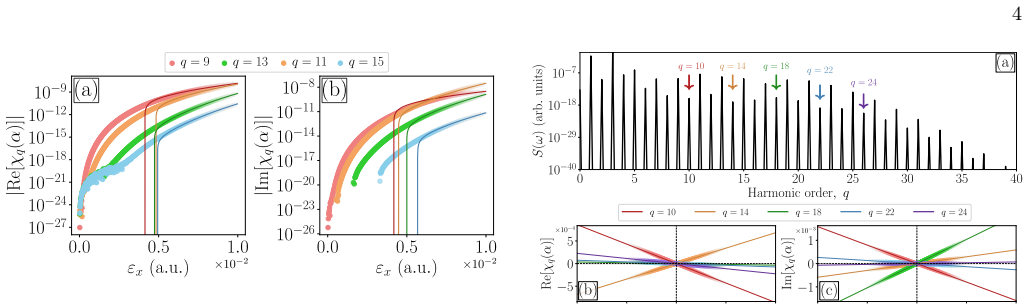
For bichromatic driving by a strong coherent field at frequency ω and a perturbative BSV field at 2ω, the even-harmonic response is approximately linear in the BSV quadrature, leading to non-classical multimode Gaussian entanglement in the harmonic field that can be described as a distributed collective squeezed mode over the even-harmonic manifold.
What carries the argument
Linear response of the even-harmonic field to the BSV quadrature under perturbative bichromatic driving, which maps the input squeezing into multimode entanglement.
If this is right
- The generated harmonic field carries non-classical multimode Gaussian entanglement.
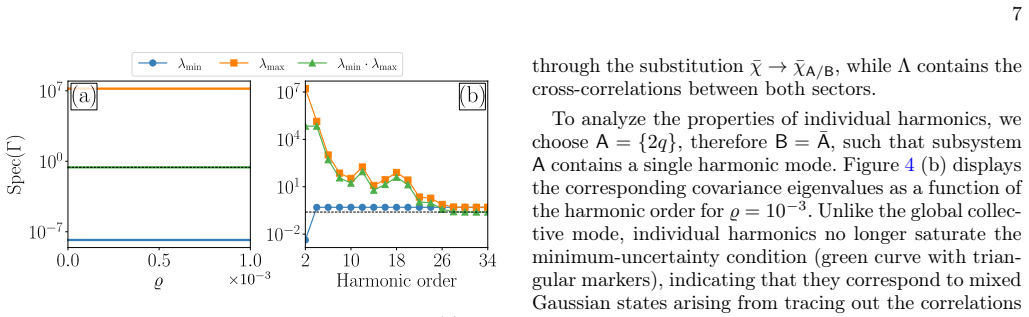
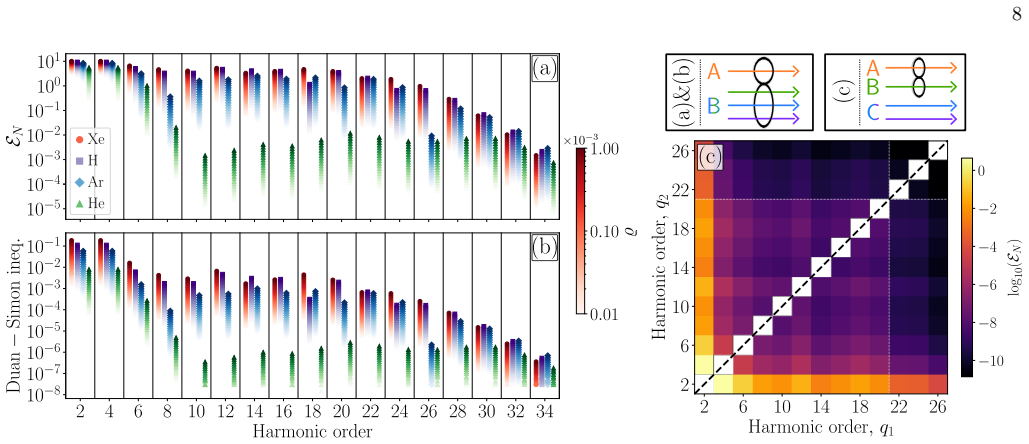
- The entangled state admits a description via its covariance matrix and entanglement structure.
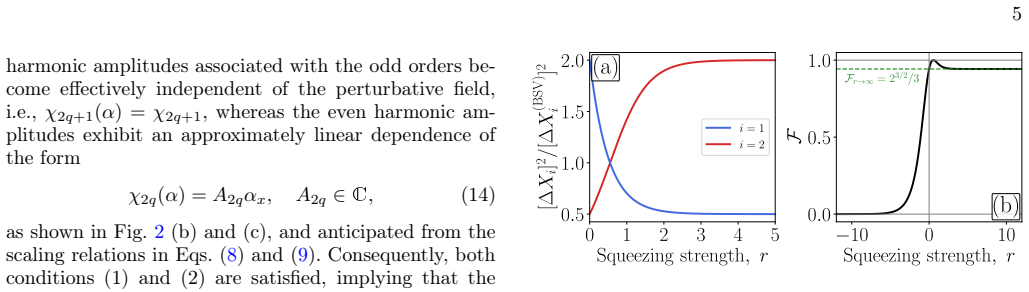
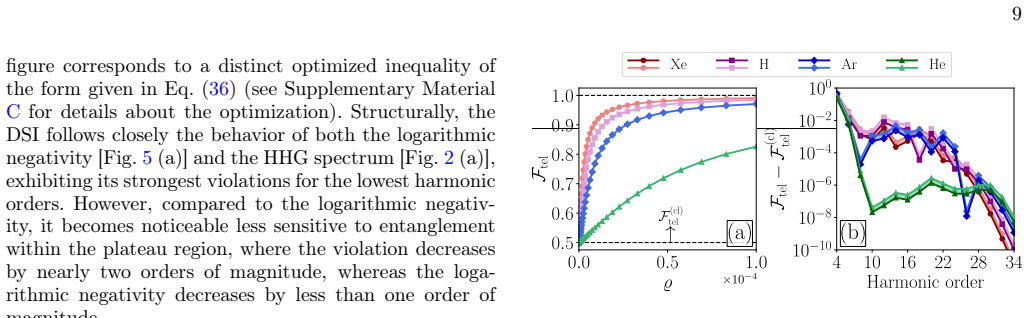
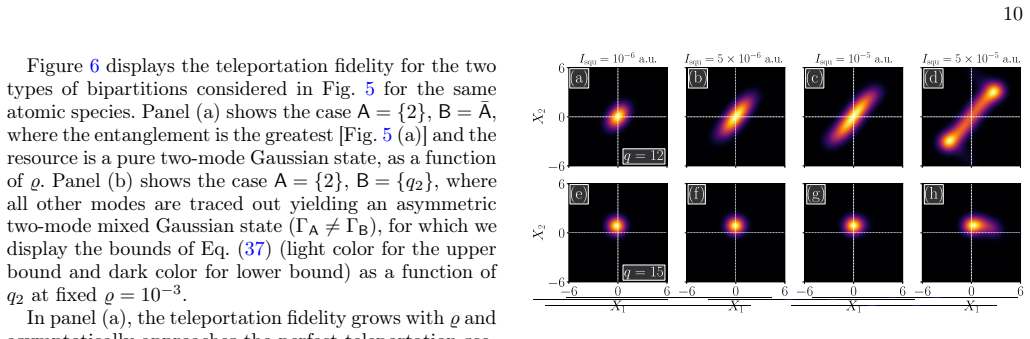
- Quantum teleportation fidelity provides an operational benchmark for the state.
- Non-classically driven HHG supplies a platform for engineering Gaussian and non-Gaussian states of light in the extreme ultraviolet.
Where Pith is reading between the lines
- The same linear-response mapping could be used to entangle harmonics in other nonlinear optical processes.
- Moving out of the perturbative regime would allow controlled generation of non-Gaussian states as the paper already flags.
- Table-top sources could deliver entangled extreme-ultraviolet light for quantum information tasks if the entanglement survives propagation.
- Experimental tests would focus on quadrature correlations between distinct even-harmonic frequencies.
Load-bearing premise
The bright squeezed vacuum component must remain perturbative so the even-harmonic response stays linear in the BSV quadrature.
What would settle it
Direct measurement of the covariance matrix among even-harmonic modes that either matches the predicted collective squeezed state or shows clear deviation once BSV intensity is increased beyond the perturbative limit.
Figures
read the original abstract
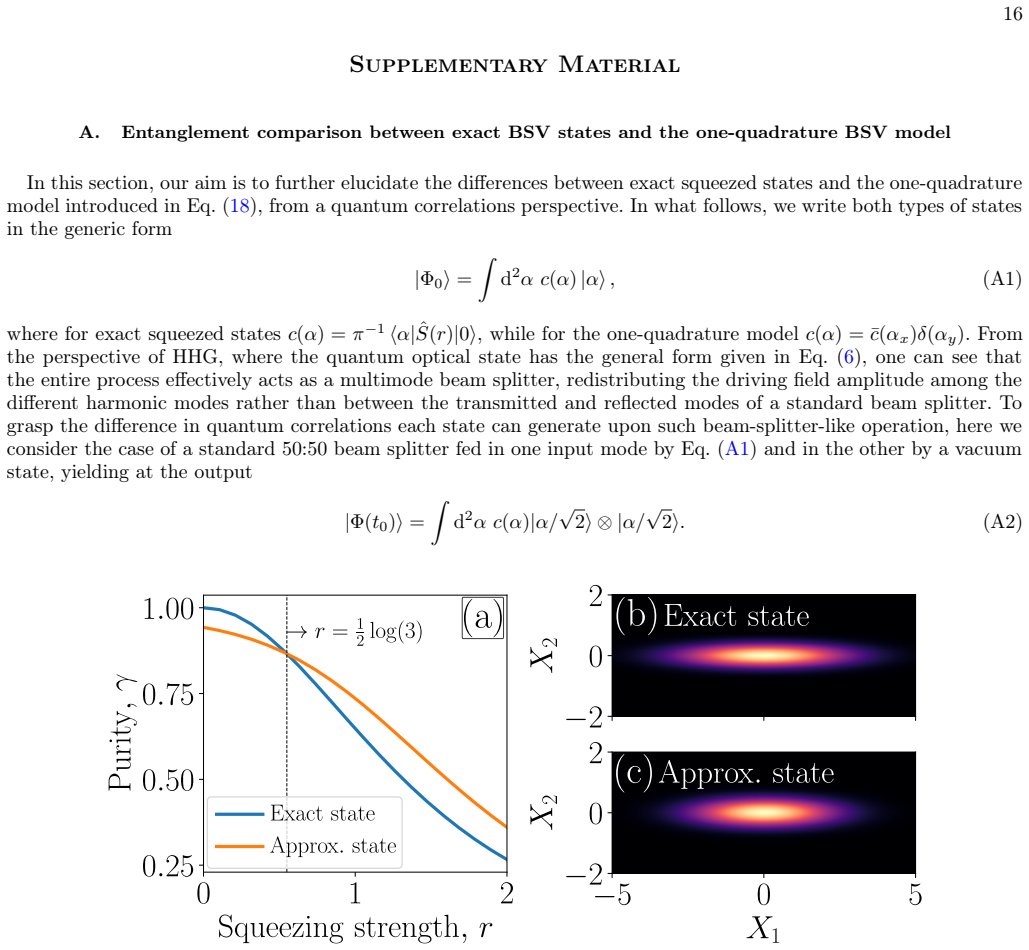
High harmonic generation (HHG) is a highly nonlinear optical process in which radiation from a strong driving field is up-converted into its high-order harmonics. In atomic systems, this nonlinearity manifests itself through the intensity scaling of the emitted harmonics with the driving field strength. Despite the highly nonlinear nature of HHG, when the driving field is prepared in a classical Gaussian state and atomic depletion remains negligible, the quantum statistical properties of the generated harmonics retains classical Gaussian quantum statistics. Driving HHG with bright squeezed vacuum (BSV) light challenges this paradigm, as its enhanced field fluctuations can modify the statistical properties of the generated harmonics. In this work, we investigate the conditions under which BSV-driven HHG gives rise to non-classical Gaussian states, and identify the regimes where this Gaussian description breaks down. For bichromatic driving by a strong coherent field at frequency $\omega$ and a perturbative BSV field at $2\omega$, the even-harmonic response is approximately linear in the BSV quadrature, leading to non-classical multimode Gaussian entanglement in the harmonic field. We show that this state can be described as a distributed collective squeezed mode over the even-harmonic manifold, and characterize its covariance matrix, entanglement structure, and quantum teleportation fidelity as an operational benchmark. Our results highlight the potential of non-classically driven HHG as a platform for engineering Gaussian and non-Gaussian states of light in the extreme ultraviolet regime.
Editorial analysis
A structured set of objections, weighed in public.
Referee Report
Summary. The manuscript investigates high-harmonic generation (HHG) driven by bright squeezed vacuum (BSV). It claims that bichromatic driving by a strong coherent field at frequency ω and a perturbative BSV field at 2ω yields an approximately linear even-harmonic response in the BSV quadrature. This linearity produces non-classical multimode Gaussian entanglement in the harmonic field, which the authors model as a distributed collective squeezed mode. They characterize the associated covariance matrix, entanglement structure, and quantum teleportation fidelity as an operational benchmark, while also identifying regimes where the Gaussian description breaks down into non-Gaussianity.
Significance. If the perturbative linearity approximation is rigorously established, the work would demonstrate a concrete route to engineering multimode Gaussian entanglement and non-Gaussian states directly in the extreme-ultraviolet regime via HHG. The provision of an explicit covariance-matrix construction and a teleportation-fidelity benchmark supplies falsifiable, operational content that strengthens the result beyond purely formal claims.
major comments (2)
- [Abstract] Abstract (bichromatic-driving paragraph): the central claim that the even-harmonic response is 'approximately linear in the BSV quadrature' is load-bearing for the Gaussian-entanglement conclusion, yet the abstract states the approximation without deriving it or specifying the perturbative regime quantitatively. The manuscript must supply the explicit expansion or numerical validation that justifies this linearity, as its validity directly determines whether the covariance matrix describes genuine non-classical entanglement.
- [Covariance-matrix section] Section describing the covariance matrix: the mapping from the linear response to the multimode covariance matrix elements must be shown explicitly (including any truncation or mode-selection steps). Without these expressions it is impossible to verify that the reported entanglement structure is not an artifact of the approximation or of an implicit choice of quadrature basis.
minor comments (2)
- [Abstract] The abstract refers to 'atomic depletion remains negligible' without quantifying the intensity threshold; a brief estimate or citation to the relevant depletion criterion would improve clarity.
- [Notation] Notation for the even-harmonic manifold and the collective squeezed mode should be introduced with a single consistent symbol set to avoid ambiguity when the covariance matrix is later presented.
Simulated Author's Rebuttal
We thank the referee for the careful reading of the manuscript and the constructive comments. We agree that the requested clarifications on the perturbative linearity and the explicit covariance-matrix construction will strengthen the presentation and make the results more verifiable. We address each major comment below.
read point-by-point responses
-
Referee: [Abstract] Abstract (bichromatic-driving paragraph): the central claim that the even-harmonic response is 'approximately linear in the BSV quadrature' is load-bearing for the Gaussian-entanglement conclusion, yet the abstract states the approximation without deriving it or specifying the perturbative regime quantitatively. The manuscript must supply the explicit expansion or numerical validation that justifies this linearity, as its validity directly determines whether the covariance matrix describes genuine non-classical entanglement.
Authors: We agree that the abstract should indicate the perturbative regime. In the revised version we will add a concise clause specifying the intensity ratio between the coherent drive and the BSV field (together with a reference to the expansion performed in the main text) under which the even-harmonic response remains linear to leading order in the BSV quadrature. This addition will make the domain of validity of the Gaussian-entanglement claim explicit already in the abstract. revision: yes
-
Referee: [Covariance-matrix section] Section describing the covariance matrix: the mapping from the linear response to the multimode covariance matrix elements must be shown explicitly (including any truncation or mode-selection steps). Without these expressions it is impossible to verify that the reported entanglement structure is not an artifact of the approximation or of an implicit choice of quadrature basis.
Authors: We accept that the mapping was presented at too high a level. The revised manuscript will contain an explicit derivation that starts from the linear response of each even harmonic to the BSV quadrature, proceeds through the definition of the collective mode, and arrives at the elements of the multimode covariance matrix. The derivation will include the truncation to the even-harmonic manifold and the choice of quadrature basis, allowing direct verification that the reported entanglement is not an artifact. revision: yes
Circularity Check
No significant circularity; derivation self-contained under stated approximation
full rationale
The abstract explicitly qualifies the key step as an approximation ('the even-harmonic response is approximately linear in the BSV quadrature') under perturbative conditions. No equations, covariance constructions, or regime analyses are shown to reduce the claimed multimode Gaussian entanglement to a fitted parameter, self-definition, or self-citation chain. The central claim rests on the physical model of bichromatic driving and the perturbative assumption, which is independent of the target result. This matches the default expectation for non-circular papers.
Axiom & Free-Parameter Ledger
axioms (2)
- domain assumption Atomic depletion remains negligible
- domain assumption Even-harmonic response is approximately linear in the BSV quadrature
Reference graph
Works this paper leans on
-
[1]
E. T. Jaynes and G. L. Bretthorst, The central, gaussian or normal distribution, inProbability Theory: The Logic of Science(Cambridge University Press, 2003) pp. 198– 242
2003
-
[2]
A.Serafini,Gaussianoperations,inQuantum Continuous Variables(CRC Press, 2023) 2nd ed
2023
-
[3]
M. O. Scully and M. S. Zubairy, Coherent and squeezed states of the radiation fieldy, inQuantum Optics(Cam- bridge University Press, Cambridge, UK, 2001) Chap. 2, pp. 1–45
2001
-
[4]
Gerry and P
C. Gerry and P. Knight, Nonclassical light, inIntro- ductory Quantum Optics(Cambridge University Press, Cambridge, UK, 2005) Chap. 7, pp. 150–194
2005
-
[5]
S. L. Braunstein and P. van Loock, Quantum information with continuous variables, Reviews of Modern Physics 77, 513 (2005)
2005
-
[6]
V. C. Usenko, A. Acín, R. Alléaume, U. L. Andersen, E. Diamanti, T. Gehring, A. A. Hajomer, F. Kanitschar, C. Pacher, S. Pirandola, and V. Pruneri, Continuous- variable quantum communication, Reviews of Modern Physics98, 015003 (2026)
2026
-
[7]
Ourjoumtsev, R
A. Ourjoumtsev, R. Tualle-Brouri, J. Laurat, and P. Grangier, Generating Optical Schrödinger Kittens for Quantum Information Processing, Science312, 83 (2006)
2006
-
[8]
J. S. Neergaard-Nielsen, B. M. Nielsen, C. Hettich, K. Mølmer, and E. S. Polzik, Generation of a Superpo- sition of Odd Photon Number States for Quantum In- formation Networks, Physical Review Letters97, 083604 (2006)
2006
-
[9]
Ourjoumtsev, H
A. Ourjoumtsev, H. Jeong, R. Tualle-Brouri, and P. Grangier, Generation of optical ‘Schrödinger cats’ from photon number states, Nature448, 784 (2007), number: 7155
2007
-
[10]
D. F. Walls, Squeezed states of light, Nature306, 141 (1983)
1983
-
[11]
Xiao, L.-A
M. Xiao, L.-A. Wu, and H. J. Kimble, Precision mea- surement beyond the shot-noise limit, Physical Review Letters59, 278 (1987)
1987
-
[12]
The LIGO Scientific Collaboration, A gravitational wave observatory operating beyond the quantum shot-noise limit, Nature Physics7, 962 (2011)
2011
-
[13]
R. E. Slusher, L. W. Hollberg, B. Yurke, J. C. Mertz, and J. F. Valley, Observation of Squeezed States Gener- ated by Four-Wave Mixing in an Optical Cavity, Physical Review Letters55, 2409 (1985)
1985
-
[14]
L.-A. Wu, M. Xiao, and H. J. Kimble, Squeezed states of light from an optical parametric oscillator, JOSA B4, 1465 (1987)
1987
-
[15]
P. K. Lam, T. C. Ralph, B. C. Buchler, D. E. McClelland, H.-A. Bachor, and J. Gao, Optimization and transfer of vacuum squeezing from an optical parametric oscillator, Journal of Optics B: Quantum and Semiclassical Optics 1, 469 (1999)
1999
-
[16]
Schneider, M
K. Schneider, M. Lang, J. Mlynek, and S. Schiller, Gener- ation of strongly squeezed continuous-wave light at 1064 nm, Optics Express2, 59 (1998)
1998
-
[17]
Heidmann, R
A. Heidmann, R. J. Horowicz, S. Reynaud, E. Giacobino, C. Fabre, and G. Camy, Observation of quantum noise reduction on twin laser beams, Physical Review Letters 59, 2555 (1987)
1987
-
[18]
Z. Y. Ou, S. F. Pereira, H. J. Kimble, and K. C. Peng, Realization of the einstein-podolsky-rosen paradox for continuous variables, Physical Review Letters68, 3663 (1992)
1992
-
[19]
Roslund, R
J. Roslund, R. M. de Araújo, S. Jiang, C. Fabre, and N. Treps, Wavelength-multiplexed quantum networks with ultrafast frequency combs, Nature Photonics8, 109 (2014)
2014
-
[20]
Medeiros de Araújo, J
R. Medeiros de Araújo, J. Roslund, Y. Cai, G. Ferrini, C. Fabre, and N. Treps, Full characterization of a highly multimode entangled state embedded in an optical fre- quency comb using pulse shaping, Physical Review A89, 053828 (2014)
2014
-
[21]
Gerke, J
S. Gerke, J. Sperling, W. Vogel, Y. Cai, J. Roslund, N. Treps, and C. Fabre, Full Multipartite Entanglement of Frequency-Comb Gaussian States, Physical Review Letters114, 050501 (2015)
2015
-
[22]
van Loock, C
P. van Loock, C. Weedbrook, and M. Gu, Building Gaus- sian cluster states by linear optics, Physical Review A76, 032321 (2007)
2007
-
[23]
M. Chen, N. C. Menicucci, and O. Pfister, Experimental Realization of Multipartite Entanglement of 60 Modes of a Quantum Optical Frequency Comb, Physical Review Letters112, 120505 (2014)
2014
-
[24]
Y. Cai, J. Roslund, G. Ferrini, F. Arzani, X. Xu, C. Fabre, and N. Treps, Multimode entanglement in re- configurable graph states using optical frequency combs, Nature Communications8, 15645 (2017)
2017
-
[25]
J. L. Krause, K. J. Schafer, and K. C. Kulander, High- order harmonic generation from atoms and ions in the high intensity regime, Physical Review Letters68, 3535 (1992)
1992
-
[26]
P. B. Corkum, Plasma perspective on strong field mul- tiphoton ionization, Physical Review Letters71, 1994 (1993)
1994
-
[27]
Lewenstein, P
M. Lewenstein, P. Balcou, M. Y. Ivanov, A. L’Huillier, and P. B. Corkum, Theory of high-harmonic generation by low-frequency laser fields, Physical Review A49, 2117 (1994)
1994
-
[28]
Antoine, A
P. Antoine, A. L’Huillier, and M. Lewenstein, Attosec- 13 ond Pulse Trains Using High–Order Harmonics, Physical Review Letters77, 1234 (1996)
1996
-
[29]
Drescher, M
M. Drescher, M. Hentschel, R. Kienberger, G. Tem- pea, C. Spielmann, G. A. Reider, P. B. Corkum, and F. Krausz, X-ray Pulses Approaching the Attosecond Frontier, Science291, 1923 (2001)
1923
-
[30]
P. M. Paul, E. S. Toma, P. Breger, G. Mullot, F. Augé, P. Balcou, H. G. Muller, and P. Agostini, Observation of a Train of Attosecond Pulses from High Harmonic Gen- eration, Science292, 1689 (2001)
2001
-
[31]
Lewenstein, M
M. Lewenstein, M. F. Ciappina, E. Pisanty, J. Rivera- Dean, P. Stammer, T. Lamprou, and P. Tzallas, Gen- eration of optical Schrödinger cat states in intense laser–matter interactions, Nature Physics17, 1104 (2021)
2021
-
[32]
Stammer, J
P. Stammer, J. Rivera-Dean, A. Maxwell, T. Lamprou, A. Ordóñez, M. F. Ciappina, P. Tzallas, and M. Lewen- stein, Quantum Electrodynamics of Intense Laser-Matter Interactions: A Tool for Quantum State Engineering, PRX Quantum4, 010201 (2023)
2023
-
[33]
Stammer, J
P. Stammer, J. Rivera-Dean, A. S. Maxwell, T. Lam- prou, J.Argüello-Luengo, P.Tzallas, M.F.Ciappina,and M. Lewenstein, Entanglement and Squeezing of the Opti- cal Field Modes in High Harmonic Generation, Physical Review Letters132, 143603 (2024)
2024
-
[34]
Rivera-Dean, H
J. Rivera-Dean, H. B. Crispin, P. Stammer, T. Lamprou, E. Pisanty, M. Krüger, P. Tzallas, M. Lewenstein, and M. F. Ciappina, Squeezed states of light after high-order harmonic generation in excited atomic systems, Physical Review A110, 063118 (2024)
2024
-
[35]
C. S. Lange, T. Hansen, and L. B. Madsen, Electron- correlation-induced nonclassicality of light from high- order harmonic generation, Physical Review A109, 033110 (2024)
2024
-
[36]
Theidel, V
D. Theidel, V. Cotte, R. Sondenheimer, V. Shiriaeva, M. Froidevaux, V. Severin, A. Merdji-Larue, P. Mosel, S. Fröhlich, K.-A. Weber, U. Morgner, M. Kovacev, J. Biegert, and H. Merdji, Evidence of the Quantum Op- tical Nature of High-Harmonic Generation, PRX Quan- tum5, 040319 (2024)
2024
-
[37]
Theidel, V
D. Theidel, V. Cotte, P. Heinzel, H. Griguer, M. Weis, R. Sondenheimer, and H. Merdji, Observation of a dis- placed squeezed state in high-harmonic generation, Phys- ical Review Research7, 033223 (2025)
2025
-
[38]
C. S. Lange and L. B. Madsen, Hierarchy of approxima- tions for describing quantum light from high-harmonic generation: A Fermi-Hubbard-model study, Physical Re- view A111, 013113 (2025)
2025
-
[39]
Gorlach, M
A. Gorlach, M. E. Tzur, M. Birk, M. Krüger, N. Rivera, O. Cohen, and I. Kaminer, High-harmonic generation driven by quantum light, Nature Physics , 1 (2023)
2023
-
[40]
A. Rasputnyi, Z. Chen, M. Birk, O. Cohen, I. Kaminer, M.Krüger, D.Seletskiy, M.Chekhova,andF.Tani,High- harmonic generation by a bright squeezed vacuum, Na- ture Physics 10.1038/s41567-024-02659-x (2024)
-
[41]
M. E. Tzur, M. Birk, A. Gorlach, I. Kaminer, M. Krüger, and O. Cohen, Generation of squeezed high-order har- monics, Physical Review Research6, 033079 (2024)
2024
-
[42]
Lemieux, S
S. Lemieux, S. A. Jalil, D. N. Purschke, N. Boroumand, T. J. Hammond, D. Villeneuve, A. Naumov, T. Brabec, and G. Vampa, Photon bunching in high-harmonic emis- sion controlled by quantum light, Nature Photonics19, 767 (2025)
2025
-
[43]
M. E. Tzur, C. Mor, N. Yaffe, M. Birk, A. Rasput- nyi, O. Kneller, I. Nisim, I. Kaminer, M. Chekhova, M. Krueger, M. Ivanov, N. Dudovich, and O. Cohen, Attosecond-resolved quantum fluctuations of light and matter (2025)
2025
-
[44]
P. Stammer, J. Rivera-Dean, M. F. Ciappina, and M. Lewenstein, Weak measurement in strong laser field physics (2025), arXiv:2508.09048 [quant-ph]
arXiv 2025
-
[45]
L. Petrovic, P. Stammer, M. Lewenstein, and J. Rivera- Dean, Generation of circular polarized high-order harmonics from single color quantum light (2026), arXiv:2601.01611 [quant-ph]
arXiv 2026
-
[46]
Z. Lyu, F. Sun, S. Yi, J. Li, H. Liu, Q. He, Q. Gong, M. Ivanov, and Y. Liu, Attosecond quantum spec- troscopy with entangled photon pairs (2026)
2026
-
[47]
P. Stammer, C. Granados, and J. Rivera-Dean, Fluctuation-induced symmetry breaking in high har- monic generation for bicircular quantum light (2026), arXiv:2603.24377 [quant-ph]
arXiv 2026
-
[48]
J.Rivera-Dean, L.Petrovic, M.Lewenstein,andP.Stam- mer, Attosecond quantum optical interferometry, Re- ports on Progress in Physics89, 047901 (2026)
2026
-
[49]
S. L. Braunstein and H. J. Kimble, Teleportation of Con- tinuous Quantum Variables, Physical Review Letters80, 869 (1998)
1998
-
[50]
Lai and H
Y. Lai and H. A. Haus, Characteristic functions and quantum measurements of optical observables, Quantum Optics: Journal of the European Optical Society Part B 1, 99 (1989)
1989
-
[51]
Vogel and D
W. Vogel and D. Welsch, Bosonic systems in phase space, inQuantum Optics(John Wiley & Sons, Ltd, 2006) pp. 113–134
2006
-
[52]
Serafini, Phase space methods, inQuantum Continu- ous Variables(CRC Press, 2023) 2nd ed
A. Serafini, Phase space methods, inQuantum Continu- ous Variables(CRC Press, 2023) 2nd ed
2023
-
[53]
In atomic units, we setℏ=m e =|e|=k c = 1
-
[54]
Amini, J
K. Amini, J. Biegert, F. Calegari, A. Chacón, M. F. Ciappina, A. Dauphin, D. K. Efimov, C. F. d. M. Faria, K. Giergiel, P. Gniewek, A. S. Landsman, M. Lesiuk, M. Mandrysz, A. S. Maxwell, R. Moszyński, L. Ort- mann, J. A. Pérez-Hernández, A. Picón, E. Pisanty, J. Prauzner-Bechcicki, K. Sacha, N. Suárez, A. Zaïr, J. Zakrzewski, and M. Lewenstein, Symphony o...
2019
-
[55]
In evaluatingχ q(α), we have used the strong-field ap- proximation, which in general does not accurately re- produce the exact harmonic intensities for low har- monic orders. However, comparison with time-dependent Schrödinger equation results shows that it correctly cap- tures the linear scaling with respect toE2ω, which is the relevant behavior in the p...
-
[56]
Pisanty, RB-SFA: High Harmonic Generation in the Strong Field Approximation via Mathematica, Github: https://github.com/episanty/RB-SFA(2020)
E. Pisanty, RB-SFA: High Harmonic Generation in the Strong Field Approximation via Mathematica, Github: https://github.com/episanty/RB-SFA(2020)
2020
-
[57]
Kulander and A
K. Kulander and A. L’Huillier, Theory of High-Order Processes in Atoms in Intense Laser Fields: Introduction, JOSA B7, 403 (1990)
1990
-
[58]
L’Huillier, P
A. L’Huillier, P. Balcou, S. Candel, K. J. Schafer, and K. C. Kulander, Calculations of high-order harmonic- generation processes in xenon at 1064 nm, Physical Re- view A46, 2778 (1992)
1992
-
[59]
Weissenbilder, S
R. Weissenbilder, S. Carlström, L. Rego, C. Guo, C. M. Heyl, P. Smorenburg, E. Constant, C. L. Arnold, and A. L’Huillier, How to optimize high-order harmonic gen- eration in gases, Nature Reviews Physics4, 713 (2022). 14
2022
-
[60]
P. Stammer, J. Rivera-Dean, and M. Lewenstein, Theory ofquantumopticsandopticalcoherenceinhighharmonic generation (2025), 2504.13287 [quant-ph]
arXiv 2025
-
[61]
J. M. Dahlström, A. L’Huillier, and J. Mauritsson, Quan- tum mechanical approach to probing the birth of attosec- ond pulses using a two-colour field, Journal of Physics B: Atomic, Molecular and Optical Physics44, 095602 (2011)
2011
-
[62]
Pedatzur, G
O. Pedatzur, G. Orenstein, V. Serbinenko, H. Soifer, B. D. Bruner, A. J. Uzan, D. S. Brambila, A. G. Harvey, L. Torlina, F. Morales, O. Smirnova, and N. Dudovich, Attosecondtunnellinginterferometry,NaturePhysics11, 815 (2015)
2015
-
[63]
K. Y. Spasibko, D. A. Kopylov, V. L. Krutyanskiy, T. V. Murzina, G. Leuchs, and M. V. Chekhova, Multiphoton Effects Enhanced due to Ultrafast Photon-Number Fluc- tuations, Physical Review Letters119, 223603 (2017)
2017
-
[64]
Manceau, K
M. Manceau, K. Y. Spasibko, G. Leuchs, R. Filip, and M. V. Chekhova, Indefinite-Mean Pareto Photon Distri- bution from Amplified Quantum Noise, Physical Review Letters123, 123606 (2019)
2019
-
[65]
Heimerl, A
J. Heimerl, A. Mikhaylov, S. Meier, H. Höllerer, I. Kaminer, M. Chekhova, and P. Hommelhoff, Multi- photon electron emission with non-classical light, Nature Physics20, 945 (2024)
2024
-
[66]
Heimerl, A
J. Heimerl, A. Rasputnyi, J. Pölloth, S. Meier, M. Chekhova, and P. Hommelhoff, Quantum light drives electrons strongly at metal needle tips, Nature Physics 21, 1899 (2025)
2025
-
[67]
Stammer, Theory of entanglement and measurement in high-order harmonic generation, Physical Review A 106, L050402 (2022)
P. Stammer, Theory of entanglement and measurement in high-order harmonic generation, Physical Review A 106, L050402 (2022)
2022
-
[68]
Stammer, J
P. Stammer, J. Rivera-Dean, T. Lamprou, E. Pisanty, M. F. Ciappina, P. Tzallas, and M. Lewenstein, High Photon Number Entangled States and Coherent State Superposition from the Extreme Ultraviolet to the Far Infrared, Physical Review Letters128, 123603 (2022)
2022
-
[69]
J. H. Eberly and M. V. Fedorov, Spectrum of light scat- tered coherently or incoherently by a collection of atoms, Physical Review A45, 4706 (1992)
1992
-
[70]
Rivera-Dean, P
J. Rivera-Dean, P. Stammer, A. S. Maxwell, T. Lam- prou, E. Pisanty, P. Tzallas, M. Lewenstein, and M. F. Ciappina, Quantum-optical analysis of high-order har- monic generation in H+ 2 molecules, Physical Review A 109, 033706 (2024)
2024
-
[71]
Horodecki, P
R. Horodecki, P. Horodecki, M. Horodecki, and K. Horodecki, Quantum entanglement, Reviews of Mod- ern Physics81, 865 (2009)
2009
-
[72]
Peres, Separability Criterion for Density Matrices, Physical Review Letters77, 1413 (1996)
A. Peres, Separability Criterion for Density Matrices, Physical Review Letters77, 1413 (1996)
1996
-
[73]
Horodecki, P
M. Horodecki, P. Horodecki, and R. Horodecki, Separa- bilityofmixedstates: necessaryandsufficientconditions, Physics Letters A223, 1 (1996)
1996
-
[74]
Simon, Peres-Horodecki Separability Criterion for Continuous Variable Systems, Physical Review Letters 84, 2726 (2000)
R. Simon, Peres-Horodecki Separability Criterion for Continuous Variable Systems, Physical Review Letters 84, 2726 (2000)
2000
-
[75]
A.Serafini,Entanglementofcontinuousvariablesystems, inQuantum Continuous Variables(CRC Press, 2023) 2nd ed
2023
-
[76]
L.-M. Duan, G. Giedke, J. I. Cirac, and P. Zoller, In- separability Criterion for Continuous Variable Systems, Physical Review Letters84, 2722 (2000)
2000
-
[77]
Adesso and F
G. Adesso and F. Illuminati, Equivalence between En- tanglement and the Optimal Fidelity of Continuous Vari- able Teleportation, Physical Review Letters95, 150503 (2005)
2005
-
[78]
Mari and D
A. Mari and D. Vitali, Optimal fidelity of teleportation of coherent states and entanglement, Physical Review A 78, 062340 (2008)
2008
-
[79]
M. A. Nielsen and I. L. Chuang, Introduction and overview, inQuantum Computation and Quantum Infor- mation: 10th Anniversary Edition(Cambridge Univer- sity Press, Cambridge, UK, 2010) Chap. 1, pp. 1–59
2010
-
[80]
Royer, Wigner function as the expectation value of a parity operator, Physical Review A15, 449 (1977)
A. Royer, Wigner function as the expectation value of a parity operator, Physical Review A15, 449 (1977)
1977
discussion (0)
Sign in with ORCID, Apple, or X to comment. Anyone can read and Pith papers without signing in.