REVIEW 2 minor 47 references
HERCULES: An Open-Source Simulation Framework for Heterogeneous Multi-Robot SLAM, Collaborative Perception, and Exploration
T0 review · 0 major / 2 minor · reviewed 2026-06-26 · grok-4.3
Pith's one-line read HERCULES resolves prior simulator limitations to enable concurrent UAV and UGV operations in large-scale photorealistic dynamic environments.
desk verdict HERCULES is a solid tool release that adds heterogeneous UAV-UGV support, LWIR sensors, and a released multi-robot benchmark to AirSim. read the letter →
The pith
A machine-rendered reading of the paper's core claim, the machinery that carries it, and where it could break.
The reading
What carries the argument
The waypoint-tracking UGV controller that mirrors UAV control interfaces together with the shared navigation stack for mapping, traversability analysis, planning, and control across heterogeneous platforms.
What would settle it
A direct comparison in which the shared navigation stack produces traversability maps or planned paths that function for one platform type but not the other, or in which time synchronization breaks during concurrent UAV-UGV runs, would falsify the central claim.
Extended reading notes
Core claim
HERCULES is an open-source simulator and data-collection pipeline that resolves key architectural limitations of prior frameworks to enable concurrent unmanned aerial and ground vehicle operation in large-scale, photorealistic, dynamic environments. It introduces a new waypoint-tracking UGV controller that mirrors existing UAV control interfaces and provides a shared navigation stack for mapping, traversability analysis, planning, and control across heterogeneous platforms. Expanding inherited sensor suites, it adds physics-based long-wave infrared cameras and configurable night-vision modes. HERCULES supplies lightweight APIs, ROS 2 wrappers, and rigorous time synchronization, integrates in
Load-bearing premise
The new waypoint-tracking UGV controller accurately mirrors existing UAV control interfaces and the shared navigation stack enables effective mapping, traversability analysis, planning, and control across heterogeneous platforms without major synchronization or fidelity issues.
Editorial extensions
If this is right
- Supports generation of reproducible multi-modal datasets by replaying offline-designed trajectories across multiple robots.
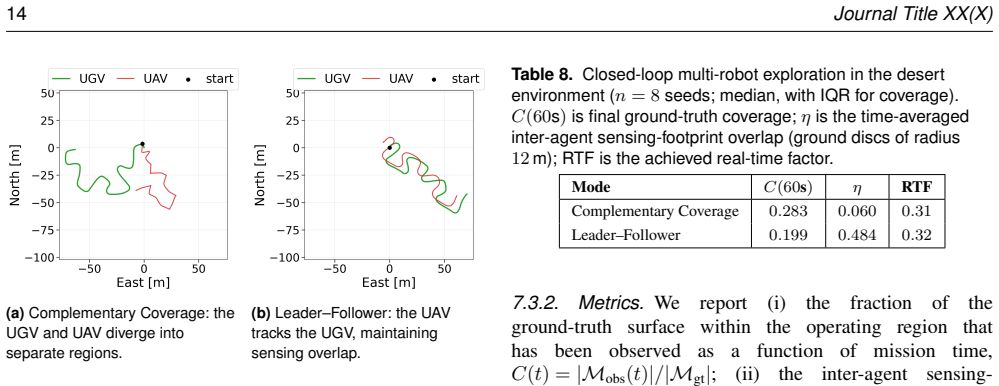
- Enables active online planning in closed loop from live sensor observations in heterogeneous teams.
- Facilitates experiments in degraded visual environments through added LWIR cameras and night-vision modes.
- Integrates dynamic elements including pedestrians, traffic, wildlife, fire, flooding, and crop disease spread into robot autonomy tests.
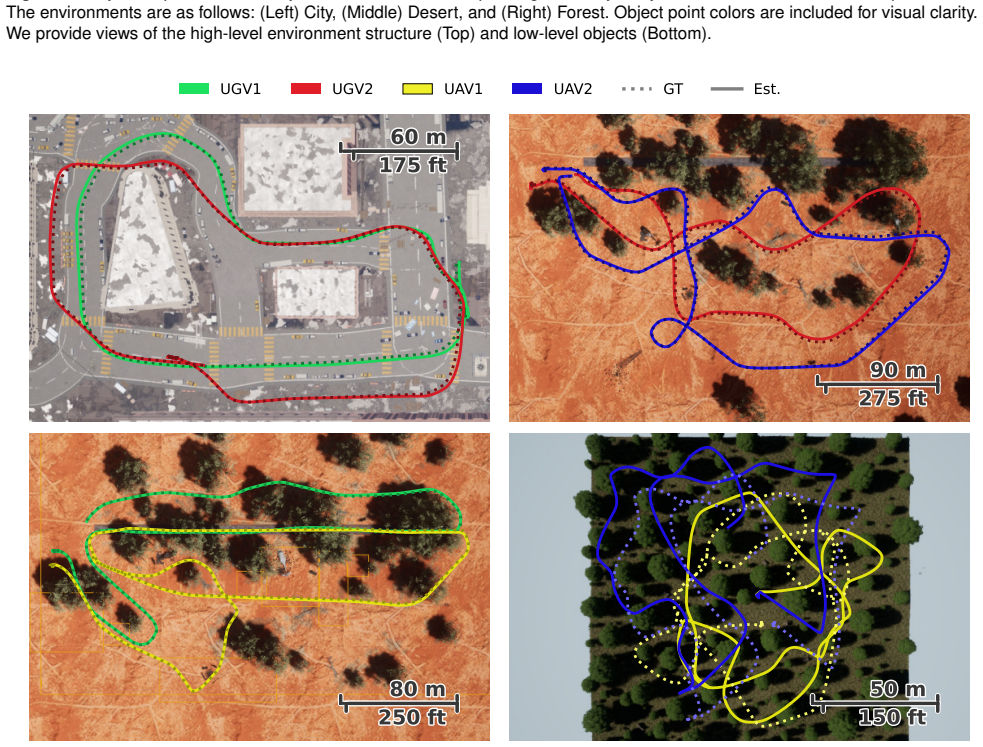
- Supplies a heterogeneous multi-robot SLAM benchmark collected with two UAVs and two UGVs across kilometer-scale desert, forest, and city environments.
Reading between the lines
- The released datasets could serve as a common reference for comparing new collaborative perception algorithms across research groups without requiring physical hardware.
- Support for dynamic phenomena such as flooding and fire spread may allow simulation of disaster-response scenarios to evaluate exploration strategies.
- The framework's architecture could be extended to additional robot types or sensor modalities to test broader multi-robot coordination questions.
- Public availability of code and benchmarks may encourage standardized evaluation protocols for heterogeneous autonomy research.
Editorial analysis
A structured set of objections, weighed in public.
Referee Report
Summary. The manuscript presents HERCULES, an open-source simulation framework extending AirSim and Cosys-AirSim on Unreal Engine 5 to support concurrent UAV-UGV operations in large-scale, photorealistic, dynamic environments. Key additions include a waypoint-tracking UGV controller mirroring UAV interfaces, a shared navigation stack for mapping/traversability/planning/control, expanded sensors (LWIR cameras, night-vision modes), ROS 2 wrappers, time synchronization, and integration of dynamic agents/phenomena (pedestrians, fire, flooding). The framework supports passive trajectory replay for dataset generation and active closed-loop planning; experiments demonstrate utility for heterogeneous multi-robot SLAM, collaborative perception, and exploration, with public release of code, documentation, and a kilometer-scale benchmark dataset across desert/forest/city settings.
Significance. If the framework performs as described, the work is a useful open-source contribution to robotics simulation research. The public release of source code, experiment code, documentation, and datasets (including the heterogeneous SLAM benchmark) enables direct verification and community extension, which strengthens the paper. Integration of physics-based sensors and dynamic environmental phenomena addresses gaps in prior heterogeneous-robot simulators.
minor comments (2)
- [Abstract] Abstract: the statement that HERCULES 'resolves key architectural limitations of prior frameworks' would be strengthened by a brief explicit comparison (e.g., a short table) to the limitations of AirSim/Cosys-AirSim and other cited simulators.
- [Experiments] Experiments section: while utility is demonstrated, inclusion of quantitative baselines or ablation results (e.g., SLAM accuracy metrics with/without the shared navigation stack) would make the performance claims more concrete.
Simulated Author's Rebuttal
We thank the referee for their positive evaluation of the manuscript, recognition of its contributions to heterogeneous multi-robot simulation, and recommendation to accept. We are pleased that the open-source release, benchmark datasets, and integration of dynamic phenomena were viewed as strengthening the work.
Circularity Check
No significant circularity
full rationale
The paper is a tool-release describing an open-source simulator built on AirSim/Cosys-AirSim. It introduces a waypoint-tracking UGV controller, shared navigation stack, LWIR sensors, and ROS 2 wrappers, with experiments in SLAM, perception, and exploration. No equations, fitted parameters, predictions, or derivation chains appear. Central claims rest on released code, time-synchronization details, and empirical utility demonstrations rather than self-referential reductions or load-bearing self-citations. No steps match any enumerated circularity pattern.
Assumptions & free parameters
assumptions (1)
- domain assumption Unreal Engine 5 and AirSim provide a sufficiently accurate base for photorealistic rendering, physics, and sensor simulation in robotics contexts
Cite this review
Pith. "Pith review of HERCULES: An Open-Source Simulation Framework for Heterogeneous Multi-Robot SLAM, Collaborative Perception, and Exploration." pith.science (2026). https://pith.science/paper/2U35FM4M
@misc{pith2026260622756,
  author       = {Pith},
  title        = {Pith review of: HERCULES: An Open-Source Simulation Framework for Heterogeneous Multi-Robot SLAM, Collaborative Perception, and Exploration},
  year         = {2026},
  howpublished = {\url{https://pith.science/paper/2U35FM4M}},
  note         = {Machine review of arXiv:2606.22756}
}
read the original abstract
We present HERCULES, an open-source simulator and data-collection pipeline for heterogeneous multi-robot autonomy. Built upon the Unreal Engine 5 (UE5)-based simulators AirSim and Cosys-AirSim, HERCULES resolves key architectural limitations of prior frameworks to enable concurrent unmanned aerial and ground vehicle (UAV-UGV) operation in large-scale, photorealistic, dynamic environments. It introduces a new waypoint-tracking UGV controller that mirrors existing UAV control interfaces, and provides a shared navigation stack for mapping, traversability analysis, planning, and control across heterogeneous platforms. Expanding inherited sensor suites, it adds physics-based long-wave infrared (LWIR) cameras and configurable night-vision modes for degraded visual environments. HERCULES provides lightweight APIs, ROS 2 wrappers, and rigorous time synchronization across sensors and platforms, and brings state-of-the-art game-engine capabilities into robotics simulation, integrating intelligent agents such as pedestrians, traffic, and wildlife with high-fidelity dynamic phenomena, including fire, flooding, and crop disease spread. HERCULES runs in two modes: passively, replaying offline-designed trajectories to generate reproducible multi-modal datasets, and actively, running an online planner in closed loop from live observations. Our experiments in heterogeneous multi-robot SLAM, collaborative perception, and exploration, using both HERCULES-generated data and active closed-loop execution, demonstrate its utility for advancing heterogeneous multi-robot autonomy. We publicly release our source code, experiment code, documentation, and datasets, including a heterogeneous multi-robot SLAM benchmark collected with two UAVs and two UGVs across kilometer-scale desert, forest, and city environments, at https://lunarlab-gatech.github.io/HERCULES-website.
Figures


Figures from the paper (10 more)





Reference graph
Works this paper leans on
-
[1]
ArduPilot Dev Team (2026) Using SITL with Gazebo . Online. ://ardupilot.org/dev/docs/sitl-with-gazebo.html. Accessed: 2026-01-27
2026
-
[2]
IEEE Transactions on Robotics 37(6): 1874--1890
Campos C, Elvira R, Rodríguez JJG, M Montiel JM and D Tardós J (2021) ORB-SLAM3 : An accurate open-source library for visual, visual–inertial, and multimap SLAM . IEEE Transactions on Robotics 37(6): 1874--1890
2021
-
[3]
Cesium GS, Inc (2026) Cesium for Unreal . Online. ://cesium.com/platform/cesium-for-unreal/. Accessed: 2026-01-22
2026
-
[4]
IEEE Robotics and Automation Letters
Cui C, Zhou X, Wang M, Gao F and Xu C (2024) FastSim : A modular and plug-and-play simulator for aerial robots. IEEE Robotics and Automation Letters
2024
-
[5]
In: Proceedings of the Conference on Robot Learning
Dosovitskiy A, Ros G, Codevilla F, Lopez A and Koltun V (2017) CARLA : An open urban driving simulator. In: Proceedings of the Conference on Robot Learning. pp. 1--16
2017
-
[6]
In: Proceedings of the IEEE International Conference on Multisensor Fusion and Integration for Intelligent Systems
Dubois R, Eudes A and Frémont V (2020) AirMuseum : a heterogeneous multi-robot dataset for stereo-visual and inertial simultaneous localization and mapping. In: Proceedings of the IEEE International Conference on Multisensor Fusion and Integration for Intelligent Systems . pp. 166--172
2020
-
[7]
Epic Games (2021) Nanite virtualized geometry in Unreal Engine . Online. ://dev.epicgames.com/documentation/en-us/unreal-engine/nanite-virtualized-geometry-in-unreal-engine. Accessed: 2026-01-27
2021
-
[8]
Epic Games (2022) Lumen global illumination and reflections in Unreal Engine . Online. ://dev.epicgames.com/documentation/en-us/unreal-engine/lumen-global-illumination-and-reflections-in-unreal-engine. Accessed: 2026-01-27
2022
Show all 47 references
-
[9]
Epic Games (2024) Artificial intelligence in Unreal Engine 5: Behavior trees, blackboards and AI controllers. Online. ://dev.epicgames.com/documentation/en-us/unreal-engine/behavior-tree-in-unreal-engine---user-guide. Accessed: 2026-01-27
2024
-
[10]
https://www.fab.com/
Epic Games (2026 a ) Fab. https://www.fab.com/. Accessed: 2026-06-15
2026
-
[11]
Epic Games (2026 b ) Unreal Engine 5 documentation. Online. ://www.unrealengine.com. Accessed: 2026-01-22
2026
-
[12]
In: Robot Operating System (ROS): The Complete Reference (Volume 1)
Furrer F, Burri M, Achtelik M and Siegwart R (2016) RotorS : A modular Gazebo MAV simulator framework. In: Robot Operating System (ROS): The Complete Reference (Volume 1). Springer International Publishing, pp. 595--625
2016
-
[13]
In: Proceedings of the IEEE International Conference on Robotics and Automation
Geneva P, Eckenhoff K, Lee W, Yang Y and Huang G (2020) OpenVINS : A research platform for visual-inertial estimation. In: Proceedings of the IEEE International Conference on Robotics and Automation . pp. 4666--4672
2020
-
[14]
Grupp M (2017) evo: Python package for the evaluation of odometry and SLAM . Online. ://github.com/MichaelGrupp/evo
2017
-
[15]
In: Proceedings of the IEEE / RSJ International Conference on Intelligent Robots and Systems
Guerra W, Tal E, Murali V, Ryou G and Karaman S (2019) FlightGoggles : Photorealistic Sensor Simulation for Perception-driven Robotics using Photogrammetry and Virtual Reality . In: Proceedings of the IEEE / RSJ International Conference on Intelligent Robots and Systems . pp. ...
2019
-
[16]
International Journal of Robotics Research 41(3): 259--269
Hall D, Talbot B, Bista SR, Zhang H, Smith R, Dayoub F and S \"u nderhauf N (2022) BenchBot environments for active robotics ( BEAR ): Simulated data for active scene understanding research. International Journal of Robotics Research 41(3): 259--269
2022
-
[17]
Autonomous Robots 34(3): 189--206
Hornung A, Wurm KM, Bennewitz M, Stachniss C and Burgard W (2013) OctoMap : An efficient probabilistic 3D mapping framework based on octrees. Autonomous Robots 34(3): 189--206
2013
-
[18]
In: Proceedings of the Annual Modeling and Simulation Conference
Jansen W, Verreycken E, Schenck A, Blanquart JE, Verhulst C, Huebel N and Steckel J (2023) Cosys-AirSim : A real-time simulation framework expanded for complex industrial applications. In: Proceedings of the Annual Modeling and Simulation Conference. pp. 37--48
2023
-
[19]
In: Proceedings of the Annual RoboCup International Symposium
Kohlbrecher S, Meyer J, Graber T, Petersen K, Klingauf U and Von Stryk O (2013) Hector open source modules for autonomous mapping and navigation with rescue robots. In: Proceedings of the Annual RoboCup International Symposium. pp. 624--631
2013
-
[20]
SPIE, pp
Kooi FL and Toet A (2005) What's crucial in night vision goggle simulation? In: Enhanced and Synthetic Vision 2005, volume 5802. SPIE, pp. 37--46. doi:10.1117/12.601432
2005 doi
-
[21]
In: Proceedings of the IEEE / CVF Conference on Computer Vision and Pattern Recognition
Lang AH, Vora S, Caesar H, Zhou L, Yang J and Beijbom O (2019) PointPillars : Fast encoders for object detection from point clouds. In: Proceedings of the IEEE / CVF Conference on Computer Vision and Pattern Recognition . pp. 12697--12705
2019
-
[22]
International Journal of Robotics Research 20(5): 378--400
LaValle SM and Kuffner Jr JJ (2001) Randomized kinodynamic planning. International Journal of Robotics Research 20(5): 378--400
2001
-
[23]
In: Proceedings of the Conference on Robot Learning, volume 164
Li C, Xia F, Mart \' n-Mart \' n R, Lingelbach M, Srivastava S, Shen B, Vainio KE, Gokmen C, Dharan G, Jain T, Kurenkov A, Liu K, Gweon H, Wu J, Fei-Fei L and Savarese S (2022) iGibson 2.0 : Object-centric simulation for robot learning of everyday household tasks. In: Proceedi...
2022
-
[24]
SmartBot 1(3)
Li D, Shi H, Cai B, Bai X, Chen L, Han G and Mi C (2025) A review of technical advances and applications of intelligent inspection robots in structural health monitoring. SmartBot 1(3)
2025
-
[25]
In: Proceedings of the IEEE International Conference on Robotics and Automation
Meier L, Honegger D and Pollefeys M (2015) PX4 : A node-based multithreaded open source robotics framework for deeply embedded platforms. In: Proceedings of the IEEE International Conference on Robotics and Automation . pp. 6235--6240
2015
-
[26]
webots™: professional mobile robot simulation
Michel O (2004) Cyberbotics ltd. webots™: professional mobile robot simulation. International Journal of Advanced Robotic Systems 1(1): 5
2004
-
[27]
Min P (2026) binvox: 3d mesh voxelizer. Online. ://www.patrickmin.com/binvox/. Accessed: 2026-01-22
2026
-
[28]
Academic press
Modest MF and Mazumder S (2021) Radiative heat transfer. Academic press
2021
-
[29]
Journal of Sensor and Actuator Networks 13(6): 81
Munasinghe I, Perera A and Deo RC (2024) A comprehensive review of UAV-UGV collaboration: Advancements and challenges. Journal of Sensor and Actuator Networks 13(6): 81
2024
-
[30]
://developer.nvidia.com/isaac-sim
NVIDIA (2022) NVIDIA Isaac Sim . ://developer.nvidia.com/isaac-sim. Accessed: 2026-01-27
2022
-
[31]
Open Robotics (2026) Gazebo . Online. ://gazebosim.org/. Accessed: 2026-01-22
2026
-
[32]
In: Proceedings of the Robotics: Science and Systems Conference
Peterson MB, Jia YX, Tian Y, Thomas A and How JP (2025) ROMAN: Open-Set Object Map Alignment for Robust View-Invariant Global Localization . In: Proceedings of the Robotics: Science and Systems Conference
2025
-
[33]
(2012) Argos: a modular, parallel, multi-engine simulator for multi-robot systems
Pinciroli C, Trianni V, O’Grady R, Pini G, Brutschy A, Brambilla M, Mathews N, Ferrante E, Di Caro G, Ducatelle F et al. (2012) Argos: a modular, parallel, multi-engine simulator for multi-robot systems. Swarm intelligence 6: 271--295
2012
-
[34]
arXiv Preprint Poster at the Twelfth International Conference on Learning Representations
Puig X, Undersander E, Szot A, Cote MD, Yang TY, Partsey R, Desai R, Clegg AW, Hlavac M, Min SY, Vondru s V, Gervet T, Berges VP, Turner JM, Maksymets O, Kira Z, Kalakrishnan M, Malik J, Chaplot DS, Jain U, Batra D, Rai A and Mottaghi R (2023) Habitat 3.0: A co-habitat for hum...
2023
-
[35]
IEEE Access 8: 191617--191643
Queralta JP, Taipalmaa J, Pullinen BC, Sarker VK, Gia TN, Tenhunen H, Gabbouj M, Raitoharju J and Westerlund T (2020) Collaborative multi-robot search and rescue: Planning, coordination, perception, and active vision. IEEE Access 8: 191617--191643
2020
-
[36]
In: Proceedings of the International Conference on Field and Service Robotics
Shah S, Dey D, Lovett C and Kapoor A (2018) AirSim : High-fidelity visual and physical simulation for autonomous vehicles. In: Proceedings of the International Conference on Field and Service Robotics. pp. 621--635
2018
-
[37]
In: Proceedings of the IEEE / RSJ International Conference on Intelligent Robots and Systems
Shan T, Englot B, Meyers D, Wang W, Ratti C and Rus D (2020) LIO-SAM : Tightly-coupled lidar inertial odometry via smoothing and mapping. In: Proceedings of the IEEE / RSJ International Conference on Intelligent Robots and Systems . pp. 5135--5142
2020
-
[38]
In: Proceedings of the Conference on Robot Learning
Song Y, Naji S, Kaufmann E, Loquercio A and Scaramuzza D (2021) Flightmare: A flexible quadrotor simulator. In: Proceedings of the Conference on Robot Learning. pp. 1147--1157
2021
-
[39]
IEEE Transactions on Robotics 38(4)
Tian Y, Chang Y, Arias FH, Nieto-Granda C, How JP and Carlone L (2022) Kimera- M ulti: Robust, distributed, dense metric-semantic SLAM for multi-robot systems. IEEE Transactions on Robotics 38(4)
2022
-
[40]
Academic Press
Tiwari K and Chong NY (2019) Multi-robot exploration for environmental monitoring: the resource constrained perspective. Academic Press
2019
-
[41]
IEEE Transactions on Pattern Analysis and Machine Intelligence 13(04): 376--380
Umeyama S (1991) Least-squares estimation of transformation parameters between two point patterns. IEEE Transactions on Pattern Analysis and Machine Intelligence 13(04): 376--380
1991
-
[42]
IEEE Transactions on Robotics
Xu Z, Garimella SS and Tzoumas V (2025) Communication- and computation-efficient distributed submodular optimization in robot mesh networks. IEEE Transactions on Robotics
2025
-
[43]
In: Proceedings of the International Conference on Computer Simulation and Modeling, Information Security
Xue H and Shi Z (2023) Research on simulation experiment of UAV crossing fire circle based on AirSim . In: Proceedings of the International Conference on Computer Simulation and Modeling, Information Security. pp. 203--209
2023
-
[44]
In: Proceedings of the IEEE / CVF Conference on Computer Vision and Pattern Recognition
Yu H, Luo Y, Shu M, Huo Y, Yang Z, Shi Y, Guo Z, Li H, Hu X, Yuan J and Nie Z (2022) DAIR-V2X : A large-scale dataset for vehicle-infrastructure cooperative 3D object detection. In: Proceedings of the IEEE / CVF Conference on Computer Vision and Pattern Recognition . pp. 21361--21370
2022
-
[45]
arXiv Preprint (2306.12156)
Zhao X, Ding W, An Y, Du Y, Yu T, Li M, Tang M and Wang J (2023) Fast segment anything. arXiv Preprint (2306.12156)
2023
-
[46]
IEEE Robotics and Automation Letters 9(7): 6416--6423
Zhou Y, Quang L, Nieto-Granda C and Loianno G (2024) CoPeD -advancing multi-robot collaborative perception: A comprehensive dataset in real-world environments. IEEE Robotics and Automation Letters 9(7): 6416--6423
2024
-
[47]
IEEE Robotics and Automation Letters 8(2): 966--973
Zhu Y, Kong Y, Jie Y, Xu S and Cheng H (2023) GRACO : A multimodal dataset for ground and aerial cooperative localization and mapping. IEEE Robotics and Automation Letters 8(2): 966--973
2023
Reviewed June 26, 2026 · model on record in the stance chip above.
Discussion (0). Sign in to comment.