Factored Gossip DiLoCo: Reducing Blocking Communication in DiLoCo
Pith reviewed 2026-06-26 09:34 UTC · model grok-4.3
The pith
Factoring DiLoCo synchronization into non-blocking and blocking gossip mixing steps reduces blocking communication while preserving training progress.
A machine-rendered reading of the paper's core claim, the machinery that carries it, and where it could break.
Core claim
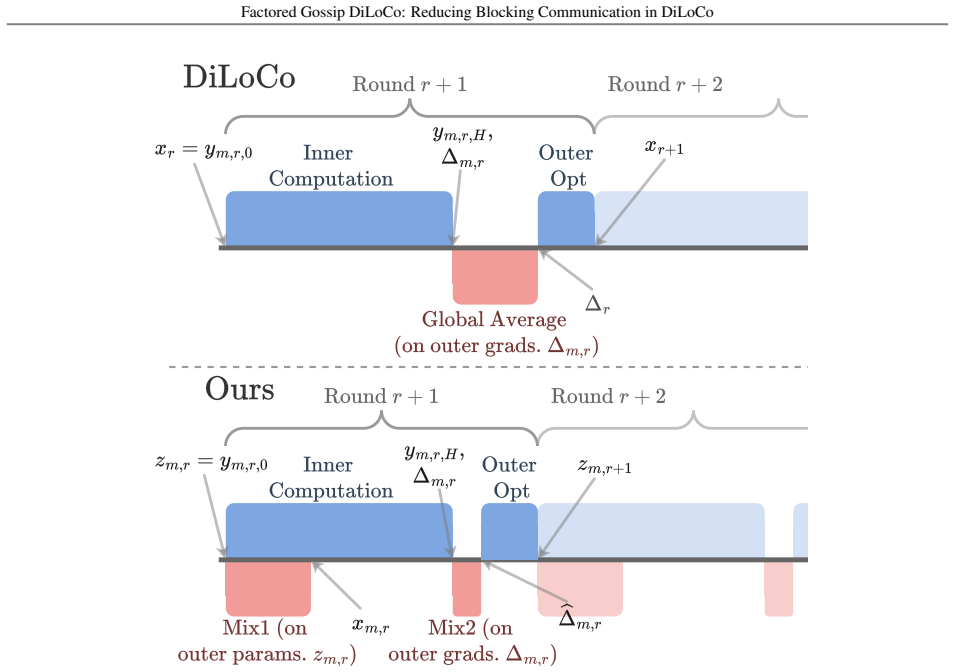
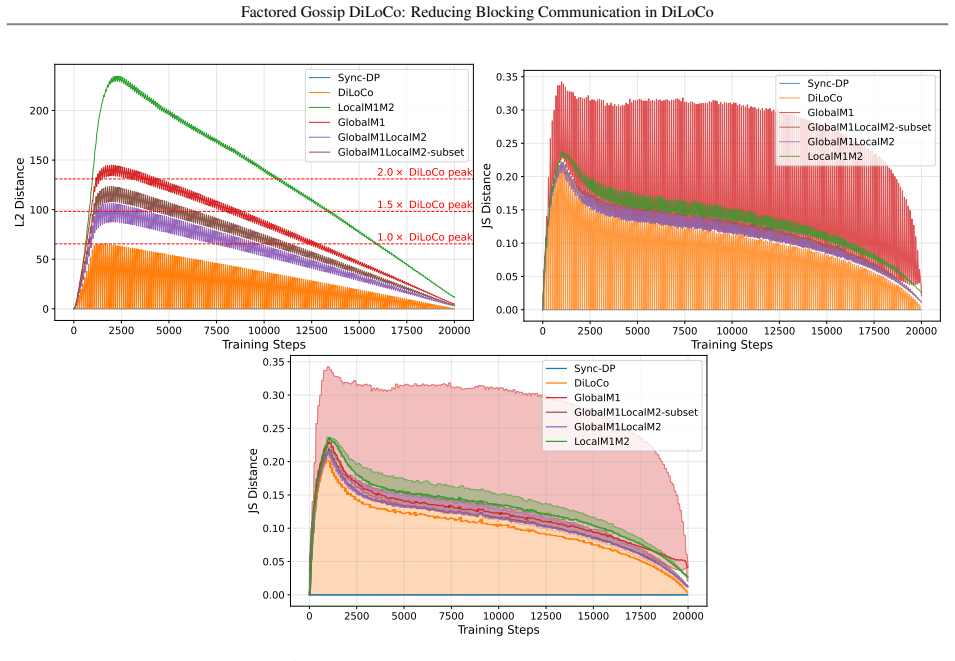
By factorizing the DiLoCo outer synchronization into a non-blocking mixing step that overlaps computation with no staleness and a blocking mixing step that tightens worker agreement, the framework yields a tunable trade-off between compute utilization and optimization stability, achieving comparable training progress on up to billion-parameter language models in low-bandwidth settings while being more robust to failures.
What carries the argument
The factorization of DiLoCo synchronization into non-blocking and blocking gossip mixing steps, which relaxes exact synchronization to approximate mixing.
If this is right
- Compute utilization improves substantially compared to DiLoCo in low-bandwidth settings.
- Training progress ranges from comparable to closely matching DiLoCo on up to billion-parameter models.
- The method is more robust to stragglers and transient communication failures.
- The split between mixing steps provides a controllable trade-off between utilization and stability.
Where Pith is reading between the lines
- The factorization might extend to other distributed methods that use infrequent outer synchronization.
- The non-blocking step could support training across more heterogeneous or variable networks.
- Adjusting the frequency of the blocking step might allow further scaling in very large worker counts.
Load-bearing premise
That approximate synchronization via gossip mixing will degrade gracefully under delays and failures while preserving optimization stability and comparable training progress.
What would settle it
An experiment on a billion-parameter model in a low-bandwidth cluster where the factored method shows markedly slower convergence or lower final performance than standard DiLoCo would falsify the claim.
Figures




read the original abstract
To make large-scale distributed training practical outside high-bandwidth datacenters, we must reduce blocking, high-volume synchronization. While DiLoCo communicates infrequently, its outer synchronization remains bandwidth-heavy and brittle to stragglers and transient failures. We relax exact synchronization to approximate synchronization via mixing/gossip, which degrades gracefully under delays and communication failures. This allows us to factorize DiLoCo synchronization into a non-blocking mixing step that overlaps computation with no staleness, and a blocking mixing step that tightens worker agreement, yielding a tunable trade-off between compute utilization and optimization stability. On up to billion-parameter language models in low-bandwidth settings, our framework substantially improves compute utilization compared to DiLoCo, with training progress ranging from comparable to closely matching it, and is more robust to failures.
Editorial analysis
A structured set of objections, weighed in public.
Referee Report
Summary. The paper proposes Factored Gossip DiLoCo, which relaxes DiLoCo's exact outer synchronization to approximate synchronization using gossip/mixing. It factorizes synchronization into a non-blocking mixing step (overlapping computation with no staleness) and a blocking mixing step (to tighten worker agreement), yielding a tunable trade-off. The central empirical claim is that this substantially improves compute utilization versus DiLoCo on up to billion-parameter language models in low-bandwidth settings, with training progress from comparable to closely matching, while being more robust to failures.
Significance. If the empirical claims hold, the approach could meaningfully improve practicality of large-scale training in bandwidth-constrained environments by reducing blocking communication volume and brittleness. The factorization idea for balancing utilization and stability is a natural extension of gossip methods to DiLoCo-style infrequent outer steps, but the manuscript provides no supporting derivations, bounds, or detailed experiments to ground the stability assumption.
major comments (2)
- [Abstract] Abstract: the central claim of 'substantially improves compute utilization' and 'training progress ranging from comparable to closely matching' on up to 1B-parameter models is unsupported by any description of experimental setup, model sizes, baselines (e.g., standard DiLoCo), metrics (e.g., tokens per second, loss curves), or failure-mode tests, so the empirical contribution cannot be evaluated.
- [Framework description] Framework description (paragraph on the framework): no derivation, convergence bound, or analysis is given to show why factored gossip mixing avoids the usual pitfalls of stale/inconsistent gradients or worker disagreement; the assumption that 'degrades gracefully' while 'preserving optimization stability' is asserted without supporting argument or test.
minor comments (1)
- [Abstract] The abstract is information-dense; separating the algorithmic contribution from the empirical claims would improve readability.
Simulated Author's Rebuttal
Thank you for the review. We address the major comments point by point below.
read point-by-point responses
-
Referee: [Abstract] Abstract: the central claim of 'substantially improves compute utilization' and 'training progress ranging from comparable to closely matching' on up to 1B-parameter models is unsupported by any description of experimental setup, model sizes, baselines (e.g., standard DiLoCo), metrics (e.g., tokens per second, loss curves), or failure-mode tests, so the empirical contribution cannot be evaluated.
Authors: Abstracts are concise by design and omit full experimental details to preserve readability. The manuscript body contains the requested information: experimental setups on models up to 1B parameters, direct comparisons to DiLoCo, metrics including compute utilization and loss, and robustness tests under failures. We can revise the abstract to include a brief pointer to the experiments section if the editor prefers. revision: partial
-
Referee: [Framework description] Framework description (paragraph on the framework): no derivation, convergence bound, or analysis is given to show why factored gossip mixing avoids the usual pitfalls of stale/inconsistent gradients or worker disagreement; the assumption that 'degrades gracefully' while 'preserving optimization stability' is asserted without supporting argument or test.
Authors: The manuscript is an empirical study. Stability and graceful degradation under the factored gossip approach are demonstrated via the reported large-scale experiments rather than theoretical bounds. No derivations or convergence analysis appear in the current version because the contribution centers on the practical factorization and its measured performance; we can add an explicit limitations paragraph acknowledging the absence of theory. revision: no
Circularity Check
No circularity: algorithmic framework is self-contained
full rationale
The paper introduces Factored Gossip DiLoCo as a new algorithmic framework that relaxes exact outer synchronization in DiLoCo to approximate gossip mixing, factorizing it into non-blocking and blocking steps. No equations, derivations, or parameter fits are present in the provided text that reduce by construction to inputs. The central claims rest on the description of the framework and empirical observations on up to 1B-parameter models, with no self-citation load-bearing steps, uniqueness theorems, or ansatzes imported from prior author work. This is a standard case of an independent algorithmic proposal.
Axiom & Free-Parameter Ledger
axioms (1)
- domain assumption Approximate synchronization via mixing/gossip degrades gracefully under delays and communication failures while maintaining optimization stability
Reference graph
Works this paper leans on
-
[1]
Asynchronous
Mishchenko, Konstantin and Bach, Francis and Even, Mathieu and Woodworth, Blake , booktitle=. Asynchronous
-
[2]
PipeDream: Generalized pipeline parallelism for
Narayanan, Deepak and Harlap, Aaron and Phanishayee, Amar and Seshadri, Vivek and Devanur, Nikhil R and Ganger, Gregory R and Gibbons, Phillip B and Zaharia, Matei , booktitle=. PipeDream: Generalized pipeline parallelism for
-
[3]
Huang, Yanping and Cheng, Youlong and Bapna, Ankur and Firat, Orhan and Chen, Dehao and Chen, Mia and Lee, HyoukJoong and Ngiam, Jiquan and Le, Quoc V and Wu, Yonghui and others , booktitle=
-
[4]
Asynchronous Local-
Liu, Bo and Chhaparia, Rachita and Douillard, Arthur and Kale, Satyen and Rusu, Andrei A and Shen, Jiajun and Szlam, Arthur and Ranzato, Marc'Aurelio , journal=. Asynchronous Local-
-
[5]
Advances in Neural Information Processing Systems (NeurIPS) , year=
Distributed delayed stochastic optimization , author=. Advances in Neural Information Processing Systems (NeurIPS) , year=
-
[6]
International Conference on Learning Representations (ICLR) , year=
Pointer Sentinel Mixture Models , author=. International Conference on Learning Representations (ICLR) , year=
-
[7]
Soviet Mathematics Doklady , volume=
A method for solving the convex programming problem with convergence rate O (1/k2) , author=. Soviet Mathematics Doklady , volume=
-
[8]
Asynchronous stochastic gradient descent for
Zhang, Shanshan and Zhang, Ce and You, Zhao and Zheng, Rong and Xu, Bo , booktitle=. Asynchronous stochastic gradient descent for. 2013 , organization=
2013
-
[9]
Memory-efficient pipeline-parallel
Narayanan, Deepak and Phanishayee, Amar and Shi, Kaiyu and Chen, Xie and Zaharia, Matei , booktitle=. Memory-efficient pipeline-parallel. 2021 , organization=
2021
-
[10]
Advances in Neural Information Processing Systems (NeurIPS) , year=
Hogwild!: A lock-free approach to parallelizing stochastic gradient descent , author=. Advances in Neural Information Processing Systems (NeurIPS) , year=
-
[11]
International Conference on Machine Learning (ICML) , pages=
Swarm parallelism: Training large models can be surprisingly communication-efficient , author=. International Conference on Machine Learning (ICML) , pages=. 2023 , organization=
2023
-
[12]
Max Ryabinin and Alexander Borzunov and Michael Diskin and Anton Gusev and Denis Mazur and Vsevolod Plokhotnyuk and Alexey Bukhtiyarov and Pavel Samygin and Anton Sinitsin and Artem Chumachenko , month = apr, year = 2020, address =
2020
-
[13]
Douillard, Arthur and Feng, Qixuan and Rusu, Andrei A and Chhaparia, Rachita and Donchev, Yani and Kuncoro, Adhiguna and Ranzato, Marc'Aurelio and Szlam, Arthur and Shen, Jiajun , journal=
-
[14]
Streaming
Douillard, Arthur and Donchev, Yanislav and Rush, Keith and Kale, Satyen and Charles, Zachary and Garrett, Zachary and Teston, Gabriel and Lacey, Dave and McIlroy, Ross and Shen, Jiajun and others , journal=. Streaming
-
[15]
International Conference on Artificial Intelligence and Statistics (AISTATS) , pages=
Communication-efficient learning of deep networks from decentralized data , author=. International Conference on Artificial Intelligence and Statistics (AISTATS) , pages=. 2017 , organization=
2017
-
[16]
International Conference on Learning Representations (ICLR) , year=
Adaptive federated optimization , author=. International Conference on Learning Representations (ICLR) , year=
-
[17]
ICLR Workshop on Modularity for Collaborative, Decentralized, and Continual Deep Learning , year=
Improving the Efficiency of Distributed Training using Sparse Parameter Averaging , author=. ICLR Workshop on Modularity for Collaborative, Decentralized, and Continual Deep Learning , year=
-
[18]
ICLR Workshop on Modularity for Collaborative, Decentralized, and Continual Deep Learning , year=
Momentum Look-Ahead for Asynchronous Distributed Low-Communication Training , author=. ICLR Workshop on Modularity for Collaborative, Decentralized, and Continual Deep Learning , year=
-
[19]
International Conference on Machine Learning (ICML) , year=
Nesterov Method for Asynchronous Pipeline Parallel Optimization , author=. International Conference on Machine Learning (ICML) , year=
-
[20]
Eager Updates For Overlapped Communication and Computation in
Kale, Satyen and Douillard, Arthur and Donchev, Yanislav , journal=. Eager Updates For Overlapped Communication and Computation in
-
[21]
Penedo, Guilherme and Kydl. The. Advances in Neural Information Processing Systems (NeurIPS) , year=
-
[22]
Understanding Outer Optimizers in Local
Ahmed Khaled and Satyen Kale and Arthur Douillard and Chi Jin and Rob Fergus and Manzil Zaheer , year=. Understanding Outer Optimizers in Local. 2509.10439 , archivePrefix=
-
[23]
Dominik Kallusky and Vinay Rao and Vishal Nandavanam and Hao-Jun Michael Shi , year=. 2510.15830 , archivePrefix=
-
[24]
Jari Kolehmainen and Nikolay Blagoev and John Donaghy and Oğuzhan Ersoy and Christopher Nies , journal=
-
[25]
International Conference on Machine Learning (ICML) , year =
Consensus Control for Decentralized Deep Learning , author =. International Conference on Machine Learning (ICML) , year =
-
[26]
2003 , booktitle =
Kempe, David and Dobra, Alin and Gehrke, Johannes , title =. 2003 , booktitle =
2003
-
[27]
Decentralized
Tongtian Zhu and Fengxiang He and Kaixuan Chen and Mingli Song and Dacheng Tao , year=. Decentralized
-
[28]
IEEE Transactions on Information Theory , year =
Boyd, Stephen and Ghosh, Arpita and Prabhakar, Balaji and Shah, Devavrat , title =. IEEE Transactions on Information Theory , year =
-
[29]
International Conference on Machine Learning (ICML) , year=
Asynchronous Decentralized Parallel Stochastic Gradient Descent , author=. International Conference on Machine Learning (ICML) , year=
-
[30]
IEEE Conference on Decision and Control (CDC) , year=
An asynchronous mini-batch algorithm for regularized stochastic optimization , author=. IEEE Conference on Decision and Control (CDC) , year=
-
[31]
Lin and Thomas S
Tom Le Paine and Hailin Jin and Jianchao Yang and Zhe L. Lin and Thomas S. Huang , journal=
-
[32]
Advances in Neural Information Processing Systems (NeurIPS) , year=
Large Scale Distributed Deep Networks , author=. Advances in Neural Information Processing Systems (NeurIPS) , year=
-
[33]
Horovod: fast and easy distributed deep learning in
Alexander Sergeev and Mike Del Balso , journal=. Horovod: fast and easy distributed deep learning in
-
[34]
and Noordhuis, Pieter and Wesolowski, Lukasz and Kyrola, Aapo and Tulloch, Andrew and Jia, Yangqing and He, Kaiming , journal =
Goyal, Priya and Dollár, Piotr and Girshick, Ross B. and Noordhuis, Pieter and Wesolowski, Lukasz and Kyrola, Aapo and Tulloch, Andrew and Jia, Yangqing and He, Kaiming , journal =. Accurate, Large Minibatch
-
[35]
International Conference on Machine Learning (ICML) , year=
Asynchronous Stochastic Gradient Descent with Delay Compensation , author=. International Conference on Machine Learning (ICML) , year=
-
[36]
Foundations and Trends in Machine Learning , publisher =
Advances and open problems in federated learning , author =. Foundations and Trends in Machine Learning , publisher =
-
[37]
IEEE Transactions on Knowledge and Data Engineering , year=
A survey on federated learning systems: Vision, hype and reality for data privacy and protection , author=. IEEE Transactions on Knowledge and Data Engineering , year=
-
[38]
Stich , booktitle=
Sebastian U. Stich , booktitle=. Local
-
[39]
International Conference on Learning Representations (ICLR) , year=
Decoupled Weight Decay Regularization , author=. International Conference on Learning Representations (ICLR) , year=
-
[40]
International Conference on Learning Representations (ICLR) , year=
Sharpness-aware Minimization for Efficiently Improving Generalization , author=. International Conference on Learning Representations (ICLR) , year=
-
[41]
How to scale distributed deep learning?
How to scale distributed deep learning? , author=. arXiv preprint arXiv:1611.04581 , year=
work page internal anchor Pith review Pith/arXiv arXiv
-
[42]
Gossip training for deep learning
Gossip training for deep learning , author=. arXiv preprint arXiv:1611.09726 , year=
work page internal anchor Pith review Pith/arXiv arXiv
-
[43]
Advances in Neural Information Processing Systems (NeurIPS) , year=
Collaborative deep learning in fixed topology networks , author=. Advances in Neural Information Processing Systems (NeurIPS) , year=
-
[44]
Advances in Neural Information Processing Systems (NeurIPS) , year=
Can decentralized algorithms outperform centralized algorithms? a case study for decentralized parallel stochastic gradient descent , author=. Advances in Neural Information Processing Systems (NeurIPS) , year=
-
[45]
Journal of Machine Learning Research (JMLR) , year =
Jianyu Wang and Gauri Joshi , title =. Journal of Machine Learning Research (JMLR) , year =
-
[46]
A Unified Theory of Decentralized
Koloskova, Anastasia and Loizou, Nicolas and Boreiri, Sadra and Jaggi, Martin and Stich, Sebastian , booktitle =. A Unified Theory of Decentralized
-
[47]
Accelerating Gossip
Chen, Yiming and Yuan, Kun and Zhang, Yingya and Pan, Pan and Xu, Yinghui and Yin, Wotao , booktitle =. Accelerating Gossip
-
[48]
Hybrid local
Guo, Yuanxiong and Sun, Ying and Hu, Rui and Gong, Yanmin , booktitle=. Hybrid local
-
[49]
2025 , eprint=
Protocol Models: Scaling Decentralized Training with Communication-Efficient Model Parallelism , author=. 2025 , eprint=
2025
-
[50]
2025 , url=
Node0: Model Parallel Training over the Internet with Protocol Models , author=. 2025 , url=
2025
-
[51]
2024 , eprint=
The Llama 3 Herd of Models , author=. 2024 , eprint=
2024
-
[52]
Advances in Neural Information Processing Systems (NeurIPS) , year=
Language models are few-shot learners , author=. Advances in Neural Information Processing Systems (NeurIPS) , year=
-
[53]
Liu, Aixin and Feng, Bei and Xue, Bing and Wang, Bingxuan and Wu, Bochao and Lu, Chengda and Zhao, Chenggang and Deng, Chengqi and Zhang, Chenyu and Ruan, Chong and others , journal=
-
[54]
Journal of Parallel and Distributed Computing , publisher =
Bandwidth optimal all-reduce algorithms for clusters of workstations , author =. Journal of Parallel and Distributed Computing , publisher =
-
[55]
, title =
Meta Platforms, Inc. , title =. GitHub repository , howpublished =. 2024 , publisher =
2024
-
[56]
Communication-Efficient Language Model Training Scales Reliably and Robustly: Scaling Laws for
Zachary Charles and Gabriel Teston and Lucio Dery and Keith Rush and Nova Fallen and Zachary Garrett and Arthur Szlam and Arthur Douillard , year=. Communication-Efficient Language Model Training Scales Reliably and Robustly: Scaling Laws for
-
[57]
International Conference on Machine Learning (ICML) , year =
Stochastic Gradient Push for Distributed Deep Learning , author =. International Conference on Machine Learning (ICML) , year =
-
[58]
Deep learning with Elastic Averaging
Zhang, Sixin and Choromanska, Anna E and LeCun, Yann , booktitle =. Deep learning with Elastic Averaging
-
[59]
Paszke, Adam and Gross, Sam and Massa, Francisco and Lerer, Adam and Bradbury, James and Chanan, Gregory and Killeen, Trevor and Lin, Zeming and Gimelshein, Natalia and Antiga, Luca and others , booktitle=
-
[60]
Advances in Neural Information Processing Systems (NeurIPS) , pages=
Parallelized Stochastic Gradient Descent , author=. Advances in Neural Information Processing Systems (NeurIPS) , pages=
-
[61]
Annual Conference of the North American Chapter of the Association for Computational Linguistics (NAACL) , year=
Distributed Training Strategies for the Structured Perceptron , author=. Annual Conference of the North American Chapter of the Association for Computational Linguistics (NAACL) , year=
-
[62]
IEEE International Conference on Acoustics, Speech and Signal Processing (ICASSP) , year=
Scalable training of deep learning machines by incremental block training with intra-block parallel optimization and blockwise model-update filtering , author=. IEEE International Conference on Acoustics, Speech and Signal Processing (ICASSP) , year=
discussion (0)
Sign in with ORCID, Apple, or X to comment. Anyone can read and Pith papers without signing in.