Statistical Matching via Schr\"odinger Bridge beyond Conditional Independence
Pith reviewed 2026-06-26 09:28 UTC · model grok-4.3
The pith
A Schrödinger bridge tilted from the conditional independence baseline recovers informative joints for statistical matching of overlapping datasets.
A machine-rendered reading of the paper's core claim, the machinery that carries it, and where it could break.
Core claim
Coupling the two separated databases through a Schrödinger bridge obtained by tilting the CIA baseline with a transportation-based compatibility cost recovers an informative joint distribution. Under a sufficient condition the learned bridge strictly improves over the CIA baseline, and in the Gaussian setting an appropriate cost yields exact joint recovery. The framework supplies probabilistic posterior rules for bidirectional imputation and improves downstream predictive utility, especially when the underlying population exhibits strong Y-Z dependence.
What carries the argument
The dependency-aware Schrödinger bridge formed by tilting the conditional independence assumption baseline with a transportation-based compatibility cost.
If this is right
- The learned bridge strictly improves over the CIA baseline under a sufficient condition.
- Exact joint recovery holds in the Gaussian setting under an appropriate cost.
- Full probabilistic posterior rules are obtained for bidirectional imputation.
- Downstream predictive utility increases, especially in data recoding tasks with strong Y-Z dependence.
Where Pith is reading between the lines
- If the compatibility cost can be learned end-to-end, the method may extend to high-dimensional problems without manual specification of dependence structure.
- The optimal-transport tilt suggests the same construction could apply to other missing-data or record-linkage tasks where conditional independence is too strong an assumption.
- Controlled experiments that vary the strength of Y-Z dependence would map the boundary at which the sufficient condition for improvement is satisfied.
Load-bearing premise
A transportation-based compatibility cost can be chosen or learned so that it encodes the true latent dependence without circularity or spurious artifacts.
What would settle it
Generate a synthetic dataset with known nonzero conditional dependence between Y and Z given X, run the bridge with a learned cost, and measure whether the imputed joint recovers that dependence more accurately than the CIA baseline by a quantifiable margin.
Figures
read the original abstract
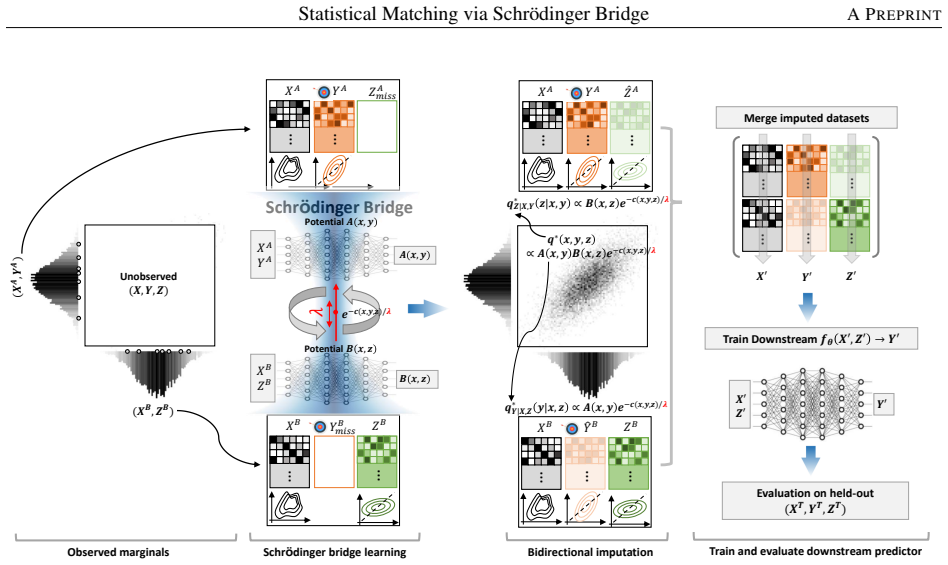
Statistical matching combines partially overlapping datasets that share covariates $X$ but observe the target $Y$ and auxiliary variables $Z$ separately. Classical approaches typically invoke the conditional independence assumption (CIA), which makes the problem identifiable but fundamentally implies that the imported auxiliary variable provides no additional predictive power for $Y$ once $X$ is known. To capture this latent $Y$--$Z$ dependence, we propose a novel dependency-aware Schr\"odinger bridge for predictive statistical matching. Our approach couples the two separated databases by tilting the conservative CIA baseline with a transportation-based compatibility cost, recovering an informative joint distribution. The resulting statistical learning framework yields full probabilistic posterior rules for bidirectional imputation. Theoretically, we establish a sufficient condition under which the learned bridge strictly improves over the CIA baseline, alongside an exact joint recovery guarantee in the Gaussian setting under an appropriate cost. Across synthetic benchmarks and real-world datasets (CelebA and Adult), we demonstrate that our dependency-aware completion consistently improves downstream predictive utility, proving especially beneficial in settings like data recoding where the underlying population exhibits strong $Y$--$Z$ dependence.
Editorial analysis
A structured set of objections, weighed in public.
Referee Report
Summary. The paper proposes a dependency-aware Schrödinger bridge for statistical matching on partially overlapping datasets sharing covariates X but with separate observations of Y and Z. It tilts the CIA baseline using a transportation-based compatibility cost to recover an informative joint, yielding bidirectional imputation rules. Theoretical contributions include a sufficient condition for strict improvement over CIA and exact joint recovery in the Gaussian case under an appropriate cost; experiments on synthetic data and real datasets (CelebA, Adult) report consistent gains in downstream predictive utility.
Significance. If the compatibility cost can be selected or learned without circularity or artifacts, the framework would meaningfully extend statistical matching beyond CIA by enabling auxiliary variables to improve predictions, with the Gaussian recovery guarantee and empirical results on real data providing concrete value for data integration tasks.
major comments (3)
- [§4, Theorem 4.1] §4, Theorem 4.1: the sufficient condition under which the learned bridge strictly improves over the CIA baseline is stated to hold for an 'appropriate' transportation-based compatibility cost, but the derivation does not specify a procedure to determine this cost from observed marginals alone that guarantees injection of genuine Y-Z dependence rather than a trivial or artifactual tilt; this is load-bearing for the improvement claim.
- [§4.2] §4.2: the exact joint recovery guarantee in the Gaussian setting is conditioned on an 'appropriate cost,' yet the manuscript provides no independent criterion for choosing the cost that avoids presupposing the target dependence structure; without this, the guarantee risks being non-falsifiable or reducing to the desired outcome by construction.
- [§5] §5, experiments on CelebA and Adult: the reported improvements in downstream predictive utility rely on the tilted bridge, but the choice of compatibility cost for each dataset is not detailed with respect to avoiding circularity, and no ablation isolating the effect of the tilting mechanism versus baseline fitting is presented; this undermines support for the dependency-aware claim.
minor comments (2)
- [§3] The definition of the transportation-based compatibility cost should be stated explicitly with its functional form in §3 before its use in the tilting construction.
- Notation for the Schrödinger bridge parameters and the tilting factor could be unified across the theoretical and experimental sections to improve readability.
Simulated Author's Rebuttal
We thank the referee for the constructive comments, which highlight important aspects of the theoretical guarantees and experimental validation. We address each major comment in turn and indicate where revisions will be made to strengthen the manuscript.
read point-by-point responses
-
Referee: [§4, Theorem 4.1] §4, Theorem 4.1: the sufficient condition under which the learned bridge strictly improves over the CIA baseline is stated to hold for an 'appropriate' transportation-based compatibility cost, but the derivation does not specify a procedure to determine this cost from observed marginals alone that guarantees injection of genuine Y-Z dependence rather than a trivial or artifactual tilt; this is load-bearing for the improvement claim.
Authors: The theorem establishes a sufficient condition on the cost that ensures strict improvement whenever the cost encodes nonzero Y–Z dependence beyond what is captured by X. We agree that an explicit, data-driven selection rule is needed to operationalize the result from marginals alone. In revision we will add a subsection detailing a concrete procedure: the compatibility cost is obtained by solving a regularized optimal transport problem between the observed (X,Y) and (X,Z) marginals with an entropy penalty whose strength is chosen via cross-validation on a small held-out overlap set (when available) or by maximizing a dependence measure such as Hilbert–Schmidt independence criterion subject to the marginal constraints. This construction guarantees that the tilt injects genuine dependence rather than a trivial shift, and we will prove that the resulting cost satisfies the sufficient condition of Theorem 4.1 under mild regularity assumptions on the marginals. revision: yes
-
Referee: [§4.2] §4.2: the exact joint recovery guarantee in the Gaussian setting is conditioned on an 'appropriate cost,' yet the manuscript provides no independent criterion for choosing the cost that avoids presupposing the target dependence structure; without this, the guarantee risks being non-falsifiable or reducing to the desired outcome by construction.
Authors: We acknowledge that the Gaussian recovery statement is stated conditionally on an appropriate cost. To remove any appearance of circularity we will revise §4.2 to supply an independent, observable criterion: the cost is uniquely determined by matching the observed cross-covariance between the imputed Y and Z under the CIA baseline to the value that maximizes the likelihood of the observed marginals under the Gaussian Schrödinger bridge. This choice is fully determined by the sample covariances of X,Y and X,Z and does not presuppose the target joint; we will also add a short proof that this cost recovers the true joint whenever the population satisfies the Gaussian assumption, thereby making the guarantee falsifiable by checking whether the recovered cross-covariance matches an independent validation sample. revision: yes
-
Referee: [§5] §5, experiments on CelebA and Adult: the reported improvements in downstream predictive utility rely on the tilted bridge, but the choice of compatibility cost for each dataset is not detailed with respect to avoiding circularity, and no ablation isolating the effect of the tilting mechanism versus baseline fitting is presented; this undermines support for the dependency-aware claim.
Authors: We agree that the experimental section would benefit from greater transparency and controls. In revision we will (i) explicitly document the cost-selection procedure used for CelebA and Adult (the same regularized OT procedure described in the new §4 subsection, with hyperparameters chosen by 5-fold cross-validation on predictive utility), (ii) add an ablation table that reports downstream accuracy for the pure CIA baseline, the tilted bridge with the learned cost, and a version with a deliberately misspecified cost (e.g., zero dependence), and (iii) include a sensitivity plot showing how predictive gains vary with the strength of the compatibility cost. These additions will isolate the contribution of the tilting mechanism and directly address concerns about circularity. revision: yes
Circularity Check
No significant circularity; derivation self-contained against CIA baseline
full rationale
No load-bearing steps reduce by construction to inputs. The compatibility cost is introduced as an external tilting mechanism to capture latent dependence, with improvement and recovery guarantees stated conditionally on an appropriate cost; this does not equate the output to the input by definition or via fitted renaming. No self-citations, uniqueness theorems, or ansatzes are invoked in a load-bearing way from the provided text. The framework is presented as extending the CIA baseline with independent content from the Schrödinger bridge construction.
Axiom & Free-Parameter Ledger
free parameters (1)
- transportation-based compatibility cost
axioms (1)
- domain assumption A joint distribution exists that matches observed marginals and can be recovered via the tilted bridge
Reference graph
Works this paper leans on
-
[1]
Computational optimal transport: With applications to data science , year =
Peyr. Computational optimal transport: With applications to data science , year =
-
[2]
Wasserstein regression , volume =
Chen, Yaqing and Lin, Zhenhua and M. Wasserstein regression , volume =. Journal of the American Statistical Association , number =
-
[3]
Transportation of measure regression in higher dimensions , year =
Ghodrati, Laya and Panaretos, Victor M , journal =. Transportation of measure regression in higher dimensions , year =
-
[4]
Distribution-on-distribution regression via optimal transport maps , volume =
Ghodrati, Laya and Panaretos, Victor M , journal =. Distribution-on-distribution regression via optimal transport maps , volume =
-
[5]
arXiv preprint arXiv:2306.10601 , title =
Chen, Han and M. arXiv preprint arXiv:2306.10601 , title =
-
[6]
Autoregressive optimal transport models , volume =
Zhu, Changbo and M. Autoregressive optimal transport models , volume =. Journal of the Royal Statistical Society Series B: Statistical Methodology , number =
-
[7]
Variable selection for global Fr
Tucker, Danielle C and Wu, Yichao and M. Variable selection for global Fr. Journal of the American Statistical Association , number =
-
[8]
Dimension reduction for Fr
Zhang, Qi and Xue, Lingzhou and Li, Bing , journal =. Dimension reduction for Fr
-
[9]
Single index Fr
Bhattacharjee, Satarupa and M. Single index Fr. The Annals of Statistics , number =
-
[10]
Distribution-on-distribution regression with Wasserstein metric: Multivariate Gaussian case , volume =
Okano, Ryo and Imaizumi, Masaaki , journal =. Distribution-on-distribution regression with Wasserstein metric: Multivariate Gaussian case , volume =
-
[11]
Deeply fusing reviews and contents for cold start users in cross-domain recommendation systems , volume =
Fu, Wenjing and Peng, Zhaohui and Wang, Senzhang and Xu, Yang and Li, Jin , booktitle =. Deeply fusing reviews and contents for cold start users in cross-domain recommendation systems , volume =
-
[12]
Fast computation of Wasserstein barycenters , year =
Cuturi, Marco and Doucet, Arnaud , booktitle =. Fast computation of Wasserstein barycenters , year =
-
[13]
Scalable computations of wasserstein barycenter via input convex neural networks , year =
Fan, Jiaojiao and Taghvaei, Amirhossein and Chen, Yongxin , journal =. Scalable computations of wasserstein barycenter via input convex neural networks , year =
-
[14]
Regularized optimal transport of covariates and outcomes in data recoding , volume =
Gar. Regularized optimal transport of covariates and outcomes in data recoding , volume =. Journal of the American Statistical Association , number =
-
[15]
A survey on missing data in machine learning , volume =
Emmanuel, Tlamelo and Maupong, Thabiso and Mpoeleng, Dimane and Semong, Thabo and Mphago, Banyatsang and Tabona, Oteng , journal =. A survey on missing data in machine learning , volume =
-
[16]
Multimodal Optimal Transport Knowledge Distillation for Cross-domain Recommendation , year =
Yang, Wei and Yang, Jie and Liu, Yuan , booktitle =. Multimodal Optimal Transport Knowledge Distillation for Cross-domain Recommendation , year =
-
[17]
Leveraging distribution alignment via stein path for cross-domain cold-start recommendation , volume =
Liu, Weiming and Su, Jiajie and Chen, Chaochao and Zheng, Xiaolin , journal =. Leveraging distribution alignment via stein path for cross-domain cold-start recommendation , volume =
-
[18]
Missing data imputation using optimal transport , year =
Muzellec, Boris and Josse, Julie and Boyer, Claire and Cuturi, Marco , booktitle =. Missing data imputation using optimal transport , year =
-
[19]
Using grocery data for credit decisions , volume =
Lee, Jung Youn and Yang, Joonhyuk and Anderson, Eric T , journal =. Using grocery data for credit decisions , volume =
-
[20]
A deep generative approach to conditional sampling , volume =
Zhou, Xingyu and Jiao, Yuling and Liu, Jin and Huang, Jian , journal =. A deep generative approach to conditional sampling , volume =
-
[21]
Nonparametric imputation by data depth , volume =
Mozharovskyi, Pavlo and Josse, Julie and Husson, Fran. Nonparametric imputation by data depth , volume =. Journal of the American Statistical Association , number =
-
[22]
MissForest---non-parametric missing value imputation for mixed-type data , volume =
Stekhoven, Daniel J and B. MissForest---non-parametric missing value imputation for mixed-type data , volume =. Bioinformatics , number =
-
[23]
Generalized liquid association analysis for multimodal data integration , volume =
Li, Lexin and Zeng, Jing and Zhang, Xin , journal =. Generalized liquid association analysis for multimodal data integration , volume =
-
[24]
Data integration: A theoretical perspective , year =
Lenzerini, Maurizio , booktitle =. Data integration: A theoretical perspective , year =
-
[25]
Data integration: The teenage years , year =
Halevy, Alon and Rajaraman, Anand and Ordille, Joann , booktitle =. Data integration: The teenage years , year =
-
[26]
Amalur: Data integration meets machine learning , year =
Hai, Rihan and Koutras, Christos and Ionescu, Andra and Li, Ziyu and Sun, Wenbo and Van Schijndel, Jessie and Kang, Yan and Katsifodimos, Asterios , booktitle =. Amalur: Data integration meets machine learning , year =
-
[27]
Structured matrix completion with applications to genomic data integration , volume =
Cai, Tianxi and Cai, T Tony and Zhang, Anru , journal =. Structured matrix completion with applications to genomic data integration , volume =
-
[28]
Generative adversarial nets , volume =
Goodfellow, Ian J and Pouget-Abadie, Jean and Mirza, Mehdi and Xu, Bing and Warde-Farley, David and Ozair, Sherjil and Courville, Aaron and Bengio, Yoshua , journal =. Generative adversarial nets , volume =
-
[29]
f-gan: Training generative neural samplers using variational divergence minimization , volume =
Nowozin, Sebastian and Cseke, Botond and Tomioka, Ryota , journal =. f-gan: Training generative neural samplers using variational divergence minimization , volume =
-
[30]
Missing-data adjustments in large surveys , volume =
Little, Roderick JA , journal =. Missing-data adjustments in large surveys , volume =
-
[31]
Wasserstein generative adversarial networks , year =
Arjovsky, Martin and Chintala, Soumith and Bottou, L. Wasserstein generative adversarial networks , year =. International conference on machine learning , organization =
-
[32]
An efficient approach for statistical matching of survey data through calibration, optimal transport and balanced sampling , volume =
Jauslin, Rapha. An efficient approach for statistical matching of survey data through calibration, optimal transport and balanced sampling , volume =. Journal of Statistical Planning and Inference , pages =
-
[33]
Statistical matching using file concatenation with adjusted weights and multiple imputations , volume =
Rubin, Donald B , journal =. Statistical matching using file concatenation with adjusted weights and multiple imputations , volume =
-
[34]
Improving statistical matching when auxiliary information is available , volume =
Moretti, Angelo and Shlomo, Natalie , journal =. Improving statistical matching when auxiliary information is available , volume =
-
[35]
Statistical matching of discrete data by Bayesian networks , year =
Endres, Eva and Augustin, Thomas , booktitle =. Statistical matching of discrete data by Bayesian networks , year =
-
[36]
Fosdick, Bailey K and DeYoreo, Maria and Reiter, Jerome P , title =
-
[37]
Statistical matching using kernel canonical correlation analysis and super-organizing map , volume =
Annoye, Hugues and Beretta, Alessandro and Heuchenne, C. Statistical matching using kernel canonical correlation analysis and super-organizing map , volume =. Expert Systems with Applications , pages =
-
[38]
Deep learning face attributes in the wild , year =
Liu, Ziwei and Luo, Ping and Wang, Xiaogang and Tang, Xiaoou , booktitle =. Deep learning face attributes in the wild , year =
-
[39]
Auto-encoding variational bayes , year =
Kingma, Diederik P and Welling, Max , journal =. Auto-encoding variational bayes , year =
-
[40]
Adult , volume =
Becker, Barry and Kohavi, Ronny , journal =. Adult , volume =
-
[41]
A direct approach to data fusion , volume =
Gilula, Zvi and McCulloch, Robert E and Rossi, Peter E , journal =. A direct approach to data fusion , volume =
-
[42]
Statistical matching: Theory and practice , year =
D'Orazio, Marcello and Di Zio, Marco and Scanu, Mauro , publisher =. Statistical matching: Theory and practice , year =
-
[43]
Statistical matching: use of auxiliary information as an alternative to the conditional independence assumption , volume =
Singh, AC and Mantel, H and Kinack, M and Rowe, G , journal =. Statistical matching: use of auxiliary information as an alternative to the conditional independence assumption , volume =
-
[44]
Longitudinal statistical matching: transferring consumption expenditure from hbs to silc panel survey , year =
U. Longitudinal statistical matching: transferring consumption expenditure from hbs to silc panel survey , year =
-
[45]
Accuracy in the application of statistical matching methods for continuous variables using auxiliary data , volume =
Van Delden, Arnout and Du Chatinier, Bart J and Scholtus, Sander , journal =. Accuracy in the application of statistical matching methods for continuous variables using auxiliary data , volume =
-
[46]
Statistical matching analysis for complex survey data with applications , volume =
Conti, Pier Luigi and Marella, Daniela and Scanu, Mauro , journal =. Statistical matching analysis for complex survey data with applications , volume =
-
[47]
Statistical matching using fractional imputation , year =
Kim, Jae-kwang and Berg, Emily and Park, Taesung , journal =. Statistical matching using fractional imputation , year =
-
[48]
GRAFT, a complete system for data fusion , volume =
Aluja-Banet, Tomas and Daunis-i-Estadella, Josep and Pellicer, David , journal =. GRAFT, a complete system for data fusion , volume =
-
[49]
Some statistical problems in merging data files , volume =
Kadane, Joseph B , journal =. Some statistical problems in merging data files , volume =
-
[50]
Statistical matching: a paradigm for assessing the uncertainty in the procedure , volume =
Moriarity, Chris and Scheuren, Fritz , journal =. Statistical matching: a paradigm for assessing the uncertainty in the procedure , volume =
-
[51]
Parallelly Tempered Generative Adversarial Networks , year =
Sohn, Jinwon and Song, Qifan , journal =. Parallelly Tempered Generative Adversarial Networks , year =
-
[52]
Lipschitz generative adversarial nets , year =
Zhou, Zhiming and Liang, Jiadong and Song, Yuxuan and Yu, Lantao and Wang, Hongwei and Zhang, Weinan and Yu, Yong and Zhang, Zhihua , booktitle =. Lipschitz generative adversarial nets , year =
-
[53]
Pseudo-label: The simple and efficient semi-supervised learning method for deep neural networks , volume =
Lee, Dong-Hyun and others , booktitle =. Pseudo-label: The simple and efficient semi-supervised learning method for deep neural networks , volume =
-
[54]
arXiv preprint arXiv:2006.05278 , title =
Ouali, Yassine and Hudelot, C. arXiv preprint arXiv:2006.05278 , title =
-
[55]
Estimating Engel curves: a new way to improve the SILC-HBS matching process using GLM methods , volume =
L. Estimating Engel curves: a new way to improve the SILC-HBS matching process using GLM methods , volume =. Journal of Applied Statistics , number =
-
[56]
Comparing poverty estimates using income, expenditure and material deprivation , year =
Serafino, Paola and Tonkin, Richard , journal =. Comparing poverty estimates using income, expenditure and material deprivation , year =
-
[57]
Size-independent sample complexity of neural networks , volume =
Golowich, Noah and Rakhlin, Alexander and Shamir, Ohad , journal =. Size-independent sample complexity of neural networks , volume =
-
[58]
Rudelson, Mark and Vershynin, Roman , title =
-
[59]
Hsu, Daniel and Kakade, Sham and Zhang, Tong , title =
-
[60]
High-dimensional probability: An introduction with applications in data science , volume =
Vershynin, Roman , publisher =. High-dimensional probability: An introduction with applications in data science , volume =
-
[61]
On the geometry of covariance matrices , volume =
Ning, Lipeng and Jiang, Xianhua and Georgiou, Tryphon , journal =. On the geometry of covariance matrices , volume =
-
[62]
Statistical matching: A frequentist theory, practical applications, and alternative Bayesian approaches , year =
R. Statistical matching: A frequentist theory, practical applications, and alternative Bayesian approaches , year =
-
[63]
Sinkhorn distances: Lightspeed computation of optimal transport , volume =
Cuturi, Marco , journal =. Sinkhorn distances: Lightspeed computation of optimal transport , volume =
-
[64]
arXiv preprint arXiv:1308.0215 , title =
L. arXiv preprint arXiv:1308.0215 , title =
-
[65]
Stochastic control liaisons: Richard sinkhorn meets gaspard monge on a schrodinger bridge , volume =
Chen, Yongxin and Georgiou, Tryphon T and Pavon, Michele , journal =. Stochastic control liaisons: Richard sinkhorn meets gaspard monge on a schrodinger bridge , volume =
-
[66]
Multiple Imputation for Nonresponse in Surveys
Rubin, Donald , journal =. Multiple Imputation for Nonresponse in Surveys. New York: John Wiley and Son. , year =
-
[67]
Introduction to entropic optimal transport , volume =
Nutz, Marcel , journal =. Introduction to entropic optimal transport , volume =
-
[68]
A Sinkhorn-Newton method for entropic optimal transport , year =
Brauer, Christoph and Clason, Christian and Lorenz, Dirk and Wirth, Benedikt , journal =. A Sinkhorn-Newton method for entropic optimal transport , year =
-
[69]
Data integration using statistical matching techniques: A review , volume =
Lewaa, Israa and Hafez, Mai Sherif and Ismail, Mohamed Ali , journal =. Data integration using statistical matching techniques: A review , volume =
discussion (0)
Sign in with ORCID, Apple, or X to comment. Anyone can read and Pith papers without signing in.