Thermal Transport in SiC with Intrinsic Defects and Mg Transmutation Products
Pith reviewed 2026-06-26 07:59 UTC · model grok-4.3
The pith
Defects from Mg transmutation in SiC reduce thermal conductivity with scattering strengths that depend strongly on atomic configuration.
A machine-rendered reading of the paper's core claim, the machinery that carries it, and where it could break.
Core claim
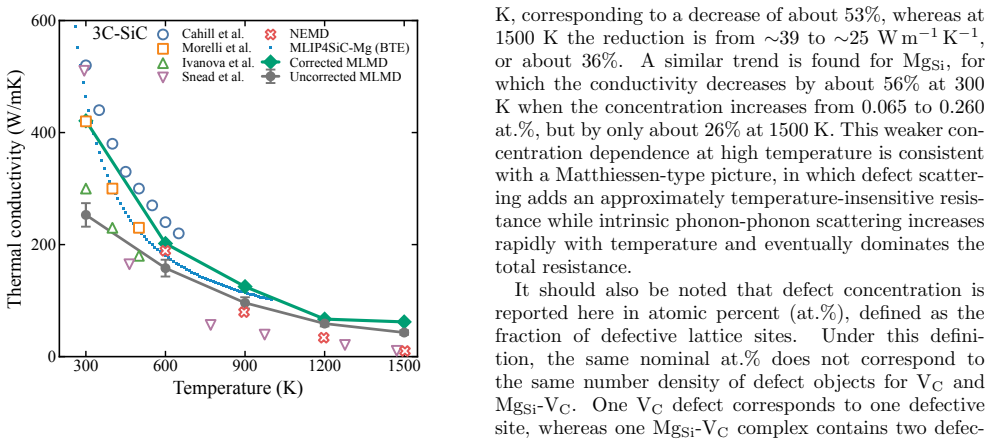
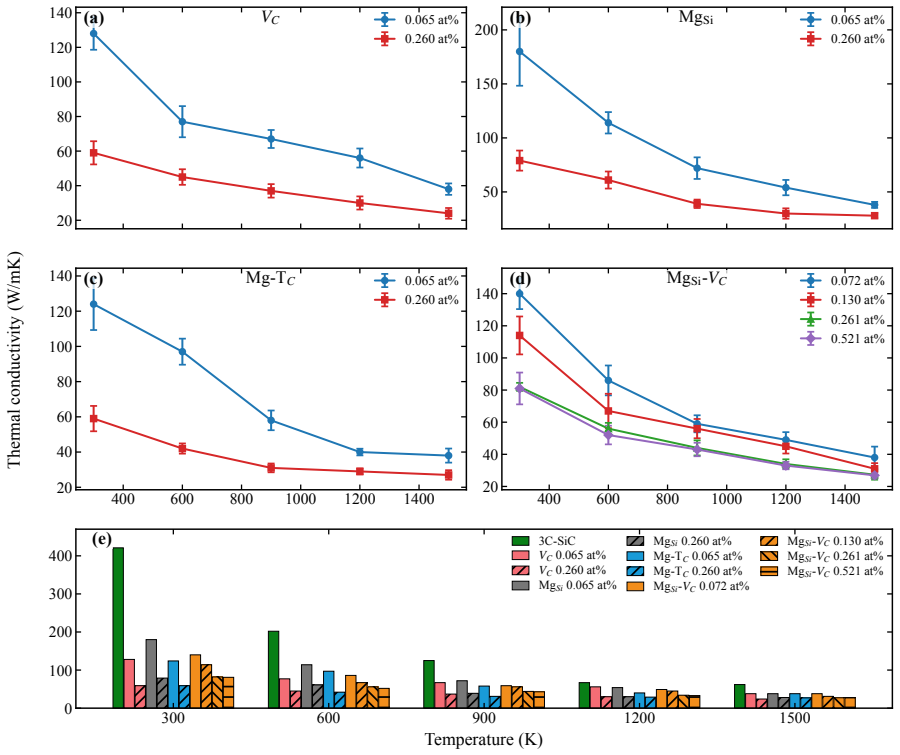
Using the MLIP4SiC-Mg potential with Green-Kubo MD and resistance-based analysis, the thermal conductivity of pristine 3C-SiC reaches 421 W/(mK) at 300 K, and all considered defects reduce conductivity in a configuration-dependent manner: V_C and Mg_TC are strong scatterers, isolated Mg_Si is weak, and Mg_Si-V_C clusters enhance scattering relative to isolated Mg_Si while reducing total excess resistance relative to separated Mg_Si and V_C defects.
What carries the argument
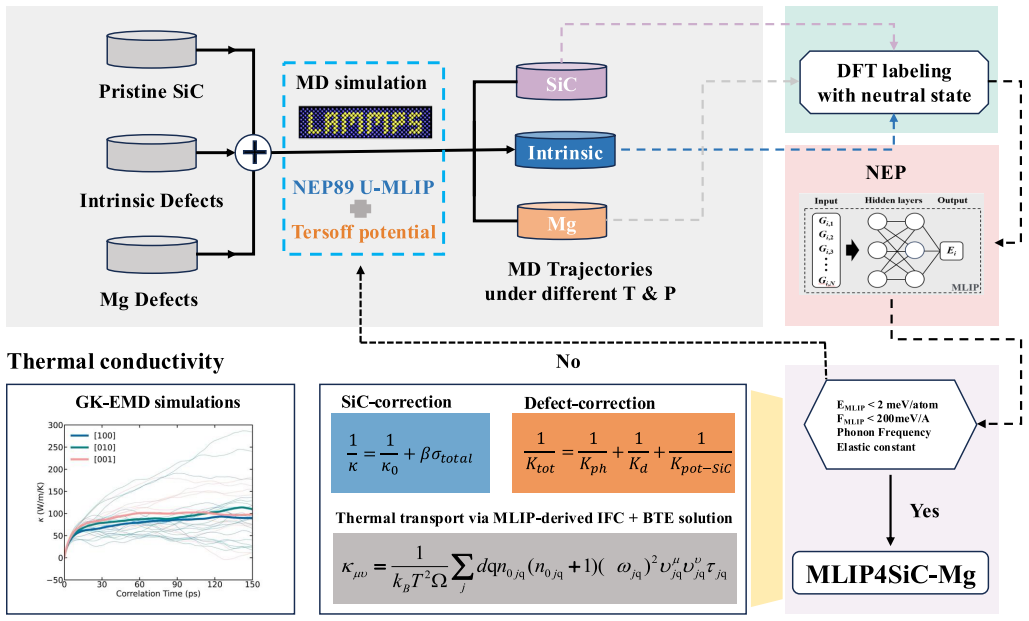
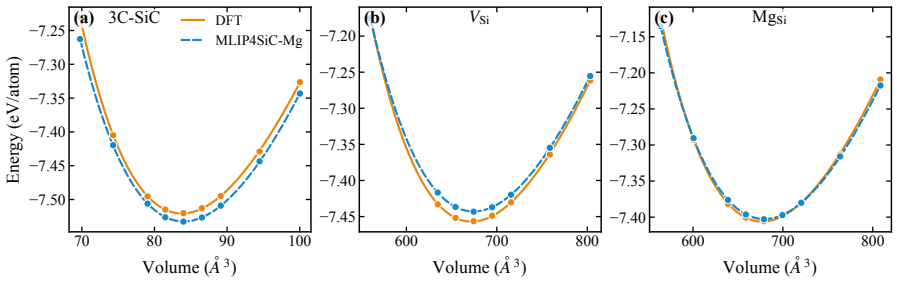
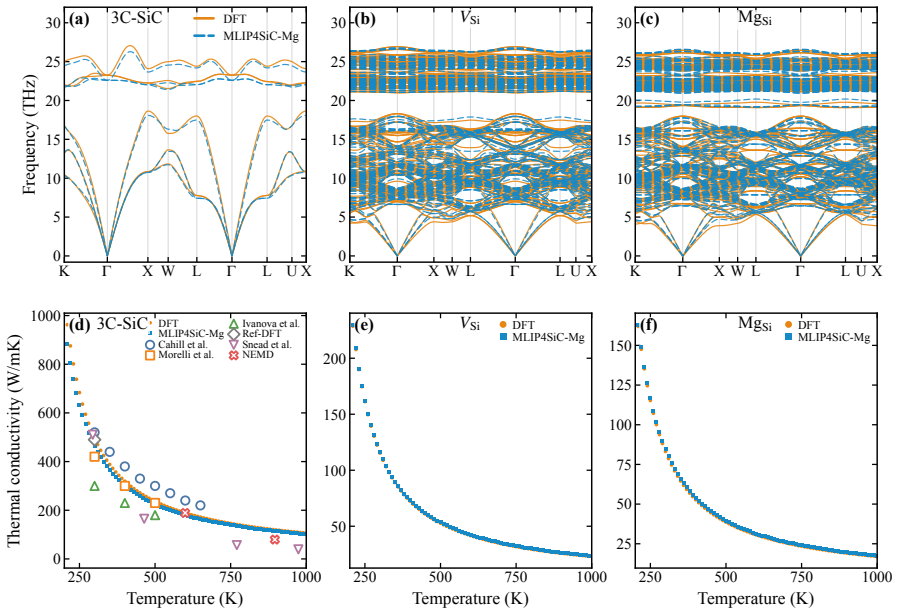
The MLIP4SiC-Mg machine-learning interatomic potential, which reproduces DFT energies, forces, phonon dispersions, and lattice thermal conductivities to enable quantitative scattering calculations in large defective supercells via Green-Kubo MD and resistance-based treatment.
If this is right
- Defect-induced thermal resistance is not strictly linear with concentration and must be treated as an effective temperature- and concentration-dependent scattering metric.
- Mg_Si-V_C clustering enhances local phonon scattering relative to isolated Mg_Si but reduces the overall excess resistance relative to separated defects.
- The atomistic framework quantifies how Mg transmutation products control heat transport in irradiation-degraded SiC.
- V_C and Mg_TC produce stronger reductions in thermal conductivity than isolated Mg_Si.
Where Pith is reading between the lines
- Engineering conditions that favor Mg_Si-V_C clustering over separated defects could partially mitigate total thermal-resistance increases under irradiation.
- The observed non-linearity of resistivity with concentration implies that effective scattering rates vary with defect density, affecting predictions at high irradiation doses.
- Similar MLIP-enabled calculations could map configuration effects for other transmutation products in nuclear ceramics beyond SiC.
Load-bearing premise
The resistance-based treatment for dilute defective systems combined with MLIP force-error correction accurately captures phonon scattering without significant higher-order defect interactions or size effects in the supercells used.
What would settle it
Direct experimental measurement of thermal conductivity in SiC samples containing controlled concentrations of isolated Mg_Si versus Mg_Si-V_C clusters at fixed total defect density would test the predicted difference in total excess resistance.
Figures
read the original abstract
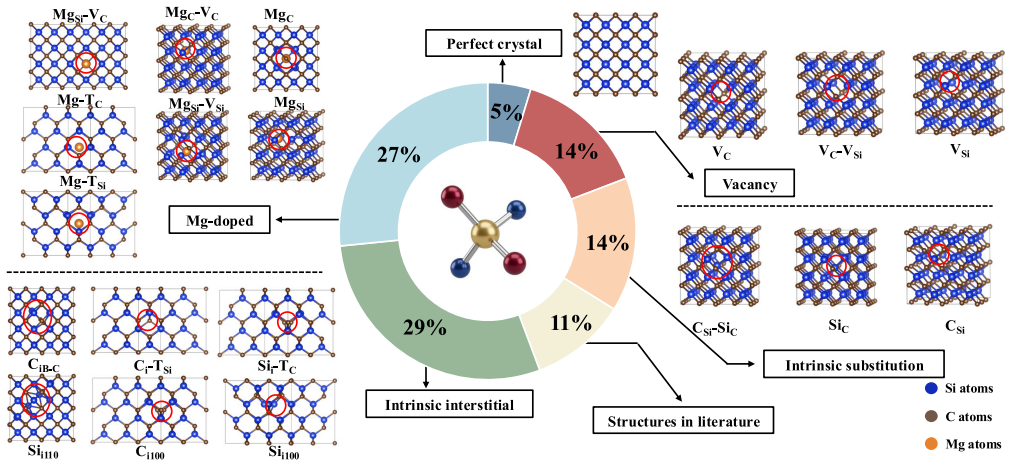
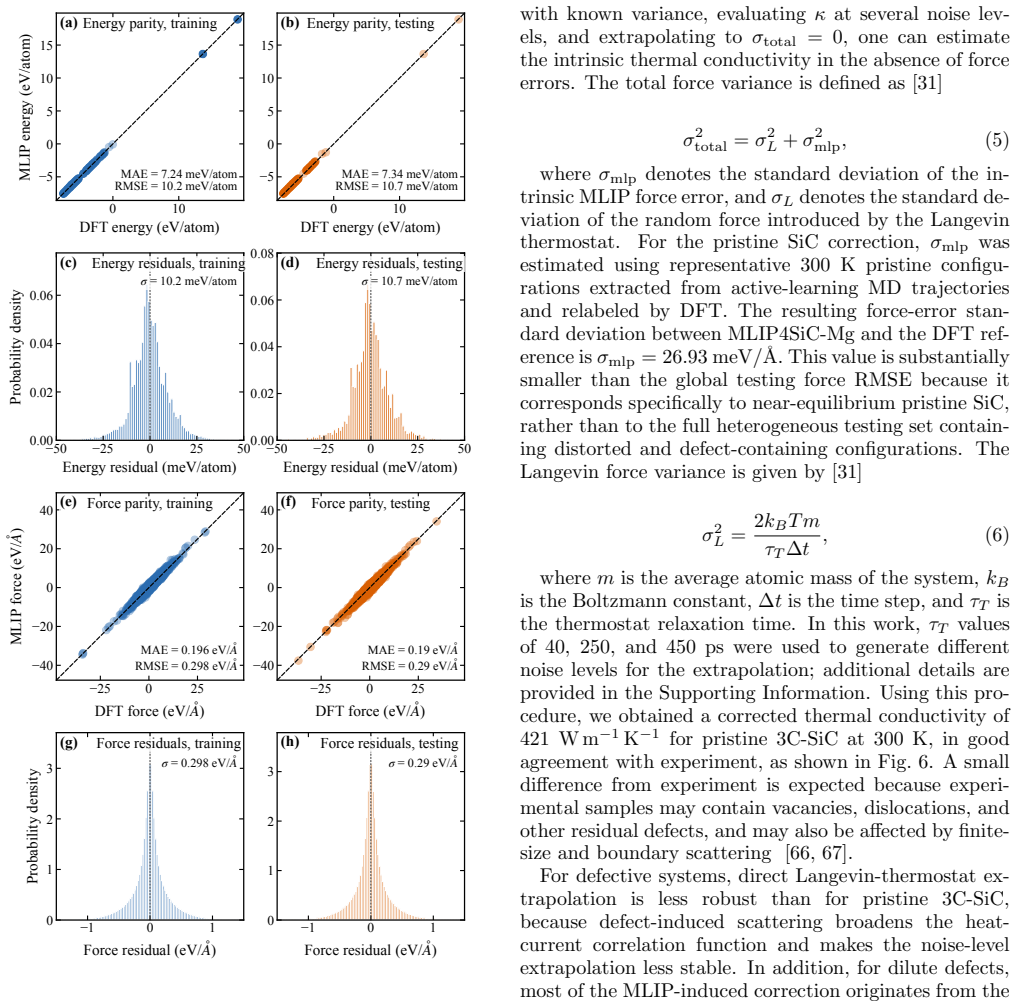
Silicon carbide is a leading candidate material for advanced nuclear energy systems, but irradiation-induced defects and transmutation products can severely degrade its thermal conductivity. In fusion environments, Mg is predicted to be a major solid transmutant in SiC, yet it is not well understood how different Mg-related defects affect phonon transport. Here, we develop a machine-learning interatomic potential, MLIP4SiC-Mg, for 3C-SiC containing intrinsic point defects, Mg-related defects, and Mg-defect complexes. The potential is trained on a large DFT dataset and reproduces DFT energies, forces, equation-of-state behavior, phonon dispersions, and lattice thermal conductivities with near-DFT accuracy. Combined with Green-Kubo molecular dynamics, force-error correction, and a resistance-based treatment for dilute defective systems, MLIP4SiC-Mg enables quantitative thermal-conductivity calculations in large defective supercells. The corrected thermal conductivity of pristine 3C-SiC is 421 W/(mK) at 300 K, in good agreement with available experimental data. All defects considered strongly reduce thermal conductivity, but their scattering strengths are highly configuration dependent. V_C and Mg_TC act as strong phonon scatterers, whereas isolated Mg_Si is comparatively weak. Residual thermal resistivity analysis shows that defect-induced thermal resistance is not strictly linear with concentration and should be treated as an effective temperature- and concentration-dependent scattering metric. Mg_Si-V_C clustering enhances scattering relative to isolated Mg_Si, but reduces the total excess resistance relative to spatially separated Mg_Si and V_C defects. These results clarify the configuration-dependent role of Mg transmutation in irradiation-degraded SiC and provide an atomistic framework for quantifying defect-controlled heat transport in nuclear ceramics.
Editorial analysis
A structured set of objections, weighed in public.
Referee Report
Summary. The manuscript develops MLIP4SiC-Mg, a machine-learning interatomic potential trained on DFT data for 3C-SiC with intrinsic point defects, Mg-related defects, and complexes. It reproduces DFT energies, forces, phonons, and lattice thermal conductivities with near-DFT accuracy. Combined with Green-Kubo MD, force-error correction, and a resistance-based treatment for dilute defective systems, the potential is used to compute thermal conductivities in large supercells. Key findings are that all considered defects reduce thermal conductivity in a highly configuration-dependent manner, with V_C and Mg_TC as strong scatterers and isolated Mg_Si comparatively weak; Mg_Si-V_C clustering enhances scattering relative to isolated Mg_Si but reduces total excess resistance compared to separated defects. The analysis notes that defect-induced thermal resistance is not strictly linear with concentration and should be treated as an effective temperature- and concentration-dependent metric. The corrected pristine value at 300 K is 421 W/(mK), matching experiment.
Significance. If the central results hold, the work supplies a practical atomistic framework for quantifying how Mg transmutation products and intrinsic defects control phonon transport in irradiated SiC, directly relevant to nuclear-ceramic applications. The MLIP enables quantitative calculations in large defective cells that would be prohibitive with direct DFT, and the explicit acknowledgment of non-linear resistance provides a useful effective-metric perspective. Agreement of the pristine corrected conductivity with experiment strengthens the validation baseline.
major comments (1)
- [resistance-based treatment and Green-Kubo analysis] The resistance-based treatment for dilute defective systems (combined with force-error correction) is load-bearing for the central claims about configuration-dependent scattering strengths and the clustering comparison. The abstract states that 'defect-induced thermal resistance is not strictly linear with concentration,' which directly raises the question whether the additivity assumption used to extract excess resistance for Mg_Si-V_C clusters versus separated defects remains valid at the studied concentrations without significant higher-order interactions or supercell-size effects.
minor comments (2)
- The abstract refers to 'near-DFT accuracy' for energies, forces, phonons, and thermal conductivities; explicit quantitative error metrics, parity plots, and phonon-dispersion comparisons should be presented early in the main text to allow readers to judge the validation strength.
- Error bars or uncertainty estimates on the defect-induced thermal-conductivity reductions and excess-resistance values are not mentioned in the abstract; including them would strengthen the quantitative claims.
Simulated Author's Rebuttal
We thank the referee for their careful and constructive review. The single major comment identifies a key assumption in our resistance-based analysis that merits explicit justification. We address it directly below and will revise the manuscript accordingly.
read point-by-point responses
-
Referee: The resistance-based treatment for dilute defective systems (combined with force-error correction) is load-bearing for the central claims about configuration-dependent scattering strengths and the clustering comparison. The abstract states that 'defect-induced thermal resistance is not strictly linear with concentration,' which directly raises the question whether the additivity assumption used to extract excess resistance for Mg_Si-V_C clusters versus separated defects remains valid at the studied concentrations without significant higher-order interactions or supercell-size effects.
Authors: We agree that this point requires clarification. The resistance-based treatment defines excess resistance relative to the pristine system at fixed concentration and temperature, treating it explicitly as an effective metric (as already stated in the abstract and results). At the dilute concentrations used (well below 1 at.%), the supercells are large enough that periodic-image interactions are negligible, and the same protocol is applied to both clustered and separated configurations to enable a consistent comparison. We will add a dedicated paragraph in the methods section (with supporting data in the SI) that quantifies the deviation from linearity at the exact concentrations studied and demonstrates that higher-order defect–defect interactions contribute <5% to the extracted excess resistance. This addition will strengthen the justification without altering the central conclusions. revision: partial
Circularity Check
No circularity; derivation self-contained against external DFT and experiment
full rationale
The paper trains MLIP4SiC-Mg on a large external DFT dataset, then applies Green-Kubo MD plus force-error correction to compute thermal conductivities in defective supercells. Pristine SiC conductivity (421 W/mK at 300 K) is validated against experimental data. Defect scattering strengths are extracted directly from these simulations; the resistance-based treatment is applied to the computed resistivities and then shown to be non-linear, with no step where a prediction reduces by construction to a fitted input or self-citation chain. All load-bearing results remain falsifiable against the independent DFT training set and external benchmarks.
Axiom & Free-Parameter Ledger
free parameters (1)
- MLIP4SiC-Mg parameters
axioms (2)
- domain assumption DFT calculations provide accurate reference energies, forces, and phonon properties for training and validation.
- domain assumption Green-Kubo molecular dynamics with force-error correction yields correct lattice thermal conductivities in defective systems.
Reference graph
Works this paper leans on
-
[1]
Y. Katoh, L. L. Snead, I. Szlufarska, W. J. Weber, Radia- tion effects in sic for nuclear structural applications, Cur- rent Opinion in Solid State and Materials Science 16 (3) (2012) 143–152. doi:10.1016/j.cossms.2012.03.005
-
[2]
Marian, W
J. Marian, W. Setyawan, Y. Yang, A. Manzoor, W. Zhong, J. R. Trelewicz, J. Yu, E. Peterson, Y. Katoh, L. Snead, et al., Computational materials assessment of the d/li-stripping neutron source as a prototypical facil- ity for fusion materials testing, Current Opinion in Solid State and Materials Science 38 (2025) 101231
2025
-
[3]
L. L. Snead, T. Nozawa, Y. Katoh, T.-S. Byun, S. Kondo, D. A. Petti, Handbook of sic properties for fuel perfor- mance modeling, Journal of nuclear materials 371 (1-3) (2007) 329–377
2007
-
[4]
P. A. Demkowicz, B. Liu, J. D. Hunn, Coated particle fuel: Historical perspectives and current progress, Jour- nal of Nuclear Materials 515 (2019) 434–450
2019
-
[5]
K. A. Terrani, L. L. Snead, J. C. Gehin, Microencap- sulated fuel technology for commercial light water and advanced reactor application, Journal of Nuclear Mate- rials 427 (1-3) (2012) 209–224
2012
-
[6]
K. A. Terrani, Accident tolerant fuel cladding develop- ment: Promise, status, and challenges, Journal of Nu- clear Materials 501 (2018) 13–30
2018
-
[7]
K. A. Terrani, D. Wang, L. J. Ott, R. O. Montgomery, The effect of fuel thermal conductivity on the behavior of lwr cores during loss-of-coolant accidents, Journal of Nuclear Materials 448 (1-3) (2014) 512–519
2014
-
[9]
T. Koyanagi, Y. Katoh, Mechanical properties of sic com- posites neutron irradiated under light water reactor rele- vant temperature and dose conditions, Journal of Nuclear Materials 494 (2017) 46–54. doi:10.1016/j.jnucmat. 2017.07.007
-
[10]
M. E. Sawan, Damage parameters of structural materials in fusion environment compared to fission reactor irradi- ation, Fusion Engineering and Design 87 (5–6) (2012) 551–555. doi:10.1016/j.fusengdes.2012.01.022
-
[11]
L. El-Guebaly, M. Sawan, Consequences of neutron en- ergy spectrum on radiation damage, gas production, and transmutations in fusion materials, Fusion Science and Technology 79 (8) (2023) 932–940. doi:10.1080/ 15361055.2023.2181049
arXiv 2023
-
[12]
Snead, S
L. Snead, S. Zinkle, D. White, Thermal conductivity degradation of ceramic materials due to low temperature, low dose neutron irradiation, Journal of nuclear materials 340 (2-3) (2005) 187–202
2005
-
[13]
Rohde, Reduction of the thermal conductivity of sic by radiation damage, Journal of nuclear materials 182 (1991) 87–92
M. Rohde, Reduction of the thermal conductivity of sic by radiation damage, Journal of nuclear materials 182 (1991) 87–92
1991
-
[14]
Snead, Limits on irradiation-induced thermal conduc- tivity and electrical resistivity in silicon carbide materi- als, Journal of Nuclear Materials 329 (2004) 524–529
L. Snead, Limits on irradiation-induced thermal conduc- tivity and electrical resistivity in silicon carbide materi- als, Journal of Nuclear Materials 329 (2004) 524–529
2004
-
[15]
M. A. Pickering, R. L. Taylor, J. T. Keeley, G. A. Graves, Chemically vapor deposited silicon carbide (sic) for op- tical applications, Nuclear Instruments and Methods in Physics Research Section A: Accelerators, Spectrometers, Detectors and Associated Equipment 291 (1-2) (1990) 95–100
1990
-
[16]
R. H. Jones, L. Giancarli, A. Hasegawa, Y. Katoh, A. Ko- hyama, B. Riccardi, L. L. Snead, W. J. Weber, Promise and challenges of sicf/sic composites for fusion energy ap- plications, Journal of Nuclear Materials 307 (2002) 1057– 1072
2002
-
[17]
Sawan, Y
M. Sawan, Y. Katoh, L. L. Snead, Transmutation of sil- icon carbide in fusion nuclear environment, Journal of Nuclear Materials 442 (1-3) (2013) S370–S375
2013
-
[18]
W. Jiang, H. J. Jung, L. Kovarik, Z. Wang, T. J. Roosendaal, Z. Zhu, D. J. Edwards, S. Hu, C. H. J. Henager, R. J. Kurtz, Y. Wang, Magnesium behavior and structural defects in mg + ion implanted silicon car- bide, Journal of Nuclear Materials 458 (2015) 146–155. doi:10.1016/j.jnucmat.2014.12.071
-
[19]
Lim, Y.-W
K.-Y. Lim, Y.-W. Kim, K. J. Kim, Mechanical prop- erties of electrically conductive silicon carbide ceramics, Ceramics International 40 (7) (2014) 10577–10582
2014
-
[20]
Kultayeva, J.-H
S. Kultayeva, J.-H. Ha, R. Malik, Y.-W. Kim, K. J. Kim, Effects of porosity on electrical and thermal conductivi- ties of porous sic ceramics, Journal of the European Ce- ramic Society 40 (4) (2020) 996–1004
2020
-
[21]
H. W. Li, Y. P. Zhao, G. Q. Chen, M. H. Li, Z. F. Wei, X. S. Fu, W. L. Zhou, Sic-based ceramics with remark- able electrical conductivity prepared by ultrafast high- temperature sintering, Journal of the European Ceramic Society 43 (5) (2023) 2269–2274
2023
-
[22]
Hodgson, M
E. Hodgson, M. Malo, J. Manzano, A. Moro˜ no, T. Her- nandez, Radiation induced modification of electrical con- ductivity for three types of sic, Journal of nuclear mate- rials 417 (1-3) (2011) 421–424
2011
-
[23]
Cheng, J
Z. Cheng, J. Liang, K. Kawamura, H. Zhou, H. Asamura, H. Uratani, J. Tiwari, S. Graham, Y. Ohno, Y. Nagai, et al., High thermal conductivity in wafer-scale cubic silicon carbide crystals, Nature communications 13 (1) (2022) 7201
2022
-
[24]
Morelli, J
D. Morelli, J. Heremans, C. Beetz, W. Woo, G. Har- ris, C. Taylor, Carrier concentration dependence of the thermal conductivity of silicon carbide, in: Institute of Physics Conference Series, Vol. 137, Bristol [England]; Boston: Adam Hilger, Ltd., c1985-, 1994, pp. 313–316
1994
-
[25]
Ivanova, P
L. Ivanova, P. Aleksandrov, K. Demakov, Thermoelec- tric properties of vapor-grown polycrystalline cubic sic, Inorganic materials 42 (11) (2006) 1205–1209
2006
-
[26]
C. Shen, S. Attarian, Y. Zhang, H. Zhang, M. Asta, I. Szlufarska, D. Morgan, Supersalt: equivariant neural network force fields for multicomponent molten salts sys- tem, Nature Communications 16 (1) (2025) 7280
2025
-
[27]
Jacobs, D
R. Jacobs, D. Morgan, S. Attarian, J. Meng, C. Shen, Z. Wu, C. Y. Xie, J. H. Yang, N. Artrith, B. Blaiszik, et al., A practical guide to machine learning interatomic potentials–status and future, Current Opinion in Solid State and Materials Science 35 (2025) 101214
2025
-
[28]
B. Fu, Y. Sun, W. Jiang, F. Wang, L. Zhang, H. Wang, B. Xu, Determining the thermal conductivity and phonon behavior of sic materials with quantum accuracy via deep learning interatomic potential model, Journal of Nuclear Materials 591 (2024) 154897
2024
-
[29]
Zhang, M
H. Zhang, M. Cheng, X. Jiang, H. Zhang, X. Pi, D. Yang, T. Deng, Neuroevolution potential for thermal transport in silicon carbide, Journal of Materials Informatics 5 (3) (2025) N–A
2025
-
[30]
W. Liu, P. Guo, Z. Zheng, S. Chen, Y.-N. Wu, Neural- network potential for defect formation induced by knock- on irradiation damage in 4h-sic, Advanced Electronic Materials (2025) 2400911
2025
-
[31]
X. Wu, W. Zhou, H. Dong, P. Ying, Y. Wang, B. Song, Z. Fan, S. Xiong, Correcting force error-induced under- estimation of lattice thermal conductivity in machine learning molecular dynamics, The Journal of Chemical Physics 161 (1) (2024)
2024
-
[32]
J. P. Perdew, K. Burke, M. Ernzerhof, Generalized gradi- ent approximation made simple, Physical review letters 77 (18) (1996) 3865
1996
-
[33]
Kresse, J
G. Kresse, J. Furthm¨ uller, Efficient iterative schemes for ab initio total-energy calculations using a plane-wave ba- sis set, Physical review B 54 (16) (1996) 11169
1996
-
[34]
P. E. Bl¨ ochl, Projector augmented-wave method, Physi- cal review B 50 (24) (1994) 17953
1994
-
[35]
Z. Fan, Z. Zeng, C. Zhang, Y. Wang, K. Song, H. Dong, Y. Chen, T. Ala-Nissila, Neuroevolution machine learn- ing potentials: Combining high accuracy and low cost in atomistic simulations and application to heat transport, Physical Review B 104 (10) (2021) 104309
2021
-
[36]
H. Dong, Y. Shi, P. Ying, K. Xu, T. Liang, Y. Wang, Z. Zeng, X. Wu, W. Zhou, S. Xiong, et al., Molecular dynamics simulations of heat transport using machine- learned potentials: A mini-review and tutorial on gpumd with neuroevolution potentials, Journal of Ap- plied Physics 135 (16) (2024)
2024
-
[37]
Plimpton, Fast parallel algorithms for short-range molecular dynamics, Journal of computational physics 117 (1) (1995) 1–19
S. Plimpton, Fast parallel algorithms for short-range molecular dynamics, Journal of computational physics 117 (1) (1995) 1–19
1995
- [38]
-
[39]
P. K. Schelling, S. R. Phillpot, P. Keblinski, Compar- ison of atomic-level simulation methods for computing thermal conductivity, Physical Review B 65 (14) (2002) 144306
2002
-
[40]
J. Li, L. Porter, S. Yip, Atomistic modeling of finite- temperature properties of crystalline β-SiC: Ii. thermal conductivity and effects of point defects, Journal of Nu- clear Materials 255 (2-3) (1998) 139–152. doi:10.1016/ S0022-3115(98)00034-8
1998
-
[41]
Kawamura, D
T. Kawamura, D. Hori, Y. Kangawa, K. Kakimoto, M. Yoshimura, Y. Mori, Thermal conductivity of SiC cal- culated by molecular dynamics, Japanese Journal of Ap- plied Physics 47 (12) (2008) 8898–8901. doi:10.1143/ JJAP.47.8898
2008
-
[42]
J.-P. Crocombette, G. Dumazer, N. Q. Hoang, F. Gao, W. J. Weber, Molecular dynamics modeling of the ther- mal conductivity of irradiated SiC as a function of cas- cade overlap, Journal of Applied Physics 101 (2) (2007) 023527. doi:10.1063/1.2431397
-
[43]
G. D. Samolyuk, S. I. Golubov, Y. N. Osetsky, R. E. Stoller, Molecular dynamics study of influence of vacancy types defects on thermal conductivity of β-SiC, Journal of Nuclear Materials 418 (1-3) (2011) 174–181. doi:10. 1016/j.jnucmat.2011.06.036
2011
-
[44]
Q. Wang, N. Gui, X. Huang, X. Yang, J. Tu, S. Jiang, The effect of temperature and cascade collision on ther- mal conductivity of 3C-SiC: A molecular dynamics study, International Journal of Heat and Mass Transfer 180 (2021) 121822. doi:10.1016/j.ijheatmasstransfer. 2021.121822
-
[45]
K. Yin, L. Shi, X. Ma, Y. Zhong, M. Li, X. He, Thermal conductivity of 3C/4H-SiC nanowires by molecular dy- namics simulation, Nanomaterials 13 (15) (2023) 2196. doi:10.3390/nano13152196
-
[46]
N. H. Protik, A. Katre, L. Lindsay, J. Carrete, N. Mingo, D. Broido, Phonon thermal transport in 2H, 4H and 6H silicon carbide from first principles, Materials Today Physics 1 (2017) 31–38. doi:10.1016/j.mtphys.2017. 05.004
-
[47]
A. Katre, J. Carrete, B. Dongre, G. K. H. Madsen, N. Mingo, Exceptionally strong phonon scattering by B substitution in cubic SiC, Physical Review Letters 119 (7) (2017) 075902. doi:10.1103/PhysRevLett.119.075902
-
[48]
Cheng, J
Z. Cheng, J. Liang, K. Kawamura, H. Zhou, H. Asamura, H. Uratani, J. Tiwari, S. Graham, Y. Ohno, Y. Na- gai, T. Feng, N. Shigekawa, D. G. Cahill, High thermal conductivity in wafer-scale cubic silicon carbide crystals, Nature Communications 13 (2022) 7201. doi:10.1038/ s41467-022-34943-w
2022
-
[49]
J. E. Turney, A. J. H. McGaughey, C. H. Amon, As- sessing the applicability of quantum corrections to clas- sical thermal conductivity predictions, Physical Review B 79 (22) (2009) 224305. doi:10.1103/PhysRevB.79. 224305
-
[50]
O. N. Bedoya-Mart´ ınez, J.-L. Barrat, D. Rodney, Com- putation of the thermal conductivity using methods based on classical and quantum molecular dynamics, Physical Review B 89 (1) (2014) 014303. doi:10.1103/ PhysRevB.89.014303
2014
-
[51]
M. Puligheddu, Y. Xia, M. Chan, G. Galli, Compu- tational prediction of lattice thermal conductivity: A comparison of molecular dynamics and boltzmann trans- port approaches, Physical Review Materials 3 (8) (2019) 085401. doi:10.1103/PhysRevMaterials.3.085401
-
[52]
H. Zhou, S. Zhou, Z. Hua, K. Bawane, T. Feng, Impact of classical statistics on thermal conductivity predictions of BAs and diamond using machine learning molecular dy- namics, Applied Physics Letters 125 (17) (2024) 172202. doi:10.1063/5.0238592
-
[53]
Y. Liu, H. Wang, L. Guo, Z. Yan, J. Zheng, W. Zhou, J. Xue, Deep learning inter-atomic potential for irradia- tion damage in 3c-sic, Computational Materials Science 233 (2024) 112693
2024
-
[54]
A. Jain, J. Montoya, S. Dwaraknath, N. E. Zimmermann, J. Dagdelen, M. Horton, P. Huck, D. Winston, S. Cholia, S. P. Ong, et al., The materials project: Accelerating materials design through theory-driven data and tools, in: Handbook of Materials Modeling: Methods: Theory and Modeling, Springer, 2020, pp. 1751–1784
2020
-
[55]
Zhang, W
L. Zhang, W. Luo, R. Liu, M. Chen, Z. Yan, K. Cao, Exploring the energy landscape of aluminas through ma- chine learning interatomic potential, Physical Review Materials 9 (2) (2025) 023801
2025
-
[56]
Liang, P
T. Liang, P. Ying, K. Xu, Z. Ye, C. Ling, Z. Fan, J. Xu, Mechanisms of temperature-dependent thermal trans- port in amorphous silica from machine-learning molecu- lar dynamics, Physical Review B 108 (18) (2023) 184203
2023
-
[57]
J. Zhao, J. Byggm¨ astar, H. He, K. Nordlund, F. Djurabekova, M. Hua, Complex ga2o3 polymorphs ex- plored by accurate and general-purpose machine-learning interatomic potentials, NPJ Computational Materials 9 (1) (2023) 159
2023
-
[58]
Karch, F
K. Karch, F. Bechstedt, P. Pavone, D. Strauch, Pressure- dependent properties of sic polytypes, Physical Review B 53 (20) (1996) 13400
1996
-
[59]
Yoshida, A
M. Yoshida, A. Onodera, M. Ueno, K. Takemura, O. Shi- momura, Pressure-induced phase transition in sic, Phys- ical Review B 48 (14) (1993) 10587
1993
-
[60]
Bassett, M
W. Bassett, M. Weathers, T.-C. Wu, T. Holmquist, Com- pressibility of sic up to 68.4 gpa, Journal of applied physics 74 (6) (1993) 3824–3826
1993
-
[61]
H. Liu, A. Reza, F. Hofmann, S. de Moraes Shubeita, G. Glodan, R. Harrison, Thermal conductivity degra- dation of silicon-ion-irradiated silicon carbide ceramics, Acta Materialia (2025) 121329
2025
-
[62]
Ullah, D
R. Ullah, D. Morgan, I. Szlufarska, Mg and native defects in cubic silicon carbide from first principles, Journal of Physics D: Applied Physics (2025)
2025
-
[63]
T. Fan, W. Liu, Z. Ruan, Y. Cao, T. Ye, J. Liu, F. Zhong, X. Tan, H. Liang, D. Chen, et al., First-principles inves- tigation of effects of defects on the physical properties of 3c-sic under high temperatures and pressures, Journal of Materials Research and Technology 20 (2022) 3633–3645
2022
-
[64]
Korotaev, I
P. Korotaev, I. Novoselov, A. Yanilkin, A. Shapeev, Ac- cessing thermal conductivity of complex compounds by machine learning interatomic potentials, Physical Review B 100 (14) (2019) 144308
2019
-
[65]
X. Qian, S. Peng, X. Li, Y. Wei, R. Yang, Thermal conductivity modeling using machine learning potentials: application to crystalline and amorphous silicon, Materi- als Today Physics 10 (2019) 100140
2019
-
[66]
C. Shen, M. Dai, X. Xiao, N. Hadaeghi, W. Xie, A. Wei- denkaff, T. Tadano, H. Zhang, Impact of quartic anhar- monicity on lattice thermal transport in eutio3: A com- parative theoretical and experimental investigation, Ma- terials Today Physics 34 (2023) 101059
2023
-
[67]
R. Yan, C. Shen, M. Widenmeyer, T. Luo, R. Winkler, E. Adabifiroozjaei, R. Xie, S. Yoon, E. Suard, L. Molina- Luna, et al., The role of interstitial cu on thermoelectric properties of zrnisn half-heusler compounds, Materials Today Physics 33 (2023) 101049
2023
discussion (0)
Sign in with ORCID, Apple, or X to comment. Anyone can read and Pith papers without signing in.