Bunny Codes: Broadening Superconducting Quantum Error Correction Capability through Advanced Control Engineering
Pith reviewed 2026-06-26 08:22 UTC · model grok-4.3
The pith
Bunny codes achieve three times the code rate of toric codes on nearest-neighbor superconducting qubit layouts by using an expanded native gate set.
A machine-rendered reading of the paper's core claim, the machinery that carries it, and where it could break.
Core claim
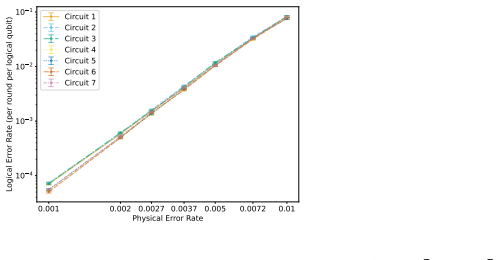
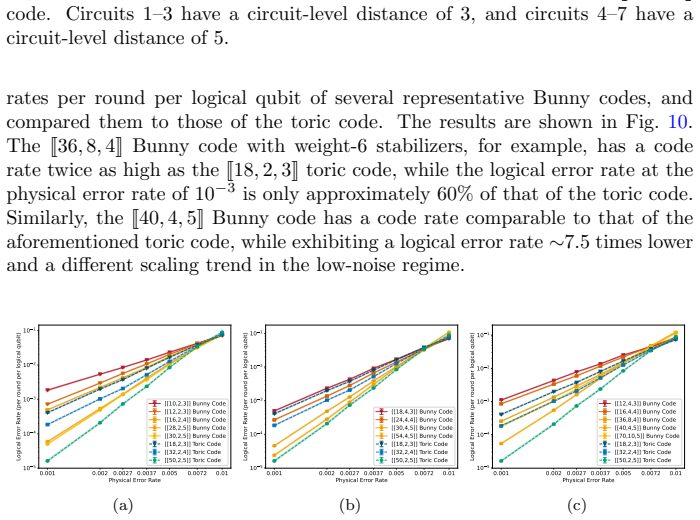
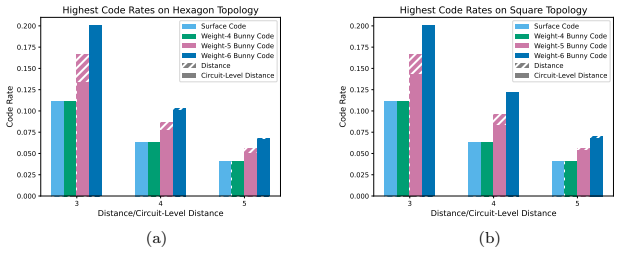
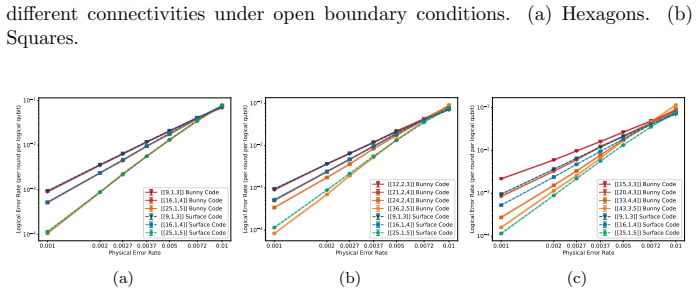
Drawing on advances in superconducting qubit control that unlock enriched native gate sets, exhaustive search identifies qLDPC codes that admit syndrome extraction using only CNOT and CXSWAP on nearest-neighbor connectivity while matching the performance of direct CNOT implementations that would otherwise require long-range interactions; the resulting Bunny codes with weight-6 stabilizers deliver approximately three times the code rate of the toric code under periodic boundaries and twice the rate of the rotated surface code under open boundaries, with some members exhibiting an order-of-magnitude reduction in logical error rate under circuit-level noise.
What carries the argument
Bunny codes: the qLDPC codes discovered by exhaustive search that admit syndrome extraction circuits using the two-qubit gate pool {CNOT, CXSWAP} on two-dimensional nearest-neighbor connectivity, thereby realizing nonlocal stabilizers without long-range couplers.
If this is right
- High-rate quantum error correction becomes feasible on existing superconducting hardware without fabrication of long-range couplers.
- Code-rate advantages of roughly 3× (periodic) and 2× (open) are obtained across examined distances for weight-6 stabilizer Bunny codes.
- Selected Bunny codes already exhibit lower logical error rates than toric codes of comparable rate under circuit-level noise.
- Hardware complexity for quantum error correction is reduced by substituting an expanded gate set for additional coupler hardware.
Where Pith is reading between the lines
- The same gate-set expansion might be tested on other qLDPC families or on hardware platforms that already support CXSWAP-like operations.
- If CXSWAP error rates prove higher than assumed, the logical-error advantage could be recovered by optimizing decoder or circuit scheduling rather than by changing the code itself.
- Bunny codes could serve as drop-in replacements for surface-code patches in near-term processors, potentially increasing the number of logical qubits per physical qubit area.
- The search method used to find Bunny codes could be applied to other enriched gate sets that become available through further control advances.
Load-bearing premise
CXSWAP gates can be realized with fidelity comparable to CNOT and without introducing correlated errors that would erase the reported logical-error advantage.
What would settle it
A circuit-level simulation or hardware experiment that includes a realistic error model for CXSWAP gates and shows that the logical error rates of the reported Bunny codes no longer remain an order of magnitude below those of toric codes at matched rates.
Figures
read the original abstract
Drawing on advances in superconducting qubit control schemes that unlock enriched native gate sets at the hardware level, we systematically examine how harnessing this enlarged physical two-qubit gate pool -- specifically CNOT and CXSWAP -- streamlines syndrome extraction for certain qLDPC codes with nonlocal stabilizers. Through an exhaustive search, we discover a set of qLDPC codes with various stabilizer weights and distances that can be implemented on the two-dimensional nearest-neighbor qubit connectivity native to superconducting hardware while achieving performance equivalent to that of the direct CNOT implementation requiring long-range interactions. We refer to those codes as Bunny codes. Across all code distances we examine, the best Bunny codes with weight-6 stabilizers in periodic boundary conditions have a code rate approximately $3\times$ that of the toric code; when converted to open boundary conditions, they retain an approximately $2\times$ code rate advantage over the rotated surface code. In circuit-level simulation, we find that some Bunny codes exhibit logical error rates an order of magnitude lower than toric codes with comparable code rates. Our results demonstrate that high-performance quantum error correction can be achieved using an expanded gate set rather than long-range couplers, thereby significantly reducing hardware complexity.
Editorial analysis
A structured set of objections, weighed in public.
Referee Report
Summary. The paper introduces Bunny codes, a family of qLDPC codes discovered via exhaustive search that exploit an expanded native gate set (CNOT + CXSWAP) on 2D nearest-neighbor superconducting qubit connectivity. The central claims are that the best weight-6 Bunny codes achieve ~3× the code rate of the toric code under periodic boundaries and ~2× that of the rotated surface code under open boundaries, while selected instances exhibit an order-of-magnitude lower logical error rate than toric codes of comparable rate in circuit-level simulations.
Significance. If the reported code-rate and logical-error advantages survive realistic hardware noise, the approach would meaningfully reduce the need for long-range couplers in superconducting QEC, lowering hardware complexity while retaining high performance. The use of an enlarged gate set to enable better qLDPC codes on planar lattices is a concrete engineering contribution.
major comments (2)
- [Circuit-level simulations] Circuit-level simulation section: the headline claim of order-of-magnitude lower logical error rates rests on the assumption that CXSWAP can be treated as fidelity-equivalent to CNOT with no additional correlated errors or crosstalk; the manuscript provides no hardware error model, calibration data, or pulse-sequence analysis to support this equivalence, which is load-bearing for the performance comparison.
- [Exhaustive search methodology] Exhaustive search and code construction section: the search criteria, distance and rate definitions, stabilizer-weight constraints, and exact parameters of the discovered Bunny codes are not specified in sufficient detail to reproduce the reported 3×/2× rate advantages or to verify that the codes remain implementable under the stated connectivity.
minor comments (2)
- [Introduction and results] Notation for code parameters (n,k,d) and boundary conditions should be stated explicitly when comparing Bunny codes to toric and surface codes.
- [Figures] Figure captions for simulation plots should include the precise noise model parameters and number of shots used.
Simulated Author's Rebuttal
We thank the referee for the constructive feedback. We address each major comment below with clarifications and indicate where the manuscript will be revised for improved clarity and reproducibility.
read point-by-point responses
-
Referee: Circuit-level simulation section: the headline claim of order-of-magnitude lower logical error rates rests on the assumption that CXSWAP can be treated as fidelity-equivalent to CNOT with no additional correlated errors or crosstalk; the manuscript provides no hardware error model, calibration data, or pulse-sequence analysis to support this equivalence, which is load-bearing for the performance comparison.
Authors: We acknowledge the validity of this point: our circuit-level simulations model CXSWAP as having equivalent error rates to CNOT, based on the premise that advanced control engineering enables the enriched gate set without introducing new dominant error channels. The manuscript does not include hardware-specific error models or calibration data, as the work is a theoretical exploration of code performance under this gate set. We will revise the simulation section to explicitly state this modeling assumption, discuss the potential impact of unmodeled effects such as crosstalk, and qualify the results as indicative of the approach's promise pending experimental validation. revision: yes
-
Referee: Exhaustive search and code construction section: the search criteria, distance and rate definitions, stabilizer-weight constraints, and exact parameters of the discovered Bunny codes are not specified in sufficient detail to reproduce the reported 3×/2× rate advantages or to verify that the codes remain implementable under the stated connectivity.
Authors: We agree that the current description of the exhaustive search lacks sufficient detail for full reproducibility. The revised manuscript will expand the code construction section to specify the search algorithm parameters, precise definitions of code distance and rate, stabilizer weight constraints used, and the explicit parameters (including stabilizer supports and qubit connectivity graphs) for the reported Bunny codes that achieve the stated rate advantages. revision: yes
Circularity Check
No significant circularity; claims rest on search and simulation outputs
full rationale
The paper's central claims (higher code rates for Bunny codes vs toric/rotated surface codes, and lower logical error rates in circuit simulations) are presented as results of an exhaustive search over qLDPC codes using CNOT+CXSWAP gates on nearest-neighbor connectivity, followed by circuit-level simulations. No equations, definitions, or performance metrics are shown to reduce to fitted parameters, self-referential quantities, or load-bearing self-citations. The abstract and provided text frame the code-rate advantages and error-rate comparisons as direct outputs of the search and simulation pipeline rather than by-construction renamings or ansatzes imported from prior author work. The CXSWAP fidelity assumption is a modeling choice whose validity is external to the derivation itself and does not create circularity within the reported results.
Axiom & Free-Parameter Ledger
Reference graph
Works this paper leans on
-
[1]
Shor, P. W. Polynomial-Time Algorithms for Prime Factorization and Dis- crete Logarithms on a Quantum Computer.SIAM Journal on Computing 26, 1484–1509 (1997). Place: USA Publisher: Society for Industrial and Applied Mathematics
1997
-
[2]
Grover, L. K. A fast quantum mechanical algorithm for database search. InProceedings of the Twenty-Eighth Annual ACM Symposium on Theory of Computing, STOC ’96, 212–219 (Association for Computing Machinery, New York, NY, USA, 1996). Event-place: Philadelphia, Pennsylvania, USA
1996
-
[3]
G., Mariantoni, M., Martinis, J
Fowler, A. G., Mariantoni, M., Martinis, J. M. & Cleland, A. N. Surface codes: Towards practical large-scale quantum computation.Physical Re- view A86, 032324 (2012). URLhttps://link.aps.org/doi/10.1103/ PhysRevA.86.032324
2012
-
[4]
23 Table 6: The index of all the action on the square grid connectivity
Acharya, R.et al.Quantum error correction below the surface code thresh- old.Nature638, 920 (2024). 23 Table 6: The index of all the action on the square grid connectivity. Index Coupler Gate 0 (0,0)↔(1,0) CNOT 1 (0,0)↔(1,0) CXSWAP 2 (0,0)↔(−1,0) CNOT 3 (0,0)↔(−1,0) CXSWAP 4 (0,0)↔(0,1) CNOT 5 (0,0)↔(0,1) CXSWAP 6 (0,0)↔(0,−1) CNOT 7 (0,0)↔(0,−1) CXSWAP 8...
2024
-
[5]
Tillich, J.-P. & Zemor, G. Quantum LDPC codes with positive rate and minimum distance proportional to the square root of the blocklength.IEEE Transactions on Information Theory60, 11931202 (2014). URLhttp: //dx.doi.org/10.1109/TIT.2013.2292061
-
[6]
URLhttps://doi.org/10.1038/ s41586-024-07107-7
Bravyi, S.et al.High-threshold and low-overhead fault-tolerant quantum memory.Nature627, 778–782 (2024). URLhttps://doi.org/10.1038/ s41586-024-07107-7
2024
-
[7]
URL https://doi.org/10.1145/3779066
Viszlai, J.et al.qSIEVE: Efficient qldpc memory via systolic movement in atom arrays.ACM Transactions on Quantum Computing7(2026). URL https://doi.org/10.1145/3779066
-
[8]
Wang, R., Lin, H.-K. & Pryadko, L. P. Abelian and non-abelian quantum two-block codes.arXiv preprint arXiv:2305.06890(2023). URLhttps: //arxiv.org/abs/2305.06890.2305.06890
arXiv 2023
-
[9]
URLhttps://doi.org/10
Wang, K.et al.Demonstration of low-overhead quantum error correction codes.Nature Physics22, 308–314 (2026). URLhttps://doi.org/10. 1038/s41567-025-03157-4. Publisher: Nature Publishing Group
2026
-
[10]
Mathews, M.et al.Placing and routing non-local quantum error correct- ing codes in multi-layer superconducting qubit hardware.arXiv preprint arXiv:2507.23011(2025).2507.23011
Pith/arXiv arXiv 2025
-
[11]
Chen, J., Ding, D., Gong, W., Huang, C. & Ye, Q. One Gate Scheme to Rule Them All: Introducing a Complex Yet Reduced Instruction Set for 24 Quantum Computing. InProceedings of the 29th ACM International Con- ference on Architectural Support for Programming Languages and Operat- ing Systems, Volume 2, ASPLOS ’24, 779–796 (Association for Computing Machiner...
arXiv 2024
-
[12]
URLhttps: //www.nature.com/articles/s41567-025-02990-x
Chen, Z.et al.Efficient implementation of arbitrary two-qubit gates us- ing unified control.Nature Physics21, 1489–1496 (2025). URLhttps: //www.nature.com/articles/s41567-025-02990-x. Publisher: Nature Publishing Group
2025
-
[13]
Under prepara- tion
Wang, H.et al.Lifting connectivity bottlenecks in superconducting quan- tum processors via enriched native two-qubit gates (2026). Under prepara- tion
2026
-
[14]
McEwen, M., Bacon, D. & Gidney, C. Relaxing Hardware Requirements for Surface Code Circuits using Time-dynamics.Quantum7, 1172 (2023). URLhttps://doi.org/10.22331/q-2023-11-07-1172
-
[15]
URLhttps://arxiv.org/abs/2412.14360
Eickbusch, A.et al.Demonstrating dynamic surface codes.arXiv preprint arXiv:2412.14360(2025). URLhttps://arxiv.org/abs/2412.14360. 2412.14360
arXiv 2025
-
[16]
Gehr, G. P., Byfield, D. & Ruban, A. Directional codes: a new family of quantum LDPC codes on hexagonal- and square-grid connectivity hard- ware.arXiv preprint arXiv:2507.19430(2025).2507.19430
arXiv 2025
-
[17]
To appear in ISCA ’26,2511.04608
Yang, Z.et al.Qubit mapping and routing tailored to advanced quantum isas: Not as costly as you think.arXiv preprint arXiv:2511.04608(2025). To appear in ISCA ’26,2511.04608
Pith/arXiv arXiv 2025
-
[18]
Zhou, R.et al.Louvre: Relaxing hardware requirements of quantum LDPC codes by routing with expanded quantum instruction set.arXiv preprint arXiv:2508.20858(2025).2508.20858
arXiv 2025
-
[19]
Liang, Z., Eberhardt, J. N. & Chen, Y.-A. Planar quantum low-density parity-check codes with open boundaries.arXiv preprint arXiv:2504.08887 (2025).2504.08887
arXiv 2025
-
[20]
URLhttps://arxiv.org/abs/2606.19482
Gu, B.et al.Nearest-neighbour gates are all you need: High-rate quan- tum low-density parity-check codes on a planar grid.arXiv preprint arXiv:2606.19482(2026). URLhttps://arxiv.org/abs/2606.19482. 2606.19482
Pith/arXiv arXiv 2026
-
[21]
Nixon, G. M., McLauchlan, C. K. & van Rest, C. C. L. Vine codes: Low- overhead quantum ldpc codes on a planar square grid.arXiv preprint arXiv:2606.20263(2026). URLhttps://arxiv.org/abs/2606.20263. 2606.20263. 25
Pith/arXiv arXiv 2026
-
[22]
Yang, Z.et al.Reconfigurable quantum instruction set computers for high performance attainable on hardware. InProceedings of the 31st ACM International Conference on Architectural Support for Programming Lan- guages and Operating Systems, Volume 2, ASPLOS ’26, 15231546 (As- sociation for Computing Machinery, New York, NY, USA, 2026). URL https://doi.org/1...
-
[23]
& Cong, J
Tan, B. & Cong, J. Optimal qubit mapping with simultaneous gate absorp- tion. In2021 IEEE/ACM International Conference On Computer Aided Design (ICCAD), 1–8 (IEEE, 2021)
2021
-
[24]
& McEwen, M
Gidney, C., Newman, M. & McEwen, M. Benchmarking the Planar Honey- comb Code.Quantum6, 813 (2022). URLhttps://doi.org/10.22331/ q-2022-09-21-813
2022
-
[25]
P., Crawford, O
Geh´ er, G. P., Crawford, O. & Campbell, E. T. Tangling schedules eases hardware connectivity requirements for quantum error correction.PRX Quantum5, 010348 (2024). URLhttps://link.aps.org/doi/10.1103/ PRXQuantum.5.010348
2024
-
[26]
In2026 Design, Automation & Test in Europe Conference (DATE), 1–7 (IEEE, 2026)
Zhang, K.et al.Optimal compilation of syndrome extraction circuits for general quantum LDPC codes. In2026 Design, Automation & Test in Europe Conference (DATE), 1–7 (IEEE, 2026)
2026
-
[27]
Shaw, M. H. & Terhal, B. M. Optimising quantum error correction using morphing circuits.arXiv preprint arXiv:2604.09797(2026).2604.09797
Pith/arXiv arXiv 2026
-
[28]
Kovalev, A. A. & Pryadko, L. P. Improved quantum hypergraph-product LDPC codes. In2012 IEEE International Symposium on Information Theory Proceedings, 348352 (IEEE, 2012). URLhttp://dx.doi.org/10. 1109/ISIT.2012.6284206
arXiv 2012
-
[29]
Liang, Z., Liu, K., Song, H. & Chen, Y.-A. Generalized toric codes on twisted tori for quantum error correction.PRX Quantum6, 020357 (2025). URLhttps://link.aps.org/doi/10.1103/rmy6-9n89
-
[30]
Landahl, A. J., Anderson, J. T. & Rice, P. R. Fault-tolerant quantum computing with color codes.arXiv preprint arXiv:1108.5738(2011).1108. 5738
Pith/arXiv arXiv 2011
-
[31]
Pecos: Performance estimator of codes on surfaces
Ryan-Anderson, C. Pecos: Performance estimator of codes on surfaces. https://github.com/PECOS-packages/PECOS(2018)
2018
-
[32]
Ignatiev, A., Morgado, A. & Marques-Silva, J. PySAT: A Python toolkit for prototyping with SAT oracles. InSAT, 428–437 (2018). URLhttps: //doi.org/10.1007/978-3-319-94144-8_26
-
[33]
Ignatiev, A., Tan, Z. L. & Karamanos, C. Towards universally accessible SAT technology. InSAT, 4:1–4:11 (2024). URLhttps://doi.org/10. 4230/LIPIcs.SAT.2024.16. 26
2024
-
[34]
Stim: a fast stabilizer circuit simulator.Quantum5, 497 (2021)
Gidney, C. Stim: a fast stabilizer circuit simulator.Quantum5, 497 (2021). Publisher: Verein zur Forderung des Open Access Publizierens in den Quantenwissenschaften
2021
-
[35]
Mller, T.et al.Improved belief propagation is sufficient for real-time decoding of quantum memory.arXiv preprint arXiv:2506.01779(2025). 2506.01779
arXiv 2025
-
[36]
Eberhardt, J. N., Pereira, F. R. F. & Steffan, V. Pruning qLDPC codes: Towards bivariate bicycle codes with open boundary conditions.arXiv preprint arXiv:2412.04181(2024).2412.04181. 27
arXiv 2024
discussion (0)
Sign in with ORCID, Apple, or X to comment. Anyone can read and Pith papers without signing in.