Interfacial-melt stability as a thermodynamic prerequisite for solid-state synthesis
Pith reviewed 2026-06-26 07:54 UTC · model grok-4.3
The pith
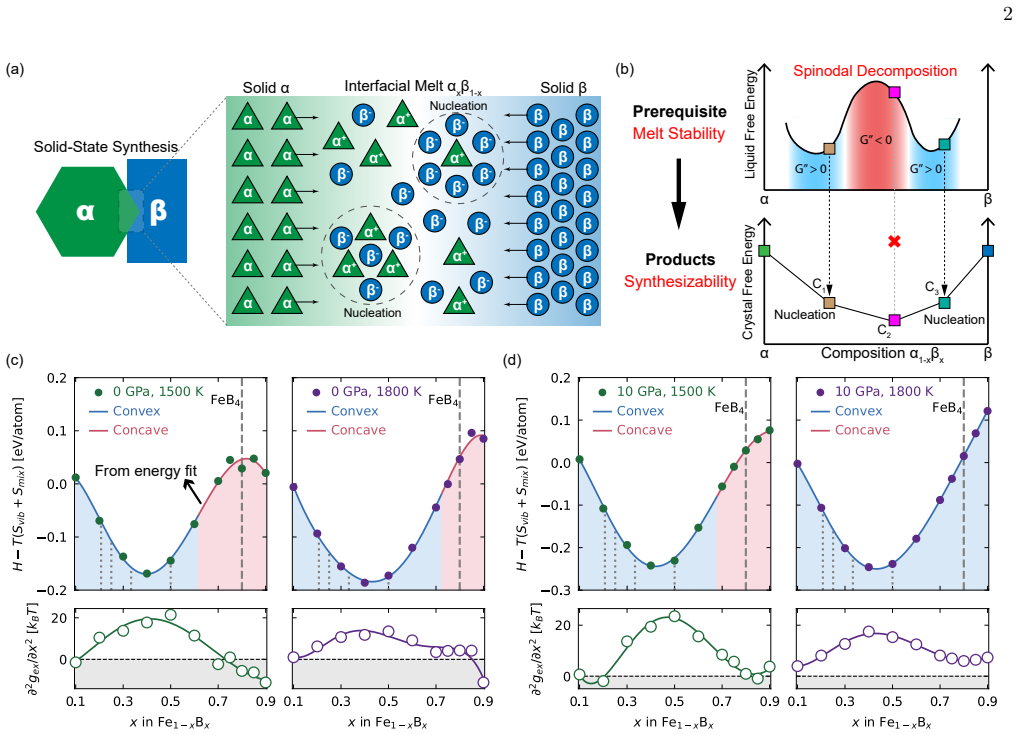
Solid-state synthesis of hull-stable phases requires the interfacial melt to remain stable against spinodal decomposition.
A machine-rendered reading of the paper's core claim, the machinery that carries it, and where it could break.
Core claim
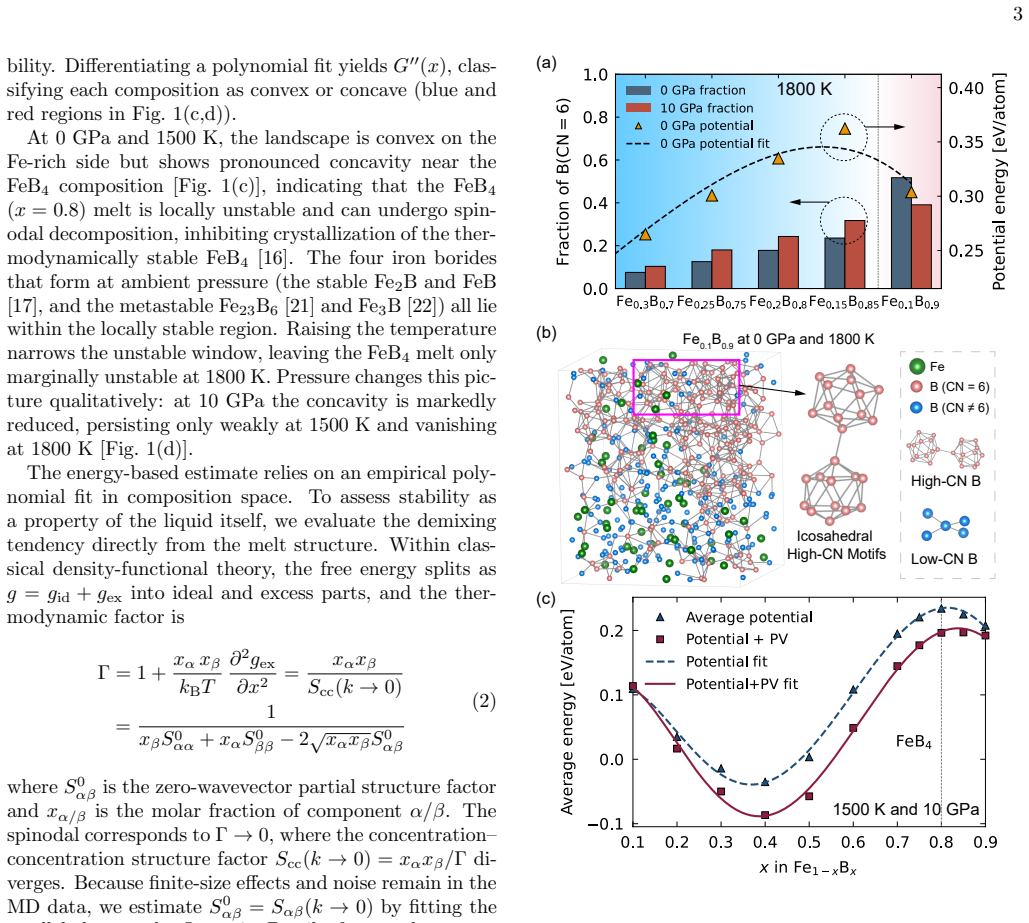
Thermodynamically stable phases such as FeB4 resist low-pressure solid-state synthesis because the B-rich interfacial melt develops a concave free-energy landscape that signals spinodal decomposition; the same melt regains local stability under pressure, consistent with experimental synthesis limits.
What carries the argument
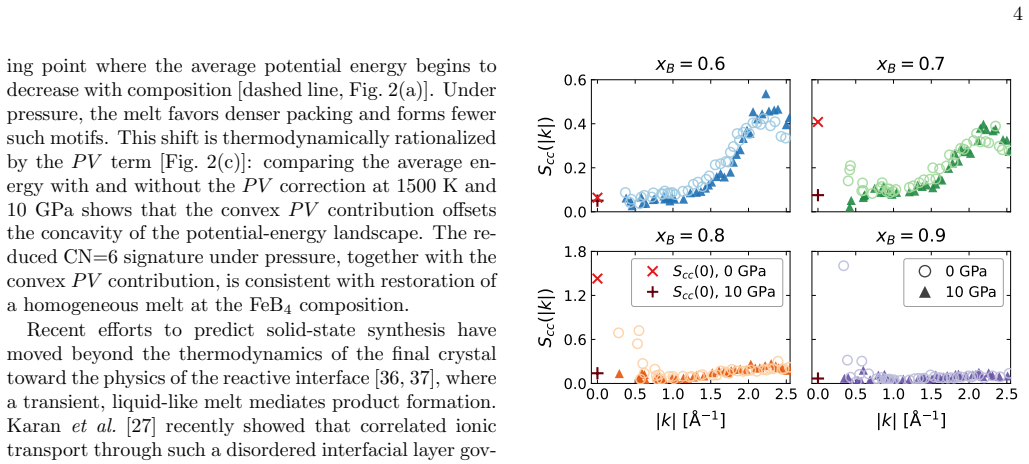
Local stability of the interfacial melt against spinodal decomposition, diagnosed by concavity of the composition-dependent free energy or divergence of the concentration-concentration structure factor in melt-quench molecular dynamics.
If this is right
- Hull-stable candidates whose interfacial melts are concave at ambient pressure will remain unsynthesizable by melt-mediated routes until pressure or composition shifts restore melt convexity.
- The PV contribution under modest pressure can flip an unstable melt to a stable one without changing the solid-phase hull position.
- Structure-factor divergence or free-energy concavity from short MD runs can serve as a fast computational filter before expensive synthesis attempts.
- The same criterion distinguishes why some predicted phases appear only under high-pressure conditions.
Where Pith is reading between the lines
- The descriptor could be applied to other binary or ternary systems to rank candidates by both hull depth and melt stability.
- If melt instability is confirmed as rate-limiting, targeted doping that flattens the melt free-energy curve might enable ambient-pressure routes.
- The approach naturally extends to ternary interfacial melts where multiple concentration variables must remain locally stable.
Load-bearing premise
Solid-state synthesis of the target phase actually proceeds through an interfacial-melt-mediated pathway rather than some other mechanism.
What would settle it
Direct observation, via scattering or microscopy, of spinodal decomposition inside the interfacial melt at ambient pressure for a composition near FeB4, or the absence of such decomposition under the pressures where synthesis succeeds.
Figures
read the original abstract
Computational materials discovery commonly ranks candidate materials by their thermodynamic stability on the formation energy convex hull, yet many predicted-stable phases resist synthesis. We propose that solid-state synthesizability through interfacial-melt-mediated routes requires an additional thermodynamic condition: the interfacial melt at the target composition must itself remain locally stable against spinodal decomposition. We demonstrate this in the classical Fe--B system, where thermodynamically stable FeB$_4$ has been reported under high-pressure synthesis but not in low-pressure synthesis attempts. Using melt--quench molecular dynamics driven by a fine-tuned machine-learning interatomic potential, we find that, at ambient pressure, the B-rich interfacial melt near the FeB$_4$ composition develops a concave free-energy landscape, signaling a demixing instability that is corroborated by the concentration--concentration structure factor and correlated with low-energy icosahedral and pentagonal-pyramidal boron motifs. Applied pressure introduces a convex $PV$ contribution that restores melt stability, consistent with the experimental synthesis boundary. Interfacial-melt stability, which atomistic simulations can assess via structure-factor divergence, is thus proposed as a practical thermodynamic screening descriptor of synthesizability for AI-assisted materials discovery.
Editorial analysis
A structured set of objections, weighed in public.
Referee Report
Summary. The paper claims that solid-state synthesizability via interfacial-melt-mediated routes requires an additional thermodynamic condition beyond convex-hull stability: the interfacial melt at the target composition must remain locally stable against spinodal decomposition. This is illustrated in the Fe-B system for FeB4 (experimentally accessible only under high pressure), where melt-quench MD with a fine-tuned ML interatomic potential shows a concave free-energy landscape in the B-rich melt at ambient pressure (signaled by concentration-concentration structure factor divergence and linked to icosahedral boron motifs), with pressure restoring convexity via the PV term and thereby matching the experimental synthesis boundary.
Significance. If the central mapping holds, the work supplies a practical, simulation-accessible descriptor (structure-factor divergence in the melt) for filtering synthesizability in AI-driven materials discovery, addressing why some thermodynamically stable phases remain elusive. The correlation between the computed ambient-pressure instability and known high-pressure synthesis boundaries for FeB4 is a concrete strength, as is the use of an ML potential to reach the relevant compositions and motifs.
major comments (2)
- [simulation results and discussion of interfacial melt] The simulations (melt-quench MD on homogeneous compositions near FeB4) establish bulk-melt concavity but do not model an explicit solid-melt interface; the title, abstract, and central claim therefore extrapolate from bulk free-energy curvature to interfacial-melt instability without direct evidence that the local chemical potential, templating, or interface structure preserve the demixing tendency.
- [computational methods and results] No quantitative free-energy values, error bars, or convergence checks are reported for the concavity, nor are validation details given for the fine-tuned ML potential against thermodynamic or mixing properties; this leaves the magnitude and robustness of the reported demixing instability unquantified and load-bearing for the proposed screening descriptor.
minor comments (1)
- [abstract] The abstract states that pressure 'introduces a convex PV contribution' but does not specify how the PV term is evaluated or whether it is computed from the same MD trajectories.
Simulated Author's Rebuttal
We thank the referee for the detailed and constructive report. The comments correctly identify that our simulations address bulk-melt thermodynamics and that quantitative details on free energies and potential validation are needed. We address each point below and commit to revisions that clarify scope and add missing data.
read point-by-point responses
-
Referee: The simulations (melt-quench MD on homogeneous compositions near FeB4) establish bulk-melt concavity but do not model an explicit solid-melt interface; the title, abstract, and central claim therefore extrapolate from bulk free-energy curvature to interfacial-melt instability without direct evidence that the local chemical potential, templating, or interface structure preserve the demixing tendency.
Authors: We agree that the simulations are performed on homogeneous bulk compositions and do not include an explicit solid-melt interface. The manuscript's central claim is that melt stability against spinodal decomposition at the target composition is a necessary thermodynamic prerequisite; the bulk free-energy curvature serves as a computationally tractable proxy for this condition. Interface-specific effects (templating, local chemical potentials) could modulate the instability, but the bulk result already correlates with the known pressure-dependent synthesis boundary. We will revise the title, abstract, and discussion to explicitly frame the bulk melt as a proxy, add a limitations paragraph on the absence of interface simulations, and avoid language implying direct interfacial modeling. revision: partial
-
Referee: No quantitative free-energy values, error bars, or convergence checks are reported for the concavity, nor are validation details given for the fine-tuned ML potential against thermodynamic or mixing properties; this leaves the magnitude and robustness of the reported demixing instability unquantified and load-bearing for the proposed screening descriptor.
Authors: We acknowledge the absence of quantitative free-energy values, error bars, and convergence tests, as well as limited validation of the ML potential on mixing thermodynamics. These omissions weaken the robustness assessment of the descriptor. In the revised manuscript we will add: (i) explicit free-energy curves with statistical uncertainties from multiple independent runs, (ii) convergence checks with respect to system size and sampling time, and (iii) additional validation metrics for the ML potential against known mixing enthalpies and melting points in the Fe-B system. revision: yes
Circularity Check
No circularity; central claim rests on independent MD computations correlated with external experiments
full rationale
The paper's derivation computes free-energy concavity and concentration-concentration structure factor directly from melt-quench MD on homogeneous B-rich compositions near FeB4 using a machine-learned potential; pressure stabilization is obtained from the standard PV term. These outputs are then correlated with known external experimental synthesis boundaries (high-pressure success, ambient failure) for FeB4. No parameter is fitted to the target synthesizability result, no self-citation chain bears the load-bearing premise, and the interfacial-melt stability criterion is an emergent simulation observable rather than a self-definition or renamed input. The derivation is therefore self-contained against external benchmarks.
Axiom & Free-Parameter Ledger
free parameters (1)
- fine-tuned ML interatomic potential parameters
axioms (2)
- standard math Thermodynamic stability is ranked by position on the formation-energy convex hull
- domain assumption Solid-state synthesis proceeds through interfacial-melt-mediated routes
Reference graph
Works this paper leans on
-
[1]
Riebesell, R
J. Riebesell, R. E. A. Goodall, P. Benner, Y. Chiang, B. Deng, G. Ceder, M. Asta, A. A. Lee, A. Jain, and K. A. Persson, A framework to evaluate machine learn- ing crystal stability predictions, Nat. Mach. Intell.7, 836 (2025)
2025
-
[2]
E. C.-Y. Yuan, Y. Liu, J. Chen, P. Zhong, S. Raja, T. Kreiman, S. Vargas, W. Xu, M. Head-Gordon, C. Yang, S. M. Blau, B. Cheng, A. Krishnapriyan, and T. Head-Gordon, Foundation models for atomistic simu- lation of chemistry and materials, Nat. Rev. Chem.10, 212 (2026)
2026
-
[3]
Lejaeghereet al., Reproducibility in density func- tional theory calculations of solids, Science351, aad3000 (2016)
K. Lejaeghereet al., Reproducibility in density func- tional theory calculations of solids, Science351, aad3000 (2016)
2016
-
[4]
M. K. Hortonet al., Accelerated data-driven materials science with the Materials Project, Nat. Mater.24, 1522 (2025)
2025
-
[5]
A. R. Oganov, C. J. Pickard, Q. Zhu, and R. J. Needs, Structure prediction drives materials discovery, Nat. Rev. Mater.4, 331 (2019)
2019
-
[6]
C. J. Pickard and R. Needs, Ab initio random structure searching, J. Phys.: Condens. Matter23, 053201 (2011)
2011
-
[7]
A. R. Oganov and C. W. Glass, Crystal structure predic- tion using ab initio evolutionary techniques: Principles and applications, J. Chem. Phys.124, 244704 (2006)
2006
-
[8]
Y. Wang, J. Lv, L. Zhu, and Y. Ma, Crystal structure prediction via particle-swarm optimization, Phys. Rev. B82, 094116 (2010)
2010
-
[9]
Zeniet al., A generative model for inorganic materials design, Nature639, 624 (2025)
C. Zeniet al., A generative model for inorganic materials design, Nature639, 624 (2025)
2025
-
[10]
X. Luo, Z. Wang, Q. Wang, X. Shao, J. Lv, L. Wang, Y. Wang, and Y. Ma, CrystalFlow: a flow-based gener- ative model for crystalline materials, Nat. Commun.16, 9267 (2025)
2025
-
[11]
Zhong, X
P. Zhong, X. Dai, B. Deng, G. Ceder, and K. A. Persson, Crystal structure prediction with host-guided inpainting generation and foundation potentials, Mater. Horiz.12, 9669 (2025)
2025
-
[12]
Woodet al., UMA: A Family of Universal Models for Atoms, Adv
B. Woodet al., UMA: A Family of Universal Models for Atoms, Adv. Neural Inform. Process. Syst.38, 129391 (2026)
2026
-
[13]
Batatiaet al., A foundation model for atomistic mate- rials chemistry, J
I. Batatiaet al., A foundation model for atomistic mate- rials chemistry, J. Chem. Phys.163, 184110 (2025)
2025
-
[14]
Miura, H
A. Miura, H. Ito, C. J. Bartel, W. Sun, N. C. Rosero- Navarro, K. Tadanaga, H. Nakata, K. Maeda, and G. Ceder, Selective metathesis synthesis of MgCr 2S4 by control of thermodynamic driving forces, Mater. Horiz. 7, 1310 (2020)
2020
-
[15]
N. J. Szymanski, B. Rendy, Y. Fei, R. E. Kumar, T. He, D. Milsted, M. J. McDermott, M. Gallant, E. D. Cubuk, A. Merchant, H. Kim, A. Jain, C. J. Bartel, K. Persson, Y. Zeng, and G. Ceder, An autonomous laboratory for the accelerated synthesis of inorganic materials, Nature 624, 86 (2023)
2023
-
[16]
A. N. Kolmogorov, S. Shah, E. R. Margine, A. F. Bialon, T. Hammerschmidt, and R. Drautz, New superconduct- ing and semiconducting Fe–B compounds predicted with an ab initio evolutionary search, Phys. Rev. Lett.105, 217003 (2010)
2010
-
[17]
Zhang, J
J. Zhang, J. Liu, H. Liao, M. Zeng, and S. Ma, A review on relationship between morphology of boride of Fe-B alloys and the wear/corrosion resistant properties and mechanisms, J. Mater. Res. Technol.8, 6308 (2019)
2019
-
[18]
H. Gou, N. Dubrovinskaia, E. Bykova, A. A. Tsirlin, D. Kasinathan, W. Schnelle, A. Richter, M. Merlini, M. Hanfland, A. M. Abakumov, D. Batuk, G. Van Ten- deloo, Y. Nakajima, A. N. Kolmogorov, and L. Dubrovin- sky, Discovery of a superhard iron tetraboride supercon- ductor, Phys. Rev. Lett.111, 157002 (2013)
2013
-
[19]
Q. Wang, J. He, W. Hu, Z. Zhao, C. Zhang, K. Luo, Y. L¨ u, C. Hao, W. L¨ u, Z. Liu, D. Yu, Y. Tian, and B. Xu, Is orthorhombic iron tetraboride superhard?, J. Materiomics1, 45 (2015)
2015
-
[20]
J. Chen, S. R. Cross, L. J. Miara, J.-J. Cho, Y. Wang, and W. Sun, Navigating phase diagram complexity to guide robotic inorganic materials synthesis, Nat. Synth. 3, 606 (2024)
2024
-
[21]
Quirinale, G
D. Quirinale, G. Rustan, A. Kreyssig, and A. Goldman, Synergistic stabilization of metastable Fe 23B6 andγ-Fe in undercooled Fe 83B17, Appl. Phys. Lett.106, 241906 (2015)
2015
-
[22]
Y. Khan, E. Kneller, and M. Sostarich, The phase Fe3B, International Journal of Materials Research73, 624 (1982)
1982
-
[23]
Miura, C
A. Miura, C. J. Bartel, Y. Goto, Y. Mizuguchi, C. Moriyoshi, Y. Kuroiwa, Y. Wang, T. Yaguchi, M. Shi- rai, M. Nagao, N. C. Rosero-Navarro, K. Tadanaga, G. Ceder, and W. Sun, Observing and modeling the se- quential pairwise reactions that drive solid-state ceramic synthesis, Adv. Mater.33, 2100312 (2021)
2021
-
[24]
M. J. McDermott, B. C. McBride, C. E. Regier, G. T. Tran, Y. Chen, A. A. Corrao, M. C. Gallant, G. E. Kamm, C. J. Bartel, K. W. Chapman, P. G. Khali- fah, G. Ceder, J. R. Neilson, and K. A. Persson, Assess- ing Thermodynamic Selectivity of Solid-State Reactions for the Predictive Synthesis of Inorganic Materials, ACS Central Science9, 1957 (2023)
1957
-
[25]
M. C. Gallant, M. J. McDermott, B. Li, and K. A. Pers- son, A Cellular Automaton Simulation for Predicting Phase Evolution in Solid-State Reactions, Chemistry of Materials37, 210 (2025)
2025
-
[26]
D. Hu, M. L. Beauvais, G. E. Kamm, B. G. Mullens, B. A. Sanchez Monserrate, S. M. Vornholt, P. J. Chupas, and K. W. Chapman, Resolving Fast Relative Kinetics in Inorganic Solid-State Synthesis, Journal of the American Chemical Society145, 26545 (2023)
2023
-
[27]
V. Karan, M. C. Gallant, Y. Fei, G. Ceder, and K. A. Persson, Ion correlations explain kinetic selectivity in diffusion-limited solid-state synthesis reactions, Nat. Mater. 10.1038/s41563-026-02596-5 (2026)
-
[28]
Unger and W
C. Unger and W. Klein, Nucleation theory near the clas- sical spinodal, Phys. Rev. B29, 2698 (1984)
1984
-
[29]
H. Park, F. Haftlang, Y.-U. Heo, J. B. Seol, Z. Wang, and H. S. Kim, Periodic spinodal decomposition in double– strengthened medium–entropy alloy, Nature Communi- cations15, 5757 (2024)
2024
-
[30]
Barros-Luque, M
L. Barros-Luque, M. Shuaibi, X. Fu, B. M. Wood, M. Dzamba, M. Gao, A. Rizvi, M. Uyttendaele, C. L. Zitnick, and Z. W. Ulissi, The open materials 2024 (OMat24) inorganic materials dataset and models, Nat. Comput. Sci. , 1 (2026)
2024
-
[31]
I. Batatia, C. Lin, J. Hart, E. Kasoar, A. M. Elena, S. W. Norwood, T. Wolf, and G. Cs´ anyi, Cross Learning be- 6 tween Electronic Structure Theories for Unifying Molec- ular, Surface, and Inorganic Crystal Foundation Force Fields (2025), arXiv:2510.25380 [physics.chem-ph]
arXiv 2025
-
[32]
A. D. Kaplan, R. Liu, J. Qi, T. W. Ko, B. Deng, J. Riebe- sell, G. Ceder, K. A. Persson, and S. P. Ong, A foun- dational potential energy surface dataset for materials, arXiv preprint arXiv:2503.04070 (2025)
arXiv 2025
-
[33]
Hong and Z.-K
Q.-J. Hong and Z.-K. Liu, Generalized approach for rapid entropy calculation of liquids and solids, Phys. Rev. Res. 7, L012030 (2025)
2025
-
[34]
Cheng, Computing chemical potentials of solutions from structure factors, The Journal of Chemical Physics 157, 121101 (2022)
B. Cheng, Computing chemical potentials of solutions from structure factors, The Journal of Chemical Physics 157, 121101 (2022)
2022
-
[35]
Albert and H
B. Albert and H. Hillebrecht, Boron: Elementary chal- lenge for experimenters and theoreticians, Angew. Chem. Int. Ed.48, 8640 (2009)
2009
-
[36]
D. P. Shoemaker, Y.-J. Hu, D. Y. Chung, G. J. Halder, P. J. Chupas, L. Soderholm, J. F. Mitchell, and M. G. Kanatzidis, In situ studies of a platform for metastable inorganic crystal growth and materials discovery, Pro- ceedings of the National Academy of Sciences111, 10922 (2014)
2014
-
[37]
M. J. McDermott, S. S. Dwaraknath, and K. A. Persson, A graph-based network for predicting chemical reaction pathways in solid-state materials synthesis, Nat. Com- mun.12, 3097 (2021)
2021
-
[38]
A. K. Cheetham, R. Seshadri, and F. Wudl, Chemical synthesis and materials discovery, Nature Synthesis1, 514 (2022)
2022
-
[39]
De Fontaine, An analysis of clustering and order- ing in multicomponent solid solutions—I
D. De Fontaine, An analysis of clustering and order- ing in multicomponent solid solutions—I. Stability cri- teria, Journal of Physics and Chemistry of Solids33, 297 (1972)
1972
discussion (0)
Sign in with ORCID, Apple, or X to comment. Anyone can read and Pith papers without signing in.