MythraGen: Two-Stage Retrieval Augmented Art Generation Framework
Pith reviewed 2026-06-26 08:58 UTC · model grok-4.3
The pith
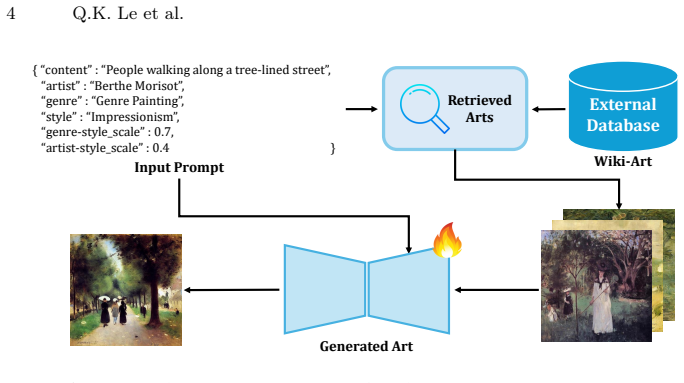
MythraGen retrieves similar artworks then applies LoRA fine-tuning to Stable Diffusion to produce text-to-art images that match prompts more closely.
A machine-rendered reading of the paper's core claim, the machinery that carries it, and where it could break.
Core claim
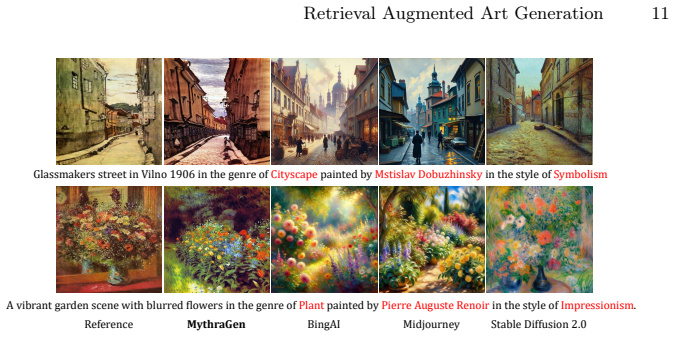
Retrieved images with highest similarity to the query prompt supply effective data for LoRA fine-tuning of Stable Diffusion, enabling generation of artworks that more faithfully match the user's textual description than existing solutions, as demonstrated by results on the WikiArt dataset.
What carries the argument
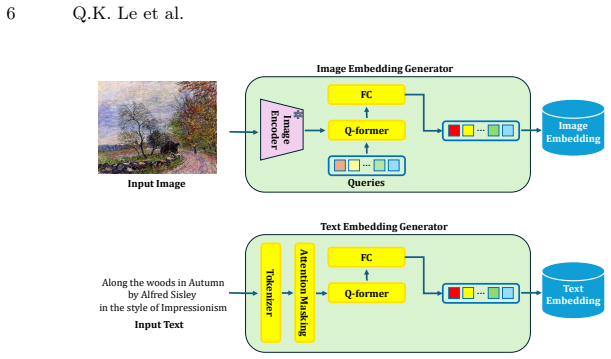
Two-stage retrieval of highest-similarity art images from an external database followed by LoRA-based fine-tuning of Stable Diffusion on those images.
If this is right
- Generated images will show closer alignment to both the subject and artistic style specified in the text prompt.
- The method outperforms standard text-to-image models in quantitative and user evaluations on art datasets.
- The retrieval-plus-adaptation pattern can be repeated for new prompts without retraining the base model from scratch.
Where Pith is reading between the lines
- The same retrieval step might help when the base model lacks training data for rare artistic styles or subjects.
- Switching the retrieval database could adapt the framework to non-art domains such as product design or illustration.
- Poor retrieval quality due to weak similarity measures would likely limit or reverse any gains from the fine-tuning stage.
Load-bearing premise
Images retrieved by highest similarity to the prompt contain the style and content needed to make the fine-tuned model produce faithful artistic outputs.
What would settle it
A controlled user study or metric evaluation on WikiArt prompts where MythraGen outputs receive no higher preference or similarity scores than baseline Stable Diffusion generations.
Figures





read the original abstract
Text-to-image generation has seen rapid advancements, especially with the development of generative models. However, challenges remain in achieving high-quality, contextually accurate image outputs that faithfully match the provided textual descriptions, especially in artistic generation. In this paper, we present a simple yet efficient retrieval augmented generation framework, namely MythraGen, for text-to-artistic image generation by integrating an art retrieval mechanism with LoRA-based model fine-tuning. Our method extracts features from a large-scale art dataset, optimizing the generation process by combining artist-specific styles and content. Particularly, retrieved images from an external art database that have the highest similarity to the query prompt are used to finetune Stable Diffusion using LoRA for desired art generation. Experimental results and user studies on the WikiArt dataset show that our proposed method can generate artworks that closely match the user's input, significantly outperforming existing solutions.
Editorial analysis
A structured set of objections, weighed in public.
Referee Report
Summary. The manuscript presents MythraGen, a two-stage retrieval-augmented framework for text-to-artistic image generation. Stage one retrieves images from an external art database with highest similarity to the input prompt; stage two uses those images to LoRA-fine-tune Stable Diffusion so that the generated output better respects the prompt's artistic style and content. The authors assert that experiments and user studies on the WikiArt dataset demonstrate that the method produces artworks closely matching user inputs and significantly outperforms existing solutions.
Significance. If the empirical results can be substantiated, the approach supplies a lightweight, data-driven way to adapt a base text-to-image model to artist-specific styles without full retraining. The integration of retrieval with parameter-efficient fine-tuning is a practical combination that could be adopted in creative tools where prompt fidelity in the art domain is critical.
major comments (3)
- [Abstract] Abstract: the claim that the method 'significantly outperform[s] existing solutions' is unsupported by any reported metrics (FID, CLIP score, etc.), baseline comparisons, number of retrieved images, LoRA hyperparameters, or statistical tests; this absence is load-bearing for the central empirical assertion.
- [Method] Method description (retrieval + fine-tuning pipeline): no ablation is presented that isolates the contribution of similarity-based retrieval versus random selection or no-retrieval baselines, nor is any analysis given of whether cosine similarity on embeddings actually supplies the stylistic or compositional signals needed for prompt-faithful generation; this directly tests the weakest assumption identified in the stress-test note.
- [Experiments] Experimental results and user studies: the manuscript supplies no tables, figures, participant counts, evaluation protocol, or inter-rater statistics for the claimed WikiArt user studies, preventing verification that the reported gains are not artifacts of post-hoc choices or self-referential evaluation.
minor comments (2)
- [Abstract] The abstract would be clearer if it named the similarity metric and the number of images used for each LoRA fine-tuning run.
- [Related Work] Standard references to Stable Diffusion and LoRA papers are present but the manuscript should cite the specific WikiArt retrieval database version and any embedding model used for similarity.
Simulated Author's Rebuttal
We thank the referee for the constructive comments. We will revise the manuscript to address the concerns by adding the requested empirical details, ablations, and experimental protocols.
read point-by-point responses
-
Referee: [Abstract] Abstract: the claim that the method 'significantly outperform[s] existing solutions' is unsupported by any reported metrics (FID, CLIP score, etc.), baseline comparisons, number of retrieved images, LoRA hyperparameters, or statistical tests; this absence is load-bearing for the central empirical assertion.
Authors: We agree the abstract claim requires supporting evidence. In revision we will add reported metrics (FID, CLIP score), baseline comparisons, the number of retrieved images, LoRA hyperparameters, and statistical tests to substantiate the performance assertions. revision: yes
-
Referee: [Method] Method description (retrieval + fine-tuning pipeline): no ablation is presented that isolates the contribution of similarity-based retrieval versus random selection or no-retrieval baselines, nor is any analysis given of whether cosine similarity on embeddings actually supplies the stylistic or compositional signals needed for prompt-faithful generation; this directly tests the weakest assumption identified in the stress-test note.
Authors: We accept that ablations are needed to isolate the retrieval contribution. We will add experiments comparing similarity-based retrieval against random selection and no-retrieval baselines, plus analysis showing that cosine similarity on embeddings supplies the relevant stylistic and compositional signals. revision: yes
-
Referee: [Experiments] Experimental results and user studies: the manuscript supplies no tables, figures, participant counts, evaluation protocol, or inter-rater statistics for the claimed WikiArt user studies, preventing verification that the reported gains are not artifacts of post-hoc choices or self-referential evaluation.
Authors: We acknowledge the user-study details were omitted. In the revised manuscript we will include tables, figures, participant counts, the full evaluation protocol, and inter-rater statistics for the WikiArt studies. revision: yes
Circularity Check
Empirical framework with no derivation chain or self-referential reductions
full rationale
The paper presents a two-stage retrieval-augmented pipeline for artistic image generation using similarity retrieval from an art database followed by LoRA fine-tuning of Stable Diffusion. No equations, mathematical derivations, or first-principles claims appear in the abstract or described framework. The central performance claim rests on experimental results and user studies on WikiArt rather than any reduction of outputs to fitted inputs or self-citations. No load-bearing self-citation chains, ansatzes smuggled via prior work, or uniqueness theorems are invoked. This is a standard empirical contribution whose validity can be assessed externally via replication or ablation, with no internal circularity.
Axiom & Free-Parameter Ledger
axioms (1)
- domain assumption Images retrieved by feature similarity to a text prompt supply useful style and content signals for subsequent LoRA adaptation of a diffusion model.
Reference graph
Works this paper leans on
-
[1]
https://doi.org/10.1145/3618322, https://doi.org/10.1145/3618322
Alaluf, Y., Richardson, E., Metzer, G., Cohen-Or, D.: A neural space-time repre- sentationfortext-to-imagepersonalization.ACMTrans.Graph.42(6), 243(2023). https://doi.org/10.1145/3618322, https://doi.org/10.1145/3618322
-
[2]
arXiv (2018), https://api.semanticscholar.org/CorpusID: 52889459
Brock, A., Donahue, J., Simonyan, K.: Large scale gan training for high fidelity natural image synthesis. arXiv (2018), https://api.semanticscholar.org/CorpusID: 52889459
2018
-
[3]
ShareGPT4V: Improving Large Multi-Modal Models with Better Captions
Chen, L., Li, J., Dong, X., Zhang, P., He, C., Wang, J., Zhao, F., Lin, D.: Sharegpt4v: Improving large multi-modal models with better captions. arXiv (2023), https://arxiv.org/abs/2311.12793
work page internal anchor Pith review Pith/arXiv arXiv 2023
-
[4]
arXiv (2022), https://api.semanticscholar.org/CorpusID: 252596087
Chen, W., Hu, H., Saharia, C., Cohen, W.W.: Re-imagen: Retrieval-augmented text-to-image generator. arXiv (2022), https://api.semanticscholar.org/CorpusID: 252596087
2022
-
[5]
In: NeurIPS
Dhariwal, P., Nichol, A.: Diffusion models beat gans on image synthesis. In: NeurIPS. vol. 34, pp. 8780–8794 (2021), https://proceedings.neurips.cc/paper_ files/paper/2021/file/49ad23d1ec9fa4bd8d77d02681df5cfa-Paper.pdf
2021
-
[6]
In: NeurIPS
Ding, M., Yang, Z., Hong, W., Zheng, W., Zhou, C., Yin, D., Lin, J., Zou, X., Shao, Z., Yang, H., Tang, J.: Cogview: Mastering text-to-image generation via transformers. In: NeurIPS. pp. 19822–19835 (2021), https://proceedings.neurips. cc/paper_files/paper/2021/file/a4d92e2cd541fca87e4620aba658316d-Paper.pdf
2021
-
[7]
Douze, M., Guzhva, A., Deng, C., Johnson, J., Szilvasy, G., Mazaré, P.E., Lomeli, M., Hosseini, L., Jégou, H.: The faiss library (2024), https://arxiv.org/abs/2401. 08281
2024
-
[8]
Gal, R., Alaluf, Y., Atzmon, Y., Patashnik, O., Bermano, A.H., Chechik, G., Cohen-Or, D.: An image is worth one word: Personalizing text-to-image gener- ation using textual inversion (2022), https://arxiv.org/abs/2208.01618
work page internal anchor Pith review Pith/arXiv arXiv 2022
-
[9]
arXiv (2020), https://api.semanticscholar.org/CorpusID:219955663
Ho, J., Jain, A., Abbeel, P.: Denoising diffusion probabilistic models. arXiv (2020), https://api.semanticscholar.org/CorpusID:219955663
2020
-
[10]
JMLR23(47), 1–33 (2022), http://jmlr.org/papers/v23/21-0635.html
Ho, J., Saharia, C., Chan, W., Fleet, D.J., Norouzi, M., Salimans, T.: Cascaded diffusion models for high fidelity image generation. JMLR23(47), 1–33 (2022), http://jmlr.org/papers/v23/21-0635.html
2022
-
[11]
In: ICLR (2022), https: //openreview.net/forum?id=nZeVKeeFYf9
Hu, E.J., Shen, Y., Wallis, P., Allen-Zhu, Z., Li, Y., Wang, S., Wang, L., Chen, W.: Lora: Low-rank adaptation of large language models. In: ICLR (2022), https: //openreview.net/forum?id=nZeVKeeFYf9
2022
-
[12]
In: ICML (2023), https://api.semanticscholar.org/CorpusID:256390509
Li, J., Li, D., Savarese, S., Hoi, S.C.H.: Blip-2: Bootstrapping language-image pre- training with frozen image encoders and large language models. In: ICML (2023), https://api.semanticscholar.org/CorpusID:256390509
2023
-
[13]
Microsoft COCO: Common Objects in Context
Lin, T.Y., Maire, M., Belongie, S.J., Bourdev, L.D., Girshick, R.B., Hays, J., Per- ona, P., Ramanan, D., Dollár, P., Zitnick, C.L.: Microsoft coco: Common objects in context. CoRRabs/1405.0312(2014), http://arxiv.org/abs/1405.0312
work page internal anchor Pith review Pith/arXiv arXiv 2014
-
[14]
Liu, D., Fan, H., Liu, J.: Expogenius: Robust personalized human image gener- ation using diffusion model for exposure variation and pose transfer. In: ICMR. pp. 239–247 (2024). https://doi.org/10.1145/3652583.3658071, https://doi.org/10. 1145/3652583.3658071
-
[15]
Nichol, A., Dhariwal, P., Ramesh, A., Shyam, P., Mishkin, P., McGrew, B., Sutskever, I., Chen, M.: Glide: Towards photorealistic image generation and editing with text-guided diffusion models (2022), https://arxiv.org/abs/2112.10741
work page internal anchor Pith review Pith/arXiv arXiv 2022
-
[16]
Hierarchical Text-Conditional Image Generation with CLIP Latents
Ramesh, A., Dhariwal, P., Nichol, A., Chu, C., Chen, M.: Hierarchical text- conditional image generation with clip latents. arXiv (2022), https://arxiv.org/ abs/2204.06125 14 Q.K. Le et al
work page internal anchor Pith review Pith/arXiv arXiv 2022
-
[17]
In: ICML
Reed, S., Akata, Z., Yan, X., Logeswaran, L., Schiele, B., Lee, H.: Generative ad- versarial text to image synthesis. In: ICML. Proceedings of Machine Learning Re- search, vol. 48, pp. 1060–1069 (2016), https://proceedings.mlr.press/v48/reed16. html
2016
-
[18]
In: CVPR
Rombach, R., Blattmann, A., Lorenz, D., Esser, P., Ommer, B.: High-resolution image synthesis with latent diffusion models. In: CVPR. pp. 10674–10685 (2021), https://api.semanticscholar.org/CorpusID:245335280
2021
-
[20]
In: CVPR
Rombach, R., Blattmann, A., Lorenz, D., Esser, P., Ommer, B.: High-resolution image synthesis with latent diffusion models. In: CVPR. pp. 10684–10695 (2022)
2022
-
[21]
Ruiz, N., Li, Y., Jampani, V., Pritch, Y., Rubinstein, M., Aberman, K.: Dream- booth: Fine tuning text-to-image diffusion models for subject-driven generation. arXiv (2022), https://arxiv.org/abs/2208.12242
-
[22]
NeurIPS35, 36479– 36494 (2022)
Saharia, C., Chan, W., Saxena, S., Li, L., Whang, J., Denton, E.L., Ghasemipour, K., Gontijo Lopes, R., Karagol Ayan, B., Salimans, T., et al.: Photorealistic text- to-image diffusion models with deep language understanding. NeurIPS35, 36479– 36494 (2022)
2022
-
[23]
Saharia, C., Chan, W., Saxena, S., Lit, L., Whang, J., Denton, E., Ghasemipour, S.K.S., Ayan, B.K., Mahdavi, S.S., Gontijo-Lopes, R., Salimans, T., Ho, J., Fleet, D.J.,Norouzi,M.:Photorealistictext-to-imagediffusionmodelswithdeeplanguage understanding. In: NeurIPS. p. 2643 (2024). https://doi.org/10.5555/3600270. 3602913
-
[24]
Tan, W.R., Chan, C.S., Aguirre, H., Tanaka, K.: Improved artgan for conditional synthesis of natural image and artwork. IEEE Trans. Image Process.28(1), 394– 409 (2019). https://doi.org/10.1109/TIP.2018.2866698, https://doi.org/10.1109/ TIP.2018.2866698
-
[25]
In: CVPR (2018)
Xu, T., Zhang, P., Huang, Q., Zhang, H., Gan, Z., Huang, X., He, X.: Attngan: Fine-grained text to image generation with attentional generative adversarial net- works. In: CVPR (2018)
2018
-
[26]
Zhang, H., Xu, T., Li, H., Zhang, S., Wang, X., Huang, X., Metaxas, D.N.: Stack- gan++: Realistic image synthesis with stacked generative adversarial networks. TPAMI41(8), 1947–1962 (2019). https://doi.org/10.1109/TPAMI.2018.2856256
-
[27]
In: 2022 IEEE/CVF Conference on Computer Vision and Pattern Recognition (CVPR)
Zhou, Y., Zhang, R., Chen, C., Li, C., Tensmeyer, C., Yu, T., Gu, J., Xu, J., Sun, T.: Towards language-free training for text-to-image generation. In: CVPR. pp. 17886–17896 (2022). https://doi.org/10.1109/CVPR52688.2022.01738
-
[28]
In: CVPR
Zhu, M., Pan, P., Chen, W., Yang, Y.: Dm-gan: Dynamic memory generative ad- versarial networks for text-to-image synthesis. In: CVPR. pp. 5795–5803 (2019), https://api.semanticscholar.org/CorpusID:91183909
2019
discussion (0)
Sign in with ORCID, Apple, or X to comment. Anyone can read and Pith papers without signing in.