From numerical proportions to analogical proportions between probabilities
Pith reviewed 2026-06-26 08:52 UTC · model grok-4.3
The pith
When four profiles form an analogical proportion componentwise, their associated probability distributions form one as well.
A machine-rendered reading of the paper's core claim, the machinery that carries it, and where it could break.
Core claim
The central claim is that when four profiles a, b, c, d represented as vectors form an analogical proportion componentwise, the discrete frequency distributions attached to them also form an analogical proportion. Definitions based on arithmetic proportion or on arithmetic-geometric combinations are examined for both single probabilities and normalized distributions, and the preservation property is tested experimentally.
What carries the argument
The analogical proportion relation between probability distributions, built from arithmetic or arithmetic-geometric combinations that preserve the unit-sum normalization constraint.
If this is right
- Analogical proportion-based classification methods extend to cases where the target attribute is represented by a full distribution rather than a single label.
- The proportion relation transfers from numerical values to distributions while automatically respecting normalization.
- Experimental checks confirm the property holds for discrete attributes in the tested settings.
- Predictions produced by analogical classification remain consistent when input profiles carry distributional information.
Where Pith is reading between the lines
- The same transfer might apply to other structured representations such as histograms or empirical measures over the same domain.
- Continuous densities could be tested by replacing frequency counts with density functions while keeping the proportion definitions.
- The approach opens a route to combine analogical reasoning with other probabilistic models that already use distributions.
Load-bearing premise
The componentwise analogical proportion defined on profile vectors extends to the associated discrete frequency distributions without requiring additional normalization constraints or post-hoc adjustments that would break the proportion.
What would settle it
A concrete counter-example of four profiles that satisfy the componentwise analogical proportion yet whose associated frequency distributions fail every proposed arithmetic or combined definition for probabilities.
Figures




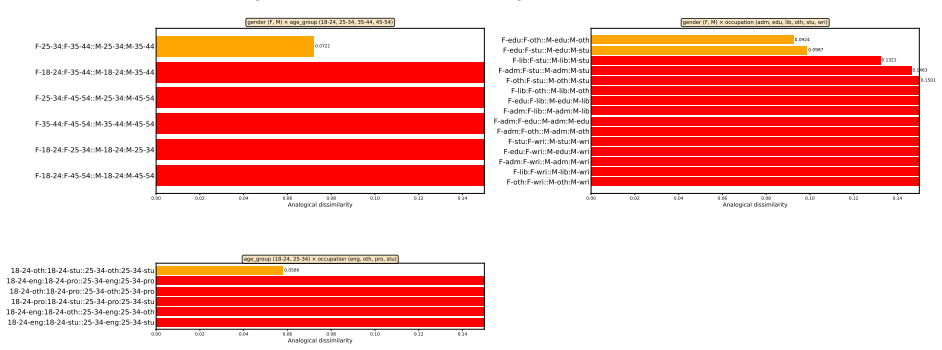
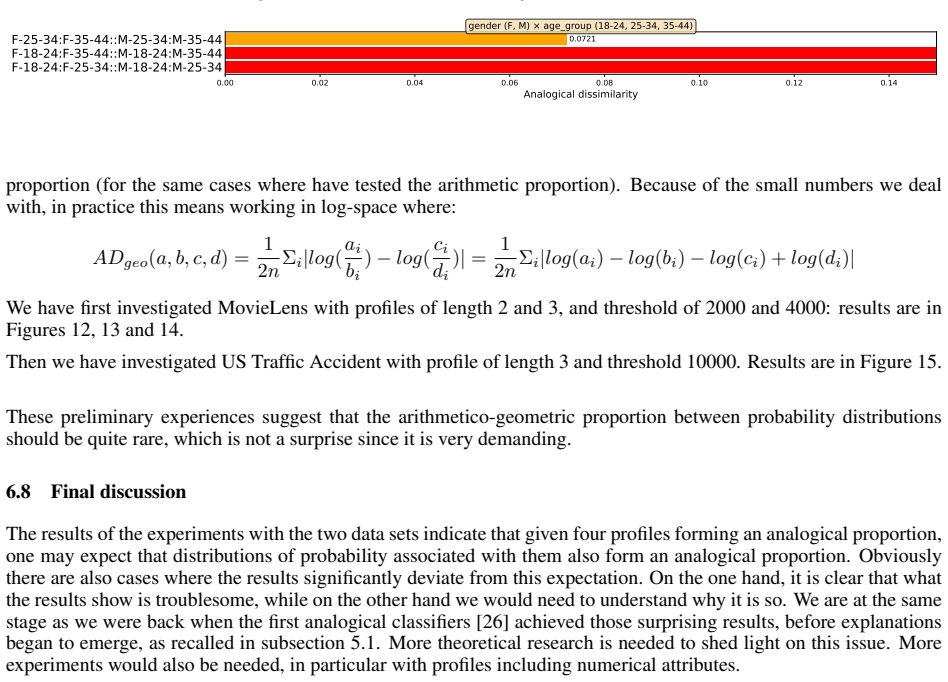
read the original abstract
Analogical proportions link four items a, b, c, d by a relation stating that ``a is to b as c is to d", a, b, c, d being the formal representation of real world entities, ranging from simple numerical values to more complex structures such as profiles. Accordingly, $a, b, c, d$ could be atomic values like Boolean, nominal or numerical values, more generally vectors of such values, or even families of items represented by logical formulas. In this paper, we consider another representation setting, which is the probabilistic one. Precisely, the article proposes a study of {analogical} proportions between probabilities, whether they are simply between probability values, or between distributions (which requires the preservation of their normalization). More particularly, we study the properties of definitions based on arithmetic proportion, or on a combination of the former with geometric proportion, while other options are also discussed. Previous works have shown that when four profiles a, b, c, d, represented as vectors, form analogical proportions componentwise, it is likely that their classes form an analogical proportion also. This is the basis of an analogical proportion-based classification method that can produce accurate predictions. Similarly, in this paper, each profile is associated with a distribution describing the frequencies of the possible values of a discrete attribute of interest. We then discuss and experimentally investigate if the distributions associated to four profiles forming an analogical proportion themselves also form an analogical proportion.
Editorial analysis
A structured set of objections, weighed in public.
Referee Report
Summary. The paper extends analogical proportions (defined via arithmetic or arithmetic+geometric means) from numerical values and componentwise profile vectors to probability values and to discrete frequency distributions. The central claim is that if four profiles a, b, c, d form an analogical proportion componentwise, then the distributions associated with those profiles also form an analogical proportion; the work studies the required normalization preservation for distributions and experimentally investigates whether the inheritance holds, building on prior results where the property transfers to class labels for classification.
Significance. If the inheritance claim is shown to hold while preserving normalization without post-hoc adjustments that invalidate the proportion, the result would extend analogical-proportion classification methods to settings with distributional attributes. This could be useful for AI tasks involving uncertainty or frequency data. The experimental component, if reproducible, would supply falsifiable evidence on the claim.
major comments (2)
- [Abstract] Abstract: the claim that distributions inherit the analogical proportion from componentwise profile vectors is load-bearing, yet the text supplies no explicit definition or derivation showing that applying the arithmetic (or arithmetic+geometric) proportion to the probability values automatically yields four normalized distributions (each summing to 1). Without this, it is impossible to confirm that renormalization is unnecessary or that any required adjustment preserves the proportion relation.
- [Abstract] Abstract: the experimental investigation of the inheritance claim is announced but no information is given on datasets, construction of distributions from profiles, the precise test for whether four distributions satisfy the proportion, or any error analysis; this prevents verification of whether the weakest assumption (no breaking normalization constraints) is satisfied.
minor comments (1)
- The abstract refers to 'previous works' on profile-based classification but does not cite them; adding the references would clarify the baseline.
Simulated Author's Rebuttal
Thank you for your review. We address each major comment below and will revise the abstract to provide the requested clarifications on definitions and experiments.
read point-by-point responses
-
Referee: [Abstract] Abstract: the claim that distributions inherit the analogical proportion from componentwise profile vectors is load-bearing, yet the text supplies no explicit definition or derivation showing that applying the arithmetic (or arithmetic+geometric) proportion to the probability values automatically yields four normalized distributions (each summing to 1). Without this, it is impossible to confirm that renormalization is unnecessary or that any required adjustment preserves the proportion relation.
Authors: The manuscript body provides explicit definitions of the analogical proportions on probability values and derives the conditions under which normalization is preserved for the resulting distributions. We will revise the abstract to include a concise statement of this derivation and the fact that no renormalization is needed as the proportions are defined to maintain the sum-to-one property. revision: yes
-
Referee: [Abstract] Abstract: the experimental investigation of the inheritance claim is announced but no information is given on datasets, construction of distributions from profiles, the precise test for whether four distributions satisfy the proportion, or any error analysis; this prevents verification of whether the weakest assumption (no breaking normalization constraints) is satisfied.
Authors: Details on the experimental setup, including the datasets (standard UCI classification benchmarks), how distributions are derived as normalized frequency vectors from the profiles, the exact proportion test applied to the four distributions, and error metrics, are provided in the experimental section of the manuscript. We will expand the abstract to summarize these elements, enabling readers to verify the normalization preservation. revision: yes
Circularity Check
No significant circularity; extension to distributions is definitional and investigative
full rationale
The paper defines analogical proportions on probabilities and distributions via arithmetic (and arithmetic+geometric) proportions, explicitly noting the need to preserve normalization. It references prior profile-based classification results but treats the distribution case as a parallel investigation to be discussed and tested experimentally rather than derived from those results. No equations reduce the central claim to a self-citation, fitted parameter, or tautological renaming; the componentwise vector case is not used to force the probabilistic outcome by construction. The work remains self-contained against external benchmarks of proportion arithmetic.
Axiom & Free-Parameter Ledger
Reference graph
Works this paper leans on
-
[1]
Prade, G
H. Prade, G. Richard, Analogical proportion-based induction: From classification to creativity, J. of Applied Logics - IfCoLog J. of Logics and their Applic. 11 (2024) 51–87
2024
-
[2]
Sznajder, Janina Hosiasson-Lindenbaum on analogical reasoning: New sources, Erkenntnis 89 (2024) 1349– 1365
M. Sznajder, Janina Hosiasson-Lindenbaum on analogical reasoning: New sources, Erkenntnis 89 (2024) 1349– 1365
2024
-
[3]
Polya, Mathematics and Plausible Reasoning-V ol.1: Induction and analogy in Mathematics, V ol.2: Patterns of Plausible Inference, Princeton Univ
G. Polya, Mathematics and Plausible Reasoning-V ol.1: Induction and analogy in Mathematics, V ol.2: Patterns of Plausible Inference, Princeton Univ. Press, 2nd ed. 1968, 1954
1968
-
[4]
Prade, G
H. Prade, G. Richard, Cataloguing/analogizing: A nonmonotonic view, Int. J. Intell. Syst. 26 (12) (2011) 1176– 1195
2011
-
[5]
S. D. Afantenos, S. Lim, H. Prade, G. Richard, Theoretical study and empirical investigation of sentence analo- gies, in: M. Couceiro, P. Murena (Eds.), Proc. Workshop on the Interactions between Analogical Reasoning and Machine Learning (Int. Joint Conf. on Artificial Intelligence - European Conf. on Artificial Intelligence (IJAI-ECAI’2022)), Vienna, Jul...
2022
-
[6]
T. Webb, K. J. Holyoak, H. Lu, Emergent analogical reasoning in large language models, Nature Human Be- haviour 7 (9) (2023) 1526–1541
2023
-
[7]
C. Stevenson, A. Pafford, H. Maas, M. Mitchell, Can large language models generalize analogy solving like people can?, 10.48550/arXiv.2411.02348 (11 2024). 27 From numerical proportions to analogical proportions between probabilitiesA PREPRINT
-
[8]
Prade, G
H. Prade, G. Richard, Analogical proportions: Why they are useful in AI, in: Proc. 30th Int. Joint Conf. on Artificial Intelligence (IJCAI-21), (Z.-H. Zhou, ed.) Virtual Event / Montreal, Aug. 19-27, 2021, pp. 4568–4576
2021
-
[9]
Gentner, Structure-mapping: A theoretical framework for analogy, Cognit
D. Gentner, Structure-mapping: A theoretical framework for analogy, Cognit. Sci. 7 (2) (1983) 155–170
1983
-
[10]
Falkenhainer, K
B. Falkenhainer, K. D. Forbus, D. Gentner, The structure-mapping engine: Algorithm and examples, Artif. Intell. 41 (1) (1989) 1–63
1989
-
[11]
Gentner, K
D. Gentner, K. J. Holyoak, B. N. Kokinov, The Analogical Mind: Perspectives from Cognitive Science, Cognitive Science, and Philosophy, MIT Press, Cambridge, MA, 2001
2001
-
[12]
M. T. Keane, T. Ledgeway, S. Duff, Constraints on analogical mapping: A comparison of three models, Cognitive Science 18 (3) (1994) 387–438
1994
-
[13]
K. J. Holyoak, Analogy, in: K. J. Holyoak, R. G. Morrison (Eds.), The Cambridge Handbook of Thinking and Reasoning, Cambridge Univ. Press, 2005, pp. 117–142, chap. 6
2005
-
[14]
Gust, K.-U
H. Gust, K.-U. Kühnberger, U. Schmid, Metaphors and heuristic-driven theory projection (hdtp), Theoretical Computer Science 354 (1) (2006) 98–117, algebraic Methods in Language Processing
2006
-
[15]
Klein, Analogy and mysticism and the structure of culture (and Com-ments & Reply), Current Anthropology 24 (2) (1983) 151–180
S. Klein, Analogy and mysticism and the structure of culture (and Com-ments & Reply), Current Anthropology 24 (2) (1983) 151–180
1983
-
[16]
Pirrelli, F
V . Pirrelli, F. Yvon, Analogy in the lexicon: A probe into analogy-based machine learning of language, in: Proc. 6th Int. Symp. on Human Communication, Santiago de Cuba, Cuba, 1999, pp. 576–581
1999
-
[17]
Lepage, Analogy and formal languages, Electr
Y . Lepage, Analogy and formal languages, Electr. Notes TCS 53 (2001)
2001
-
[18]
Delhay, L
A. Delhay, L. Miclet, Analogical equations in sequences: Definition and resolution, in: G. Paliouras, Y . Sakak- ibara (Eds.), Proc. 7th Int. Colloq. on Grammatical Inference(ICGI’04), Athens, V ol. 3264 of LNCS, Springer, 2004, pp. 127–138
2004
-
[19]
Stroppa, F
N. Stroppa, F. Yvon, Du quatrième de proportion comme principe inductif : une proposition et son application à l’apprentissage de la morphologie, Traitement Automatique des Langues 47 (2) (2006) 1–27
2006
-
[20]
Miclet, H
L. Miclet, H. Prade, Handling analogical proportions in classical logic and fuzzy logics settings, in: Proc. 10th Eur. Conf. on Symbolic and Quantitative Approaches to Reasoning with Uncertainty (ECSQARU’09),Verona, Springer, LNCS 5590, 2009, pp. 638–650
2009
-
[21]
Lepage, M
Y . Lepage, M. Couceiro, Analogie et moyenne généralisée, in: Actes des 18èmes Journées d’Intelligence Artif. Fondamentale, La Rochelle, 1-3 Jul., 2024, pp. 114–124
2024
-
[22]
Prade, G
H. Prade, G. Richard, Frank’s triangular norms in Piaget’s logical proportions, in: S. Destercke, M. V . Martinez, G. Sanfilippo (Eds.), Proc. 16th Int. Conf. on Scalable Uncert. Management (SUM’24), Palermo, Nov. 27-29, V ol. 15350 of LNCS, Springer, 2024, pp. 369–377
2024
-
[23]
Prade, G
H. Prade, G. Richard, Diagrammatic analogical reasoning, in: J. Lemanski, M. W. Johansen, E. Manalo, P. Viana, R. Bhattacharjee, R. Burns (Eds.), Proc. 14th Int. Conf. on Diagrammatic Representation and Inference (Dia- grams’24), Münster, Sept. 27 - Oct. 1, V ol. 14981 of LNCS, Springer, 2024, pp. 485–489
2024
-
[24]
T. R. Davies, S. J. Russell, A logical approach to reasoning by analogy, in: J. P. McDermott (Ed.), Proc. 10th Int. Joint Conference on Artificial Intelligence. Milan, Aug. 23-28, Morgan Kaufmann, 1987, pp. 264–270
1987
-
[25]
Bounhas, H
M. Bounhas, H. Prade, G. Richard, Analogy-based classifiers for nominal or numerical data, Int. J. Approx. Reason. 91 (2017) 36–55
2017
-
[26]
Miclet, S
L. Miclet, S. Bayoudh, A. Delhay, Analogical dissimilarity: Definition, algorithms and two experiments in machine learning, J. Artif. Intell. Res. 32 (2008) 793–824
2008
-
[27]
Bounhas, H
M. Bounhas, H. Prade, Analogy-based classifiers: An improved algorithm exploiting competent data pairs, Int. J. Approx. Reason. 158 (2023) 108923
2023
-
[28]
Bounhas, H
M. Bounhas, H. Prade, Revisiting analogical proportions and analogical inference, Int. J. Approx. Reason. 171 (2024) 109202
2024
-
[29]
Prade, G
H. Prade, G. Richard, Analogical proportions analogiques between probabilities, in: M. T. K. Sauerwald (Ed.), Proc. 18th Europ. Conf. on Symbolic and Quantitative Approaches to Reasoning with Uncertainty, Hagen, V ol. 16099 of LNCS, LNCS, Springer, 2025, pp. 148–163
2025
-
[30]
Prade, G
H. Prade, G. Richard, Analogical proportions and probabilities: Are they compatible?, in: T. T. Quan, C. Som- battheera, H. Pham, N. T. Tran (Eds.), Proc. 18th Int. Conf. Multi-disciplinary Trends in Artificial Intelligence (MIW AI’ 20’25), Ho Chi Minh City, Dec. 3-5, Part I, LNCS, Springer, 2025, pp. 217–229. 28 From numerical proportions to analogical p...
2025
-
[31]
Prade, G
H. Prade, G. Richard, Proportions analogiques entre probabilités, in: 19èmes Journées d’IA Fon- damentale (JIAF’25), Plate-Forme Intelligence Artificielle (PFIA), Dijon, 2-4 Juil., https://pfia2025.u- bourgogne.fr/conferences/jiaf/, 2025, pp. 143–151
2025
-
[32]
Prade, G
H. Prade, G. Richard, Analogical proportions: From equality to inequality, Int. J. Approx. Reasoning 101 (2018) 234–254
2018
-
[33]
Prade, G
H. Prade, G. Richard, From analogical proportion to logical proportions, Logica Universalis 7(4) (2013) 441– 505
2013
-
[34]
Barbot, L
N. Barbot, L. Miclet, H. Prade, Analogy between concepts, Art. Intel. 275 (2019) 487–539
2019
-
[35]
Schockaert, Y
S. Schockaert, Y . Ibáñez-García, V . Gutiérrez-Basulto, A description logic for analogical reasoning, in: Z. Zhou (Ed.), Proc. 30th Int. Joint Conf. on Artificial Intelligence (IJCAI’21), 2021, pp. 2040–2046
2021
-
[36]
S. Link, H. Prade, G. Richard, Analogical proportions, multivalued dependencies and explanations, in: F. D. de Saint-Cyr, M. Öztürk-Escoffier, N. Potyka (Eds.), Proc. 15th Int. Conf. on Scalable Uncertainty Management SUM’22, Paris, , Oct. 17-19, V ol. 13562 of LNCS, Springer, 2022, pp. 351–360
2022
-
[37]
P. C. Fischer, D. Van Gucht, Weak multivalued dependencies, in: Proc. 3rd ACM SIGACT-SIGMOD Symp. on Principles of Database Systems, April 2-4, Waterloo, Ontario, 1984, pp. 266–274
1984
-
[38]
Prade, G
H. Prade, G. Richard, Multiple analogical proportions, AI Commun. 34 (3) (2021) 211–228
2021
-
[39]
Dubois, H
D. Dubois, H. Prade, G. Richard, Multiple-valued extensions of analogical proportions, Fuzzy Sets Syst. 292 (2016) 193–202
2016
-
[40]
Dubois, H
D. Dubois, H. Prade, G. Richard, Multiple-valued extensions of analogical proportions, Fuzzy Sets and Systems 292 (2016) 193–202
2016
-
[41]
Lepage, M
Y . Lepage, M. Couceiro, L’analogie numérique revisitée et étendue, précisée, rétrécie ou agrandie, in: Actes des 19èmes Journées d’Intelligence Artif. Fondamentale, Plate-Forme Intelligence Artificielle (PFIA), Dijon, 2-4 Jul., https://pfia2025.u-bourgogne.fr/conferences/jiaf/, 2025, pp. 133–142
2025
-
[42]
L. A. Zadeh, Fuzzy sets as a basis for a theory of possibility, Fuz. Sets & Syst. 1 (1978) 3–28
1978
-
[43]
Dubois, H
D. Dubois, H. Prade, Possibility Theory: An Approach to Computerized Processing of Uncertainty, Plenum Press, 1988
1988
-
[44]
J. Soch, et al., StatProofBook/StatProofBook.github.io: The Book of Statistical Proofs (Version 2023) (2024). doi:10.5281/zenodo.4305949. URLhttps://doi.org/10.5281/zenodo.4305949
-
[45]
A. L. Gibbs, F. E. Su, On choosing and bounding probability metrics, International Statistical Review 70 (2002) 419–435, arXiv:math/0209021 [math.PR]
Pith/arXiv arXiv 2002
-
[46]
A. Ramdas, N. G. Trillos, M. Cuturi, On Wasserstein two-sample testing and related families of nonparametric tests, Entropy 19 (2), arXiv:1509.02237 [math.ST] (2017)
Pith/arXiv arXiv 2017
-
[47]
Couceiro, N
M. Couceiro, N. Hug, H. Prade, G. Richard, Analogy-preserving functions: A way to extend Boolean samples, Proc. of 26th Inter. Joint Conf. on Artificial Intelligence (IJCAI’17), Melbourne (2017) 1575–1581
2017
-
[48]
Couceiro, E
M. Couceiro, E. Lehtonen, L. Miclet, H. Prade, G. Richard, When nominal analogical proportions do not fail, in: J. Davis, K. Tabia (Eds.), Proc. 14th Int. Conf. on Scalable Uncertainty Management (SUM’20), Bozen-Bolzano, Sept. 23-25, V ol. 12322 of LNCS, Springer, 2020, pp. 68–83
2020
-
[49]
Couceiro, N
M. Couceiro, N. Hug, H. Prade, G. Richard, Behavior of analogical inference w.r.t. Boolean functions, in: Proc. 27th IJCAI Stockholm, 2018, pp. 2057–2063
2018
-
[50]
Cunha, Y
F. Cunha, Y . Lepage, M. Couceiro, Z. Bouraoui, Generalizing analogical inference from boolean to continuous domains, in: S. Koenig, C. Jenkins, M. E. Taylor (Eds.), Proc. 40th AAAI Conference on Artificial Intelligence, AAAI 2026, Singapore, Jan. 20-27, 2026, AAAI Press, 2026, pp. 19021–19029
2026
-
[51]
F. M. Harper, J. A. Konstan, The MovieLens datasets: History and context, ACM Transactions on Interactive Intelligent Systems 5 (4) (2015) 1–19
2015
-
[52]
S. Moosavi, M. S. S. Hosseinabad, R. Ramnath, A. Nandi, A countrywide traffic accident dataset, arXiv preprint arXiv:1906.05409 (2019)
Pith/arXiv arXiv 1906
-
[53]
Fuchs, J
B. Fuchs, J. Lieber, L. Miclet, A. Mille, A. Napoli, H. Prade, G. Richard, Case-based reasoning, analogy, and interpolation, in: P. Marquis, O. Papini, H. Prade (Eds.), A Guided Tour of Artificial Intelligence Research: V olume I: Knowledge Representation, Reasoning and Learning, Springer, 2020, pp. 307–339
2020
-
[54]
H. Wang, Q. Yang, Transfer learning by structural analogy, in: W. Burgard, D. Roth (Eds.), Proc. 25th AAAI Conf. on Artificial Intelligence, (AAAI’11), San Francisco, Aug.7-11, AAAI Press, 2011, pp. 513–518. 29
2011
discussion (0)
Sign in with ORCID, Apple, or X to comment. Anyone can read and Pith papers without signing in.