DrivingVoxels: Compositional Sparse Voxel Rasterization for Dynamic Driving Scene Reconstruction
Pith reviewed 2026-06-26 09:09 UTC · model grok-4.3
The pith
DrivingVoxels reconstructs dynamic driving scenes by jointly rasterizing sparse voxels from separate octrees for each rigid object and the static background.
A machine-rendered reading of the paper's core claim, the machinery that carries it, and where it could break.
Core claim
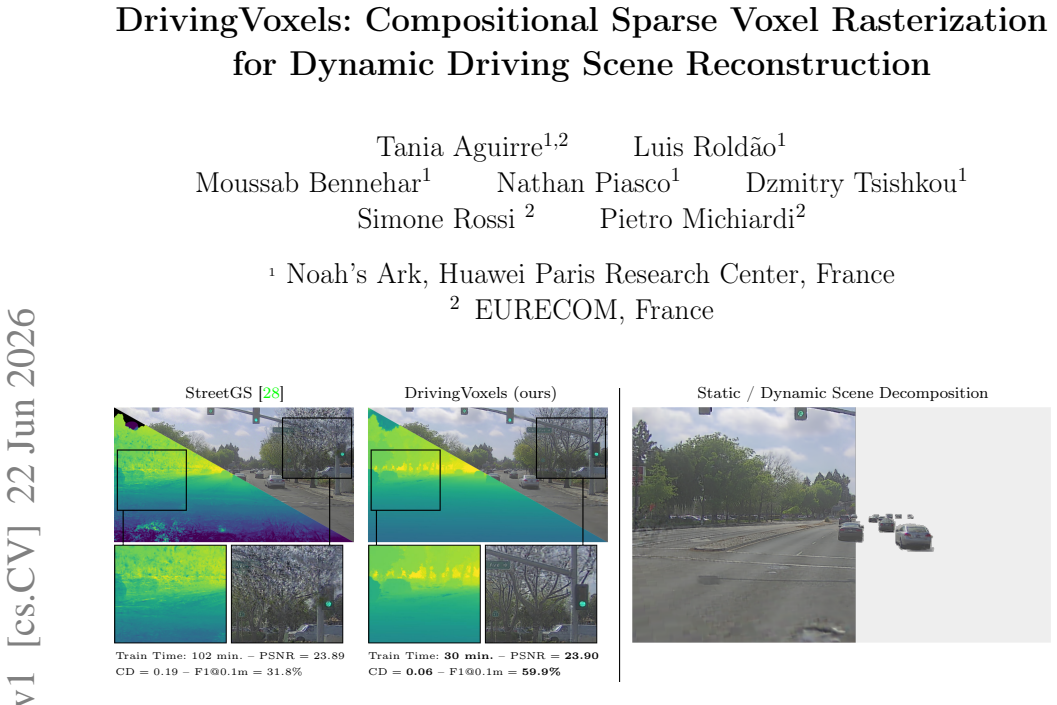
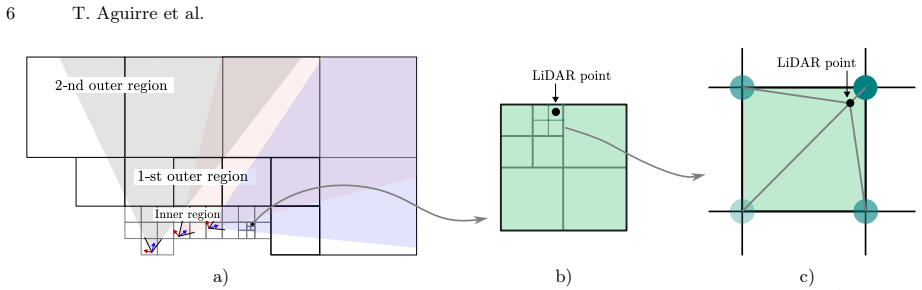
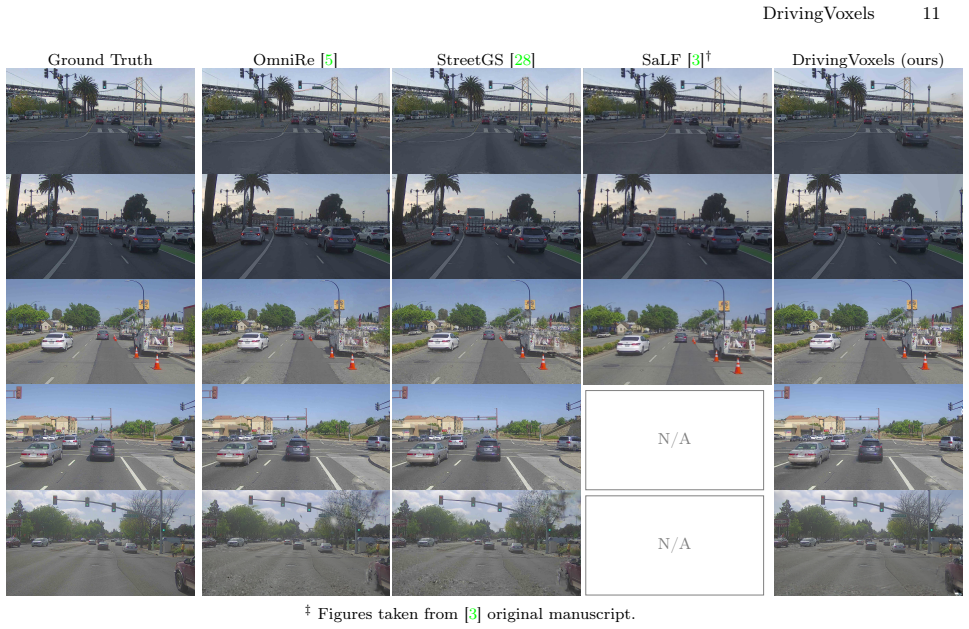
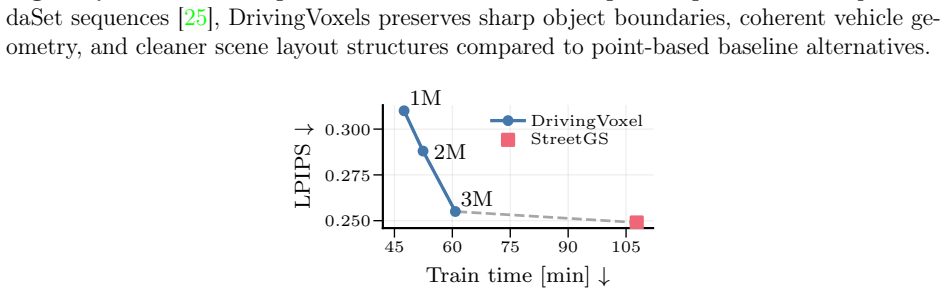
DrivingVoxels is a compositional sparse voxel rendering framework that jointly rasterizes voxels from multiple independent octrees within a single rendering pass. Each rigid dynamic object is represented by an octree defined in its local coordinate frame, while a separate static octree models the stationary background. The approach adopts a fully explicit, neural-free representation together with a LiDAR-guided structural initialization that efficiently captures scene geometry. On the PandaSet benchmark the method matches prior 3DGS-based work on perceptual metrics for novel-view synthesis and reconstruction, exceeds it on structural metrics, and requires shorter training times.
What carries the argument
Joint single-pass rasterization of multiple independent octrees, one per rigid dynamic object in its local frame plus one static background octree.
If this is right
- Perceptual quality for novel view synthesis and reconstruction stays on par with prior 3DGS methods.
- Structural metrics improve relative to those methods on the same benchmark.
- Training completes in less time because of the LiDAR-anchored optimization workflow.
- Memory growth remains controllable even as the driving scene expands.
Where Pith is reading between the lines
- The local-frame octrees could be updated independently when new object tracks become available, supporting online map maintenance.
- Because the representation is fully explicit, the same octrees could be directly exported for use in physics simulators without additional conversion steps.
- The single-pass joint rasterization may extend naturally to include additional sensor modalities such as radar returns placed in the same coordinate frames.
Load-bearing premise
That each rigid dynamic object can be modeled by an independent octree in its local coordinate frame and rasterized jointly with the static background without extra mechanisms for non-rigid motion or unbounded scene growth.
What would settle it
A measurable drop in structural metrics on a test sequence containing non-rigid motion such as walking pedestrians, when compared against a baseline that explicitly models deformation.
Figures





read the original abstract
Reconstructing dynamic urban scenes remains challenging due to the unbounded nature of driving environments and the presence of multiple dynamic objects. Currently, potentially faster sparse voxel methods are mainly designed for static scenarios. On the other hand, dynamic approaches based on 3D Gaussian Splatting, despite their high-fidelity, are often time-consuming for driving scenarios and exhibit uncontrollable memory growth in large scenes. To address these limitations, we present DrivingVoxels, a compositional sparse voxel rendering framework for dynamic driving scenes. Our method jointly rasterizes sparse voxels from multiple independent octrees within a single rendering pass. Each rigid dynamic object is represented by an octree defined in its local coordinate frame, while a separate static octree models the stationary background. DrivingVoxels adopts a fully explicit, neural-free representation together with a LiDAR-guided structural initialization that efficiently captures scene geometry. We evaluate our framework on the PandaSet benchmark, demonstrating that DrivingVoxels performs on par on perceptual metrics and better on structural metrics for NVS and reconstruction while requiring shorter training times than previous 3DGS-base methods to an efficient optimization workflow anchored by a strong LiDAR prior.
Editorial analysis
A structured set of objections, weighed in public.
Referee Report
Summary. The paper introduces DrivingVoxels, a compositional sparse voxel rasterization framework for dynamic driving scene reconstruction. It jointly renders from a static background octree and independent octrees for each rigid dynamic object (defined in local coordinates), using a fully explicit neural-free representation with LiDAR-guided initialization. On PandaSet, it claims on-par perceptual metrics, superior structural metrics for novel view synthesis and reconstruction, and shorter training times than prior 3DGS-based methods.
Significance. If the compositional octree design and LiDAR prior deliver the claimed efficiency and quality, the work offers a practical explicit alternative to 3DGS for large-scale dynamic urban scenes, with potential advantages in training speed and memory control for driving applications.
major comments (2)
- [Abstract] Abstract: The performance claims (on-par perceptual, better structural metrics, shorter training) rest on the compositional structure maintaining fidelity for rigid objects only. The manuscript must explicitly address how non-rigid elements (pedestrians, cyclists) common in PandaSet are handled or approximated, as this directly affects whether the reconstruction advantages hold.
- [Abstract] Abstract and Method: No mechanism is described for controlling memory growth as the vehicle trajectory lengthens in unbounded scenes. The claim that independent local octrees prevent uncontrollable growth requires a concrete analysis or bound (e.g., memory vs. trajectory length) to support the efficiency advantage over 3DGS.
minor comments (1)
- [Abstract] Abstract: The final sentence contains a grammatical issue ('than previous 3DGS-base methods to an efficient optimization workflow'); rephrase for clarity.
Simulated Author's Rebuttal
We thank the referee for the constructive comments, which help clarify the scope and strengthen the efficiency claims. We address each major comment below and will revise the manuscript accordingly.
read point-by-point responses
-
Referee: [Abstract] Abstract: The performance claims (on-par perceptual, better structural metrics, shorter training) rest on the compositional structure maintaining fidelity for rigid objects only. The manuscript must explicitly address how non-rigid elements (pedestrians, cyclists) common in PandaSet are handled or approximated, as this directly affects whether the reconstruction advantages hold.
Authors: We agree that explicit clarification is needed. The framework is designed exclusively for rigid dynamic objects, as stated in the abstract and method: each such object receives an independent octree in its local coordinate frame, while the background uses a separate static octree. Non-rigid elements (pedestrians, cyclists) in PandaSet fall outside this design and are not assigned dedicated dynamic octrees; they may be approximated as rigid during segmentation or partially absorbed into the static background octree. In the revised manuscript we will add a paragraph in Section 3 and a qualifying sentence in the abstract to state this scope limitation and note that the reported metrics apply to the rigid-object subset of the scenes. revision: yes
-
Referee: [Abstract] Abstract and Method: No mechanism is described for controlling memory growth as the vehicle trajectory lengthens in unbounded scenes. The claim that independent local octrees prevent uncontrollable growth requires a concrete analysis or bound (e.g., memory vs. trajectory length) to support the efficiency advantage over 3DGS.
Authors: We acknowledge that a quantitative memory analysis would strengthen the efficiency argument. The compositional design keeps each dynamic object in its own local octree, so memory scales with the number and geometric complexity of objects rather than total path length; new objects encountered along an extended trajectory receive new, bounded octrees instead of accumulating primitives in a single global structure. The current manuscript does not contain an explicit plot or bound relating memory to trajectory length. In the revision we will add an analysis subsection with both theoretical reasoning and empirical measurements on longer PandaSet sequences, directly comparing memory growth curves against 3DGS baselines. revision: yes
Circularity Check
No circularity; method is a direct compositional design with external benchmarks
full rationale
The paper introduces DrivingVoxels as an explicit compositional sparse voxel framework using independent octrees for rigid objects and background, initialized via LiDAR. No derivation chain, equations, or predictions are presented that reduce to fitted inputs or self-citations by construction. Performance claims rest on external PandaSet evaluation against prior 3DGS methods, with no self-referential fitting or uniqueness theorems invoked. The design assumptions (rigidity, bounded growth) are stated explicitly as limitations rather than derived results. This is a standard engineering contribution without load-bearing circular steps.
Axiom & Free-Parameter Ledger
Reference graph
Works this paper leans on
-
[1]
In: Proc
Chen, A., Xu, Z., Geiger, A., Yu, J., Su, H.: TensoRF: Tensorial radiance fields. In: Proc. of the European Conf. on Computer Vision (ECCV) (2022)
2022
-
[2]
In: Proc
Chen, Y., Dong, S., Wang, X., Cai, L., Zheng, Y., Yang, Y.: SG-NeRF: Neural surface reconstruction with scene graph optimization. In: Proc. of the European Conf. on Computer Vision (ECCV) (2024)
2024
-
[3]
In: Proc
Chen, Y., Haines, M., Wang, J., Baron-Lis, K., Manivasagam, S., Yang, Z., Urtasun, R.: SaLF: Sparse local fields for multi-sensor rendering in real-time. In: Proc. IEEE International Conf. on Robotics and Automation (ICRA) (2026)
2026
-
[4]
International Journal of Computer Vision (IJCV) (2026)
Chen, Y., Gu, C., Jiang, J., Zhu, X., Zhang, L.: Periodic vibration gaussian: Dynamic urban scene reconstruction and real-time rendering. International Journal of Computer Vision (IJCV) (2026)
2026
-
[5]
In: International Conf
Chen, Z., Yang, J., Huang, J., de Lutio, R., Esturo, J.M., Ivanovic, B., Litany, O., Gojcic, Z., Fidler, S., Pavone, M., Song, L., Wang, Y.: OmniRe: Omni urban scene reconstruction. In: International Conf. on Learning Repre- sentations (ICLR) (2025)
2025
-
[6]
In: IEEE Conf
Djeghim, H., Piasco, N., Bennehar, M., Roldao, L., Tsishkou, D., Sidibé, D.: ViiNeuS: Volumetric initialization for implicit neural surface reconstruction of urban scenes with limited image overlap. In: IEEE Conf. on Computer Vision and Pattern Recognition (CVPR)) (2025)
2025
-
[7]
In: IEEE Conf
Fridovich-Keil, S., Yu, A., Tancik, M., Chen, Q., Recht, B., Kanazawa, A.: Plenoxels: Radiance fields without neural networks. In: IEEE Conf. on Computer Vision and Pattern Recognition (CVPR) (2022)
2022
-
[8]
In: IEEE Conf
Guédon, A., Lepetit, V.: SuGaR: Surface-aligned gaussian splatting for efficient 3d mesh reconstruction and high-quality mesh rendering. In: IEEE Conf. on Computer Vision and Pattern Recognition (CVPR) (2024)
2024
-
[9]
Guo, J., Deng, N., Li, X., Bai, Y., Shi, B., Wang, C., Ding, C., Wang, D., Li, Y.: StreetSurf: Extending multi-view implicit surface reconstruction to street views. arXiv:2306.04988 (2023)
-
[10]
Herau, Q., Piasco, N., Bennehar, M., Rolado, L., Tsishkou, D.V., Liu, B., Migniot, C., Vasseur, P., Demonceaux, C.: Pose optimization for autonomous driving datasets using neural rendering models. arXiv:2504.15776 (2025)
-
[11]
ACM Transactions on Graphics (TOG) (2023)
Kerbl, B., Kopanas, G., Leimkuehler, T., Drettakis, G.: 3D gaussian splatting for real-time radiance field ren- dering. ACM Transactions on Graphics (TOG) (2023)
2023
-
[12]
In: Advances in Neural Information Processing Systems (NeurIPS) (2025) 16 T
Li, J., Zhang, J., Zhang, Y., Bai, X., Zheng, J., Yu, X., Gu, L.: GeoSVR: Taming sparse voxels for geometrically accurate surface reconstruction. In: Advances in Neural Information Processing Systems (NeurIPS) (2025) 16 T. Aguirre et al
2025
-
[13]
In: Advances in Neural Information Processing Systems (NeurIPS) (2020)
Liu, L., Gu, J., Lin, K.Z., Chua, T.S., Theobalt, C.: Neural sparse voxel fields. In: Advances in Neural Information Processing Systems (NeurIPS) (2020)
2020
-
[14]
In: Proc
Mildenhall, B., Srinivasan, P.P., Tancik, M., Barron, J.T., Ramamoorthi, R., Ng, R.: NeRF: Representing scenes as neural radiance fields for view synthesis. In: Proc. of the European Conf. on Computer Vision (ECCV) (2020)
2020
-
[15]
ACM Transactions on Graphics (SIGGRAPH) (2022)
Müller, T., Evans, A., Schied, C., Keller, A.: Instant neural graphics primitives with a multiresolution hash encoding. ACM Transactions on Graphics (SIGGRAPH) (2022)
2022
-
[16]
Oh, S., Choe, J., Lee, D., Lee, D., Jeong, S., Wang, Y.C.F., Park, J.: SVRecon: Sparse voxel rasterization for surface reconstruction. arXiv:2511.17364 (2025)
-
[17]
In: IEEE Conference on Computer Vision and Pattern Recognition (CVPR) (June 2024)
Ranzinger, M., Heinrich, G., Molchanov, P., Kautz, J.: AM-RADIO: Agglomerative model - reduce all domains into one. In: IEEE Conference on Computer Vision and Pattern Recognition (CVPR) (June 2024)
2024
-
[18]
In: IEEE Conf
Sun, C., Choe, J., Loop, C., Ma, W.C., Wang, Y.C.F.: Sparse voxels rasterization: Real-time high-fidelity radiance field rendering. In: IEEE Conf. on Computer Vision and Pattern Recognition (CVPR) (2025)
2025
-
[19]
In: IEEE Conf
Sun, C., Sun, M., Chen, H.: Direct voxel grid optimization: Super-fast convergence for radiance fields reconstruc- tion. In: IEEE Conf. on Computer Vision and Pattern Recognition (CVPR) (2022)
2022
-
[20]
In: IEEE Conf
Tonderski, A., Lindström, C., Hess, G., Ljungbergh, W., Svensson, L., Petersson, C.: NeuRAD: Neural rendering for autonomous driving. In: IEEE Conf. on Computer Vision and Pattern Recognition (CVPR) (2024)
2024
-
[21]
In: IEEE Conf
Turki, H., Ramanathan, J., Mahajan, R., Bi, Z., Isola, P., Deva, R.: SUDS: Scalable unbounded dynamic scenes. In: IEEE Conf. on Computer Vision and Pattern Recognition (CVPR) (2023)
2023
-
[22]
In: International Conference on 3D Vision (3DV) (2026)
WANG, F., Djeghim, H., Moutarde, F., Sidibé, D.: J-neus: Joint field optimization for neural surface reconstruc- tion in urban scenes with limited image overlap. In: International Conference on 3D Vision (3DV) (2026)
2026
-
[23]
In: International Conference on 3D Vision (3DV) (2024)
Wang, F., Louys, A., Piasco, N., Bennehar, M., Roldãao, L., Tsishkou, D.: Planerf: Svd unsupervised 3d plane regularization for nerf large-scale urban scene reconstruction. In: International Conference on 3D Vision (3DV) (2024)
2024
-
[24]
Wang, F., Piasco, N., Bennehar, M., Roldão, L., Tsishkou, D., Moutarde, F.: LESV: Language embedded sparse voxel fusion for open-vocabulary 3D scene understanding. arXiv:2604.01388 (2026)
-
[25]
In: IEEE International Intelligent Transportation Systems Conference (ITSC) (2021)
Xiao, P., Shao, Z., Hao, S., Zhang, Z., Chai, X., Jiao, J., Li, Z., Wu, J., Sun, K., Jiang, K., et al.: Pandaset: Advanced sensor suite dataset for autonomous driving. In: IEEE International Intelligent Transportation Systems Conference (ITSC) (2021)
2021
-
[26]
In: Neural Information Processing Systems (NeurIPS) (2021)
Xie, E., Wang, W., Yu, Z., Anandkumar, A., Alvarez, J.M., Luo, P.: Segformer: Simple and efficient design for semantic segmentation with transformers. In: Neural Information Processing Systems (NeurIPS) (2021)
2021
-
[27]
In: IEEE Conf
Yan, C., Qu, D., Xu, D., Zhao, B., Wang, Z., Wang, D., Li, X.: GS-SLAM: Dense visual slam with 3D gaussian splatting. In: IEEE Conf. on Computer Vision and Pattern Recognition (CVPR) (2024)
2024
-
[28]
In: Proc
Yan, Y., Lin, H., Zhou, C., Wang, W., Sun, H., Zhan, K., Lang, X., Zhou, X., Peng, S.: Street gaussians: Modeling dynamic urban scenes with gaussian splatting. In: Proc. of the European Conf. on Computer Vision (ECCV) (2024)
2024
-
[29]
In: Advances in Neural Information Processing Systems (NeurIPS) (2024)
Yang, L., Kang, B., Huang, Z., Zhao, Z., Xu, X., Feng, J., Zhao, H.: Depth anything v2. In: Advances in Neural Information Processing Systems (NeurIPS) (2024)
2024
-
[30]
In: IEEE Conf
Yang, Z., Chen, Y., Wang, J., Manivasagam, S., Ma, W.C., Yang, A.J., Urtasun, R.: UniSim: A neural closed-loop sensor simulator. In: IEEE Conf. on Computer Vision and Pattern Recognition (CVPR) (2023)
2023
-
[31]
In: IEEE Conf
Zhou, X., Lin, Z., Shan, X., Wang, Y., Sun, D., Yang, M.H.: DrivingGaussian: Composite gaussian splatting for surrounding dynamic autonomous driving scenes. In: IEEE Conf. on Computer Vision and Pattern Recognition (CVPR) (2024) DrivingVoxels 17 A Algorithmic Multi-Octree Render Our rendering pipeline handles a static background (Obg) and a dynamic sequen...
2024
discussion (0)
Sign in with ORCID, Apple, or X to comment. Anyone can read and Pith papers without signing in.