Deviance from a pink noise regime in the temporal organization of semantic relations in psychosis
Pith reviewed 2026-06-26 06:44 UTC · model grok-4.3
The pith
In psychosis, semantic relations in speech display abnormally strong long-range correlations, deviating from the pink noise regime seen in healthy controls.
A machine-rendered reading of the paper's core claim, the machinery that carries it, and where it could break.
Core claim
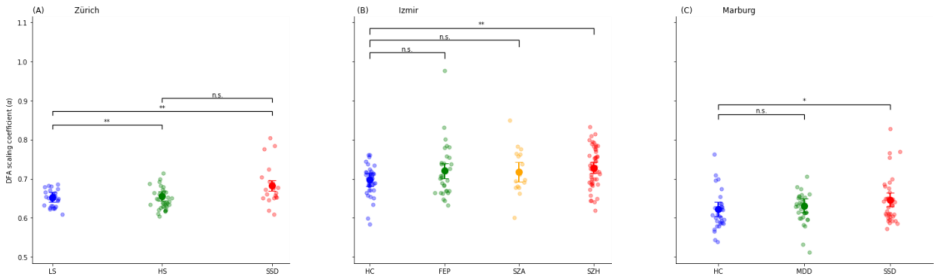
Across all datasets, patients exhibited significantly elevated scaling exponents relative to controls, indicating abnormally strong long-range correlations with excessive persistence in semantic fluctuations.
What carries the argument
Detrended fluctuation analysis applied to BERT-derived cosine-similarity time series from discourse transcripts, which quantifies the strength of long-range temporal correlations in semantic space trajectories.
Load-bearing premise
That BERT-derived continuous cosine-similarity time series accurately capture the temporal organization of semantic relations as they unfold in natural discourse transcripts.
What would settle it
A replication study using different language models or manual semantic coding that finds no significant difference in scaling exponents between patient and control groups would falsify the claim.
Figures
read the original abstract
The notion of pink noise refers to 'scale-invariant' temporal dynamics, where fluctuations exhibit similar statistical structure across time scales. Departures from a regime associated with such scale-free organization toward uncorrelated 'white' noise or overly persistent 'brown' noise have been widely identified as markers of pathology across physiological and cognitive domains. Whether comparable alterations characterize the temporal organization of language remains largely unexplored. We address this question in the domain of psychosis, where language anomalies are pervasively documented. Specifically, we apply detrended fluctuation analysis (DFA) to quantify temporal scaling in BERT-derived continuous cosine-similarity time series capturing trajectories through semantic space, using clinical transcripts from patients and controls across three independent datasets. DFA scaling exponents were extracted to characterize the strength of long-range temporal correlations. Across all datasets, patients exhibited significantly elevated scaling exponents relative to controls, indicating abnormally strong long-range correlations with excessive persistence in semantic fluctuations. This temporal analysis opens a window into the multi-timescale organization of meaning as it unfolds in discourse. The results reveal a signature of altered temporal scaling in speech, consistent with deviations from criticality in physiological domains, paralleling known departures from criticality in brain function in psychosis and suggesting possible links between these two domains.
Editorial analysis
A structured set of objections, weighed in public.
Referee Report
Summary. The manuscript applies detrended fluctuation analysis (DFA) to BERT-derived continuous cosine-similarity time series extracted from clinical transcripts across three independent datasets. It reports that patients with psychosis exhibit significantly elevated DFA scaling exponents relative to controls, interpreted as abnormally strong long-range correlations and excessive persistence in semantic fluctuations, indicating a departure from a pink-noise regime toward more persistent dynamics.
Significance. If substantiated with full statistical reporting and validation of the time-series construction, the work would extend concepts of scale-free dynamics and criticality from physiology to the temporal organization of semantic relations in discourse. It could provide a quantitative bridge between language anomalies in psychosis and known departures from criticality in brain function, using a parameter-light DFA approach on embedding-derived trajectories.
major comments (3)
- [Abstract] Abstract: the claim of 'significantly elevated scaling exponents' across all datasets is stated without sample sizes, effect sizes, p-values, confidence intervals, or details on the statistical tests employed; this information is load-bearing for the central claim of a group difference and must be supplied in the main text and abstract.
- [Abstract] Abstract/Methods (implied): the construction of the 'BERT-derived continuous cosine-similarity time series' is not specified (token-level embeddings, aggregation method, handling of variable transcript lengths, or stationarity checks), so it is impossible to evaluate whether the series isolate semantic fluctuation trajectories or instead reflect embedding-space geometry, lexical-choice artifacts, or speech-rate confounds common in psychosis transcripts.
- [Abstract] Abstract: no mention is made of validation that the DFA time series meet the stationarity assumptions required for reliable exponent estimation, nor of any controls for speech-rate differences between groups; both are necessary to support the interpretation of elevated exponents as a signature of altered semantic organization.
minor comments (1)
- [Abstract] Abstract: the phrase 'pink noise regime' is used without a brief definition or reference to the canonical DFA exponent range (~0.5–1.5) that distinguishes it from white or brown noise.
Simulated Author's Rebuttal
We thank the referee for the constructive comments, which help clarify the presentation of our results. We address each major point below and will incorporate revisions to strengthen the manuscript.
read point-by-point responses
-
Referee: [Abstract] Abstract: the claim of 'significantly elevated scaling exponents' across all datasets is stated without sample sizes, effect sizes, p-values, confidence intervals, or details on the statistical tests employed; this information is load-bearing for the central claim of a group difference and must be supplied in the main text and abstract.
Authors: We agree that the abstract and main text should report these details to support the central claim. The revised version will include sample sizes per dataset and group, effect sizes (e.g., Cohen's d), p-values, confidence intervals, and the specific statistical tests (two-sample t-tests or non-parametric equivalents after checking normality) in both the abstract and Results section. revision: yes
-
Referee: [Abstract] Abstract/Methods (implied): the construction of the 'BERT-derived continuous cosine-similarity time series' is not specified (token-level embeddings, aggregation method, handling of variable transcript lengths, or stationarity checks), so it is impossible to evaluate whether the series isolate semantic fluctuation trajectories or instead reflect embedding-space geometry, lexical-choice artifacts, or speech-rate confounds common in psychosis transcripts.
Authors: The Methods section details the use of token-level embeddings from a pre-trained BERT model, computation of consecutive-token cosine similarities to form the time series, and handling of variable transcript lengths via consistent segmentation into fixed windows. To address the concern directly, the revision will add a concise description of this construction to the abstract and explicitly discuss potential confounds such as lexical choice or embedding geometry, along with any mitigation steps. revision: yes
-
Referee: [Abstract] Abstract: no mention is made of validation that the DFA time series meet the stationarity assumptions required for reliable exponent estimation, nor of any controls for speech-rate differences between groups; both are necessary to support the interpretation of elevated exponents as a signature of altered semantic organization.
Authors: We agree these validations are important for interpretation. The revised manuscript will report stationarity checks (e.g., results from the Augmented Dickey-Fuller test or visual inspection of trends) on the DFA time series and will include analyses or covariates addressing speech-rate differences (e.g., words per minute) between groups, either as supplementary controls or by noting their absence as a limitation if they prove non-significant. revision: yes
Circularity Check
No significant circularity detected
full rationale
The derivation proceeds from construction of BERT cosine-similarity time series, through direct application of DFA to extract scaling exponents, to group comparison. No step reduces by construction to a fitted parameter renamed as prediction, no self-definitional loop exists between the scaling exponent and the input series, and no load-bearing self-citation or uniqueness theorem is invoked. The central empirical claim remains independent of its own inputs.
Axiom & Free-Parameter Ledger
axioms (2)
- domain assumption BERT embeddings and cosine similarity produce time series that reflect semantic relations in spoken discourse.
- domain assumption Detrended fluctuation analysis is valid for detecting long-range correlations in these semantic similarity series.
Reference graph
Works this paper leans on
-
[1]
Meaning unfolds over time and over multiple timescales , from single words to phrases to sentences to discourse and conversation
Introduction Language production is a fundamentally temporal process. Meaning unfolds over time and over multiple timescales , from single words to phrases to sentences to discourse and conversation. These timescales are not independent from each other but hierarchically organized , inviting the study of potential self -repeating properties across scales....
-
[2]
Demographics for all samples are summarized in Table 1, along with differences between groups
Methods Datasets Three datasets – here referred to as Zürich (Switzerland), Marburg (Germany), and Izmir (Turkey) – were used in this analysis. Demographics for all samples are summarized in Table 1, along with differences between groups. The Zürich dataset [33–35] is comprised of recordings from 85 Swiss- German speakers: 20 patients with schizophrenia (...
2020
-
[3]
were used to examine clinical factors related to negative and positive symptoms respectively. Speech was elicited through a picture description/story telling task: the Thematic Apperception Test (TAT; 40) using the methodology outlined for assessing the Thought and Language Index (TLI; 41). Transcriptions were conducted manually. Ethical permissions for t...
-
[4]
Results Group comparisons Individuals with psychosis showed a consistently higher scaling coefficient s as compared to healthy controls across all datasets, indicating more persistent long-range temporal correlations in semantic similarity time series. In the Zürich dataset, a n adjusted linear regression model predicting DFA scaling exponents from diagno...
-
[5]
Discussion The present study examined whether speech in psychosis exhibits alterations in the temporal scaling properties in their semantic similarity time series. Across all three datasets, patients with SSD had consistently higher DFA scaling exponents relative to healthy controls, indicating overly persistent long-range temporal correlations in speech ...
-
[6]
show that parent-child dyads in autism spectrum disorder exhibit higher hierarchical temporal scaling, reflecting an increased clustering of speech and silences and decreased flexibility in the balance of vocal event timings compared to control dyads. Given findings of increased pressure of speech with positive symptoms of SSD and slower speech correlated...
-
[7]
Conclusions This study provides evidence of an alteration of the temporal distribution of semantic similarity values in psychosis, suggesting a possible deviation from criticality in speech in the disorder. We applied DFA to word -level cosine similarity time series across three independent datasets and found that patients with SSD exhibited significantly...
-
[8]
2010 Scaling laws in cognitive sciences
Kello CT, Brown GDA, Ferrer-i-Cancho R, Holden JG, Linkenkaer-Hansen K, Rhodes T, Orden GCV. 2010 Scaling laws in cognitive sciences. Trends Cogn. Sci. 14, 223–232. (doi:10.1016/j.tics.2010.02.005)
-
[9]
2022 How critical is brain criticality? Trends Neurosci
O’Byrne J, Jerbi K. 2022 How critical is brain criticality? Trends Neurosci. 45, 820–837. (doi:10.1016/j.tins.2022.08.007)
-
[10]
2023 Heterogeneity extends criticality
Sánchez-Puig F, Zapata O, Pineda OK, Iñiguez G, Gershenson C. 2023 Heterogeneity extends criticality. Front. Complex Syst. 1. (doi:10.3389/fcpxs.2023.1111486)
-
[11]
2012 On the origin of long-range correlations in texts
Altmann EG, Cristadoro G, Esposti MD. 2012 On the origin of long-range correlations in texts. Proc. Natl. Acad. Sci. 109, 11582–11587. (doi:10.1073/pnas.1117723109)
-
[12]
2017 Goals and strategies influence lexical prediction during sentence comprehension
Brothers T, Swaab TY, Traxler MJ. 2017 Goals and strategies influence lexical prediction during sentence comprehension. J. Mem. Lang. 93, 203–216. (doi:10.1016/j.jml.2016.10.002)
-
[13]
1994 Mosaic organization of DNA nucleotides
Peng CK, Buldyrev SV, Havlin S, Simons M, Stanley HE, Goldberger AL. 1994 Mosaic organization of DNA nucleotides. Phys. Rev. E Stat. Phys. Plasmas Fluids Relat. Interdiscip. Top. 49, 1685–1689. (doi:10.1103/physreve.49.1685)
-
[14]
2025 Is criticality a unified setpoint of brain function? Neuron 113, 2582-2598.e2
Hengen KB, Shew WL. 2025 Is criticality a unified setpoint of brain function? Neuron 113, 2582-2598.e2. (doi:10.1016/j.neuron.2025.05.020)
-
[15]
2011 Living in the Pink: Intentionality, Wellbeing, and Complexity
Van Orden GC, Kloos H, Wallot S. 2011 Living in the Pink: Intentionality, Wellbeing, and Complexity. In Philosophy of Complex Systems (ed C Hooker), pp. 629–672. Amsterdam: North-Holland. (doi:10.1016/B978-0-444-52076-0.50022-5)
-
[16]
Hausdorff JM, Mitchell SL, Firtion R, Peng CK, Cudkowicz ME, Wei JY, Goldberger AL. 1997 Altered fractal dynamics of gait: reduced stride-interval correlations with aging and Huntington’s disease. J. Appl. Physiol. 82, 262–269. (doi:10.1152/jappl.1997.82.1.262)
-
[17]
2006 Where Medicine Went Wrong: Rediscovering The Path To Complexity
West BJ. 2006 Where Medicine Went Wrong: Rediscovering The Path To Complexity. World Scientific
2006
-
[18]
2007 Power-law temporal autocorrelation of activity reflects severity of parkinsonism
Pan W, Ohashi K, Yamamoto Y, Kwak S. 2007 Power-law temporal autocorrelation of activity reflects severity of parkinsonism. Mov. Disord. Off. J. Mov. Disord. Soc. 22, 1308–
2007
-
[19]
(doi:10.1002/mds.21527)
-
[20]
2017 Criticality in Formal Languages and Statistical Physics
Lin HW, Tegmark M. 2017 Criticality in Formal Languages and Statistical Physics. Entropy 19, 299. (doi:10.3390/e19070299)
-
[21]
2006 When language breaks into pieces
Ferrer-i-Cancho R. 2006 When language breaks into pieces. A conflict between communication through isolated signals and language. Biosystems 84, 242–253. (doi:10.1016/j.biosystems.2005.12.001) 20
-
[22]
2015 Scaling and universality in the human voice
Luque J, Luque B, Lacasa L. 2015 Scaling and universality in the human voice. J. R. Soc. Interface 12, 20141344. (doi:10.1098/rsif.2014.1344)
-
[23]
2024 The ‘L-factor’: Language as a transdiagnostic dimension in psychopathology
Hinzen W, Palaniyappan L. 2024 The ‘L-factor’: Language as a transdiagnostic dimension in psychopathology. Prog. Neuropsychopharmacol. Biol. Psychiatry 131, 110952. (doi:10.1016/j.pnpbp.2024.110952)
-
[24]
2022 Automatic language analysis identifies and predicts schizophrenia in first-episode of psychosis
Figueroa-Barra A, Del Aguila D, Cerda M, Gaspar PA, Terissi LD, Durán M, Valderrama C. 2022 Automatic language analysis identifies and predicts schizophrenia in first-episode of psychosis. Schizophrenia 8, 53. (doi:10.1038/s41537-022-00259-3)
-
[25]
Parola A, Lin JM, Simonsen A, Bliksted V, Zhou Y, Wang H, Inoue L, Koelkebeck K, Fusaroli R. 2023 Speech disturbances in schizophrenia: Assessing cross-linguistic generalizability of NLP automated measures of coherence. Schizophr. Res. 259, 59–70. (doi:10.1016/j.schres.2022.07.002)
-
[26]
Efficient Estimation of Word Representations in Vector Space
Mikolov T, Chen K, Corrado G, Dean J. 2013 Efficient Estimation of Word Representations in Vector Space. (doi:10.48550/arXiv.1301.3781)
work page internal anchor Pith review Pith/arXiv arXiv doi:10.48550/arxiv.1301.3781 2013
-
[27]
Arslan B et al. 2024 Automated linguistic analysis in speech samples of Turkish-speaking patients with schizophrenia-spectrum disorders. Schizophr. Res. 267, 65–71. (doi:10.1016/j.schres.2024.03.014)
-
[28]
Çabuk T, Sevim N, Mutlu E, Yağcıoğlu AEA, Koç A, Toulopoulou T. 2024 Natural language processing for defining linguistic features in schizophrenia: A sample from Turkish speakers. Schizophr. Res. 266, 183–189. (doi:10.1016/j.schres.2024.02.026)
-
[29]
He R, Palominos C, Zhang H, Alonso-Sánchez MF, Palaniyappan L, Hinzen W. 2024 Navigating the semantic space: Unraveling the structure of meaning in psychosis using different computational language models. Psychiatry Res. 333, 115752. (doi:10.1016/j.psychres.2024.115752)
-
[30]
2021 Quantified language connectedness in schizophrenia-spectrum disorders
Voppel AE, de Boer JN, Brederoo SG, Schnack HG, Sommer I. 2021 Quantified language connectedness in schizophrenia-spectrum disorders. Psychiatry Res. 304, 114130. (doi:10.1016/j.psychres.2021.114130)
-
[31]
2025 The structure of meaning in schizophrenia: A study of spontaneous speech in Chinese
Zhang H, He R, Palominos C, Hsu N, Cheung H, Hinzen W. 2025 The structure of meaning in schizophrenia: A study of spontaneous speech in Chinese. Psychiatry Res. 344, 116347. (doi:10.1016/j.psychres.2024.116347)
-
[32]
2024 Approximating the semantic space: word embedding techniques in psychiatric speech analysis
Palominos C et al. 2024 Approximating the semantic space: word embedding techniques in psychiatric speech analysis. Schizophrenia 10, 114. (doi:10.1038/s41537-024-00524-7)
-
[33]
2025 Lexical meaning is lower dimensional in psychosis
Palominos C, Stein F, Kircher T, Ayesa-Arriola R, Palaniyappan L, Homan P, Sommer IE, Hinzen W. 2025 Lexical meaning is lower dimensional in psychosis. Sci. Rep. 16, 859. (doi:10.1038/s41598-025-30443-1) 21
-
[34]
2026 Lyapunov Spectral Analysis of Speech Embedding Trajectories in Psychosis
Vasic J, Andjelic B, Mancic A, Djurdjevic DF, Mihic L, Kovacevic A, Maric NP, Maluckov A. 2026 Lyapunov Spectral Analysis of Speech Embedding Trajectories in Psychosis. (doi:10.48550/arXiv.2602.16273)
-
[35]
2022 Altered Brain Criticality in Schizophrenia: New Insights From Magnetoencephalography
Alamian G, Lajnef T, Pascarella A, Lina J-M, Knight L, Walters J, Singh KD, Jerbi K. 2022 Altered Brain Criticality in Schizophrenia: New Insights From Magnetoencephalography. Front. Neural Circuits 16. (doi:10.3389/fncir.2022.630621)
-
[36]
Fekete T, Hinrichs H, Sitt JD, Heinze H-J, Shriki O. 2021 Multiscale criticality measures as general-purpose gauges of proper brain function. Sci. Rep. 11, 14441. (doi:10.1038/s41598- 021-93880-8)
-
[37]
2021 Alteration of power law scaling of spontaneous brain activity in schizophrenia
Lee Y-J, Huang S-Y, Lin C-P, Tsai S-J, Yang AC. 2021 Alteration of power law scaling of spontaneous brain activity in schizophrenia. Schizophr. Res. 238, 10–19. (doi:10.1016/j.schres.2021.08.026)
-
[38]
Alonso-Sánchez MF, Hinzen W, He R, Gati J, Palaniyappan L. 2024 Perplexity of utterances in untreated first-episode psychosis: An ultra–high field MRI dynamic causal modelling study of the semantic network. J. Psychiatry Neurosci. 49, E252–E262. (doi:10.1503/jpn.240031)
-
[39]
1987 Computer simulations of neural information processing and the schizophrenia-mania dichotomy
Hoffman RE. 1987 Computer simulations of neural information processing and the schizophrenia-mania dichotomy. Arch. Gen. Psychiatry 44, 178–188. (doi:10.1001/archpsyc.1987.01800140090014)
-
[40]
He R, Alonso-Sánchez MF, Sepulcre J, Palaniyappan L, Hinzen W. 2024 Changes in the structure of spontaneous speech predict the disruption of hierarchical brain organization in first-episode psychosis. Hum. Brain Mapp. 45, e70030. (doi:10.1002/hbm.70030)
-
[41]
Surbeck W et al. 2025 Altered white matter microstructure of language pathways and semantic cognition deficiencies in early psychosis. Schizophrenia 11, 136. (doi:10.1038/s41537-025-00682-2)
-
[42]
2026 Uncertainty modeling in multimodal speech analysis across the psychosis spectrum
Rohanian M et al. 2026 Uncertainty modeling in multimodal speech analysis across the psychosis spectrum. Npj Digit. Med. 9, 218. (doi:10.1038/s41746-025-02309-3)
-
[43]
Sarti P et al. 2025 An exploratory network analysis to investigate schizotypy’s structure using the ‘Multidimensional Schizotypy Scale’ and ‘Oxford-Liverpool Inventory’ in a healthy cohort. Schizophrenia 11, 34. (doi:10.1038/s41537-025-00584-3)
-
[44]
2023 WhisperX: Time-Accurate Speech Transcription of Long-Form Audio
Bain M, Huh J, Han T, Zisserman A. 2023 WhisperX: Time-Accurate Speech Transcription of Long-Form Audio. (doi:10.48550/arXiv.2303.00747)
-
[45]
1987 The positive and negative syndrome scale (PANSS) for schizophrenia
Kay SR, Fiszbein A, Opler LA. 1987 The positive and negative syndrome scale (PANSS) for schizophrenia. Schizophr. Bull. 13, 261–276. (doi:10.1093/schbul/13.2.261)
-
[46]
1983 The scale for the assessment of negative symptoms (SANS)
Andreasen NC. 1983 The scale for the assessment of negative symptoms (SANS). 22
1983
-
[47]
1984 Scale for the assessment of positive symptoms (SAPS)
Andreasen NC. 1984 Scale for the assessment of positive symptoms (SAPS)
1984
-
[48]
1943 Thematic apperception test
Murray HA. 1943 Thematic apperception test
1943
-
[49]
2002 Thought and Language Index: an instrument for assessing thought and language in schizophrenia
Liddle PF, Ngan ETC, Caissie SL, Anderson CM, Bates AT, Quested DJ, White R, Weg R. 2002 Thought and Language Index: an instrument for assessing thought and language in schizophrenia. Br. J. Psychiatry 181, 326–330. (doi:10.1192/bjp.181.4.326)
-
[50]
2025 Qwen3 Embedding: Advancing Text Embedding and Reranking Through Foundation Models
Zhang Y et al. 2025 Qwen3 Embedding: Advancing Text Embedding and Reranking Through Foundation Models. arXiv.org. See https://arxiv.org/abs/2506.05176v3 (accessed on 5 March 2026)
Pith/arXiv arXiv 2025
-
[51]
Sentence- BERT : Sentence Embeddings using S iamese BERT -Networks
Reimers N, Gurevych I. 2019 Sentence-BERT: Sentence Embeddings using Siamese BERT- Networks. In Proceedings of the 2019 Conference on Empirical Methods in Natural Language Processing and the 9th International Joint Conference on Natural Language Processing (EMNLP-IJCNLP) (eds K Inui, J Jiang, V Ng, X Wan), pp. 3982–3992. Hong Kong, China: Association for ...
-
[52]
2017 Evaluating text coherence based on semantic similarity graph
Putra JWG, Tokunaga T. 2017 Evaluating text coherence based on semantic similarity graph. In Proceedings of TextGraphs-11: the Workshop on Graph-based Methods for Natural Language Processing (eds M Riedl, S Somasundaran, G Glavaš, E Hovy), pp. 76–85. Vancouver, Canada: Association for Computational Linguistics. (doi:10.18653/v1/W17- 2410)
-
[53]
2024 Pink noise in speakers’ semantic synchrony dynamics as a metric of conversation quality
O’Nell K, Finn ES. 2024 Pink noise in speakers’ semantic synchrony dynamics as a metric of conversation quality. Proc. Annu. Meet. Cogn. Sci. Soc. 46
2024
-
[54]
Kuznetsov NA, Rhea CK. 2017 Power considerations for the application of detrended fluctuation analysis in gait variability studies. PLOS ONE 12, e0174144. (doi:10.1371/journal.pone.0174144)
-
[55]
2010 Statsmodels: Econometric and Statistical Modeling with Python
Seabold S, Perktold J. 2010 Statsmodels: Econometric and Statistical Modeling with Python. SciPy 2010 (doi:10.25080/Majora-92bf1922-011)
-
[56]
2020 Why Brain Criticality Is Clinically Relevant: A Scoping Review
Zimmern V. 2020 Why Brain Criticality Is Clinically Relevant: A Scoping Review. Front. Neural Circuits 14. (doi:10.3389/fncir.2020.00054)
-
[57]
Boorom O, Alviar C, Zhang Y, Muñoz VA, Kello CT, Lense MD. 2022 Child Language and Autism Diagnosis Impact Hierarchical Temporal Structure of Parent-Child Vocal Interactions in Early Childhood. Autism Res. Off. J. Int. Soc. Autism Res. 15, 2099–2111. (doi:10.1002/aur.2804)
-
[58]
2025 Measurement of schizophrenia symptoms through speech analysis from PANSS interview recordings
Worthington M et al. 2025 Measurement of schizophrenia symptoms through speech analysis from PANSS interview recordings. Front. Psychiatry 16, 1571647. (doi:10.3389/fpsyt.2025.1571647) 23
-
[59]
2012 Modulation of scale-free properties of brain activity in MEG
Zilber N, Ciuciu P, Abry P, van Wassenhove V. 2012 Modulation of scale-free properties of brain activity in MEG. In 2012 9th IEEE International Symposium on Biomedical Imaging (ISBI), pp. 1531–1534. (doi:10.1109/ISBI.2012.6235864)
-
[60]
1951 The basic symptoms of schizophrenia
Bleuler E. 1951 The basic symptoms of schizophrenia. In Organization and pathology of thought: Selected sources, pp. 581–649. New York, NY, US: Columbia University Press. (doi:10.1037/10584-026)
-
[61]
2015 Eugen Bleuler’s schizophrenia—a modern perspective
Maatz A, Hoff P, Angst J. 2015 Eugen Bleuler’s schizophrenia—a modern perspective. Dialogues Clin. Neurosci. 17, 43–49. (doi:10.31887/DCNS.2015.17.1/amaatz) 24 Table 1: Demographics of participants and comparisons for each sample Marburg HC (mean ± SD) MDD (mean ± SD) SSD (mean ± SD) MDD - HC (p-value) MDD - SSD (p-value) HC - SSD (p-value) # participants...
discussion (0)
Sign in with ORCID, Apple, or X to comment. Anyone can read and Pith papers without signing in.