Poisson2Gaussian: Noise Gaussianization to Enhance Image Denoising
Pith reviewed 2026-06-26 08:49 UTC · model grok-4.3
The pith
Converting Poisson-mixed image noise to i.i.d. Gaussian form via density matching improves denoising without clean data or noise parameters.
A machine-rendered reading of the paper's core claim, the machinery that carries it, and where it could break.
Core claim
P2G explicitly converts complex real-world noise to i.i.d. Gaussian noise via probability density matching beyond low-order moments and designs an unbiased denoising framework that synergizes with downstream denoisers, ensuring convergence to the underlying signal without requiring paired clean data or explicit noise parameters.
What carries the argument
Poisson2Gaussian (P2G), a noise Gaussianization procedure that uses probability density matching to turn Poisson-mixed noise into i.i.d. Gaussian noise.
If this is right
- State-of-the-art results across multiple datasets
- PSNR gains of up to 0.75 dB when noise deviates strongly from Gaussian statistics
- Architecture-agnostic gains that apply to many different denoisers
- Effective operation without paired clean images or known noise parameters
Where Pith is reading between the lines
- The same density-matching step could be tested on other non-Gaussian noise families common in scientific imaging.
- Once noise is standardized to Gaussian, models trained only on synthetic Gaussian data might transfer more readily to real captures after the transform is applied.
- Lowering the statistical complexity of the input noise could reduce the amount of training data needed to reach a given denoising accuracy.
- keywords:[
Load-bearing premise
Probability density matching can reliably turn Poisson-mixed inputs into i.i.d. Gaussian noise that downstream denoisers can exploit without creating new biases.
What would settle it
A controlled test in which the transformed noise after P2G remains signal-dependent or asymmetric, or in which the combined framework fails to converge to the true signal when no clean reference or noise parameters are supplied.
Figures
read the original abstract
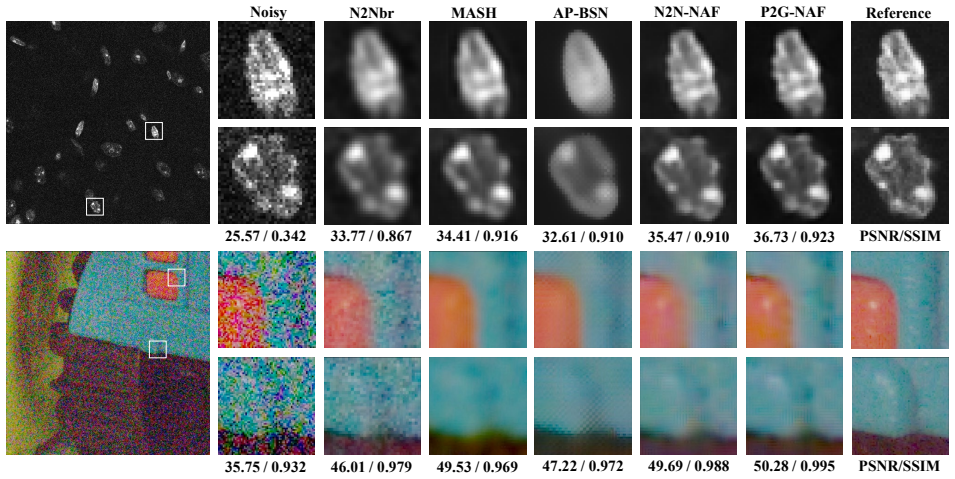
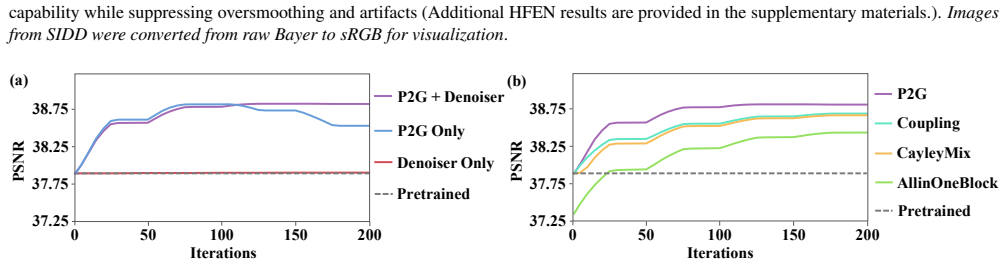
The quantum nature of light determines the inherent Poisson stochasticity of photon detection, which is ubiquitous in photography, microscopy, and astronomy. However, our controlled numerical studies reveal that the signal-dependency, heteroscedasticity, and statistical asymmetry of Poisson-mixed noise make it challenging for existing denoisers to learn. In contrast, i.i.d. Gaussian noise, with its statistical independence and symmetric distribution, is easier to model for networks. To address this gap, we propose Poisson2Gaussian (P2G), a noise Gaussianization method that explicitly converts complex real-world noise to i.i.d. Gaussian noise via probability density matching beyond low-order moments. We also design an unbiased denoising framework that synergizes P2G with downstream denoisers, ensuring convergence to the underlying signal without requiring paired clean data or explicit noise parameters. Extensive experiments demonstrate that P2G consistently achieves state-of-the-art performance across diverse datasets. In challenging scenarios where noise strongly deviates from Gaussian statistics, our method improves the PSNR by up to 0.75 dB. Notably, P2G is architecture-agnostic and can provide universal improvements for various denoisers. The source code will be publicly available.
Editorial analysis
A structured set of objections, weighed in public.
Referee Report
Summary. The manuscript proposes Poisson2Gaussian (P2G), a noise Gaussianization technique that converts signal-dependent, heteroscedastic Poisson-mixed noise to i.i.d. Gaussian noise via probability density matching beyond low-order moments. It further introduces an unbiased denoising framework that integrates P2G with arbitrary downstream denoisers, claiming convergence to the clean signal without paired clean-noisy data or explicit noise-parameter estimation. Experiments are said to demonstrate consistent SOTA performance across datasets, with PSNR gains up to 0.75 dB in non-Gaussian regimes, and the method is presented as architecture-agnostic.
Significance. If the central claims hold, the work would supply a practical, parameter-free preprocessing step that improves a broad class of existing denoisers for real-world imaging modalities (photography, microscopy, astronomy) where Poisson statistics dominate. The absence of requirements for paired data or noise parameters would be a notable practical advantage.
major comments (2)
- [Abstract] Abstract: The central claim that probability density matching (beyond low-order moments) produces strictly i.i.d. Gaussian noise from intensity-dependent Poisson-mixed inputs, enabling unbiased convergence without signal estimation or new biases, is load-bearing yet unsupported by any explicit construction, equations, or proof sketch. For heteroscedastic Poisson noise the per-pixel PDF depends on local intensity; a signal-independent mapping cannot equalize the family of Poisson distributions, while a signal-dependent mapping would implicitly estimate the signal and risk distorting it or introducing bias. This directly engages the skeptic concern and must be resolved with a concrete derivation or algorithm in the method section.
- [Abstract] Abstract / Experiments: The reported SOTA results and 0.75 dB PSNR gains are asserted without any dataset details, ablation studies, error analysis, or comparison tables in the provided text. Because the soundness of the Gaussianization step is unverified, these empirical claims cannot be assessed as evidence for the framework's unbiased convergence property.
minor comments (1)
- The abstract states that source code will be publicly available; this commitment should be fulfilled with a permanent repository link upon acceptance.
Simulated Author's Rebuttal
We thank the referee for the careful reading and constructive feedback. We address the two major comments point by point below. The full manuscript contains the requested derivations and experimental details in Sections 3 and 4; we will revise to improve clarity and prominence of these elements.
read point-by-point responses
-
Referee: [Abstract] Abstract: The central claim that probability density matching (beyond low-order moments) produces strictly i.i.d. Gaussian noise from intensity-dependent Poisson-mixed inputs, enabling unbiased convergence without signal estimation or new biases, is load-bearing yet unsupported by any explicit construction, equations, or proof sketch. For heteroscedastic Poisson noise the per-pixel PDF depends on local intensity; a signal-independent mapping cannot equalize the family of Poisson distributions, while a signal-dependent mapping would implicitly estimate the signal and risk distorting it or introducing bias. This directly engages the skeptic concern and must be resolved with a concrete derivation or algorithm in the method section.
Authors: We agree that the abstract alone does not contain the derivation and that a concrete construction is required. Section 3 of the full manuscript presents the explicit density-matching transformation, including the per-pixel mapping derived from equating the cumulative distribution functions of the Poisson-mixed noise to a standard Gaussian, together with the algorithm that applies this mapping. The unbiasedness argument is given by showing that the composition of the (signal-dependent) mapping with the downstream denoiser preserves the conditional expectation of the clean signal. We will add a compact proof sketch and pseudocode to Section 3 in the revision to make the construction and bias analysis fully explicit. revision: yes
-
Referee: [Abstract] Abstract / Experiments: The reported SOTA results and 0.75 dB PSNR gains are asserted without any dataset details, ablation studies, error analysis, or comparison tables in the provided text. Because the soundness of the Gaussianization step is unverified, these empirical claims cannot be assessed as evidence for the framework's unbiased convergence property.
Authors: The full manuscript's Section 4 supplies the missing elements: dataset descriptions (BSD68, Kodak, microscopy and astronomy sets), ablation tables isolating the contribution of the density-matching step, error analysis across noise regimes, and side-by-side PSNR/SSIM tables that document the reported gains. These results are presented after the method has been defined. We will revise the abstract to include a brief pointer to these experimental validations and will ensure the experimental section is cross-referenced more prominently. revision: partial
Circularity Check
No circularity in derivation; method presented as independent proposal
full rationale
The provided abstract and description introduce Poisson2Gaussian as a novel PDF-matching transform to i.i.d. Gaussian noise plus an unbiased denoising framework, without any equations, fitted parameters, or self-citations shown that would reduce the claimed convergence or performance gains to quantities defined by the paper's own inputs. No self-definitional steps, fitted-input predictions, or load-bearing self-citations appear. The derivation chain is therefore self-contained against external benchmarks and experiments.
Axiom & Free-Parameter Ledger
Reference graph
Works this paper leans on
-
[1]
Abdelrahman Abdelhamed, Stephen Lin, and Michael S. Brown. A high-quality denoising dataset for smartphone cameras. In2018 IEEE/CVF Conference on Computer Vision and Pattern Recognition (CVPR), pages 1692–1700, 2018. 2, 6, 8
2018
-
[2]
Noise flow: Noise modeling with conditional nor- malizing flows
Abdelrahman Abdelhamed, Marcus Brubaker, and Michael Brown. Noise flow: Noise modeling with conditional nor- malizing flows. In2019 IEEE/CVF International Conference on Computer Vision (ICCV), pages 3165–3173, 2019. 3
2019
-
[3]
Aharon, M
M. Aharon, M. Elad, and A. Bruckstein. K-svd: An al- gorithm for designing overcomplete dictionaries for sparse representation.IEEE Transactions on Signal Processing, 54 (11):4311–4322, 2006. 2
2006
-
[4]
F. J. ANSCOMBE. The transformation of poisson, binomial and negative-binomial data.Biometrika, 35(3-4):246–254,
-
[5]
Framework for Easily Invertible Architectures (FrEIA), 2018-2022
Lynton Ardizzone, Till Bungert, Felix Draxler, Ullrich K¨othe, Jakob Kruse, Robert Schmier, and Peter Sorren- son. Framework for Easily Invertible Architectures (FrEIA), 2018-2022. 5, 7
2018
-
[6]
Variance stabilization for noisy+estimate combination in iterative poisson denoising
Lucio Azzari and Alessandro Foi. Variance stabilization for noisy+estimate combination in iterative poisson denoising. IEEE Signal Processing Letters, 23(8):1086–1090, 2016. 2
2016
-
[7]
High-resolution single-photon imaging with physics-informed deep learning.Nature Communica- tions, 14(1):5902, 2023
Liheng Bian, Haoze Song, Lintao Peng, Xuyang Chang, Xi Yang, Roarke Horstmeyer, Lin Ye, Chunli Zhu, Tong Qin, Dezhi Zheng, et al. High-resolution single-photon imaging with physics-informed deep learning.Nature Communica- tions, 14(1):5902, 2023. 2
2023
-
[8]
Buades, B
A. Buades, B. Coll, and J.-M. Morel. A non-local algo- rithm for image denoising. In2005 IEEE Computer Soci- ety Conference on Computer Vision and Pattern Recognition (CVPR’05), pages 60–65 vol. 2, 2005. 2
2005
-
[9]
Fbi- denoiser: Fast blind image denoiser for poisson-gaussian noise
Jaeseok Byun, Sungmin Cha, and Taesup Moon. Fbi- denoiser: Fast blind image denoiser for poisson-gaussian noise. In2021 IEEE/CVF Conference on Computer Vision and Pattern Recognition (CVPR), pages 5764–5773, 2021. 2, 8
2021
-
[10]
Physics-guided iso-dependent sen- sor noise modeling for extreme low-light photography
Yue Cao, Ming Liu, Shuai Liu, Xiaotao Wang, Lei Lei, and Wangmeng Zuo. Physics-guided iso-dependent sen- sor noise modeling for extreme low-light photography. In 2023 IEEE/CVF Conference on Computer Vision and Pat- tern Recognition (CVPR), pages 5744–5753, 2023. 2, 3
2023
-
[11]
Quantum-enhanced nonlinear microscopy.Nature, 594(7862):201–206, 2021
Catxere A Casacio, Lars S Madsen, Alex Terrasson, Muham- mad Waleed, Kai Barnscheidt, Boris Hage, Michael A Tay- lor, and Warwick P Bowen. Quantum-enhanced nonlinear microscopy.Nature, 594(7862):201–206, 2021. 2
2021
-
[12]
Simple baselines for image restoration
Liangyu Chen, Xiaojie Chu, Xiangyu Zhang, and Jian Sun. Simple baselines for image restoration. InComputer Vision – ECCV 2022, pages 17–33, Cham, 2022. Springer Nature Switzerland. 6, 8
2022
-
[13]
Masked and shuf- fled blind spot denoising for real-world images
Hamadi Chihaoui and Paolo Favaro. Masked and shuf- fled blind spot denoising for real-world images. In2024 IEEE/CVF Conference on Computer Vision and Pattern Recognition (CVPR), pages 3025–3034, 2024. 3, 8
2024
-
[14]
Image denoising by sparse 3-d transform- domain collaborative filtering.IEEE Transactions on Image Processing, 16(8):2080–2095, 2007
Kostadin Dabov, Alessandro Foi, Vladimir Katkovnik, and Karen Egiazarian. Image denoising by sparse 3-d transform- domain collaborative filtering.IEEE Transactions on Image Processing, 16(8):2080–2095, 2007. 2, 8
2080
-
[15]
NICE: Non-linear Independent Components Estimation
Laurent Dinh, David Krueger, and Yoshua Bengio. Nice: Non-linear independent components estimation.arXiv preprint arXiv:1410.8516, 2014. 3
work page internal anchor Pith review Pith/arXiv arXiv 2014
-
[16]
Density estimation using real nvp
Laurent Dinh, Jascha Sohl-Dickstein, and Samy Bengio. Density estimation using real nvp. 2017. 3, 4, 5
2017
-
[17]
Image denoising: The deep learning revolution and beyond – a sur- vey paper –
Michael Elad, Bahjat Kawar, and Gregory Vaksman. Image denoising: The deep learning revolution and beyond – a sur- vey paper –. 2023. 1
2023
-
[18]
Practical poissonian-gaussian noise mod- eling and fitting for single-image raw-data.IEEE Transac- tions on Image Processing, 17(10):1737–1754, 2008
Alessandro Foi, Mejdi Trimeche, Vladimir Katkovnik, and Karen Egiazarian. Practical poissonian-gaussian noise mod- eling and fitting for single-image raw-data.IEEE Transac- tions on Image Processing, 17(10):1737–1754, 2008. 2
2008
-
[19]
srgb real noise synthesizing with neighboring correlation-aware noise model
Zixuan Fu, Lanqing Guo, and Bihan Wen. srgb real noise synthesizing with neighboring correlation-aware noise model. In2023 IEEE/CVF Conference on Computer Vision and Pattern Recognition (CVPR), pages 1683–1691, 2023. 3
2023
-
[20]
Goncharova, Alf Honigmann, Florian Jug, and Alexander Krull
Anna S. Goncharova, Alf Honigmann, Florian Jug, and Alexander Krull. Improving blind spot denoising for mi- croscopy. InComputer Vision – ECCV 2020 Workshops, pages 380–393, Cham, 2020. Springer International Publish- ing. 8
2020
-
[21]
Toward convolutional blind denoising of real pho- tographs
Shi Guo, Zifei Yan, Kai Zhang, Wangmeng Zuo, and Lei Zhang. Toward convolutional blind denoising of real pho- tographs. In2019 IEEE/CVF Conference on Computer Vi- sion and Pattern Recognition (CVPR), pages 1712–1722,
-
[22]
Deeper detection limits in astronomical imaging us- ing self-supervised spatiotemporal denoising.Science, 0(0): eady9404, 2026
Yuduo Guo, Hao Zhang, Mingyu Li, Fujiang Yu, Yunjing Wu, Yuhan Hao, Song Huang, Yongming Liang, Xiaojing Lin, Xinyang Li, Jiamin Wu, Zheng Cai, and Qionghai Dai. Deeper detection limits in astronomical imaging us- ing self-supervised spatiotemporal denoising.Science, 0(0): eady9404, 2026. 2
2026
-
[23]
Self-calibrated variance-stabilizing transformations for real-world image denoising
S ´ebastien Herbreteau and Michael Unser. Self-calibrated variance-stabilizing transformations for real-world image denoising. InICCV, 2025. 2, 6, 8
2025
-
[24]
Neighbor2neighbor: Self-supervised de- noising from single noisy images
Tao Huang, Songjiang Li, Xu Jia, Huchuan Lu, and Jianzhuang Liu. Neighbor2neighbor: Self-supervised de- noising from single noisy images. In2021 IEEE/CVF Conference on Computer Vision and Pattern Recognition (CVPR), pages 14776–14785, 2021. 3, 6, 8
2021
-
[25]
C2n: Practical generative noise modeling for real-world denoising
Geonwoon Jang, Wooseok Lee, Sanghyun Son, and Ky- oungmu Lee. C2n: Practical generative noise modeling for real-world denoising. In2021 IEEE/CVF International Conference on Computer Vision (ICCV), pages 2330–2339,
-
[26]
Lan: Learning to adapt noise for image denoising
Changjin Kim, Tae Hyun Kim, and Sungyong Baik. Lan: Learning to adapt noise for image denoising. In2024 IEEE/CVF Conference on Computer Vision and Pattern Recognition (CVPR), pages 25193–25202, 2024. 1, 2
2024
-
[27]
Transfer learning from synthetic to real-noise denois- ing with adaptive instance normalization
Yoonsik Kim, Jae Woong Soh, Gu Yong Park, and Nam Ik Cho. Transfer learning from synthetic to real-noise denois- ing with adaptive instance normalization. In2020 IEEE/CVF Conference on Computer Vision and Pattern Recognition (CVPR), pages 3479–3489, 2020. 2
2020
-
[28]
Kingma and Prafulla Dhariwal
Diederik P. Kingma and Prafulla Dhariwal. Glow: Genera- tive flow with invertible 1x1 convolutions, 2018. 3, 4 10
2018
-
[29]
Brown, and Mar- cus A
Shayan Kousha, Ali Maleky, Michael S. Brown, and Mar- cus A. Brubaker. Modeling srgb camera noise with normal- izing flows. In2022 IEEE/CVF Conference on Computer Vi- sion and Pattern Recognition (CVPR), pages 17442–17450,
-
[30]
Noise2void - learning denoising from single noisy images
Alexander Krull, Tim-Oliver Buchholz, and Florian Jug. Noise2void - learning denoising from single noisy images. In2019 IEEE/CVF Conference on Computer Vision and Pat- tern Recognition (CVPR), pages 2124–2132, 2019. 2, 3, 8
2019
-
[31]
High-quality self-supervised deep image denoising
Samuli Laine, Tero Karras, Jaakko Lehtinen, and Timo Aila. High-quality self-supervised deep image denoising. InAd- vances in Neural Information Processing Systems. Curran Associates, Inc., 2019. 8
2019
-
[32]
Ap- bsn: Self-supervised denoising for real-world images via asymmetric pd and blind-spot network
Wooseok Lee, Sanghyun Son, and Kyoung Mu Lee. Ap- bsn: Self-supervised denoising for real-world images via asymmetric pd and blind-spot network. In2022 IEEE/CVF Conference on Computer Vision and Pattern Recognition (CVPR), pages 17704–17713, 2022. 3, 8
2022
-
[33]
Noise2Noise: Learning Image Restoration without Clean Data
Jaakko Lehtinen, Jacob Munkberg, Jon Hasselgren, Samuli Laine, Tero Karras, Miika Aittala, and Timo Aila. Noise2noise: Learning image restoration without clean data. arXiv preprint arXiv:1803.04189, 2018. 2, 3, 6, 8
work page internal anchor Pith review Pith/arXiv arXiv 2018
-
[34]
Deep image prior
Victor Lempitsky, Andrea Vedaldi, and Dmitry Ulyanov. Deep image prior. In2018 IEEE/CVF Conference on Com- puter Vision and Pattern Recognition, pages 9446–9454,
-
[35]
Spatially adaptive self-supervised learning for real-world image denoising
Junyi Li, Zhilu Zhang, Xiaoyu Liu, Chaoyu Feng, Xiao- tao Wang, Lei Lei, and Wangmeng Zuo. Spatially adaptive self-supervised learning for real-world image denoising. In 2023 IEEE/CVF Conference on Computer Vision and Pat- tern Recognition (CVPR), pages 9914–9924, 2023. 8
2023
-
[36]
Reinforcing neuron extraction and spike in- ference in calcium imaging using deep self-supervised de- noising.Nature Methods, 18(11):1395–1400, 2021
Xinyang Li, Guoxun Zhang, Jiamin Wu, Yuanlong Zhang, Zhifeng Zhao, Xing Lin, Hui Qiao, Hao Xie, Haoqian Wang, Lu Fang, et al. Reinforcing neuron extraction and spike in- ference in calcium imaging using deep self-supervised de- noising.Nature Methods, 18(11):1395–1400, 2021. 2
2021
-
[37]
Spatial redundancy transformer for self-supervised fluorescence im- age denoising.Nature Computational Science, 3(12):1067– 1080, 2023
Xinyang Li, Xiaowan Hu, Xingye Chen, Jiaqi Fan, Zhifeng Zhao, Jiamin Wu, Haoqian Wang, and Qionghai Dai. Spatial redundancy transformer for self-supervised fluorescence im- age denoising.Nature Computational Science, 3(12):1067– 1080, 2023. 1
2023
-
[38]
Real-time denoising enables high-sensitivity flu- orescence time-lapse imaging beyond the shot-noise limit
Xinyang Li, Yixin Li, Yiliang Zhou, Jiamin Wu, Zhifeng Zhao, Jiaqi Fan, Fei Deng, Zhaofa Wu, Guihua Xiao, Jing He, et al. Real-time denoising enables high-sensitivity flu- orescence time-lapse imaging beyond the shot-noise limit. Nature Biotechnology, 41(2):282–292, 2023. 2, 6
2023
-
[39]
Asymmetric mask scheme for self- supervised real image denoising
Xiangyu Liao, Tianheng Zheng, Jiayu Zhong, Pingping Zhang, and Chao Ren. Asymmetric mask scheme for self- supervised real image denoising. InComputer Vision – ECCV 2024, pages 199–215, Cham, 2025. Springer Nature Switzerland. 8
2024
-
[40]
Image de- noising in mixed poisson–gaussian noise.IEEE Transactions on Image Processing, 20(3):696–708, 2011
Florian Luisier, Thierry Blu, and Michael Unser. Image de- noising in mixed poisson–gaussian noise.IEEE Transactions on Image Processing, 20(3):696–708, 2011. 8
2011
-
[41]
A closed-form ap- proximation of the exact unbiased inverse of the anscombe variance-stabilizing transformation.IEEE Transactions on Image Processing, 20(9):2697–2698, 2011
Markku Makitalo and Alessandro Foi. A closed-form ap- proximation of the exact unbiased inverse of the anscombe variance-stabilizing transformation.IEEE Transactions on Image Processing, 20(9):2697–2698, 2011. 2
2011
-
[42]
Optimal inversion of the anscombe transformation in low-count poisson image de- noising.IEEE Transactions on Image Processing, 20(1):99– 109, 2011
Markku Makitalo and Alessandro Foi. Optimal inversion of the anscombe transformation in low-count poisson image de- noising.IEEE Transactions on Image Processing, 20(1):99– 109, 2011
2011
-
[43]
Optimal inversion of the generalized anscombe transformation for poisson- gaussian noise.IEEE Transactions on Image Processing, 22 (1):91–103, 2013
Markku Makitalo and Alessandro Foi. Optimal inversion of the generalized anscombe transformation for poisson- gaussian noise.IEEE Transactions on Image Processing, 22 (1):91–103, 2013. 2, 8
2013
-
[44]
Brown, and Mar- cus A
Ali Maleky, Shayan Kousha, Michael S. Brown, and Mar- cus A. Brubaker. Noise2noiseflow: Realistic camera noise modeling without clean images. In2022 IEEE/CVF Confer- ence on Computer Vision and Pattern Recognition (CVPR), pages 17611–17620, 2022. 3
2022
-
[45]
Zero-shot noise2noise: Efficient image denoising without any data
Youssef Mansour and Reinhard Heckel. Zero-shot noise2noise: Efficient image denoising without any data. In 2023 IEEE/CVF Conference on Computer Vision and Pat- tern Recognition (CVPR), pages 14018–14027, 2023. 3, 8
2023
-
[46]
Richter, Laura Waller, and Vladlen Koltun
Kristina Monakhova, Stephan R. Richter, Laura Waller, and Vladlen Koltun. Dancing under the stars: video denoising in starlight. In2022 IEEE/CVF Conference on Computer Vision and Pattern Recognition (CVPR), pages 16220–16230, 2022. 2
2022
-
[47]
Noisier2noise: Learning to denoise from unpaired noisy data
Nick Moran, Dan Schmidt, Yu Zhong, and Patrick Coady. Noisier2noise: Learning to denoise from unpaired noisy data. In2020 IEEE/CVF Conference on Computer Vision and Pattern Recognition (CVPR), pages 12061–12069, 2020. 3
2020
-
[48]
Cvf-sid: Cyclic multi-variate function for self-supervised image denoising by disentangling noise from image
Reyhaneh Neshatavar, Mohsen Yavartanoo, Sanghyun Son, and Kyoung Mu Lee. Cvf-sid: Cyclic multi-variate function for self-supervised image denoising by disentangling noise from image. In2022 IEEE/CVF Conference on Computer Vi- sion and Pattern Recognition (CVPR), pages 17562–17570,
-
[49]
Nguyen, Magnus O
Han V . Nguyen, Magnus O. Ulfarsson, and Johannes R. Sveinsson. Hyperspectral image denoising using sure-based unsupervised convolutional neural networks.IEEE Transac- tions on Geoscience and Remote Sensing, 59(4):3369–3382,
-
[50]
Random sub-samples generation for self- supervised real image denoising
Yizhong Pan, Xiao Liu, Xiangyu Liao, Yuanzhouhan Cao, and Chao Ren. Random sub-samples generation for self- supervised real image denoising. In2023 IEEE/CVF In- ternational Conference on Computer Vision (ICCV), pages 12116–12125, 2023. 3, 8
2023
-
[51]
Fully un- supervised diversity denoising with convolutional variational autoencoders
Mangal Prakash, Alexander Krull, and Florian Jug. Fully un- supervised diversity denoising with convolutional variational autoencoders. InInternational Conference on Learning Rep- resentations, 2021. 8
2021
-
[52]
Meisam Rakhshanfar and Maria A. Amer. Estimation of gaussian, poissonian–gaussian, and processed visual noise and its level function.IEEE Transactions on Image Process- ing, 25(9):4172–4185, 2016. 2
2016
-
[53]
U- net: Convolutional networks for biomedical image segmen- tation
Olaf Ronneberger, Philipp Fischer, and Thomas Brox. U- net: Convolutional networks for biomedical image segmen- tation. InMedical Image Computing and Computer-Assisted Intervention – MICCAI 2015, pages 234–241, Cham, 2015. Springer International Publishing. 6, 8
2015
-
[54]
Realization of the first sub-shot-noise 11 wide field microscope.Light: Science & Applications, 6(7): e17005–e17005, 2017
Nigam Samantaray, Ivano Ruo-Berchera, Alice Meda, and Marco Genovese. Realization of the first sub-shot-noise 11 wide field microscope.Light: Science & Applications, 6(7): e17005–e17005, 2017. 2
2017
-
[55]
Blind2unblind: Self-supervised image denoising with visi- ble blind spots
Zejin Wang, Jiazheng Liu, Guoqing Li, and Hua Han. Blind2unblind: Self-supervised image denoising with visi- ble blind spots. In2022 IEEE/CVF Conference on Computer Vision and Pattern Recognition (CVPR), pages 2017–2026,
2017
-
[56]
A physics-based noise formation model for extreme low-light raw denoising
Kaixuan Wei, Ying Fu, Jiaolong Yang, and Hua Huang. A physics-based noise formation model for extreme low-light raw denoising. In2020 IEEE/CVF Conference on Computer Vision and Pattern Recognition (CVPR), pages 2755–2764,
-
[57]
Cycleisp: Real image restoration via improved data synthesis
Syed Waqas Zamir, Aditya Arora, Salman Khan, Munawar Hayat, Fahad Shahbaz Khan, Ming-Hsuan Yang, and Ling Shao. Cycleisp: Real image restoration via improved data synthesis. In2020 IEEE/CVF Conference on Computer Vi- sion and Pattern Recognition (CVPR), pages 2693–2702,
-
[58]
Restormer: Efficient transformer for high-resolution image restoration
Syed Waqas Zamir, Aditya Arora, Salman Khan, Mu- nawar Hayat, Fahad Shahbaz Khan, and Ming–Hsuan Yang. Restormer: Efficient transformer for high-resolution image restoration. In2022 IEEE/CVF Conference on Computer Vision and Pattern Recognition (CVPR), pages 5718–5729,
-
[59]
Bio-friendly long-term subcellular dy- namic recording by self-supervised image enhancement mi- croscopy.Nature Methods, 20(12):1957–1970, 2023
Guoxun Zhang, Xiaopeng Li, Yuanlong Zhang, Xiaofei Han, Xinyang Li, Jinqiang Yu, Boqi Liu, Jiamin Wu, Li Yu, and Qionghai Dai. Bio-friendly long-term subcellular dy- namic recording by self-supervised image enhancement mi- croscopy.Nature Methods, 20(12):1957–1970, 2023. 2
1957
-
[60]
Beyond a gaussian denoiser: Residual learning of deep cnn for image denoising.IEEE Transactions on Image Processing, 26(7):3142–3155, 2017
Kai Zhang, Wangmeng Zuo, Yunjin Chen, Deyu Meng, and Lei Zhang. Beyond a gaussian denoiser: Residual learning of deep cnn for image denoising.IEEE Transactions on Image Processing, 26(7):3142–3155, 2017. 8
2017
-
[61]
Plug-and-play image restora- tion with deep denoiser prior.IEEE Transactions on Pat- tern Analysis and Machine Intelligence, 44(10):6360–6376,
Kai Zhang, Yawei Li, Wangmeng Zuo, Lei Zhang, Luc Van Gool, and Radu Timofte. Plug-and-play image restora- tion with deep denoiser prior.IEEE Transactions on Pat- tern Analysis and Machine Intelligence, 44(10):6360–6376,
-
[62]
A poisson-gaussian denoising dataset with real fluorescence microscopy images
Yide Zhang, Yinhao Zhu, Evan Nichols, Qingfei Wang, Siyuan Zhang, Cody Smith, and Scott Howard. A poisson-gaussian denoising dataset with real fluorescence microscopy images. In2019 IEEE/CVF Conference on Com- puter Vision and Pattern Recognition (CVPR), pages 11702– 11710, 2019. 6, 8
2019
-
[63]
Idr: Self-supervised image de- noising via iterative data refinement
Yi Zhang, Dasong Li, Ka Lung Law, Xiaogang Wang, Hong- wei Qin, and Hongsheng Li. Idr: Self-supervised image de- noising via iterative data refinement. In2022 IEEE/CVF Conference on Computer Vision and Pattern Recognition (CVPR), pages 2088–2097, 2022. 1
2088
-
[64]
W2s: mi- croscopy data with joint denoising and super-resolution for widefield to sim mapping
Ruofan Zhou, Majed El Helou, Daniel Sage, Thierry Laroche, Arne Seitz, and Sabine S ¨usstrunk. W2s: mi- croscopy data with joint denoising and super-resolution for widefield to sim mapping. InEuropean Conference on Com- puter Vision, pages 474–491. Springer, 2020. 6, 8
2020
-
[65]
When awgn-based denoiser meets real noises
Yuqian Zhou, Jianbo Jiao, Haibin Huang, Yang Wang, Jue Wang, Honghui Shi, and Thomas Huang. When awgn-based denoiser meets real noises. InProceedings of the AAAI Con- ference on Artificial Intelligence, pages 13074–13081, 2020. 2
2020
-
[66]
From learning models of nat- ural image patches to whole image restoration
Daniel Zoran and Yair Weiss. From learning models of nat- ural image patches to whole image restoration. In2011 In- ternational Conference on Computer Vision, pages 479–486,
discussion (0)
Sign in with ORCID, Apple, or X to comment. Anyone can read and Pith papers without signing in.