Enormous Fluid Antenna Systems (E-FAS) for Wireless Sensing: Channel Modeling and Conditional Estimation Limits
Pith reviewed 2026-06-26 06:31 UTC · model grok-4.3
The pith
E-FAS creates a new ISAC sensing regime where maximizing surface-wave routing gain does not maximize angular estimation performance.
A machine-rendered reading of the paper's core claim, the machinery that carries it, and where it could break.
Core claim
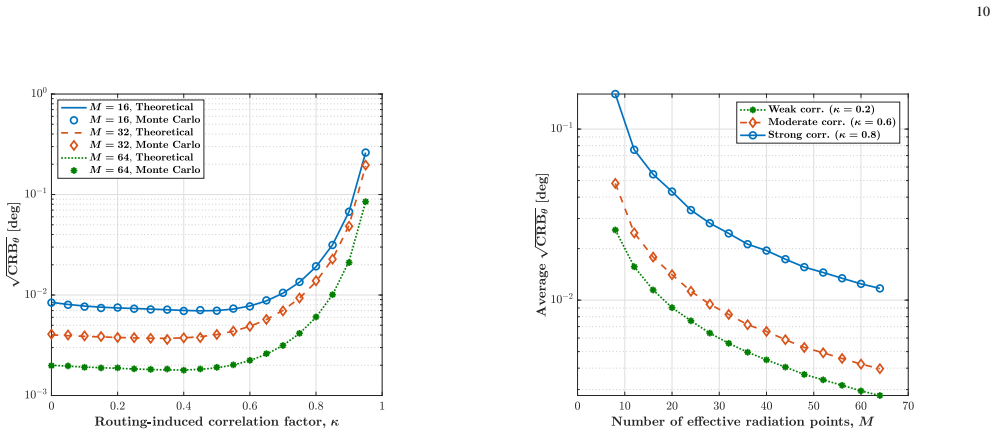
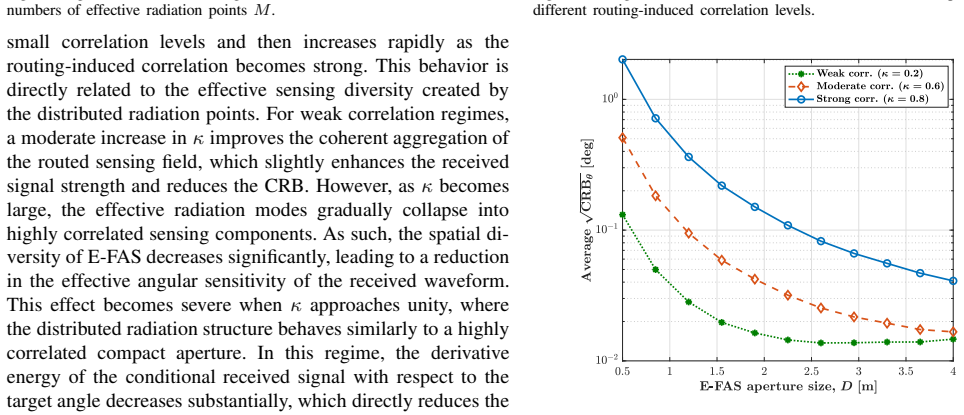
E-FAS gives rise to a fundamentally different sensing regime compared with conventional array-based and reconfigurable-surface-aided ISAC architectures. Maximizing coherent routing gain does not necessarily maximize sensing performance, exposing a fundamental trade-off between SW routing gain and sensing diversity in programmable propagation environments.
What carries the argument
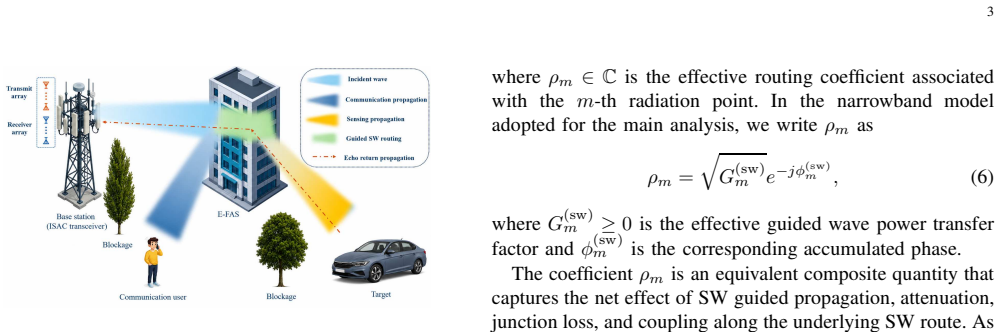
The bidirectional sensing channel model that captures the complete sensing process including surface-wave routing, distributed reradiation, target scattering, and echo propagation, from which the parametric observation model, FIM, and CRB are derived.
If this is right
- E-FAS-enabled ISAC systems achieve substantial angular sensing gains over conventional architectures under the same transmit-power budget.
- Joint optimization of propagation routing and sensing functionality is required for best performance.
- Programmable propagation environments must balance routing gain against diversity for sensing tasks.
Where Pith is reading between the lines
- Designers of future ISAC systems may need to rethink surface configuration strategies beyond pure gain maximization.
- The framework could extend to other estimation tasks such as range or velocity sensing in fluid antenna setups.
- Validation through hardware prototypes would test if the modeled trade-off appears in real propagation environments.
Load-bearing premise
The bidirectional sensing channel model captures the complete sensing process and produces a valid parametric observation model for deriving the FIM and CRB.
What would settle it
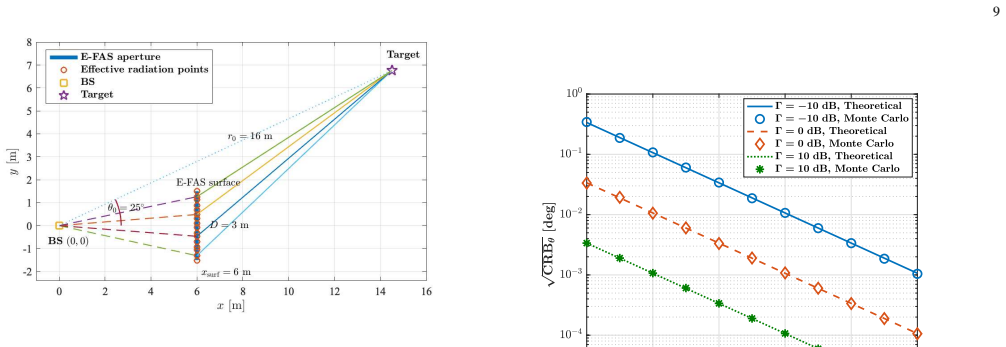
A simulation or measurement campaign that computes actual angular estimation error variance for E-FAS configurations and checks whether it matches the derived CRB while exhibiting the predicted routing-diversity trade-off.
Figures
read the original abstract
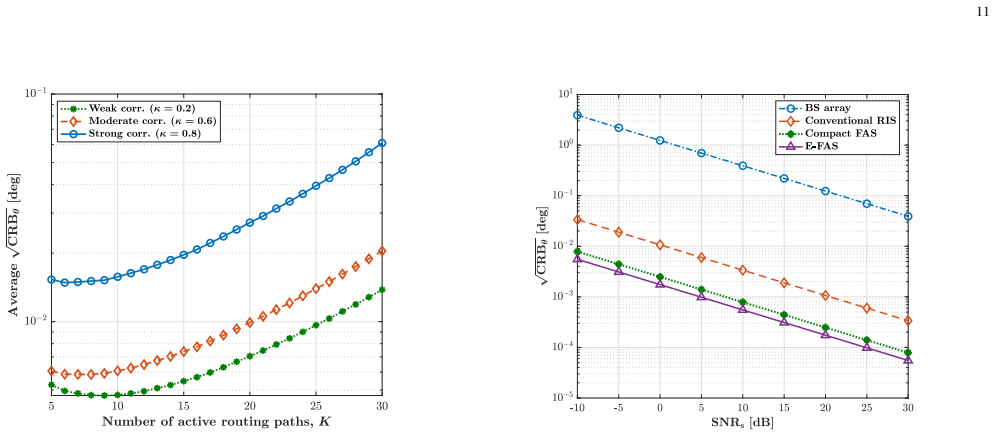
In this paper, we develop a fundamental analytical framework for integrated sensing and communications (ISAC) enabled by the Enormous Fluid Antenna System (E-FAS), which transforms a collection of coordinated intelligent surfaces into a gigantic reconfigurable electromagnetic aperture, with particular emphasis on the limits of angular sensing.We begin by developing a bidirectional sensing channel model that explicitly captures the complete sensing process, including surface-wave (SW) routing, distributed reradiation, target scattering, and echo propagation. Based on this channel model, we formulate a parametric observation model for target sensing and derive the associated Fisher information matrix (FIM) and Cramer-Rao bound (CRB) for angular estimation. The analysis demonstrates that E-FAS gives rise to a fundamentally different sensing regime compared with conventional array-based and reconfigurable-surface-aided ISAC architectures. Our analysis uncovers that maximizing coherent routing gain does not necessarily maximize sensing performance, exposing a fundamental trade-off between SW routing gain and sensing diversity in programmable propagation environments. Numerical results validate the developed framework and demonstrate that E-FAS-enabled ISAC systems can achieve substantial angular sensing gains over conventional architectures under the same transmit-power budget. The results further underscore the importance of jointly optimizing propagation routing and sensing functionality, positioning E-FAS as a new paradigm for ISAC.
Editorial analysis
A structured set of objections, weighed in public.
Referee Report
Summary. The paper develops a bidirectional sensing channel model for Enormous Fluid Antenna Systems (E-FAS) in integrated sensing and communications (ISAC). The model explicitly captures surface-wave routing, distributed reradiation, target scattering, and echo propagation. From this, a parametric observation model is formulated and the Fisher information matrix (FIM) together with the Cramer-Rao bound (CRB) for angular estimation are derived. The analysis claims that E-FAS produces a fundamentally different sensing regime relative to conventional array-based and reconfigurable-surface-aided ISAC architectures, that maximizing coherent routing gain does not necessarily maximize sensing performance, and that a fundamental trade-off exists between surface-wave routing gain and sensing diversity. Numerical results are invoked to demonstrate substantial angular sensing gains over conventional architectures under identical transmit-power budgets.
Significance. If the channel model and the subsequent FIM/CRB derivations are correct, the work could be significant for ISAC research by showing that routing-gain maximization and sensing performance are not aligned in programmable propagation environments, thereby motivating joint optimization of routing and sensing. The numerical validation of gains would strengthen the case for E-FAS as a distinct paradigm if the comparisons are fair and reproducible.
major comments (1)
- [Abstract] Abstract: the central claim that E-FAS gives rise to a fundamentally different sensing regime and exposes a fundamental trade-off between SW routing gain and sensing diversity rests on the bidirectional channel model yielding a valid parametric observation model from which the FIM and CRB follow. No equations, model construction details, or FIM expressions are supplied, so it is impossible to verify whether the math supports the stated conclusions or whether modeling choices affect the reported trade-off.
Simulated Author's Rebuttal
Thank you for the opportunity to respond to the referee report. We address the single major comment below.
read point-by-point responses
-
Referee: [Abstract] Abstract: the central claim that E-FAS gives rise to a fundamentally different sensing regime and exposes a fundamental trade-off between SW routing gain and sensing diversity rests on the bidirectional channel model yielding a valid parametric observation model from which the FIM and CRB follow. No equations, model construction details, or FIM expressions are supplied, so it is impossible to verify whether the math supports the stated conclusions or whether modeling choices affect the reported trade-off.
Authors: We agree that the abstract contains no equations or detailed derivations, as is conventional for abstracts to preserve conciseness and readability. The bidirectional channel model (including surface-wave routing, distributed reradiation, target scattering, and echo propagation) is constructed in Section II. The parametric observation model is formulated in Section III. The Fisher information matrix and CRB for angular estimation, together with the analysis of the distinct sensing regime and the routing-gain versus diversity trade-off, are derived explicitly in Section IV. These sections supply the model construction details, FIM expressions, and supporting analysis that underpin the claims. The numerical results in Section V further illustrate the gains under fixed transmit power. We therefore maintain that the full manuscript permits verification of the conclusions. Should the editor wish, we can expand the abstract with one or two key equations in a revision. revision: no
Circularity Check
No significant circularity detected
full rationale
The paper constructs a bidirectional sensing channel model that explicitly incorporates surface-wave routing, distributed reradiation, target scattering, and echo propagation. From this model it forms a parametric observation model and derives the FIM and CRB for angular estimation in the standard manner of estimation theory. The claims of a distinct sensing regime and a routing-gain versus diversity trade-off are presented as direct consequences of the derived expressions and are further supported by numerical validation under a fixed transmit-power budget. No load-bearing step reduces to a self-definition, a fitted parameter renamed as a prediction, or a self-citation chain; the derivation chain remains self-contained and independent of the target results.
Axiom & Free-Parameter Ledger
axioms (1)
- domain assumption The bidirectional sensing channel model accurately captures surface-wave routing, distributed reradiation, target scattering, and echo propagation.
Reference graph
Works this paper leans on
-
[1]
Integrated sensing and communications: Toward dual- functional wireless networks for 6G and beyond,
F. Liu et al. , “Integrated sensing and communications: Toward dual- functional wireless networks for 6G and beyond,” IEEE J. Sel. Areas Commun., vol. 40, no. 6, pp. 1728–1767, Jun. 2022
2022
-
[2]
Toward multi-functional 6G wireless networks: Integrat - ing sensing, communication, and security,
Z. Wei et al. , “Toward multi-functional 6G wireless networks: Integrat - ing sensing, communication, and security,” IEEE Commun. Mag. , vol. 60, no. 4, pp. 65–71, Apr. 2022
2022
-
[3]
Integrated sensing and communication signals toward 5G-A and 6G: A survey,
Z. Wei et al. , “Integrated sensing and communication signals toward 5G-A and 6G: A survey,” IEEE Internet Things J. , vol. 10, no. 13, pp. 11068–11092, Jul. 2023
2023
-
[4]
Joint transmit beamforming for multiuser MIMO com- munications and MIMO radar,
X. Liu et al. , “Joint transmit beamforming for multiuser MIMO com- munications and MIMO radar,” IEEE Trans. Signal Process. , vol. 68, pp. 3929–3944, 2020
2020
-
[5]
Active RIS-aided ISAC systems: Beamforming design and performance analysis,
Z. Y u et al. , “Active RIS-aided ISAC systems: Beamforming design and performance analysis,” IEEE Trans. Commun. , vol. 72, no. 3, pp. 1578–1595, Mar. 2024
2024
-
[6]
Joint design for STAR-RIS aided ISAC: Decoupling or learning,
J. Zhang et al., “Joint design for STAR-RIS aided ISAC: Decoupling or learning,” IEEE Trans. Wireless Commun. , vol. 23, no. 10, pp. 14365– 14379, Oct. 2024
2024
-
[7]
Simultaneous beam training and target sensing in ISAC systems with RIS,
K. Chen, C. Qi, O. A. Dobre and G. Y . Li, “Simultaneous beam training and target sensing in ISAC systems with RIS,” IEEE Trans. Wireless Commun., vol. 23, no. 4, pp. 2696–2710, Apr. 2024
2024
-
[8]
Smart radio environments empowered by reconfig- urable intelligent surfaces: How it works, state of researc h, and the road ahead,
M. Di Renzo et al., “Smart radio environments empowered by reconfig- urable intelligent surfaces: How it works, state of researc h, and the road ahead,” IEEE J. Sel. Areas Commun. , vol. 38, no. 11, pp. 2450–2525, Nov. 2020
2020
-
[9]
A tutorial on fluid antenna system for 6G networks: Encompassing communication theory, optimization methods and hard- ware designs,
W. K. New et al. , “A tutorial on fluid antenna system for 6G networks: Encompassing communication theory, optimization methods and hard- ware designs,” IEEE Commun. Surv. & Tut. , vol. 27, no. 4, pp. 2325– 2377, 2025
2025
-
[10]
Fluid antenna systems: Redefining reconfigurable wireless communications,
W. K. New et al. , “Fluid antenna systems: Redefining reconfigurable wireless communications,” IEEE J. Sel. Areas Commun. , vol. 44, pp. 1013–1044, 2026
2026
-
[11]
Fluid antennas: Reshaping intrinsic properties for flexible radiation characteristics in intelligent wireles s networks,
W.-J. Lu et al. , “Fluid antennas: Reshaping intrinsic properties for flexible radiation characteristics in intelligent wireles s networks,” IEEE Commun. Mag. , vol. 63, no. 5, pp. 40–45, May 2025
2025
-
[12]
A contemporary survey on fluid antenna systems: Fundamentals and networking perspectives,
H. Hong et al. , “A contemporary survey on fluid antenna systems: Fundamentals and networking perspectives,” IEEE Trans. Netw. Sci. Eng., vol. 13, pp. 2305–2328, 2026
2026
-
[13]
Fluid antenna systems enabling 6G: Principles, applica- tions, and research directions
T. Wu et al. , “Fluid antenna systems enabling 6G: Principles, applica- tions, and research directions,” to appear in IEEE Wireless Commun. , DOI:10.1109/MWC.2025.3629597, 2025
-
[14]
Fl uid antenna systems,
K. K. Wong, A. Shojaeifard, K.-F. Tong, and Y . Zhang, “Fl uid antenna systems,” IEEE Trans. Wireless Commun., vol. 20, no. 3, pp. 1950–1962, Mar. 2021
1950
-
[15]
Per formance limits of fluid antenna systems,
K. K. Wong, A. Shojaeifard, K. F. Tong, and Y . Zhang, “Per formance limits of fluid antenna systems,” IEEE Commun. Lett. , vol. 24, no. 11, pp. 2469–2472, Nov. 2020
2020
-
[16]
Fluid antenna system liberating multiuser MIMO for ISAC via deep reinforcement learning,
C. Wang et al. , “Fluid antenna system liberating multiuser MIMO for ISAC via deep reinforcement learning,” IEEE Trans. Wireless Commun., vol. 23, no. 9, pp. 10879–10894, Sept. 2024
2024
-
[17]
Fluid antenna-assisted ISAC systems,
L. Zhou et al. , “Fluid antenna-assisted ISAC systems,” IEEE Wireless Commun. Lett. , vol. 13, no. 12, pp. 3533–3537, Dec. 2024
2024
-
[18]
Shifting the ISAC trade-off with fluid antenna systems,
J. Zou et al. , “Shifting the ISAC trade-off with fluid antenna systems,” IEEE Wireless Commun. Lett. , vol. 13, no. 12, pp. 3479–3483, Dec. 2024
2024
-
[19]
Performance analysis of FAS-aided NOMA-ISAC: A backscattering scenario,
F. R. Ghadi et al. , “Performance analysis of FAS-aided NOMA-ISAC: A backscattering scenario,” IEEE Internet Things J. , vol. 12, no. 23, pp. 51326–51340, Dec. 2025
2025
-
[20]
On fundamental limits for fluid antenna-assisted integrated sensing and communications for unsourced rando m access,
Z. Zhang et al. , “On fundamental limits for fluid antenna-assisted integrated sensing and communications for unsourced rando m access,” IEEE J. Sel. Areas Commun. , vol. 44, pp. 136–149, 2026
2026
-
[21]
AI-limited fluid antenna-aided integrated sensing and communication systems,
F. Rostami Ghadi et al. , “AI-limited fluid antenna-aided integrated sensing and communication systems,” arXiv preprint, arXiv:2602.06247, 2026
arXiv 2026
-
[22]
On performance of RIS-aided fluid antenna systems,
F. Rostami Ghadi et al. , “On performance of RIS-aided fluid antenna systems,” IEEE Wireless Commun. Lett. , vol. 13, no. 8, pp. 2175–2179, Aug. 2024
2024
-
[23]
Power minimization of multiuser FAS-RIS downlink system,
B. Tang et al. , “Power minimization of multiuser FAS-RIS downlink system,” IEEE Trans. V eh. Technol., vol. 74, no. 10, pp. 16471–16476, Oct. 2025
2025
-
[24]
A framework of FAS-RIS systems: Performance analysis and throughput optimization,
J. Y ao et al. , “A framework of FAS-RIS systems: Performance analysis and throughput optimization,” IEEE Trans. Wireless Commun. , vol. 25, pp. 1333–1348, 2026
2026
-
[25]
Fluid reconfigurable intelligent surfaces: Joint on-off selection and beamforming with discrete phase shifts,
H. Xiao et al. , “Fluid reconfigurable intelligent surfaces: Joint on-off selection and beamforming with discrete phase shifts,” IEEE Wireless Commun. Lett. , vol. 14, no. 10, pp. 3124–3128, Oct. 2025
2025
-
[26]
Performance analysis of wireless communica- tion systems assisted by fluid reconfigurable intelligent su rfaces,
F. Rostami Ghadi et al. , “Performance analysis of wireless communica- tion systems assisted by fluid reconfigurable intelligent su rfaces,” IEEE Wireless Commun. Lett. , vol. 14, no. 12, pp. 3922–3926, Dec. 2025
2025
-
[27]
FIRES: Fluid integrated reflecting and emitting surfaces,
F. Rostami Ghadi et al., “FIRES: Fluid integrated reflecting and emitting surfaces,” IEEE Wireless Commun. Lett., vol. 14, no. 11, pp. 3744–3748, Nov. 2025
2025
-
[28]
On the performance enhancement potential of fluid reconfigu rable intelligent surfaces,
A. Salem, K. K. Wong, G. Alexandropoulos, C.-B. Chae, an d R. Murch, “On the performance enhancement potential of fluid reconfigu rable intelligent surfaces,” IEEE Trans. Wireless Commun., vol. 25, pp. 14426– 14439, 2026
2026
-
[29]
Physical layer security over fluid reconfigurable intelli - gent surface-assisted communication systems,
M. Kaveh et al., “Physical layer security over fluid reconfigurable intelli - gent surface-assisted communication systems,” IEEE Wireless Commun. Lett., vol. 15, pp. 1697–1701, 2026
2026
-
[30]
From fixed to fluid: Unlocking the new potential with fluid RIS (FRIS),
H. Xiao et al. , “From fixed to fluid: Unlocking the new potential with fluid RIS (FRIS),” arXiv preprint, arXiv:2509.18899v1, 2025
arXiv 2025
-
[31]
A vision to sm art radio environment: Surface wave communication superhighw ays,
K. K. Wong, K. F. Tong, Z. Chu, and Y . Zhang, “A vision to sm art radio environment: Surface wave communication superhighw ays,” IEEE Wireless Commun., vol. 28, no. 1, pp. 112–119, Feb. 2021
2021
-
[32]
Enormous fluid antenna systems (E-FAS): Rethink- ing the future of wireless communications,
K. K. Wong et al., “Enormous fluid antenna systems (E-FAS): Rethink- ing the future of wireless communications,” Research Squar e preprint, https://doi.org/10.21203/rs.3.rs-8002084/v1, 2025
-
[33]
Reimagining wireless connectivity: The F AS- RIS synergy for 6G smart cities,
T. Wu et al. , “Reimagining wireless connectivity: The FAS- RIS synergy for 6G smart cities,” IEEE Commun. Mag. , doi:10.1109/MCOM.001.2500802, 2026
-
[34]
Path loss and surface impedance models for surface wave-assisted wireless communication system,
H. Liu et al. , “Path loss and surface impedance models for surface wave-assisted wireless communication system,” IEEE Access , vol. 12, pp. 125786–125799, Aug. 2024
2024
-
[35]
Enormous fluid antenna systems (E-FAS) for multiuser MIMO: Channel modeling and analysis,
F. Rostami Ghadi et al. , “Enormous fluid antenna systems (E-FAS) for multiuser MIMO: Channel modeling and analysis,” arXiv preprint , arXiv:2602.11099, 2026
arXiv 2026
-
[36]
Enormous fluid antenna systems (E-FAS)–Part II: Channel estimation
F. Rostami Ghadi et al., “Enormous fluid antenna systems (E-FAS)–Part II: Channel estimation”, arXiv preprint, arXiv:2602.20127v1, 2026
arXiv 2026
-
[37]
F. Rostami Ghadi et al., “Enormous fluid antenna systems (E-FAS) under correlated surface-wave leakage: Physical layer security ,” arXiv preprint, arXiv:2603.25943v1, 2026
arXiv 2026
-
[38]
H. L. V an Trees, Optimum array processing: Part IV of detection, estimation, and modulation theory , John Wiley & Sons, 2002
2002
-
[39]
MUSIC, Maximum likelihood, a nd Cram´ er- Rao bound,
P . Stoica and A. Nehorai, “MUSIC, Maximum likelihood, a nd Cram´ er- Rao bound,” IEEE Trans. Acoust., Speech, Signal Process. , vol. 37, no. 5, pp. 720–741, May 1989
1989
-
[40]
D. M. Pozar, Microwave engineering, John Wiley & Sons, 2011
2011
-
[41]
Fad ing correlation and its effect on the capacity of multielement a ntenna systems,
D.-S. Shiu, G. J. Foschini, M. J. Gans and J. M. Kahn, “Fad ing correlation and its effect on the capacity of multielement a ntenna systems,” IEEE Trans. Commun., vol. 48, no. 3, pp. 502–513, Mar. 2000
2000
-
[42]
A stochastic MIMO radio channel model with ex perimen- tal validation,
J. P . Kermoal, L. Schumacher, K. I. Pedersen, P . E. Mogen sen and F. Frederiksen, “A stochastic MIMO radio channel model with ex perimen- tal validation,” IEEE J. Sel. Areas Commun. , vol. 20, no. 6, pp. 1211– 1226, Aug. 2002
2002
-
[43]
Integrated sensing and communication with reconfigurabl e intelligent surfaces: Opportunities, applications, and f uture directions,
R. Liu et al., “Integrated sensing and communication with reconfigurabl e intelligent surfaces: Opportunities, applications, and f uture directions,” IEEE Wireless Commun. , vol. 30, no. 1, pp. 50–57, Feb. 2023
2023
-
[44]
MIMO integrated sensing and communication with extended target: CRB-rate tradeoff,
H. Hua et al. , “MIMO integrated sensing and communication with extended target: CRB-rate tradeoff,” in Proc. IEEE Global Commun. Conf. (GLOBECOM) , pp. 4075–4080, 4-8 Dec. 2022, Rio de Janeiro, Brazil
2022
-
[45]
Intelligent surface empowered integrated sensing and communication: From coexistence to reciprocity,
K. Meng et al. , “Intelligent surface empowered integrated sensing and communication: From coexistence to reciprocity,” IEEE Wireless Commun., vol. 31, no. 5, pp. 84–91, Oct. 2024
2024
-
[46]
MU-MIMO c ommu- nications with MIMO radar: From co-existence to joint trans mission,
F. Liu, C. Masouros, A. Li, H. Sun and L. Hanzo, “MU-MIMO c ommu- nications with MIMO radar: From co-existence to joint trans mission,” IEEE Trans. Wireless Commun. , vol. 17, no. 4, pp. 2755–2770, Apr. 2018
2018
-
[47]
Full-duplex integrated sensing an d communica- tion: Waveform design and performance analysis,
Z. Xiao and Y . Zeng, “Full-duplex integrated sensing an d communica- tion: Waveform design and performance analysis,” in Proc. Int. Conf. Wireless Commun. Signal Proc. (WCSP) , 20-22 Oct. 2021, Changsha, China
2021
discussion (0)
Sign in with ORCID, Apple, or X to comment. Anyone can read and Pith papers without signing in.