A Matter of Time: Towards a General Theory of Agency
Pith reviewed 2026-06-26 08:40 UTC · model grok-4.3
The pith
Agency emerges when a semantically closed organization acquires an endogenous anticipatory structure that modulates its coupling to the environment according to possible futures.
A machine-rendered reading of the paper's core claim, the machinery that carries it, and where it could break.
Core claim
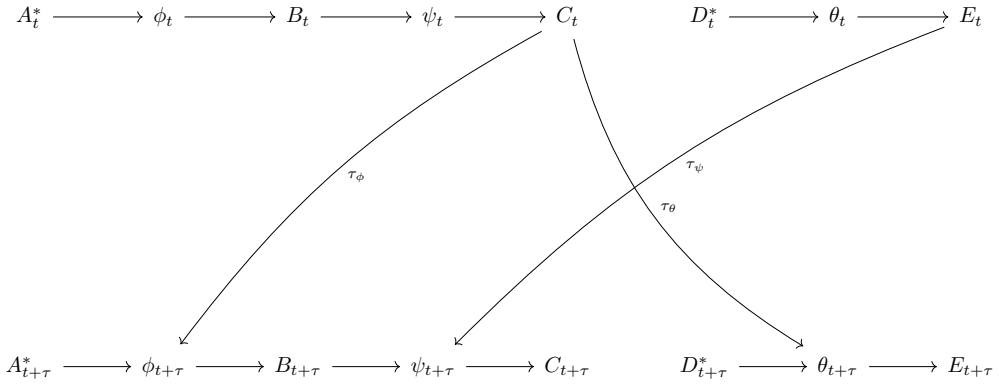
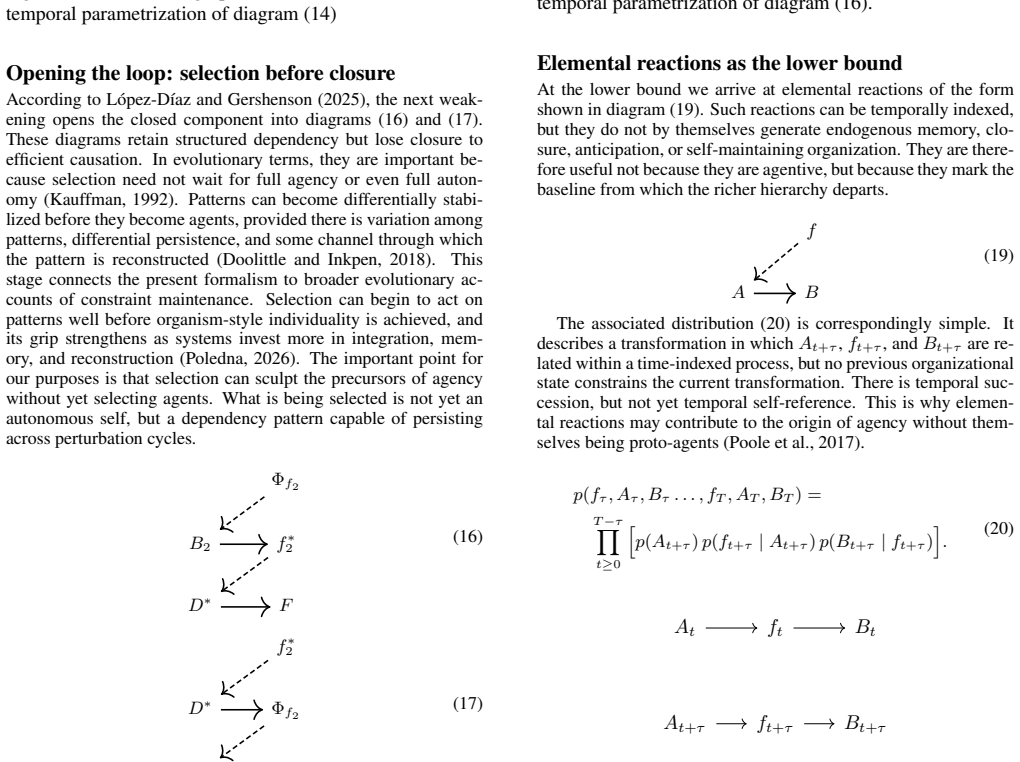
Once the constitutive processes of a semantically closed organization are associated with distinct characteristic timescales, the organization unfolds into an out-of-sync dependency structure that can be formally redescribed as a history-dependent, revisable Asynchronous Dynamic Bayesian Network. Agency appears precisely when this structure acquires an endogenous anticipatory component that selectively modulates organism-environment coupling in light of possible futures; open-endedness begins when the same organization can reconstruct its own future space of possibilities.
What carries the argument
Temporally parametrized (F, A)-systems, which convert the association of distinct timescales with constitutive processes of a closed organization into a revisable Asynchronous Dynamic Bayesian Network that supports endogenous anticipation.
If this is right
- Autonomy arises from precarious closure to efficient causation under material openness.
- Goal-directedness follows from the maintenance of viability-supporting organization.
- Agency requires the addition of an endogenous anticipatory structure to the timed organization.
- Open-endedness requires the further capacity to reconstruct the organization's own future space of possibilities.
- Markov blankets and active inference appear only as derived formal redescriptions, not as first principles.
Where Pith is reading between the lines
- The same timescale-association mechanism could be used to model how multicellular organisms develop graded forms of anticipation during ontogeny.
- Synthetic life experiments could test the hierarchy by constructing chemical or computational systems whose processes are deliberately assigned mismatched timescales.
- Neuroscience models might reinterpret neural dynamics as instances of the same out-of-sync dependency structure rather than as implementations of Bayesian inference.
Load-bearing premise
Associating the constitutive processes of a semantically closed organization with distinct characteristic timescales is sufficient to redescribe the organization as a history-dependent, revisable Asynchronous Dynamic Bayesian Network.
What would settle it
Observation of a system that exhibits endogenous anticipatory modulation of its environment coupling yet shows no association between its constitutive processes and distinct characteristic timescales.
Figures


read the original abstract
Agency is often invoked in research on philosophy, biology, and cognitive science without a clear account of how it originates from material organization. Building on temporally parametrized (F, A)-systems, this paper develops a graded organizational theory of agency grounded in relational biology, physical biosemiotics, and process ontology. We argue that self-referential closure cannot be adequately conceived outside time: once the constitutive processes of a semantically closed organization are associated with distinct characteristic timescales, the organization unfolds into an out-of-sync dependency structure that can be formally redescribed as a history-dependent, revisable Asynchronous Dynamic Bayesian Network. This move allows for a principled distinction between autonomy, goal-directedness, agency, and open-endedness. Autonomy arises from precarious closure to efficient causation under material openness; goal-directedness from the maintenance of viability-supporting organization; agency appears when such organization acquires an endogenous anticipatory structure that selectively modulates organism-environment coupling in light of possible futures; open-endedness begins when this anticipatory organization can reconstruct its own future space of possibilities. Our framework reconciles Rosennean anticipation with organizational closure, restricts Markov blankets and active inference to derived formal redescriptions rather than first principles, and reinterprets computational enactivism in non-Fristonian terms. By deriving weaker temporalized organizations, our contribution outlines a hierarchy from proto-agential chemical systems to fully semantically closed agents, with implications for multicellular organisms, synthetic lifeforms, and neuroscience.
Editorial analysis
A structured set of objections, weighed in public.
Referee Report
Summary. The paper claims to develop a graded organizational theory of agency grounded in relational biology and temporally parametrized (F, A)-systems. It argues that associating constitutive processes of semantically closed organizations with distinct characteristic timescales produces an out-of-sync dependency structure formally redescribable as a history-dependent, revisable Asynchronous Dynamic Bayesian Network; this enables distinctions between autonomy (precarious closure), goal-directedness (viability maintenance), agency (endogenous anticipatory structure modulating coupling to possible futures), and open-endedness (reconstruction of future possibility spaces), while reconciling Rosennean anticipation with organizational closure and reinterpreting Markov blankets and active inference as derived rather than foundational.
Significance. If the central redescription step holds, the framework would supply a principled hierarchy from proto-agential chemical systems to semantically closed agents, with potential implications for multicellularity, synthetic life, and neuroscience. The manuscript draws on established traditions in relational biology and process ontology but supplies no derivations, data, or formal proofs to support the key temporal-to-network mapping.
major comments (1)
- [Abstract] Abstract (paragraph beginning 'once the constitutive processes...'): the assertion that associating constitutive processes with distinct characteristic timescales 'unfolds' the organization into 'an out-of-sync dependency structure that can be formally redescribed as a history-dependent, revisable Asynchronous Dynamic Bayesian Network' is stated without any mapping, construction, intermediate derivation, or proof showing how the temporal parametrization induces history dependence, revisability, or the endogenous anticipatory structure. This step is load-bearing for every subsequent distinction (autonomy vs. goal-directedness vs. agency vs. open-endedness) and for the claimed reconciliation with Rosennean anticipation.
minor comments (1)
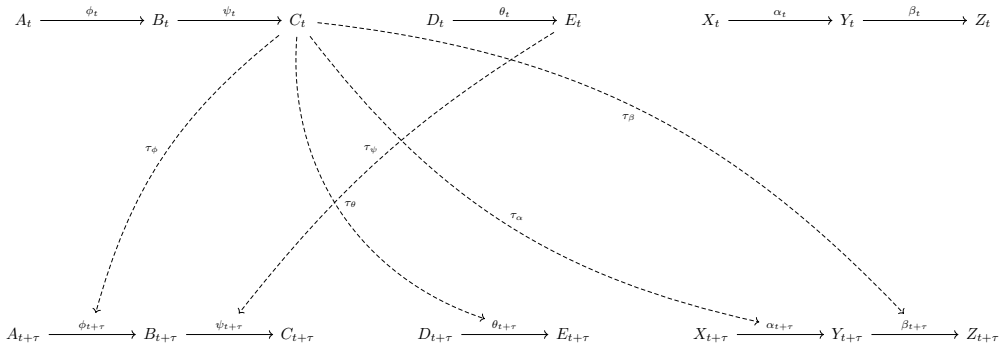
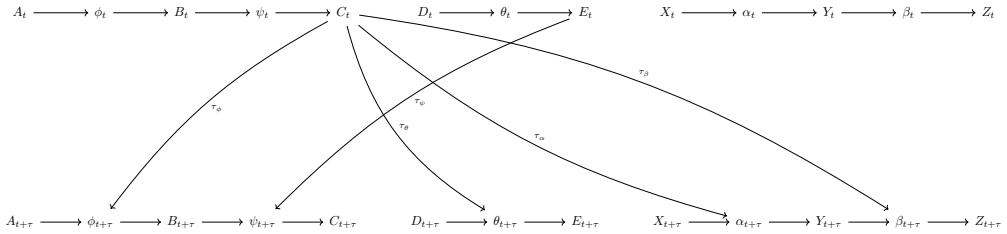
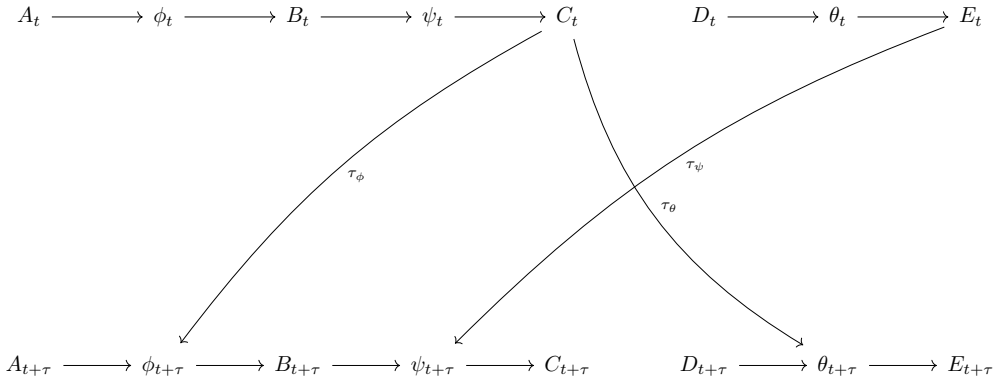
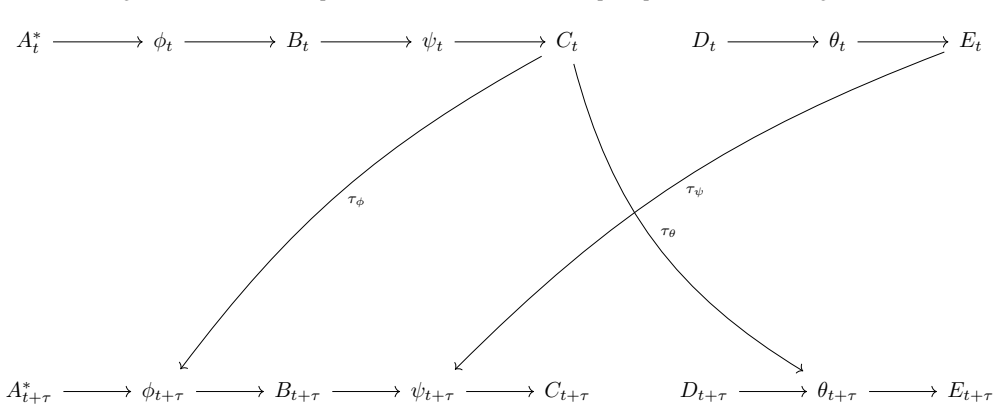
- The abstract is unusually dense; a schematic diagram or enumerated list of the successive temporal additions in the introduction would clarify the definitional chain.
Simulated Author's Rebuttal
We thank the referee for their thoughtful engagement with the manuscript. The central concern is that the key redescription from temporally parametrized (F, A)-systems to a history-dependent Asynchronous Dynamic Bayesian Network lacks an explicit mapping or derivation. We address this below, clarifying the conceptual nature of the argument while agreeing that additional explicit steps would improve clarity.
read point-by-point responses
-
Referee: [Abstract] Abstract (paragraph beginning 'once the constitutive processes...'): the assertion that associating constitutive processes with distinct characteristic timescales 'unfolds' the organization into 'an out-of-sync dependency structure that can be formally redescribed as a history-dependent, revisable Asynchronous Dynamic Bayesian Network' is stated without any mapping, construction, intermediate derivation, or proof showing how the temporal parametrization induces history dependence, revisability, or the endogenous anticipatory structure. This step is load-bearing for every subsequent distinction (autonomy vs. goal-directedness vs. agency vs. open-endedness) and for the claimed reconciliation with Rosennean anticipation.
Authors: We accept that the abstract condenses the central move without spelling out the intermediate construction. The manuscript develops the temporal parametrization of (F, A)-systems in the main text by associating distinct characteristic timescales with constitutive processes, which produces asynchronous dependencies that are history-dependent by construction (earlier states at faster timescales constrain later states at slower ones). This structure is then redescribed as an Asynchronous Dynamic Bayesian Network whose conditional dependencies are revisable because the underlying closure relations remain open to material perturbation. The distinctions among autonomy, goal-directedness, agency, and open-endedness follow directly from the graded presence of these features. We agree that an explicit step-by-step mapping would strengthen the presentation and will insert a new subsection (provisionally titled 'From Temporal Parametrization to Asynchronous Dependency Networks') that enumerates the construction: (1) assignment of timescales, (2) resulting out-of-sync closure graph, (3) encoding as history-dependent conditional probabilities, and (4) endogenous modulation of future couplings. This addition will also make the reconciliation with Rosennean anticipation more transparent. revision: yes
Circularity Check
No significant circularity; conceptual distinctions are definitional but not tautological reductions
full rationale
The paper builds a graded theory by associating timescales with processes in temporally parametrized (F,A)-systems and asserting that this permits redescription as a history-dependent Asynchronous Dynamic Bayesian Network, from which the distinctions among autonomy, goal-directedness, agency, and open-endedness follow by successive addition of properties. No equations, mappings, or constructions are exhibited in the provided text that would make any claimed result equivalent to its inputs by definition or by a fitted parameter renamed as output. The framework is presented as grounded in relational biology and process ontology rather than derived from self-referential premises or prior self-citations that bear the full load of the central claim. This is a standard conceptual organization of definitions and is self-contained against external benchmarks.
Axiom & Free-Parameter Ledger
axioms (2)
- domain assumption Self-referential closure cannot be adequately conceived outside time.
- domain assumption Constitutive processes of a semantically closed organization can be associated with distinct characteristic timescales.
Reference graph
Works this paper leans on
-
[1]
Open Questions about Time and Self-reference in Living Systems
Abramsky, S., Banzhaf, W., Caves, L. S., Levin, M., Machado, P., Ofria, C., Stepney, S., and White, R. (2025). Open ques- tions about time and self-reference in living systems.arXiv preprint arXiv:2508.11423. Alim, K., Andrew, N., Pringle, A., and Brenner, M. P. (2017). Mechanism of signal propagation in physarum poly- cephalum.Proceedings of the National...
work page internal anchor Pith review arXiv 2025
-
[2]
Beer, R. D. and Di Paolo, E. A. (2023). The theoretical foundations of enaction: Precariousness.Biosystems, 223:104823. Bich, L. and Bechtel, W. (2021). Mechanism, autonomy and bio- logical explanation.Biology & Philosophy, 36(6):53. Bich, L. and Bechtel, W. (2022). Organization needs organization: Understanding integrated control in living organisms.Stud...
2023
-
[3]
On the Measure of Intelligence
xi±xvii. Cambridge, MA: MIT Press. Bourrat, P. and Barron, A. B. (2026). Agency, goal directedness, and the levels of biological organization.BioScience, page biag030. Brown, E. and Vittadello, S. T. (2025). Studying organisational clo- sure in biological systems with process-enablement graphs. BioSystems, page 105567. Bruineberg, J., Doł˛ ega, K., Dewhur...
work page internal anchor Pith review Pith/arXiv arXiv 2026
-
[4]
sense of agency
Frankfurt am Main: MIND Group. Cornish-Bowden, A. and Cárdenas, M. L. (2020). Contrasting the- ories of life: Historical context, current theories. in search of an ideal theory.Biosystems, 188:104063. Craver, C. F. (2007).Explaining the brain: Mechanisms and the mosaic unity of neuroscience. Clarendon Press. David, N., Newen, A., and V ogeley, K. (2008). ...
2020
-
[5]
Di Paolo, E. A. (2005). Autopoiesis, adaptivity, teleology, agency. Phenomenology and the cognitive sciences, 4(4):429–452. DiFrisco, J. and Gawne, R. (2025). Biological agency: a concept without a research program.Journal of Evolutionary Biology, 38(2):143–156. DiFrisco, J. and Orzack, S. H. (2026). Biology needs philosophy, but what philosophy?BioScienc...
2005
-
[6]
Friston, K
Harvard university press. Friston, K. (2009). The free-energy principle: a rough guide to the brain?Trends in cognitive sciences, 13(7):293–301. Friston, K. (2013). Life as we know it.Journal of the Royal Society Interface, 10(86):20130475. Fulda, F. C. (2023). Agential autonomy and biological individual- ity.Evolution & Development, 25(6):353–370. Gallag...
2009
-
[7]
MIT Press. Hofmeyr, J.-H. S. (2018). Causation, constructors and codes. Biosystems, 164:121–127. Hofmeyr, J.-H. S. (2021). A biochemically-realisable rela- tional model of the self-manufacturing cell.Biosystems, 207:104463. Jaeger, J. (2023a). Artificial intelligence is algorithmic mimicry: why artificial" agents" are not (and won’t be) proper agents. arX...
-
[8]
Levin, M. (2019). The computational boundary of a “self”: devel- opmental bioelectricity drives multicellularity and scale-free cognition.Frontiers in psychology, 10:493866. Longo, G., Montévil, M., and Kauffman, S. (2012). No entail- ing laws, but enablement in the evolution of the biosphere. InProceedings of the 14th annual conference companion on Genet...
-
[9]
minimal cognition
Walter de Gruyter. Lyon, P. (2020). Of what is “minimal cognition” the half-baked version?Adaptive Behavior, 28(6):407–424. López-Díaz, A. J. and Gershenson, C. (2025). Closing the loop: how semantic closure enables open-ended evolution?Journal of The Royal Society Interface, 22(233):20250784. López-Díaz, A. J., Rivera Torres, P. J., Febres, G. L., and Ge...
2020
-
[10]
(2010).Vision: A computational investigation into the human representation and processing of visual information
Marr, D. (2010).Vision: A computational investigation into the human representation and processing of visual information. MIT press. Maturana, H. and Varela, F. (1980).Autopoiesis and Cognition: The realization of living. Reidel Publishing Company, Dor- drecht. Mitchell, M. and Krakauer, D. C. (2023). The debate over under- standing in ai’s large language...
2010
-
[11]
Noble, D. (2012). A theory of biological relativity: no privileged level of causation.Interface focus, 2(1):55–64. Noble, R., Tasaki, K., Noble, P. J., and Noble, D. (2019). Bio- logical relativity requires circular causality but not symmetry of causation: so, where, what and when are the boundaries? Frontiers in physiology, 10:827. Pattee, H. (2021). Sym...
work page internal anchor Pith review Pith/arXiv arXiv 2012
-
[12]
Polanyi, M. (1968). Life’s irreducible structure: Live mechanisms and information in dna are boundary conditions with a se- quence of boundaries above them.Science, 160(3834):1308–
1968
-
[13]
Poledna, P. (2026).Towards a Logic of Life. PhD thesis, University of Vienna. Poole, W., Ortiz-Munoz, A., Behera, A., Jones, N. S., Ouldridge, T. E., Winfree, E., and Gopalkrishnan, M. (2017). Chemi- cal boltzmann machines. InDNA Computing and Molecu- lar Programming: 23rd International Conference, DNA 23, Austin, TX, USA, September 24–28, 2017, Proceedin...
-
[14]
von Neumann, J
MIT Press. von Neumann, J. (1966). Theory of self-reproducing automata. Edited by Arthur W. Burks. Walsh, D. M. (2015).Organisms, agency, and evolution. Cam- bridge University Press. Walsh, D. M. (2018). Objectcy and agency: Towards a method- ological vitalism. In Nicholson, D. J. and Dupré, J., editors, Everything Flows: Towards a Processual Philosophy o...
1966
-
[15]
Weckström, M. M. (2023). Natural law, the modeling relation, and two roots of perspectivism.Synthese, 201(3):92. Williams, D. J. (2022). Markov blankets: Realism and our ontolog- ical commitments.Behavioral and Brain Sciences, 45:e217. Wilson, S. P. and Prescott, T. J. (2022). Scaffolding layered control architectures through constraint closure: insights ...
2023
discussion (0)
Sign in with ORCID, Apple, or X to comment. Anyone can read and Pith papers without signing in.