REVIEW 1 major objections 144 references
AI-Empowered UAV-Assisted Backscatter Localization and ISAC for Zero-Energy IoT: A Comprehensive Survey
T0 review · 1 major / 0 minor · reviewed 2026-06-26 · grok-4.3
Pith's one-line read This survey develops a unified taxonomy for AI-empowered UAV-assisted backscatter localization and ISAC in zero-energy IoT.
desk verdict A survey that organizes the UAV-backscatter-ISAC space with tables and a taxonomy, but the PRISMA process is not documented enough to confirm the coverage is representative. read the letter →
The pith
A machine-rendered reading of the paper's core claim, the machinery that carries it, and where it could break.
The reading
What carries the argument
The unified taxonomy that classifies the field along the dimensions of network architectures, UAV roles, backscatter modes, RF sources, localization and sensing functions, AI techniques, and performance metrics.
What would settle it
A substantial body of peer-reviewed work on UAV-assisted backscatter localization or ISAC that falls outside the taxonomy categories or was omitted despite matching the inclusion criteria.
Extended reading notes
Core claim
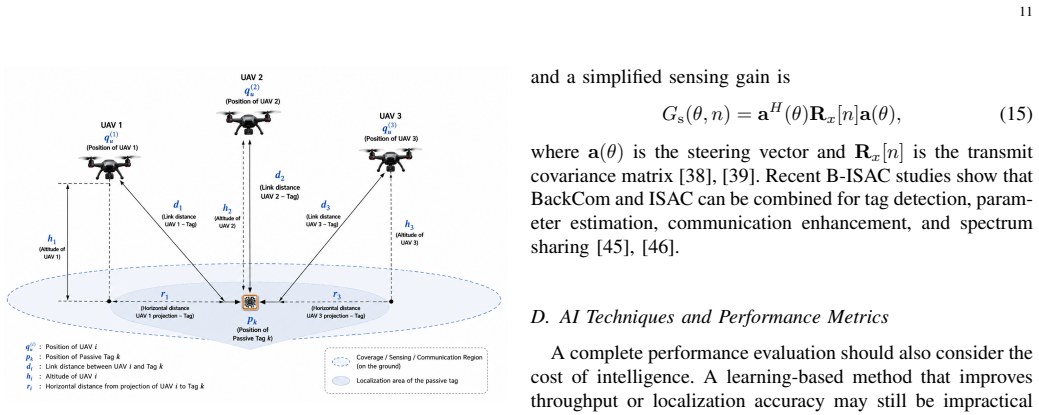
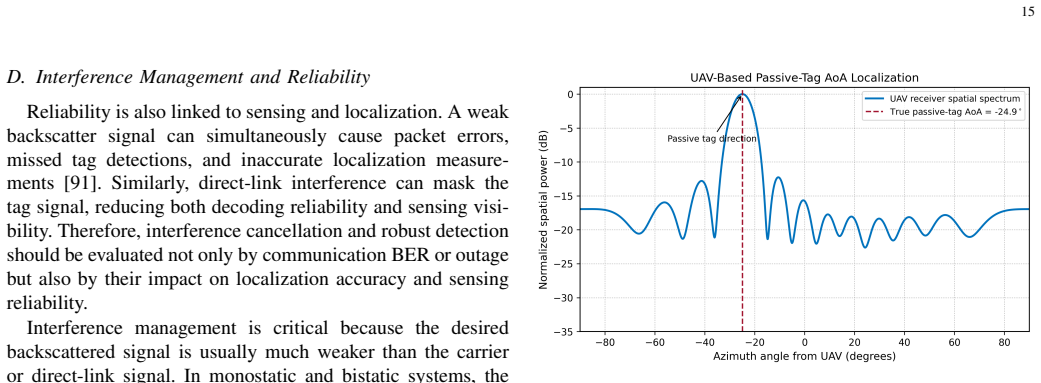
The paper establishes that RF-based AI-empowered UAV-assisted backscatter localization and ISAC form an integrated approach for zero-energy IoT; it develops a unified taxonomy covering network architectures, UAV roles, backscatter modes, RF sources, localization and sensing functions, AI techniques, and performance metrics, reviews enabling technologies and UAV-assisted BackCom and ISAC-enabled systems through tables and illustrations, and identifies open challenges in realistic channel modeling, energy-neutral operation, benchmarking, scalable AI, security, hardware validation, and integration with RIS, MEC, digital twins, and 6G.
Load-bearing premise
The PRISMA-informed methodology and literature selection process yields a representative and unbiased coverage of the field without significant omissions in the reviewed works on UAV-assisted backscatter and ISAC systems.
Editorial extensions
If this is right
- New research can be classified consistently using the taxonomy's categories for architectures, roles, and AI methods.
- Quantitative trend analysis and tables supply baselines for comparing future UAV-backscatter and ISAC performance.
- Listed open challenges in channel modeling, energy neutrality, and 6G integration directly indicate priority areas for investigation.
- Tutorial-style numerical illustrations demonstrate how the surveyed techniques can be evaluated in concrete scenarios.
Reading between the lines
- The taxonomy could serve as a template for organizing related surveys on passive sensing with other aerial platforms.
- Emphasis on reproducibility and benchmarking implies that standardized datasets or simulation frameworks would accelerate progress in the area.
- Integration challenges with digital twins suggest that closed-loop simulation of UAV-backscatter systems may become a practical testbed.
- Security and privacy gaps point to the need for lightweight authentication mechanisms tailored to passive tags.
Editorial analysis
A structured set of objections, weighed in public.
Referee Report
Summary. This survey paper reviews RF-based AI-empowered UAV-assisted backscatter localization and ISAC for zero-energy IoT. It presents a structured PRISMA-informed methodology, develops a unified taxonomy covering network architectures, UAV roles, backscatter modes, RF sources, localization and sensing functions, AI techniques, and performance metrics, provides comparative tables, quantitative trend analysis, and tutorial-style numerical illustrations, and identifies open challenges in channel modeling, energy-neutral operation, benchmarking, AI trustworthiness, security, and integration with RIS, MEC, digital twins, and 6G.
Significance. If the literature selection process is transparent and representative, the unified taxonomy and trend analysis would consolidate an emerging interdisciplinary area, offering a structured reference for researchers working on passive IoT, UAV-enabled systems, and ISAC, while the identified challenges could usefully direct future work toward reproducible and hardware-validated solutions.
major comments (1)
- [PRISMA-informed methodology description] The section describing the structured PRISMA-informed methodology states that a systematic review process is followed but provides no explicit details on queried databases (IEEE Xplore, Web of Science, etc.), Boolean search strings, date ranges, inclusion/exclusion criteria, or PRISMA flow numbers (records identified, screened, full-text assessed, included). This directly affects the verifiability of the claim that the taxonomy and open-challenge identification are comprehensive and free of major selection bias.
Simulated Author's Rebuttal
We thank the referee for the constructive feedback on our survey. We address the major comment below and will incorporate the suggested improvements to enhance the transparency of our methodology.
read point-by-point responses
-
Referee: [PRISMA-informed methodology description] The section describing the structured PRISMA-informed methodology states that a systematic review process is followed but provides no explicit details on queried databases (IEEE Xplore, Web of Science, etc.), Boolean search strings, date ranges, inclusion/exclusion criteria, or PRISMA flow numbers (records identified, screened, full-text assessed, included). This directly affects the verifiability of the claim that the taxonomy and open-challenge identification are comprehensive and free of major selection bias.
Authors: We agree that the current manuscript provides insufficient detail on the PRISMA-informed process, which limits verifiability. In the revised version, we will expand the methodology section to explicitly list the queried databases (IEEE Xplore, Web of Science, Scopus, and arXiv), the Boolean search strings, the date range (e.g., 2015–2024), the inclusion/exclusion criteria, and a full PRISMA flow diagram with the exact numbers of records identified, screened, assessed, and included. This will directly address the concern regarding selection bias and reproducibility. revision: yes
Circularity Check
No circularity: survey paper with no derivations or predictions
full rationale
This is a literature survey that develops a taxonomy of prior work on UAV-assisted backscatter localization and ISAC. It contains no mathematical derivations, fitted parameters, predictions, uniqueness theorems, or ansatzes. The PRISMA methodology is a literature-selection process whose transparency issues (if any) concern coverage completeness rather than any derivation chain reducing to its own inputs. No load-bearing steps match the enumerated circularity patterns; the contribution is self-contained as a review.
Assumptions & free parameters
Cite this review
Pith. "Pith review of AI-Empowered UAV-Assisted Backscatter Localization and ISAC for Zero-Energy IoT: A Comprehensive Survey." pith.science (2026). https://pith.science/paper/J2R3CGZC
@misc{pith2026260623125,
  author       = {Pith},
  title        = {Pith review of: AI-Empowered UAV-Assisted Backscatter Localization and ISAC for Zero-Energy IoT: A Comprehensive Survey},
  year         = {2026},
  howpublished = {\url{https://pith.science/paper/J2R3CGZC}},
  note         = {Machine review of arXiv:2606.23125}
}
read the original abstract
Zero-energy Internet of Things (IoT) enables passive or near-passive devices to operate on harvested energy rather than batteries. Backscatter communication (BackCom) supports this vision by enabling tags to transmit data via reflection and modulation of incident RF signals, but it suffers from weak reflections, double-path loss, limited coverage, direct-link interference, and dependence on external RF sources. Unmanned aerial vehicles (UAVs) can mitigate these limitations by acting as mobile carrier emitters, data collectors, relays, aerial receivers, mobile anchors, sensing platforms, and edge-intelligence nodes. Integrated sensing and communication (ISAC) further enables the sharing of wireless resources for data transmission, localization, target sensing, and environmental awareness. This article surveys RF-based AI-empowered UAV-assisted backscatter localization and ISAC for zero-energy IoT. It reviews enabling technologies, presents a structured PRISMA-informed methodology, and develops a unified taxonomy covering network architectures, UAV roles, backscatter modes, RF sources, localization and sensing functions, AI techniques, and performance metrics. It also discusses UAV-assisted BackCom, passive localization, ISAC-enabled UAV-backscatter systems, and AI-driven optimization through comparative tables, quantitative trend analysis, coverage evaluation, and tutorial-style numerical illustrations. Finally, it identifies open challenges and future directions in realistic channel modeling, energy-neutral operation, benchmarking, reproducibility, scalable and trustworthy AI, security, privacy, hardware validation, and integration with RIS, MEC, digital twins, and 6G technologies.
Figures


Figures from the paper (16 more)




Reference graph
Works this paper leans on
-
[1]
The Internet of Things: A Survey,
L. Atzori, A. Iera, and G. Morabito, “The Internet of Things: A Survey,” Computer Networks, vol. 54, no. 15, pp. 2787–2805, 2010
2010
-
[2]
Internet of Things (IoT): A Vision, Architectural Elements, and Future Directions,
J. Gubbi, R. Buyya, S. Marusic, and M. Palaniswami, “Internet of Things (IoT): A Vision, Architectural Elements, and Future Directions,” Future Generation Computer Systems, vol. 29, no. 7, pp. 1645–1660, 2013
2013
-
[3]
Internet of Things: A Survey on Enabling Technologies, Protocols, and Applications,
A. Al-Fuqaha, M. Guizani, M. Mohammadi, M. Aledhari, and M. Ayyash, “Internet of Things: A Survey on Enabling Technologies, Protocols, and Applications,”IEEE Communications Surveys & Tuto- rials, vol. 17, no. 4, pp. 2347–2376, 2015
2015
-
[4]
Framework and Overall Objectives of the Future Development of IMT for 2030 and Beyond,
International Telecommunication Union Radiocommunication Sector, “Framework and Overall Objectives of the Future Development of IMT for 2030 and Beyond,” Recommendation ITU-R M.2160-0, Nov
-
[5]
Available: https://www.itu.int/rec/R-REC-M.2160-0- 202311-I/en
[Online]. Available: https://www.itu.int/rec/R-REC-M.2160-0- 202311-I/en
-
[6]
A Vision of 6G Wireless Systems: Applications, Trends, Technologies, and Open Research Problems,
W. Saad, M. Bennis, and M. Chen, “A Vision of 6G Wireless Systems: Applications, Trends, Technologies, and Open Research Problems,” IEEE Network, vol. 34, no. 3, pp. 134–142, 2020
2020
-
[7]
6G Wireless Systems: Vision, Requirements, Chal- lenges, Insights, and Opportunities,
H. Tataria, M. Shafi, A. F. Molisch, M. Dohler, H. Sjöland, and F. Tufvesson, “6G Wireless Systems: Vision, Requirements, Chal- lenges, Insights, and Opportunities,”Proceedings of the IEEE, vol. 109, no. 7, pp. 1166–1199, 2021
2021
-
[8]
The Roadmap to 6G: AI Empowered Wireless Networks,
K. B. Letaief, W. Chen, Y . Shi, J. Zhang, and Y .-J. A. Zhang, “The Roadmap to 6G: AI Empowered Wireless Networks,”IEEE Communications Magazine, vol. 57, no. 8, pp. 84–90, 2019
2019
Show all 144 references
-
[9]
Wireless Networks With RF Energy Harvesting: A Contemporary Survey,
X. Lu, P. Wang, D. Niyato, D. I. Kim, and Z. Han, “Wireless Networks With RF Energy Harvesting: A Contemporary Survey,”IEEE Communications Surveys & Tutorials, vol. 17, no. 2, pp. 757–789, 2015
2015
-
[10]
Wireless Information and Power Transfer: Architecture Design and Rate-Energy Tradeoff,
X. Zhou, R. Zhang, and C. K. Ho, “Wireless Information and Power Transfer: Architecture Design and Rate-Energy Tradeoff,”IEEE Trans- actions on Communications, vol. 61, no. 11, pp. 4754–4767, 2013
2013
-
[11]
Wireless Powered Communication Networks: An Overview,
S. Bi, Y . Zeng, and R. Zhang, “Wireless Powered Communication Networks: An Overview,”IEEE Wireless Communications, vol. 23, no. 2, pp. 10–18, 2016
2016
-
[12]
Wireless Energy Harvesting for the Internet of Things,
P. Kamalinejad, C. Mahapatra, Z. Sheng, S. Mirabbasi, V . C. M. Leung, and Y . L. Guan, “Wireless Energy Harvesting for the Internet of Things,”IEEE Communications Magazine, vol. 53, no. 6, pp. 102–108, 2015
2015
-
[13]
Ambient IoT in 3GPP Release 19: A Survey,
M. Qu, Y . Zhao, X. Tang, R. Jian, W. Huang, T. Zhang, and J. Zeng, “Ambient IoT in 3GPP Release 19: A Survey,” inProceedings of the 2024 IEEE Smart World Congress. IEEE, 2024, pp. 2181–2186
2024
-
[14]
Release 19 Ambient IoT,
3GPP, “Release 19 Ambient IoT,” Online, 2025, accessed: 2026-05-20. [Online]. Available: https://www.3gpp.org/technologies/rel19-aiot
2025
-
[15]
3GPP Evolution from 5G to 6G: A 10-Year Retrospective,
X. Lin, “3GPP Evolution from 5G to 6G: A 10-Year Retrospective,”
-
[16]
Available: https://arxiv.org/abs/2412.21077
[Online]. Available: https://arxiv.org/abs/2412.21077
-
[17]
Ambient Backscatter: Wireless Communication Out of Thin Air,
V . Liu, A. Parks, V . Talla, S. Gollakota, D. Wetherall, and J. R. Smith, “Ambient Backscatter: Wireless Communication Out of Thin Air,” in Proceedings of the ACM SIGCOMM 2013 Conference. ACM, 2013, pp. 39–50
2013
-
[18]
Wi-Fi Backscatter: Internet Connectivity for RF-Powered Devices,
B. Kellogg, A. Parks, S. Gollakota, J. R. Smith, and D. Wetherall, “Wi-Fi Backscatter: Internet Connectivity for RF-Powered Devices,” inProceedings of the 2014 ACM Conference on SIGCOMM. ACM, 2014, pp. 607–618
2014
-
[19]
Backscatter Communication and RFID: Coding, Energy, and MIMO Analysis,
C. Boyer and S. Roy, “Backscatter Communication and RFID: Coding, Energy, and MIMO Analysis,”IEEE Transactions on Communications, vol. 62, no. 3, pp. 770–785, 2014
2014
-
[20]
Ambient Backscatter Communications: A Contemporary Sur- vey,
N. V . Huynh, D. T. Hoang, X. Lu, D. Niyato, P. Wang, and D. I. Kim, “Ambient Backscatter Communications: A Contemporary Sur- vey,”IEEE Communications Surveys & Tutorials, vol. 20, no. 4, pp. 2889–2922, 2018
2018
-
[21]
Next Generation Backscatter Communication: Systems, Techniques, and Applications,
Q. Zhang, H. Guo, Y . Liang, and X. Li, “Next Generation Backscatter Communication: Systems, Techniques, and Applications,”EURASIP Journal on Wireless Communications and Networking, vol. 2019, no. 1, p. 69, 2019
2019
-
[22]
The State of AI-Empowered Backscatter Communications: A Comprehensive Survey,
F. Xu, T. Hussain, M. Ahmed, K. Ali, M. A. Mirza, W. U. Khan, A. Ihsan, and Z. Han, “The State of AI-Empowered Backscatter Communications: A Comprehensive Survey,”IEEE Internet of Things Journal, vol. 10, no. 24, pp. 21 763–21 786, 2023
2023
-
[23]
Intelligent Interference Can- cellation and Ambient Backscatter Signal Extraction for Wireless- Powered UA V IoT Network,
C. Zhong, D. Zhai, Y . Lu, and K. Li, “Intelligent Interference Can- cellation and Ambient Backscatter Signal Extraction for Wireless- Powered UA V IoT Network,”EURASIP Journal on Advances in Signal Processing, vol. 2024, no. 30, 2024
2024
-
[24]
Wireless Communications With Unmanned Aerial Vehicles: Opportunities and Challenges,
Y . Zeng, R. Zhang, and T. J. Lim, “Wireless Communications With Unmanned Aerial Vehicles: Opportunities and Challenges,”IEEE Com- munications Magazine, vol. 54, no. 5, pp. 36–42, 2016
2016
-
[25]
A Tutorial on UA Vs for Wireless Networks: Applications, Challenges, and Open Problems,
M. Mozaffari, W. Saad, M. Bennis, Y .-H. Nam, and M. Debbah, “A Tutorial on UA Vs for Wireless Networks: Applications, Challenges, and Open Problems,”IEEE Communications Surveys & Tutorials, vol. 21, no. 3, pp. 2334–2360, 2019
2019
-
[26]
A Deterministic Game-Theoretic Handover Protocol for UA V- RSU Integrated Networks,
Z. Shafiq, M. Ismail, M. A. Alshara, T. Jan, N. Ahmad, and R. A. Khalil, “A Deterministic Game-Theoretic Handover Protocol for UA V- RSU Integrated Networks,”IEEE Open Journal of the Communications Society, vol. 7, pp. 4223–4238, 2026
2026
-
[27]
UA V Communications for 5G and Beyond: Recent Advances and Future Trends,
B. Li, Z. Fei, and Y . Zhang, “UA V Communications for 5G and Beyond: Recent Advances and Future Trends,”IEEE Internet of Things Journal, vol. 6, no. 2, pp. 2241–2263, 2019
2019
-
[28]
Survey on UA V Cellular Communications: Practical Aspects, Standardization Advancements, Regulation, and Se- curity Challenges,
A. Fotouhi, H. Qiang, M. Ding, M. Hassan, L. G. Giordano, A. Garcia- Rodriguez, and J. Yuan, “Survey on UA V Cellular Communications: Practical Aspects, Standardization Advancements, Regulation, and Se- curity Challenges,”IEEE Communications Surveys & Tutorials, vol. 21, no. 4...
2019
-
[29]
Unmanned Aerial Vehicles: A Survey on Civil Applications and Key Research Challenges,
H. Shakhatreh, A. H. Sawalmeh, A. Al-Fuqaha, Z. Dou, E. Almaita, I. Khalil, N. S. Othman, A. Khreishah, and M. Guizani, “Unmanned Aerial Vehicles: A Survey on Civil Applications and Key Research Challenges,”IEEE Access, vol. 7, pp. 48 572–48 634, 2019
2019
-
[30]
Low-Altitude Unmanned Aerial Vehicles-Based Internet of Things Services: Comprehensive Survey and Future Perspectives,
N. H. Motlagh, T. Taleb, and O. Arouk, “Low-Altitude Unmanned Aerial Vehicles-Based Internet of Things Services: Comprehensive Survey and Future Perspectives,”IEEE Internet of Things Journal, vol. 3, no. 6, pp. 899–922, 2016
2016
-
[31]
Energy-Efficient UA V Backscatter Communication With Joint Trajectory Design and Resource Optimiza- tion,
G. Yang, R. Dai, and Y .-C. Liang, “Energy-Efficient UA V Backscatter Communication With Joint Trajectory Design and Resource Optimiza- tion,”IEEE Transactions on Wireless Communications, vol. 20, no. 2, pp. 926–941, 2021
2021
-
[32]
Resource Allocation for UA V-Assisted Backscatter Communication,
Z. Wang, D. Hong, Z. Fan, X. Wan, Y . Xu, and B. Duo, “Resource Allocation for UA V-Assisted Backscatter Communication,”EURASIP Journal on Wireless Communications and Networking, vol. 2022, no. 104, 2022
2022
-
[33]
Locating the Nodes: Cooperative Localization in Wireless Sensor Networks,
N. Patwari, J. N. Ash, S. Kyperountas, A. O. H. III, R. L. Moses, and N. S. Correal, “Locating the Nodes: Cooperative Localization in Wireless Sensor Networks,”IEEE Signal Processing Magazine, vol. 22, no. 4, pp. 54–69, 2005
2005
-
[34]
Wireless Sensor Network Localization Techniques,
G. Mao, B. Fidan, and B. D. O. Anderson, “Wireless Sensor Network Localization Techniques,”Computer Networks, vol. 51, no. 10, pp. 2529–2553, 2007
2007
-
[35]
Survey of Wireless Indoor Positioning Techniques and Systems,
H. Liu, H. Darabi, P. Banerjee, and J. Liu, “Survey of Wireless Indoor Positioning Techniques and Systems,”IEEE Transactions on Systems, Man, and Cybernetics, Part C, vol. 37, no. 6, pp. 1067–1080, 2007
2007
-
[36]
A Survey of Indoor Local- ization Systems and Technologies,
F. Zafari, A. Gkelias, and K. K. Leung, “A Survey of Indoor Local- ization Systems and Technologies,”IEEE Communications Surveys & Tutorials, vol. 21, no. 3, pp. 2568–2599, 2019
2019
-
[37]
Cooperative Localization in Wireless Networks,
H. Wymeersch, J. Lien, and M. Z. Win, “Cooperative Localization in Wireless Networks,”Proceedings of the IEEE, vol. 97, no. 2, pp. 427– 450, 2009
2009
-
[38]
Trustworthy Localization in IoT Networks: A Survey of Localization Techniques, Threats, and Mitigation,
G. Pettorru, V . Pilloni, and M. Martalò, “Trustworthy Localization in IoT Networks: A Survey of Localization Techniques, Threats, and Mitigation,”Sensors, vol. 24, no. 7, p. 2214, 2024. 31
2024
-
[39]
Joint Radar and Communication Design: Applications, State-of-the-Art, and the Road Ahead,
F. Liu, C. Masouros, A. P. Petropulu, H. Griffiths, and L. Hanzo, “Joint Radar and Communication Design: Applications, State-of-the-Art, and the Road Ahead,”IEEE Transactions on Communications, vol. 68, no. 6, pp. 3834–3862, 2020
2020
-
[40]
An Overview of Signal Processing Techniques for Joint Communication and Radar Sensing,
J. A. Zhang, F. Liu, C. Masouros, R. W. H. Jr., Z. Feng, L. Zheng, and A. Petropulu, “An Overview of Signal Processing Techniques for Joint Communication and Radar Sensing,”IEEE Journal of Selected Topics in Signal Processing, vol. 15, no. 6, pp. 1295–1315, 2021
2021
-
[41]
Integrated Sensing and Communications: Toward Dual- Functional Wireless Networks for 6G and Beyond,
F. Liu, Y . Cui, C. Masouros, J. Xu, T. X. Han, Y . C. Eldar, and S. Buzzi, “Integrated Sensing and Communications: Toward Dual- Functional Wireless Networks for 6G and Beyond,”IEEE Journal on Selected Areas in Communications, vol. 40, no. 6, pp. 1728–1767, 2022
2022
-
[42]
A Survey on Fundamental Limits of Integrated Sensing and Communication,
A. Liu, Z. Huang, M. Li, Y . Wan, W. Li, T. X. Han, C.-X. Liu, R. Du, D. K. Tan, J. Lu, Y . Shen, F. Colone, and K. Chetty, “A Survey on Fundamental Limits of Integrated Sensing and Communication,”IEEE Communications Surveys & Tutorials, vol. 24, no. 2, pp. 994–1034, 2022
2022
-
[43]
Robust ISAC Localization in Smart Cities: A Hybrid Network Approach for NLOS Challenges with Uncertain Parameters,
T. Althobaiti, R. A. Khalil, and N. Saeed, “Robust ISAC Localization in Smart Cities: A Hybrid Network Approach for NLOS Challenges with Uncertain Parameters,”Journal of Sensor and Actuator Networks, vol. 13, no. 1, p. 2, 2024
2024
-
[44]
Integrated Sensing and Communication Signals Toward 5G-A and 6G: A Survey,
Z. Wei, H. Qu, Y . Wang, X. Yuan, H. Wu, Y . Du, K. Han, N. Zhang, and Z. Feng, “Integrated Sensing and Communication Signals Toward 5G-A and 6G: A Survey,”IEEE Internet of Things Journal, vol. 10, no. 13, pp. 11 068–11 092, 2023
2023
-
[45]
A Survey on Integrated Sensing, Communication, and Computation,
D. Wen, Y . Zhou, X. Li, Y . Shi, K. Huang, and K. B. Letaief, “A Survey on Integrated Sensing, Communication, and Computation,” IEEE Communications Surveys & Tutorials, vol. 27, no. 5, pp. 3058– 3098, 2025
2025
-
[46]
Robust Multi-Target Localization in ISAC Systems: Leveraging Multidimensional Scaling,
R. A. Khalil and N. Saeed, “Robust Multi-Target Localization in ISAC Systems: Leveraging Multidimensional Scaling,”IEEE Open Journal of the Communications Society, vol. 5, pp. 3678–3689, 2024
2024
-
[47]
Sensing and Backscatter Communication Integration: Realizing Efficiency in Wire- less Systems for IoT,
S. Zargari, D. Galappaththige, and C. Tellambura, “Sensing and Backscatter Communication Integration: Realizing Efficiency in Wire- less Systems for IoT,” 2023
2023
-
[48]
B- ISAC: Backscatter Integrated Sensing and Communication for IoE Applications,
Z. Zhao, Y . Dong, T. Wei, X. Tang, X.-P. Zhang, and Z. Liu, “B- ISAC: Backscatter Integrated Sensing and Communication for IoE Applications,” 2024
2024
-
[49]
UA V Assisted Integrated Sensing and Communications for Internet of Things: 3D Trajectory Optimization and Resource Allocation,
Z. Liu, X. Liu, Y . Liu, V . C. M. Leung, and T. S. Durrani, “UA V Assisted Integrated Sensing and Communications for Internet of Things: 3D Trajectory Optimization and Resource Allocation,”IEEE Transactions on Wireless Communications, vol. 23, no. 8, pp. 8654– 8667, 2024
2024
-
[50]
Advancements in UA V-Based Integrated Sensing and Communication: A Comprehensive Survey,
M. Ahmed, A. A. Nasir, M. Masood, K. A. Memon, K. K. Qureshi, F. Khan, W. U. Khan, F. Xu, and Z. Han, “Advancements in UA V-Based Integrated Sensing and Communication: A Comprehensive Survey,” 2025
2025
-
[51]
An Introduction to Deep Learning for the Physical Layer,
T. J. O’Shea and J. Hoydis, “An Introduction to Deep Learning for the Physical Layer,”IEEE Transactions on Cognitive Communications and Networking, vol. 3, no. 4, pp. 563–575, 2017
2017
-
[52]
Deep Learning in Mobile and Wireless Networking: A Survey,
C. Zhang, P. Patras, and H. Haddadi, “Deep Learning in Mobile and Wireless Networking: A Survey,”IEEE Communications Surveys & Tutorials, vol. 21, no. 3, pp. 2224–2287, 2019
2019
-
[53]
To- wards Artificial Intelligence Enabled 6G: State of the Art, Challenges, and Opportunities,
S. Chen, Y .-C. Liang, S. Sun, S. Kang, W. Cheng, and M. Peng, “To- wards Artificial Intelligence Enabled 6G: State of the Art, Challenges, and Opportunities,”Computer Networks, vol. 183, p. 107556, 2020
2020
-
[54]
R. S. Sutton and A. G. Barto,Reinforcement Learning: An Introduction, 2nd ed. MIT Press, 2018. [Online]. Available: http://incompleteideas.net/book/the-book-2nd.html
2018
-
[55]
Intelligent Integrated Sensing and Communication: A Survey,
J. Zhang, W. Lu, C. Xing, N. Zhao, N. Al-Dhahir, G. K. Karagiannidis et al., “Intelligent Integrated Sensing and Communication: A Survey,” Science China Information Sciences, vol. 68, no. 3, p. 131301, 2025
2025
-
[56]
A Survey on Mobile Edge Computing: The Communication Perspective,
Y . Mao, C. You, J. Zhang, K. Huang, and K. B. Letaief, “A Survey on Mobile Edge Computing: The Communication Perspective,”IEEE Communications Surveys & Tutorials, vol. 19, no. 4, pp. 2322–2358, 2017
2017
-
[57]
Advances and Open Problems in Federated Learning,
P. Kairouz, H. B. McMahan, B. Avent, A. Bellet, M. Bennis, A. N. Bhagoji, K. Bonawitz, Z. Charles, G. Cormode, R. Cummings, R. G. L. D’Oliveira, S. E. Rouayheb, D. Evans, J. Gardner, Z. Garrett, A. Gascón, B. Ghazi, P. B. Gibbons, M. Gruteser, Z. Harchaoui, C. He, L. He, Z. Hu...
2021
-
[58]
Wireless Communications Through Reconfigurable Intelligent Surfaces,
E. Basar, M. D. Renzo, J. de Rosny, M. Debbah, M.-S. Alouini, and R. Zhang, “Wireless Communications Through Reconfigurable Intelligent Surfaces,”IEEE Access, vol. 7, pp. 116 753–116 773, 2019
2019
-
[59]
Digital Twin of Wireless Systems: Overview, Taxonomy, Chal- lenges, and Opportunities,
L. U. Khan, Z. Han, W. Saad, E. Hossain, M. Guizani, and C. S. Hong, “Digital Twin of Wireless Systems: Overview, Taxonomy, Chal- lenges, and Opportunities,”IEEE Communications Surveys & Tutorials, vol. 24, no. 4, pp. 2230–2254, 2022
2022
-
[60]
A Survey of Millimeter Wave Backscatter Communication Systems,
W. Chen, W. Yang, and W. Gong, “A Survey of Millimeter Wave Backscatter Communication Systems,”Computer Networks, vol. 242, p. 110235, 2024
2024
-
[61]
THz ISAC: A Physical-Layer Perspective of Terahertz Integrated Sensing and Communication,
C. Han, Y . Wu, Z. Chen, Y . Chen, and G. Wang, “THz ISAC: A Physical-Layer Perspective of Terahertz Integrated Sensing and Communication,”IEEE Communications Magazine, vol. 62, no. 2, pp. 102–108, 2024
2024
-
[62]
Terahertz- band integrated sensing and communications: Challenges and oppor- tunities,
A. M. Elbir, K. V . Mishra, S. Chatzinotas, and M. Bennis, “Terahertz- band integrated sensing and communications: Challenges and oppor- tunities,”IEEE Aerospace and Electronic Systems Magazine, vol. 39, no. 12, pp. 38–49, 2024
2024
-
[63]
A Survey on UA V-Assisted Wireless Commu- nications: Recent Advances and Future Trends,
X. Gu and G. Zhang, “A Survey on UA V-Assisted Wireless Commu- nications: Recent Advances and Future Trends,”Computer Communi- cations, vol. 208, pp. 44–78, 2023
2023
-
[64]
Joint Communica- tion and Sensing Toward 6G: Models and Potential of Using MIMO,
X. Fang, W. Feng, Y . Chen, N. Ge, and Y . Zhang, “Joint Communica- tion and Sensing Toward 6G: Models and Potential of Using MIMO,” IEEE Internet of Things Journal, vol. 10, no. 5, pp. 4093–4116, 2023
2023
-
[65]
Convex Hull Optimization for Robust Localization in ISAC Systems,
R. A. Khalil and N. Saeed, “Convex Hull Optimization for Robust Localization in ISAC Systems,”IEEE Sensors Letters, vol. 7, no. 12, pp. 1–4, 2023
2023
-
[66]
Fundamentals of Wireless Information and Power Transfer: From RF Energy Harvester Models to Signal and System Designs,
B. Clerckx, R. Zhang, R. Schober, D. W. K. Ng, D. I. Kim, and H. V . Poor, “Fundamentals of Wireless Information and Power Transfer: From RF Energy Harvester Models to Signal and System Designs,” IEEE Journal on Selected Areas in Communications, vol. 37, no. 1, pp. 4–33, 2019
2019
-
[67]
BackFi: High Throughput WiFi Backscatter,
D. Bharadia, K. R. Joshi, M. Kotaru, and S. Katti, “BackFi: High Throughput WiFi Backscatter,” inProceedings of the ACM SIGCOMM 2015 Conference. ACM, 2015, pp. 283–296
2015
-
[68]
Passive Wi-Fi: Bringing Low Power to Wi-Fi Transmissions,
B. Kellogg, V . Talla, S. Gollakota, and J. R. Smith, “Passive Wi-Fi: Bringing Low Power to Wi-Fi Transmissions,” inProceedings of the 13th USENIX Symposium on Networked Systems Design and Implementation. USENIX Association, 2016, pp. 151–
2016
-
[69]
Available: https://www.usenix.org/conference/nsdi16/ technical-sessions/presentation/kellogg
[Online]. Available: https://www.usenix.org/conference/nsdi16/ technical-sessions/presentation/kellogg
-
[70]
Inter- Technology Backscatter: Towards Internet Connectivity for Implanted Devices,
V . Iyer, V . Talla, B. Kellogg, S. Gollakota, and J. R. Smith, “Inter- Technology Backscatter: Towards Internet Connectivity for Implanted Devices,” inProceedings of the ACM SIGCOMM 2016 Conference. ACM, 2016, pp. 356–369
2016
-
[71]
LoRa Backscatter: Enabling the Vision of Ubiquitous Connec- tivity,
V . Talla, M. Hessar, B. Kellogg, A. Najafi, J. R. Smith, and S. Gol- lakota, “LoRa Backscatter: Enabling the Vision of Ubiquitous Connec- tivity,”Proceedings of the ACM on Interactive, Mobile, Wearable and Ubiquitous Technologies, vol. 1, no. 3, pp. 1–24, 2017
2017
-
[72]
Simplifying Backscatter Deployment: Full-Duplex LoRa Backscatter,
M. Katanbaf, A. Weinand, and V . Talla, “Simplifying Backscatter Deployment: Full-Duplex LoRa Backscatter,” inProceedings of the 18th USENIX Symposium on Networked Systems Design and Implementation. USENIX Association, 2021, pp. 955–
2021
-
[73]
Available: https://www.usenix.org/conference/nsdi21/ presentation/katanbaf
[Online]. Available: https://www.usenix.org/conference/nsdi21/ presentation/katanbaf
-
[74]
Non-Terrestrial Networks in 5G & Beyond: A Survey,
F. Rinaldi, H.-L. Määttänen, J. Torsner, S. Pizzi, S. Andreev, A. Iera, Y . Koucheryavy, and G. Araniti, “Non-Terrestrial Networks in 5G & Beyond: A Survey,”IEEE Access, vol. 8, pp. 165 178–165 200, 2020
2020
-
[75]
Evolution of Non-Terrestrial Networks from 5G to 6G: A Survey,
M. M. Azari, S. Solanki, S. Chatzinotas, O. Kodheli, H. Sallouha, A. Colpaert, J. F. M. Montoya, S. Pollin, A. Haqiqatnejad, A. Mostaani et al., “Evolution of Non-Terrestrial Networks from 5G to 6G: A Survey,”IEEE Communications Surveys & Tutorials, vol. 24, no. 4, pp. 2633–2672, 2022
2022
-
[76]
Non-Terrestrial Networks in the 6G Era: Challenges and Opportunities,
M. Giordani and M. Zorzi, “Non-Terrestrial Networks in the 6G Era: Challenges and Opportunities,”IEEE Network, vol. 35, no. 2, pp. 244– 251, 2021
2021
-
[77]
Federated Learning in Mobile Edge Networks: A Comprehensive Survey,
W. Y . B. Lim, Z. Xiong, D. Niyato, X. Cao, C. Miao, C. Leung, and Q. Yang, “Federated Learning in Mobile Edge Networks: A Comprehensive Survey,”IEEE Communications Surveys & Tutorials, vol. 22, no. 3, pp. 2031–2063, 2020
-
[78]
Adaptive Federated Learning in Resource Constrained Edge Computing Systems,
S. Wang, T. Tuor, T. Salonidis, K. K. Leung, C. Makaya, T. He, and K. Chan, “Adaptive Federated Learning in Resource Constrained Edge Computing Systems,”IEEE Journal on Selected Areas in Communica- tions, vol. 37, no. 6, pp. 1205–1221, 2019. 32
2019
-
[79]
The PRISMA 2020 Statement: An Updated Guideline for Reporting Systematic Reviews,
M. J. Page, J. E. McKenzie, P. M. Bossuyt, I. Boutron, T. C. Hoffmann, C. D. Mulrow, L. Shamseer, J. M. Tetzlaff, E. A. Akl, S. E. Brennan, R. Chou, J. Glanville, J. M. Grimshaw, A. Hróbjartsson, M. M. Lalu, T. Li, E. W. Loder, E. Mayo-Wilson, S. McDonald, L. A. McGuinness, L....
2020
-
[80]
PRISMA-S: An Extension to the PRISMA Statement for Reporting Literature Searches in Systematic Reviews,
M. L. Rethlefsen, S. Kirtley, S. Waffenschmidt, A. P. Ayala, D. Moher, M. J. Page, and J. B. Koffel, “PRISMA-S: An Extension to the PRISMA Statement for Reporting Literature Searches in Systematic Reviews,”Systematic Reviews, vol. 10, no. 1, p. 39, 2021
2021
-
[81]
Guidelines for Conduct- ing Systematic Mapping Studies in Software Engineering: An Update,
K. Petersen, S. Vakkalanka, and L. Kuzniarz, “Guidelines for Conduct- ing Systematic Mapping Studies in Software Engineering: An Update,” Information and Software Technology, vol. 64, pp. 1–18, 2015
2015
-
[82]
Guidelines for Performing Systematic Literature Reviews in Software Engineering,
B. Kitchenham and S. Charters, “Guidelines for Performing Systematic Literature Reviews in Software Engineering,” Keele University and Durham University, Tech. Rep. EBSE 2007-001, 2007. [Online]. Available: https://ebse.webspace.durham.ac.uk/ebse-bibliography/guidelines-for- p...
2007
-
[83]
Guidelines for Snowballing in Systematic Literature Stud- ies and a Replication in Software Engineering,
C. Wohlin, “Guidelines for Snowballing in Systematic Literature Stud- ies and a Replication in Software Engineering,” inProceedings of the 18th International Conference on Evaluation and Assessment in Software Engineering. ACM, 2014, pp. 1–10
2014
-
[84]
A Comprehensive Survey of Machine Learning Based Localization with Wireless Signals,
D. Burghal, A. T. Ravi, V . Rao, A. A. Alghafis, and A. F. Molisch, “A Comprehensive Survey of Machine Learning Based Localization with Wireless Signals,” 2020
2020
-
[85]
Energy Efficiency Optimization for UA V-Assisted Backscatter Communications,
S. Yang, Y . Deng, X. Tang, Y . Ding, and J. Zhou, “Energy Efficiency Optimization for UA V-Assisted Backscatter Communications,”IEEE Communications Letters, vol. 23, no. 11, pp. 2041–2045, 2019
-
[86]
Robust and Adaptive UA Vs-Based Localization Without Predefined NLoS Error Models,
R. A. Khalil, J. B. Khan, A. Jehangir, and N. Saeed, “Robust and Adaptive UA Vs-Based Localization Without Predefined NLoS Error Models,”IEEE Open Journal of the Communications Society, vol. 6, pp. 4051–4062, 2025
2025
-
[87]
Throughput Maximization for UA V-Aided Backscatter Communication Networks,
M. Hua, L. Yang, C. Li, Q. Wu, and A. L. Swindlehurst, “Throughput Maximization for UA V-Aided Backscatter Communication Networks,” IEEE Transactions on Communications, vol. 68, no. 2, pp. 1254–1270, 2020
2020
-
[88]
Beyond Line of Sight Defense Communication Systems: Recent Advances and Future Challenges,
R. A. Khalil, M. Haris, and N. Saeed, “Beyond Line of Sight Defense Communication Systems: Recent Advances and Future Challenges,” 2023
2023
-
[89]
A Survey of Channel Modeling for UA V Communications,
A. A. Khuwaja, Y . Chen, N. Zhao, M.-S. Alouini, and P. Dobbins, “A Survey of Channel Modeling for UA V Communications,”IEEE Communications Surveys & Tutorials, vol. 20, no. 4, pp. 2804–2821, 2018
2018
-
[90]
A Comprehensive Survey on UA V Communication Channel Modeling,
C. Yan, L. Fu, J. Zhang, and J. Wang, “A Comprehensive Survey on UA V Communication Channel Modeling,”IEEE Access, vol. 7, pp. 107 769–107 792, 2019
2019
-
[91]
Joint optimization of resource allocation and trajectory based on user trajectory for uav-assisted backscatter communication system,
P. Xie, J. Jiang, T. Li, and Y . Lu, “Joint optimization of resource allocation and trajectory based on user trajectory for uav-assisted backscatter communication system,”China Communications, vol. 21, no. 2, pp. 197–209, 2024
2024
-
[92]
Fairness aware secure energy efficiency maximization for uav-assisted data collection in backscattering networks,
J. Zeng, D. Mishra, H. H. Gharakheili, and A. Seneviratne, “Fairness aware secure energy efficiency maximization for uav-assisted data collection in backscattering networks,”Vehicular Communications, vol. 52, p. 100881, 2025
2025
-
[93]
UA V-Aided Backscatter Communications: Performance Analysis and Trajectory Optimization,
R. Han, L. Bai, Y . Wen, J. Liu, J. Choi, and W. Zhang, “UA V-Aided Backscatter Communications: Performance Analysis and Trajectory Optimization,”IEEE Journal on Selected Areas in Communications, vol. 39, no. 10, pp. 3129–3143, 2021
2021
-
[94]
Hierarchical Deep Reinforcement Learning for Backscattering Data Collection With Multiple UA Vs,
Y . Zhang, Z. Mou, F. Gao, L. Xing, J. Jiang, and Z. Han, “Hierarchical Deep Reinforcement Learning for Backscattering Data Collection With Multiple UA Vs,”IEEE Internet of Things Journal, vol. 8, no. 5, pp. 3786–3800, 2021
2021
-
[95]
Joint Communication and Localization Enhancement for UA V-Assisted ISAC System Under Location Uncertainty,
J. Yang, J. Lee, H. Baek, and J. Lim, “Joint Communication and Localization Enhancement for UA V-Assisted ISAC System Under Location Uncertainty,”IEEE Wireless Communications Letters, vol. 15, pp. 1090–1094, 2026
2026
-
[96]
Energy Efficient Transmission Design for NOMA Backscatter-Aided UA V Networks with Imperfect CSI,
S. AlJubayrin, F. N. Al-Wesabi, H. Alsolai, M. A. Duhayyim, M. K. Nour, W. U. Khan, A. Mahmood, K. Rabie, and T. Shongwe, “Energy Efficient Transmission Design for NOMA Backscatter-Aided UA V Networks with Imperfect CSI,”Drones, vol. 6, no. 8, p. 190, 2022
2022
-
[97]
Multi-UA V Collaboration and IMU Fusion Localization Method in Partial GNSS-Denied Scenarios,
Y . Zheng, Y . Xie, and J. Li, “Multi-UA V Collaboration and IMU Fusion Localization Method in Partial GNSS-Denied Scenarios,”IEEE Access, vol. 11, pp. 105 499–105 512, 2023
2023
-
[98]
Optimal Measurement of Drone Swarm in RSS-Based Passive Localization With Region Constraints,
X. Cheng, F. Shu, Y . Li, Z. Zhuang, D. Wu, and J. Wang, “Optimal Measurement of Drone Swarm in RSS-Based Passive Localization With Region Constraints,”IEEE Open Journal of Vehicular Technology, vol. 4, pp. 1–11, 2023
2023
-
[99]
UA Vs-Assisted Passive Source Localization Using Robust TDOA Ranging for Search and Rescue,
R. A. Khalil, N. Saeed, and M. Almutiry, “UA Vs-Assisted Passive Source Localization Using Robust TDOA Ranging for Search and Rescue,”ICT Express, vol. 9, no. 4, pp. 677–682, 2023
2023
-
[100]
RADAR: An In-Building RF-Based User Location and Tracking System,
P. Bahl and V . N. Padmanabhan, “RADAR: An In-Building RF-Based User Location and Tracking System,” inProceedings IEEE INFOCOM 2000, vol. 2. IEEE, 2000, pp. 775–784
2000
-
[101]
CSI-Based Fingerprinting for Indoor Localization: A Deep Learning Approach,
X. Wang, L. Gao, S. Mao, and S. Pandey, “CSI-Based Fingerprinting for Indoor Localization: A Deep Learning Approach,”IEEE Transac- tions on Vehicular Technology, vol. 66, no. 1, pp. 763–776, 2017
2017
-
[102]
ConFi: Convolutional Neural Networks Based Indoor Wi-Fi Localization Using Channel State Information,
H. Chen, Y . Zhang, W. Li, X. Tao, and P. Zhang, “ConFi: Convolutional Neural Networks Based Indoor Wi-Fi Localization Using Channel State Information,”IEEE Access, vol. 5, pp. 18 066–18 074, 2017
2017
-
[103]
Deep Learning Based Wireless Localization for Indoor Navigation,
R. Ayyalasomayajula, A. Arun, C. Wu, S. Sharma, A. R. Sethi, D. Va- sisht, and D. Bharadia, “Deep Learning Based Wireless Localization for Indoor Navigation,” inProceedings of the 26th Annual International Conference on Mobile Computing and Networking. ACM, 2020, pp. 1–14
2020
-
[104]
A Generalized Capon Estimator for Localization of Multiple Spread Sources,
A. Hassanien, S. Shahbazpanahi, and A. B. Gershman, “A Generalized Capon Estimator for Localization of Multiple Spread Sources,”IEEE Transactions on Signal Processing, vol. 52, no. 1, pp. 280–283, 2004
2004
-
[105]
Björnson and Ö
E. Björnson and Ö. T. Demir,Introduction to Multiple Antenna Communications and Reconfigurable Surfaces. Boston, MA, USA and Delft, The Netherlands: Now Publishers, 2024, available online
2024
-
[106]
Trajectory Planning of Cellular- Connected UA V for Communication-Assisted Radar Sensing,
S. Hu, X. Yuan, W. Ni, and X. Wang, “Trajectory Planning of Cellular- Connected UA V for Communication-Assisted Radar Sensing,”IEEE Transactions on Communications, vol. 70, no. 9, pp. 6385–6396, 2022
2022
-
[107]
UA V-Enabled Integrated Sensing and Communi- cation: Opportunities and Challenges,
K. Meng, Q. Wu, J. Xu, W. Chen, Z. Feng, R. Schober, and A. L. Swindlehurst, “UA V-Enabled Integrated Sensing and Communi- cation: Opportunities and Challenges,”IEEE Wireless Communications, vol. 31, no. 2, pp. 97–104, 2024
2024
-
[108]
UA V Trajectory and Beamforming Optimization for Integrated Periodic Sensing and Communication,
K. Meng, Q. Wu, S. Ma, W. Chen, and T. Q. S. Quek, “UA V Trajectory and Beamforming Optimization for Integrated Periodic Sensing and Communication,”IEEE Wireless Communications Letters, vol. 11, no. 6, pp. 1211–1215, 2022
2022
-
[109]
Throughput Maximization for UA V-Enabled Integrated Periodic Sensing and Com- munication,
K. Meng, Q. Wu, S. Ma, W. Chen, K. Wang, and J. Li, “Throughput Maximization for UA V-Enabled Integrated Periodic Sensing and Com- munication,”IEEE Transactions on Wireless Communications, vol. 22, no. 1, pp. 671–687, 2023
2023
-
[110]
Distributed Transmit Beamforming: Design and Demonstration From the Lab to UA Vs,
S. Hanna and D. Cabric, “Distributed Transmit Beamforming: Design and Demonstration From the Lab to UA Vs,”IEEE Transactions on Wireless Communications, vol. 22, no. 2, pp. 778–792, 2023
2023
-
[111]
Energy- Efficient Anchor Activation Protocol for Non-Cooperative Localization of Industrial Internet of Things (IIoT),
R. A. Khalil, N. Saeed, M. Almutiry, and A. H. Alenezi, “Energy- Efficient Anchor Activation Protocol for Non-Cooperative Localization of Industrial Internet of Things (IIoT),”ICT Express, vol. 9, no. 5, pp. 815–820, 2023
2023
-
[112]
Joint Beamforming for Backscatter Integrated Sensing and Communication,
Z. Zhao, T. Wei, Z. Liu, X. Tang, X.-P. Zhang, and Y . Dong, “Joint Beamforming for Backscatter Integrated Sensing and Communication,” 2024
2024
-
[113]
Fundamental Trade-Offs in Commu- nication and Trajectory Design for UA V-Enabled Wireless Network,
Q. Wu, L. Liu, and R. Zhang, “Fundamental Trade-Offs in Commu- nication and Trajectory Design for UA V-Enabled Wireless Network,” IEEE Wireless Communications, vol. 26, no. 1, pp. 36–44, 2019
2019
-
[114]
Adaptive Digital Twin for UA V-Assisted Integrated Sensing, Communication, and Com- putation Networks,
B. Li, W. Liu, W. Xie, N. Zhang, and Y . Zhang, “Adaptive Digital Twin for UA V-Assisted Integrated Sensing, Communication, and Com- putation Networks,”IEEE Transactions on Green Communications and Networking, vol. 7, no. 4, pp. 1996–2009, 2023
1996
-
[115]
Power of Deep Learning for Channel Estimation and Signal Detection in OFDM Systems,
H. Ye, G. Y . Li, and B.-H. Juang, “Power of Deep Learning for Channel Estimation and Signal Detection in OFDM Systems,”IEEE Wireless Communications Letters, vol. 7, no. 1, pp. 114–117, 2018
2018
-
[116]
Deep Residual Learning-Assisted Channel Estimation in Ambient Backscatter Com- munications,
X. Liu, C. Liu, Y . Li, B. Vucetic, and D. W. K. Ng, “Deep Residual Learning-Assisted Channel Estimation in Ambient Backscatter Com- munications,”IEEE Wireless Communications Letters, vol. 10, no. 2, pp. 339–343, 2021
2021
-
[117]
Deep Transfer Learning for Signal Detection in Ambient Backscatter Communica- tions,
C. Liu, Z. Wei, D. W. K. Ng, J. Yuan, and Y .-C. Liang, “Deep Transfer Learning for Signal Detection in Ambient Backscatter Communica- tions,”IEEE Transactions on Wireless Communications, vol. 20, no. 3, pp. 1624–1638, 2021
2021
-
[118]
Enhancing AmBC Systems With Deep Learning for Joint Channel Estimation and Signal Detection,
S. Zargari, A. Hakimi, C. Tellambura, and A. Maaref, “Enhancing AmBC Systems With Deep Learning for Joint Channel Estimation and Signal Detection,”IEEE Transactions on Communications, vol. 72, no. 3, pp. 1716–1731, 2024
2024
-
[119]
Trajectory Design and Resource Allocation for Multi-UA V Networks: Deep Reinforcement Learning Approaches,
Z. Chang, H. Deng, L. You, G. Min, S. Garg, and G. Kaddoum, “Trajectory Design and Resource Allocation for Multi-UA V Networks: Deep Reinforcement Learning Approaches,”IEEE Transactions on Network Science and Engineering, vol. 10, no. 5, pp. 2940–2951, 2023. 33
2023
-
[120]
Deep Reinforcement Learning Based Trajectory Design and Resource Allocation for UA V- Assisted Communications,
C. Zhang, Z. Li, C.-L. He, K. Wang, and C. Pan, “Deep Reinforcement Learning Based Trajectory Design and Resource Allocation for UA V- Assisted Communications,”IEEE Communications Letters, vol. 27, no. 9, pp. 2398–2402, 2023
2023
-
[121]
Deep Reinforce- ment Learning Based Resource Allocation and Trajectory Planning in Integrated Sensing and Communications UA V Network,
Y . Qin, Z. Zhang, X. Li, W. Huangfu, and H. Zhang, “Deep Reinforce- ment Learning Based Resource Allocation and Trajectory Planning in Integrated Sensing and Communications UA V Network,”IEEE Transactions on Wireless Communications, vol. 22, no. 11, pp. 8158– 8169, 2023
2023
-
[122]
Deep Reinforcement Learning Based Trajectory Design and Resource Allocation for Task-Aware Multi-UA V Enabled MEC Networks,
Z. Li, C. Xu, Z. Zhang, and R. Wu, “Deep Reinforcement Learning Based Trajectory Design and Resource Allocation for Task-Aware Multi-UA V Enabled MEC Networks,”Computer Communications, vol. 213, pp. 88–98, 2024
2024
-
[123]
Deep Reinforcement Learning for Online Computation Offload- ing in Wireless Powered Mobile-Edge Computing Networks,
C. Huang, G. C. Alexandropoulos, A. Zappone, C. Yuen, and M. Deb- bah, “Deep Reinforcement Learning for Online Computation Offload- ing in Wireless Powered Mobile-Edge Computing Networks,”IEEE Transactions on Mobile Computing, vol. 19, no. 11, pp. 2581–2593, 2020
2020
-
[124]
Edge Intel- ligence: Architectures, Challenges, and Applications,
D. Xu, T. Li, Y . Li, X. Su, S. Tarkoma, T. He, and P. Hui, “Edge Intel- ligence: Architectures, Challenges, and Applications,”IEEE Network, vol. 34, no. 4, pp. 29–35, 2020
2020
-
[125]
TinyML Meets IoT: A Comprehensive Survey,
L. Dutta and S. Bharali, “TinyML Meets IoT: A Comprehensive Survey,”Internet of Things, vol. 16, p. 100461, 2021
2021
-
[126]
Communication-Efficient Learning of Deep Networks from Decentralized Data,
H. B. McMahan, E. Moore, D. Ramage, S. Hampson, and B. A. y Arcas, “Communication-Efficient Learning of Deep Networks from Decentralized Data,” inProceedings of the 20th International Conference on Artificial Intelligence and Statistics. PMLR, 2017, pp. 1273–1282. [Online]. Av...
2017
-
[127]
Federated Learning for 6G: Applications, Challenges, and Opportunities,
Z. Yang, M. Chen, K.-K. Wong, H. V . Poor, and S. Cui, “Federated Learning for 6G: Applications, Challenges, and Opportunities,”Engi- neering, vol. 8, pp. 33–41, 2022
2022
-
[128]
Explainable Artificial Intelligence (XAI): Concepts, Taxonomies, Opportunities and Challenges toward Respon- sible AI,
A. B. Arrieta, N. Díaz-Rodríguez, J. D. Ser, A. Bennetot, S. Tabik, A. Barbado, S. Garcia, S. Gil-Lopez, D. Molina, R. Benjamins, R. Chatila, and F. Herrera, “Explainable Artificial Intelligence (XAI): Concepts, Taxonomies, Opportunities and Challenges toward Respon- sible AI,...
2020
-
[129]
Explainable AI in 6G O-RAN: A Tutorial and Survey on Architecture, Use Cases, Challenges, and Future Research,
B. Brik, H. Chergui, L. Zanzi, F. Devoti, A. Ksentini, M. S. Siddiqui, X. Costa-Pérez, and C. Verikoukis, “Explainable AI in 6G O-RAN: A Tutorial and Survey on Architecture, Use Cases, Challenges, and Future Research,”IEEE Communications Surveys & Tutorials, vol. 27, no. 5, pp...
2025
-
[130]
Robot-Assisted Backscatter Localization for IoT Applications,
S. Zhang, W. Wang, S. Tang, S. Jin, and T. Jiang, “Robot-Assisted Backscatter Localization for IoT Applications,”IEEE Transactions on Wireless Communications, vol. 19, no. 9, pp. 5807–5818, 2020
2020
-
[131]
Deep Reinforcement Learning That Matters,
P. Henderson, R. Islam, P. Bachman, J. Pineau, D. Precup, and D. Meger, “Deep Reinforcement Learning That Matters,” inProceed- ings of the AAAI Conference on Artificial Intelligence, vol. 32, no. 1, 2018, pp. 3207–3214
2018
-
[132]
Improving Reproducibility in Machine Learning Research: A Report from the NeurIPS 2019 Reproducibility Program,
J. Pineau, P. Vincent-Lamarre, K. Sinha, V . Larivière, A. Beygelzimer, F. d’Alché Buc, E. Fox, and H. Larochelle, “Improving Reproducibility in Machine Learning Research: A Report from the NeurIPS 2019 Reproducibility Program,”Journal of Machine Learning Research, vol. 22, no...
2019
-
[133]
DeepMIMO: A Generic Deep Learning Dataset for Millimeter Wave and Massive MIMO Applications,
A. Alkhateeb, “DeepMIMO: A Generic Deep Learning Dataset for Millimeter Wave and Massive MIMO Applications,” inProceedings of the Information Theory and Applications Workshop, 2019
2019
-
[134]
Sionna: An Open-Source Library for Next-Generation Physical Layer Research,
J. Hoydis, S. Cammerer, F. A. Aoudia, A. Vem, N. Binder, G. Marcus, and A. Keller, “Sionna: An Open-Source Library for Next-Generation Physical Layer Research,” 2022
2022
-
[135]
Study on Channel Model for Frequencies from 0.5 to 100 GHz,
3GPP, “Study on Channel Model for Frequencies from 0.5 to 100 GHz,” 3rd Generation Partnership Project, Tech. Rep. TR 38.901, 2025, release 19. [On- line]. Available: https://portal.3gpp.org/desktopmodules/Specifications/ SpecificationDetails.aspx?specificationId=3173
2025
-
[136]
Enhanced LTE Support for Aerial Vehicles,
——, “Enhanced LTE Support for Aerial Vehicles,” 3rd Generation Partnership Project, Tech. Rep. TR 36.777, 2018, release
2018
-
[137]
Available: https://portal.3gpp.org/desktopmodules/ Specifications/SpecificationDetails.aspx?specificationId=3231
[Online]. Available: https://portal.3gpp.org/desktopmodules/ Specifications/SpecificationDetails.aspx?specificationId=3231
-
[138]
Gen- erating MIMO Channels for 6G Virtual Worlds Using Ray-Tracing Simulations,
A. Klautau, A. D. Oliveira, I. P. Trindade, and W. Alves, “Gen- erating MIMO Channels for 6G Virtual Worlds Using Ray-Tracing Simulations,” inProceedings of the IEEE Statistical Signal Processing Workshop, 2021
2021
-
[139]
RadioUNet: Fast Radio Map Estimation With Convolutional Neural Networks,
R. Levie, Ç. Yapar, G. Kutyniok, and G. Caire, “RadioUNet: Fast Radio Map Estimation With Convolutional Neural Networks,”IEEE Transactions on Wireless Communications, vol. 20, no. 6, pp. 4001– 4015, 2021
2021
-
[140]
A Theoretical Foundation of Network Localization and Navigation,
M. Z. Win, Y . Shen, and W. Dai, “A Theoretical Foundation of Network Localization and Navigation,”Proceedings of the IEEE, vol. 106, no. 7, pp. 1136–1165, 2018
2018
-
[141]
Dataset of Pathloss and ToA Radio Maps With Localization Application,
Ç. Yapar, R. Levie, G. Kutyniok, and G. Caire, “Dataset of Pathloss and ToA Radio Maps With Localization Application,” 2022
2022
-
[142]
Net-Zero Integrated Sensing and Communication in Backscatter Systems,
Y . Zhang, T. Xu, C. Masouros, and Z. Han, “Net-Zero Integrated Sensing and Communication in Backscatter Systems,” inProceedings of IEEE Global Communications Conference. IEEE, 2024, pp. 1894– 1899
2024
-
[143]
Towards Smart and Reconfigurable Environ- ment: Intelligent Reflecting Surface Aided Wireless Network,
Q. Wu and R. Zhang, “Towards Smart and Reconfigurable Environ- ment: Intelligent Reflecting Surface Aided Wireless Network,”IEEE Communications Magazine, vol. 58, no. 1, pp. 106–112, 2020
2020
-
[144]
Smart Radio Environments Empow- ered by Reconfigurable Intelligent Surfaces: How It Works, State of Research, and the Road Ahead,
M. D. Renzo, A. Zappone, M. Debbah, M.-S. Alouini, C. Yuen, J. de Rosny, and S. Tretyakov, “Smart Radio Environments Empow- ered by Reconfigurable Intelligent Surfaces: How It Works, State of Research, and the Road Ahead,”IEEE Journal on Selected Areas in Communications, vol. ...
2020
Reviewed June 26, 2026 · model on record in the stance chip above.
Discussion (0). Continue with ORCID to comment.