Unconventional topological Hall response and anisotropic magnetotransport properties of a helical magnet EuAuAs
Pith reviewed 2026-06-26 07:36 UTC · model grok-4.3
The pith
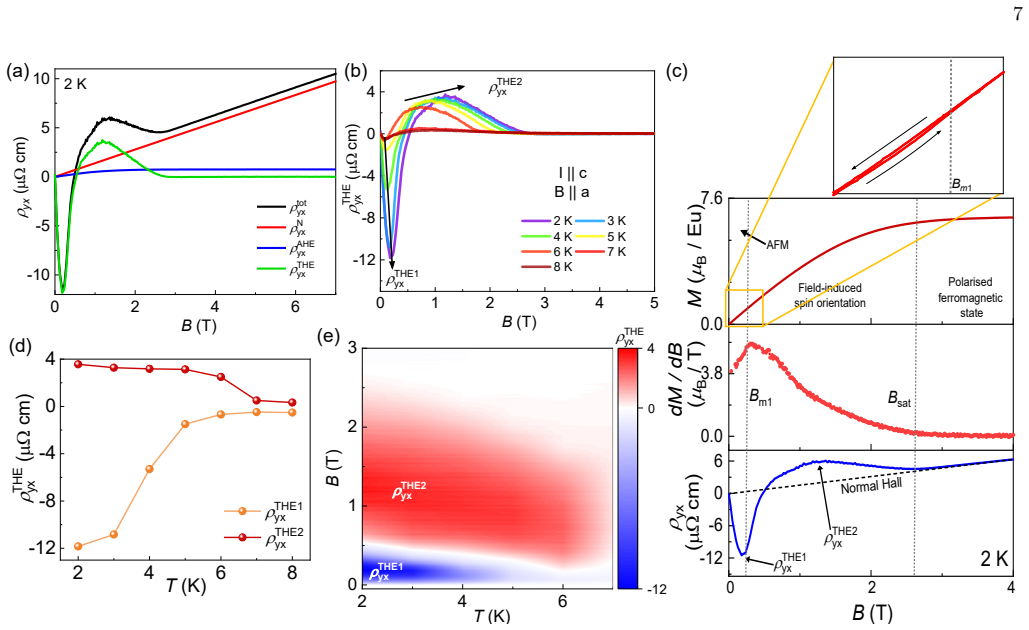
EuAuAs shows a giant topological Hall effect from scalar spin chirality in its helical antiferromagnetic order.
A machine-rendered reading of the paper's core claim, the machinery that carries it, and where it could break.
Core claim
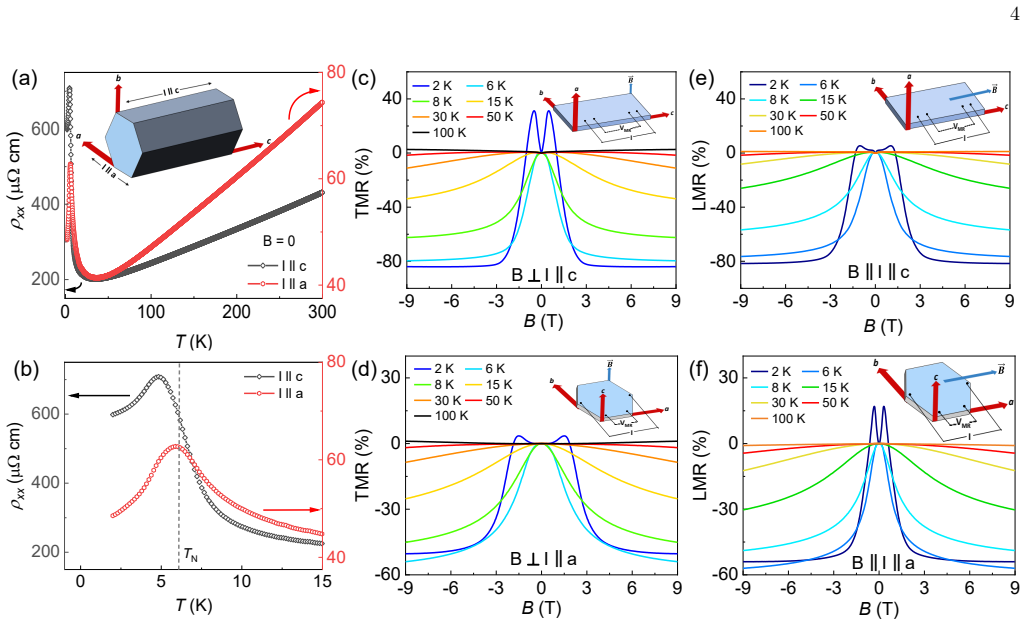
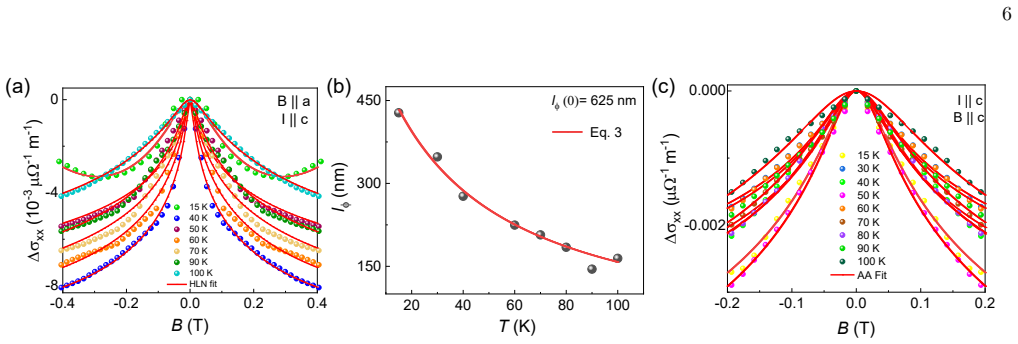
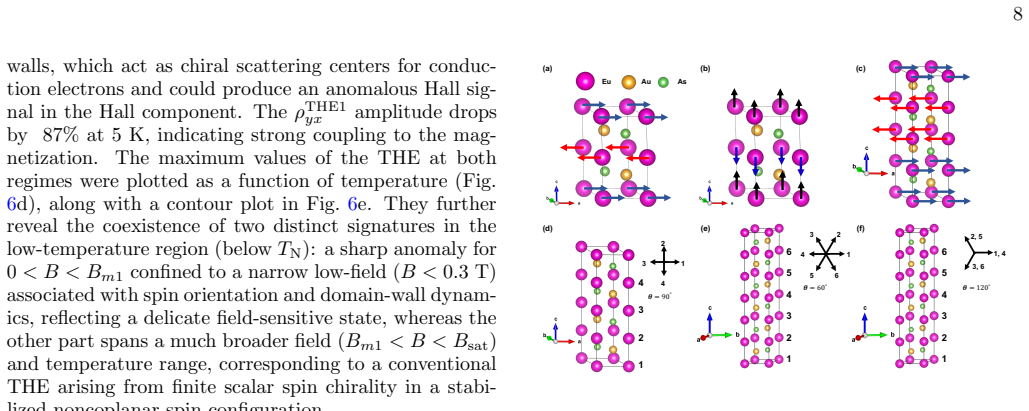
Below the Néel temperature the helical magnetic structure of Eu moments generates a giant topological Hall effect through scalar spin chirality. First-principles calculations reproduce the helical order and the anisotropic Fermi surface responsible for the observed anisotropy in longitudinal resistivity and magnetoresistance. The low-field positive longitudinal and transverse magnetoresistance arise from weak antilocalization, while high-field negative magnetoresistance reflects spin-dependent scattering.
What carries the argument
Scalar spin chirality generated by the noncoplanar helical spin texture, which imprints an emergent Berry phase on conduction electrons and produces the topological Hall resistivity.
If this is right
- The size of the topological Hall resistivity should track the magnitude of scalar spin chirality computed from the helical structure.
- Direction-dependent resistivity and magnetoresistance should match the calculated Fermi surface anisotropy in both sign and magnitude.
- The low-field positive magnetoresistance should continue to be described by weak antilocalization models in both geometries.
- EuAuAs provides a centrosymmetric platform in which noncoplanar spins alone drive topological transport.
Where Pith is reading between the lines
- Other helical magnets with similar calculated spin textures could be checked for comparable Hall responses.
- Pressure or doping experiments that alter the helical pitch would test whether the Hall magnitude scales with chirality.
- The temperature window of the effect could be used to map the stability range of the chiral spin texture.
- The anisotropy offers a route to direction-selective transport studies in related centrosymmetric compounds.
Load-bearing premise
The helical magnetic structure obtained from ab-initio calculations accurately represents the real-space spin texture that produces the observed scalar spin chirality contribution to the Hall resistivity.
What would settle it
If the giant topological Hall resistivity remains unchanged when the helical order is suppressed, for example by warming above the Néel temperature or by applying a field that polarizes the moments, the chirality mechanism would be ruled out.
Figures
read the original abstract
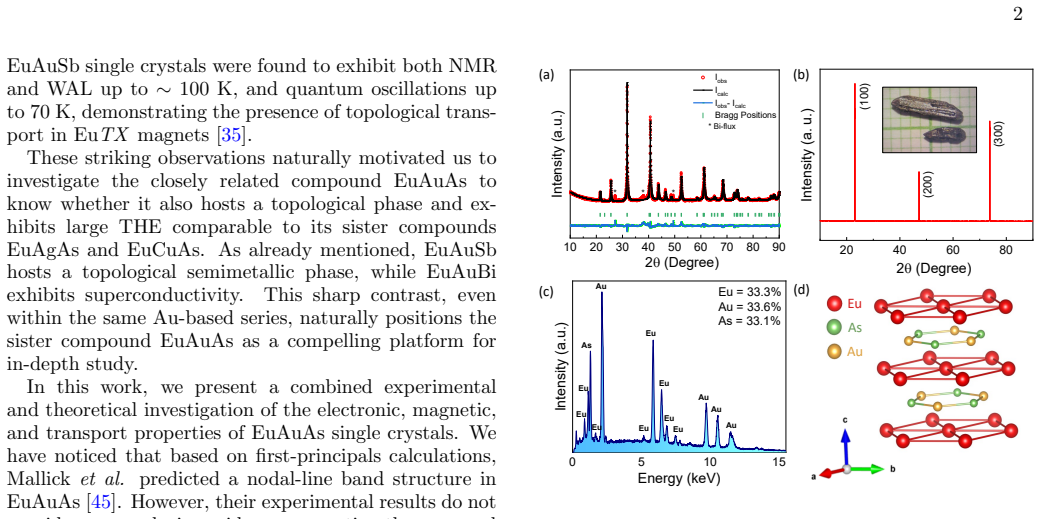
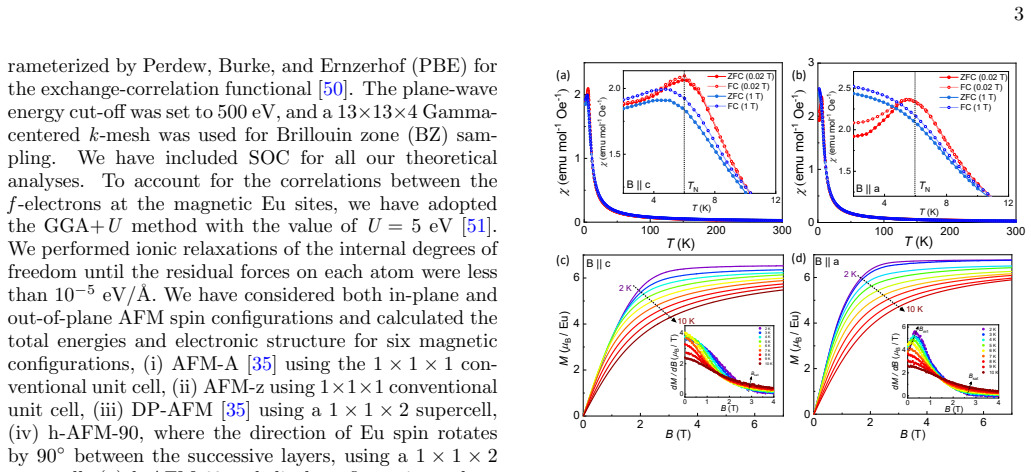
Topological magnets with nontrivial spin texture have attracted considerable interest because they display a rich spectrum of emergent quantum phenomena. Here, we present a combined experimental and theoretical investigation of the magnetic and magnetotransport properties of EuAuAs, an antiferromagnet with N\'eel temperature ($T_\mathrm{N}$) $\sim$ 6 K. The temperature and magnetic field dependence of electrical resistivity and magnetization demonstrate that the charge transport in EuAuAs is strongly influenced by the spin configuration of local Eu moments. Below $T_\mathrm{N}$, both longitudinal magnetoresistance (LMR) and transverse magnetoresistance (TMR) are positive at low fields but large and negative at high fields. With increasing temperature, TMR becomes positive above 60 K, whereas LMR remains negative up to 100 K. The low-field positive LMR and TMR originate from weak antilocalization (WAL). The WAL contribution in TMR is well captured by the Hikami-Larkin-Nagaoka model, whereas the LMR data are described by a generalized Altshuler-Aronov framework. Moreover, we observe a giant topological Hall effect arising from the scalar spin chirality, which is further supported by the helical magnetic structure obtained from the ab-initio calculations. The observed anisotropy in longitudinal resistivity and magnetoresistance underscores the very nature of the Fermi surface of the EuAuAs, as confirmed by first-principles calculations. These results establish EuAuAs as a unique platform for exploring the interplay between electronic structure and noncoplanar spin texture in a centrosymmetric helical magnet.
Editorial analysis
A structured set of objections, weighed in public.
Referee Report
Summary. The manuscript reports magnetotransport and magnetization data on the antiferromagnet EuAuAs (TN ≈ 6 K), attributing a giant topological Hall resistivity below TN to scalar spin chirality generated by a helical spin texture. This attribution is supported by ab-initio calculations that predict a helical ground state and anisotropic Fermi surface; longitudinal and transverse MR are analyzed with WAL (Hikami-Larkin-Nagaoka) and generalized Altshuler-Aronov models, with temperature-dependent sign changes in MR linked to the electronic structure.
Significance. If the scalar-spin-chirality assignment is robust, the work supplies a centrosymmetric helical-magnet platform in which noncoplanar real-space texture produces a measurable topological Hall signal whose magnitude and anisotropy can be compared with first-principles Fermi-surface calculations. The explicit use of ab-initio results to interpret both the spin texture and the resistivity anisotropy is a positive feature.
major comments (2)
- [Hall resistivity analysis and ab-initio magnetic-structure section] The central claim that the observed Hall resistivity is topological and arises from scalar spin chirality (abstract and the section presenting the Hall data) rests on the ab-initio prediction of a helical structure with non-zero chirality; no neutron-diffraction or other direct experimental determination of the propagation vector or spin texture below TN is reported, leaving open the possibility that field-induced canting or incomplete ordinary-Hall subtraction accounts for the residual signal.
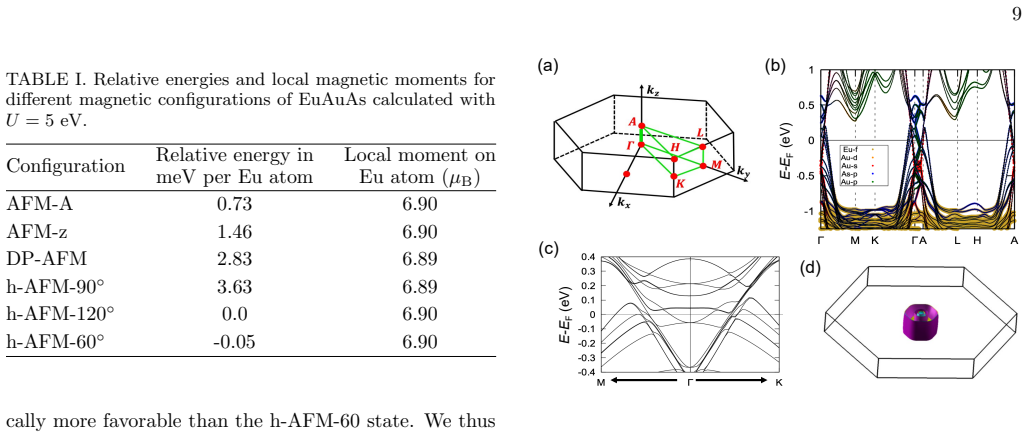
- [Ab-initio calculations] The ab-initio section does not report the Hubbard-U dependence or spin-orbit treatment for the Eu 4f states; because small changes in these parameters can alter the calculated propagation vector or stabilize a coplanar state with vanishing net chirality, the robustness of the helical-structure input to the THE interpretation is not quantified.
minor comments (2)
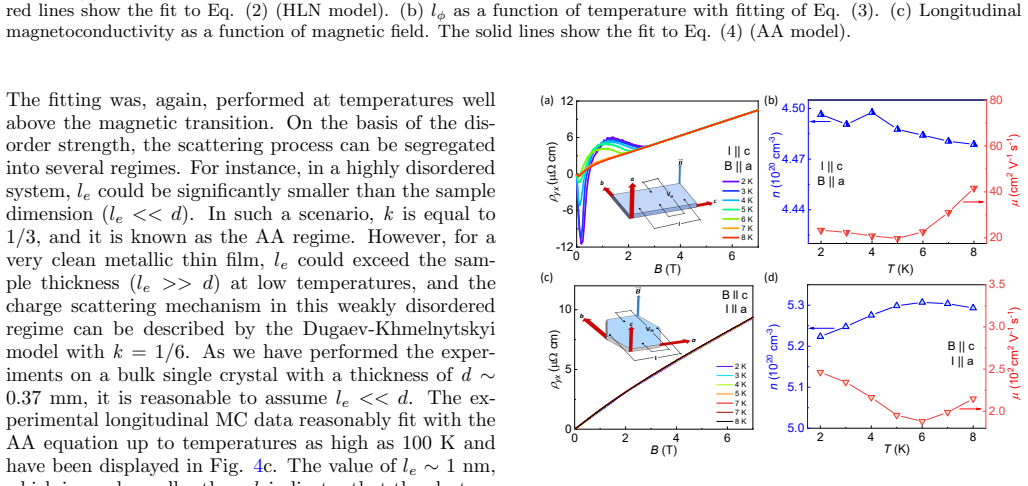
- [Abstract and MR modeling paragraphs] The abstract states that TMR is 'well captured' by the HLN model and LMR by a generalized AA framework, but does not quote the fitted dephasing lengths or the quality of the fits (R² or residuals) that would allow the reader to judge the WAL contribution.
- [Figure captions and methods] Figure captions and text should explicitly state the criteria used to separate ordinary, anomalous, and topological Hall components (e.g., high-field linear extrapolation range) and report the uncertainty on the extracted THE amplitude.
Simulated Author's Rebuttal
We thank the referee for the careful and constructive review of our manuscript. Below we address each major comment point by point, indicating where revisions have been made or additional discussion added.
read point-by-point responses
-
Referee: [Hall resistivity analysis and ab-initio magnetic-structure section] The central claim that the observed Hall resistivity is topological and arises from scalar spin chirality (abstract and the section presenting the Hall data) rests on the ab-initio prediction of a helical structure with non-zero chirality; no neutron-diffraction or other direct experimental determination of the propagation vector or spin texture below TN is reported, leaving open the possibility that field-induced canting or incomplete ordinary-Hall subtraction accounts for the residual signal.
Authors: We agree that the absence of direct experimental probes such as neutron diffraction leaves the spin texture assignment reliant on ab-initio results and indirect transport signatures. The manuscript already presents supporting evidence from the field- and temperature-dependent Hall resistivity, magnetization isotherms, and the characteristic sign and magnitude of the residual Hall signal below TN. In the revised version we have expanded the discussion of ordinary-Hall subtraction (including explicit fitting details and error estimates) and added arguments why field-induced canting is inconsistent with the observed saturation behavior and the persistence of the signal up to TN. We have also clarified that similar indirect assignments have been accepted in other centrosymmetric helical magnets when neutron data are unavailable. revision: partial
-
Referee: [Ab-initio calculations] The ab-initio section does not report the Hubbard-U dependence or spin-orbit treatment for the Eu 4f states; because small changes in these parameters can alter the calculated propagation vector or stabilize a coplanar state with vanishing net chirality, the robustness of the helical-structure input to the THE interpretation is not quantified.
Authors: We thank the referee for highlighting this omission. In the revised manuscript we have added a dedicated paragraph (and supplementary figures) that systematically varies the Hubbard U on Eu 4f states from 4 to 8 eV and compares calculations with and without spin-orbit coupling. These checks confirm that the helical ground state with finite scalar spin chirality remains the lowest-energy configuration across the tested range, with only minor changes in the propagation vector. The updated text now quantifies this robustness and explicitly links it to the THE interpretation. revision: yes
Circularity Check
No significant circularity detected
full rationale
The central claim links an experimentally observed giant topological Hall resistivity to scalar spin chirality, with the helical structure obtained from separate ab-initio calculations performed within the paper. This attribution does not reduce by construction to any fitted parameter, self-definition, or load-bearing self-citation chain; the transport data and first-principles results remain independent inputs. No equations or steps in the abstract exhibit renaming of known results or smuggling of ansatzes via prior self-work. The derivation chain is therefore self-contained against external benchmarks.
Axiom & Free-Parameter Ledger
axioms (1)
- domain assumption The helical magnetic structure obtained from ab-initio calculations accurately represents the spin texture responsible for scalar spin chirality
Reference graph
Works this paper leans on
-
[1]
M. Z. Hasan and C. L. Kane, Colloquium: Topological insulators, Reviews of Modern Physics82, 3045 (2010)
2010
-
[2]
Qi and S.-C
X.-L. Qi and S.-C. Zhang, Topological insulators and superconductors, Reviews of Modern Physics83, 1057 (2011)
2011
-
[3]
Kumar, S
N. Kumar, S. N. Guin, K. Manna, C. Shekhar, and C. Felser, Topological quantum materials from the view- point of chemistry, Chemical Reviews121, 2780 (2020)
2020
-
[4]
Bradlyn, J
B. Bradlyn, J. Cano, Z. Wang, M. Vergniory, C. Felser, R. J. Cava, and B. A. Bernevig, Beyond Dirac and Weyl fermions: Unconventional quasiparticles in conventional crystals, Science353, aaf5037 (2016)
2016
-
[5]
Y. Wang, I. Petrides, G. McNamara, M. M. Hosen, S. Lei, Y.-C. Wu, J. L. Hart, H. Lv, J. Yan, D. Xiao,et al., Axial Higgs mode detected by quantum pathway interference inRTe 3, Nature606, 896 (2022)
2022
-
[6]
Sarkar, J
S. Sarkar, J. Bhattacharya, P. Sadhukhan, D. Curcio, R. Dutt, V. K. Singh, M. Bianchi, A. Pariari, S. Roy, P. Mandal,et al., Charge density wave induced nodal lines in LaTe3, Nature Communications14, 3628 (2023)
2023
-
[7]
Sarkar, J
S. Sarkar, J. Bhattacharya, P. Bhakuni, D. Jangra, P. Sadhukhan, R. Batabyal, C. D. Malliakas, M. Bianchi, D. Curcio, S. Roy,et al., Kramers nodal line in the charge density wave state of YTe3 and the influence of twin do- mains, Physical Review B113, 035129 (2026)
2026
-
[8]
Armitage, E
N. Armitage, E. Mele, and A. Vishwanath, Weyl and Dirac semimetals in three-dimensional solids, Reviews of Modern Physics90, 015001 (2018)
2018
-
[9]
Yan and C
B. Yan and C. Felser, Topological materials: Weyl semimetals, Annual Review of Condensed Matter Physics 8, 337 (2017)
2017
-
[10]
C. Fang, H. Weng, X. Dai, and Z. Fang, Topological nodal line semimetals, Chinese Physics B25, 117106 (2016)
2016
-
[11]
S. Roy, A. Pariari, R. Singha, B. Satpati, and P. Mandal, Magneto-transport properties of proposed triply degen- erate topological semimetal Pd 3Bi2S2, Applied Physics Letters112(2018)
2018
-
[12]
Lv, Z.-L
B. Lv, Z.-L. Feng, Q.-N. Xu, X. Gao, J.-Z. Ma, L.-Y. Kong, P. Richard, Y.-B. Huang, V. Strocov, C. Fang, et al., Observation of three-component fermions in the topological semimetal molybdenum phosphide, Nature 546, 627 (2017)
2017
-
[13]
Ma, J.-B
J.-Z. Ma, J.-B. He, Y.-F. Xu, B. Lv, D. Chen, W.-L. Zhu, S. Zhang, L.-Y. Kong, X. Gao, L.-Y. Rong,et al., Three- component fermions with surface Fermi arcs in tungsten carbide, Nature Physics14, 349 (2018)
2018
-
[14]
Singha, A
R. Singha, A. K. Pariari, B. Satpati, and P. Mandal, Large nonsaturating magnetoresistance and signature of nondegenerate Dirac nodes in ZrSiS, Proc. Nat. Acad. Sci.114, 2468 (2017)
2017
-
[15]
C. K. Barman, C. Mondal, S. Pujari, B. Pathak, and A. Alam, Symmetry protection and giant Fermi arcs from multifold fermions in binary, ternary, and quaternary compounds, Physical Review B102, 155147 (2020)
2020
-
[16]
B. A. Bernevig, C. Felser, and H. Beidenkopf, Progress and prospects in magnetic topological materials, Nature 603, 41 (2022)
2022
-
[17]
Nagaosa, J
N. Nagaosa, J. Sinova, S. Onoda, A. H. MacDonald, and N. P. Ong, Anomalous Hall effect, Reviews of Modern Physics82, 1539 (2010)
2010
-
[18]
Singha, S
R. Singha, S. Roy, A. Pariari, B. Satpati, and P. Man- dal, Magnetotransport properties and giant anomalous Hall angle in the half-Heusler compound TbPtBi, Phys- ical Review B99, 035110 (2019)
2019
-
[19]
E. Liu, Y. Sun, N. Kumar, L. Muechler, A. Sun, L. Jiao, S.-Y. Yang, D. Liu, A. Liang, Q. Xu,et al., Giant anomalous Hall effect in a ferromagnetic kagome-lattice semimetal, Nature Physics14, 1125 (2018)
2018
-
[20]
D. Xiao, Y. Yao, Z. Fang, and Q. Niu, Berry-phase effect in anomalous thermoelectric transport, Physical Review Letters97, 026603 (2006)
2006
-
[21]
Ikhlas, T
M. Ikhlas, T. Tomita, T. Koretsune, M.-T. Suzuki, D. Nishio-Hamane, R. Arita, Y. Otani, and S. Nakatsuji, Large anomalous Nernst effect at room temperature in a chiral antiferromagnet, Nature Physics13, 1085 (2017)
2017
-
[22]
Huang, L
X. Huang, L. Zhao, Y. Long, P. Wang, D. Chen, Z. Yang, H. Liang, M. Xue, H. Weng, Z. Fang,et al., Observa- tion of the chiral-anomaly-induced negative magnetore- sistance in 3D Weyl semimetal TaAs, Physical Review X 5, 031023 (2015)
2015
-
[23]
Balduini, A
F. Balduini, A. Molinari, L. Rocchino, V. Hasse, C. Felser, M. Sousa, C. Zota, H. Schmid, A. G. Grushin, 11 and B. Gotsmann, Intrinsic negative magnetoresistance from the chiral anomaly of multifold fermions, Nature Communications15, 6526 (2024)
2024
-
[24]
A. J. Lee, A. S. Ahmed, J. Flores, S. Guo, B. Wang, N. Bagu´ es, D. W. McComb, and F. Yang, Probing the source of the interfacial Dzyaloshinskii-Moriya in- teraction responsible for the topological Hall effect in metal/Tm 3Fe5O12 systems, Physical Review Letters 124, 107201 (2020)
2020
-
[25]
Kurumaji, T
T. Kurumaji, T. Nakajima, M. Hirschberger, A. Kikkawa, Y. Yamasaki, H. Sagayama, H. Nakao, Y. Taguchi, T.-h. Arima, and Y. Tokura, Skyrmion lattice with a giant topological Hall effect in a frustrated triangular-lattice magnet, Science365, 914 (2019)
2019
-
[26]
J. M. Moya, S. Lei, E. M. Clements, C. S. Kengle, S. Sun, K. Allen, Q. Li, Y. Peng, A. A. Husain, M. Mitrano, et al., Incommensurate magnetic orders and topological Hall effect in the square-net centrosymmetric EuGa 2Al2 system, Physical Review Materials6, 074201 (2022)
2022
-
[27]
M. R. U. Nabi, A. Wegner, F. Wang, Y. Zhu, Y. Guan, A. Fereidouni, K. Pandey, R. Basnet, G. Acharya, H. O. Churchill,et al., Giant topological Hall effect in cen- trosymmetric tetragonal Mn 2−xZnxSb, Physical Review B104, 174419 (2021)
2021
-
[28]
Lu and S.-Q
H.-Z. Lu and S.-Q. Shen, Weak localization and weak anti-localization in topological insulators, inSpintronics VII, Vol. 9167 (SPIE, 2014) pp. 263–273
2014
-
[29]
A. Laha, R. Singha, S. Mardanya, B. Singh, A. Agar- wal, P. Mandal, and Z. Hossain, Topological Hall effect in the antiferromagnetic Dirac semimetal EuAgAs, Phys- ical Review B103, L241112 (2021)
2021
-
[30]
Malick, A
S. Malick, A. Ghosh, C. K. Barman, A. Alam, Z. Hos- sain, P. Mandal, and J. Nayak, Weak antilocalization ef- fect and triply degenerate state in Cu-doped CaAuAs, Physical Review B105, 165105 (2022)
2022
-
[31]
Z. Hou, Y. Wang, G. Xu, X. Zhang, E. Liu, W. Wang, Z. Liu, X. Xi, W. Wang, and G. Wu, Transition from semiconducting to metallic-like conducting and weak an- tilocalization effect in single crystals of LuPtSb, Applied Physics Letters106(2015)
2015
-
[32]
Jin, X.-T
Y. Jin, X.-T. Zeng, X. Feng, X. Du, W. Wu, X.-L. Sheng, Z.-M. Yu, Z. Zhu, and S. A. Yang, Multiple magnetism- controlled topological states in EuAgAs, Physical Review B104, 165424 (2021)
2021
-
[33]
H. Yin, M. He, Y. Qin, Q. Feng, L. Cao, W. Gao, H. Xu, L. Ling, W. Tong, H. Zhang,et al., Mag- netism and anomalous Hall effect in the antiferromag- netic semimetal EuAgSb, Journal of Alloys and Com- pounds1010, 178172 (2025)
2025
-
[34]
D. Ram, J. Singh, S. Banerjee, A. Sundaresan, D. Samal, V. Kanchana, and Z. Hossain, Magnetotransport and electronic structure of EuAuSb: A candidate antifer- romagnetic Dirac semimetal, Physical Review B109, 155152 (2024)
2024
-
[35]
S. Roy, B. Das, A. Ghosh, A. Bera, C. K. Barman, M. Mondal, A. Alam, and P. Mandal, Chiral anomaly and weak antilocalization effects in the Weyl semimetal EuAuSb, Physical Review B110, 085145 (2024)
2024
-
[36]
Chi and G
S. Chi and G. Xu, Electronic and topological characters of the ideal magnetic topological materials EuAuXwith X= P, As, Sb, and Bi, Computational Materials Today 4, 100022 (2024)
2024
-
[37]
Takahashi, K
H. Takahashi, K. Akiba, M. Takahashi, A. H. Mayo, M. Ochi, T. C. Kobayashi, and S. Ishiwata, Superconduc- tivity in a magnetic Rashba semimetal EuAuBi, Journal of the Physical Society of Japan92, 013701 (2023)
2023
-
[38]
Singh, A
Lipika, S. Singh, A. Saraswati, V. Chahar, Y. Sun, P. Manuel, D. Adroja, W. Schnelle, N. Kumar, J. San- nigrahi,et al., Complex spin dynamics induced meta- magnetic phase transitions in Dirac semimetal EuAuBi, Physical Review B113, 104406 (2026)
2026
-
[39]
X. Wang, B. Li, L. Zhou, L. Chen, Y. Wang, Y. Yang, Y. Zhou, K. Liao, H. Weng, and G. Wang, Structure, physical properties, and magnetically tunable topological phases in the topological semimetal EuCuBi, Physical Review B108, 115126 (2023)
2023
-
[40]
A. F. May, E. M. Clements, H. Zhang, R. P. Hermann, J. Yan, and M. A. McGuire, Coupling of magnetism, crys- tal lattice, and transport in EuCuP and EuCuAs, Phys- ical Review Materials7, 064406 (2023)
2023
-
[41]
J. Wang, J. Shen, Y. Wang, T. Liang, X. Wang, R. Zu, S. Zhang, Q. Zeng, E. Liu, and X. Xu, Anisotropic magneto-transport behavior in a hexagonal ferromag- netic EuCuP single crystal, Journal of Alloys and Com- pounds947, 169620 (2023)
2023
-
[42]
J. Wang, Y. Wang, X. Wang, J. Shen, E. Liu, and X. Xu, Large topological Hall effect induced by a field-driven metamagnetic transition in a centrosymmetric antiferro- magnetic EuCuSb single crystal, Physical Review B111, 054428 (2025)
2025
-
[43]
Roychowdhury, K
S. Roychowdhury, K. Samanta, P. Yanda, B. Malaman, M. Yao, W. Schnelle, E. Guilmeau, P. Constantinou, S. Chandra, H. Borrmann,et al., Interplay between mag- netism and topology: large topological Hall effect in an antiferromagnetic topological insulator, EuCuAs, Jour- nal of the American Chemical Society145, 12920 (2023)
2023
-
[44]
S. Singh, R. Koban, W. Schnelle, K. Manna,et al., Intrinsic magnetotransport and orientation dependent topological Hall effect in EuAuBi, arXiv preprint arXiv:2604.25365 (2026)
Pith/arXiv arXiv 2026
-
[45]
Malick, J
S. Malick, J. Singh, A. Laha, V. Kanchana, Z. Hossain, and D. Kaczorowski, Electronic structure and physical properties of EuAuAs single crystal, Physical Review B 105, 045103 (2022)
2022
-
[46]
P. E. Bl¨ ochl, Projector augmented-wave method, Physi- cal Review B50, 17953 (1994)
1994
-
[47]
Kresse and D
G. Kresse and D. Joubert, From ultrasoft pseudopoten- tials to the projector augmented-wave method, Physical Review B59, 1758 (1999)
1999
-
[48]
Kresse and J
G. Kresse and J. Furthm¨ uller, Efficiency of ab-initio total energy calculations for metals and semiconductors using a plane-wave basis set, Computational Materials Science 6, 15 (1996)
1996
-
[49]
Kresse and J
G. Kresse and J. Furthm¨ uller, Efficient iterative schemes for ab initio total-energy calculations using a plane-wave basis set, Physical Review B54, 11169 (1996)
1996
-
[50]
J. P. Perdew, K. Burke, and M. Ernzerhof, Generalized gradient approximation made simple, Physical Review Letters77, 3865 (1996)
1996
-
[51]
S. L. Dudarev, G. A. Botton, S. Y. Savrasov, C. Humphreys, and A. P. Sutton, Electron-energy-loss spectra and the structural stability of nickel oxide: An LSDA + U study, Physical Review B57, 1505 (1998)
1998
-
[52]
See the Supplementary Information file for additional supporting data
-
[53]
Kurumaji, M
T. Kurumaji, M. Gen, S. Kitou, H. Sagayama, A. Ikeda, and T.-h. Arima, Anisotropic magnetotransport proper- ties coupled with spiral spin modulation in a magnetic semimetal EuZnGe, Physical Review Materials6, 094410 (2022). 12
2022
-
[54]
G. Xu, W. Wang, X. Zhang, Y. Du, E. Liu, S. Wang, G. Wu, Z. Liu, and X. X. Zhang, Weak antilocaliza- tion effect and noncentrosymmetric superconductivity in a topologically nontrivial semimetal LuPdBi, Scientific Reports4, 5709 (2014)
2014
-
[55]
Sasmal, R
S. Sasmal, R. Mondal, R. Kulkarni, A. Thamizhavel, and B. Singh, Magnetotransport properties of noncentrosym- metric CaAgBi single crystal, Journal of Physics: Con- densed Matter32, 335701 (2020)
2020
-
[56]
Shrestha, M
K. Shrestha, M. Chou, D. Graf, H. Yang, B. Lorenz, and C. Chu, Extremely large nonsaturating magnetore- sistance and ultrahigh mobility due to topological surface states in the metallic Bi 2Te3 topological insulator, Phys- ical Review B95, 195113 (2017)
2017
-
[57]
Bergmann, Weak anti-localization—an experimental proof for the destructive interference of rotated spin 12, Solid State Communications42, 815 (1982)
G. Bergmann, Weak anti-localization—an experimental proof for the destructive interference of rotated spin 12, Solid State Communications42, 815 (1982)
1982
-
[58]
Saraswati, S
A. Saraswati, S. Chatterjee, and N. Kumar, Single Crystal Growth and Magnetotransport Properties of 4f Electron Antiferromagnet SmGaSi, physica status solidi (RRL)–Rapid Research Letters , e202500350 (2025)
2025
-
[59]
Chamorro, A
J. Chamorro, A. Topp, Y. Fang, M. J. Winiarski, C. Ast, M. Krivenkov, A. Varykhalov, B. Ramshaw, L. Schoop, and T. McQueen, Dirac Fermions and possible weak an- tilocalization in LaCuSb 2, APL Materials7(2019)
2019
-
[60]
Hikami, A
S. Hikami, A. I. Larkin, and Y. Nagaoka, Spin-orbit in- teraction and magnetoresistance in the two-dimensional random system, Progress of Theoretical Physics63, 707 (1980)
1980
-
[61]
C. Lin, X. He, J. Liao, X. Wang, V. S. Iv, W. Yang, T. Guan, Q. Zhang, L. Gu, G. Zhang,et al., Paral- lel field magnetoresistance in topological insulator thin films, Physical Review B—Condensed Matter and Mate- rials Physics88, 041307 (2013)
2013
-
[62]
Bruno, V
P. Bruno, V. Dugaev, and M. Taillefumier, Topological Hall effect and Berry phase in magnetic nanostructures, Physical Review Letters93, 096806 (2004)
2004
-
[63]
G¨ obel, L
B. G¨ obel, L. Schimpf, and I. Mertig, Topological orbital Hall effect caused by skyrmions and antiferromagnetic skyrmions, Communications Physics8, 17 (2025)
2025
-
[64]
Y. He, S. Schneider, T. Helm, J. Gayles, D. Wolf, I. Soldatov, H. Borrmann, W. Schnelle, R. Schaefer, G. H. Fecher,et al., Topological Hall effect arising from the mesoscopic and microscopic non-coplanar magnetic structure in MnBi, Acta Materialia226, 117619 (2022)
2022
-
[65]
H.-Y. Chen, T. Nomoto, M. Hirschberger, and R. Arita, Topological Hall effect of Skyrmions from First Princi- ples, Physical Review X15, 011054 (2025)
2025
-
[66]
G. Gong, L. Xu, Y. Bai, Y. Wang, S. Yuan, Y. Liu, and Z. Tian, Large topological Hall effect near room tem- perature in noncollinear ferromagnet LaMn 2Ge2 single crystal, Physical Review Materials5, 034405 (2021)
2021
-
[67]
Huang, H
D. Huang, H. Li, B. Ding, X. Xi, J. Gao, Y.-C. Lau, and W. Wang, Plateau-like magnetoresistance and topologi- cal Hall effect in Kagome magnets TbCo 2 and DyCo 2, Applied Physics Letters121(2022)
2022
-
[68]
H. Li, B. Ding, J. Chen, Z. Li, Z. Hou, E. Liu, H. Zhang, X. Xi, G. Wu, and W. Wang, Large topological Hall ef- fect in a geometrically frustrated kagome magnet Fe3Sn2, Applied Physics Letters114(2019)
2019
-
[69]
P. K. Rout, P. P. Madduri, S. K. Manna, and A. K. Nayak, Field-induced topological Hall effect in the noncoplanar triangular antiferromagnetic geometry of Mn3Sn, Physical Review B99, 094430 (2019)
2019
-
[70]
H. Li, B. Ding, J. Chen, Z. Li, E. Liu, X. Xi, G. Wu, and W. Wang, Large anisotropic topological Hall effect in a hexagonal non-collinear magnet Fe5Sn3, Applied Physics Letters116(2020)
2020
-
[71]
Q. Wang, K. J. Neubauer, C. Duan, Q. Yin, S. Fujitsu, H. Hosono, F. Ye, R. Zhang, S. Chi, K. Krycka,et al., Field-induced topological Hall effect and double-fan spin structure with ac-axis component in the metallic kagome antiferromagnetic compound YMn6Sn6, Physical Review B103, 014416 (2021)
2021
-
[72]
Ohgata and S
S. Ohgata and S. Hayami, Large anomalous Hall effect in double-Q magnets without net scalar spin chirality, Physical Review B113, L180401 (2026)
2026
-
[73]
P¨ ottgen and D
R. P¨ ottgen and D. Johrendt, Equiatomic intermetal- lic europium compounds: syntheses, crystal chemistry, chemical bonding, and physical properties, Chemistry of Materials12, 875 (2000)
2000
-
[74]
Sears, J
J. Sears, J. Yao, Z. Hu, W. Tian, N. Aryal, W. Yin, A. Tsvelik, I. A. Zaliznyak, Q. Li, and J. M. Tranquada, EuAuSb: An odd-parity helical variation of altermag- netism, Physical Review B112, 094455 (2025)
2025
discussion (0)
Sign in with ORCID, Apple, or X to comment. Anyone can read and Pith papers without signing in.