Movable Antennas for Robust Wireless Sensing via Joint Cram\'er-Rao Bound and Sidelobe Minimization
Reviewed by Pith T0 review T1 audit T2 compute T3 formal T4 kernel 2026-06-26 06:26 UTCgrok-4.3pith:6MMR2CVLrecord.jsonopen to challenge →
The pith
Movable antenna positions can be optimized to minimize the Cramér-Rao bound subject to a maximum sidelobe level constraint, reducing angle-of-arrival estimation mean squared error across all SNR regimes compared with fixed arrays.
A machine-rendered reading of the paper's core claim, the machinery that carries it, and where it could break.
Core claim
By formulating and solving an optimization that minimizes the Cramér-Rao bound of angle-of-arrival estimation subject to a prescribed maximum sidelobe level constraint on the ambiguity function, movable-antenna positions can be chosen so that the overall mean squared error is lower than that of any fixed-position array for every signal-to-noise ratio.
What carries the argument
The successive convex approximation algorithm that iteratively solves for the antenna position vector under the joint CRB-minimization and MSL-constraint objective, together with the outer one-dimensional line search over the MSL threshold.
If this is right
- The optimal placement concentrates antennas near the edges of the movement region when the CRB term dominates and near the center when sidelobes dominate.
- A single tunable MSL threshold, found by one-dimensional search, yields the lowest actual MSE for any prescribed SNR.
- The scheme produces lower AoA estimation MSE than both uniform and non-uniform fixed-position arrays over the entire SNR range.
- The same position vector works for every SNR once the threshold has been chosen; no per-SNR repositioning is required.
Where Pith is reading between the lines
- The same decomposition and constrained-optimization idea could be applied to two-dimensional movement regions or to joint range-angle estimation.
- If the movement region is small relative to wavelength, the performance gain over fixed arrays may shrink because the possible position diversity is limited.
- Hardware imperfections such as mutual coupling or position quantization error would tighten the feasible region of the optimization and could be folded into the same SCA framework.
Load-bearing premise
The mean squared error decomposes cleanly into a local Cramér-Rao term plus a separate sidelobe-induced ambiguity term whose relative size shifts with SNR regime.
What would settle it
A measurement or Monte-Carlo trial at moderate SNR in which the observed mean squared error for the optimized movable-antenna placement is no lower than the error obtained by the fixed-position array that minimizes only the Cramér-Rao bound.
Figures



read the original abstract
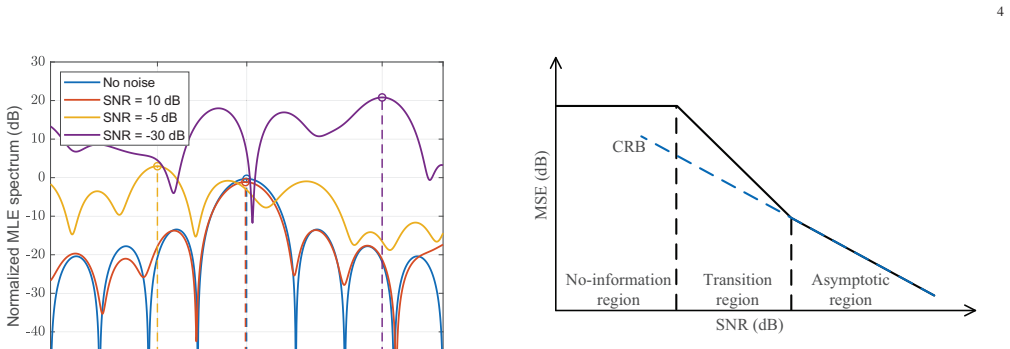
This paper presents a novel design approach for movable antenna (MA)-enabled wireless sensing systems by jointly minimizing the Cram\'er-Rao bound (CRB) and the maximum sidelobe level (MSL) of the ambiguity function via antenna position optimization. In particular, the mean squared error (MSE) of angle-of-arrival (AoA) estimation is decomposed into a local estimation error within the mainlobe of the ambiguity function (i.e., CRB) and an additional ambiguity error caused by its sidelobes. Since the MSE is dominated by the CRB in the high-signal-to-noise ratio (SNR) regime but by the sidelobes of the ambiguity function in the low-SNR regime, our analysis reveals a fundamental trade-off between CRB minimization and MSL minimization in the moderate-SNR regime. Specifically, minimizing the CRB prefers a narrower mainlobe, where antennas are concentrated near the two edges of the one-dimensional (1-D) movement region; whereas minimizing the MSL favors a wider mainlobe, where antennas are distributed more densely near the center of the movement region. Inspired by this and to ensure robust sensing performance across different SNR regimes, we formulate an optimization problem to minimize the CRB subject to a prescribed MSL constraint via antenna position optimization. An efficient successive convex approximation (SCA) algorithm is developed to optimize the antenna position vector (APV), and a 1-D linear search method is proposed to determine the optimal MSL threshold that minimizes the actual MSE for any given SNR. Numerical results demonstrate that the proposed scheme effectively balances the trade-off between MSL and CRB minimization, thus achieving a significantly lower AoA estimation MSE across the entire SNR range compared to conventional uniform and non-uniform fixed-position antenna (FPA) arrays.
Editorial analysis
A structured set of objections, weighed in public.
Referee Report
Summary. The manuscript proposes optimizing the positions of movable antennas (MAs) to jointly minimize the Cramér-Rao bound (CRB) for angle-of-arrival (AoA) estimation while constraining the maximum sidelobe level (MSL) of the ambiguity function. It decomposes the AoA MSE into a local CRB term (mainlobe) plus an ambiguity term (sidelobes), identifies an SNR-dependent trade-off, formulates a constrained optimization solved via successive convex approximation (SCA) on the antenna position vector together with a 1-D search over the MSL threshold, and reports via numerical results a lower AoA MSE than uniform or non-uniform fixed-position arrays across the full SNR range.
Significance. If the MSE decomposition holds and the reported simulations are reproducible, the work supplies a concrete, algorithmically tractable method for robust sensing with movable antennas that explicitly trades mainlobe width against sidelobe height; the SCA procedure and per-SNR threshold search constitute constructive engineering contributions to position-optimized estimation.
major comments (1)
- [§III] §III (MSE decomposition and trade-off analysis): the central justification for the CRB-minimization subject to MSL constraint rests on the claim that AoA MSE decomposes into local CRB error plus sidelobe ambiguity error, with the dominant term shifting by SNR regime. This decomposition is invoked to motivate the optimization and the 1-D search, yet the manuscript provides no explicit Monte-Carlo comparison of the decomposed expression against the empirical MSE of a concrete estimator (e.g., MUSIC or maximum-likelihood). Without that validation the claimed MSE improvement over FPA arrays remains tied to proxy metrics rather than end-to-end performance.
Simulated Author's Rebuttal
We thank the referee for the constructive comment. We address the major point below and agree that additional validation will strengthen the manuscript.
read point-by-point responses
-
Referee: [§III] §III (MSE decomposition and trade-off analysis): the central justification for the CRB-minimization subject to MSL constraint rests on the claim that AoA MSE decomposes into local CRB error plus sidelobe ambiguity error, with the dominant term shifting by SNR regime. This decomposition is invoked to motivate the optimization and the 1-D search, yet the manuscript provides no explicit Monte-Carlo comparison of the decomposed expression against the empirical MSE of a concrete estimator (e.g., MUSIC or maximum-likelihood). Without that validation the claimed MSE improvement over FPA arrays remains tied to proxy metrics rather than end-to-end performance.
Authors: We agree that direct Monte-Carlo validation of the decomposed MSE expression against the empirical performance of a concrete estimator (such as MUSIC) would provide stronger support for the claimed trade-off and performance gains. The decomposition follows from the standard separation of the ambiguity function into mainlobe (CRB) and sidelobe (ambiguity) contributions, which is theoretically justified in the literature on array processing. Nevertheless, to address the referee's concern, we will add new numerical results in the revised manuscript that compare the decomposed MSE formula to the actual MSE obtained via Monte-Carlo trials of the MUSIC estimator across the full SNR range. These results will also be used to confirm that the optimized positions indeed yield lower end-to-end MSE than the FPA baselines. revision: yes
Circularity Check
No significant circularity; derivation uses standard estimation-theoretic quantities
full rationale
The paper states an MSE decomposition into CRB (mainlobe) plus sidelobe ambiguity error and uses it to motivate a CRB-minimization problem subject to an MSL constraint, followed by a 1-D search over the MSL threshold that minimizes simulated MSE. This decomposition and the subsequent optimization are presented as analysis drawn from classical array signal processing (CRB and ambiguity function), not derived from or reduced to any fitted parameter, self-citation chain, or the paper's own output equations. Numerical comparisons to FPA baselines are external to the optimization variables. No load-bearing step matches any of the enumerated circularity patterns.
Axiom & Free-Parameter Ledger
free parameters (1)
- MSL threshold
axioms (1)
- domain assumption MSE of AoA estimation decomposes into local CRB error plus sidelobe-induced ambiguity error whose dominance shifts with SNR regime
Reference graph
Works this paper leans on
-
[1]
The roa d towards 6G: A comprehensive survey,
W. Jiang, B. Han, M. A. Habibi, and H. D. Schotten, “The roa d towards 6G: A comprehensive survey,” IEEE Open J. Commun. Soc. , vol. 2, pp. 334–366, Feb. 2021
2021
-
[2]
R. J. Mailloux, Phased Array Antenna Handbook . 2nd ed. Norwood, MA, USA: Artech House, 2005
2005
-
[3]
Sparse antenna ar ray design for MIMO active sensing applications,
W. Roberts, L. Xu, J. Li, and P . Stoica, “Sparse antenna ar ray design for MIMO active sensing applications,” IEEE Trans. Antennas Propagat. , vol. 59, no. 3, pp. 846–858, Mar. 2011
2011
-
[4]
Movable antennas for wireles s commu- nication: Opportunities and challenges,
L. Zhu, W. Ma, and R. Zhang, “Movable antennas for wireles s commu- nication: Opportunities and challenges,” IEEE Commun. Mag. , vol. 62, no. 6, pp. 114–120, Jun. 2024
2024
-
[5]
A tutorial on movable antennas for wi reless networks,
L. Zhu, W. Ma, W. Mei, Y . Zeng, Q. Wu, B. Ning, Z. Xiao, X. Sha o, J. Zhang, and R. Zhang, “A tutorial on movable antennas for wi reless networks,” IEEE Commun. Surveys Tuts. , vol. 28, pp. 3002–3054, Feb. 2025. 13
2025
-
[6]
Single antenna spatial div ersity,
S. Zhao, H. Y ang, and H. Y ang, “Single antenna spatial div ersity,” in Proc. IEEE Int. Conf. Wireless Commun., Netw., Mobile Compu t. (WiCOM), Beijing, China, Sep. 2009, pp. 1–4
2009
-
[7]
Fluid antenna systems enabling 6G: Principles, applica- tions, and research directions
T. Wu, K. Zhi, J. Y ao, X. Lai, J. Zheng, H. Niu, M. Elkashlan , K.- K. Wong, C.-B. Chae, Z. Ding, G. K. Karagiannidis, M. Debbah, and C. Y uen, “Fluid antenna systems enabling 6G: Principles, ap plications, and research directions,” IEEE Wireless Commun. , 2025, early access, DOI: 10.1109/MWC.2025.3629597
-
[8]
Modeling and performance ana lysis for movable antenna enabled wireless communications,
L. Zhu, W. Ma, and R. Zhang, “Modeling and performance ana lysis for movable antenna enabled wireless communications,” IEEE Trans. Wireless Commun., vol. 23, no. 6, pp. 6234–6250, Jun. 2024
2024
-
[9]
Movable-an tenna po- sition optimization: A graph-based approach,
W. Mei, X. Wei, B. Ning, Z. Chen, and R. Zhang, “Movable-an tenna po- sition optimization: A graph-based approach,” IEEE Wireless Commun. Lett., vol. 13, no. 7, pp. 1853–1857, Jul. 2024
2024
-
[10]
Movable antenna-enhanced wireless communications: Gene ral architec- tures and implementation methods,
B. Ning, S. Y ang, Y . Wu, P . Wang, W. Mei, C. Y uen, and E. Bj¨ ornson, “Movable antenna-enhanced wireless communications: Gene ral architec- tures and implementation methods,” IEEE Wireless Commun. , vol. 32, no. 5, pp. 108–116, Oct. 2025
2025
-
[11]
Secure MIM O communication relying on movable antennas,
J. Tang, C. Pan, Y . Zhang, H. Ren, and K. Wang, “Secure MIM O communication relying on movable antennas,” IEEE Trans. Commun. , vol. 73, no. 4, pp. 2159–2175, Apr. 2025
2025
-
[12]
Movable-antenna en hanced multiuser communication via antenna position optimizatio n,
L. Zhu, W. Ma, B. Ning, and R. Zhang, “Movable-antenna en hanced multiuser communication via antenna position optimizatio n,” IEEE Trans. Wireless Commun. , vol. 23, no. 7, pp. 7214–7229, Jul. 2024
2024
-
[13]
M ovable antenna-enhanced multiuser communication: Optimal discr ete antenna positioning and beamforming,
Y . Wu, D. Xu, D. W. K. Ng, W. Gerstacker, and R. Schober, “M ovable antenna-enhanced multiuser communication: Optimal discr ete antenna positioning and beamforming,” in Proc. IEEE Global Commun. Conf. (Globecom), Kuala Lumpur, Malaysia, Dec. 2023, pp. 7508–7513
2023
-
[14]
Anten na positioning and beamforming design for fluid antenna-assis ted multi- user downlink communications,
H. Qin, W. Chen, Z. Li, Q. Wu, N. Cheng, and F. Chen, “Anten na positioning and beamforming design for fluid antenna-assis ted multi- user downlink communications,” IEEE Wireless Commun. Lett. , vol. 13, no. 4, pp. 1073–1077, Apr. 2024
2024
-
[15]
Su m-rate maximization for movable antenna enabled multiuser commun ications,
Z. Cheng, N. Li, J. Zhu, X. She, C. Ouyang, and P . Chen, “Su m-rate maximization for movable antenna enabled multiuser commun ications,” arXiv preprint arXiv:2309.11135 , 2023
-
[16]
Flexible antenna arrays for wireless communic ations: Modeling and performance evaluation,
S. Y ang, J. An, Y . Xiu, W. Lyu, B. Ning, Z. Zhang, M. Debbah , and C. Y uen, “Flexible antenna arrays for wireless communic ations: Modeling and performance evaluation,” IEEE Trans. Wireless Commun., vol. 24, no. 6, pp. 4937–4951, Jun. 2025
2025
-
[17]
Fluid antennas-enabled multiuser uplink: A low-complexity grad ient descent for total transmit power minimization,
G. Hu, Q. Wu, K. Xu, J. Ouyang, J. Si, Y . Cai, and N. Al-Dhah ir, “Fluid antennas-enabled multiuser uplink: A low-complexity grad ient descent for total transmit power minimization,” IEEE Commun. Lett. , vol. 28, no. 3, pp. 602–606, Mar. 2025
2025
-
[18]
Minimizing movemen t delay for movable antennas via trajectory optimization,
Q. Li, W. Mei, B. Ning, and R. Zhang, “Minimizing movemen t delay for movable antennas via trajectory optimization,” in Proc. IEEE Global Commun. Conf. (Globecom) , Cape Town, South Africa, Dec. 2024, pp. 1–6
2024
-
[19]
MIMO capacity characteriza tion for movable antenna systems,
W. Ma, L. Zhu, and R. Zhang, “MIMO capacity characteriza tion for movable antenna systems,” IEEE Trans. Wireless Commun. , vol. 23, no. 4, pp. 3392–3407, Apr. 2024
2024
-
[20]
Joint beamforming and antenna movement design for moveable anten na systems based on statistical CSI,
X. Chen, B. Feng, Y . Wu, D. W. K. Ng, and R. Schober, “Joint beamforming and antenna movement design for moveable anten na systems based on statistical CSI,” in Proc. IEEE Global Commun. Conf. (Globecom), Kuala Lumpur, Malaysia, Dec. 2023, pp. 4387–4392
2023
-
[21]
Flui d antenna- assisted MIMO transmission exploiting statistical CSI,
Y . Y e, L. Y ou, J. Wang, H. Xu, K.-K. Wong, and X. Gao, “Flui d antenna- assisted MIMO transmission exploiting statistical CSI,” IEEE Commun. Lett., vol. 28, no. 1, pp. 223–227, Jan. 2024
2024
-
[22]
Compressed sensing based ch annel estimation for movable antenna communications,
W. Ma, L. Zhu, and R. Zhang, “Compressed sensing based ch annel estimation for movable antenna communications,” IEEE Commun. Lett. , vol. 27, no. 10, pp. 2747–2751, Oct. 2023
2023
-
[23]
Channel estimation for movable antenna communication sys tems: A framework based on compressed sensing,
Z. Xiao, S. Cao, L. Zhu, Y . Liu, B. Ning, X.-G. Xia, and R. Z hang, “Channel estimation for movable antenna communication sys tems: A framework based on compressed sensing,” IEEE Trans. Wireless Com- mun., vol. 23, no. 9, pp. 11 814–11 830, Sep. 2024
2024
-
[24]
Movable-antenna array enha nced beam- forming: Achieving full array gain with null steering,
L. Zhu, W. Ma, and R. Zhang, “Movable-antenna array enha nced beam- forming: Achieving full array gain with null steering,” IEEE Commun. Lett., vol. 27, no. 12, pp. 3340–3344, Dec. 2023
2023
-
[25]
Multi-beam forming with mov able- antenna array,
W. Ma, L. Zhu, and R. Zhang, “Multi-beam forming with mov able- antenna array,” IEEE Commun. Lett. , vol. 28, no. 3, pp. 697–701, Mar. 2024
2024
-
[26]
Dynamic beam c overage for satellite communications aided by movable-antenna arr ay,
L. Zhu, X. Pi, W. Ma, Z. Xiao, and R. Zhang, “Dynamic beam c overage for satellite communications aided by movable-antenna arr ay,” IEEE Trans. Wireless Commun. , vol. 24, no. 3, pp. 1916–1933, Mar. 2025
1916
-
[27]
Movable antenna ena bled near-field communications: Channel modeling and performan ce opti- mization,
L. Zhu, W. Ma, Z. Xiao, and R. Zhang, “Movable antenna ena bled near-field communications: Channel modeling and performan ce opti- mization,” IEEE Trans. Commun. , vol. 73, no. 9, pp. 7240–7256, Sep. 2025
2025
-
[28]
6D movable antenna base d on user distribution: Modeling and optimization,
X. Shao, Q. Jiang, and R. Zhang, “6D movable antenna base d on user distribution: Modeling and optimization,” IEEE Trans. Wireless Commun., vol. 24, no. 1, pp. 355–370, Jan. 2025
2025
-
[29]
6DMA enhanced wireless network wi th flexible antenna position and rotation: Opportunities and challeng es,
X. Shao and R. Zhang, “6DMA enhanced wireless network wi th flexible antenna position and rotation: Opportunities and challeng es,” IEEE Commun. Mag. , vol. 63, no. 4, pp. 121–128, Apr. 2025
2025
-
[30]
Exploiting six-dime nsional mov- able antenna for wireless sensing,
X. Shao, R. Zhang, and R. Schober, “Exploiting six-dime nsional mov- able antenna for wireless sensing,” IEEE Wireless Commun. Lett. , vol. 14, no. 2, pp. 265–269, Feb. 2025
2025
-
[31]
Distributed channel estimation and optimization for 6D mo vable an- tenna: Unveiling directional sparsity,
X. Shao, R. Zhang, Q. Jiang, J. Park, T. Q. S. Quek, and R. S chober, “Distributed channel estimation and optimization for 6D mo vable an- tenna: Unveiling directional sparsity,” IEEE J. Select. Topics Signal Processing, vol. 19, no. 2, pp. 349–365, Mar. 2025
2025
-
[32]
Rotatable antenna e nabled wireless communication: Modeling and optimization,
B. Zheng, Q. Wu, T. Ma, and R. Zhang, “Rotatable antenna e nabled wireless communication: Modeling and optimization,” IEEE Trans. Commun., vol. 74, pp. 6825–6842, Mar. 2026
2026
-
[33]
Pinc hing- antenna systems: Architecture designs, opportunities, an d outlook,
Y . Liu, Z. Wang, X. Mu, C. Ouyang, X. Xu, and Z. Ding, “Pinc hing- antenna systems: Architecture designs, opportunities, an d outlook,” IEEE Commun. Mag. , vol. 64, no. 1, pp. 190–196, Jan. 2026
2026
-
[34]
Experimental simulation of multi-static radar with a pair of separated movable antennas,
A. Zhuravlev, V . Razevig, S. Ivashov, A. Bugaev, and M. C hizh, “Experimental simulation of multi-static radar with a pair of separated movable antennas,” in Proc. IEEE International Conf. Microwaves Commun. Antennas Electron. Syst. (COMCAS) , Nov. 2015, pp. 1–5
2015
-
[35]
Using a movable RFID ant enna to automatically determine the position and orientation of ob jects on a tabletop,
S. Hinske and M. Langheinrich, “Using a movable RFID ant enna to automatically determine the position and orientation of ob jects on a tabletop,” in Smart Sensing Context, 3rd Eur . Conf. Springer, 2008, pp. 14–26
2008
-
[36]
Movable antenna enhanced wi reless sensing via antenna position optimization,
W. Ma, L. Zhu, and R. Zhang, “Movable antenna enhanced wi reless sensing via antenna position optimization,” IEEE Trans. Wireless Com- mun., vol. 23, no. 11, pp. 16 575–16 589, Nov. 2024
2024
-
[37]
Antenna p osition and beamforming optimization for movable antenna enabled ISAC : Optimal solutions and efficient algorithms,
L. Chen, M.-M. Zhao, M.-J. Zhao, and R. Zhang, “Antenna p osition and beamforming optimization for movable antenna enabled ISAC : Optimal solutions and efficient algorithms,” IEEE Trans. Signal Processing , vol. 73, pp. 3812–3828, Jul. 2025
2025
-
[38]
Antenna pos ition optimization for movable antenna-empowered near-field sen sing,
Y . Wang, W. Mei, X. Wei, B. Ning, and Z. Chen, “Antenna pos ition optimization for movable antenna-empowered near-field sen sing,” in Proc. IEEE Int. Conf. Commun. W orkshops (ICC W orkshops), Montreal, QC, Canada, Jun. 2025, pp. 324–329
2025
-
[39]
Mo vable- antenna array enhanced multi-target sensing: CRB characte rization and optimization,
H. Mao, L. Zhu, W. Ma, Z. Xiao, X.-G. Xia, and R. Zhang, “Mo vable- antenna array enhanced multi-target sensing: CRB characte rization and optimization,” arXiv preprint arXiv:2511.18907 , 2025
-
[40]
Optimal movable antenna plac ement for near-field wireless sensing,
J. Liu, X. Song, and X. Y u, “Optimal movable antenna plac ement for near-field wireless sensing,” arXiv preprint arXiv:2603.10383 , 2026
-
[41]
Movable-antenna trajector y optimization for wireless sensing: CRB scaling laws over time and space,
W. Ma, L. Zhu, and R. Zhang, “Movable-antenna trajector y optimization for wireless sensing: CRB scaling laws over time and space,” arXiv preprint arXiv:2509.14905, 2025
-
[42]
3-D Trajectory Opti mization for Robust Direction Sensing in Movable Antenna Systems,
W. Ma, L. Zhu, X. Shao, and R. Zhang, “3-D Trajectory Opti mization for Robust Direction Sensing in Movable Antenna Systems,” arXiv preprint arXiv:2603.10426, 2026
-
[43]
Movable antenna enhanced in tegrated sensing and communication via antenna position optimizati on,
W. Ma, L. Zhu, and R. Zhang, “Movable antenna enhanced in tegrated sensing and communication via antenna position optimizati on,” IEEE Trans. Signal Processing , vol. 74, pp. 1522–1537, Mar. 2026
2026
-
[44]
Threshold region performance of maximum li kelihood direc- tion of arrival estimators,
F. Athley, “Threshold region performance of maximum li kelihood direc- tion of arrival estimators,” IEEE Trans. Signal Process. , vol. 53, no. 4, pp. 1359–1373, Apr. 2005
2005
-
[45]
IRS aided mil limeter- wave sensing and communication: Beam scanning, beam splitt ing, and performance analysis,
R. Li, X. Shao, S. Sun, M. Tao, and R. Zhang, “IRS aided mil limeter- wave sensing and communication: Beam scanning, beam splitt ing, and performance analysis,” IEEE Trans. Wireless Commun. , vol. 23, no. 12, pp. 19 713–19 727, Dec. 2024
2024
-
[46]
Ambiguity function analysis and optimization of frequenc y-hopping MIMO radar with movable antennas,
X. Chen, M.-M. Zhao, M. Li, L. Li, M.-J. Zhao, and J. Wang, “Ambiguity function analysis and optimization of frequenc y-hopping MIMO radar with movable antennas,” IEEE Internet Things J. , vol. 12, no. 12, pp. 21 836–21 851, Jun. 2025
2025
-
[47]
On the use of windows for harmonic analysi s with the discrete fourier transform,
F. J. Harris, “On the use of windows for harmonic analysi s with the discrete fourier transform,” Proc. IEEE , vol. 66, no. 1, pp. 51–83, Jan. 1978
1978
discussion (0)
Sign in with ORCID, Apple, or X to comment. Anyone can read and Pith papers without signing in.