Single Particle Excitations, Band Structures and Octupole Correlation in ⁶⁵Zn
Pith reviewed 2026-06-26 05:56 UTC · model grok-4.3
The pith
New gamma-ray data on zinc-65 reveal both single-particle excitations and collective band structures, including octupole correlations.
A machine-rendered reading of the paper's core claim, the machinery that carries it, and where it could break.
Core claim
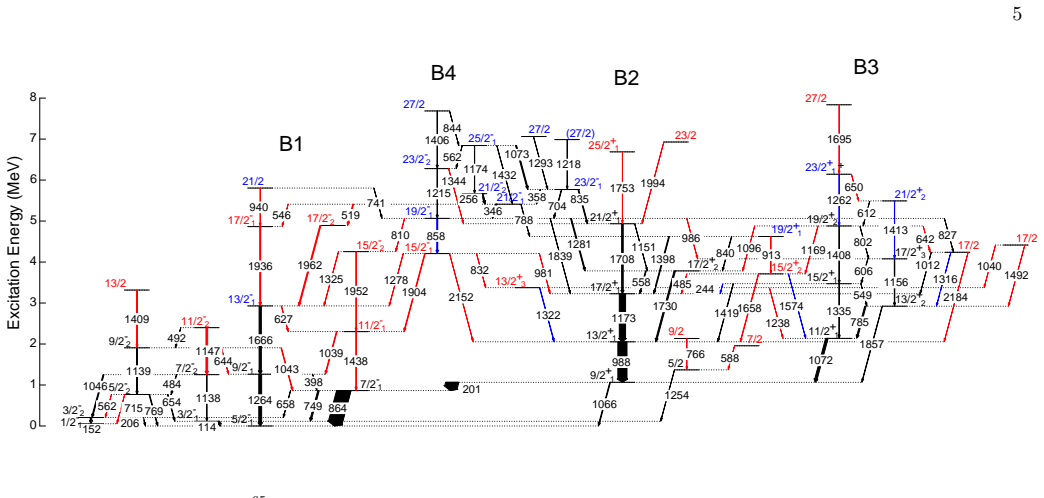
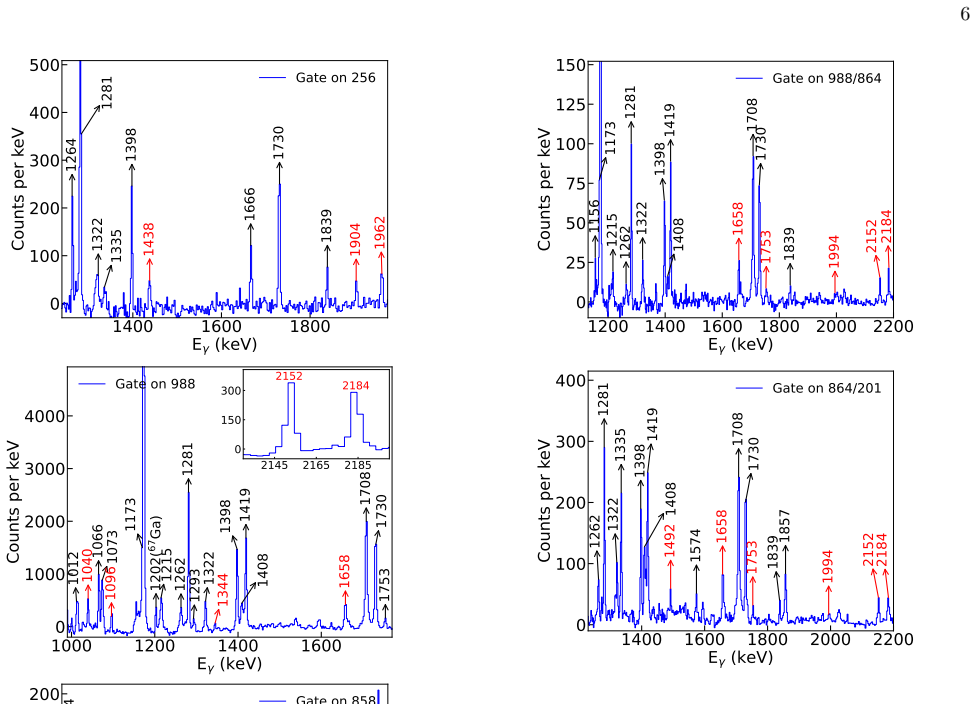
The experimental level scheme of 65Zn exhibits both single-particle excitations and collective band structures. Shell-model calculations with two different interactions reproduce the measured energies when the model space includes the p3/2, f5/2, p1/2 and g9/2 orbitals. Total Routhian surface calculations for the associated deformations indicate the shapes responsible for the observed collective bands and support the presence of octupole correlations.
What carries the argument
Comparison of the observed gamma-ray transitions and level energies with large-basis shell-model calculations in the p3/2-f5/2-p1/2-g9/2 valence space together with Total Routhian Surface calculations that determine nuclear deformations.
If this is right
- The level scheme of 65Zn contains both single-particle states and collective bands whose properties are reproduced by shell-model and TRS calculations.
- Collectivity develops as nucleons occupy high-j orbitals outside the doubly magic core.
- Octupole correlations appear in the collective excitations of this nucleus.
- The structural evolution observed here is expected to continue in neighboring isotopes with additional valence nucleons.
Where Pith is reading between the lines
- The same competition between single-particle and collective degrees of freedom should appear in the level schemes of nearby nuclei such as 66Zn or 64Zn.
- The TRS surfaces could be used to predict the location of additional octupole-enhanced bands at higher spins.
- Future lifetime measurements on the collective transitions would provide direct tests of the deformation parameters obtained from the TRS calculations.
Load-bearing premise
The multipolarities and electric or magnetic character of the observed gamma rays have been correctly determined by standard angular-correlation and polarization methods, allowing reliable spin-parity assignments.
What would settle it
A new measurement of the angular distribution or linear polarization for one of the key linking transitions that reverses its multipolarity and thereby changes the spin-parity assignment of a bandhead, breaking the agreement with the shell-model or TRS calculations.
Figures

read the original abstract
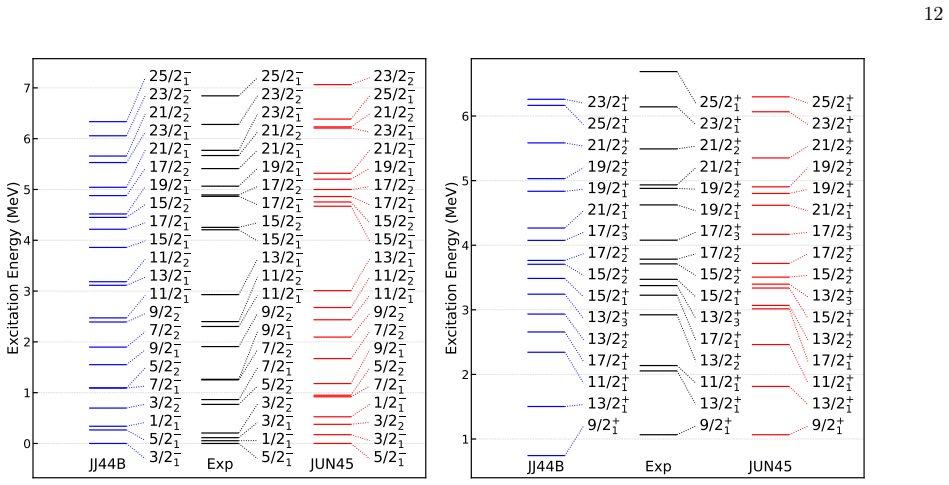
The excitation scheme of the $^{65}$Zn ($Z = 30, N = 35$) nucleus has been probed following its population in the $^{63}$Cu($\alpha$,pn) reaction at E$_{beam}$ = 30 MeV and using an array of Compton suppressed HPGe clovers as the detection system. This work has identified several new transitions of the nucleus and have modified the placements of some of the previously known ones. The multipolarities and the electric/ magnetic nature of the observed $\gamma$-ray rays have been measured, using the conventional methodologies. The spin-parity assignments for the levels have consequently been made; some of the spin-parities are new while others are either validation of the existing values or are modified results based on the present analysis. The experimental level scheme exhibits collective as well as single particle structures. The measured level energies have been compared with those calculated in the framework of the large basis shell model using a model space of $p_{3/2}, f_{5/2}, p_{1/2}, g_{9/2}$ orbitals and two different interactions. The collective excitations of the nucleus were probed through the properties of its band structures and through the calculations of the Total Routhian Surface (TRS) for the associated deformations/ shapes. The results of this study brings out the essential features of evolving structural characteristics and developing collectivity with increasing number of nucleons outside a doubly-magic core and with their occupancy of deformation driving high-$j$ orbitals.
Editorial analysis
A structured set of objections, weighed in public.
Referee Report
Summary. The paper reports an experimental study of the level scheme of 65Zn populated in the 63Cu(α,pn) reaction at 30 MeV using Compton-suppressed HPGe clovers. Several new γ-ray transitions are identified and some prior placements revised. Multipolarities and E/M character are determined via conventional methods, enabling spin-parity assignments (some new, some revised). The resulting level scheme is compared to large-basis shell-model calculations in the p3/2-f5/2-p1/2-g9/2 space with two interactions, and collective features are examined via band properties and Total Routhian Surface (TRS) calculations. The work concludes that the structure exhibits both single-particle and collective excitations, illustrating evolving collectivity with increasing nucleons outside the 56Ni core and occupancy of high-j orbitals.
Significance. If the spin-parity assignments hold, the results add to the systematics of structure evolution in the A≈65 region near the N=Z=28 closure, providing new data on the interplay between single-particle excitations and emerging collectivity driven by high-j orbitals. The use of standard experimental techniques and direct comparison to established shell-model interactions and TRS calculations strengthens the nuclear-structure database for Zn isotopes.
major comments (2)
- [Experimental results / level scheme] Experimental results section: the spin-parity assignments that underpin all structural interpretations (collective vs. single-particle bands, model comparisons) rest on multipolarity determinations stated to follow 'conventional methodologies,' yet the manuscript provides no tabulated DCO ratios, angular-distribution coefficients, or polarization asymmetries for the key transitions. Without these observables the assignments cannot be independently verified and remain the load-bearing step for the central claim.
- [Shell-model calculations] Shell-model comparison section: level energies are compared to calculations with two interactions, but no quantitative measure of agreement (rms deviation, χ² per degree of freedom, or tabulated energy differences) is given. This weakens the assertion that the data validate the model space and interactions.
minor comments (2)
- [Abstract] Abstract: grammatical errors ('have identified', 'γ-ray rays', 'brings out') and missing quantitative indicators of data quality (fit metrics, error bars) should be corrected.
- [Theoretical calculations] Notation: the model space is listed as p3/2, f5/2, p1/2, g9/2 but the effective charges or truncation scheme used in the calculations are not stated explicitly.
Simulated Author's Rebuttal
We thank the referee for the careful review and constructive comments. We address each major comment below.
read point-by-point responses
-
Referee: [Experimental results / level scheme] Experimental results section: the spin-parity assignments that underpin all structural interpretations (collective vs. single-particle bands, model comparisons) rest on multipolarity determinations stated to follow 'conventional methodologies,' yet the manuscript provides no tabulated DCO ratios, angular-distribution coefficients, or polarization asymmetries for the key transitions. Without these observables the assignments cannot be independently verified and remain the load-bearing step for the central claim.
Authors: We agree that the supporting observables for the multipolarity assignments were omitted. In the revised manuscript we will add a table of DCO ratios, angular-distribution coefficients and polarization asymmetries for the key transitions, together with the deduced multipolarities and spin-parity assignments, enabling independent verification. revision: yes
-
Referee: [Shell-model calculations] Shell-model comparison section: level energies are compared to calculations with two interactions, but no quantitative measure of agreement (rms deviation, χ² per degree of freedom, or tabulated energy differences) is given. This weakens the assertion that the data validate the model space and interactions.
Authors: We acknowledge the absence of quantitative metrics. While visual level-scheme comparisons are common, we will calculate and report the rms deviations between experimental and calculated energies for both interactions, together with a brief discussion of the agreement, in the revised manuscript. revision: yes
Circularity Check
No circularity: experimental assignments and model comparisons remain independent of fitted inputs or self-citation chains.
full rationale
The paper reports new transitions and multipolarity measurements via standard ('conventional') techniques, followed by spin-parity assignments and direct comparison of measured level energies to shell-model calculations that employ two published interactions in a fixed model space. TRS calculations are likewise described as standard probes of collective shapes. No parameters are fitted to the present dataset and then relabeled as predictions; no self-citation supplies a uniqueness theorem or ansatz that bears the central claim; the experimental observables (level scheme, gamma-ray properties) are not redefined in terms of the model outputs. The derivation chain therefore does not reduce to its own inputs by construction.
Axiom & Free-Parameter Ledger
axioms (2)
- domain assumption The 63Cu(alpha,pn) reaction at 30 MeV populates the observed states without significant contamination from other channels.
- domain assumption Conventional angular-correlation and polarization methods yield unambiguous multipolarity assignments.
Reference graph
Works this paper leans on
-
[1]
modified
identified the lowest positive parity states, below ≈5 MeV, as originating from the coupling of an odd neutron in theg 9/2 orbital to the quadrupole excitations of the 64Zn (anharmonic vibrator) core. The later work by Yuet al.[15], on the other hand, was directed at the high-spin states of the nucleus and used state-of-the-art experimental facilities to ...
-
[2]
As is the practice, data, with event trigger set on singles (M γ ≥
The two- and higher-fold coincidence events collected during the experiment were≈1.7×10 9. As is the practice, data, with event trigger set on singles (M γ ≥
-
[3]
The coincidence data were sorted into symmetric and asymmetric (angle dependent) matrices using the IUCPIX [18] package developed at the UGC-DAE CSR, Kolkata Centre
were also acquired with standard radioactive sources (152Eu, 133Ba) for energy and efficiency calibration of the detection system as well as to determine its intrinsic geometrical asymmetry for polarization measurements (explained hereafter). The coincidence data were sorted into symmetric and asymmetric (angle dependent) matrices using the IUCPIX [18] pa...
-
[4]
known”, “modified
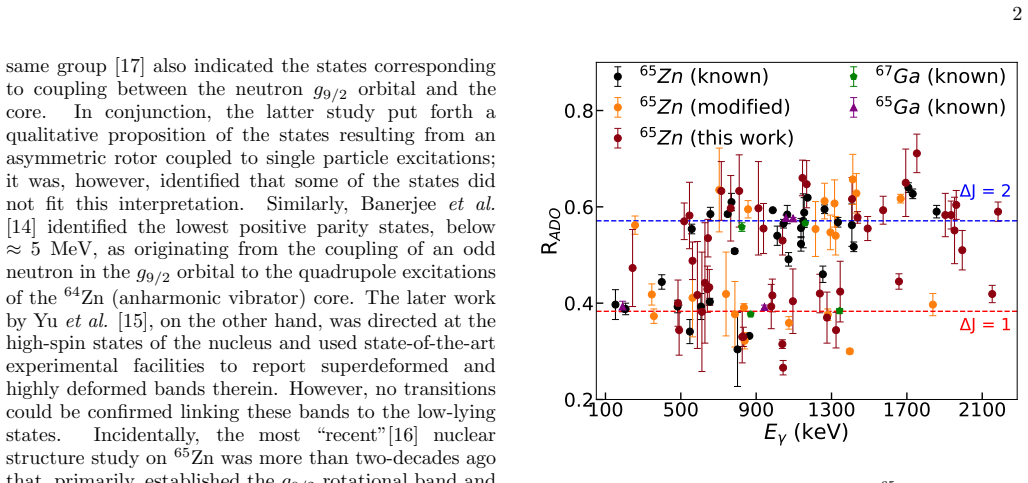
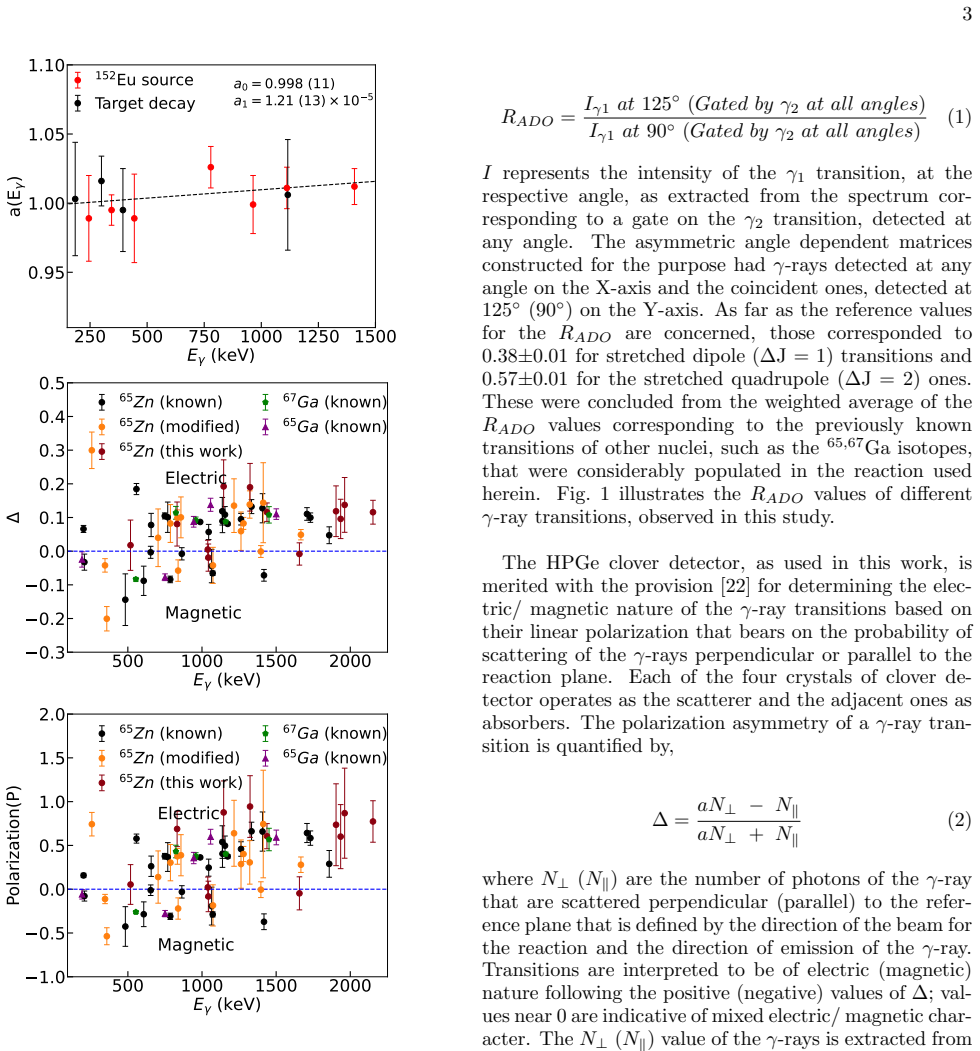
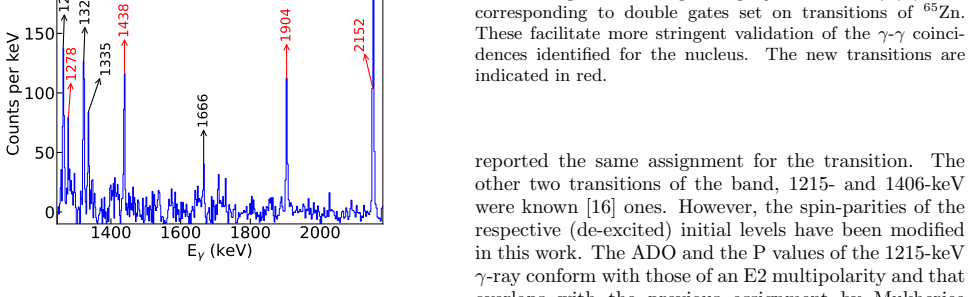
codes towards determining the measurables relevant to the excitation scheme of the nucleus of interest. The assignment of multipolarities of theγ-ray transi- tions followed theirR ADO (Ratio of Angular Distribution from Oriented nuclei) values using, 3 250 500 750 1000 1250 1500 E (keV) 0.95 1.00 1.05 1.10 a(E ) a0 = 0.998 (11) a1 = 1.21 (13) × 10 5 152Eu...
2000
-
[5]
DCO-type analysis
for the nucleus, that could not be confirmed in this investigation. The level scheme of the nucleus has been established up to an excitation energy E x ≈ 8 MeV and spin≈14ℏ. The spin-parities of several levels, particularly those above≈5 MeV, have either been modified from the existing assignments or have been newly assigned following the analysis herein....
1936
-
[6]
The next section addresses the excitation mechanisms and the associated parameters underlying the bands and other structures in the excitation scheme
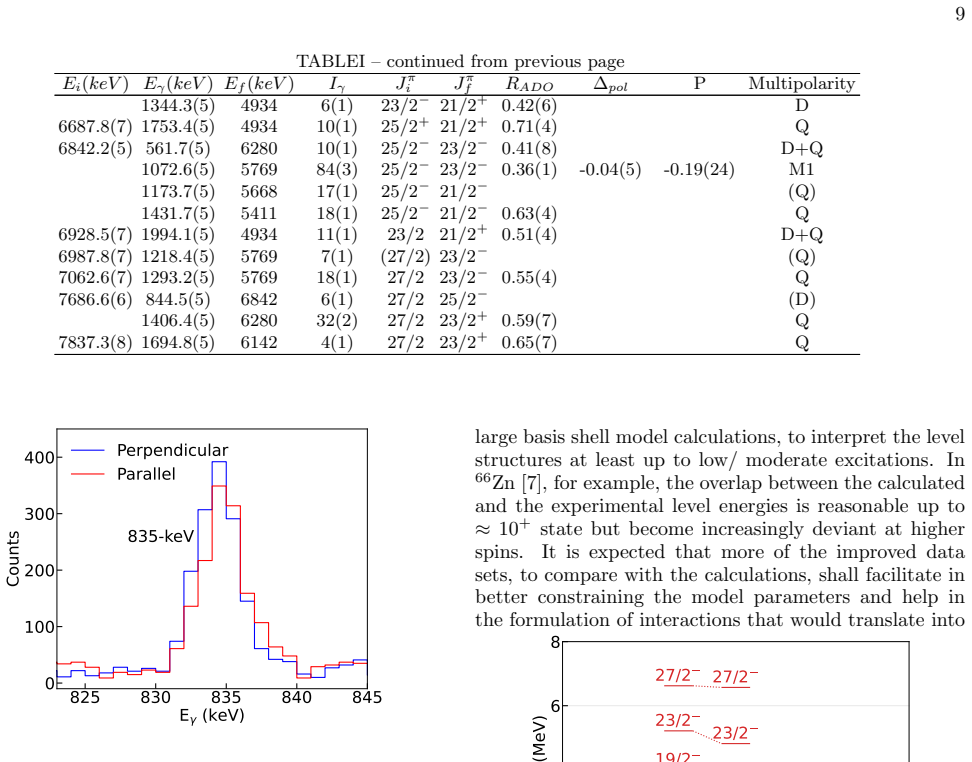
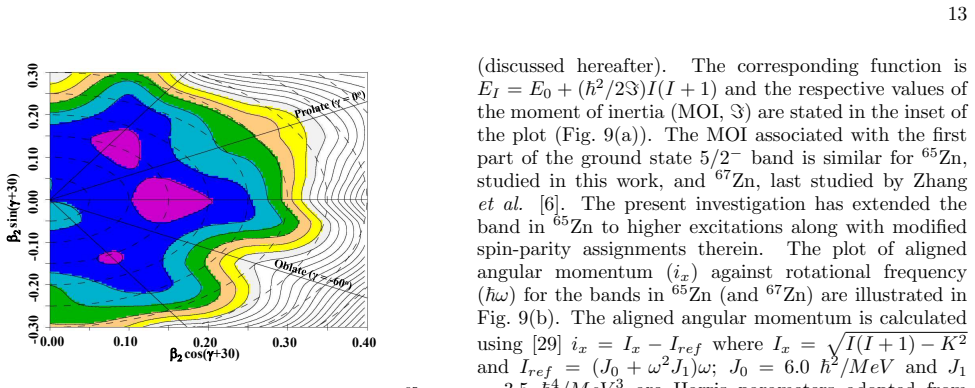
while others have been newly identified in this work. The next section addresses the excitation mechanisms and the associated parameters underlying the bands and other structures in the excitation scheme. TABLE I: Details of the levels and theγ-ray transitions of 65Zn observed/ validated in the present study. The level energies (Ei andE f) are those follo...
1907
-
[7]
That is illustrated in Fig
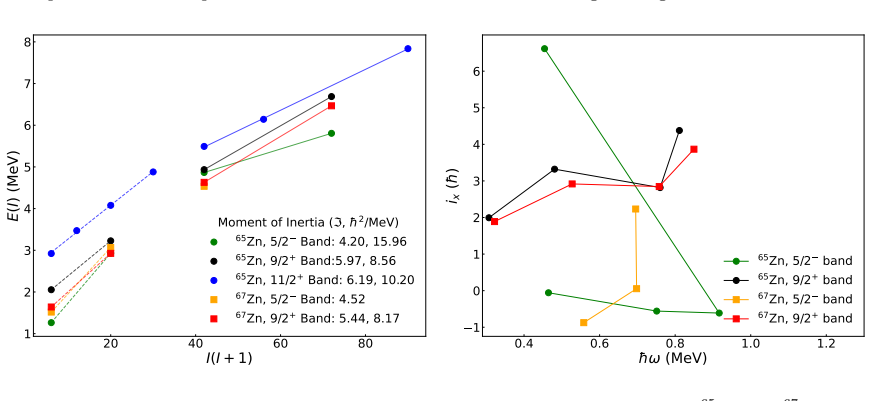
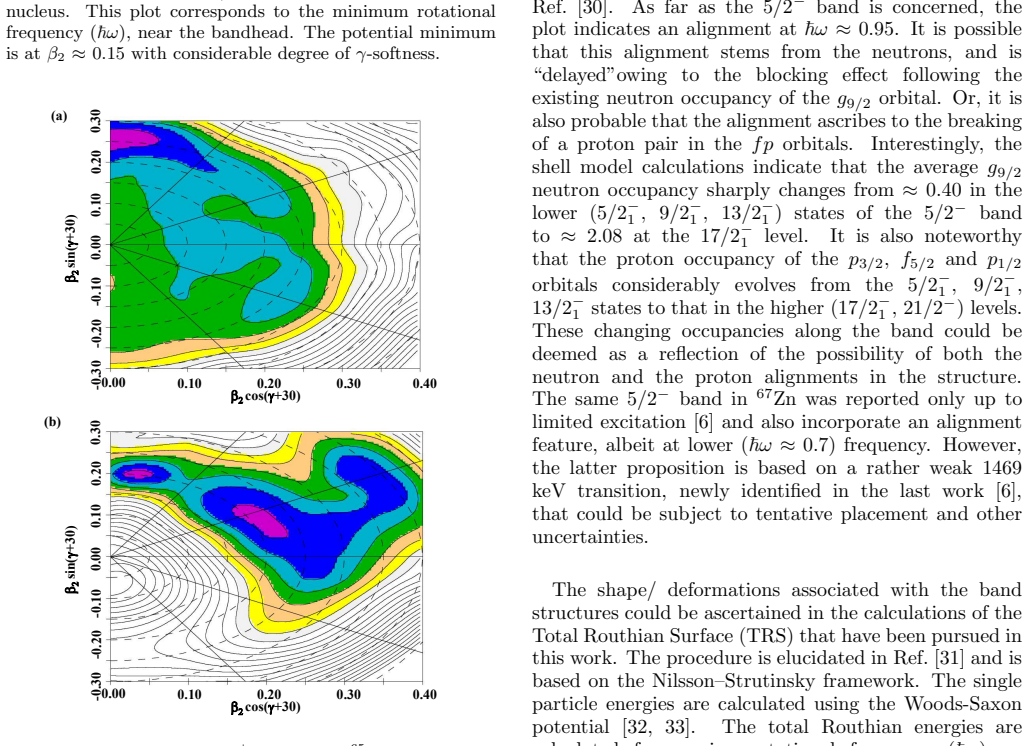
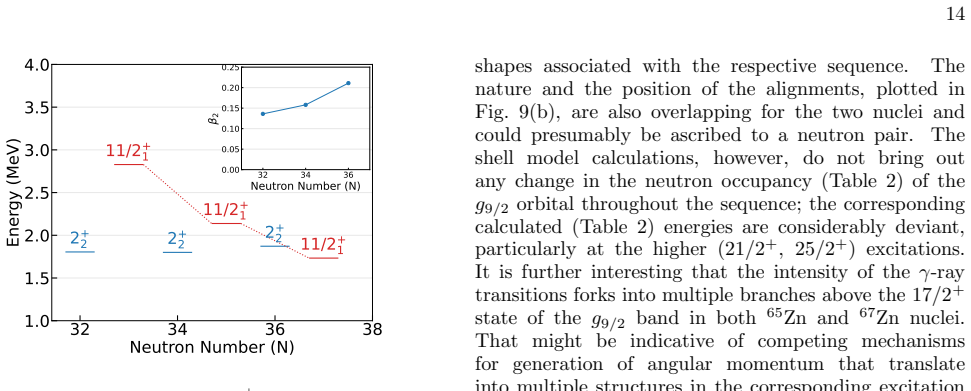
of the corresponding even-even core and keeping the evolvingβ-value in perspective. That is illustrated in Fig. 12 wherein it is noted that the energy of the vibrational 2 + 2 state remains almost constant for the even-even isotopes. However, the steady decrease in the excitation energy of the 11/2 + level, with increasing neutron number andβ-deformation ...
2003
-
[8]
Samanta, S
S. Samanta, S. Das, R. Bhattacharjee, S. Chatterjee, S. S. Ghugre, A. K. Sinha, U. Garg, Neelam, N. Kumar, P. Jones, et al., Phys. Rev. C99, 014315 (2019)
2019
-
[9]
Bhattacharya, V
S. Bhattacharya, V. Tripathi, E. Rubino, S. Ajayi, L. T. Baby, C. Benetti, R. S. Lubna, S. L. Tabor, J. Doring, Y. Utsuno, et al., Phys. Rev. C107, 054311 (2023)
2023
-
[10]
Samanta, S
S. Samanta, S. Das, R. Bhattacharjee, S. Chatterjee, S. S. Ghugre, A. K. Sinha, U. Garg, Neelam, N. Kumar, P. Jones, et al., Phys. Rev. C97, 014319 (2018)
2018
-
[11]
Chatterjee, B
S. Chatterjee, B. Mondal, S. Samanta, S. Das, R. Raut, S. S. Ghugre, P. C. Srivastava, A. K. Sinha, U. Garg, Neelam, et al., Phys. Rev. C107, 024312 (2023)
2023
-
[12]
Saracino, S
A. Saracino, S. Zhu, N. Sensharma, A. D. Ayangeakaa, R. V. F. Janssens, Q. B. Chen, M. P. Carpenter, P. Chowdhury, A. Gade, F. G. Kondev, et al., Phys. Rev. C109, 024319 (2024)
2024
-
[13]
S. Y. Zhang, D. W. Luo, R. Han, C. Xu, H. Y. Wu, H. Hua, J. Z. Li, Y. Zheng, Y. D. Fang, Z. H. Li, et al., Phys. Rev. C112, 054313 (2025)
2025
-
[14]
A. D. Ayangeakaa, N. Sensharma, M. Fulghieri, R. V. F. Janssens, Q. B. Chen, S. Zhu, M. Alcorta, M. P. Carpen- ter, P. Chowdhury, A. G. C. R. Hoffman, et al., Phys. Rev. C105, 054315 (2022)
2022
-
[15]
Z. X. Zhou, D. W. Luo, H. Y. Wu, Y. Y. Wang, Y. F. Niu, W. Zhang, C. Xu, G. S. Li, Z. H. Li, H. Hua, et al., Phys. Rev. C110, 024309 (2024)
2024
-
[16]
Sharma, S
A. Sharma, S. Nandi, S. Samanta, S. Kundu, A. Das, S. S. Ghugre, R. Raut, S. S. Tiwary, I. Bala, R. P. Singh, et al., Phys. Rev. C113, 014304 (2026)
2026
-
[17]
A. K. Singh, G. Gangopadhyay, D. Banerjee, R. Bhat- tacharya, R. K. Bhowmik, S. Muralithar, R. P. Singh, U. D. P. A. Mukherjee, A. Goswami, S. Chattopadhyay, et al., Phys. Rev. C57, 1617 (1998)
1998
-
[18]
U. S. Ghosh, S. Rai, B. Mukherjee, A. Biswas, A. K. Mondal, K. Mandal, A. Chakraborty, S. Chakraborty, G. Mukherjee, A. Sharma, et al., Phys. Rev. C100, 034314 (2019)
2019
-
[19]
Karlgren, R
D. Karlgren, R. M. Clark, I. Ragnarsson, C. E. Svensson, D. Ward, R. Wyss, C. Andreoiu, R. A. E. Austin, M. P. Carpenter, M. Cromaz, et al., Phys. Rev. C69, 034330 (2004)
2004
-
[20]
Nilsson and Z
A. Nilsson and Z. P. Sawa, Phys. Scr.9, 83 (1974)
1974
-
[21]
Banerjee, B
P. Banerjee, B. Sethi, M. B. Chatterjee, and R. Goswami, Phys. Rev. C50, 1813 (1994)
1994
-
[22]
C. H. Yu, C. Baktash, J. Dobaczewski, J. A. Cameron, M. Devlin, J. Eberth, A. Galindo-Uribarri, D. S. Haslip, D. R. LaFosse, T. J. Lampman, et al., Phys. Rev. C62, 041301(R) (2000)
2000
-
[23]
Mukherjee, S
B. Mukherjee, S. Muralithar, R. P. Singh, R. Kumar, K. Rani, and R. K. Bhowmik, Phys. Rev. C63, 057302 (2001)
2001
-
[24]
G. F. Neal, Z. P. Sawa, and P. R. Changon, Nucl. Phy. 16 A295, 351 (1978)
1978
-
[25]
S. Das, S. Samanta, R. Banik, R. Bhattacharjee, K. Basu, R. Raut, S. S. Ghugre, A. K. Sinha, S. Bhattacharya, S. Imran, et al., Nucl. Instr. Meth. Phys. Res. A893, 138 (2018)
2018
-
[26]
R. K. Bhowmik, S. Muralithar, and R. P. Singh, Proc. DAE Symp. Nucl. Phys.44B, 422 (2001)
2001
-
[27]
D. C. Radford, Nucl. Instr. Meth. Phys. Res. A361, 297 (1995)
1995
-
[28]
URLhttps://zenodo.org/record/10683241
-
[29]
Duchene, F
G. Duchene, F. A. Beck, P. J. Twin, G. de France, D. Curien, L. Han, C. W. Beausang, M. A. Bentley, P. J. Nolan, and J. Simpson, Nucl. Instr. Meth. Phys. Res. A432, 90 (1999)
1999
-
[30]
Palit, H
R. Palit, H. C. Jain, P. K. Joshi, S. Nagaraj, B. V. T. Rao, S. N. Chintalapudi, and S. S. Ghugre, Pramana54, 347 (2000)
2000
-
[31]
URLhttps://www-nds.iaea.org/public/ensdf_pgm/ index.htm
-
[32]
A. D. Ayangeakaa, R. V. F. Janssens, S. Zhu, J. M. All- mond, B. A. Brown, C. Y. Wu, M. Albers, K. Auranen, B. Bucher, M. P. Carpenter, et al., Phys. Rev. C107, 044314 (2023)
2023
-
[33]
Shimizu, T
N. Shimizu, T. Mizusaki, Y. Utsuno, and Y. Tsunoda, Comp. Phys. Comm.244, 372 (2019)
2019
-
[34]
Honma, T
M. Honma, T. Otsuka, T. Mizusaki, and M. Hjorth- Jensen, Phys. Rev. C80, 064323 (2009)
2009
-
[35]
A. F. Lisetskiy, B. A. Brown, M. Horoi, and H. Grawe, Phys. Rev. C70, 044314 (2004)
2004
-
[36]
Regan,Post Graduate Nuclear Experimental Tech- niques (4NET) Course Notes(University of Surrey, 2003)
P. Regan,Post Graduate Nuclear Experimental Tech- niques (4NET) Course Notes(University of Surrey, 2003)
2003
-
[37]
S. Rai, U. S. Ghosh, B. Mukherjee, A. Biswas, A. K. Mondal, K. Mandal, A. Chakraborty, S. Chakraborty, G. Mukherjee, A. Sharma, et al., Phys. Rev. C102, 064313 (2020)
2020
-
[38]
Mukherjee, P
G. Mukherjee, P. Joshi, R. K. Bhowmik, S. N. Roy, S. Dutta, S. Muralithar, and R. P. Singh, Nucl. Phy. A829, 137 (2009)
2009
-
[39]
Nasarewicz, J
W. Nasarewicz, J. Dudek, R. Bengtsson, T. Bengtsson, and I. Ragnarsson, Nucl. Phy. A435, 397 (1985)
1985
-
[40]
Nasarewicz, M
W. Nasarewicz, M. A. riley, and J. D. Garrett, Nucl. Phy. A512, 61 (1990)
1990
-
[41]
Neuhausen, Nucl
R. Neuhausen, Nucl. Phy. A282, 125 (1977)
1977
-
[42]
C. G. Wang, R. Han, C. Xu, H. Hua, R. A. Bark, S. Q. Zhang, S. Y. Wang, T. M. Shneidman, S. G. Zhou, J. Meng, et al., Phys. Rev. C106, L011303 (2022)
2022
discussion (0)
Sign in with ORCID, Apple, or X to comment. Anyone can read and Pith papers without signing in.