High Throughput Analysis of Nanobeam Electron Diffraction Datasets using Unsupervised Clustering
Pith reviewed 2026-06-26 07:31 UTC · model grok-4.3
The pith
Applying unsupervised clustering to lists of diffraction peak position vectors from nanobeam electron diffraction datasets automatically decomposes them into crystalline phases, orientations, and amorphous components.
A machine-rendered reading of the paper's core claim, the machinery that carries it, and where it could break.
Core claim
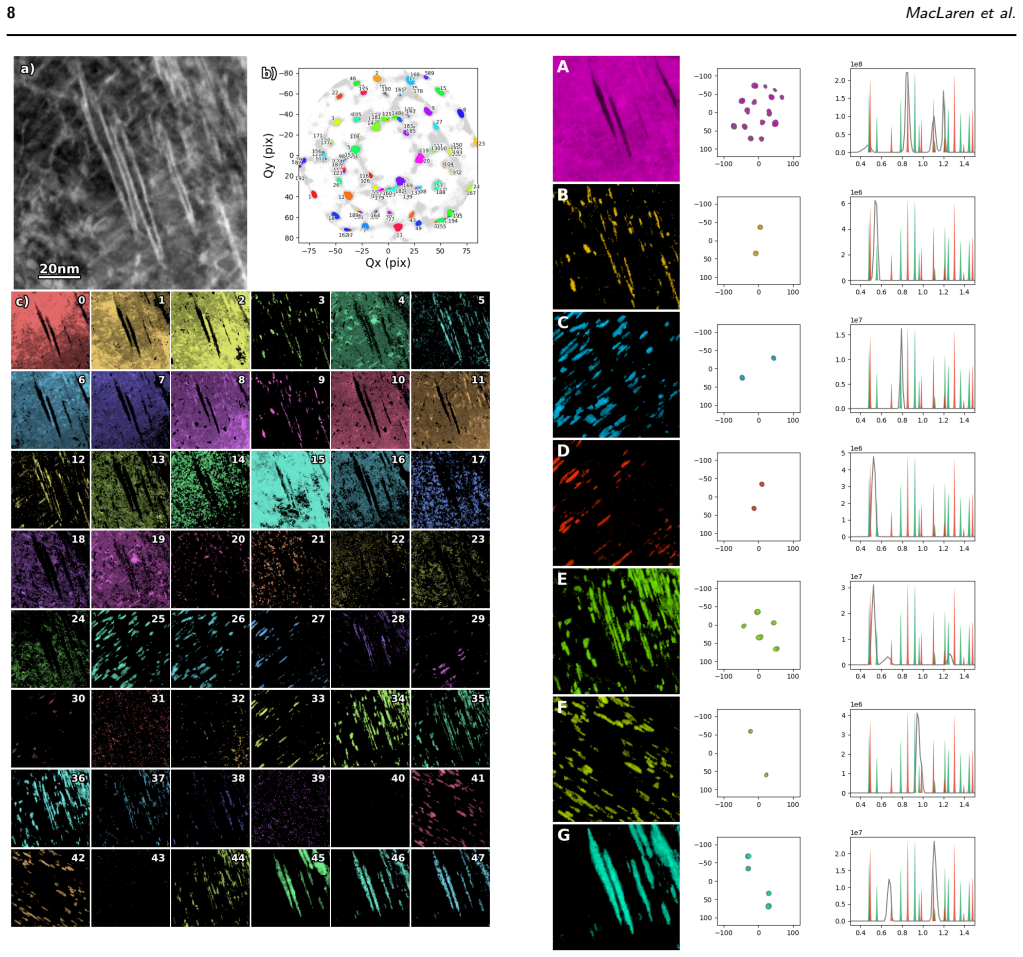
If disk detection is applied to nanobeam electron diffraction datasets, then the results are effectively a list of vectors describing the position of every diffraction peak in real and reciprocal space. This is the natural territory for the application of clustering algorithms, and they are shown to be highly effective at decomposing such datasets and automating imaging and analysis. Examples are shown in both polycrystalline and single crystal (with precipitates) systems. Additionally, automated separation of amorphous or deeply nanocrystalline components is also found to be possible allowing composite images of both amorphous and crystalline components in partially crystallised samples to
What carries the argument
Unsupervised clustering applied to vectors of diffraction peak positions extracted by disk detection from nanobeam patterns.
If this is right
- Increased throughput for atomic structure analysis of nanobeam diffraction data.
- Easier identification of minor crystalline or amorphous components in composite samples.
- Generation of composite images separating amorphous and crystalline regions without manual intervention.
- Use as an initial step before detailed crystallographic indexing or grain-size distribution measurements.
Where Pith is reading between the lines
- The method could be chained with subsequent orientation mapping or strain analysis on the same peak lists.
- It may reduce the need for exhaustive manual inspection when surveying large areas of heterogeneous materials.
- The vector-based input could extend to other diffraction modalities that produce discrete peak lists.
- Performance would likely degrade on patterns with heavy peak overlap or low signal-to-noise where disk detection itself becomes unreliable.
Load-bearing premise
Disk detection on the raw diffraction patterns produces accurate, complete lists of peak position vectors that form distinct, physically meaningful clusters.
What would settle it
A dataset from a sample with known phase or orientation boundaries where the clustering output merges or misses those boundaries when compared to independent mapping.
Figures

read the original abstract
If disk detection is applied to nanobeam electron diffraction datasets, then the results are effectively a list of vectors describing the position of every diffraction peak in real and reciprocal space. This is the natural territory for the application of clustering algorithms, and they are shown to be highly effective at decomposing such datasets and automating imaging and analysis. Examples are shown in both polycrystalline and single crystal (with precipitates) systems. Additionally, automated separation of amorphous or deeply nanocrystalline components is also found to be possible allowing composite images of both amorphous and crystalline components in partially crystallised samples to be easily and automatically generated. These advances promise to increase throughput in atomic structure analysis with nanobeam diffraction, and also make finding minor components much easier. They can also serve as a preliminary step towards more detailed crystallographic or crystal size/shape distribution analysis.
Editorial analysis
A structured set of objections, weighed in public.
Referee Report
Summary. The paper claims that applying disk detection to nanobeam electron diffraction (NBED) datasets produces lists of peak position vectors in real and reciprocal space that are naturally suited to unsupervised clustering. It asserts that such clustering is highly effective at decomposing the datasets to automate imaging and analysis, with examples in polycrystalline and single-crystal (with precipitates) systems. It further claims that the method enables automated separation of amorphous or deeply nanocrystalline components, allowing composite images of mixed phases in partially crystallized samples, thereby increasing throughput and aiding identification of minor components as a preliminary step toward detailed crystallographic analysis.
Significance. If the disk detection produces accurate peak lists and the resulting clusters align with physically distinct components, the approach could meaningfully accelerate NBED data processing in materials science by reducing manual intervention. The exploration of amorphous-component separation is a potentially useful extension beyond standard crystalline orientation mapping. However, the current manuscript provides only qualitative examples without quantitative benchmarks, limiting assessment of whether the pipeline delivers reliable gains over existing methods.
major comments (3)
- [Abstract] Abstract: The assertion that clustering algorithms are 'highly effective at decomposing such datasets' is unsupported by any quantitative metrics (e.g., precision/recall of disk detection, cluster validity indices, or agreement with manual indexing), validation against ground truth, or error analysis. This absence directly undermines evaluation of the central effectiveness claim.
- [Methods/Results (no dedicated validation subsection)] The manuscript provides no description or validation of the disk detection step that generates the input peak position vectors. Without reported completeness (recall) or accuracy metrics on simulated or experimental patterns with known peaks, it is impossible to determine whether downstream clustering results reflect true physical separation or artifacts from missed weak peaks or false positives.
- [Results/Examples] Examples (polycrystalline and single-crystal sections): The presented decompositions are visually consistent with the claims but contain no quantitative checks on cluster distinctness (e.g., overlap metrics for orientation-induced peak shifts) or comparison to alternative analysis methods, leaving the assumption that vector lists form distinct, physically meaningful clusters untested.
minor comments (2)
- The manuscript would benefit from an explicit methods section detailing the specific clustering algorithm(s), hyperparameters, and disk detection implementation to enable reproducibility.
- Figure captions should include quantitative details (e.g., number of patterns, cluster counts) rather than relying solely on visual inspection.
Simulated Author's Rebuttal
We thank the referee for their constructive and detailed comments on our manuscript. We agree that the addition of quantitative validation will strengthen the work and will revise accordingly. Below we respond point by point to the major comments.
read point-by-point responses
-
Referee: [Abstract] Abstract: The assertion that clustering algorithms are 'highly effective at decomposing such datasets' is unsupported by any quantitative metrics (e.g., precision/recall of disk detection, cluster validity indices, or agreement with manual indexing), validation against ground truth, or error analysis. This absence directly undermines evaluation of the central effectiveness claim.
Authors: We accept that the abstract phrasing 'highly effective' is not backed by quantitative metrics in the current text. The claim rests on the visual success of the decompositions shown in the examples. We will revise the abstract to moderate the language and add a dedicated validation subsection that reports precision/recall for disk detection on simulated patterns together with cluster validity indices (silhouette score, Davies-Bouldin index) on both simulated and experimental data. revision: yes
-
Referee: [Methods/Results (no dedicated validation subsection)] The manuscript provides no description or validation of the disk detection step that generates the input peak position vectors. Without reported completeness (recall) or accuracy metrics on simulated or experimental patterns with known peaks, it is impossible to determine whether downstream clustering results reflect true physical separation or artifacts from missed weak peaks or false positives.
Authors: The disk-detection procedure is described only briefly because it employs a standard peak-finding routine; however, we agree that explicit validation is absent. In the revision we will expand the methods section with the precise parameters used, add a validation subsection that quantifies recall and precision on simulated NBED patterns containing known peaks, and report false-positive rates on experimental patterns where possible. revision: yes
-
Referee: [Results/Examples] Examples (polycrystalline and single-crystal sections): The presented decompositions are visually consistent with the claims but contain no quantitative checks on cluster distinctness (e.g., overlap metrics for orientation-induced peak shifts) or comparison to alternative analysis methods, leaving the assumption that vector lists form distinct, physically meaningful clusters untested.
Authors: The examples are presented as qualitative demonstrations of the workflow. We will augment the results with quantitative cluster-validity metrics and, where ground-truth orientation maps exist, report agreement with manual indexing. Direct head-to-head comparison with every alternative method is beyond the scope of the present study, but we will add a short discussion of how the vector-clustering approach differs from existing orientation-mapping pipelines. revision: partial
Circularity Check
No circularity: empirical application of standard clustering to disk-detected peak vectors with no derivation or self-referential prediction.
full rationale
The paper presents a workflow applying unsupervised clustering to lists of peak position vectors extracted via disk detection from nanobeam electron diffraction patterns. No equations, fitted parameters renamed as predictions, uniqueness theorems, or self-citations are invoked to derive results. Claims of effectiveness rest on example outputs in polycrystalline and single-crystal cases, with no reduction of any output to its inputs by construction. This matches the default non-circular case for an applied-methods paper.
Axiom & Free-Parameter Ledger
Reference graph
Works this paper leans on
-
[1]
Francisco de la Peña and Eric Prestat and Jonas Lähnemann and Vidar Tonaas Fauske and Pierre Burdet and Petras Jokubauskas and Tom Furnival and Carter Francis and Magnus Nord and Tomas Ostasevicius and Katherine E. MacArthur and Duncan N. Johnstone and Mike Sarahan and Thomas Aarholt and Joshua Taillon and pquinn-dls and Vadim Migunov and Alberto Eljarrat...
-
[2]
Microscopy and Microanalysis , volume =
MacLaren, Ian and Fraser, Andrew T and Lipsett, Matthew R and Ophus, Colin , title =. Microscopy and Microanalysis , volume =. 2025 , month =
2025
-
[3]
and Lennon, Ciaran T
Choudhary, Nidhi and Peeters, Silke A. and Lennon, Ciaran T. and Besprozvannyy, Dmytro and Knoops, Harm C. M. and Maclaren, Ian and Hadfield, Robert H. , title =. APL Materials , volume =. 2025 , month =
2025
-
[4]
and Calisir, Ilkan and Paterson, Gary W
McCartan, Shane J. and Calisir, Ilkan and Paterson, Gary W. and Webster, Robert W. H. and Macgregor, Thomas A. and Hall, David A. and MacLaren, Ian , title =. Journal of the American Ceramic Society , volume =. doi:https://doi.org/10.1111/jace.17599 , year =
-
[5]
and Lipsett, Matthew R
MacLaren, Ian and Fraser, Andrew T. and Lipsett, Matthew R. , journal =. Structural effects of (111) growth of. 2025 , month =
2025
-
[6]
Journal of Microscopy , volume =
MacLaren, Ian and Frutos-Myro, Enrique and Zeltmann, Steven and Ophus, Colin , title =. Journal of Microscopy , volume =. doi:10.1111/jmi.13275 , year =
-
[7]
Johnstone, Duncan N. and Martineau, Ben H. and Crout, Phillip and Midgley, Paul A. and Eggeman, Alexander S. , title =. Journal of Applied Crystallography , volume =. doi:doi:10.1107/S1600576720011103 , year =
-
[8]
Goldstein, Joseph. I. and Michael, Joseph. R. , title =. Meteoritics & Planetary Science , volume =. doi:10.1111/j.1945-5100.2006.tb00482.x , year =
-
[9]
Rauch, Edgar F. and Portillo, Joachim and Nicolopoulos, Stavros and Bultreys, Daniel and Rouvimov, Sergei and Moeck, Peter , title =. Zeitschrift Fur Kristallographie-Crystalline Materials , volume =. doi:10.1524/zkri.2010.1205 , year =
-
[10]
Microscopy and Microanalysis , volume =
Ribet, Stephanie M and Dhall, Rohan and Ophus, Colin and Bustillo, Karen C , title =. Microscopy and Microanalysis , volume =. 2025 , month =
2025
-
[11]
Anwar, Md Shadab and Cansever, Hamza and Boehm, Benny and Gallardo, Rodolfo A. and Hübner, René and Zhou, Shengqiang and Kentsch, Ulrich and Rauls, Simon and Eggert, Benedikt and Wende, Heiko and Potzger, Kay and Fassbender, Juergen and Lenz, Kilian and Lindner, Jürgen and Hellwig, Olav and Bali, Rantej , title =. ACS Applied Electronic Materials , volume...
-
[12]
Microscopy and Microanalysis , volume =
Lee, Serin and Ribet, Stephanie M and McCray, Arthur R C and Barnum, Andrew and Dionne, Jennifer A and Ophus, Colin , title =. Microscopy and Microanalysis , volume =. 2026 , month =
2026
-
[13]
and Colliex, Christian , title =
Jeanguillaume, C. and Colliex, Christian , title =. Ultramicroscopy , volume =. doi:10.1016/0304-3991(89)90304-5 , year =
-
[14]
Microscopy and Microanalysis , volume =
Ophus, Colin , title =. Microscopy and Microanalysis , volume =. doi:10.1017/S1431927619000497 , year =
-
[15]
MacLaren, Ian and Macgregor, Thomas A. and Allen, Christopher S. and Kirkland, Angus I. , title =. APL Materials , volume =. doi:10.1063/5.0026992 , year =
-
[16]
Semiconductor Science and Technology , volume =
Cooper, David and Béché, Armand and Hartmann, Jean Michel and Carron, Veronique and Rouvière, Jean-Luc , title =. Semiconductor Science and Technology , volume =. doi:10.1088/0268-1242/25/9/095012 , year =
-
[17]
and Hartmann, Jean Michel , title =
Béché, Armand and Rouvière, Jean-Luc and Clément, L. and Hartmann, Jean Michel , title =. Applied Physics Letters , volume =. doi:10.1063/1.3224886 , year =
-
[18]
Daulton, Tyrone. L. and Bondi, K. S. and Kelton, Kenneth. F. , title =. Ultramicroscopy , volume =. doi:10.1016/j.ultramic.2010.05.010 , year =
-
[19]
Savitzky, Benjamin H. and Zeltmann, Steven E. and Hughes, Lauren A. and Brown, Hamish G. and Zhao, Shiteng and Pelz, Philipp M. and Pekin, Thomas C. and Barnard, Edward S. and Donohue, Jennifer and Rangel DaCosta, Luis and Kennedy, Ellis and Xie, Yujun and Janish, Matthew T. and Schneider, Matthew M. and Herring, Patrick and Gopal, Chirranjeevi and Anapol...
-
[20]
and Bruefach, Alexandra and Rakowski, Alexander and Savitzky, Benjamin H
Ophus, Colin and Zeltmann, Steven E. and Bruefach, Alexandra and Rakowski, Alexander and Savitzky, Benjamin H. and Minor, Andrew M. and Scott, Mary C. , title =. Microscopy and Microanalysis , volume =. doi:10.1017/S1431927622000101 , year =
-
[21]
Anwar, Md. Shadab and Cansever, Hamza and Lenz, Kilian and Kentsch, Ulrich and Zhou, Shengqiang and Fassbender, Jürgen and Potzger, Kay and Hellwig, Olav and Lindner, Jürgen and Bali, Rantej , title =. Advanced Electronic Materials , volume =. doi:10.1002/aelm.202500697 , year =
-
[22]
Kataoka and K
N. Kataoka and K. Sumiyama and Y. Nakamura , journal=. Metastable Crystalline and Amorphous. 1986 , doi=
1986
-
[23]
Anwar, Md. Shadab and Zelenina, Iryna and Sobieszczyk, Paweł and Hlawacek, Gregor and Tveitstøl, Kristian and Potzger, Kay and Fassbender, Jürgen and Hellwig, Olav and Lindner, Jürgen and Krupiński, Michał and Nord, Magnus and Bali, Rantej , title =. Advanced Functional Materials , volume =. doi:10.1002/adfm.202513904 , year =
-
[24]
Direct Depth- and Lateral- Imaging of Nanoscale Magnets Generated by Ion Impact , journal=
R. Direct Depth- and Lateral- Imaging of Nanoscale Magnets Generated by Ion Impact , journal=. 2015 , month=
2015
-
[25]
Sample preparation for atomic-resolution. Ultramicroscopy , volume =. 2012 , issn =. doi:10.1016/j.ultramic.2012.01.005 , author =
-
[26]
Geochimica et Cosmochimica Acta , volume =
Main-group pallasites: Thermal history, relationship to. Geochimica et Cosmochimica Acta , volume =. 2010 , doi =
2010
-
[27]
Walte and Giulio F.D
Nicolas P. Walte and Giulio F.D. Solferino and Gregor J. Golabek and Danielle. Two-stage formation of pallasites and the evolution of their parent bodies revealed by deformation experiments , journal =. 2020 , doi =
2020
-
[28]
Geochimica et Cosmochimica Acta , volume =
Microstructural and paleomagnetic insight into the cooling history of the. Geochimica et Cosmochimica Acta , volume =. 2018 , doi =
2018
-
[29]
Martineau, B. and Johnstone, D. N. and van Helvoort, A. T. J. and Midgley, P. A. and Eggeman, A. S. , title =. Advanced Structural and Chemical Imaging , volume =. doi:10.1186/s40679-019-0063-3 , year =
-
[30]
A density-based algorithm for discovering clusters in large spatial databases with noise , year =
Ester, Martin and Kriegel, Hans-Peter and Sander, J\". A density-based algorithm for discovering clusters in large spatial databases with noise , year =. Proceedings of the Second International Conference on Knowledge Discovery and Data Mining , pages =
-
[31]
Scikit-learn: Machine Learning in Python , year =
Pedregosa, Fabian and Varoquaux, Ga\". Scikit-learn: Machine Learning in Python , year =. J. Mach. Learn. Res. , month = nov, pages =
-
[32]
Vogl and Shunda Chen and Peter Schweizer and Xiaochen Jin and Shui-Qing Yu and Jifeng Liu and Tianshu Li and Andrew M
Lilian M. Vogl and Shunda Chen and Peter Schweizer and Xiaochen Jin and Shui-Qing Yu and Jifeng Liu and Tianshu Li and Andrew M. Minor , title =. Science , volume =. 2025 , doi =
2025
-
[33]
Computers & Geosciences , volume =. 1984 , issn =. doi:10.1016/0098-3004(84)90020-7 , author =
-
[34]
Diffraction contrast imaging using virtual apertures , journal =
Christoph Gammer and V. Diffraction contrast imaging using virtual apertures , journal =. 2015 , doi =
2015
-
[35]
Materials Characterization , volume =
Automated crystal orientation and phase mapping in. Materials Characterization , volume =. 2014 , issn =. doi:10.1016/j.matchar.2014.08.010 , author =
-
[36]
Microscopy and Microanalysis , volume =
Paterson, Gary W and Webster, Robert W H and Ross, Andrew and Paton, Kirsty A and Macgregor, Thomas A and McGrouther, Damien and MacLaren, Ian and Nord, Magnus , title =. Microscopy and Microanalysis , volume =. 2020 , month =
2020
-
[37]
and Danaie, Mohsen and Eggeman, Alexander S
Kho, Zhiquan and Bridger, Andy and Butler, Keith and Duran, Ercin C. and Danaie, Mohsen and Eggeman, Alexander S. , title =. APL Materials , volume =. 2025 , month =
2025
-
[38]
Yoo, Timothy and Hershkovitz, Eitan and Yang, Yang and da Cruz Gallo, Flávia and Manuel, Michele V. and Kim, Honggyu , title =. npj Computational Materials , volume =. doi:10.1038/s41524-024-01414-3 , year =
-
[39]
Microscopy research and technique , volume=
Electron nanodiffraction , author=. Microscopy research and technique , volume=. 1999 , publisher=
1999
-
[40]
1932 , publisher=
Quantitative expression of cultural relationships , author=. 1932 , publisher=
1932
-
[41]
Cluster analysis: correlation profile and orthometric (factor) analysis for the isolation of unities in mind and personality , author=
-
[42]
The K-means algorithm evolution , booktitle=
P. The K-means algorithm evolution , booktitle=. 2019 , publisher=
2019
-
[43]
Least squares quantization in
Lloyd, Stuart , journal=. Least squares quantization in. 1982 , publisher=
1982
-
[44]
Meteoritics & Planetary Science , volume=
A new empirical cooling rate indicator for meteorites based on the size of the cloudy zone of the metallic phases , author=. Meteoritics & Planetary Science , volume=. 1997 , publisher=
1997
-
[45]
Journal of Applied Physics , volume =
MacLaren, Ian and Villaurrutia, Rafael and Peláiz-Barranco, Aimé , title =. Journal of Applied Physics , volume =. 2010 , month =
2010
-
[46]
doi:10.1007/978-0-387-76501-3 , year =
Williams, DB and Carter, CB , title =. doi:10.1007/978-0-387-76501-3 , year =
discussion (0)
Sign in with ORCID, Apple, or X to comment. Anyone can read and Pith papers without signing in.