Temporally Aware Densification for Dynamic 3D Gaussian Splatting
Pith reviewed 2026-06-26 09:04 UTC · model grok-4.3
The pith
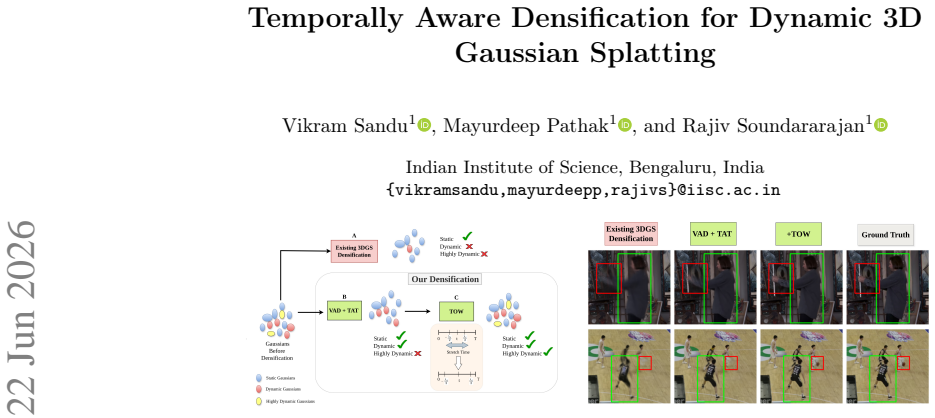
Dynamic 3D Gaussian Splatting can sharpen moving regions by tying densification to each Gaussian's temporal visibility and lifespan.
A machine-rendered reading of the paper's core claim, the machinery that carries it, and where it could break.
Core claim
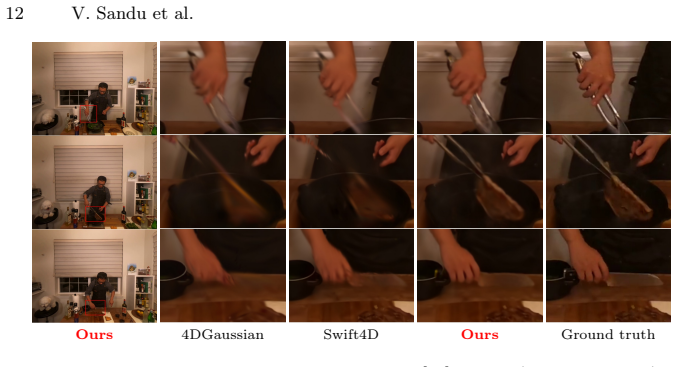
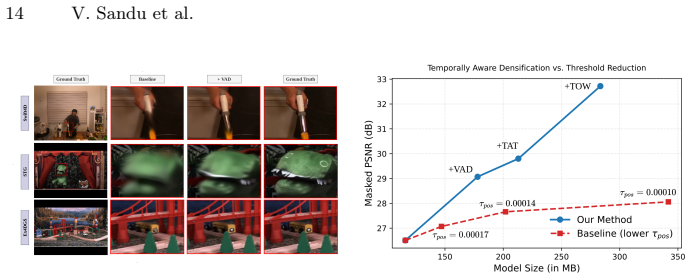
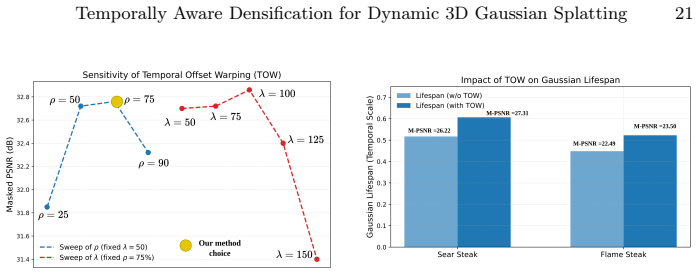
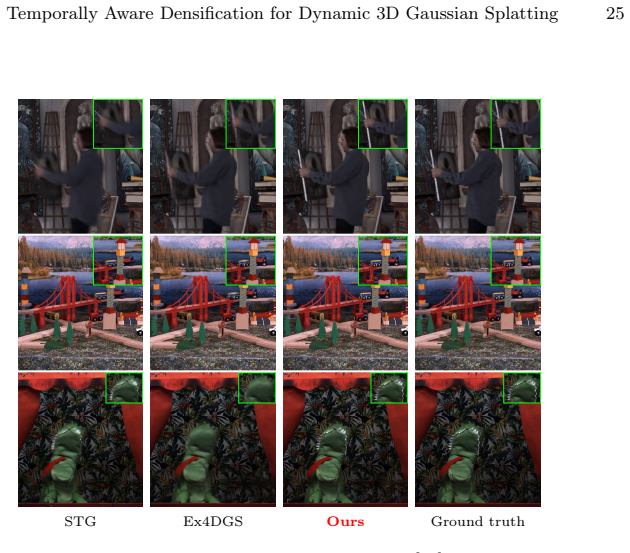
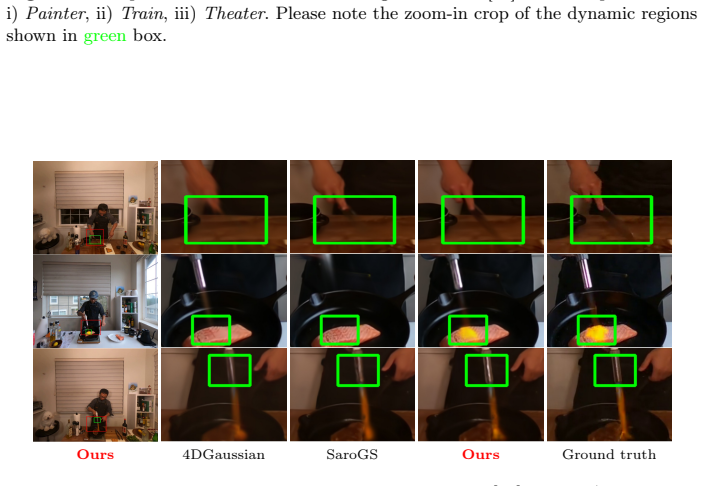
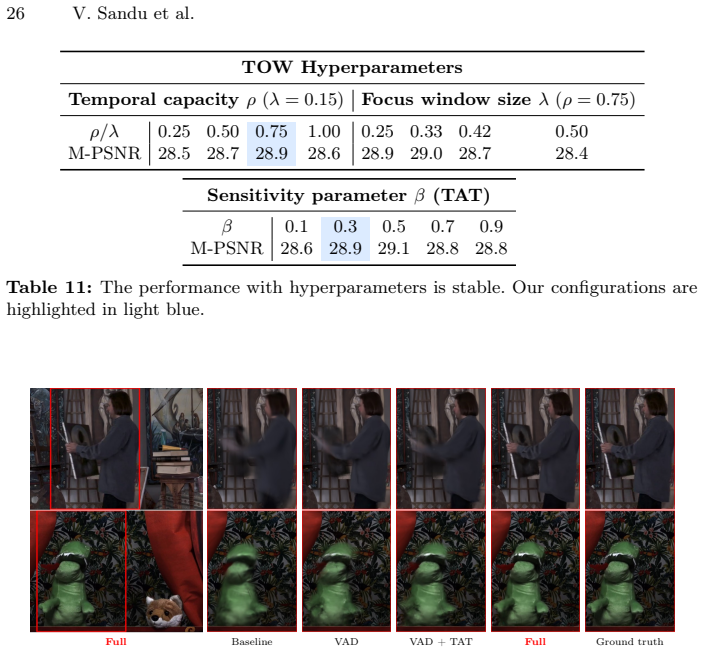
By integrating temporal visibility into the densification process, the Visibility-Aware Densification framework ensures Gaussians are refined based on their actual temporal presence. A Temporally-Adaptive Thresholding mechanism adjusts each Gaussian's densification threshold according to its temporal lifespan, and a Temporal Offset Warping design enhances deformation capacity around temporal centers. This approach leads to substantial improvements in the visual quality of dynamic regions and outperforms existing methods on three dynamic multi-view benchmark datasets while generalizing across diverse dynamic 3DGS methods as a plug-and-play component.
What carries the argument
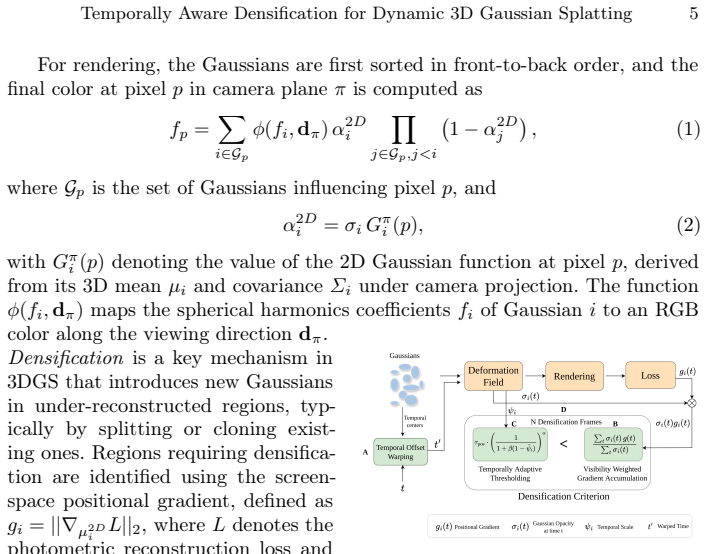
Visibility-Aware Densification (VAD) framework, which computes temporal visibility and lifespan from supervision signals to control densification thresholds and offset warping.
If this is right
- Dynamic regions receive more balanced refinement because short-lived Gaussians are no longer under-densified.
- Static regions remain unaffected because their longer lifespans keep original thresholds intact.
- Highly dynamic Gaussians gain extended deformation capacity through temporal offset warping.
- The module improves reconstruction when inserted into multiple existing dynamic 3DGS pipelines without retraining from scratch.
- Overall visual quality rises across three standard dynamic multi-view datasets.
Where Pith is reading between the lines
- Similar temporal signals could be injected into other stages of the 3DGS optimization loop, such as opacity or color updates.
- The same visibility computation may transfer to non-Gaussian dynamic representations that also rely on sparse supervision over time.
- Scenes with extreme motion variation would test whether the lifespan-based threshold scaling remains stable or needs further calibration.
Load-bearing premise
Temporal visibility and lifespan can be reliably computed from the existing supervision signals and used to adjust densification thresholds without introducing new artifacts or requiring extra labeled data.
What would settle it
Applying the full VAD pipeline to any of the three benchmark datasets produces no improvement or a measurable drop in PSNR or SSIM specifically on dynamic regions relative to the unmodified baseline method.
Figures
read the original abstract
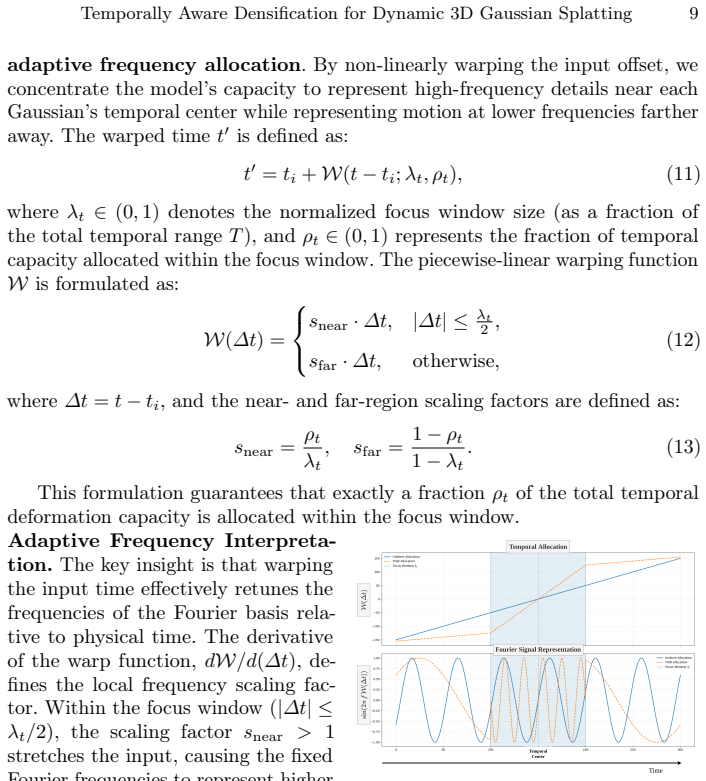
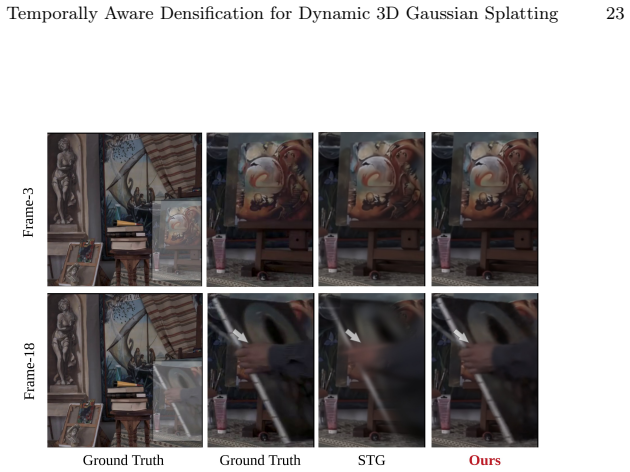
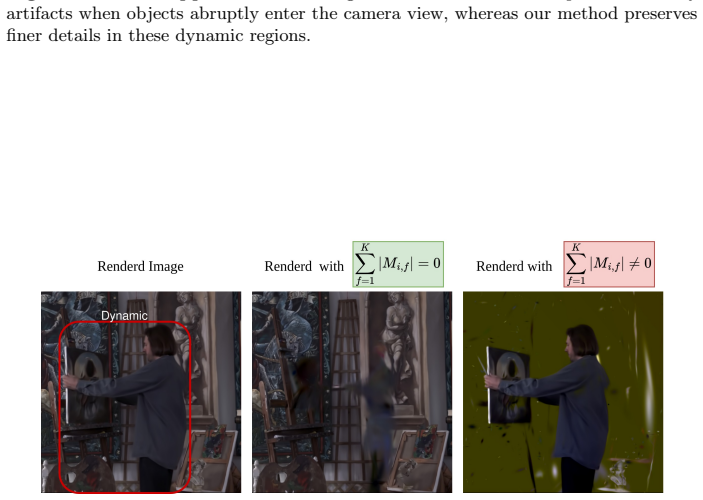
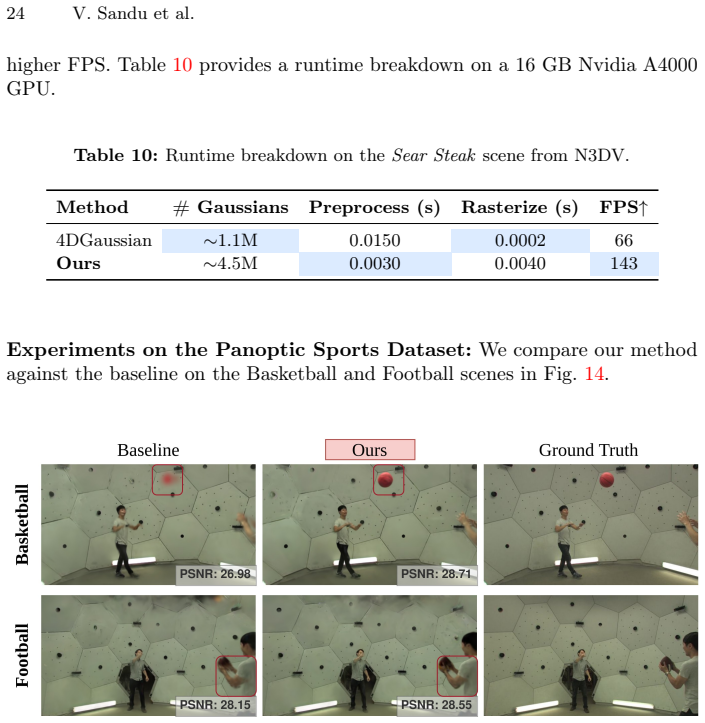
Despite modeling temporal motion, dynamic 3D Gaussian Splatting (3DGS) methods still inherit a static densification strategy that is ill-suited for dynamic scenes. This neglect of temporal behavior leads to under-reconstructed and blurry dynamic regions, as short-lived Gaussians receive sparse supervision and fail to densify effectively. We propose a Visibility-Aware Densification (VAD) framework that integrates temporal visibility into the densification process, ensuring that Gaussians are refined based on their actual temporal presence. A Temporally-Adaptive Thresholding (TAT) mechanism further adjusts each Gaussian's densification threshold according to its temporal lifespan, promoting balanced refinement of both static and dynamic regions. Finally, a Temporal Offset Warping (TOW) design enhances deformation capacity around temporal centers, extending the lifespan of highly dynamic Gaussians and facilitating more effective densification. Our approach achieves substantial improvements in the visual quality of dynamic regions, outperforming existing methods across three dynamic multi-view benchmark datasets. Moreover, the proposed VAD module generalizes across diverse dynamic 3DGS methods, consistently improving dynamic reconstruction as a plug-and-play component.
Editorial analysis
A structured set of objections, weighed in public.
Referee Report
Summary. The paper claims that static densification in dynamic 3D Gaussian Splatting leads to under-reconstruction of dynamic regions due to sparse supervision on short-lived Gaussians. It introduces a Visibility-Aware Densification (VAD) framework incorporating Temporally-Adaptive Thresholding (TAT) to modulate thresholds by temporal lifespan and Temporal Offset Warping (TOW) to extend dynamic Gaussian capacity around temporal centers. The approach reportedly yields substantial visual quality gains on three dynamic multi-view benchmarks and generalizes as a plug-and-play module across existing dynamic 3DGS methods.
Significance. If validated, the integration of temporal visibility and lifespan into densification could offer a lightweight, supervision-free improvement to dynamic scene modeling in 3DGS, addressing a practical mismatch between static heuristics and time-varying content without new data requirements.
major comments (2)
- [Abstract] Abstract: the central premise that temporal visibility and lifespan can be reliably extracted from existing multi-view supervision signals alone (to drive TAT adjustments) is load-bearing for all three proposed components, yet the abstract provides no mechanism, auxiliary loss, or regularization to stabilize this for short-lived Gaussians that receive sparse gradients; this directly matches the stress-test concern and requires explicit validation in the method section.
- [Abstract] Abstract: the generalization claim that VAD improves diverse dynamic 3DGS methods as a plug-and-play component is unsupported by any quantitative cross-method results or ablation tables in the provided text; without such evidence the 'consistent improvement' assertion cannot be assessed.
minor comments (1)
- [Abstract] Abstract: the three benchmark datasets are not named; listing them (e.g., D-NeRF, HyperNeRF, etc.) would aid reproducibility assessment.
Simulated Author's Rebuttal
We thank the referee for the detailed feedback on our manuscript. We address each major comment below and commit to revisions that strengthen the presentation of our method and claims.
read point-by-point responses
-
Referee: [Abstract] Abstract: the central premise that temporal visibility and lifespan can be reliably extracted from existing multi-view supervision signals alone (to drive TAT adjustments) is load-bearing for all three proposed components, yet the abstract provides no mechanism, auxiliary loss, or regularization to stabilize this for short-lived Gaussians that receive sparse gradients; this directly matches the stress-test concern and requires explicit validation in the method section.
Authors: We agree that the abstract, being a high-level summary, does not detail the extraction mechanism. In the full method section (Section 3), temporal visibility is computed directly from the per-Gaussian contribution to rendered pixels across training views and timesteps using the existing multi-view supervision signals, without auxiliary losses. Lifespan is derived from the temporal extent of non-zero opacity contributions. To address the concern for short-lived Gaussians, we will add explicit validation in the revised manuscript, including a new analysis subsection with gradient flow visualizations and stability metrics on dynamic regions to demonstrate that the TAT modulation remains robust under sparse supervision. revision: yes
-
Referee: [Abstract] Abstract: the generalization claim that VAD improves diverse dynamic 3DGS methods as a plug-and-play component is unsupported by any quantitative cross-method results or ablation tables in the provided text; without such evidence the 'consistent improvement' assertion cannot be assessed.
Authors: The referee is correct that the provided manuscript excerpt does not include the supporting quantitative tables. The full paper contains cross-method experiments applying VAD to multiple dynamic 3DGS baselines (e.g., 4DGS, Deformable-3DGS), but we acknowledge these results need to be more prominently featured. We will revise the manuscript to include dedicated quantitative tables and ablation studies demonstrating consistent PSNR/SSIM gains across methods, ensuring the generalization claim is fully substantiated. revision: yes
Circularity Check
No circularity: algorithmic modules defined independently of their claimed outputs.
full rationale
The paper introduces VAD, TAT, and TOW as explicit algorithmic components that integrate temporal visibility and lifespan into densification thresholds. No equations, fitted parameters, or self-citations are shown that would make any claimed improvement equivalent to its inputs by construction. The central claims rest on the design of these modules and their empirical performance on external benchmarks, which are independent of the definitions themselves. This is the standard case of a method paper whose derivation chain does not reduce to self-reference.
Axiom & Free-Parameter Ledger
axioms (1)
- domain assumption Standard 3D Gaussian Splatting representation and optimization assumptions hold for dynamic scenes
invented entities (3)
-
Visibility-Aware Densification (VAD)
no independent evidence
-
Temporally-Adaptive Thresholding (TAT)
no independent evidence
-
Temporal Offset Warping (TOW)
no independent evidence
Reference graph
Works this paper leans on
-
[1]
In: Proceedings of the IEEE/CVF Conference on Computer Vision and Pattern Recognition (CVPR)
Barron,J.T.,Mildenhall,B.,Tancik,M.,Hedman,P.,Martin-Brualla,R.,Srinivasan, P.P.: Mip-nerf: A multiscale representation for anti-aliasing neural radiance fields. In: Proceedings of the IEEE/CVF Conference on Computer Vision and Pattern Recognition (CVPR). pp. 5855–5864 (2021)
2021
-
[2]
arXiv preprint arXiv:2501.04782 (2025)
Bond, A., Wang, J.H., Mai, L., Erdem, E., Erdem, A.: Gaussianvideo: Efficient video representation via hierarchical gaussian splatting. arXiv preprint arXiv:2501.04782 (2025)
arXiv 2025
-
[3]
In: Proceedings of the European Conference on Computer Vision (ECCV) (2022)
Chen, A., Xu, Z., Geiger, A., Yu, J., Su, H.: Tensorf: Tensorial radiance fields. In: Proceedings of the European Conference on Computer Vision (ECCV) (2022)
2022
-
[4]
In: Proceedings of the ACM Special Interest Group on Computer Graphics and Interactive Techniques (SIGGRAPH) (July 2024)
Duan,Y.,Wei,F.,Dai,Q.,He,Y.,Chen,W.,Chen,B.:4D-RotorGaussianSplatting: Towards Efficient Novel View Synthesis for Dynamic Scenes. In: Proceedings of the ACM Special Interest Group on Computer Graphics and Interactive Techniques (SIGGRAPH) (July 2024)
2024
-
[5]
In: Proceedings of the IEEE/CVF Conference on Computer Vision and Pattern Recognition (CVPR) (2022)
Fridovich-Keil, S., Yu, A., Tancik, M., Chen, Q., Recht, B., Kanazawa, A.: Plenox- els: Radiance fields without neural networks. In: Proceedings of the IEEE/CVF Conference on Computer Vision and Pattern Recognition (CVPR) (2022)
2022
-
[6]
Grubert, G., Barthel, F., Hilsmann, A., Eisert, P.: Improving adaptive density control for 3d gaussian splatting. In: Proceedings of the 20th International Joint Conference on Computer Vision, Imaging and Computer Graphics Theory and Applications. pp. 610–621. SCITEPRESS - Science and Technology Publications (2025). https://doi.org/10.5220/001330850000391...
-
[7]
Huang, B., Yu, Z., Chen, A., Geiger, A., Gao, S.: 2d gaussian splatting for geomet- rically accurate radiance fields. In: Proceedings of the ACM Special Interest Group on Computer Graphics and Interactive Techniques (SIGGRAPH). Association for Computing Machinery (2024).https://doi.org/10.1145/3641519.3657428
-
[8]
Huang, H., Zhang, Z., Wu, G., Wang, R.: Pgdgs: Improving few-shot 3d gaussian splatting with progressive gaussian densification. In: ICASSP 2025 - 2025 IEEE International Conference on Acoustics, Speech and Signal Processing (ICASSP). pp. 1–5 (2025).https://doi.org/10.1109/ICASSP49660.2025.10889028
-
[9]
ACM Transactions on Graphics (TOG)42(4) (July 2023)
Kerbl, B., Kopanas, G., Leimkühler, T., Drettakis, G.: 3D Gaussian Splatting for Real-Time Radiance Field Rendering. ACM Transactions on Graphics (TOG)42(4) (July 2023)
2023
-
[10]
In: Proceedings of the IEEE/CVF Conference on Computer Vision and Pattern Recognition Workshops (CVPRW)
Kim, S., Lee, K., Lee, Y.: Color-cued efficient densification method for 3d gaussian splatting. In: Proceedings of the IEEE/CVF Conference on Computer Vision and Pattern Recognition Workshops (CVPRW). pp. 775–783 (June 2024)
2024
-
[11]
arXiv preprint arXiv:1412.6980 (2014)
Kingma, D.P.: Adam: A method for stochastic optimization. arXiv preprint arXiv:1412.6980 (2014)
Pith/arXiv arXiv 2014
-
[12]
In: Proceedings of the Neural Information Processing Systems (2024) 16 V
Lee, J., Won, C., Jung, H., Bae, I., Jeon, H.G.: Fully explicit dynamic guassian splatting. In: Proceedings of the Neural Information Processing Systems (2024) 16 V. Sandu et al
2024
-
[13]
In: Proceedings of the IEEE/CVF Conference on Computer Vision and Pattern Recognition (CVPR)
Li, T., Slavcheva, M., Zollhoefer, M., Green, S., Lassner, C., Kim, C., Schmidt, T., Lovegrove, S., Goesele, M., Newcombe, R., et al.: Neural 3D video synthesis from multi-view video. In: Proceedings of the IEEE/CVF Conference on Computer Vision and Pattern Recognition (CVPR). pp. 5521–5531 (2022)
2022
-
[14]
Li, Y., Pang, B., Chen, Y., Wang, G.: Anchored 4d gaussian splatting for dynamic novel view synthesis. In: Proceedings of the ACM Special Interest Group on Com- puter Graphics and Interactive Techniques - Asia (SIGGRAPH-Asia). Association for Computing Machinery, New York, NY, USA (2025).https://doi.org/10. 1145/3757377.3763898,https://doi.org/10.1145/375...
-
[15]
Proceedings of the IEEE/CVF Conference on Computer Vision and Pattern Recognition (CVPR) (2024)
Li, Z., Chen, Z., Li, Z., Xu, Y.: Spacetime gaussian feature splatting for real-time dynamic view synthesis. Proceedings of the IEEE/CVF Conference on Computer Vision and Pattern Recognition (CVPR) (2024)
2024
-
[16]
In: Proceedings of the IEEE/CVF Conference on Computer Vision and Pattern Recognition (CVPR) (2021)
Li, Z., Niklaus, S., Snavely, N., Wang, O.: Neural scene flow fields for space-time view synthesis of dynamic scenes. In: Proceedings of the IEEE/CVF Conference on Computer Vision and Pattern Recognition (CVPR) (2021)
2021
-
[17]
In: Proceedings of the IEEE/CVF Conference on Computer Vision and Pattern Recognition (CVPR)
Lin, Y., Dai, Z., Zhu, S., Yao, Y.: Gaussian-flow: 4d reconstruction with dynamic 3d gaussian particle. In: Proceedings of the IEEE/CVF Conference on Computer Vision and Pattern Recognition (CVPR). pp. 21136–21145 (2024)
2024
-
[18]
In: Proceedings of the European Conference on Computer Vision (ECCV) (2020)
Mildenhall, B., Srinivasan, P.P., Tancik, M., Barron, J.T., Ramamoorthi, R., Ng, R.: Nerf: Representing scenes as neural radiance fields for view synthesis. In: Proceedings of the European Conference on Computer Vision (ECCV) (2020)
2020
-
[19]
Müller, T., Evans, A., Schied, C., Keller, A.: Instant neural graphics primitives with a multiresolution hash encoding. ACM Transactions on Graphics (TOG) 41(4), 102:1–102:15 (Jul 2022).https://doi.org/10.1145/3528223.3530127 , https://doi.org/10.1145/3528223.3530127
-
[20]
In: Proceedings of the IEEE/CVF Conference on Computer Vision and Pattern Recognition (CVPR) (2025)
Park, H., Ryu, G., Kim, W.: Dropgaussian: Structural regularization for sparse-view gaussian splatting. In: Proceedings of the IEEE/CVF Conference on Computer Vision and Pattern Recognition (CVPR) (2025)
2025
-
[21]
In: Proceedings of the IEEE/CVF Conference on Computer Vision and Pattern Recognition (CVPR)
Park, J., Bui, M.Q.V., Bello, J.L.G., Moon, J., Oh, J., Kim, M.: Splinegs: Robust motion-adaptive spline for real-time dynamic 3d gaussians from monocular video. In: Proceedings of the IEEE/CVF Conference on Computer Vision and Pattern Recognition (CVPR). pp. 26866–26875 (June 2025)
2025
-
[22]
Patle, G., Girgaonkar, N., Somraj, N., Soundararajan, R.: AD-GS: Alternating Densification for Sparse-Input 3D Gaussian Splatting. In: Proceedings of the ACM Special Interest Group on Computer Graphics and Interactive Techniques - Asia (SIGGRAPH-Asia) (2025).https://doi.org/10.1145/3757377.3763993
-
[23]
In: Proceedings of the European Conference on Computer Vision (ECCV) (2024)
RotaBulò,S.,Porzi,L.,Kontschieder,P.:Revisingdensificationingaussiansplatting. In: Proceedings of the European Conference on Computer Vision (ECCV) (2024)
2024
-
[24]
In: Proceedings of the IEEE/CVF Conference on Computer Vision and Pattern Recognition Workshops (CVPRW) (2017)
Sabater, N., Boisson, G., Vandame, B., Kerbiriou, P., Babon, F., Hog, M., Langlois, T., Gendrot, R., Bureller, O., Schubert, A., Allie, V.: Dataset and pipeline for multi- view light-field video. In: Proceedings of the IEEE/CVF Conference on Computer Vision and Pattern Recognition Workshops (CVPRW) (2017)
2017
-
[25]
In: Proceedings of the European Conference on Computer Vision (ECCV)
Shaw, R., Nazarczuk, M., Song, J., Moreau, A., Catley-Chandar, S., Dhamo, H., Pérez-Pellitero, E.: Swings: sliding windows for dynamic 3d gaussian splatting. In: Proceedings of the European Conference on Computer Vision (ECCV). pp. 37–54. Springer (2024)
2024
-
[26]
Somraj, N., Karanayil, A., Soundararajan, R.: SimpleNeRF: Regularizing sparse in- put neural radiance fields with simpler solutions. In: Proceedings of the ACM Special Interest Group on Computer Graphics and Interactive Techniques - Asia (SIGGRAPH-Asia) (December 2023).https://doi.org/10.1145/3610548. 3618188 Temporally Aware Densification for Dynamic 3D ...
-
[27]
Somraj, N., Soundararajan, R.: ViP-NeRF: Visibility prior for sparse input neural radiance fields. In: Proceedings of the ACM Special Interest Group on Computer Graphics and Interactive Techniques (SIGGRAPH) (August 2023).https://doi. org/10.1145/3588432.3591539
-
[28]
In: Proceedings of the ACM Special Interest Group on Computer Graphics and Interactive Techniques - Asia (SIGGRAPH-Asia)
Stearns, C., Harley, A.W., Uy, M., Dubost, F., Tombari, F., Wetzstein, G., Guibas, L.: Dynamic gaussian marbles for novel view synthesis of casual monocular videos. In: Proceedings of the ACM Special Interest Group on Computer Graphics and Interactive Techniques - Asia (SIGGRAPH-Asia). pp. 1–11 (2024)
2024
-
[29]
In: Proceedings of the IEEE/CVF Conference on Computer Vision and Pattern Recognition (CVPR) (2022)
Sun, C., Sun, M., Chen, H.: Direct voxel grid optimization: Super-fast convergence for radiance fields reconstruction. In: Proceedings of the IEEE/CVF Conference on Computer Vision and Pattern Recognition (CVPR) (2022)
2022
-
[30]
Proceedings of the European Conference on Computer Vision (ECCV) (2020)
Teed, Z., Deng, J.Y.: Raft: Recurrent all-pairs field transforms for optical flow. Proceedings of the European Conference on Computer Vision (ECCV) (2020)
2020
-
[31]
Wang, Z., Wu, G., Wang, Z., Xiao, L., Liu, R., Wu, J., Wang, R.: Hda-gs: Hi- erarchical density-controlled for anisotropic 3d gaussian splatting. In: ICASSP 2025 - 2025 IEEE International Conference on Acoustics, Speech and Signal Pro- cessing (ICASSP). pp. 1–5 (2025).https://doi.org/10.1109/ICASSP49660.2025. 10887967
-
[32]
IEEE Transactions on Image Processing 13(4), 600–612 (2004).https://doi.org/10.1109/TIP.2003.819861
Wang, Z., Bovik, A., Sheikh, H., Simoncelli, E.: Image quality assessment: from error visibility to structural similarity. IEEE Transactions on Image Processing 13(4), 600–612 (2004).https://doi.org/10.1109/TIP.2003.819861
-
[33]
In: Proceedings of the IEEE/CVF Conference on Computer Vision and Pattern Recognition (CVPR)
Wu, G., Yi, T., Fang, J., Xie, L., Zhang, X., Wei, W., Liu, W., Tian, Q., Wang, X.: 4d gaussian splatting for real-time dynamic scene rendering. In: Proceedings of the IEEE/CVF Conference on Computer Vision and Pattern Recognition (CVPR). pp. 20310–20320 (June 2024)
2024
-
[34]
In: Proceedings of the International Conference on Learning Representations (ICLR) (2025)
Wu, J., Peng, R., Wang, Z., Xiao, L., Tang, L., Yan, J., Xiong, K., Wang, R.: Swift4d: Adaptive divide-and-conquer gaussian splatting for compact and efficient reconstruction of dynamic scene. In: Proceedings of the International Conference on Learning Representations (ICLR) (2025)
2025
-
[35]
ACM Transactions on Graphics (TOG)43(6) (November 2024)
Xu, Z., Xu, Y., Yu, Z., Peng, S., Sun, J., Bao, H., Zhou, X.: Representing long volumetric video with temporal gaussian hierarchy. ACM Transactions on Graphics (TOG)43(6) (November 2024)
2024
-
[36]
In: ACM Multimedia 2024 (2024)
Yan, J., Peng, R., Tang, L., Wang, R.: 4d gaussian splatting with scale-aware residual field and adaptive optimization for real-time rendering of temporally complex dynamic scenes. In: ACM Multimedia 2024 (2024)
2024
-
[37]
In: Proceedings of the International Conference on Learning Representations (ICLR) (2024)
Yang, Z., Yang, H., Pan, Z., Zhang, L.: Real-time photorealistic dynamic scene representation and rendering with 4d gaussian splatting. In: Proceedings of the International Conference on Learning Representations (ICLR) (2024)
2024
-
[38]
In: Proceedings of the IEEE/CVF Conference on Computer Vision and Pattern Recognition (CVPR) (2024)
Yang, Z., Gao, X., Zhou, W., Jiao, S., Zhang, Y., Jin, X.: Deformable 3d gaussians for high-fidelity monocular dynamic scene reconstruction. In: Proceedings of the IEEE/CVF Conference on Computer Vision and Pattern Recognition (CVPR) (2024)
2024
-
[39]
Yuan, Y., Shen, Q., Yang, X., Wang, X.: 1000+ fps 4d gaussian splatting for dynamic scene rendering (2025),https://arxiv.org/abs/2503.16422
arXiv 2025
-
[40]
In: Proceedings of the European Conference on Computer Vision (ECCV) (2024)
Zhang, J., Li, J., Yu, X., Huang, L., Gu, L., Zheng, J., Bai, X.: Cor-gs: Sparse- view 3d gaussian splatting via co-regularization. In: Proceedings of the European Conference on Computer Vision (ECCV) (2024)
2024
-
[41]
In: Proceedings of the IEEE/CVF Conference on Computer Vision and Pattern Recognition (CVPR) (2018) 18 V
Zhang, R., Isola, P., Efros, A.A., Shechtman, E., Wang, O.: The unreasonable effec- tiveness of deep features as a perceptual metric. In: Proceedings of the IEEE/CVF Conference on Computer Vision and Pattern Recognition (CVPR) (2018) 18 V. Sandu et al
2018
-
[42]
In: Proceedings of the European Conference on Computer Vision (ECCV) (2024)
Zhang, Z., Hu, W., Lao, Y., He, T., Zhao, H.: Pixel-gs: Density control with pixel-aware gradient for 3d gaussian splatting. In: Proceedings of the European Conference on Computer Vision (ECCV) (2024)
2024
-
[43]
Zhu, Z., Fan, Z., Jiang, Y., Wang, Z.: Fsgs: Real-time few-shot view synthesis using gaussian splatting. In: Proceedings of the European Conference on Computer Vision (ECCV) (2024) Temporally Aware Densification for Dynamic 3D Gaussian Splatting 19 Supplementary Material The contents of this supplement include
2024
-
[44]
Implementation details
-
[45]
Qualitative Comparisons
-
[46]
base- line
Scene-wise quantitative comparisons. 7 Implementation Details We implement our framework in PyTorch, building upon the 3DGS codebase and its differentiable rasterization pipeline. All experiments are conducted on a single NVIDIA A4000 16GB GPU. We employ the Adam optimizer [11] with an initial learning rate of2.6 × 10−4 for Gaussian mean parameters, apply...
discussion (0)
Sign in with ORCID, Apple, or X to comment. Anyone can read and Pith papers without signing in.