Fast quantum-state transfer in Su-Schrieffer-Heeger chains beyond the noninteracting regime
Pith reviewed 2026-06-26 07:56 UTC · model grok-4.3
The pith
Tunable phases in next-nearest-neighbor hoppings remove nonlinear obstructions to fast state transfer in interacting Su-Schrieffer-Heeger chains
A machine-rendered reading of the paper's core claim, the machinery that carries it, and where it could break.
Core claim
By rendering the next-nearest-neighbor shortcut hopping phase tunable in Su-Schrieffer-Heeger chains, the obstruction from nonlinear phase accumulation is removed. In the mean-field regime this yields an exact nonlinear shortcut, and when applied to the full Bose-Hubbard dynamics with optimization in the many-body space, complex phase-tunable hoppings recover near-perfect fidelity.
What carries the argument
The tunable phase of the next-nearest-neighbor hopping, which splits into two quadratures to separately control the dark-state trajectory and cancel interaction-induced self-phase modulation.
Load-bearing premise
The interaction-induced self-phase modulation can be exactly canceled by the orthogonal quadrature of the tunable next-nearest-neighbor hopping without introducing new many-body errors that cannot be compensated by further optimization.
What would settle it
A numerical simulation or experiment measuring whether fidelity reaches near unity when optimizing complex phase-tunable next-nearest-neighbor hoppings directly in the many-body Hilbert space for Bose-Hubbard SSH transfer, versus saturation without such phase control.
Figures
read the original abstract
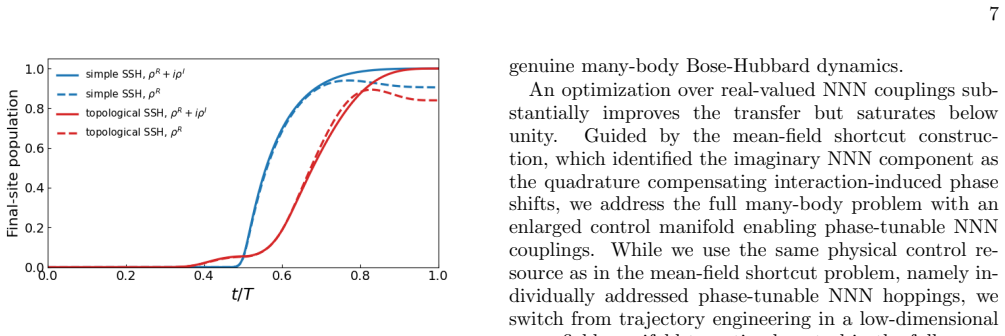
Shortcuts to adiabaticity have made topological edge-state transfer fast in the single-particle regime, but their extension to interacting systems is obstructed by nonlinear phase accumulation. We show that this obstruction can be removed in Su-Schrieffer-Heeger chains by making the next-nearest-neighbor shortcut hopping phase tunable. In the mean-field regime, this yields an exact nonlinear shortcut: one hopping quadrature keeps the state on the instantaneous dark-state trajectory, while the orthogonal quadrature cancels the interaction-induced self-phase modulation. The resulting protocol is nonperturbative in the mean-field interaction strength. When applied to the full Bose-Hubbard dynamics, the mean-field shortcut remains beneficial but saturates below unit fidelity, exposing genuinely many-body corrections beyond the product-state picture. We then optimize the transfer directly in the many-body Hilbert space and find that complex, phase-tunable next-nearest-neighbor hoppings recover near-perfect fidelity. Our results show that hopping phases are not merely a technical refinement, but a key control resource for fast and high-fidelity transport in interacting topological systems.
Editorial analysis
A structured set of objections, weighed in public.
Referee Report
Summary. The manuscript develops shortcuts to adiabaticity for quantum state transfer in interacting Su-Schrieffer-Heeger (SSH) chains. It shows that tunable phases in next-nearest-neighbor (NNN) shortcut hoppings remove the obstruction from nonlinear phase accumulation. In the mean-field regime an exact nonlinear shortcut is constructed by using orthogonal quadratures of the complex NNN hopping; one keeps the state on the dark-state trajectory while the other cancels interaction-induced self-phase modulation. When applied to the full Bose-Hubbard dynamics the mean-field protocol improves fidelity but saturates below unity; direct many-body optimization with complex NNN hoppings then recovers near-perfect fidelity, indicating that hopping phases constitute a key control resource beyond the product-state approximation.
Significance. If the central claims hold, the work supplies a concrete, nonperturbative construction that extends shortcuts to adiabaticity into the interacting regime and isolates the role of complex hoppings as an independent control degree of freedom. The separation between mean-field success and many-body corrections, together with the explicit optimization in the full Hilbert space, provides a falsifiable benchmark for future many-body STA protocols in topological lattices.
major comments (2)
- [Abstract and many-body optimization results] Abstract (final paragraph) and the many-body optimization section: the headline claim that 'complex, phase-tunable next-nearest-neighbor hoppings recover near-perfect fidelity' and that phases are 'a key control resource' is not supported by a control experiment in which the same many-body optimization is performed with real-valued (phase-fixed) NNN hoppings. Without this baseline it remains possible that amplitude optimization alone suffices, rendering the phase tunability non-essential to the reported fidelity gain.
- [Mean-field regime derivation] Mean-field derivation (section describing the nonlinear shortcut): the statement that the orthogonal quadrature 'exactly cancels the interaction-induced self-phase modulation' without introducing new many-body errors is asserted but the explicit cancellation condition and the resulting fidelity bound are not shown; a concrete equation relating the two quadratures to the interaction term would be required to substantiate the 'exact' and 'nonperturbative' character of the shortcut.
minor comments (2)
- [Abstract] The abstract states that the mean-field shortcut 'saturates below unit fidelity' but supplies neither the numerical value of the saturation nor error bars; these data should appear in the corresponding figure or table.
- Notation for the complex NNN hopping amplitudes is introduced without an explicit definition of the real and imaginary parts; a short equation or parenthetical clarification would improve readability.
Simulated Author's Rebuttal
We thank the referee for the constructive feedback and the recommendation for major revision. The two major comments identify important gaps in evidentiary support and derivation clarity. We address each point below and will revise the manuscript to incorporate the requested controls and explicit equations.
read point-by-point responses
-
Referee: [Abstract and many-body optimization results] Abstract (final paragraph) and the many-body optimization section: the headline claim that 'complex, phase-tunable next-nearest-neighbor hoppings recover near-perfect fidelity' and that phases are 'a key control resource' is not supported by a control experiment in which the same many-body optimization is performed with real-valued (phase-fixed) NNN hoppings. Without this baseline it remains possible that amplitude optimization alone suffices, rendering the phase tunability non-essential to the reported fidelity gain.
Authors: We agree that a direct control optimization restricted to real-valued NNN hoppings is required to isolate the contribution of phase tunability. In the revised manuscript we will perform this additional many-body optimization (identical protocol and Hilbert-space search but with phase fixed at zero) and include a side-by-side fidelity comparison. This will either confirm that phase freedom is essential for near-unit fidelity or quantify the incremental gain, thereby placing the claim on firmer ground. revision: yes
-
Referee: [Mean-field regime derivation] Mean-field derivation (section describing the nonlinear shortcut): the statement that the orthogonal quadrature 'exactly cancels the interaction-induced self-phase modulation' without introducing new many-body errors is asserted but the explicit cancellation condition and the resulting fidelity bound are not shown; a concrete equation relating the two quadratures to the interaction term would be required to substantiate the 'exact' and 'nonperturbative' character of the shortcut.
Authors: We accept that the mean-field section would be strengthened by an explicit derivation of the cancellation. In the revision we will insert the concrete equations that decompose the complex NNN hopping into orthogonal quadratures, show how one quadrature enforces the instantaneous dark-state condition while the second exactly cancels the interaction-induced phase accumulation, and derive the resulting fidelity bound that remains unity for arbitrary mean-field interaction strength. This will make the nonperturbative character of the shortcut fully transparent. revision: yes
Circularity Check
No significant circularity; derivation is self-contained
full rationale
The paper constructs a new protocol by making NNN hopping phases tunable, derives the mean-field shortcut from the instantaneous dark-state condition plus quadrature cancellation of self-phase modulation, and performs direct many-body optimization. No load-bearing step reduces to a fitted parameter renamed as prediction, no self-citation chain justifies the central claim, and no ansatz is smuggled via prior work. The abstract and described derivation chain are independent of the target fidelity result.
Axiom & Free-Parameter Ledger
axioms (2)
- domain assumption Mean-field approximation accurately captures the leading interaction effects in the Bose-Hubbard SSH chain for the purpose of shortcut design
- domain assumption Next-nearest-neighbor hoppings with controllable complex phases are experimentally realizable without additional decoherence
Reference graph
Works this paper leans on
-
[1]
Thus real-valued NNN couplings cannot, in general, provide an exact mean-field shortcut
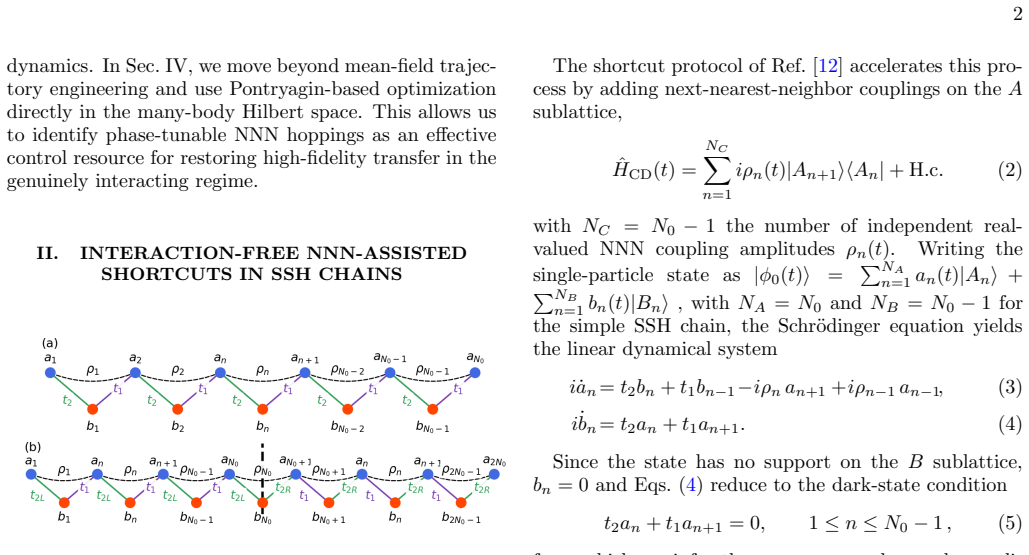
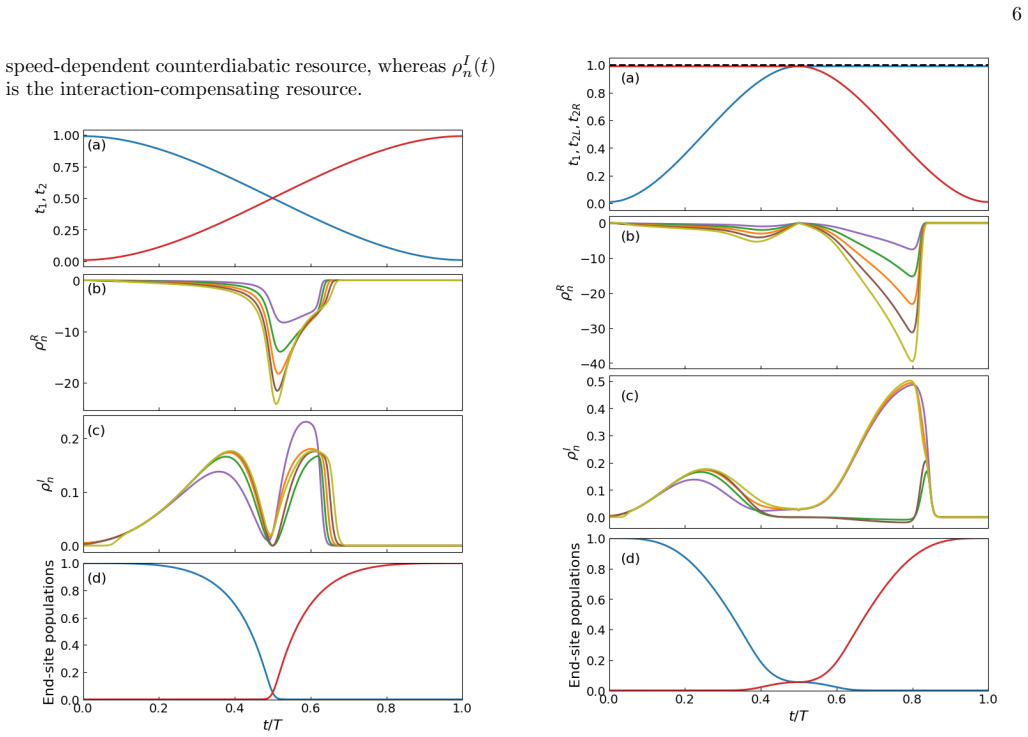
Such a profile is not sufficient to transport the edge mode from the left end to the right end of the chain, since transfer requires sweeping the localization from|ϵ| ≪1 to|ϵ| ≫1. Thus real-valued NNN couplings cannot, in general, provide an exact mean-field shortcut. C. Exact nonlinear shortcut with two control quadratures The limitation found above can ...
2023
-
[2]
Consider a finite- dimensional Schr¨ odinger equation i d dt |ψ(t)⟩=H[u(t)]|ψ(t)⟩,(22) whereu(t) = (u 1(t), u2(t),
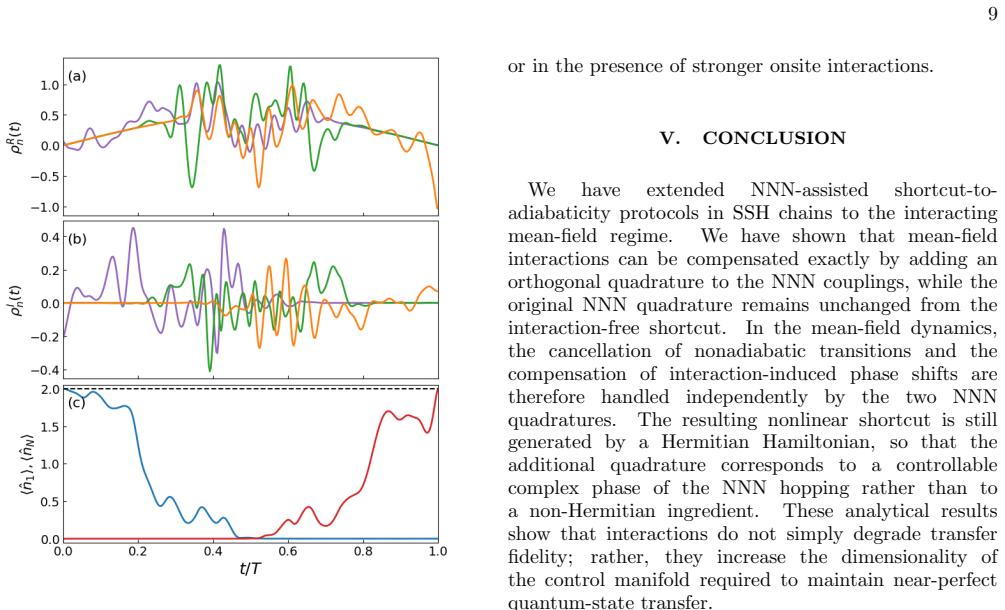
Basics of Pontryagin maximum principle optimization We briefly recall the Pontryagin-based procedure used in the numerical optimizations [39–42]. Consider a finite- dimensional Schr¨ odinger equation i d dt |ψ(t)⟩=H[u(t)]|ψ(t)⟩,(22) whereu(t) = (u 1(t), u2(t), . . .) denotes the set of control functions. The dimension of the Hilbert space depends on the p...
-
[3]
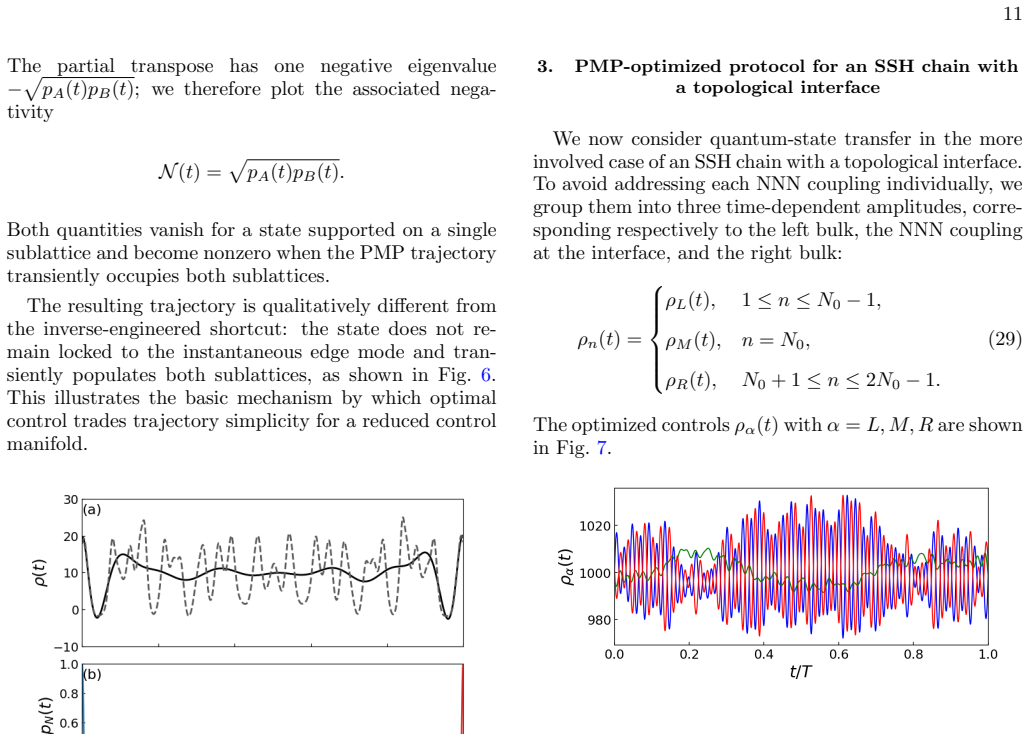
PMP-optimized protocol for a simple SSH chain As a first restricted-control benchmark, we consider the simple SSH chain with a single global NNN control ρn(t)≡ρ(t). The PMP optimization yields a final fidelity F ≃0.9995, showing that near-perfect transfer can be recovered even after reducing the control manifold from N0 −1 independent shortcut couplings t...
-
[4]
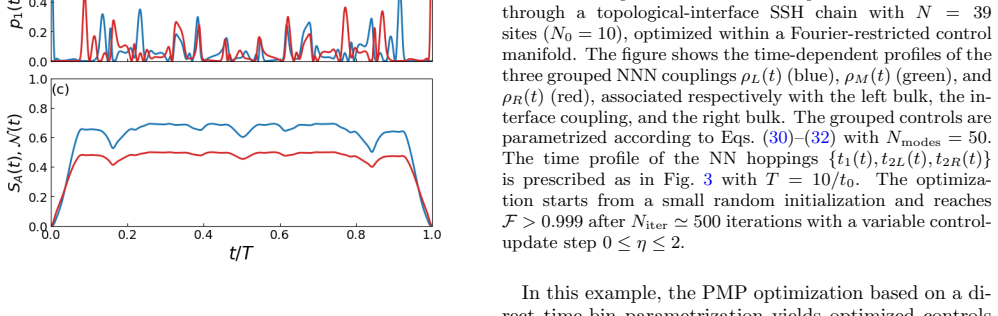
PMP-optimized protocol for an SSH chain with a topological interface We now consider quantum-state transfer in the more involved case of an SSH chain with a topological interface. To avoid addressing each NNN coupling individually, we group them into three time-dependent amplitudes, corre- sponding respectively to the left bulk, the NNN coupling at the in...
-
[5]
A. Y. Kitaev, Unpaired Majorana fermions in quantum wires, Physics-Uspekhi44, 131 (2001)
2001
-
[6]
Lang and H
N. Lang and H. P. B¨ uchler, Topological networks for quantum communication between distant qubits, npj Quantum Information3, 47 (2017)
2017
-
[7]
W. P. Su, J. R. Schrieffer, and A. J. Heeger, Solitons in polyacetylene, Phys. Rev. Lett.42, 1698 (1979)
1979
-
[8]
St-Jean, V
P. St-Jean, V. Goblot, E. Galopin, A. Lemaˆ ıtre, T. Ozawa, L. Le Gratiet, I. Sagnes, J. Bloch, and A. Amo, Lasing in topological edge states of a one-dimensional lat- tice, Nature Photonics11, 651 (2017)
2017
-
[9]
Blanco-Redondo, B
A. Blanco-Redondo, B. Bell, D. Oren, B. J. Eggleton, and M. Segev, Topological protection of biphoton states, Science362, 568 (2018)
2018
-
[10]
de L´ es´ eleuc, V
S. de L´ es´ eleuc, V. Lienhard, P. Scholl, D. Barredo, S. We- ber, N. Lang, H. P. B¨ uchler, T. Lahaye, and A. Browaeys, Observation of a symmetry-protected topological phase of interacting bosons with rydberg atoms, Science365, 775 (2019)
2019
-
[11]
D. Xie, W. Gou, T. Xiao, B. Gadway, and B. Yan, Topo- logical characterizations of an extended Su–Schrieffer– Heeger model, npj Quantum Information5, 55 (2019). 13
2019
-
[12]
D. Ronco, F. Arrouas, N. Ombredane, E. Flament, Q. Levoy, B. Peaudecerf, and D. Gu´ ery-Odelin, Floquet engineering of tight-binding hamiltonians in momentum space lattices, e-print: arXiv:2604.24722 (2026)
Pith/arXiv arXiv 2026
-
[13]
Longhi, G
S. Longhi, G. L. Giorgi, and R. Zambrini, Landau–zener topological quantum state transfer, Advanced Quantum Technologies2, 1800090 (2019)
2019
-
[14]
Longhi, Topological pumping of edge states via adia- batic passage, Phys
S. Longhi, Topological pumping of edge states via adia- batic passage, Phys. Rev. B99, 155150 (2019)
2019
-
[15]
K. Z. Li, J. Z. Tian, and L. T. Xiao, Topological quantum state transfer via resonant adiabatic passage, Physical Review A111, 022403 (2025)
2025
-
[16]
F. M. D’Angelis, F. A. Pinheiro, D. Gu´ ery-Odelin, S. Longhi, and F. Impens, Fast and robust quantum state transfer in a topological su-schrieffer-heeger chain with next-to-nearest-neighbor interactions, Phys. Rev. Res.2, 033475 (2020)
2020
-
[17]
N. E. Palaiodimopoulos, I. Brouzos, F. K. Diakonos, and G. Theocharis, Fast and robust quantum state transfer via a topological chain, Phys. Rev. A103, 052409 (2021)
2021
-
[18]
L. Qi, Y. Yan, Y. Xing, X.-D. Zhao, S. Liu, W.-X. Cui, X. Han, S. Zhang, and H.-F. Wang, Topological router induced via long-range hopping in a Su-Schrieffer-Heeger chain, Physical Review Research3, 023037 (2021)
2021
-
[19]
L. Qi, Y. Xing, X.-D. Zhao, S. Liu, S. Zhang, S. Hu, and H.-F. Wang, Topological beam splitter via defect-induced edge channel in the Rice-Mele model, Physical Review B 103, 085129 (2021)
2021
-
[20]
E. Baum, A. Broman, T. Clarke, N. C. Costa, J. Mucciac- cio, A. Yue, Y. Zhang, V. Norman, J. Patton, M. Radu- laski, and R. T. Scalettar, Effect of emitters on quantum state transfer in coupled cavity arrays, Phys. Rev. B105, 195429 (2022)
2022
-
[21]
Huang, Z
L. Huang, Z. Tan, H. Zhong, and B. Zhu, Fast and robust quantum state transfer assisted by zero-energy interface states in a splicing Su-Schrieffer-Heeger chain, Physical Review A106, 022419 (2022)
2022
-
[22]
Zurita, C
J. Zurita, C. E. Creffield, and G. Platero, Fast quantum transfer mediated by topological domain walls, Quantum 7, 1043 (2023)
2023
-
[23]
Guo, J.-L
J.-K. Guo, J.-L. Wu, J. Cao, S. Zhang, and S.-L. Su, Shortcut engineering for accelerating topological quan- tum state transfers in optomechanical lattices, Phys. Rev. A110, 043510 (2024)
2024
-
[24]
Han, J.-L
J.-X. Han, J.-L. Wu, Z.-H. Yuan, Y.-J. Chen, Y. Xia, Y.- Y. Jiang, and J. Song, Fast and controllable topological excitation transfers in hybrid magnon-photon systems, Physical Review Applied21, 014057 (2024)
2024
-
[25]
T. Tian, H. Cai, L. Zhang, Y. Zhang, C.-K. Duan, and J. Zhou, Nonadiabatic topological transfer in a nanome- chanical phononic lattice, Physical Review B109, 125123 (2024)
2024
-
[26]
J. Xu, F. Mei, and Y.-Q. Zhu, Spectrum-based shortcut method for topological systems, Physical Review A110, 032431 (2024)
2024
-
[27]
S. V. Romero, X. Chen, G. Platero, and Y. Ban, Opti- mizing edge-state transfer in a Su-Schrieffer-Heeger chain via hybrid analog-digital strategies, Phys. Rev. Appl.21, 034033 (2024)
2024
-
[28]
J. Yao, S. Tang, C. L¨ u, J.-N. Zhang, J. Song, and Y.- Y. Jiang, Fast energy transfer in an acoustic multicav- ity coupler based on the Su-Schrieffer-Heeger topological model, Physical Review Applied22, 044009 (2024)
2024
- [29]
-
[30]
K. Funo, N. Lambert, F. Nori, and C. Flindt, Short- cuts to adiabatic pumping in classical stochastic systems, Phys. Rev. Lett.124, 150603 (2020)
2020
-
[31]
Takahashi, K
K. Takahashi, K. Fujii, Y. Hino, and H. Hayakawa, Nona- diabatic control of geometric pumping, Phys. Rev. Lett. 124, 150602 (2020)
2020
-
[32]
Impens, F
F. Impens, F. M. D’Angelis, D. Gu´ ery-Odelin, F. A. Pin- heiro, and C. Lewenkopf, Optimal control over the full counting statistics in a nonadiabatic pump, Phys. Rev. Res.7, 033253 (2025)
2025
-
[33]
X. Z. Hao, X. Y. Zhang, and X. X. Yi, Topological quan- tum state transfer beyond the single-excitation assump- tion, Phys. Rev. A111, 032417 (2025)
2025
-
[34]
X. You, L. Xiao, B. Huang, Y. Ke, and C. Lee, Nonlinear topological pumping of edge solitons, Phys. Rev. A111, 033306 (2025)
2025
-
[35]
Xi, Z.-H
W. Xi, Z.-H. Zhang, Z.-C. Gu, and W.-Q. Chen, Classifi- cation of topological phases in one dimensional interact- ing non-Hermitian systems and emergent unitarity, Sci- ence China Physics, Mechanics & Astronomy64, 237011 (2021)
2021
-
[36]
Kawabata, K
K. Kawabata, K. Shiozaki, and S. Ryu, Many-body topology of non-Hermitian systems, Physical Review B 105, 165137 (2022)
2022
-
[37]
S. d. A. Sousa-Junior, P. B. Melo, R. Mondaini, A. K. Ghosh, and R. Arouca, Enhancement of charge correla- tions and real-space topological marker on an interact- ing non-Hermitian Su–Schrieffer–Heeger model, e-print: arXiv:2606.06466 (2026)
Pith/arXiv arXiv 2026
-
[38]
Jaksch, C
D. Jaksch, C. Bruder, J. I. Cirac, C. W. Gardiner, and P. Zoller, Cold bosonic atoms in optical lattices, Physical Review Letters81, 3108 (1998)
1998
-
[39]
Defenu, T
N. Defenu, T. Donner, T. Macr` ı, G. Pagano, S. Ruffo, and A. Trombettoni, Long-range interacting quantum systems, Reviews of Modern Physics95, 035002 (2023)
2023
-
[40]
Smirnova, D
D. Smirnova, D. Leykam, Y. Chong, and Y. Kivshar, Nonlinear topological photonics, Applied Physics Re- views7, 021306 (2020)
2020
-
[41]
Trimborn, D
F. Trimborn, D. Witthaut, and H. J. Korsch, Exact number-conserving phase-space dynamics of them-site bose-hubbard model, Phys. Rev. A77, 043631 (2008)
2008
-
[42]
Zheng, X.-Y
L.-N. Zheng, X.-Y. Zhang, A.-L. He, and L. Qi, Phase- factor-optimized topological transmission in a dimer- ized lattice with long-range hopping, Phys. Rev. A110, 022401 (2024)
2024
-
[43]
L. S. Pontryagin, V. Boltianski, R. Gamkrelidze, and E. Mitchtchenko,The Mathematical Theory of Optimal Processes(John Wiley and Sons, New York, 1962)
1962
-
[44]
Boscain, M
U. Boscain, M. Sigalotti, and D. Sugny, Introduction to the Pontryagin Maximum Principle for quantum optimal control, PRX Quantum2, 030203 (2021)
2021
-
[45]
Dupont, G
N. Dupont, G. Chatelain, L. Gabardos, M. Arnal, J. Billy, B. Peaudecerf, D. Sugny, and D. Gu´ ery-Odelin, Quantum state control of a Bose-Einstein condensate in an optical lattice, PRX Quantum2, 040303 (2021)
2021
-
[46]
Ansel, E
Q. Ansel, E. Dionis, F. Arrouas, B. Peaudecerf, S. Gu´ erin, D. Gu´ ery-Odelin, and D. Sugny, Introduction to theoretical and experimental aspects of quantum op- timal control, Journal of Physics B: Atomic, Molecular and Optical Physics57, 133001 (2024)
2024
-
[47]
A. K. Ghosh, R. Seoane Souto, V. Azimi-Mousolou, 14 A. M. Black-Schaffer, and P. Holmvall, Quantum state transfer and maximal entanglement between distant qubits using a minimal quasicrystal pump, Physical Re- view B112, 205427 (2025)
2025
discussion (0)
Sign in with ORCID, Apple, or X to comment. Anyone can read and Pith papers without signing in.