A kinetic-diffusion Monte Carlo-based particle-level fluid-kinetic decomposition for neutral transport simulations
Pith reviewed 2026-06-26 06:36 UTC · model grok-4.3
The pith
A particle-level KDMC hybrid decomposes neutral transport into fluid and kinetic parts without iterative coupling and yields at least 500 times speedup over pure kinetic Monte Carlo.
A machine-rendered reading of the paper's core claim, the machinery that carries it, and where it could break.
Core claim
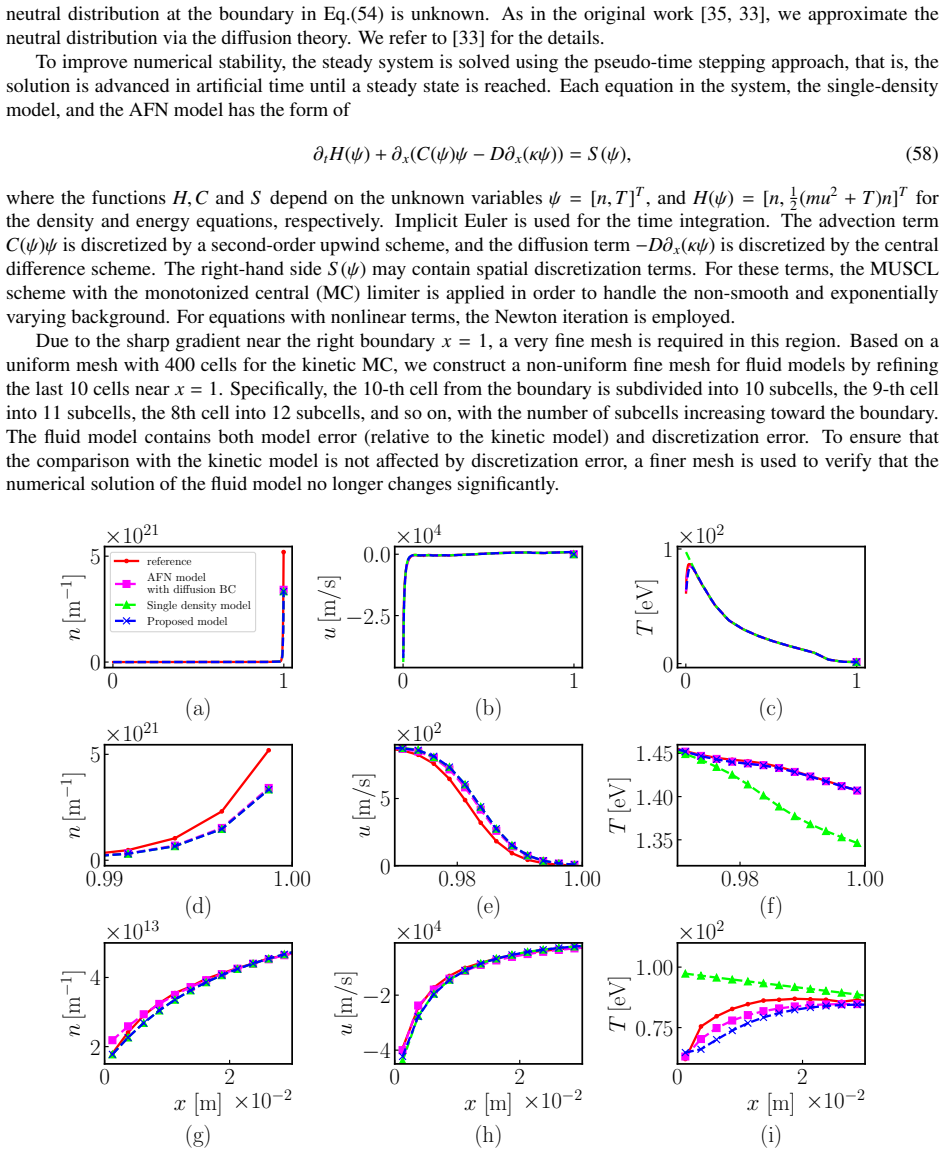
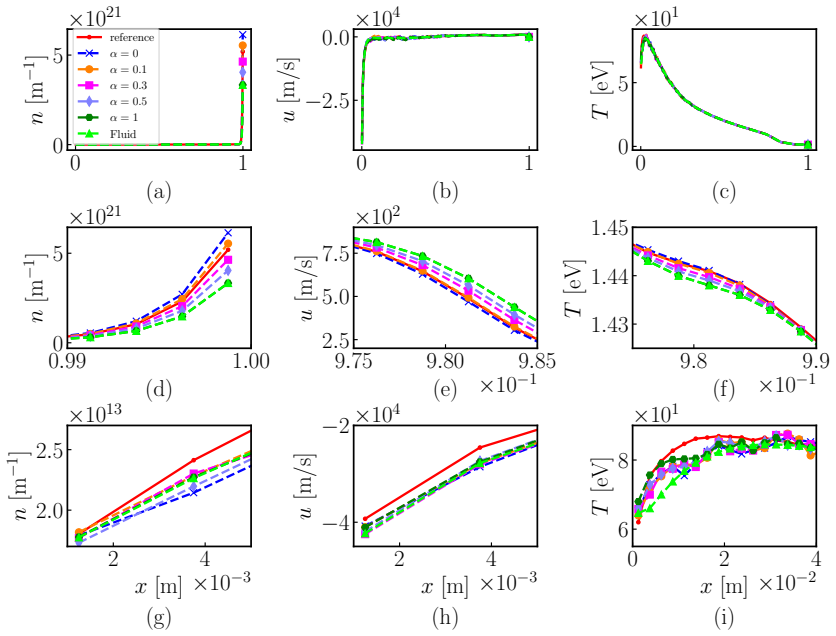
The central claim is that a distribution-decomposition hybrid model built at the particle level on the kinetic-diffusion Monte Carlo method combines the efficiency of a fluid description with the accuracy of a kinetic description without requiring iterative coupling between the two. The fluid component is closed by a Navier-Stokes-type system derived via Hilbert-Chapman-Enskog expansion, which requires substantially fewer nonlinear iterations than the AFN model used in SOLPS-ITER while delivering comparable accuracy. In one-dimensional tests the model achieves at least 500 times speedup over pure kinetic Monte Carlo with relative L2 errors around 10 percent in charge-exchange-dominant cases;
What carries the argument
The kinetic-diffusion Monte Carlo (KDMC) particle-level distribution decomposition, which splits particles into fluid and kinetic components at each step while remaining asymptotic-preserving and free of iterative coupling.
If this is right
- The hybrid scheme can be applied directly to reactor-relevant neutral transport problems that are currently limited by the cost of full kinetic Monte Carlo.
- The Navier-Stokes fluid closure derived for KDMC matches the accuracy of the AFN model but reduces the number of nonlinear iterations required.
- The tunable reflective boundary condition provides a direct knob for trading accuracy against speed in different collisionality regimes.
- Because the decomposition occurs at the particle level, the method avoids unphysical assumptions and domain-decomposition interfaces that appear in other hybrid approaches.
Where Pith is reading between the lines
- Extending the boundary treatment refinement suggested in the paper could widen the range of regimes where the 10 percent error target is met without sacrificing the speedup.
- The particle-level decomposition may transfer to other transport problems that combine diffusive and ballistic regimes, such as radiation or phonon transport.
- Because the method is asymptotic-preserving, it could serve as a building block for multi-scale plasma-edge codes that automatically transition between fluid and kinetic descriptions.
Load-bearing premise
The fluid approximation remains accurate enough near boundaries when the regime is not charge-exchange dominant.
What would settle it
A non-charge-exchange-dominant test case in which relative L2 errors exceed 10 percent after the tunable reflective boundary condition is optimized would show that the fluid component's boundary limitation prevents the claimed accuracy level.
Figures

read the original abstract
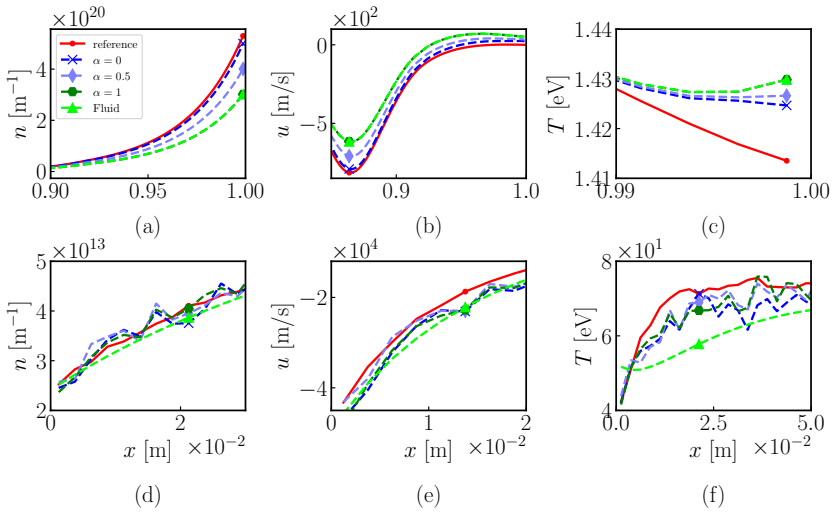
Neutrals in the plasma edge are commonly modeled by kinetic equations, with quantities of interest given by macroscopic quantities such as density, velocity, and temperature. In reactor-relevant regimes, fully kinetic descriptions solved by Monte Carlo (MC) methods, although accurate, become computationally expensive, whereas fluid-limit approximations are computationally more efficient but may lose accuracy due to boundary effects or low-collisional regimes. Hybrid fluid-kinetic approaches aim to combine the strengths of both descriptions. However, existing simulation methods face challenges, including interface handling in domain decomposition, unphysical assumptions, and iterative coupling in distribution decomposition. In this work, we propose a distribution-decomposition hybrid model constructed at the particle level based on the kinetic-diffusion Monte Carlo (KDMC) method. The model inherits key properties of KDMC: it is asymptotic-preserving and does not require iterative coupling between the fluid and kinetic components. To improve the accuracy of the fluid-part quantities estimation, a Navier-Stokes-type fluid system is derived via Hilbert-Chapman-Enskog expansions, tailored for KDMC. In the considered one-dimensional tests, the resulting fluid system has comparable accuracy to the AFN model used in SOLPS-ITER while requiring substantially fewer nonlinear iterations. Additionally, a tunable reflective boundary condition is introduced that allows balancing accuracy and efficiency. The model exhibits at least 500 times speedup over the kinetic MC, while maintaining relative L2 errors around 10% in a charge exchange (CX)-dominant test case. In non-CX-dominant regimes, the accuracy becomes increasingly sensitive to boundary treatment due to the inherent limitations of the fluid approximation near the boundary, motivating further refinement of the KDMC boundary conditions.
Editorial analysis
A structured set of objections, weighed in public.
Referee Report
Summary. The paper proposes a particle-level fluid-kinetic decomposition for neutral transport in plasma edge simulations, built on the kinetic-diffusion Monte Carlo (KDMC) framework. It derives a Navier-Stokes-type fluid system via Hilbert-Chapman-Enskog expansion tailored to KDMC, introduces a tunable reflective boundary condition to balance accuracy and efficiency, and reports that the hybrid model is asymptotic-preserving with no iterative coupling. In 1D tests, it claims at least 500x speedup over pure kinetic MC while keeping relative L2 errors around 10% in a charge-exchange-dominant case; accuracy is noted to become more sensitive to boundary treatment in non-CX regimes due to fluid limitations.
Significance. If the performance and accuracy claims generalize, the method offers a promising route to efficient hybrid neutral transport modeling that inherits KDMC's asymptotic-preserving property and avoids iterative fluid-kinetic coupling. The tailored fluid derivation and tunable BC address practical limitations of existing hybrids. Credit is due for the particle-level construction and the explicit acknowledgment of boundary sensitivity as a limitation motivating further work.
major comments (2)
- [Numerical results section] Numerical results (1D test cases): the 500x speedup and ~10% relative L2 error are reported only for the CX-dominant regime; no quantitative data (error bars, data-selection criteria, or parameter sweeps) are given for how the tunable reflective BC parameter affects these metrics when the fluid approximation is active near boundaries in non-CX-dominant regimes, which directly bears on whether the headline performance numbers hold beyond the single reported case.
- [Fluid derivation section] Fluid derivation and interface (Hilbert-Chapman-Enskog section): the claim that the NS-type system preserves the asymptotic-preserving property of KDMC at the particle level requires explicit verification that the tunable reflective BC does not violate the Chapman-Enskog ordering at the fluid-kinetic interface; the abstract flags increasing boundary sensitivity in non-CX regimes, but no moment comparisons or ordering checks with/without the tunable parameter are described.
minor comments (2)
- [Methods] Notation for the tunable reflective BC parameter should be introduced with a clear symbol and range in the methods section rather than only in the abstract.
- [Figures] Figure captions for the 1D test results should include the exact value of the tunable BC parameter used and the collisionality regime for each panel.
Simulated Author's Rebuttal
We thank the referee for their thorough review and positive assessment of the work's potential. Below we provide point-by-point responses to the major comments.
read point-by-point responses
-
Referee: [Numerical results section] Numerical results (1D test cases): the 500x speedup and ~10% relative L2 error are reported only for the CX-dominant regime; no quantitative data (error bars, data-selection criteria, or parameter sweeps) are given for how the tunable reflective BC parameter affects these metrics when the fluid approximation is active near boundaries in non-CX-dominant regimes, which directly bears on whether the headline performance numbers hold beyond the single reported case.
Authors: The reported performance metrics are indeed specific to the CX-dominant regime, as indicated in the abstract. The manuscript already highlights that accuracy in non-CX regimes is more sensitive to boundary treatment due to fluid limitations. While we did not include parameter sweeps or error bars for the BC in non-CX cases in the original submission, we agree this would strengthen the claims. In the revised manuscript, we will add quantitative analysis of the tunable BC parameter's impact, including any available data or additional tests. revision: yes
-
Referee: [Fluid derivation section] Fluid derivation and interface (Hilbert-Chapman-Enskog section): the claim that the NS-type system preserves the asymptotic-preserving property of KDMC at the particle level requires explicit verification that the tunable reflective BC does not violate the Chapman-Enskog ordering at the fluid-kinetic interface; the abstract flags increasing boundary sensitivity in non-CX regimes, but no moment comparisons or ordering checks with/without the tunable parameter are described.
Authors: The asymptotic-preserving property is maintained by the particle-level decomposition and the KDMC framework itself, with the fluid system derived to be consistent via the Hilbert-Chapman-Enskog expansion. The tunable reflective BC is introduced as a practical adjustment at the boundary. However, the current manuscript does not provide explicit moment comparisons or ordering verifications at the interface with respect to the tunable parameter. We will include such checks in the revision to explicitly confirm that the BC does not violate the ordering. revision: yes
Circularity Check
No significant circularity; derivation is self-contained.
full rationale
The Navier-Stokes-type fluid system is obtained from standard Hilbert-Chapman-Enskog expansions applied to the kinetic model, with no indication that parameters are fitted to the target outputs and then relabeled as predictions. The reported 500x speedup and 10% L2 error are simulation outcomes on test cases, not quantities defined by construction from the same inputs. The tunable reflective boundary condition is introduced as an auxiliary device for balancing accuracy and efficiency rather than a fitted parameter whose value is then used to define the claimed performance. No load-bearing self-citation or uniqueness theorem imported from prior author work appears in the provided text. The central claims therefore rest on independent derivations and numerical experiments rather than reducing to the inputs by definition.
Axiom & Free-Parameter Ledger
free parameters (1)
- tunable reflective boundary condition parameter
axioms (2)
- standard math Hilbert-Chapman-Enskog expansion yields a suitable Navier-Stokes-type closure for the KDMC fluid component
- domain assumption KDMC is asymptotic-preserving and requires no iterative fluid-kinetic coupling
Reference graph
Works this paper leans on
-
[1]
D. Reiter, M. Baelmans, P. Börner, The EIRENE and B2-EIRENE Codes, Fusion Science and Technology 47 (2005) 172–186. doi:10.13182/FST47-172
-
[2]
Multi-scale deep neural network (mscalednn) methods for oscillatory stokes flows in complex domains
B. Mortier, M. Baelmans, G. Samaey, A Study of Source Term Estimators in Coupled Finite-V olume/Monte- Carlo Methods with Applications to Plasma Edge Simulations in Nuclear Fusion: Track-Length and Next- Event Methods, Communications in Computational Physics 36 (2024) 1186–1218. doi:10.4208/cicp. OA-2023-0224
-
[3]
J. Fleck, E. Canfield, A random walk procedure for improving the computational efficiency of the implicit Monte Carlo method for nonlinear radiation transport, Journal of Computational Physics 54 (1984) 508–523. doi:10.1016/0021-9991(84)90130-X
-
[4]
Börgers, E
C. Börgers, E. W. Larsen, M. L. Adams, The asymptotic diffusion limit of a linear discontinuous discretization of a two-dimensional linear transport equation, Journal of Computational Physics 98 (1992) 285–300. doi:10. 1016/0021-9991(92)90143-M
1992
-
[5]
Q. Sun, I. D. Boyd, G. V . Candler, A hybrid continuum/particle approach for modeling subsonic, rarefied gas flows, Journal of Computational Physics 194 (2004) 256–277. doi:10.1016/j.jcp.2003.09.005
-
[6]
M. Blommaert, N. Horsten, P. Börner, W. Dekeyser, A spatially hybrid fluid-kinetic neutral model for SOLPS- ITER plasma edge simulations, Nuclear Materials and Energy 19 (2019) 28–33. doi:10.1016/j.nme.2019. 01.022. 24
-
[7]
N. Horsten, M. Groth, M. Blommaert, W. Dekeyser, I. P. Pérez, S. Wiesen, Application of spatially hybrid fluid–kinetic neutral model on JET L-mode plasmas, Nuclear Materials and Energy 27 (2021) 100969. doi:10. 1016/j.nme.2021.100969
arXiv 2021
-
[8]
W. Van Uytven, W. Dekeyser, M. Blommaert, N. Horsten, Y . Marandet, M. Baelmans, Advanced spatially hybrid fluid-kinetic modelling of plasma-edge neutrals and application to ITER case using SOLPS-ITER, Contributions to Plasma Physics 62 (2022) e202100191. doi:10.1002/ctpp.202100191
-
[9]
C. F. F. Karney, D. P. Stotler, B. J. Braams, Modeling of neutral plasma in a divertor in the fluid-kinetic transition, Contributions to Plasma Physics 38 (1998) 319–324. doi:10.1002/ctpp.2150380148
-
[10]
P. Degond, G. Dimarco, Fluid simulations with localized boltzmann upscaling by direct simulation Monte-Carlo, Journal of Computational Physics 231 (2012) 2414–2437. doi:10.1016/j.jcp.2011.11.030
-
[11]
P. Degond, S. Jin, L. Mieussens, A smooth transition model between kinetic and hydrodynamic equations, Journal of Computational Physics 209 (2005) 665–694. doi:10.1016/j.jcp.2005.03.025
-
[13]
P. Degond, G. Dimarco, L. Mieussens, A multiscale kinetic–fluid solver with dynamic localization of kinetic effects, Journal of Computational Physics 229 (2010) 4907–4933. doi:10.1016/j.jcp.2010.03.009
-
[14]
N. Crouseilles, P. Degond, M. Lemou, A hybrid kinetic/fluid model for solving the gas dynamics Boltzmann– BGK equation, Journal of Computational Physics 199 (2004) 776–808. doi:10.1016/j.jcp.2004.03.007
-
[15]
S. Tiwari, A. Klar, S. Hardt, A particle–particle hybrid method for kinetic and continuum equations, Journal of Computational Physics 228 (2009) 7109–7124. doi:10.1016/j.jcp.2009.06.019
-
[16]
V . Kolobov, R. Arslanbekov, V . Aristov, A. Frolova, S. Zabelok, Unified solver for rarefied and continuum flows with adaptive mesh and algorithm refinement, Journal of Computational Physics 223 (2007) 589–608. doi:10.1016/j.jcp.2006.09.021
-
[17]
M. Valentinuzzi, Y . Marandet, H. Bufferand, G. Ciraolo, P. Tamain, Two-phases hybrid model for neutrals, Nuclear Materials and Energy 18 (2019) 41–45. doi:10.1016/j.nme.2018.12.003
-
[18]
N. Horsten, G. Samaey, M. Baelmans, A hybrid fluid-kinetic model for hydrogenic atoms in the plasma edge of tokamaks based on a micro-macro decomposition of the kinetic equation, Journal of Computational Physics 409 (2020) 109308. doi:10.1016/j.jcp.2020.109308
-
[19]
N. Horsten, W. Dekeyser, M. Blommaert, G. Samaey, M. Baelmans, A hybrid fluid–kinetic neutral model based on a micro–macro decomposition in the SOLPS-ITER plasma edge code suite, Contributions to Plasma Physics 60 (2020) e201900132. doi:10.1002/ctpp.201900132
-
[21]
M. A. Katsoulakis, A. J. Majda, A. Sopasakis, Multiscale Couplings In Prototype Hybrid Deterministic/Stochas- tic Systems: Part I, Deterministic Closures, Communications in Mathematical Sciences 2 (2004) 255–294. doi:10.4310/CMS.2004.v2.n2.a7
-
[22]
P. Le Tallec, F. Mallinger, Coupling Boltzmann and Navier–Stokes Equations by Half Fluxes, Journal of Computational Physics 136 (1997) 51–67. doi:10.1006/jcph.1997.5729
-
[23]
B. Mortier, M. Baelmans, G. Samaey, A Kinetic-Diffusion Asymptotic-Preserving Monte Carlo Algorithm for the Boltzmann-BGK Model in the Diffusive Scaling, SIAM Journal on Scientific Computing 44 (2022) A720– A744. doi:10.1137/20M1381526. 25
-
[24]
Efficient asymptotic-preserving schemes for some multiscale kinetic equations
S. Jin, Efficient Asymptotic-Preserving (AP) Schemes For Some Multiscale Kinetic Equations, SIAM Journal on Scientific Computing 21 (1999) 441–454. doi:10.1137/S1064827598334599
-
[25]
G. Dimarco, L. Pareschi, Hybrid Multiscale Methods II. Kinetic Equations, Multiscale Modeling & Simulation 6 (2008) 1169–1197. doi:10.1137/070680916
-
[26]
A. Crestetto, N. Crouseilles, M. Lemou, A particle micro-macro decomposition based numerical scheme for collisional kinetic equations in the diffusion scaling, Communications in Mathematical Sciences 16 (2018) 887–911. doi:10.4310/CMS.2018.v16.n4.a1
-
[27]
E. Løvbak, G. Samaey, Accelerated Simulation of Boltzmann-BGK Equations near the Diffusive Limit with Asymptotic-Preserving Multilevel Monte Carlo, SIAM Journal on Scientific Computing 45 (2023) A1862– A1889. doi:10.1137/22M1498498
-
[28]
B. Mortier, P. Robbe, M. Baelmans, G. Samaey, Multilevel asymptotic-preserving Monte Carlo for kinetic- diffusive particle simulations of the Boltzmann-BGK equation, Journal of Computational Physics 450 (2022) 110736. doi:10.1016/j.jcp.2021.110736
-
[29]
B. Mortier, V . Maes, G. Samaey, Estimation as a post-processing step for random walk approximations of the Boltzmann-BGK model, Contributions to Plasma Physics 62 (2022). doi:10.1002/ctpp.202100197
-
[30]
I. Lux, L. Koblinger, Monte Carlo Particle Transport Methods: Neutron and Photon Calculations, 1 ed., CRC Press, 2018. doi:10.1201/9781351074834
-
[31]
Z. Tang, J. Koellermeier, E. Løvbak, G. Samaey, Analysis of kinetic-diffusion Monte Carlo simulation and source term estimation scheme in nuclear fusion applications, 2025. doi:10.48550/arXiv.2512.23580. arXiv:2512.23580
-
[32]
V . Maes, W. Dekeyser, J. Koellermeier, M. Baelmans, G. Samaey, Hilbert expansion based fluid models for kinetic equations describing neutral particles in the plasma edge of a fusion device, Physics of Plasmas 30 (2023) 063907. doi:10.1063/5.0146158
-
[33]
N. Horsten, W. Dekeyser, G. Samaey, M. Baelmans, Comparison of fluid neutral models for one-dimensional plasma edge modeling with a finite volume solution of the Boltzmann equation, Physics of Plasmas 23 (2016) 012510. doi:10.1063/1.4940309
-
[34]
B. Lapeyre, É. Pardoux, R. Sentis, Introduction to Monte-Carlo Methods for Transport and Diffusion Equations, Oxford University PressOxford, 2003. doi:10.1093/oso/9780198525929.001.0001
-
[35]
Horsten, G
N. Horsten, G. Samaey, M. Baelmans, Development and assessment of 2D fluid neutral models that in- clude atomic databases and a microscopic reflection model, Nuclear Fusion 57 (2017) 116043. doi:10.1088/ 1741-4326/aa8009
2017
-
[36]
C. Cercignani, R. Illner, M. Pulvirenti, The Mathematical Theory of Dilute Gases, volume 106 ofApplied Mathematical Sciences, Springer New York, New York, NY , 1994. doi:10.1007/978-1-4419-8524-8
-
[37]
Harris, An Introduction to the Theory of the Boltzmann Equation, Dover Books on Physics, Dover Publica- tions, Mineola, N.Y ., 2004
S. Harris, An Introduction to the Theory of the Boltzmann Equation, Dover Books on Physics, Dover Publica- tions, Mineola, N.Y ., 2004
2004
-
[39]
S. MacNamara, G. Strang, Operator Splitting, in: R. Glowinski, S. J. Osher, W. Yin (Eds.), Splitting Methods in Communication, Imaging, Science, and Engineering, Springer International Publishing, Cham, 2016, pp. 95–114. doi:10.1007/978-3-319-41589-5_3. 26
-
[40]
G. Dimarco, L. Pareschi, G. Samaey, Asymptotic-Preserving Monte Carlo Methods for Transport Equations in the Diffusive Limit, SIAM Journal on Scientific Computing 40 (2018) A504–A528. doi:10.1137/17M1140741
- [41]
-
[42]
A. Kukushkin, H. Pacher, V . Kotov, D. Reiter, D. Coster, G. Pacher, Effect of conditions for gas recirculation on divertor operation in ITER, Nuclear Fusion 47 (2007) 698. doi:10.1088/0029-5515/47/7/021
-
[43]
B. P. Welford, Note on a Method for Calculating Corrected Sums of Squares and Products, Technometrics 4 (1962) 419–420. doi:10.1080/00401706.1962.10490022
-
[44]
N. Horsten, G. Samaey, M. Baelmans, Hybrid fluid–kinetic neutral model based on a kinetic correction on a fluid solution, Contributions to Plasma Physics 58 (2018) 703–709. doi:10.1002/ctpp.201700179. 27
discussion (0)
Sign in with ORCID, Apple, or X to comment. Anyone can read and Pith papers without signing in.