Bounding Classical and Quantum Correlations in Bayesian Networks with Quasiprobabilities
Pith reviewed 2026-06-26 07:53 UTC · model grok-4.3
The pith
Quasiprobabilities on unobserved nodes generate all non-signaling correlations in a broad class of Bayesian networks.
A machine-rendered reading of the paper's core claim, the machinery that carries it, and where it could break.
Core claim
Quasiprobabilistic models for Bayesian networks, obtained by replacing probability distributions on unobserved nodes with quasiprobabilities that respect only normalization, yield a set of observable correlations (the quasi set) that contains all non-signaling distributions for a broad class of networks; the same construction is conjectured to recover exactly the nested Markov model associated with the network.
What carries the argument
The quasi set formed by allowing quasiprobabilities (normalized but possibly negative) solely on unobserved nodes while retaining ordinary probabilities on observed nodes.
If this is right
- The quasi set supplies an outer approximation to the quantum correlations permitted by any given network.
- Tensor-network decompositions become a practical tool for describing the allowed correlations.
- The conjecture equates the quasi set with the nested Markov model, thereby characterizing all non-signaling distributions compatible with the causal structure.
Where Pith is reading between the lines
- The tensor-network representation may be reusable for analyzing other factorization problems in classical and quantum probability.
- If the conjecture holds, linear programming over quasiprobabilities would compute the exact non-signaling bound for those networks without enumerating quantum strategies.
Load-bearing premise
That quasiprobabilities placed only on hidden nodes produce observable marginals that match or outer-bound the quantum set for the networks studied.
What would settle it
A non-signaling correlation over observed nodes in one of the considered networks that cannot be realized by any assignment of quasiprobabilities to the hidden nodes.
Figures
read the original abstract
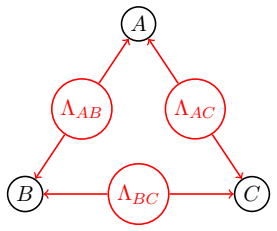
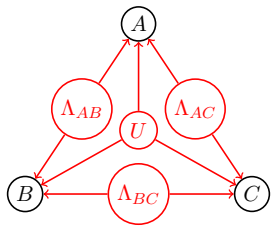
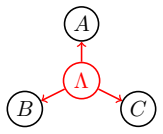
Bell's theorem reveals that quantum theory is in tension with classical causal reasoning and, in particular, the notion of local causality. This is now understood as a particular example of non-classicality in the study of correlations in (Bayesian) networks with both unobserved and observed nodes: the correlations are probability distributions over the observed nodes. There is a great deal of work aiming to understand the bounds on quantum and classical correlations in such networks and one approach is to consider outer approximations to the former. Along these lines, we consider quasiprobabilistic models for Bayesian networks, which can be seen as classical models but the probability distributions involving unobserved nodes are "replaced" with quasiprobabilities that respect normalisation but not positivity. We denote the set of correlations resulting from these models as the quasi set. Such models have a history in the study of Bell-type non-classicality where it has been shown that they can produce all non-signalling correlations. We show a generalisation of this result for a broad class of networks, which motivates a conjecture that the quasi set recovers the so called nested Markov model. Our work utilises a connection to tensor network decompositions, which may be of independent interest.
Editorial analysis
A structured set of objections, weighed in public.
Referee Report
Summary. The paper introduces quasiprobabilistic models for Bayesian networks in which probability distributions on unobserved nodes are replaced by quasiprobabilities obeying normalization but not positivity. It shows that these models recover all non-signalling observable marginals for a broad class of networks, via an explicit connection to tensor-network decompositions. This generalization is used to motivate the conjecture that the resulting 'quasi set' exactly coincides with the nested Markov model.
Significance. If the conjecture holds, the quasiprobabilistic construction would supply a concrete outer approximation (or exact characterization) to the set of quantum correlations compatible with a given causal structure, extending the known recovery of the non-signalling set in Bell scenarios. The tensor-network link may be of independent interest for relating causal models to tensor decompositions. The approach is parameter-free once the network is fixed and directly falsifiable against explicit distributions.
major comments (2)
- [Abstract] Abstract and conjecture statement: the identification of the quasi set with the nested Markov model is presented only as a conjecture motivated by the generalization; no explicit construction is supplied showing that every distribution in the nested Markov model arises from some quasiprobability assignment on the hidden nodes (or vice versa).
- [Main text (generalization)] Generalization claim: while the tensor-network argument is said to establish recovery of all non-signalling marginals for a broad class of networks, the manuscript does not delineate the precise class of networks for which the result holds nor provide worked examples of networks and explicit quasiprobability assignments that realize the non-signalling set.
minor comments (2)
- [Introduction] The term 'quasi set' is used repeatedly before a formal definition appears; an early equation or boxed definition would improve readability.
- Notation for quasiprobability distributions on unobserved nodes should be distinguished typographically from ordinary probability distributions to avoid confusion with the classical case.
Simulated Author's Rebuttal
We thank the referee for their careful reading and constructive feedback. We appreciate the positive assessment of the work's significance and address the major comments point by point below, with plans for revision where appropriate.
read point-by-point responses
-
Referee: [Abstract] Abstract and conjecture statement: the identification of the quasi set with the nested Markov model is presented only as a conjecture motivated by the generalization; no explicit construction is supplied showing that every distribution in the nested Markov model arises from some quasiprobability assignment on the hidden nodes (or vice versa).
Authors: We agree that the equivalence between the quasi set and the nested Markov model is presented strictly as a conjecture, motivated by the tensor-network generalization result but without a full bidirectional explicit construction. The manuscript establishes one direction (that quasiprobabilistic models recover all non-signalling marginals) for a broad class via the tensor-network link, which provides the motivation for the conjecture. We will revise the abstract and main text to state the conjectural status more explicitly and add a short discussion of the structural features (e.g., the ability of quasiprobabilities to match arbitrary marginals while respecting normalization) that support expecting the converse to hold. A complete proof remains an open question beyond the present scope. revision: partial
-
Referee: [Main text (generalization)] Generalization claim: while the tensor-network argument is said to establish recovery of all non-signalling marginals for a broad class of networks, the manuscript does not delineate the precise class of networks for which the result holds nor provide worked examples of networks and explicit quasiprobability assignments that realize the non-signalling set.
Authors: The referee is correct that the precise class of networks is described only as 'broad' without formal delineation and that no explicit worked examples with quasiprobability assignments are provided. In the revised manuscript we will define the class more rigorously as the set of Bayesian networks whose observed marginals admit a tensor-network decomposition allowing quasiprobability assignments on hidden nodes to reproduce any non-signalling distribution. We will also add at least two concrete examples: the Bell scenario (recovering the full non-signalling polytope) and a simple three-node chain with one hidden variable, including explicit quasiprobability values and the resulting observable marginals. revision: yes
Circularity Check
No significant circularity; quasiprobability models and tensor-network generalization are defined independently
full rationale
The paper defines the quasi set by replacing unobserved-node distributions with quasiprobabilities obeying only normalization (no positivity), a construction stated independently of any quantum or nested-Markov target. The generalization to a broad class of networks is shown via an explicit tensor-network connection that recovers all non-signalling marginals; this step does not reduce to a self-definition, fitted parameter renamed as prediction, or self-citation chain. The further claim that the quasi set recovers the nested Markov model is presented only as a conjecture motivated by the generalization, not as a proven identity. No load-bearing self-citations, ansatzes smuggled via citation, or renamings of known results appear in the derivation chain. The central results therefore remain self-contained against external benchmarks.
Axiom & Free-Parameter Ledger
axioms (1)
- domain assumption Quasiprobabilities on unobserved nodes (normalization preserved, positivity dropped) can be used to generate observable correlations in Bayesian networks
Reference graph
Works this paper leans on
-
[1]
Journal of Minimally Invasive Surgery26(3), 97–107 (2023).doi: 10.7602/jmis.2023.26.3.97
Sangmin Byeon, W.L.: Directed acyclic graphs for clinical research: a tutorial. Journal of Minimally Invasive Surgery26(3), 97–107 (2023).doi: 10.7602/jmis.2023.26.3.97
-
[2]
Frontiers in Psychol- ogy13(2022).doi: 10.3389/fpsyg.2022.996609
García-Franco, J.D., Díez, F.J., Carrasco, M.Á.: Probabilistic graphical model for the evaluation of the emotional and dramatic personality disorders. Frontiers in Psychol- ogy13(2022).doi: 10.3389/fpsyg.2022.996609
-
[3]
Journal of Economic Literature 58(4), 1129–1179 (2020)
Imbens, G.W.: Potential Outcome and Directed Acyclic Graph Approaches to Causal- ity: Relevance for Empirical Practice in Economics. Journal of Economic Literature 58(4), 1129–1179 (2020)
2020
-
[4]
Aca- demic Press (2020)
Theodoridis, S.: Machine Learning: A Bayesian and Optimization Perspective. Aca- demic Press (2020)
2020
-
[5]
The Annals of Mathematical Statistics 5(3), 161–215 (1934).https://www.jstor.org/stable/2957502
Wright, S.: The Method of Path Coefficients. The Annals of Mathematical Statistics 5(3), 161–215 (1934).https://www.jstor.org/stable/2957502
arXiv 1934
-
[6]
Cambridge University Press (2009)
Pearl, J.: Causality. Cambridge University Press (2009)
2009
-
[7]
Clarendon Press (1996)
Lauritzen, S.L.: Graphical Models. Clarendon Press (1996)
1996
-
[8]
The Annals of Statistics49(5) (2021).doi: 10.1214/21-aos2064
Bongers, S., Forré, P., Peters, J., Mooij, J.M.: Foundations of structural causal mod- els with cycles and latent variables. The Annals of Statistics49(5) (2021).doi: 10.1214/21-aos2064
-
[9]
Nature Com- munications12(1) (2021).doi: 10.1038/s41467-020-20456-x
Barrett, J., Lorenz, R., Oreshkov, O.: Cyclic quantum causal models. Nature Com- munications12(1) (2021).doi: 10.1038/s41467-020-20456-x
-
[10]
In: Proceedings of the Sixth Annual Conference on Uncertainty in Artificial Intelligence
Verma, T., Pearl, J.: Equivalence and synthesis of causal models. In: Proceedings of the Sixth Annual Conference on Uncertainty in Artificial Intelligence. UAI ’90, pp. 255–
-
[11]
Elsevier Science Inc., USA (1990)
1990
-
[12]
Springer New York, NY (1993)
Spirtes, P., Glymour, C., Scheines, R.: Causation, Prediction, and Search. Springer New York, NY (1993)
1993
-
[13]
In: Proceedings of the Eighteenth Conference on Uncertainty in Artificial Intelligence
Tian, J., Pearl, J.: On the testable implications of causal models with hidden variables. In: Proceedings of the Eighteenth Conference on Uncertainty in Artificial Intelligence. UAI’02, pp. 519–527. Morgan Kaufmann Publishers Inc., Alberta, Canada (2002)
2002
-
[14]
The Annals of Statistics46(6A) (2018).doi: 10.1214/17-aos1631
Evans, R.J.: Margins of discrete Bayesian networks. The Annals of Statistics46(6A) (2018).doi: 10.1214/17-aos1631
-
[15]
Morgan Kaufmann Publishers Inc., San Francisco, CA, USA (1988)
Pearl, J.: Probabilistic Reasoning in Intelligent Systems: Networks of Plausible Infer- ence. Morgan Kaufmann Publishers Inc., San Francisco, CA, USA (1988)
1988
-
[16]
Annals of Statistics51(2023).doi: 10.1214/22- AOS2253 45
Richardson, T.S., Evans, R.J., Robins, J.M., Shpitser, I.: Nested Markov Properties for Acyclic Directed Mixed Graphs. Annals of Statistics51(2023).doi: 10.1214/22- AOS2253 45
work page doi:10.1214/22- 2023
-
[17]
Behaviormetrika41, 3–39 (2014)
Shpitser,I.,Evans,R.J.,Richardson,T.S.,Robins,J.M.:IntroductiontonestedMarkov models. Behaviormetrika41, 3–39 (2014)
2014
-
[18]
The Annals of Statistics42(4), 1452–1482 (2014)
Evans, R.J., Richardson, T.S.: Markovian Acyclic Directed Mixed Graphs For Discrete Data. The Annals of Statistics42(4), 1452–1482 (2014)
2014
-
[19]
Bernoulli25(2) (2019).doi: 10.3150/17-bej1005
Evans, R.J., Richardson, T.S.: Smooth, identifiable supermodels of discrete DAG mod- els with latent variables. Bernoulli25(2) (2019).doi: 10.3150/17-bej1005
-
[20]
Shpitser, I., Richardson, T.S., Robins, J.M., Evans, R.: Parameter and Structure Learning in Nested Markov Models, (2012). arXiv:1207 . 5058 [stat.ML].https : //arxiv.org/abs/1207.5058
Pith/arXiv arXiv 2012
-
[22]
Bell, J.S.: On the Einstein Podolsky Rosen paradox. Physics Physique Fizika1, 195– 200 (1964).doi: 10.1103/PhysicsPhysiqueFizika.1.195.https://link.aps.org/doi/ 10.1103/PhysicsPhysiqueFizika.1.195
work page doi:10.1103/physicsphysiquefizika.1.195.https://link.aps.org/doi/ 1964
-
[23]
Freedman, S.J., Clauser, J.F.: Experimental Test of Local Hidden-Variable Theories. Phys. Rev. Lett.28, 938–941 (1972).doi: 10.1103/PhysRevLett.28.938.https : / / link.aps.org/doi/10.1103/PhysRevLett.28.938
-
[26]
arXiv:quant - ph / 0404076 [quant-ph].https : / / arxiv
Cleve, R., Hoyer, P., Toner, B., Watrous, J.: Consequences and Limits of Nonlocal Strategies, (2010). arXiv:quant - ph / 0404076 [quant-ph].https : / / arxiv . org / abs/quant-ph/0404076
Pith/arXiv arXiv 2010
-
[27]
arXiv:0712.0921 [quant-ph].https://arxiv.org/abs/0712.0921
Greenberger, D.M., Horne, M.A., Zeilinger, A.: Going Beyond Bell’s Theorem, (2007). arXiv:0712.0921 [quant-ph].https://arxiv.org/abs/0712.0921
Pith/arXiv arXiv 2007
-
[28]
Americal Journal of Physics58, 1131–1143 (1990).doi: 10.1119/1.16243
Greenberger, D.M., Horne, M.A., Shimony, A., Zeilinger, A.: Bell’s theorem without inequalities. Americal Journal of Physics58, 1131–1143 (1990).doi: 10.1119/1.16243
-
[29]
Physical Review Letters 82(7), 1345–1349 (1999).doi: 10.1103/physrevlett.82.1345
Bouwmeester, D., Pan, J.-W., Daniell, M., Weinfurter, H., Zeilinger, A.: Observation of Three-Photon Greenberger-Horne-Zeilinger Entanglement. Physical Review Letters 82(7), 1345–1349 (1999).doi: 10.1103/physrevlett.82.1345
-
[30]
Nature403, 515–519 (2000)
Pan, J.-W., Bouwmeester, D., Daniell, M., Weinfurter, H., Zeilinger, A.: Experimental test of quantum nonlocality in three-photon Greenberger–Horne–Zeilinger entangle- ment. Nature403, 515–519 (2000)
2000
-
[32]
New Journal of Physics17(3) (2015).doi: 10.1088/1367-2630/17/3/033002 46
Wood, C.J., Spekkens, R.W.: The lesson of causal discovery algorithms for quantum correlations: causal explanations of Bell-inequality violations require fine-tuning. New Journal of Physics17(3) (2015).doi: 10.1088/1367-2630/17/3/033002 46
-
[34]
New Journal of Physics14 (2012).doi: 10.1088/1367-2630/14/10/103001
Fritz, T.: Beyond Bell’s Theorem: Correlation Scenarios. New Journal of Physics14 (2012).doi: 10.1088/1367-2630/14/10/103001
-
[35]
Fritz, T.: Beyond Bell’s Theorem II: Scenarios with Arbitrary Causal Structure. Com- munications in Mathematical Physics341(2), 391–434 (2015).doi: 10.1007/s00220- 015-2495-5
-
[36]
Laskey, K.B.: Quantum Causal Networks, (2007). arXiv:0710 . 1200 [quant-ph]. https://arxiv.org/abs/0710.1200
Pith/arXiv arXiv 2007
-
[38]
Barrett, J., Lorenz, R., Oreshkov, O.: Quantum Causal Models, (2020). arXiv:1906. 10726 [quant-ph].https://arxiv.org/abs/1906.10726
arXiv 2020
-
[39]
Quantum Information and Computation18(11 & 12) (2018)
Rosset, D., Gisin, N., Wolfe, E.: Universal bound on the cardinality of local hidden variables in networks. Quantum Information and Computation18(11 & 12) (2018). doi: 10.26421/qic18.11-12
-
[40]
Journal of Causal Inference7(2) (2019).doi: 10.1515/jci-2017-0020
Wolfe,E.,Spekkens,R.W.,Fritz,T.:TheInflationTechniqueforCausalInferencewith Latent Variables. Journal of Causal Inference7(2) (2019).doi: 10.1515/jci-2017-0020
-
[41]
Journal of Causal Inference8(1), 70–91 (2020).doi: 10.1515/jci- 2018-0008
Navascués, M., Wolfe, E.: The Inflation Technique Completely Solves the Causal Com- patibility Problem. Journal of Causal Inference8(1), 70–91 (2020).doi: 10.1515/jci- 2018-0008
-
[42]
Physical Review X11.doi: 10.1103/PhysRevX.11.021043
Wolfe, E., Pozas-Kerstjens, A., Grinberg, M., Rosset, D., Acín, A., Navascués, M.: Quantum Inflation: A General Approach to Quantum Causal Compatibility. Physical Review X11.doi: 10.1103/PhysRevX.11.021043
-
[43]
Clauser, J.F., Horne, M.A., Shimony, A., Holt, R.A.: Proposed Experiment to Test Lo- calHidden-VariableTheories.Phys.Rev.Lett.23,880–884(1969).doi:10.1103/Phys- RevLett.23.880.https://link.aps.org/doi/10.1103/PhysRevLett.23.880
-
[44]
arXiv:quan t-ph/0101005 [quant-ph].https://arxiv.org/abs/quant-ph/0101005
Brassard, G.: Quantum Communication Complexity (A Survey), (2001). arXiv:quan t-ph/0101005 [quant-ph].https://arxiv.org/abs/quant-ph/0101005
arXiv 2001
-
[45]
Physical Review Let- ters98(2007).doi: 10.1103/PhysRevLett.98.230501
Acín,A.,Brunner,N.,Gisin,N.,Massar,S.,Pironio,S.,Scarani,V.:Device-Independent Security of Quantum Cryptography against Collective Attacks. Physical Review Let- ters98(2007).doi: 10.1103/PhysRevLett.98.230501
-
[46]
Physical Review A71(2005).doi: 10.1103/PhysRevA.71.022101
Barrett, J., Linden, N., Massar, S., Pironio, S., Popescu, S., Roberts, D.: Non-local correlations as an information theoretic resource. Physical Review A71(2005).doi: 10.1103/PhysRevA.71.022101
-
[47]
Supplement8(4), 329–345 (1993)
Tsirelson,B.S.:SomeresultsandproblemsonquantumBell-typeinequalities.Hadronic Journal. Supplement8(4), 329–345 (1993)
1993
-
[48]
arXiv: 2001.04383 [quant-ph].https://arxiv.org/abs/2001.04383
Ji, Z., Natarajan, A., Vidick, T., Wright, J., Yuen, H.: MIP*=RE, (2022). arXiv: 2001.04383 [quant-ph].https://arxiv.org/abs/2001.04383
arXiv 2022
-
[49]
arXiv:1703.08618 [quant-ph].https://arxiv.org/abs/1703.08618
Slofstra, W.: The set of quantum correlations is not closed, (2017). arXiv:1703.08618 [quant-ph].https://arxiv.org/abs/1703.08618. 47
Pith/arXiv arXiv 2017
-
[50]
Communications in Mathematical Physics406(5) (2025).doi: 10.1007/s00220-024-05229-7
Fu, H., Miller, C.A., Slofstra, W.: The Membership Problem for Constant-Sized Quan- tum Correlations is Undecidable. Communications in Mathematical Physics406(5) (2025).doi: 10.1007/s00220-024-05229-7
-
[51]
doi: 10.1103/physrevlett.111.170403
Al-Safi, S.W., Short, A.J.: Simulating all Nonsignaling Correlations via Classical or QuantumTheorywithNegativeProbabilities.PhysicalReviewLetters111(17)(2013). doi: 10.1103/physrevlett.111.170403
-
[52]
EnhancedMolecularYieldfromaCryogenic Buffer Gas Beam Source via Excited State Chemistry
Abramsky, S., Brandenburger, A.: The sheaf-theoretic structure of non-locality and contextuality. New Journal of Physics13(11), 113036 (2011).doi: 10.1088/1367- 2630/13/11/113036
-
[53]
arXiv: quant-ph/0508211 [quant-ph].https://arxiv.org/abs/quant-ph/0508211
Barrett, J.: Information processing in generalized probabilistic theories, (2006). arXiv: quant-ph/0508211 [quant-ph].https://arxiv.org/abs/quant-ph/0508211
Pith/arXiv arXiv 2006
-
[54]
Wigner, E.: On the Quantum Correction For Thermodynamic Equilibrium. Phys. Rev. 40, 749–759 (1932).doi: 10.1103/PhysRev.40.749.https://link.aps.org/doi/10. 1103/PhysRev.40.749
work page doi:10.1103/physrev.40.749.https://link.aps.org/doi/10 1932
-
[55]
In: Quantum Implications: Essays in Honour of David Bohm
Feynman, R.P.: Negative Probability. In: Quantum Implications: Essays in Honour of David Bohm. Ed. by B.J. Hiley and D. Peat, pp. 235–248. Methuen (1987)
1987
-
[56]
arXiv:2212.11834 [cs.FL].https://arxiv.org/abs/2212.11834
Yakaryılmaz,A.:Real-valuedaffineautomatacomputebeyondTuringmachines,(2022). arXiv:2212.11834 [cs.FL].https://arxiv.org/abs/2212.11834
arXiv 2022
-
[57]
Barrett, J., de Beaudrap, N., Hoban, M.J., Lee, C.M.: The computational landscape of general physical theories. npj Quantum Information5(1) (2019).doi: 10.1038/s41534- 019-0156-9
-
[58]
In: Proceedings of the 21st AAAI Conference on Artificial Intelligence (2006)
Shpitser, I., Pearl, J.: Identification of Joint Interventional Distributions in Recursive Semi-Markovian Causal Models. In: Proceedings of the 21st AAAI Conference on Artificial Intelligence (2006)
2006
-
[59]
Evans,R.J.:GraphsforMarginsofBayesianNetworks.ScandinavianJournalofStatis- tics43(3), 625–648 (2015).doi: 10.1111/sjos.12194
-
[60]
Scandinavian Journal of Statistics30(1), 145–157 (2003).doi: 10.1111/1467-9469.00323
Richardson, T.: Markov Properties for Acyclic Directed Mixed Graphs. Scandinavian Journal of Statistics30(1), 145–157 (2003).doi: 10.1111/1467-9469.00323
-
[61]
arXiv:2411.11614 [quant-ph].https://arxiv
Zhang, X., Wang, Y.: On the physics of nested Markov models: a generalized proba- bilistic theory perspective, (2024). arXiv:2411.11614 [quant-ph].https://arxiv. org/abs/2411.11614
arXiv 2024
-
[62]
Information andInference:AJournaloftheIMA8(2),273–288(2018).doi:10.1093/imaiai/iay009
Robeva, E., Seigal, A.: Duality of graphical models and tensor networks. Information andInference:AJournaloftheIMA8(2),273–288(2018).doi:10.1093/imaiai/iay009. eprint:https://academic.oup.com/imaiai/article- pdf/8/2/273/28864933/ iay009.pdf
-
[63]
Foundations of Computational Mathematics16, 1423–1472 (2016).doi: 10.1007/s10208-016-9317-9
Bachmayr, M., Schneider, R., Uschmajew, A.: Tensor Networks and Hierarchical Ten- sors for the Solution of High-Dimensional Partial Differential Equations. Foundations of Computational Mathematics16, 1423–1472 (2016).doi: 10.1007/s10208-016-9317-9
-
[64]
Letters in Mathematical Physics112(4) (2022).doi: 10.1007/s11005-022- 01552-z
Barthel, T., Lu, J., Friesecke, G.: On the closedness and geometry of tensor network state sets. Letters in Mathematical Physics112(4) (2022).doi: 10.1007/s11005-022- 01552-z
-
[65]
Ye, K., Lim, L.-H.: Tensor network ranks, (2019). arXiv:1801 . 02662 [math.NA]. https://arxiv.org/abs/1801.02662. 48
Pith/arXiv arXiv 2019
-
[66]
Electronic Proceedings in Theoretical Computer Science171, 84–89 (2014).doi: 10.4204/eptcs.171.8
Janotta, P., Lal, R.: Non-locality in theories without the no-restriction hypothesis. Electronic Proceedings in Theoretical Computer Science171, 84–89 (2014).doi: 10.4204/eptcs.171.8
-
[67]
Journal of Algorithms11, 644–654 (1990)
Håstad, J.: Tensor rank is NP-complete. Journal of Algorithms11, 644–654 (1990). doi: 10.1016/0196-6774(90)90014-6 49
discussion (0)
Sign in with ORCID, Apple, or X to comment. Anyone can read and Pith papers without signing in.