High-Stability Deformable Mirrors for Correcting Non-Axisymmetric Residual Aberrations in Thermal Compensation of Future Gravitational Wave Interferometers
Pith reviewed 2026-06-26 07:35 UTC · model grok-4.3
The pith
Deformable mirrors shape CO2 beams to correct non-axisymmetric aberrations in future gravitational wave detectors.
A machine-rendered reading of the paper's core claim, the machinery that carries it, and where it could break.
Core claim
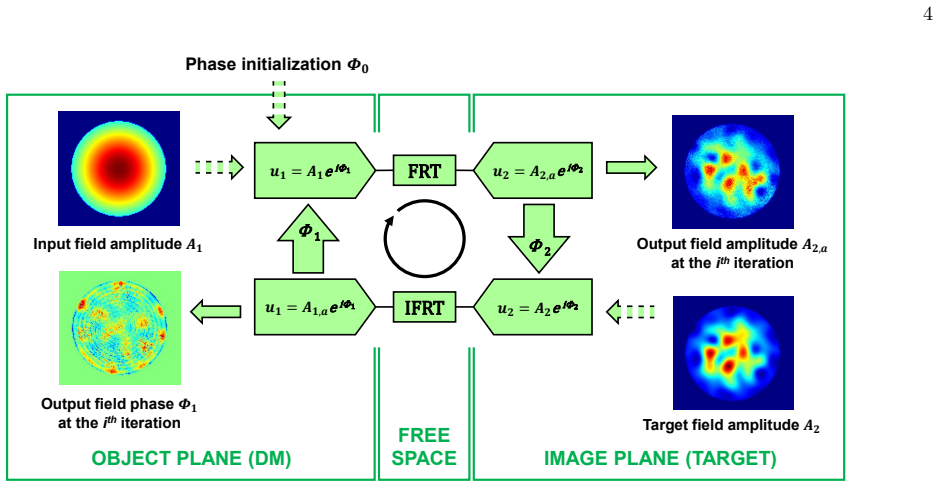
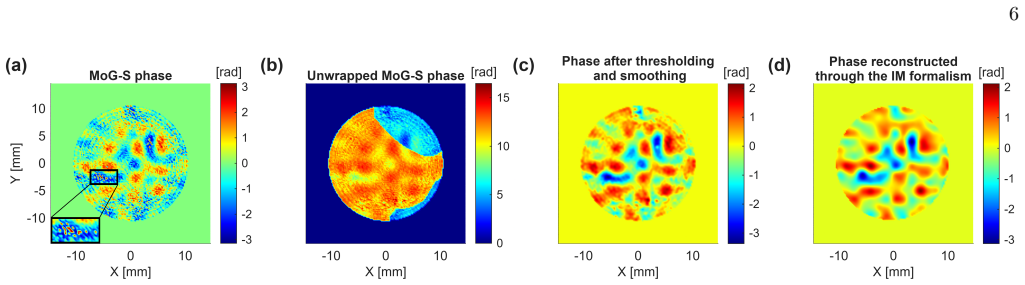
Deformable mirrors reflect and shape the CO2 beam phase according to maps from a modified Gerchberg-Saxton algorithm, imprinting non-axisymmetric intensity patterns on the lensing optics; simulations and experimental validation demonstrate consistent reproduction of the desired patterns without introducing frequency-dependent noise.
What carries the argument
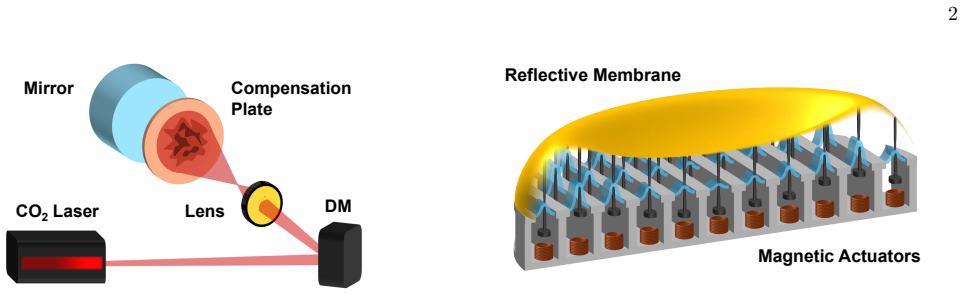
Deformable mirrors that shape the phase of the reflected CO2 beam according to a target map from the modified Gerchberg-Saxton algorithm.
If this is right
- Non-axisymmetric residual aberrations become correctable in high circulating power environments.
- The correction method adds no frequency-dependent noise that would degrade detector performance.
- Instruments such as the Einstein Telescope high-frequency detector can achieve better stability and sensitivity.
- The approach provides a flexible way to address a range of production defects and absorption-induced distortions.
Where Pith is reading between the lines
- The technique could be added to the thermal compensation systems already operating in Advanced LIGO and Advanced Virgo.
- Real-time updating of the phase map might allow the system to track slowly varying aberration patterns during long observing runs.
- Phase-shaping methods of this type could be adapted to other high-power laser applications that require custom non-Gaussian intensity profiles.
Load-bearing premise
The phase map computed by the modified Gerchberg-Saxton algorithm can be realized by the deformable mirror hardware with enough accuracy and stability to produce the target asymmetric intensity pattern in the actual high-power interferometer environment.
What would settle it
A high-power test in which the deformable mirror either fails to reproduce the computed asymmetric intensity pattern or adds measurable frequency-dependent noise to the interferometer output.
Figures
read the original abstract
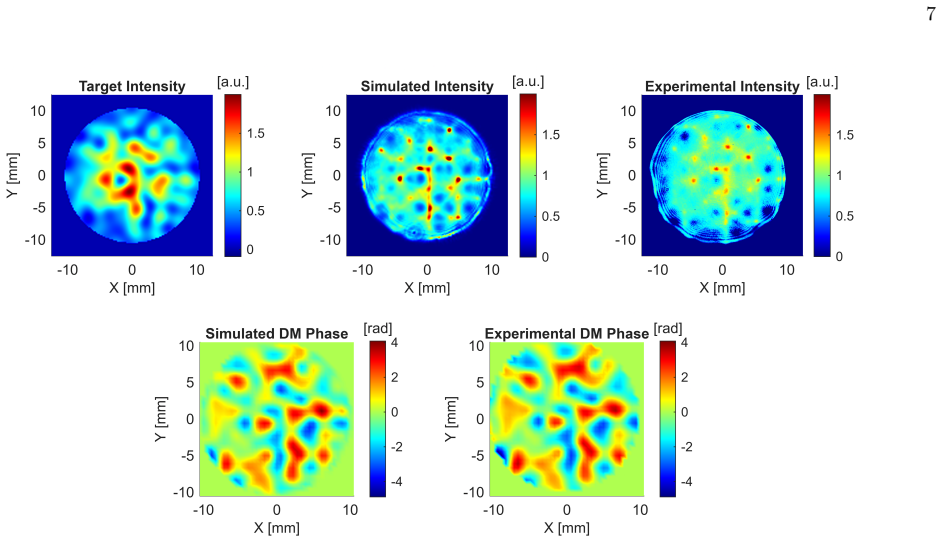
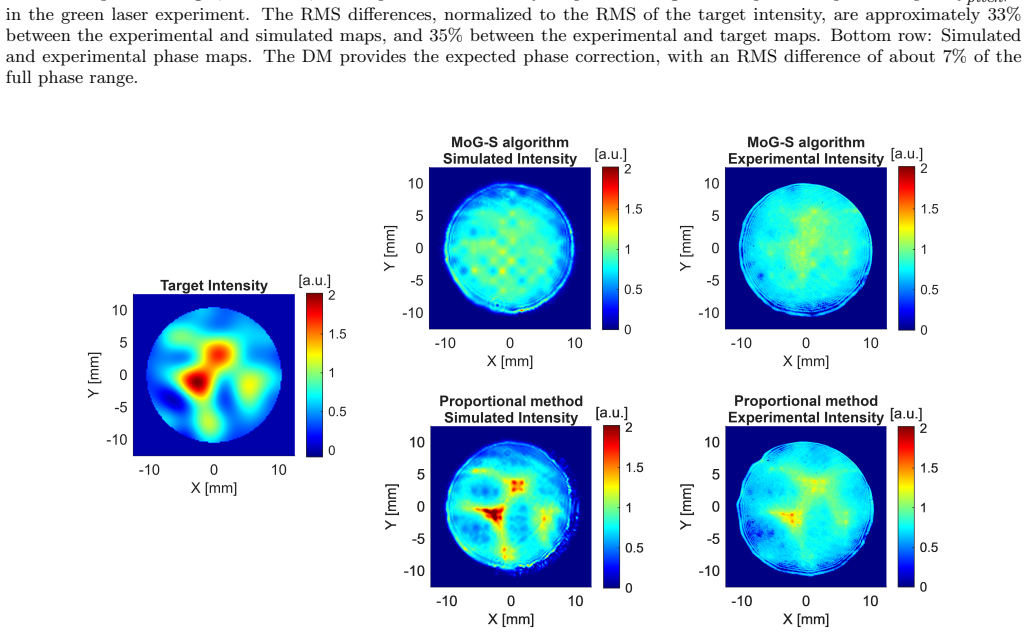
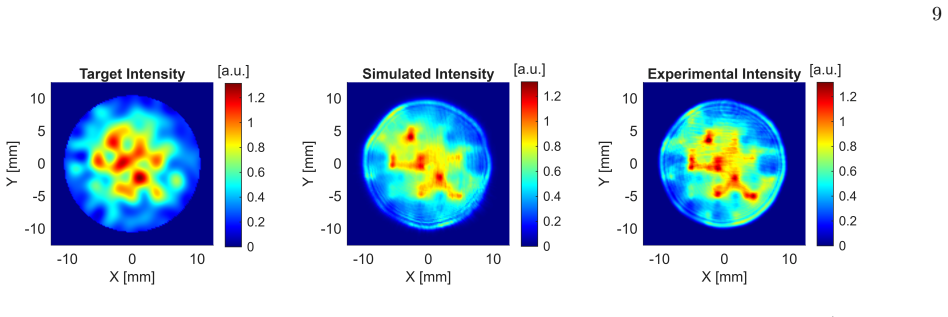
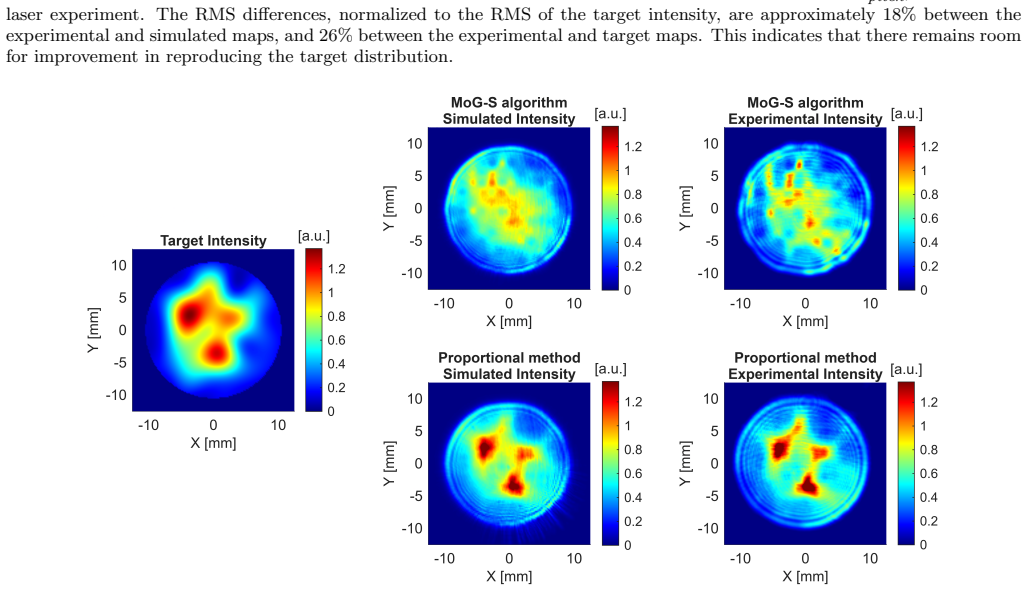
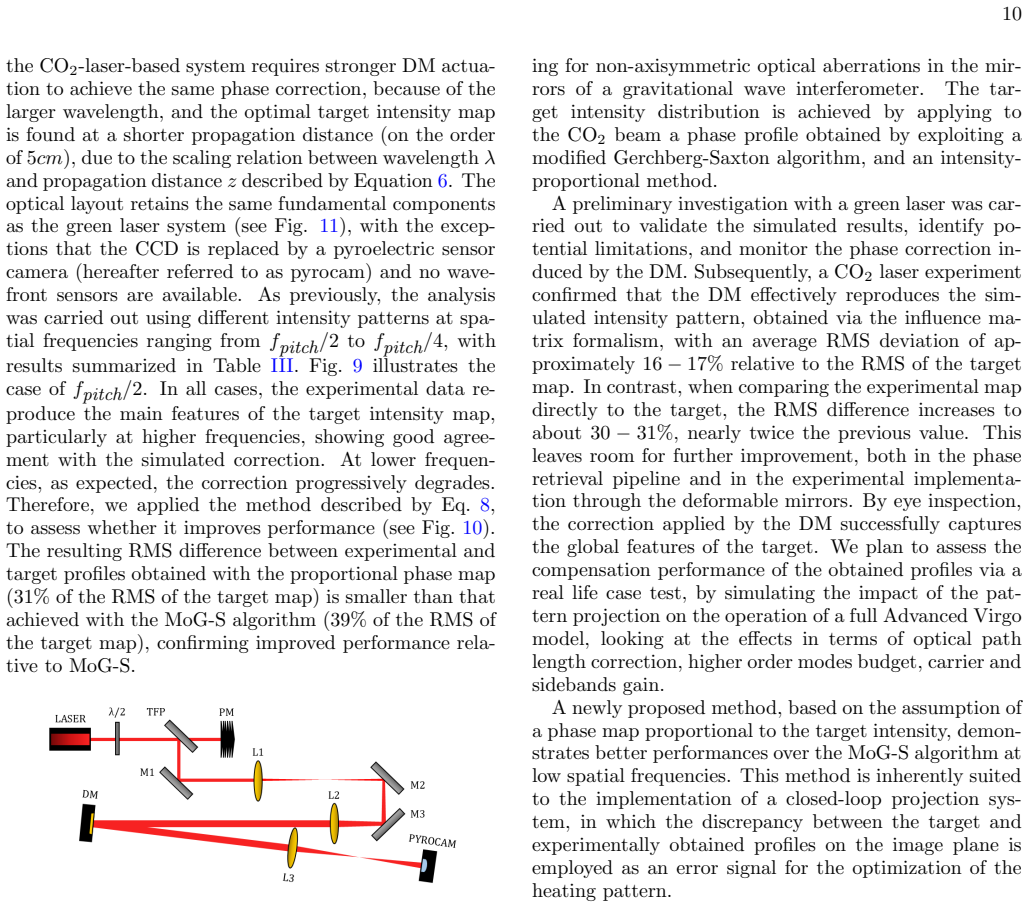
In gravitational wave detectors, optical aberrations arise mainly from laser absorption in coatings and production process defects in the optics along the laser path. If left uncorrected, these optical path distortions drive the interferometer away from its optimal working point, degrading both stability and sensitivity. Future instruments such as the Einstein Telescope high-frequency detector will operate with unprecedented circulating power, further amplifying the aberration budget. In the current detectors Advanced Virgo and Advanced LIGO, the axisymmetric distortions are corrected using thermal actuators and CO2 laser projectors, however, non-axisymmetric wavefront distortions remain unmitigated. Deformable mirrors are investigated as a flexible solution for mitigating such defects: by shaping the CO2 beam phase upon reflection, they can imprint the required asymmetric intensity pattern on the lensing optics without introducing frequency dependent noise. The target phase map is computed via a modified Gerchberg-Saxton algorithm. We present simulations of this projection strategy and experimental validation demonstrating consistent reproduction of the desired intensity patterns.
Editorial analysis
A structured set of objections, weighed in public.
Referee Report
Summary. The manuscript proposes the use of deformable mirrors to correct non-axisymmetric residual aberrations in the thermal compensation systems of future gravitational wave interferometers such as the Einstein Telescope high-frequency detector. By shaping the phase of the CO2 laser beam upon reflection using a modified Gerchberg-Saxton algorithm to compute the target phase map, the approach aims to imprint the required asymmetric intensity patterns on the lensing optics. Simulations of this projection strategy are presented along with experimental validation demonstrating consistent reproduction of the desired intensity patterns without introducing frequency-dependent noise.
Significance. If the central claim holds under relevant conditions, the work would address an important gap in current thermal compensation techniques used in Advanced Virgo and LIGO, where only axisymmetric distortions are mitigated. Providing a flexible method for non-axisymmetric corrections while avoiding frequency-dependent noise could improve interferometer stability and sensitivity at the high circulating powers planned for next-generation detectors.
major comments (2)
- [Abstract] Abstract: The statement that 'simulations and experimental validation support the claim' provides no quantitative metrics, error bars, controls, or data exclusion criteria. Without these, it is not possible to evaluate whether the reproduction of intensity patterns meets the accuracy and stability thresholds required for the central claim.
- [Abstract] Abstract (paragraph on projection strategy): The experimental validation is performed in a laboratory setting outside the high circulating power, thermal lensing, and vacuum environment of the target interferometer. The claim that the method works 'without introducing frequency dependent noise' in the actual detector therefore rests on an untested extrapolation; this is load-bearing for the strongest claim and requires either additional testing or explicit qualification of the operating regime.
Simulated Author's Rebuttal
We thank the referee for their constructive comments. We address each major comment below and indicate the revisions planned for the manuscript.
read point-by-point responses
-
Referee: [Abstract] Abstract: The statement that 'simulations and experimental validation support the claim' provides no quantitative metrics, error bars, controls, or data exclusion criteria. Without these, it is not possible to evaluate whether the reproduction of intensity patterns meets the accuracy and stability thresholds required for the central claim.
Authors: We agree that the abstract is qualitative and would benefit from quantitative support. In the revised manuscript we will update the abstract to include key metrics from the simulations and experiments, such as intensity pattern fidelity (e.g., RMS error) and temporal stability, with references to the detailed results and error analysis presented in the main text. revision: yes
-
Referee: [Abstract] Abstract (paragraph on projection strategy): The experimental validation is performed in a laboratory setting outside the high circulating power, thermal lensing, and vacuum environment of the target interferometer. The claim that the method works 'without introducing frequency dependent noise' in the actual detector therefore rests on an untested extrapolation; this is load-bearing for the strongest claim and requires either additional testing or explicit qualification of the operating regime.
Authors: The referee correctly notes the difference between the laboratory demonstration and full interferometer conditions. Our noise claim rests on the static actuation of the deformable mirrors, which introduces no time-varying effects in the relevant band. We will revise the abstract to explicitly qualify the laboratory conditions of the validation and to state that the noise performance applies to the demonstrated regime, thereby avoiding untested extrapolation while preserving the central result. revision: partial
Circularity Check
No circularity; validation rests on independent simulations and measurements
full rationale
The paper computes a target phase map via a modified Gerchberg-Saxton algorithm, then reports simulations and lab measurements showing reproduction of desired intensity patterns by the deformable mirror. No equations, fitted parameters, or self-citations are presented that reduce any claimed result to an input by construction; the experimental validation chain is independent of the target pattern definition and does not rely on renaming or self-referential fitting.
Axiom & Free-Parameter Ledger
Reference graph
Works this paper leans on
-
[1]
Acernese et al
F. Acernese et al. (Virgo Collaboration), Advanced Virgo: a second-generation interferometric gravitational wave detector, Classical and Quantum Gravity32, 024001 (2014)
2014
-
[2]
Aasi et al
J. Aasi et al. (LIGO Collaboration), Advanced LIGO, Classical and Quantum Gravity32, 074001 (2015)
2015
-
[3]
Akutsu et al
T. Akutsu et al. (KAGRA Collaboration), Overview of KAGRA: Kyoto Astronomical Gravitational-wave Obser- vatory, Progress of Theoretical and Experimental Physics 2021, 05A101 (2021). 11
2021
-
[4]
B. P. Abbott et al. (LIGO Scientific Collaboration and Virgo Collaboration), GWTC-1: A Gravitational-Wave Transient Catalog of Compact Binary Mergers Observed by LIGO and Virgo during the First and Second Ob- serving Runs, Physical Review X9, 031040 (2019), arXiv:1811.12907 [gr-qc]
Pith/arXiv arXiv 2019
-
[5]
R. Abbott et al. (LIGO Scientific Collaboration and Virgo Collaboration), GWTC-2: Compact Binary Co- alescences Observed by LIGO and Virgo during the First Half of the Third Observing Run, Physical Review X11, 021053 (2021), arXiv:2010.14527 [gr-qc]
Pith/arXiv arXiv 2021
-
[6]
R. Abbott et al. (LIGO Scientific Collaboration and Virgo Collaboration), GWTC-2.1: Deep Extended Cata- log of Compact Binary Coalescences Observed by LIGO and Virgo During the First Half of the Third Observ- ing Run, Physical Review D (2022), arXiv:2108.01045 [gr-qc]
Pith/arXiv arXiv 2022
-
[7]
R. Abbott et al. (LIGO Scientific Collaboration, Virgo Collaboration, and KAGRA Collaboration), GWTC- 3: Compact Binary Coalescences Observed by LIGO and Virgo during the Second Part of the Third Ob- serving Run, Physical Review X13, 041039 (2023), arXiv:2111.03606 [gr-qc]
Pith/arXiv arXiv 2023
-
[8]
A. G. Abac et al. (LIGO Scientific Collaboration, Virgo Collaboration, and KAGRA Collaboration), GWTC- 4.0: Updating the Gravitational-Wave Transient Cata- log with Observations from the First Part of the Fourth LIGO-Virgo-KAGRA Observing Run, The Astrophysical Journal Letters (2025), arXiv:2508.18082 [gr-qc]
Pith/arXiv arXiv 2025
-
[9]
A. G. Abac et al. (LIGO Scientific Collaboration, Virgo Collaboration, and KAGRA Collaboration), GWTC-5.0: An Introduction to Version 5.0 of the Gravitational-Wave Transient Catalog, (2026), arXiv:2605.27223 [gr-qc]
Pith/arXiv arXiv 2026
-
[10]
Rocchi et al., Thermal effects and their compensation in Advanced Virgo, inJournal of Physics: Conference Series, Vol
A. Rocchi et al., Thermal effects and their compensation in Advanced Virgo, inJournal of Physics: Conference Series, Vol. 363 (IOP Publishing, 2012) p. 012016
2012
-
[11]
Aiello et al., Thermal compensation system in ad- vanced and third generation gravitational wave interfer- ometric detectors, inJournal of Physics: Conference Se- ries, Vol
L. Aiello et al., Thermal compensation system in ad- vanced and third generation gravitational wave interfer- ometric detectors, inJournal of Physics: Conference Se- ries, Vol. 1226 (IOP Publishing, 2019) p. 012019
2019
-
[12]
Fafone et al., Wavefront sensing and aberration miti- gation in Advanced Virgo, (2026), in preparation
V. Fafone et al., Wavefront sensing and aberration miti- gation in Advanced Virgo, (2026), in preparation
2026
-
[13]
A. F. Brooks et al., Overview of Advanced LIGO adap- tive optics, Applied Optics55, 8256 (2016)
2016
-
[14]
Einstein Telescope Collaboration,ET Design Report Up- date 2020, Internal Note ET-0007A-20 (Einstein Tele- scope Collaboration, 2020)
2020
-
[15]
The Virgo Collaboration,Advanced Virgo Plus Phase I – Design Report, Technical Report VIR-0596A-19 (Virgo Collaboration, 2019)
2019
-
[16]
Nardecchia et al., Integrated dynamical thermal com- pensation techniques for Advanced Virgo, inProceedings of the GRASS 2019 Workshop(2019)
I. Nardecchia et al., Integrated dynamical thermal com- pensation techniques for Advanced Virgo, inProceedings of the GRASS 2019 Workshop(2019)
2019
-
[17]
Lorenzini et al.,A Bildungsroman of the TCS in Ad- vanced Virgo, Presentation VIR-0483A-23 (Virgo Collab- oration, 2023)
M. Lorenzini et al.,A Bildungsroman of the TCS in Ad- vanced Virgo, Presentation VIR-0483A-23 (Virgo Collab- oration, 2023)
2023
-
[18]
Lawrence et al., Adaptive thermal compensation of test masses in advanced LIGO, Classical and Quantum Gravity19, 1803 (2002)
R. Lawrence et al., Adaptive thermal compensation of test masses in advanced LIGO, Classical and Quantum Gravity19, 1803 (2002)
2002
-
[19]
The Virgo Collaboration,Advanced Virgo Plus Phase II – Design Report, Technical Report VIR-0501C-22 (Virgo Collaboration, 2022)
2022
-
[20]
Aiello,Development of new approaches for optical aberration control in gravitational wave interferometers, Ph.D
L. Aiello,Development of new approaches for optical aberration control in gravitational wave interferometers, Ph.D. thesis, SISSA – GSSI (Scuola Internazionale di Studi Superiori Avanzati / Gran Sasso Science Institute), Italy (2019)
2019
-
[21]
Taranto,Upgraded optical aberration correction tech- niques for Advanced Virgo+: commissioning toward O4 and mitigation of non-axisymmetric optical de- fects, Ph.D
C. Taranto,Upgraded optical aberration correction tech- niques for Advanced Virgo+: commissioning toward O4 and mitigation of non-axisymmetric optical de- fects, Ph.D. thesis, Universit` a degli Studi di Roma La Sapienza;Universit` a degli Studi di Roma Tor Vergata; Istituto Nazionale di Astrofisica (INAF), Italy (2023), VIR-0850A-23
2023
-
[22]
Huang et al., Modified Gaussian influence function of deformable mirror actuators, Optics Express16, 108 (2008)
L. Huang et al., Modified Gaussian influence function of deformable mirror actuators, Optics Express16, 108 (2008)
2008
-
[23]
E. H. Moore, On the reciprocal of the general algebraic matrix, Bulletin of the American Mathematical Society 26(1920)
1920
-
[24]
Penrose, A generalized inverse for matrices, Proceed- ings of the Cambridge Philosophical Society51(1955)
R. Penrose, A generalized inverse for matrices, Proceed- ings of the Cambridge Philosophical Society51(1955)
1955
-
[25]
R. W. Gerchberg and W. O. Saxton, A practical algo- rithm for the determination of phase from image and diffraction plane pictures, Optik35, 237 (1972)
1972
-
[26]
S. Mehrabkhani et al., Optimization of phase retrieval in the Fresnel domain by the modified Gerchberg–Saxton algorithm (2019), arXiv:1711.01176
Pith/arXiv arXiv 2019
-
[27]
Bertin-Alpao Adaptive Optics Systems, accessed: 2025- 12-01
2025
-
[28]
Zhao et al., Robust 2D phase unwrapping algorithm based on the transport of intensity equation, Measure- ment Science and Technology30, 015201 (2018)
Z. Zhao et al., Robust 2D phase unwrapping algorithm based on the transport of intensity equation, Measure- ment Science and Technology30, 015201 (2018)
2018
discussion (0)
Sign in with ORCID, Apple, or X to comment. Anyone can read and Pith papers without signing in.