Interpretable Kolmogorov-Arnold Network with Feature-Isolated Temporal Attention Mechanism for Electricity Load Forecasting
Pith reviewed 2026-06-26 08:33 UTC · model grok-4.3
The pith
A hybrid attention-KAN model forecasts electricity load competitively while revealing interpretable mobility effects.
A machine-rendered reading of the paper's core claim, the machinery that carries it, and where it could break.
Core claim
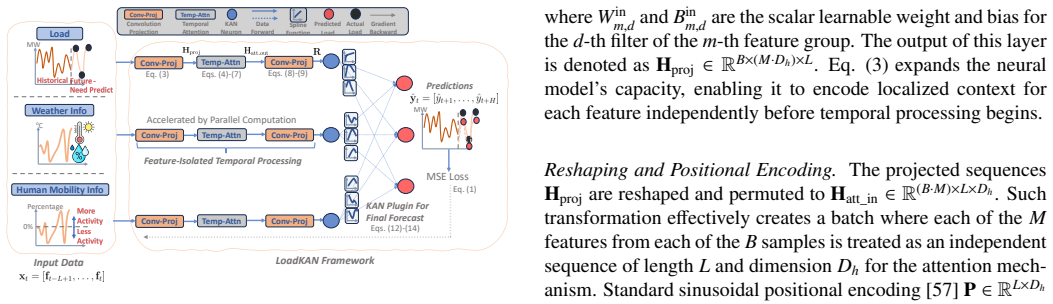
LoadKAN is a novel hybrid framework that combines a feature-isolated temporal attention mechanism with a KAN module; the attention stage extracts temporal dynamics from each input feature independently to supply the KAN with representations for interpretable predictions, and evaluations show it competes with state-of-the-art black-box models while enabling granular analysis of non-linear mobility-load relationships through KAN-learned activation functions.
What carries the argument
Feature-isolated temporal attention mechanism that independently extracts temporal dynamics from each input feature to feed the KAN module.
If this is right
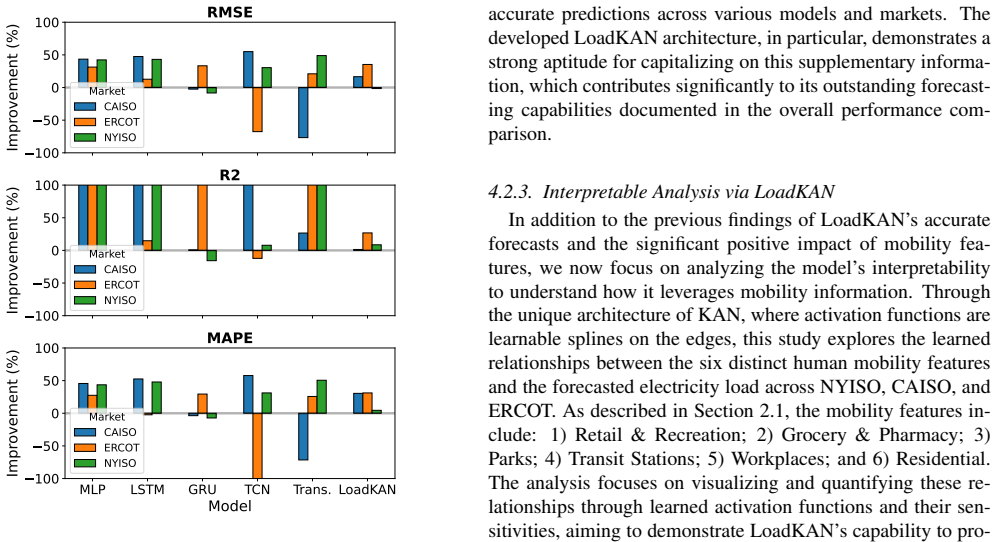
- Remains competitive with state-of-the-art black-box deep learning models on three U.S. electricity market datasets.
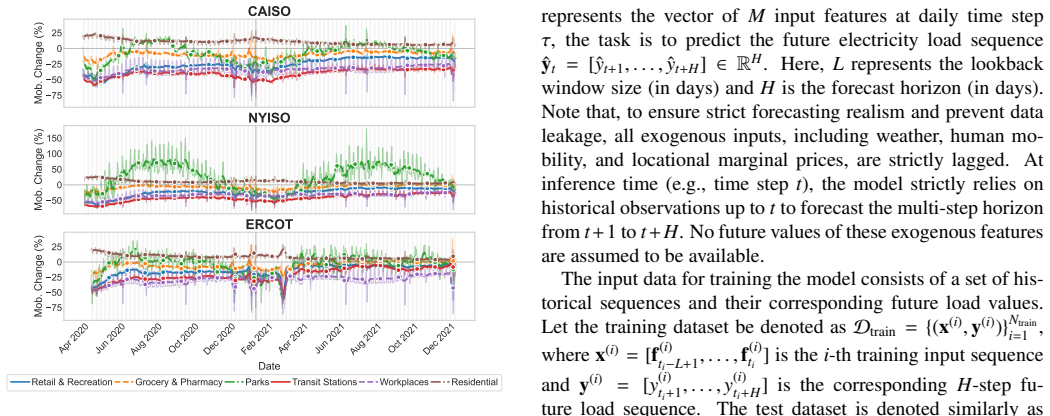
- Enables granular analysis of learned non-linear relationships between six mobility patterns and electricity load.
- Supports quantitative sensitivity analyses revealing complex and market-specific dependencies on mobility features.
- Generates insights often hidden in black-box neural forecasting models.
Where Pith is reading between the lines
- Similar hybrid designs could improve interpretability in other forecasting tasks involving multiple input streams.
- The market-specific mobility dependencies indicate that general models may miss local patterns in load prediction.
- Isolating features in attention might help reduce spurious correlations in time-series models more broadly.
Load-bearing premise
The feature-isolated temporal attention can extract temporal dynamics from each feature independently to give the KAN representations that produce reliable insights into mobility-load relationships.
What would settle it
A test showing that the activation functions learned by the KAN do not correspond to verifiable patterns in the mobility data or that LoadKAN accuracy falls below that of the compared black-box models on the evaluation datasets.
Figures





read the original abstract
Accurate electricity load forecasting is a crucial prerequisite for stable power system operations. While prevalent deep learning models present competitive performance, they often operate as black boxes and lack interpretability. While the Kolmogorov-Arnold network (KAN) has emerged as a promising alternative because of its learnable activation function design, its direct application to time-series forecasting faces challenges in modeling complex temporal data patterns. Also, simple integration into existing architectures, such as serving as replacement of neural modules, cannot fully leverage KAN's interpretability strengths. To address these gaps, this study develops LoadKAN, a novel hybrid and interpretable framework for load forecasting that synergistically combines a specifically-designed feature-isolated temporal attention mechanism with a KAN module. The attention stage aims to extract temporal dynamics from each input feature independently, such as historical load and human mobility, providing distilled feature representations to the KAN module for interpretable predictions. When evaluated on datasets from three representative U.S. electricity markets, our LoadKAN remains highly competitive when compared to extensively-tuned, state-of-the-art, black-box deep learning benchmarks. More importantly, LoadKAN's interpretability enables a granular analysis of the learned non-linear relationships between six distinct mobility patterns and electricity load. Through KAN-learned activation functions, our quantitative sensitivity analyses on mobility features reveal complex and market-specific dependencies. These findings further demonstrate the ability of our LoadKAN to generate insights often obscured by opaque black-box neural forecasting models.
Editorial analysis
A structured set of objections, weighed in public.
Referee Report
Summary. The paper proposes LoadKAN, a hybrid architecture that pairs a feature-isolated temporal attention stage (intended to distill independent temporal dynamics from each input feature such as historical load and six mobility patterns) with a Kolmogorov-Arnold Network (KAN) module. It claims that the resulting model remains competitive with extensively tuned black-box deep-learning baselines on three U.S. electricity-market datasets while additionally supplying interpretable univariate activation functions that reveal market-specific non-linear mobility-load relationships.
Significance. If the performance comparisons are statistically sound and the KAN activations can be shown to reflect genuine rather than artifactual structure, the work would offer a concrete route to interpretable load forecasting that exploits mobility data. The interpretability component, however, rests on an unvalidated assumption that the attention stage supplies the KAN with representations free of residual temporal leakage or spurious correlations; without supporting ablations or external checks this contribution remains provisional.
major comments (2)
- [Abstract] Abstract: the claim of 'highly competitive' performance against 'extensively-tuned, state-of-the-art, black-box deep learning benchmarks' is asserted without any reported metrics, baseline specifications, statistical tests, or error analysis, rendering the central empirical claim impossible to evaluate from the provided text.
- [Abstract] Abstract (interpretability paragraph): the assertion that 'KAN-learned activation functions' and 'quantitative sensitivity analyses on mobility features reveal complex and market-specific dependencies' is load-bearing for the interpretability contribution, yet no ablation of the feature-isolated attention, consistency check across random seeds, or external validation against known mobility-electricity elasticities is described; the design alone does not guarantee that the univariate functions are non-spurious.
Simulated Author's Rebuttal
We thank the referee for the constructive feedback. We agree that the abstract would benefit from greater specificity to support its claims and will revise it accordingly. We address each major comment below.
read point-by-point responses
-
Referee: [Abstract] Abstract: the claim of 'highly competitive' performance against 'extensively-tuned, state-of-the-art, black-box deep learning benchmarks' is asserted without any reported metrics, baseline specifications, statistical tests, or error analysis, rendering the central empirical claim impossible to evaluate from the provided text.
Authors: We acknowledge that the abstract does not include quantitative details. The full manuscript (Experiments section) reports MAE, RMSE, and MAPE on the three U.S. market datasets, with comparisons to extensively tuned LSTM, GRU, Transformer, and other baselines, including hyperparameter search procedures and error analysis. Statistical significance across random seeds is assessed via paired tests. In revision we will condense these results into the abstract (e.g., 'LoadKAN achieves X% lower MAE than the best baseline on average') while retaining the high-level claim. revision: yes
-
Referee: [Abstract] Abstract (interpretability paragraph): the assertion that 'KAN-learned activation functions' and 'quantitative sensitivity analyses on mobility features reveal complex and market-specific dependencies' is load-bearing for the interpretability contribution, yet no ablation of the feature-isolated attention, consistency check across random seeds, or external validation against known mobility-electricity elasticities is described; the design alone does not guarantee that the univariate functions are non-spurious.
Authors: The manuscript presents the KAN activation functions and sensitivity plots in the Results section, showing market-specific non-linear patterns. We agree the abstract does not reference supporting checks. In revision we will add a sentence pointing to the relevant figures and note that the feature-isolated attention processes each input stream independently before the KAN stage. We will also include a short consistency analysis across seeds. External validation against published mobility-electricity elasticities is not performed in the current work and would require additional domain datasets; we will therefore qualify the claim to reflect the evidence actually provided. revision: partial
- External validation of the learned mobility-load relationships against independent econometric elasticities, which is outside the scope of the present datasets and would require new data collection.
Circularity Check
No circularity; empirical evaluation independent of self-defined quantities
full rationale
The paper describes a hybrid architecture (feature-isolated temporal attention feeding a KAN module) and reports empirical performance on three external U.S. electricity market datasets against black-box benchmarks. No derivation chain, equations, or fitted-parameter predictions are presented that reduce to the model's own inputs by construction. Interpretability claims rest on post-hoc inspection of learned KAN activations rather than any self-referential prediction or uniqueness theorem imported via self-citation. The central claims therefore remain externally falsifiable and do not collapse into the architecture's fitted values.
Axiom & Free-Parameter Ledger
Reference graph
Works this paper leans on
-
[1]
A. El Maghraoui, H. El Hadraoui, Y . Ledmaoui, N. El Bazi, N. Guennouni, A. Chebak, Revolutionizing smart 19 grid-ready management systems: A holistic frame- work for optimal grid reliability, Sustainable Energy, Grids and Networks 39 (2024) 101452.doi:https: //doi.org/10.1016/j.segan.2024.101452. URLhttps://www.sciencedirect.com/science/ article/pii/S235...
-
[3]
L. Yang, R. Ren, X. Gu, L. Sun, Interactive general- ized additive model and its applications in electric load forecasting, in: Proceedings of the 29th ACM SIGKDD Conference on Knowledge Discovery and Data Mining, KDD ’23, Association for Computing Machinery, New York, NY , USA, 2023, p. 5393–5403.doi:10.1145/ 3580305.3599848. URLhttps://doi.org/10.1145/3...
-
[4]
D. Marshman, M. Brear, B. Ring, Impact of unit com- mitment and rocof constraints on revenue sufficiency in decarbonising wholesale electricity markets, En- ergy Economics 106 (2022) 105763.doi:https: //doi.org/10.1016/j.eneco.2021.105763. URLhttps://www.sciencedirect.com/science/ article/pii/S0140988321006046
-
[5]
D. Davis, M. J. Brear, Impact of short-term wind forecast accuracy on the performance of decar- bonising wholesale electricity markets, Energy Economics 130 (2024) 107304.doi:https: //doi.org/10.1016/j.eneco.2024.107304. URLhttps://www.sciencedirect.com/science/ article/pii/S0140988324000124
-
[6]
Next Move Strategy Consulting, Power generation market – global opportunity analysis and industry forecast, 2024–2030,https://www.nextmsc.com/report/ power-generation-market, accessed: 2025-05-09 (2024)
2024
-
[7]
Licence: CC BY 4.0
International Energy Agency, Electricity 2024,https: //www.iea.org/reports/electricity-2024, iEA, Paris. Licence: CC BY 4.0. Accessed: 2025-05-09 (2024)
2024
-
[8]
O. Rubasinghe, T. Zhang, X. Zhang, S. S. Choi, T. K. Chau, Y . Chow, T. Fernando, H. H.-C. Iu, Highly accurate peak and valley prediction short-term net load forecasting approach based on decompo- sition for power systems with high pv penetration, Applied Energy 333 (2023) 120641.doi:https: //doi.org/10.1016/j.apenergy.2023.120641. URLhttps://www.scienced...
-
[9]
H. Min, B. Noh, Solarnexus: A deep learning framework for adaptive photovoltaic power gen- eration forecasting and scalable management, Ap- plied Energy 391 (2025) 125848.doi:https: //doi.org/10.1016/j.apenergy.2025.125848. URLhttps://www.sciencedirect.com/science/ article/pii/S0306261925005781
-
[10]
X. Wang, H. Wang, S. Li, H. Jin, A reinforcement learning-based online learning strategy for real-time short-term load forecasting, Energy 305 (2024) 132344
2024
-
[11]
C. Kuster, Y . Rezgui, M. Mourshed, Electrical load fore- casting models: A critical systematic review, Sustainable Cities and Society 35 (2017) 257–270.doi:https: //doi.org/10.1016/j.scs.2017.08.009. URLhttps://www.sciencedirect.com/science/ article/pii/S2210670717305899
-
[12]
M. Xia, H. Shao, X. Ma, C. W. de Silva, A stacked gru- rnn-based approach for predicting renewable energy and electricity load for smart grid operation, IEEE Transac- tions on Industrial Informatics 17 (10) (2021) 7050–7059. doi:10.1109/TII.2021.3056867
-
[13]
C. Wang, H. Zhao, Y . Liu, G. Fan, Minute-level ultra- short-term power load forecasting based on time series data features, Applied Energy 372 (2024) 123801. doi:https://doi.org/10.1016/j.apenergy. 2024.123801. URLhttps://www.sciencedirect.com/science/ article/pii/S030626192401184X
-
[14]
J. Li, H. Wang, A multi-view multi-timescale hypergraph- empowered spatiotemporal framework for ev charging forecasting, IEEE Transactions on Smart Grid 17 (2) (2026) 1430–1443.doi:10.1109/TSG.2025.3633777
-
[15]
H. Mansoor, M. S. Gull, H. Rauf, I. ul Hasan Shaikh, M. Khalid, N. Arshad, Graph convolutional networks based short-term load forecasting: Leveraging spatial information for improved accuracy, Electric Power Systems Research 230 (2024) 110263.doi:https: //doi.org/10.1016/j.epsr.2024.110263. URLhttps://www.sciencedirect.com/science/ article/pii/S0378779624001512
-
[16]
N. Giamarelos, E. N. Zois, Boosting short term electric load forecasting of high & medium voltage substations with visibility graphs and graph neural networks, Sustain- able Energy, Grids and Networks 38 (2024) 101304.doi: https://doi.org/10.1016/j.segan.2024.101304. URLhttps://www.sciencedirect.com/science/ article/pii/S235246772400033X
-
[17]
Z. Peng, X. Yang, Short- and medium-term power load forecasting model based on a hybrid attention mechanism in the time and frequency domains, Expert Systems with Applications 278 (2025) 127329.doi:https: //doi.org/10.1016/j.eswa.2025.127329. 20 URLhttps://www.sciencedirect.com/science/ article/pii/S0957417425009510
-
[18]
B. Jiang, H. Yang, Y . Wang, Y . Liu, H. Geng, H. Zeng, J. Ding, Dynamic temporal dependency model for multi- ple steps ahead short-term load forecasting of power sys- tem, IEEE Transactions on Industry Applications 60 (4) (2024) 5244–5254.doi:10.1109/TIA.2024.3375802
-
[19]
Y . Chen, W. Yang, B. Zhang, Using mobility for electri- cal load forecasting during the covid-19 pandemic (2020). arXiv:2006.08826. URLhttps://arxiv.org/abs/2006.08826
arXiv 2020
-
[20]
J. Liu, Z. Zhang, X. Fan, Y . Zhang, J. Wang, K. Zhou, S. Liang, X. Yu, W. Zhang, Power system load forecasting using mobility optimiza- tion and multi-task learning in covid-19, Ap- plied Energy 310 (2022) 118303.doi:https: //doi.org/10.1016/j.apenergy.2021.118303. URLhttps://www.sciencedirect.com/science/ article/pii/S0306261921015622
-
[21]
N. Zarbakhsh, M. S. Misaghian, G. Mcardle, Human mobility-based features to analyse the impact of covid- 19 on power system operation of ireland, IEEE Open Access Journal of Power and Energy 9 (2022) 213–225. doi:10.1109/OAJPE.2022.3155960
-
[22]
J. Cordova, L. M. Konila Sriram, A. Kocatepe, Y . Zhou, E. E. Ozguven, R. Arghandeh, Combined electricity and traffic short-term load forecasting using bundled causality engine, IEEE Transactions on Intelligent Transportation Systems 20 (9) (2019) 3448–3458.doi:10.1109/TITS. 2018.2876871
-
[23]
Z. Zhang, J. Liu, S. Pang, M. Shi, H. H. Goh, Y . Zhang, D. Zhang, General short-term load forecasting based on multi-task temporal convolutional network in covid-19, International Journal of Electrical Power & Energy Systems 147 (2023) 108811.doi:https: //doi.org/10.1016/j.ijepes.2022.108811. URLhttps://www.sciencedirect.com/science/ article/pii/S0142061...
-
[24]
A. Prabowo, K. Chen, H. Xue, S. Sethuvenkatraman, F. D. Salim, Navigating out-of-distribution electricity load fore- casting during covid-19: Benchmarking energy load fore- casting models without and with continual learning, in: Proceedings of the 10th ACM International Conference on Systems for Energy-Efficient Buildings, Cities, and Transportation, Buil...
-
[25]
D. Obst, J. de Vilmarest, Y . Goude, Adaptive methods for short-term electricity load forecasting during covid-19 lockdown in france, IEEE Transactions on Power Systems 36 (5) (2021) 4754–4763.doi:10.1109/TPWRS.2021. 3067551
-
[26]
Z. Liu, Y . Wang, S. Vaidya, F. Ruehle, J. Halver- son, M. Soljacic, T. Y . Hou, M. Tegmark, KAN: Kolmogorov–arnold networks, in: The Thirteenth Inter- national Conference on Learning Representations, 2025. URLhttps://openreview.net/forum?id= Ozo7qJ5vZi
2025
-
[27]
L. Baur, K. Ditschuneit, M. Schambach, C. Kaymakci, T. Wollmann, A. Sauer, Explainability and interpretability in electric load forecasting using machine learning tech- niques – a review, Energy and AI 16 (2024) 100358.doi: https://doi.org/10.1016/j.egyai.2024.100358. URLhttps://www.sciencedirect.com/science/ article/pii/S2666546824000247
-
[28]
M. T. Ribeiro, S. Singh, C. Guestrin, "why should i trust you?": Explaining the predictions of any classifier, in: Proceedings of the 22nd ACM SIGKDD International Conference on Knowledge Discovery and Data Mining, KDD ’16, Association for Computing Machinery, New York, NY , USA, 2016, p. 1135–1144.doi:10.1145/ 2939672.2939778. URLhttps://doi.org/10.1145/...
-
[29]
S. M. Lundberg, S.-I. Lee, A unified approach to inter- preting model predictions, in: I. Guyon, U. V . Luxburg, S. Bengio, H. Wallach, R. Fergus, S. Vishwanathan, R. Garnett (Eds.), Advances in Neural Information Processing Systems 30, Curran Associates, Inc., 2017, pp. 4765–4774. URLhttp://papers.nips.cc/paper/ 7062-a-unified-approach-to-interpreting-mo...
2017
-
[30]
Slack, A
D. Slack, A. Hilgard, S. Singh, H. Lakkaraju, Reliable post hoc explanations: Modeling uncertainty in explain- ability, in: M. Ranzato, A. Beygelzimer, Y . Dauphin, P. Liang, J. W. Vaughan (Eds.), Advances in Neural Infor- mation Processing Systems, V ol. 34, Curran Associates, Inc., 2021, pp. 9391–9404. URLhttps://proceedings.neurips. cc/paper_files/pape...
2021
-
[31]
W. Waheed, Q. Xu, Data-driven short term load fore- casting with deep neural networks: Unlocking insights for sustainable energy management, Electric Power Systems Research 232 (2024) 110376.doi:https: //doi.org/10.1016/j.epsr.2024.110376. URLhttps://www.sciencedirect.com/science/ article/pii/S0378779624002645
-
[32]
Long short-term memory.Neural Computation, 9(8):1735–1780, 1997
S. Hochreiter, J. Schmidhuber, Long short-term memory, Neural Comput. 9 (8) (1997) 1735–1780. doi:10.1162/neco.1997.9.8.1735. URLhttps://doi.org/10.1162/neco.1997.9.8. 1735 21
-
[33]
J. Chung, C. Gulcehre, K. Cho, Y . Bengio, Empirical eval- uation of gated recurrent neural networks on sequence modeling, cite arxiv:1412.3555Comment: Presented in NIPS 2014 Deep Learning and Representation Learning Workshop (2014). URLhttp://arxiv.org/abs/1412.3555
Pith/arXiv arXiv 2014
-
[34]
C. Lea, M. D. Flynn, R. Vidal, A. Reiter, G. D. Hager, Temporal convolutional networks for action segmentation and detection, in: 2017 IEEE Conference on Computer Vision and Pattern Recognition (CVPR), 2017, pp. 1003– 1012.doi:10.1109/CVPR.2017.113
-
[35]
H. Eskandari, M. Imani, M. P. Moghaddam, Convo- lutional and recurrent neural network based model for short-term load forecasting, Electric Power Sys- tems Research 195 (2021) 107173.doi:https: //doi.org/10.1016/j.epsr.2021.107173. URLhttps://www.sciencedirect.com/science/ article/pii/S0378779621001541
-
[36]
Y . Chen, C. Lin, Y . Zhang, J. Liu, D. Yu, Day-ahead load forecast based on conv2d-gru_sc aimed to adapt to steep changes in load, Energy 302 (2024) 131814.doi:https: //doi.org/10.1016/j.energy.2024.131814. URLhttps://www.sciencedirect.com/science/ article/pii/S0360544224015871
-
[37]
F. Saeed, A. Rehman, H. A. Shah, M. Diyan, J. Chen, J.-M. Kang, Smartformer: Graph-based transformer model for energy load forecasting, Sustainable Energy Technologies and Assessments 73 (2025) 104133.doi: https://doi.org/10.1016/j.seta.2024.104133. URLhttps://www.sciencedirect.com/science/ article/pii/S2213138824005290
- [38]
-
[39]
Z. Su, G. Zheng, M. Hu, L. Kong, G. Wang, Short-term load forecasting of regional integrated energy system based on spatio-temporal convolu- tional graph neural network, Electric Power Sys- tems Research 232 (2024) 110427.doi:https: //doi.org/10.1016/j.epsr.2024.110427. URLhttps://www.sciencedirect.com/science/ article/pii/S0378779624003158
-
[40]
Z. Tian, W. Liu, W. Jiang, C. Wu, Cnns- transformer based day-ahead probabilistic load forecasting for weekends with limited data avail- ability, Energy 293 (2024) 130666.doi:https: //doi.org/10.1016/j.energy.2024.130666. URLhttps://www.sciencedirect.com/science/ article/pii/S0360544224004389
-
[41]
H. Xu, F. Hu, X. Liang, G. Zhao, M. Abugunmi, A frame- work for electricity load forecasting based on attention mechanism time series depthwise separable convolutional neural network, Energy 299 (2024) 131258.doi:https: //doi.org/10.1016/j.energy.2024.131258. URLhttps://www.sciencedirect.com/science/ article/pii/S0360544224010314
-
[42]
V . Pentsos, S. Tragoudas, J. Wibbenmeyer, N. Khdeer, A hybrid lstm-transformer model for power load forecasting, IEEE Transactions on Smart Grid 16 (3) (2025) 2624– 2634.doi:10.1109/TSG.2025.3535407
-
[43]
J. Dong, Y . Jiang, P. Chen, J. Li, Z. Wang, S. Han, Short-term power load forecasting using bidirectional gated recurrent units-based adaptive stacked autoen- coder, International Journal of Electrical Power & Energy Systems 165 (2025) 110459.doi:https: //doi.org/10.1016/j.ijepes.2025.110459. URLhttps://www.sciencedirect.com/science/ article/pii/S0142061...
-
[44]
J. Hu, W. Hu, D. Cao, X. Sun, J. Chen, Y . Huang, Z. Chen, F. Blaabjerg, Probabilistic net load fore- casting based on transformer network and gaussian process-enabled residual modeling learning method, Renewable Energy 225 (2024) 120253.doi:https: //doi.org/10.1016/j.renene.2024.120253. URLhttps://www.sciencedirect.com/science/ article/pii/S0960148124003185
-
[45]
Rigotti, C
M. Rigotti, C. Miksovic, I. Giurgiu, T. Gschwind, P. Scot- ton, Attention-based interpretability with concept trans- formers, in: International conference on learning repre- sentations, 2021
2021
-
[46]
H. Zhao, H. Zhang, C. Tian, Z. Wei, A. Zhou, Srlinear: Lightweight long-term time series forecasting via sym- bolic regression, IEEE Transactions on Artificial Intelli- gence (2025)
2025
-
[47]
X. Han, X. Zhang, Y . Wu, Z. Zhang, Z. Wu, Are kans effective for multivariate time series forecasting? (2025). arXiv:2408.11306. URLhttps://arxiv.org/abs/2408.11306
arXiv 2025
- [48]
-
[49]
AIP Advances14(7), 075120 (2024)
M. Abbas, Y . Che, A. Zafar, Utilizing the new kolmogorov-arnold network for short-term electric load forecasting, Journal of Renewable and Sustainable Energy 17 (2) (2025) 025501.arXiv:https://pubs. aip.org/aip/jrse/article-pdf/doi/10.1063/5. 0253629/20479602/025501\_1\_5.0253629.pdf, doi:10.1063/5.0253629. URLhttps://doi.org/10.1063/5.0253629 22
work page doi:10.1063/5 2025
- [50]
-
[51]
Y . Zhang, L. Cui, W. Yan, Integrating kolmogorov–arnold networks with time series prediction framework in electricity demand forecasting, Energies 18 (6) (2025). doi:10.3390/en18061365. URLhttps://www.mdpi.com/1996-1073/18/6/ 1365
-
[52]
M. U. Danish, K. Grolinger, Kolmogorov–arnold recur- rent network for short term load forecasting across diverse consumers, Energy Reports 13 (2025) 713–727.doi: https://doi.org/10.1016/j.egyr.2024.12.038. URLhttps://www.sciencedirect.com/science/ article/pii/S2352484724008539
-
[53]
S. Wang, Y . Huang, Q. Wang, Medium-term jointly load forecasting via an enhanced kan-based mtl framework, in: 2024 IEEE PES 16th Asia-Pacific Power and En- ergy Engineering Conference (APPEEC), 2024, pp. 1–5. doi:10.1109/APPEEC61255.2024.10922466
-
[54]
Z. Pei, Z. Zhang, J. Chen, W. Liu, B. Chen, Y . Huang, H. Yang, Y . Lu, Kan–cnn: A novel framework for electric vehicle load forecasting with enhanced engineering appli- cability and simplified neural network tuning, Electronics 14 (3) (2025).doi:10.3390/electronics14030414. URLhttps://www.mdpi.com/2079-9292/14/3/414
-
[55]
G. Ruan, D. Wu, X. Zheng, H. Zhong, C. Kang, M. Dahleh, S. Sivaranjani, L. Xie, A cross-domain ap- proach to analyzing the short-run impact of covid-19 on the us electricity sector, Joule 4 (11) (2020) 2322–2337. doi:10.1016/j.joule.2020.08.017
-
[56]
URLhttps://www.google.com/covid19/ mobility/
Google, Covid-19 community mobility report (2021). URLhttps://www.google.com/covid19/ mobility/
2021
-
[57]
Vaswani, N
A. Vaswani, N. Shazeer, N. Parmar, J. Uszkoreit, L. Jones, A. N. Gomez, Ł. Kaiser, I. Polosukhin, Attention is all you need, Advances in neural information processing systems 30 (2017)
2017
-
[58]
A. Noorizadegan, S. Wang, L. Ling, A practitioner’s guide to kolmogorov-arnold networks (2025).arXiv:2510. 25781. URLhttps://arxiv.org/abs/2510.25781
Pith/arXiv arXiv 2025
-
[59]
C. Zeng, J. Wang, H. Shen, Q. Wang, Kan versus mlp on irregular or noisy functions (2024).arXiv:2408.07906. URLhttps://arxiv.org/abs/2408.07906
arXiv 2024
-
[60]
Y . Cang, Y . hang liu, L. Shi, Can kan work? exploring the potential of kolmogorov-arnold networks in computer vision (2024).arXiv:2411.06727. URLhttps://arxiv.org/abs/2411.06727
arXiv 2024
-
[61]
H. Zhou, S. Zhang, J. Peng, S. Zhang, J. Li, H. Xiong, W. Zhang, Informer: Beyond efficient transformer for long sequence time-series forecasting, in: Proceedings of the AAAI conference on artificial intelligence, V ol. 35, 2021, pp. 11106–11115
2021
-
[62]
A. F. Ansari, L. Stella, C. Turkmen, X. Zhang, P. Mercado, H. Shen, O. Shchur, S. S. Rangapuram, S. P. Arango, S. Kapoor, et al., Chronos: Learning the language of time series, arXiv preprint arXiv:2403.07815 (2024)
Pith/arXiv arXiv 2024
-
[63]
Y . Li, X. Lu, Y . Wang, D. Dou, Generative time series forecasting with diffusion, denoise, and disentanglement, in: S. Koyejo, S. Mohamed, A. Agarwal, D. Belgrave, K. Cho, A. Oh (Eds.), Advances in Neural Information Processing Systems, V ol. 35, Curran Associates, Inc., 2022, pp. 23009–23022. URLhttps://proceedings.neurips. cc/paper_files/paper/2022/fi...
2022
-
[64]
Z. An, J. You, J. Li, Y . Tang, W. Li, H. Du, S. Du, Fredn: Spectral disentanglement for time series forecasting via learnable frequency decomposition (2025).arXiv:2511. 11817. URLhttps://arxiv.org/abs/2511.11817
arXiv 2025
-
[65]
Y . Li, Z. Chen, D. Zha, M. Du, J. Ni, D. Zhang, H. Chen, X. Hu, Towards learning disentangled representations for time series, in: Proceedings of the 28th ACM SIGKDD Conference on Knowledge Discovery and Data Mining, KDD ’22, Association for Computing Machinery, New York, NY , USA, 2022, p. 3270–3278.doi:10.1145/ 3534678.3539140. URLhttps://doi.org/10.11...
-
[66]
Z. Liu, J. Yang, Q. Mao, Y . Zhao, M. Cheng, Z. Li, Q. Liu, E. Chen, Disents: Disentangled channel evolving pattern modeling for multivariate time series forecasting (2024). arXiv:2410.22981. URLhttps://arxiv.org/abs/2410.22981
arXiv 2024
-
[67]
E. N. Cawood, D. Fiorello, P. Christidis, Mobility patterns after the pandemic: a survey in 20 european cities, Transportation Research Procedia 72 (2023) 611–618, tRA Lisbon 2022 Conference Proceedings Transport Research Arena (TRA Lisbon 2022),14th- 17th November 2022, Lisboa, Portugal.doi:https: //doi.org/10.1016/j.trpro.2023.11.446. URLhttps://www.sci...
-
[68]
Shokouhyar, S
S. Shokouhyar, S. Shokoohyar, A. Sobhani, A. J. Gorizi, Shared mobility in post-covid era: New challenges and opportunities, Sustainable Cities and Society 67 (2021) 102714
2021
-
[69]
Z. Zarabi, E. O. D. Waygood, T. Schwanen, Switching back to transit? post-pandemic commute choices and 23 emotional response, Transportation Research Part A: Policy and Practice 203 (2026) 104748.doi:https: //doi.org/10.1016/j.tra.2025.104748. URLhttps://www.sciencedirect.com/science/ article/pii/S0965856425003817 24
discussion (0)
Sign in with ORCID, Apple, or X to comment. Anyone can read and Pith papers without signing in.