Neutron Star Mass-Radius Constraints for EXO 0748-676 from 2008-2025 Quiescent X-ray Spectra
Pith reviewed 2026-06-26 07:25 UTC · model grok-4.3
The pith
A global fit tying parameters across 20 quiescent spectra constrains the neutron star in EXO 0748-676 to a mass of 1.77 solar masses and radius of 12.62 kilometers.
A machine-rendered reading of the paper's core claim, the machinery that carries it, and where it could break.
Core claim
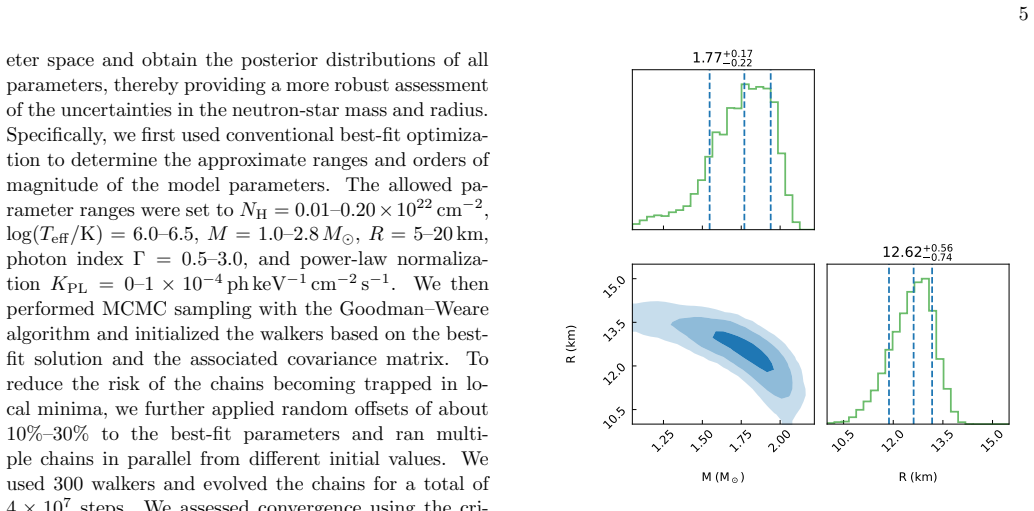
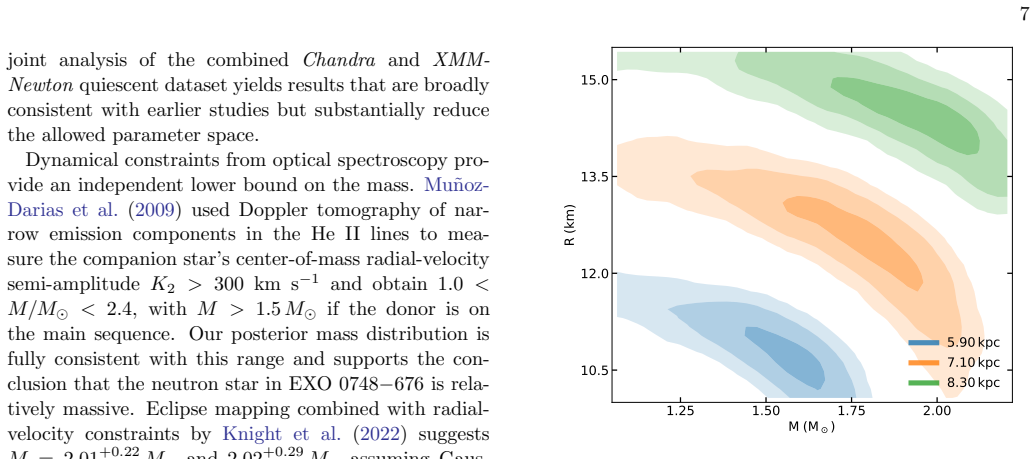
In a global Markov Chain Monte Carlo analysis in which the hydrogen column density, neutron star mass, and radius are tied across all observations, we obtain a neutron-star mass of 1.77^{+0.17}_{-0.22} M_⊙ and a radius of 12.62^{+0.56}_{-0.74} km (1σ credible intervals). Incorporating the distance uncertainty of 7.1±1.2 kpc, we conservatively constrain the neutron-star mass and radius to M≃1.41-2.11 M_⊙ and R≃10.15-15.13 km, favoring relatively stiff dense-matter equations of state. We also trace the thermal evolution across two quiescent epochs and find evidence for renewed crust cooling following the 2024-2025 outburst.
What carries the argument
Global Markov Chain Monte Carlo fit that ties hydrogen column density, mass, and radius across the 20 spectra while using a hydrogen-atmosphere model at fixed distance.
If this is right
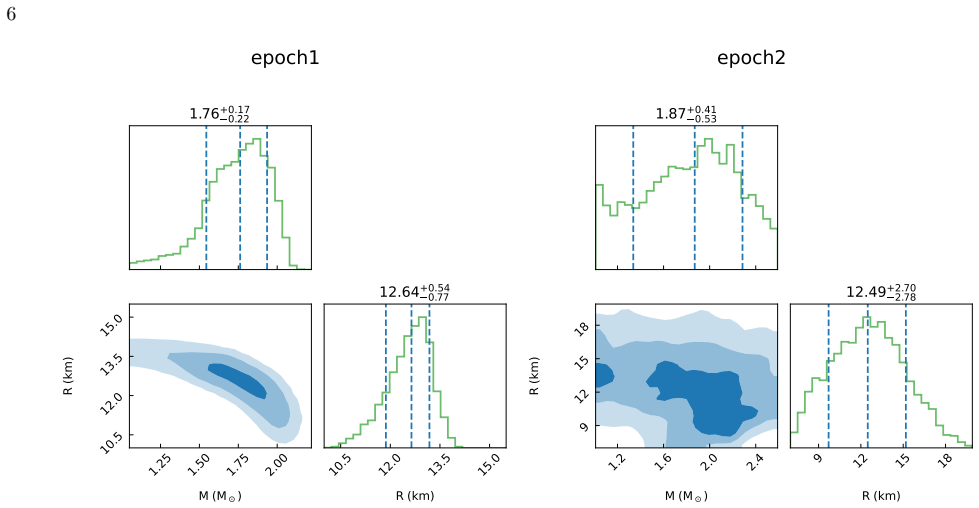
- The joint analysis narrows the low-mass tail of the posterior relative to separate epoch fits.
- The mass-radius point lies in the parameter space of stiff dense-matter equations of state.
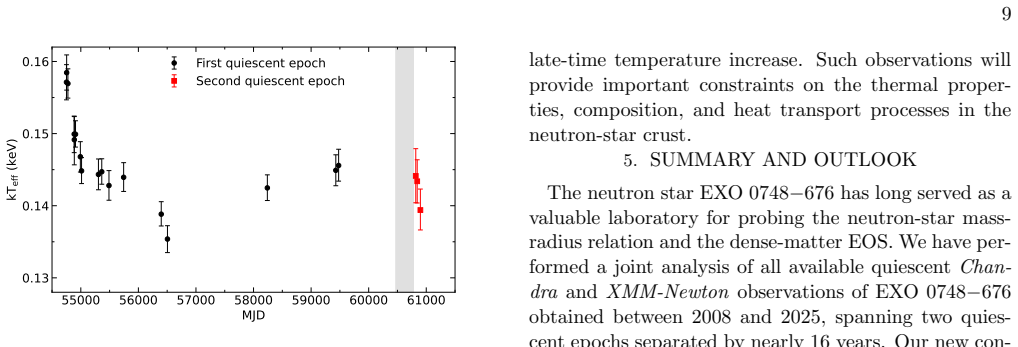
- Renewed crust cooling after the 2024-2025 outburst provides a second baseline for comparing thermal relaxation timescales.
- The conservative bounds after folding in distance uncertainty still exclude the softest equations of state.
Where Pith is reading between the lines
- If future distance measurements shrink the 1.2 kpc uncertainty, the radius error bar could tighten enough to discriminate among specific equation-of-state models.
- Repeated joint analyses of other quiescent neutron-star binaries could build a statistical sample of mass-radius points without assuming identical source properties.
- Monitoring the source after the next outburst would test whether the crust-cooling curve repeats or depends on accretion history.
Load-bearing premise
The neutron star mass, radius, and hydrogen column density remain the same across all twenty observations from two different quiescent epochs.
What would settle it
A new quiescent spectrum whose best-fit mass or radius lies outside the reported 1σ credible intervals when the other parameters are left free would contradict the tied-parameter assumption.
Figures
read the original abstract
We present new constraints on the mass and radius of the neutron star in the neutron star low-mass X-ray binary EXO 0748$-$676 obtained from a joint analysis of 20 quiescent X-ray observations obtained between 2008 and 2025, including 14 Chandra and 6 XMM-Newton exposures. These data sample two quiescent episodes separated by the 2024$-$2025 outburst. We model the 0.5$-$10 keV spectra with a hydrogen-atmosphere model, assuming a source distance of 7.1 kpc. In a global Markov Chain Monte Carlo analysis in which the hydrogen column density, neutron star mass, and radius are tied across all observations, we obtain a neutron-star mass of $1.77^{+0.17}_{-0.22}\,M_\odot$ and a radius of $12.62^{+0.56}_{-0.74}$ km ($1\sigma$ credible intervals). We further perform independent fits to the first and second quiescent epochs and find that the combined data set significantly reduces the low-mass tail in the posterior distribution, leading to tighter lower bounds on the neutron-star mass. Incorporating the distance uncertainty of $7.1\pm1.2$ kpc, we conservatively constrain the neutron-star mass and radius to $M\simeq 1.41-2.11~M_{\odot}$ and $R\simeq 10.15-15.13$ km, favoring relatively stiff dense-matter equations of state. We also trace the thermal evolution across two quiescent epochs and find evidence for renewed crust cooling following the 2024$-$2025 outburst, providing a unique opportunity to compare the thermal relaxation behavior after two distinct accretion episodes.
Editorial analysis
A structured set of objections, weighed in public.
Referee Report
Summary. The paper presents new mass-radius constraints for the neutron star in EXO 0748-676 from a joint analysis of 20 quiescent X-ray spectra (14 Chandra, 6 XMM-Newton) spanning 2008-2025 across two quiescent epochs. Using a hydrogen-atmosphere model at fixed distance 7.1 kpc, a global MCMC ties N_H, M, and R across observations to obtain M = 1.77^{+0.17}_{-0.22} M_⊙ and R = 12.62^{+0.56}_{-0.74} km (1σ); independent epoch fits show the joint data reduce the low-mass tail. After conservatively incorporating ±1.2 kpc distance uncertainty, the ranges broaden to M ≃ 1.41-2.11 M_⊙ and R ≃ 10.15-15.13 km, favoring stiff EOS; the work also reports evidence for renewed crust cooling after the 2024-2025 outburst.
Significance. If the tied-parameter global fit and distance handling hold, this adds a well-sampled M-R measurement from a quiescent LMXB with multi-epoch coverage, enabling direct comparison of thermal relaxation after distinct accretion episodes. The global MCMC approach with tied parameters across 20 observations is a methodological strength that reduces degeneracies and tightens the low-mass posterior tail relative to epoch-specific fits.
major comments (2)
- [Abstract / Methods (global MCMC description)] The global MCMC ties M and R (and N_H) across all 20 observations at fixed 7.1 kpc; while the abstract states that independent epoch fits were performed and the joint data reduce the low-mass tail, the manuscript should quantify this improvement (e.g., the shift in the 16th percentile of the mass posterior or overlap metrics between epoch-only and joint posteriors) to substantiate the claim that the combined dataset significantly tightens the lower bound.
- [Abstract / Results (distance handling)] Distance is fixed at 7.1 kpc for the quoted 1σ credible intervals, with ±1.2 kpc uncertainty then folded in conservatively to produce the broad ranges M ≃ 1.41-2.11 M_⊙ and R ≃ 10.15-15.13 km. A proper marginalization over distance within the MCMC (rather than post-hoc broadening) would better propagate the uncertainty into the final EOS constraints and should be shown or justified.
minor comments (3)
- [Abstract / Discussion] The statement that the results 'favor relatively stiff dense-matter equations of state' would benefit from an explicit comparison (e.g., a figure overlaying the posterior on specific EOS curves or a table of excluded models) rather than a qualitative assertion.
- [Methods] Clarify the exact treatment of the atmosphere model parameters (e.g., whether surface gravity is self-consistently updated with the fitted M and R or held fixed) and any assumed composition or magnetic field effects.
- [Results (thermal evolution)] The thermal evolution discussion across epochs is interesting but would be strengthened by reporting specific temperature or flux change values with uncertainties for the two quiescent periods.
Simulated Author's Rebuttal
We thank the referee for their constructive review and positive assessment of the work. We address each major comment below.
read point-by-point responses
-
Referee: [Abstract / Methods (global MCMC description)] The global MCMC ties M and R (and N_H) across all 20 observations at fixed 7.1 kpc; while the abstract states that independent epoch fits were performed and the joint data reduce the low-mass tail, the manuscript should quantify this improvement (e.g., the shift in the 16th percentile of the mass posterior or overlap metrics between epoch-only and joint posteriors) to substantiate the claim that the combined dataset significantly tightens the lower bound.
Authors: We agree that explicit quantification would strengthen the claim. The independent epoch fits have already been performed as part of the analysis. In the revised manuscript we will report the 16th percentile of the mass posterior for each epoch-specific fit alongside the joint-fit value, and we will add a short comparison (including the shift in the lower bound) in the results section to document the tightening. revision: yes
-
Referee: [Abstract / Results (distance handling)] Distance is fixed at 7.1 kpc for the quoted 1σ credible intervals, with ±1.2 kpc uncertainty then folded in conservatively to produce the broad ranges M ≃ 1.41-2.11 M_⊙ and R ≃ 10.15-15.13 km. A proper marginalization over distance within the MCMC (rather than post-hoc broadening) would better propagate the uncertainty into the final EOS constraints and should be shown or justified.
Authors: We acknowledge that full marginalization over distance inside the MCMC would be more statistically rigorous. However, re-running the global fit with distance as an additional free parameter is computationally expensive for 20 spectra. Our conservative post-hoc broadening already incorporates the full ±1.2 kpc uncertainty without assuming a distance prior, yielding the broad ranges used for the EOS discussion. We will add an explicit justification of this choice in the methods section, noting that the conservative ranges remain the basis for the EOS conclusions. revision: partial
Circularity Check
No significant circularity; direct MCMC fit to spectral data
full rationale
The paper's central result is a global MCMC fit in which neutron-star mass M and radius R are free parameters (tied across the 20 observations) whose posterior is sampled directly from the 0.5-10 keV spectral data under a fixed distance and hydrogen-atmosphere model. No equation in the provided text reduces M or R to a previously fitted quantity, renames an input as a prediction, or invokes a self-citation chain whose uniqueness theorem forces the reported values. Independent epoch fits are mentioned only to show that the joint data tighten the low-mass tail; this is a standard statistical combination, not a definitional loop. The distance uncertainty is folded in after the fit and does not alter the internal derivation. The result is therefore self-contained against external spectral benchmarks.
Axiom & Free-Parameter Ledger
free parameters (2)
- Source distance =
7.1 kpc
- Hydrogen column density
axioms (2)
- domain assumption Hydrogen-atmosphere model accurately describes the 0.5-10 keV emission
- domain assumption Neutron star mass, radius, and N_H are identical across observations
Reference graph
Works this paper leans on
-
[1]
Arnaud, K. A. 1996, in Astronomical Society of the Pacific Conference Series, Vol. 101, Astronomical Data Analysis Software and Systems V, ed. G. H. Jacoby & J. Barnes, 17
1996
-
[2]
Aromal, P., Kashyap, U., Chakraborty, M., et al. 2026, Journal of High Energy Astrophysics, 51, 100535, doi: 10.1016/j.jheap.2025.100535 10 Baillot d’Etivaux, N., Guillot, S., Margueron, J., et al. 2019, ApJ, 887, 48, doi: 10.3847/1538-4357/ab4f6c
-
[3]
2024, ApJL, 977, L17, doi: 10.3847/2041-8213/ad9337
Bhattacharya, S., Bhattacharyya, S., & Shaw, G. 2024, ApJL, 977, L17, doi: 10.3847/2041-8213/ad9337
-
[4]
1998, A&A Rv, 8, 279, doi: 10.1007/s001590050012
Tavani, M. 1998, A&A Rv, 8, 279, doi: 10.1007/s001590050012
-
[5]
2017, MNRAS, 471, 2605, doi: 10.1093/mnras/stx1452
Cheng, Z., M´ endez, M., D´ ıaz-Trigo, M., & Costantini, E. 2017, MNRAS, 471, 2605, doi: 10.1093/mnras/stx1452
-
[6]
2002, Nature, 420, 51, doi: 10.1038/nature01159
Cottam, J., Paerels, F., & Mendez, M. 2002, Nature, 420, 51, doi: 10.1038/nature01159
-
[7]
2025, The Astronomer’s Telegram, 17191, 1
Degenaar, N., Homan, J., Cackett, E., et al. 2025, The Astronomer’s Telegram, 17191, 1
2025
-
[8]
, archivePrefix = "arXiv", eprint =
Degenaar, N., Wijnands, R., Wolff, M. T., et al. 2009, MNRAS, 396, L26, doi: 10.1111/j.1745-3933.2009.00655.x
-
[9]
Monthly Notices of the Royal Astronomical Society , volume =
Degenaar, N., Wolff, M. T., Ray, P. S., et al. 2011, MNRAS, 412, 1409, doi: 10.1111/j.1365-2966.2010.17562.x
-
[10]
2014, ApJ, 791, 47, doi: 10.1088/0004-637X/791/1/47 D’Elia, V., Kennea, J
Degenaar, N., Medin, Z., Cumming, A., et al. 2014, ApJ, 791, 47, doi: 10.1088/0004-637X/791/1/47 D’Elia, V., Kennea, J. A., Page, K. L., Parsotan, T. M., & Neil Gehrels Swift Observatory Team. 2024, GRB Coordinates Network, 36653, 1 D´ ıaz Trigo, M., Boirin, L., Costantini, E., M´ endez, M., &
-
[11]
2011, A&A, 528, A150, doi: 10.1051/0004-6361/201016200
Parmar, A. 2011, A&A, 528, A150, doi: 10.1051/0004-6361/201016200
-
[12]
Fruscione, A., McDowell, J. C., Allen, G. E., et al. 2006, in Society of Photo-Optical Instrumentation Engineers (SPIE) Conference Series, Vol. 6270, Observatory Operations: Strategies, Processes, and Systems, ed. D. R. Silva & R. E. Doxsey, 62701V, doi: 10.1117/12.671760
-
[13]
K., Lin, J., Chakrabarty, D., & Hartman, J
Galloway, D. K., Lin, J., Chakrabarty, D., & Hartman, J. M. 2010, ApJL, 711, L148, doi: 10.1088/2041-8205/711/2/L148
-
[14]
2008, MNRAS, 388, 1011, doi: 10.1111/j.1365-2966.2008.13472.x
Galloway, D. K., ¨Ozel, F., & Psaltis, D. 2008, MNRAS, 387, 268, doi: 10.1111/j.1365-2966.2008.13219.x
-
[15]
Garcia, M. R., & Callanan, P. J. 1999, AJ, 118, 1390, doi: 10.1086/301014
-
[16]
Gottwald, M., Haberl, F., Parmar, A. N., & White, N. E. 1986, ApJ, 308, 213, doi: 10.1086/164491
-
[17]
Guillot, S., & Rutledge, R. E. 2014, ApJL, 796, L3, doi: 10.1088/2041-8205/796/1/L3
-
[18]
Heinke, C. O., Rybicki, G. B., Narayan, R., & Grindlay, J. E. 2006, ApJ, 644, 1090, doi: 10.1086/503701
-
[19]
S., & Cominsky, L
Hertz, P., Wood, K. S., & Cominsky, L. R. 1993, in American Astronomical Society Meeting Abstracts, Vol. 183, American Astronomical Society Meeting Abstracts, 55.15
1993
-
[20]
Jonker, P. G. 2008, in American Institute of Physics Conference Series, Vol. 983, 40 Years of Pulsars: Millisecond Pulsars, Magnetars and More, ed. C. Bassa, Z. Wang, A. Cumming, & V. M. Kaspi (AIP), 519–525, doi: 10.1063/1.2900287
-
[21]
H., Ingram, A., Middleton, M., & Drake, J
Knight, A. H., Ingram, A., Middleton, M., & Drake, J. 2022, MNRAS, 510, 4736, doi: 10.1093/mnras/stab3722
-
[22]
Lattimer, J. M., & Steiner, A. W. 2014, ApJ, 784, 123, doi: 10.1088/0004-637X/784/2/123
-
[23]
2020, Journal of High Energy Astrophysics, 28, 19, doi: 10.1016/j.jheap.2020.07.001
Li, A., Zhu, Z.-Y., Zhou, E.-P., et al. 2020, Journal of High Energy Astrophysics, 28, 19, doi: 10.1016/j.jheap.2020.07.001
-
[24]
L., Zhang, G., et al
Li, A., Watts, A. L., Zhang, G., et al. 2025, Science China
2025
-
[25]
Physics, Mechanics, and Astronomy, 68, 119503, doi: 10.1007/s11433-025-2761-4
-
[26]
2010, The Astrophysical Journal, 723, 1053, doi: 10.1088/0004-637X/723/2/1053
Lin, J., ¨Ozel, F., Chakrabarty, D., & Psaltis, D. 2010, The Astrophysical Journal, 723, 1053, doi: 10.1088/0004-637X/723/2/1053
-
[27]
2018, MNRAS, 479, 3634, doi: 10.1093/mnras/sty1585
Marino, A., Degenaar, N., Di Salvo, T., et al. 2018, MNRAS, 479, 3634, doi: 10.1093/mnras/sty1585
-
[28]
2024, PhRvD, 109, 123005, doi: 10.1103/PhysRevD.109.123005
Miao, Z., Qi, L., Zhang, J., Li, A., & Ge, M. 2024, PhRvD, 109, 123005, doi: 10.1103/PhysRevD.109.123005
-
[29]
Miller, M. C., Lamb, F. K., Dittmann, A. J., Bogdanov, S., et al. 2021, ApJL, 918, L28, doi: 10.3847/2041-8213/ac089b
-
[30]
Miller, M. C., Lamb, F. K., Dittmann, A. J., et al. 2019, ApJL, 887, L24, doi: 10.3847/2041-8213/ab50c5 Mu˜ noz-Darias, T., Casares, J., O’Brien, K., et al. 2009, MNRAS, 394, L136, doi: 10.1111/j.1745-3933.2009.00630.x ¨Ozel, F. 2006, Nature, 441, 1115, doi: 10.1038/nature04858
-
[31]
Thermal and transport properties of the neutron star inner crust
Page, D., & Reddy, S. 2012, arXiv e-prints, arXiv:1201.5602, doi: 10.48550/arXiv.1201.5602
work page internal anchor Pith review Pith/arXiv arXiv doi:10.48550/arxiv.1201.5602 2012
-
[32]
Parikh, A. S., & Degenaar, N. 2021, Monthly Notices of the Royal Astronomical Society, 501, 1453, doi: 10.1093/mnras/staa3734
-
[33]
S., Wijnands, R., Homan, J., et al
Parikh, A. S., Wijnands, R., Homan, J., et al. 2020, A&A, 638, L2, doi: 10.1051/0004-6361/202038198
-
[34]
N., White, N
Parmar, A. N., White, N. E., Giommi, P., et al. 1985, IAUC, 4039, 1
1985
-
[35]
Ratti, E. M., Steeghs, D. T. H., Jonker, P. G., et al. 2012, MNRAS, 420, 75, doi: 10.1111/j.1365-2966.2011.19999.x
-
[36]
Riley, T. E., Watts, A. L., Bogdanov, S., et al. 2019, ApJL, 887, L21, doi: 10.3847/2041-8213/ab481c
-
[37]
Riley, T. E., Watts, A. L., Ray, P. S., et al. 2021, ApJL, 918, L27, doi: 10.3847/2041-8213/ac0a81
-
[38]
Steiner, A. W., Lattimer, J. M., & Brown, E. F. 2013, ApJL, 765, L5, doi: 10.1088/2041-8205/765/1/L5
-
[39]
2026, Journal of High Energy Astrophysics, 53, 100595, doi: 10.1016/j.jheap.2026.100595 11
Subba, N. 2026, Journal of High Energy Astrophysics, 53, 100595, doi: 10.1016/j.jheap.2026.100595 11
-
[40]
2024, arXiv e-prints, arXiv:2410.06201, doi: 10.48550/arXiv.2410.06201
Subba, N., Subba, N., Paul, J., Sharma, P., & Ghimiray, M. 2024, arXiv e-prints, arXiv:2410.06201, doi: 10.48550/arXiv.2410.06201
-
[41]
Suleimanov, V., Potekhin, A. Y., & Werner, K. 2009, A&A, 500, 891, doi: 10.1051/0004-6361/200912121
-
[42]
Verner, D. A., Ferland, G. J., Korista, K. T., & Yakovlev, D. G. 1996, ApJ, 465, 487, doi: 10.1086/177435
work page internal anchor Pith review doi:10.1086/177435 1996
-
[43]
Villarreal, A. R., & Strohmayer, T. E. 2004, ApJL, 614, L121, doi: 10.1086/425737
-
[44]
L., Andersson, N., Chakrabarty, D., et al
Watts, A. L., Andersson, N., Chakrabarty, D., et al. 2016, Reviews of Modern Physics, 88, 021001, doi: 10.1103/RevModPhys.88.021001
-
[45]
2004, Cooling curves of accretion-heated neutron stars, Chandra Proposal ID 06400229
Wijnands, R. 2004, Cooling curves of accretion-heated neutron stars, Chandra Proposal ID 06400229
2004
-
[46]
2000, ApJ, 542, 914, doi: 10.1086/317016 3.2
Wilms, J., Allen, A., & McCray, R. 2000, The Astrophysical Journal, 542, 914, doi: 10.1086/317016
work page internal anchor Pith review doi:10.1086/317016 2000
-
[47]
Wolff, M. T., Becker, P. A., Ray, P. S., & Wood, K. S. 2005, ApJ, 632, 1099, doi: 10.1086/444348
-
[48]
Yunes, N., Miller, M. C., & Yagi, K. 2022, Nature Reviews Physics, 4, 237, doi: 10.1038/s42254-022-00420-y
-
[49]
Modeling Neutron Star Atmospheres
Zavlin, V. E., & Pavlov, G. G. 2002, in Neutron Stars, Pulsars, and Supernova Remnants, ed. W. Becker, H. Lesch, & J. Tr ¨umper, 263, doi: 10.48550/arXiv.astro-ph/0206025
work page internal anchor Pith review Pith/arXiv arXiv doi:10.48550/arxiv.astro-ph/0206025 2002
-
[50]
Zhang, G., M´ endez, M., Jonker, P., & Hiemstra, B. 2011, MNRAS, 414, 1077, doi: 10.1111/j.1365-2966.2011.18443.x
discussion (0)
Sign in with ORCID, Apple, or X to comment. Anyone can read and Pith papers without signing in.