Time Series Classification through Diffeomorphic Time Warping (DiffTW)
Pith reviewed 2026-06-26 06:11 UTC · model grok-4.3
The pith
Diffeomorphic mappings from transport equations supply a continuous dissimilarity measure that beats dynamic time warping for nearest-neighbor classification on most time series benchmarks.
A machine-rendered reading of the paper's core claim, the machinery that carries it, and where it could break.
Core claim
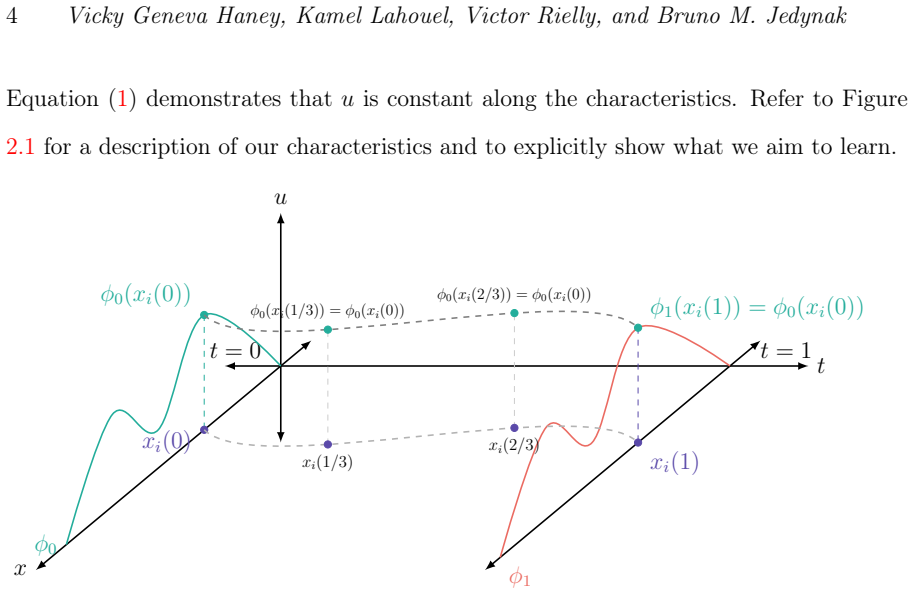
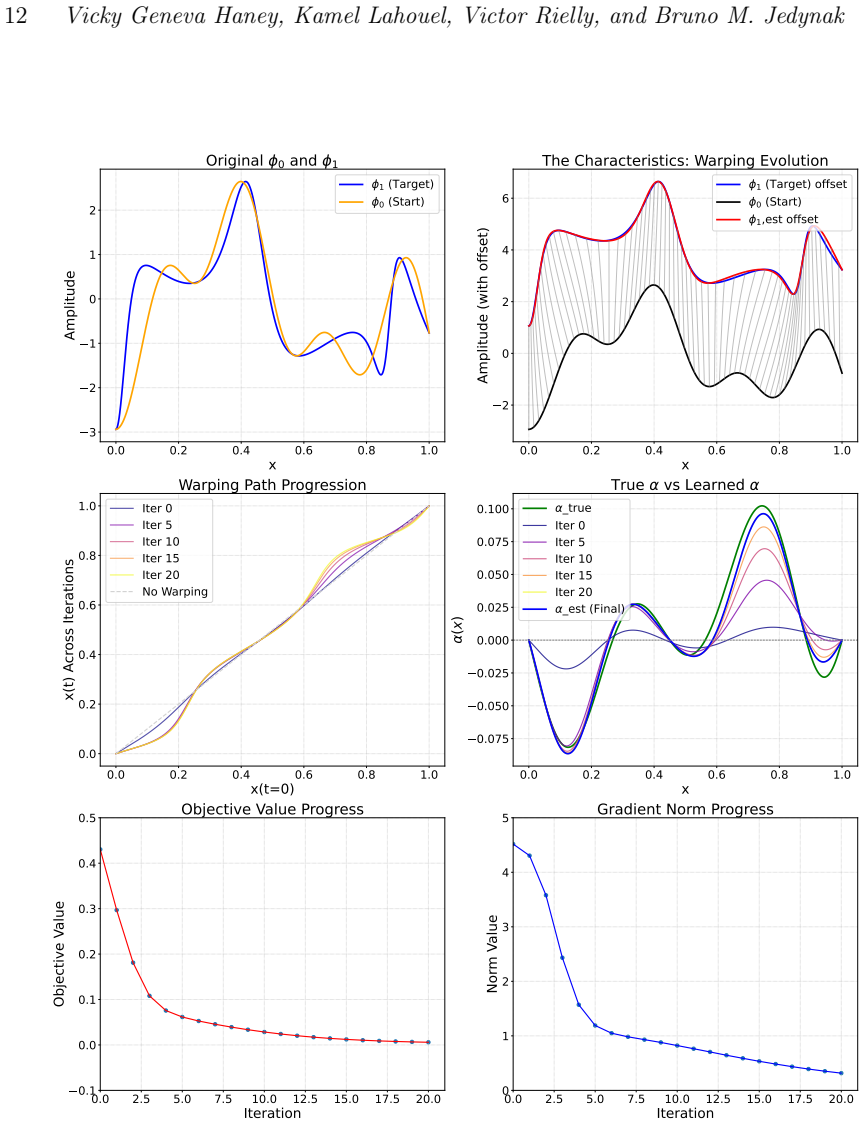
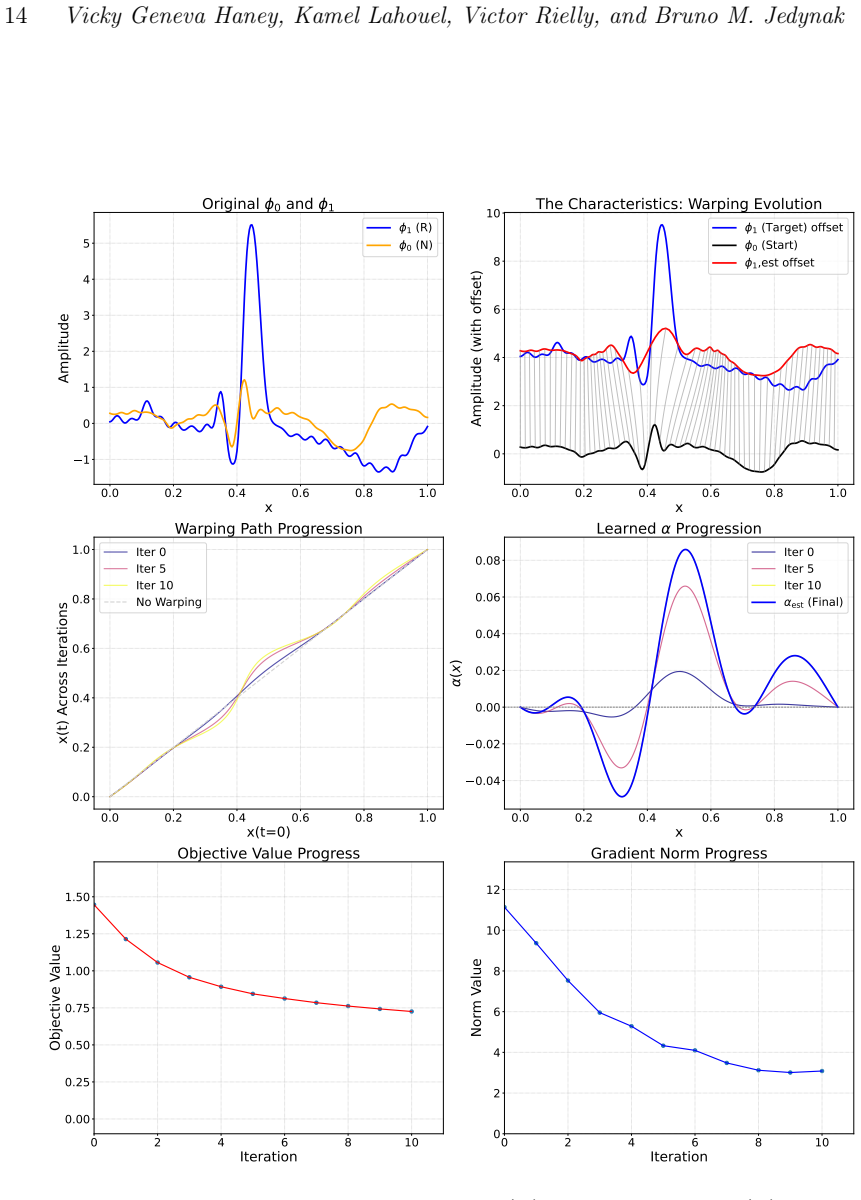
DiffTW supplies a dissimilarity measure by learning diffeomorphic transformations that approximate the flows of characteristic curves of a linear transport equation with space-dependent velocity, obtained by reducing the equation to ordinary differential equations and optimizing the velocity field in a reproducing kernel Hilbert space.
What carries the argument
Diffeomorphic mapping produced by integrating the velocity field along the characteristic curves of the transport equation.
If this is right
- Time series similarity is measured by a continuous deformation rather than discrete point correspondences.
- The dissimilarity can be inserted directly into any distance-based classifier such as 1-nearest neighbor.
- The construction links time-series alignment to the theory of linear transport equations.
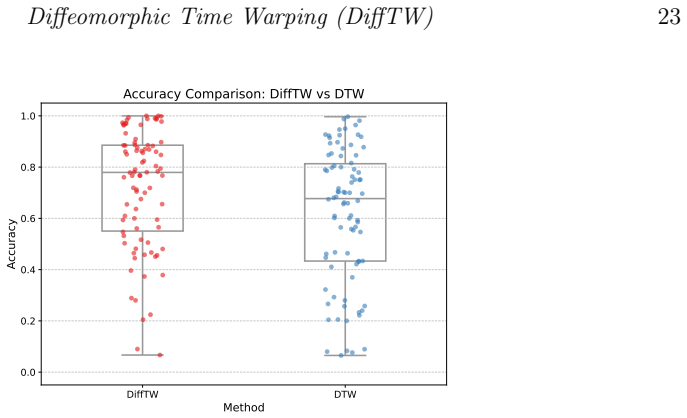
- The method yields higher classification accuracy than DTW on 60 of the 86 tested datasets.
Where Pith is reading between the lines
- The same transport-based construction could be tested on other sequence problems such as clustering or anomaly detection.
- Alternative partial differential equations or different function spaces for the velocity field might produce further gains on particular data domains.
Load-bearing premise
The learned mappings can be treated as approximations to the flows associated with the characteristic curves of a linear transport equation that has a space-dependent velocity field.
What would settle it
A head-to-head run of 1-nearest-neighbor classification on the same 86 datasets in which the DiffTW distance fails to exceed DTW accuracy on more than 43 datasets would falsify the performance claim.
Figures
read the original abstract
Time series classification involves learning a mapping from a continuous, temporally ordered sequence of real-valued observations to a discrete response variable, like class labels. This task is fundamental in domains, including health monitoring, where the temporal structure of data is critical for accurate prediction. Dynamic Time Warping (DTW) is a standard technique for measuring similarity between sequences varying in time or speed. However, DTW is restricted to discrete point matching. To move beyond pairwise alignment, we propose a theoretical framework that learns mappings between real-valued functions. These mappings approximate the flow associated with the characteristic curves of a linear transport equation with a space-dependent velocity field, providing a diffeomorphic transformation between two time series. Using the method of characteristics, we transform this partial differential equation into ordinary differential equations (ODEs) modeling system dynamics. The objective function used to learn these ODEs derives from the fundamental theorem of calculus. To enable flexible, expressive representations of the velocity field, we utilize reproducing kernel Hilbert spaces and optimal control methods. Our method, Diffeomorphic Time Warping (DiffTW), provides a theoretically grounded dissimilarity measure. Using a 1-nearest neighbor classifier, DiffTW outperforms DTW on 60 of 86 datasets.
Editorial analysis
A structured set of objections, weighed in public.
Referee Report
Summary. The manuscript introduces Diffeomorphic Time Warping (DiffTW) for time series classification. It constructs diffeomorphic mappings between functions by approximating flows along characteristic curves of a linear transport PDE with space-dependent velocity, converts the PDE to ODEs via the method of characteristics, obtains the learning objective from the fundamental theorem of calculus, represents the velocity field in an RKHS via optimal control, and reports that 1NN classification using the resulting dissimilarity outperforms DTW on 60 of 86 datasets.
Significance. If the PDE-to-ODE derivation and FTC-based objective are internally consistent and the empirical gains are reproducible, the work supplies a continuous, theoretically motivated dissimilarity that extends DTW while preserving diffeomorphic properties. This could be useful in domains requiring smooth temporal alignments. No machine-checked proofs, open code, or parameter-free derivations beyond the stated FTC link are described.
major comments (2)
- [Abstract] Abstract: the claim that the objective derives from the fundamental theorem of calculus and yields a dissimilarity independent of fitted parameters is load-bearing for the parameter-free assertion, yet the description leaves open whether the measure reduces to quantities defined by the RKHS coefficients or velocity parameters; explicit expansion of this step is required to confirm the construction does not become circular.
- [Abstract] Abstract: the central empirical result (1NN outperformance on 60/86 datasets) rests on the learned dissimilarity being a valid diffeomorphic warping; without verification that the characteristic-curve approximation and RKHS control preserve the diffeomorphism in the implemented solver, the claim that DiffTW is theoretically grounded cannot be assessed.
minor comments (1)
- [Abstract] Abstract: the number and identity of the 86 datasets should be stated explicitly (e.g., UCR archive version) to allow direct replication of the 60/86 count.
Simulated Author's Rebuttal
We thank the referee for the constructive comments on the manuscript. We address each major comment below and will revise the paper accordingly to improve clarity and strengthen the theoretical grounding.
read point-by-point responses
-
Referee: [Abstract] Abstract: the claim that the objective derives from the fundamental theorem of calculus and yields a dissimilarity independent of fitted parameters is load-bearing for the parameter-free assertion, yet the description leaves open whether the measure reduces to quantities defined by the RKHS coefficients or velocity parameters; explicit expansion of this step is required to confirm the construction does not become circular.
Authors: We agree that the link from the FTC to a parameter-independent dissimilarity requires explicit expansion to eliminate any ambiguity. The objective is obtained by integrating the transport equation along characteristics, after which the dissimilarity depends only on the resulting endpoint mappings rather than the specific RKHS coefficients or velocity parameters. In the revision we will insert a step-by-step derivation (in the methods section, with a brief reference in the abstract) that shows the reduction explicitly and confirms the construction is non-circular. revision: yes
-
Referee: [Abstract] Abstract: the central empirical result (1NN outperformance on 60/86 datasets) rests on the learned dissimilarity being a valid diffeomorphic warping; without verification that the characteristic-curve approximation and RKHS control preserve the diffeomorphism in the implemented solver, the claim that DiffTW is theoretically grounded cannot be assessed.
Authors: The theoretical construction guarantees diffeomorphism because the velocity field belongs to an RKHS that yields Lipschitz-continuous flows, and the method of characteristics produces a diffeomorphic mapping under these conditions. Nevertheless, the referee correctly notes that the implemented solver requires explicit verification that the numerical approximations preserve this property. In the revision we will add a dedicated paragraph (with supporting analysis or bounds) confirming that the characteristic-curve discretization and RKHS control maintain invertibility and positive Jacobian determinants in practice. revision: yes
Circularity Check
No significant circularity in derivation chain
full rationale
The paper's core derivation transforms a linear transport PDE into ODEs via the method of characteristics and obtains the objective from the fundamental theorem of calculus; both steps invoke standard external mathematics rather than self-referential definitions or fitted parameters renamed as predictions. RKHS optimal control is introduced only as a representation tool for the velocity field. No self-citations, uniqueness theorems, or ansatzes smuggled from prior author work appear in the abstract or described framework. The 1NN empirical comparison on 86 datasets is an independent evaluation step, not part of the claimed derivation. The construction is therefore self-contained against external benchmarks.
Axiom & Free-Parameter Ledger
Reference graph
Works this paper leans on
-
[1]
A global averaging method for dynamic time warping, with applications to clustering , journal =
Petitjean, Fran. A global averaging method for dynamic time warping, with applications to clustering , journal =. 2011 , publisher =
2011
-
[2]
Advances in Neural Information Processing Systems , volume =
Neural Ordinary Differential Equations , author =. Advances in Neural Information Processing Systems , volume =. 2018 , publisher =
2018
-
[3]
and Ba, Jimmy , title =
Kingma, Diederik P. and Ba, Jimmy , title =. International Conference on Learning Representations (ICLR) , year =
-
[4]
Advances in neural information processing systems , volume=
Random features for large-scale kernel machines , author=. Advances in neural information processing systems , volume=
-
[6]
A novel distance measure based on dynamic time warping to improve time series classification , journal =. 2024 , issn =. doi:https://doi.org/10.1016/j.ins.2023.119921 , url =
-
[7]
2023 , eprint=
Computing Continuous Dynamic Time Warping of Time Series in Polynomial Time , author=. 2023 , eprint=
2023
-
[8]
Marco Cuturi and Mathieu Blondel , booktitle =. Soft-. 2017 , editor =
2017
-
[9]
Hoang Anh Dau and Anthony Bagnall and Kaveh Kamgar and Chin-Chia Michael Yeh and Yan Zhu, Shaghayegh Gharghabi and Chotirat Ann Ratanamahatana and Eamonn Keogh , url =. The
-
[10]
Moody GB and Mark RG , url =. The
-
[11]
Bake off redux: a review and experimental evaluation of recent time series classification algorithms , author =. Data Mining and Knowledge Discovery , year =. doi:10.1007/s10618-024-01022-1 , url =
-
[12]
2011 , institution =
Cardiac Arrhythmia Detection using Dynamic Time Warping of ECG Beats in E-Healthcare Systems , author =. 2011 , institution =
2011
-
[13]
Journal of Statistical Software , volume =
Computing and Visualizing Dynamic Time Warping Alignments in R: The dtw Package , author =. Journal of Statistical Software , volume =. 2009 , doi =
2009
-
[14]
McOwen , title = "
Robert C. McOwen , title = ". 2003 , address =
2003
-
[15]
Brendon J Brewer, Daniel Foreman-Mackey, and David W Hogg
Beg, M. Faisal and Miller, Michael I. and Trouv. Computing Large Deformation Metric Mappings via Geodesic Flows of Diffeomorphisms , journal =. 2005 , volume =. doi:10.1023/B:VISI.0000043755.93987.aa , url =
-
[16]
2022 , address =
Sergei Pereverzyev , title =. 2022 , address =
2022
-
[17]
Econometrica , number = 1, pages =
Regression Quantiles , author =. Econometrica , number = 1, pages =
-
[18]
and Kozubowski, T
Kotz, S. and Kozubowski, T. and Podg\'orski, K. , publisher =. The
-
[19]
Pozdnyakov, V. and Elbroch, L. M. and Labarga, A. and Meyer, T. and Yan, J. , title =. Methodology and Computing in Applied Probability , year = 2019, volume = 21, number = 3, pages =. doi:10.1007/s11009-017-9547-6 , url =
discussion (0)
Sign in with ORCID, Apple, or X to comment. Anyone can read and Pith papers without signing in.