Atomic-scale theory of robust out-of-plane ferroelectricity in ultrathin films
Pith reviewed 2026-06-26 07:08 UTC · model grok-4.3
The pith
Robust out-of-plane ferroelectricity in ultrathin films arises from self-polarizing and switchable termination-layer effects tied to the film's characteristic structure.
A machine-rendered reading of the paper's core claim, the machinery that carries it, and where it could break.
Core claim
By considering the work function of the termination layers of the film, robust ferroelectricity arises from self-polarizing and switchable role of the termination layer effects strongly correlated to the characteristic structure. This theory provides further insights on the importance of top electrodes in stabilizing ferroelectricity for this class of materials in the ultrathin limit.
What carries the argument
The atomic-scale framework that connects termination-layer work function to self-polarizing and switchable-role effects within the characteristic structure.
Load-bearing premise
The work function of the termination layers is the dominant factor that produces the self-polarizing and switchable-role effects in the ultrathin regime.
What would settle it
A calculation or measurement in which altering the termination-layer work function leaves the polarization stability of ultrathin films unchanged would falsify the central claim.
Figures
read the original abstract
Ferroelectricity in ultrathin films, characterized by robust switchable out-of-plane polarization, is key to next-generation nanoelectronics. Although the macroscopic theory of ferroelectricity suggests that ferroelectricity is inevitably suppressed as the film thickness decreases, recent studies have demonstrated robust ultra thin-film ferroelectricity, for certain ferroelectric materials, specifically HfO$_2$-based oxides and bismuth-based oxides. In this work, we develop an atomic-scale theoretical framework for understanding ferroelectricity in this limiting regime. By considering the work function of the termination layers of the film, we find that robust ferroelectricity arises from ``self-polarizing'' and ``switchable role of the termination layer'' effects strongly correlated to the ``characteristic structure.'' This theory also provides further insights on the importance of top electrodes in stabilizing ferroelectricity for this class of materials in the ultrathin limit. This work aims to develop a comprehensive theoretical framework for thin-film ferroelectricity, providing fundamental insights that can guide the design of next-generation nanoscale devices.
Editorial analysis
A structured set of objections, weighed in public.
Referee Report
Summary. The manuscript develops an atomic-scale theoretical framework to explain robust out-of-plane ferroelectricity in ultrathin films of HfO2-based and bismuth-based oxides. By considering the work function of termination layers, the authors attribute the observed ferroelectricity to self-polarizing and switchable-role-of-the-termination-layer effects that are strongly correlated to the characteristic structure of the film. The framework also yields insights on the stabilizing role of top electrodes in the ultrathin limit.
Significance. If the framework is substantiated, it supplies a conceptual atomic-scale explanation for ferroelectricity in a thickness regime where macroscopic theory predicts suppression, potentially guiding material and electrode design for nanoscale devices. The internal consistency of the logic (work-function-driven effects tied to termination layers) is a positive feature, though the absence of quantitative predictions or direct experimental comparisons in the provided description limits immediate falsifiability.
minor comments (2)
- The abstract introduces the key effects in quotation marks without immediate definitions; the main text should supply explicit operational definitions or derivations for "self-polarizing," "switchable role of the termination layer," and "characteristic structure" to allow readers to assess the framework.
- No equations, model Hamiltonians, or numerical results are referenced in the abstract. If the full manuscript contains them, a brief statement of the central equation or computational method would strengthen the summary.
Simulated Author's Rebuttal
We thank the referee for their review and for accurately summarizing the key elements of our atomic-scale framework for ultrathin ferroelectricity. No specific major comments were provided in the report, so we have no point-by-point responses to offer at this time. We are happy to address any additional questions the referee may have.
Circularity Check
No significant circularity detected
full rationale
The provided abstract and description present a conceptual atomic-scale framework in which termination-layer work function produces self-polarizing and switchable-role effects. No equations, fitted parameters, self-citations, or derivation steps are supplied that reduce any prediction or central claim to its own inputs by construction. The framework is offered as an explanatory model rather than a quantitative derivation containing hidden self-referential definitions or fitted-input predictions. This is the most common honest finding for papers whose central contribution is a new conceptual organization without load-bearing algebraic reductions.
Axiom & Free-Parameter Ledger
Reference graph
Works this paper leans on
-
[1]
self-polarization
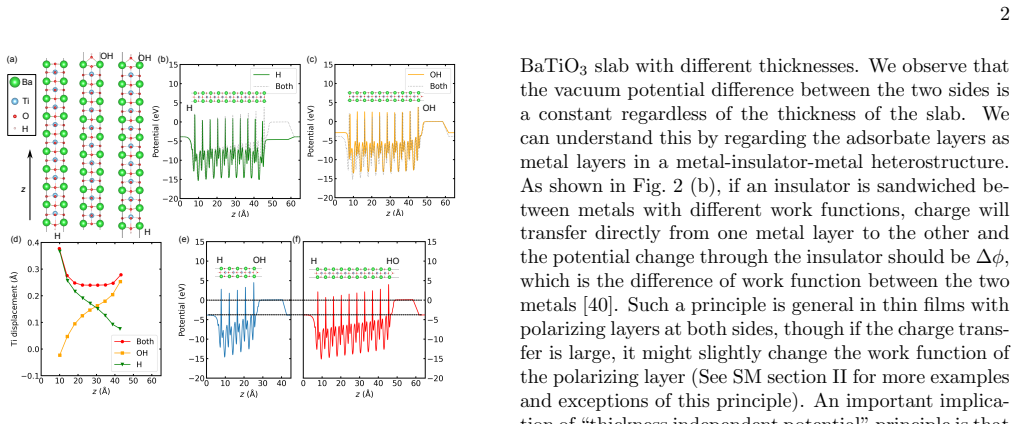
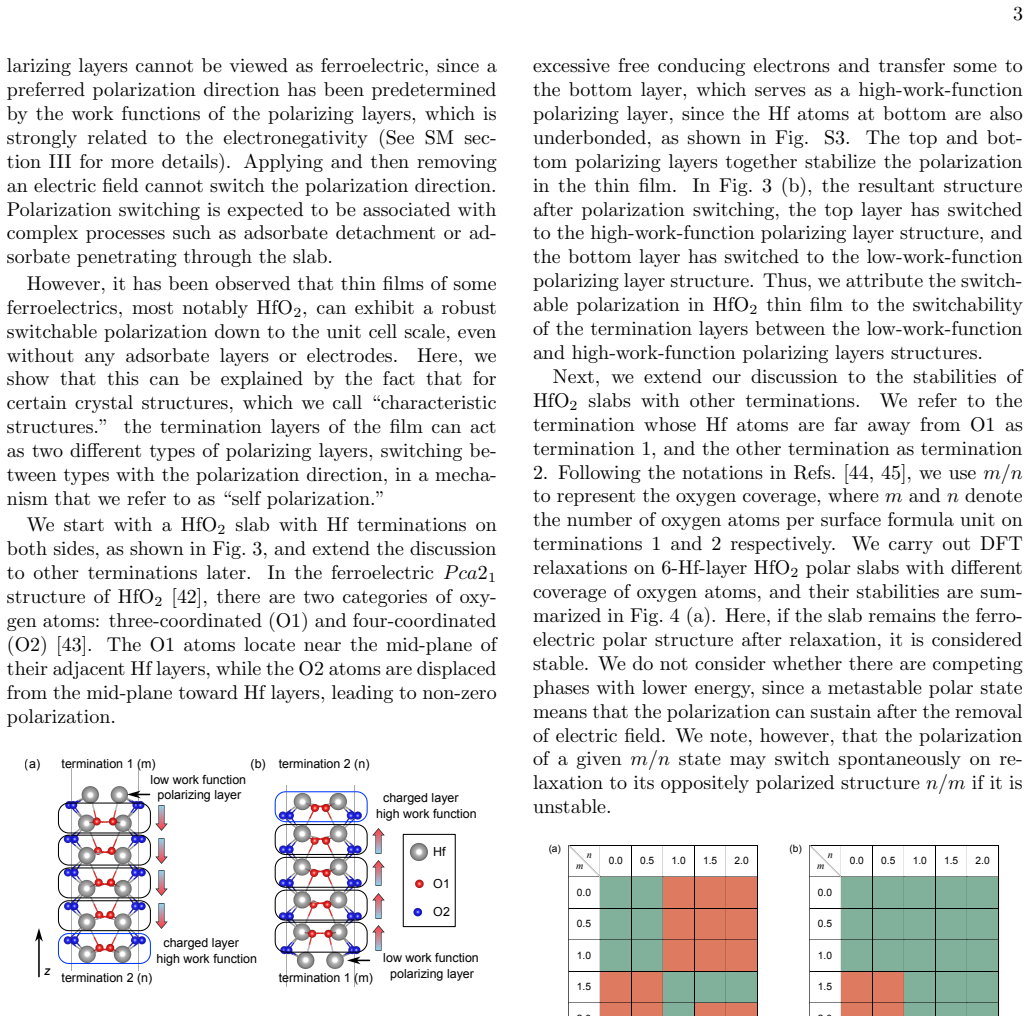
Following the notations in Refs. [44, 45], we usem/n to represent the oxygen coverage, wheremandndenote the number of oxygen atoms per surface formula unit on terminations 1 and 2 respectively. We carry out DFT relaxations on 6-Hf-layer HfO 2 polar slabs with different coverage of oxygen atoms, and their stabilities are sum- marized in Fig. 4 (a). Here, i...
-
[2]
Non-volatile memory based on the ferroelectric photovoltaic effect,
Rui Guo, Lu You, Yang Zhou, Zhi Shiuh Lim, Xi Zou, Lang Chen, R Ramesh, and Junling Wang, “Non-volatile memory based on the ferroelectric photovoltaic effect,” Nature Communications4, 1990 (2013)
1990
-
[3]
A scalable fer- roelectric non-volatile memory operating at 600°C,
Dhiren K Pradhan, David C Moore, Gwangwoo Kim, Yunfei He, Pariasadat Musavigharavi, Kwan-Ho Kim, Nishant Sharma, Zirun Han, Xingyu Du, Venkata S Puli, Eric A Stach, W Joshua Kennedy, Nicholas R Glavin, Roy H Olsson III, and Deep Jariwala, “A scalable fer- roelectric non-volatile memory operating at 600°C,” Na- ture Electronics7, 348–355 (2024)
2024
-
[4]
Enabling distributed intelligence with ferroelectric multifunctionalities,
Kui Yao, Shuting Chen, Szu Cheng Lai, and Yasmin Mo- hamed Yousry, “Enabling distributed intelligence with ferroelectric multifunctionalities,” Advanced Science9, 2103842 (2022)
2022
-
[5]
The future of ferroelectric field-effect transistor tech- nology,
Asif Islam Khan, Ali Keshavarzi, and Suman Datta, “The future of ferroelectric field-effect transistor tech- nology,” Nature Electronics3, 588–597 (2020)
2020
-
[6]
Ferroelectric field-effect transistors based on HfO 2: a review,
Halid Mulaosmanovic, Evelyn T Breyer, Stefan D¨ unkel, Sven Beyer, Thomas Mikolajick, and Stefan Slesazeck, “Ferroelectric field-effect transistors based on HfO 2: a review,” Nanotechnology32, 502002 (2021)
2021
-
[7]
Phase tran- sition, stability, and depolarization field in ferroelectric thin films,
I P Batra, P Wurfel, and B D Silverman, “Phase tran- sition, stability, and depolarization field in ferroelectric thin films,” Physical Review B8, 3257 (1973)
1973
-
[8]
Depolar- ization fields in thin ferroelectric films,
R R Mehta, B D Silverman, and J T Jacobs, “Depolar- ization fields in thin ferroelectric films,” Journal of Ap- plied Physics44, 3379–3385 (1973)
1973
-
[9]
Ferroelectric thin films: Review of materials, properties, and applications,
Nava Setter, D Damjanovic, L Eng, G Fox, Spartak Gevorgian, S Hong, A Kingon, H Kohlstedt, N Y Park, G B Stephenson, I Stolitchnov, A K Taganstev, D V Taylor, Y Yamada, and S Streiffer, “Ferroelectric thin films: Review of materials, properties, and applications,” Journal of Applied Physics100, 051606 (2006)
2006
-
[10]
Overcoming size effects in ferroelec- tric thin films,
Sung Hyuk Park, Jae Young Kim, Jae Yong Song, and Ho Won Jang, “Overcoming size effects in ferroelec- tric thin films,” Advanced Physics Research2, 2200096 (2023)
2023
-
[11]
Critical thickness for ferroelectricity in perovskite ultrathin films,
Javier Junquera and Philippe Ghosez, “Critical thickness for ferroelectricity in perovskite ultrathin films,” Nature 422, 506–509 (2003)
2003
-
[12]
The stability of ionic crystal surfaces,
PW Tasker, “The stability of ionic crystal surfaces,” Journal of Physics C: Solid State Physics12, 4977 (1979)
1979
-
[13]
Physics of thin-film ferroelectric oxides,
Matthew Dawber, K M Rabe, and J F Scott, “Physics of thin-film ferroelectric oxides,” Reviews of Modern Physics77, 1083–1130 (2005)
2005
-
[14]
Depolarization-field-induced instability in thin ferroelectric films-experiment and the- ory,
P Wurfel and I P Batra, “Depolarization-field-induced instability in thin ferroelectric films-experiment and the- ory,” Physical Review B8, 5126 (1973)
1973
-
[15]
Polarization relaxation induced by a depolarization field in ultrathin ferroelectric BaTiO3 capacitors,
D J Kim, J Y Jo, Y S Kim, Y J Chang, J S Lee, Jong-Gul Yoon, T K Song, and T W Noh, “Polarization relaxation induced by a depolarization field in ultrathin ferroelectric BaTiO3 capacitors,” Physical Review Letters95, 237602 (2005)
2005
-
[16]
Designing ferroelectric field-effect transistors based on the polarization-rotation effect for low operating voltage and fast switching,
Yubo Qi and Andrew M Rappe, “Designing ferroelectric field-effect transistors based on the polarization-rotation effect for low operating voltage and fast switching,” Phys- ical Review Applied4, 044014 (2015)
2015
-
[17]
Understanding order in compositionally graded ferroelectrics: Flexoelectricity, gradient, and depolariza- tion field effects,
J Zhang, R Xu, A R Damodaran, Z-H Chen, and L W Martin, “Understanding order in compositionally graded ferroelectrics: Flexoelectricity, gradient, and depolariza- tion field effects,” Physical Review B89, 224101 (2014)
2014
-
[18]
Review and perspective on ferroelectric HfO 2-based thin films for memory applications,
Min Hyuk Park, Young Hwan Lee, Thomas Mikolajick, Uwe Schroeder, and Cheol Seong Hwang, “Review and perspective on ferroelectric HfO 2-based thin films for memory applications,” Mrs Communications8, 795–808 (2018)
2018
-
[19]
Ferroelectricity and antiferroelec- tricity of doped thin hfo 2-based films,
Min Hyuk Park, Young Hwan Lee, Han Joon Kim, Yu Jin Kim, Taehwan Moon, Keum Do Kim, Johannes M¨ uller, Alfred Kersch, Uwe Schroeder, Thomas Mikolajick, and Cheol Seong Hwang, “Ferroelectricity and antiferroelec- tricity of doped thin hfo 2-based films,” Advanced Mate- rials27, 1811–1831 (2015)
2015
-
[20]
Ferroelectricity in hafnium oxide thin films,
T S B¨ oscke, J M¨ uller, D Br¨ auhaus, U Schr¨ oder, and U B¨ ottger, “Ferroelectricity in hafnium oxide thin films,” Applied Physics Letters99, 102903 (2011)
2011
-
[21]
Phase tran- sitions in ferroelectric silicon doped hafnium oxide,
T S B¨ oscke, St Teichert, D Br¨ auhaus, J M¨ uller, U Schr¨ oder, U B¨ ottger, and T Mikolajick, “Phase tran- sitions in ferroelectric silicon doped hafnium oxide,” Ap- plied Physics Letters99, 112904 (2011)
2011
-
[22]
Ferroelectricity in yttrium–doped hafnium oxide,
J M¨ uller, U Schr¨ oder, T S B¨ oscke, I M¨ uller, U B¨ ottger, L Wilde, J Sundqvist, M Lemberger, P K¨ ucher, T Miko- 6 lajick, and L Frey, “Ferroelectricity in yttrium–doped hafnium oxide,” Journal of Applied Physics110, 114113 (2011)
2011
-
[23]
Intrinsic two-dimensional ferroelectricity with dipole locking,
Jun Xiao, Hanyu Zhu, Ying Wang, Wei Feng, Yunxia Hu, Arvind Dasgupta, Yimo Han, Yuan Wang, David A Muller, Lane W Martin, PingAn Hu, and Xiang Zhang, “Intrinsic two-dimensional ferroelectricity with dipole locking,” Physical Review Letters120, 227601 (2018)
2018
-
[24]
An ultrathin two-dimensional vertical ferroelec- tric tunneling junction based on CuInP 2S6 monolayer,
Min Zhao, Gaoyang Gou, Xiangdong Ding, and Jun Sun, “An ultrathin two-dimensional vertical ferroelec- tric tunneling junction based on CuInP 2S6 monolayer,” Nanoscale12, 12522–12530 (2020)
2020
-
[25]
Ferroelectricity in layered bismuth oxide down to 1 nanometer,
Qianqian Yang, Jingcong Hu, Yue-Wen Fang, Yueyang Jia, Rui Yang, Shiqing Deng, Yue Lu, Oswaldo Dieguez, Longlong Fan, Dongxing Zheng, Xixiang Zhang, Yongqi Dong, Zhenlin Luo, Zhen Wang, Huanhua Wang, Man- ling Sui, Xianran Xing, Jun Chen, Jianjun Tian, and Linxing Zhang, “Ferroelectricity in layered bismuth oxide down to 1 nanometer,” Science379, 1218–1224 (2023)
2023
-
[26]
Hybrid im- proper ferroelectricity: A mechanism for controllable polarization-magnetization coupling,
Nicole A Benedek and Craig J Fennie, “Hybrid im- proper ferroelectricity: A mechanism for controllable polarization-magnetization coupling,” Physical Review Letters106, 107204 (2011)
2011
-
[27]
Origin of the critical thickness in improper ferroelec- tric thin films,
Alexander Vogel, Alicia Ruiz Caridad, Johanna Nord- lander, Martin F Sarott, Quintin N Meier, Rolf Erni, Nicola A Spaldin, Morgan Trassin, and Marta D Rossell, “Origin of the critical thickness in improper ferroelec- tric thin films,” ACS Applied Materials & Interfaces15, 18482–18492 (2023)
2023
-
[28]
Absence of critical thickness in an ultrathin improper ferroelectric film,
Na Sai, Craig J Fennie, and Alexander A Demkov, “Absence of critical thickness in an ultrathin improper ferroelectric film,” Physical Review Letters102, 107601 (2009)
2009
-
[29]
Strain-induced antipolar phase in hafnia stabilizes ro- bust thin-film ferroelectricity,
Songsong Zhou, Jiahao Zhang, and Andrew M Rappe, “Strain-induced antipolar phase in hafnia stabilizes ro- bust thin-film ferroelectricity,” Science Advances8, eadd5953 (2022)
2022
-
[30]
Scale-free fer- roelectricity induced by flat phonon bands in HfO2,
Hyun-Jae Lee, Minseong Lee, Kyoungjun Lee, Jinhyeong Jo, Hyemi Yang, Yungyeom Kim, Seung Chul Chae, Umesh Waghmare, and Jun Hee Lee, “Scale-free fer- roelectricity induced by flat phonon bands in HfO2,” Sci- ence369, 1343–1347 (2020)
2020
-
[31]
Stabilization of monodomain polarization in ultrathin PbTiO 3 films,
D D Fong, A M Kolpak, J A Eastman, S K Streiffer, P H Fuoss, G B Stephenson, Carol Thompson, D M Kim, Kyoung Jin Choi, C B Eom, I Grinberg, and A M Rappe, “Stabilization of monodomain polarization in ultrathin PbTiO 3 films,” Physical Review Letters96, 127601 (2006)
2006
-
[32]
Electrochemical ferro- electric switching: Origin of polarization reversal in ul- trathin films,
N C Bristowe, Massimiliano Stengel, P B Littlewood, J M Pruneda, and Emilio Artacho, “Electrochemical ferro- electric switching: Origin of polarization reversal in ul- trathin films,” Physical Review B-Condensed Matter and Materials Physics85, 024106 (2012)
2012
-
[33]
Adsorbate screening of surface charge of micro- scopic ferroelectric domains in Sol–Gel PbZr 0.2Ti0.8O3 thin films,
Olivier Copie, Nicolas Chevalier, Gwenael Le Rhun, Cindy L Rountree, Dominique Martinotti, Sara Gonza- lez, Claire Mathieu, Olivier Renault, and Nicholas Bar- rett, “Adsorbate screening of surface charge of micro- scopic ferroelectric domains in Sol–Gel PbZr 0.2Ti0.8O3 thin films,” ACS Applied Materials & Interfaces9, 29311–29317 (2017)
2017
-
[34]
Ferroelectric surface chemistry: First- principles study of adsorption on the stoichiometric LiNbO3 (0001) surface,
Chen Yue, Xiaomei Lu, Junting Zhang, Fengzhen Huang, and Jinsong Zhu, “Ferroelectric surface chemistry: First- principles study of adsorption on the stoichiometric LiNbO3 (0001) surface,” Physical Review B100, 245432 (2019)
2019
-
[35]
Ferroelectric phase transi- tion in individual single-crystalline BaTiO 3 nanowires,
Jonathan E Spanier, Alexie M Kolpak, Jeffrey J Urban, Ilya Grinberg, Lian Ouyang, Wan Soo Yun, Andrew M Rappe, and Hongkun Park, “Ferroelectric phase transi- tion in individual single-crystalline BaTiO 3 nanowires,” Nano letters6, 735–739 (2006)
2006
-
[36]
Reversible chemical switching of a ferroelectric film,
R V Wang, D D Fong, F Jiang, M J Highland, P H Fu- oss, Carol Thompson, A M Kolpak, J A Eastman, S K Streiffer, A M Rappe, and G B Stephenson, “Reversible chemical switching of a ferroelectric film,” Physical Re- view Letters102, 047601 (2009)
2009
-
[37]
Sur- face reconstruction and ferroelectricity in PbTiO 3 thin films,
M Sepliarsky, M G Stachiotti, and R L Migoni, “Sur- face reconstruction and ferroelectricity in PbTiO 3 thin films,” Physical Review B-Condensed Matter and Mate- rials Physics72, 014110 (2005)
2005
-
[38]
Ferroelectricity and self-polarization in ultrathin relaxor ferroelectric films,
Peixian Miao, Yonggang Zhao, Nengneng Luo, Diyang Zhao, Aitian Chen, Zhong Sun, Meiqi Guo, Meihong Zhu, Huiyun Zhang, and Qiang Li, “Ferroelectricity and self-polarization in ultrathin relaxor ferroelectric films,” Scientific reports6, 19965 (2016)
2016
-
[39]
Interface-induced polarization and inhibition of ferroelectricity in epitaxial SrTiO 3/Si,
A M Kolpak, F J Walker, J W Reiner, Y Segal, D Su, M S Sawicki, C C Broadbridge, Z Zhang, Y Zhu, C H Ahn, and S S. Ismail-Beigi1, “Interface-induced polarization and inhibition of ferroelectricity in epitaxial SrTiO 3/Si,” Physical Review Letters105, 217601 (2010)
2010
-
[40]
The atomic structure and polariza- tion of strained SrTiO 3/Si,
D P Kumah, J W Reiner, Y Segal, A M Kolpak, Z Zhang, D Su, Y Zhu, MS Sawicki, C C Broadbridge, C H Ahn, and F J Walker, “The atomic structure and polariza- tion of strained SrTiO 3/Si,” Applied Physics Letters97, 251902 (2010)
2010
-
[41]
Band bending in semi- conductors: chemical and physical consequences at sur- faces and interfaces,
Zhen Zhang and John T Yates Jr, “Band bending in semi- conductors: chemical and physical consequences at sur- faces and interfaces,” Chemical Reviews112, 5520–5551 (2012)
2012
-
[42]
characteristic structures
“See Supplementary Material (SM) at href for informa- tion regarding the computational details, more exam- ples and exceptions about thickness independent poten- tial principles, relationship between electronegativity and work function, stabilitiies of HfO 2 slabs with different oxygen coverages, stabilitiies of HfO 2 slabs with cu elec- trodes, and schem...
-
[43]
On the structural origins of ferroelectricity in HfO 2 thin films,
Xiahan Sang, Everett D Grimley, Tony Schenk, Uwe Schroeder, and James M LeBeau, “On the structural origins of ferroelectricity in HfO 2 thin films,” Applied Physics Letters106, 162905 (2015)
2015
-
[44]
Hydrogen defects in HfO 2: impacts on ferroelectricity and leakage,
Tao Yu, Binjian Zeng, Qiong Yang, Shuaizhi Zheng, Yichun Zhou, and Min Liao, “Hydrogen defects in HfO 2: impacts on ferroelectricity and leakage,” Computational Materials Science260, 114219 (2025)
2025
-
[45]
Relationship between ferroelectric polarization and stoichiometry of HfO2 surfaces,
Adrian Acosta, J Mark P Martirez, Norleakvisoth Lim, Jane P Chang, and Emily A Carter, “Relationship between ferroelectric polarization and stoichiometry of HfO2 surfaces,” Physical Review Materials5, 124417 (2021)
2021
-
[46]
Effect of thickness and surface composition on the stability of polarization in ferroelectric Hf xZr1−xO2 thin films,
Adrian Acosta, J Mark P Martirez, Norleakvisoth Lim, Jane P Chang, and Emily A Carter, “Effect of thickness and surface composition on the stability of polarization in ferroelectric Hf xZr1−xO2 thin films,” Physical Review Materials7, 124401 (2023)
2023
-
[47]
Origin of ferroelectric phase stabi- 7 lization via the clamping effect in ferroelectric hafnium zirconium oxide thin films,
Shelby S Fields, Truong Cai, Samantha T Jaszewski, Ale- jandro Salanova, Takanori Mimura, Helge H Heinrich, Michael David Henry, Kyle P Kelley, Brian W Sheldon, and Jon F Ihlefeld, “Origin of ferroelectric phase stabi- 7 lization via the clamping effect in ferroelectric hafnium zirconium oxide thin films,” Advanced Electronic Mate- rials8, 2200601 (2022)
2022
-
[48]
Stabilization of ferroelectric phase in tungsten capped Hf0.8Zr0.2O2,
Golnaz Karbasian, Roberto Dos Reis, Ajay K Yadav, Ava J Tan, Chenming Hu, and Sayeef Salahuddin, “Stabilization of ferroelectric phase in tungsten capped Hf0.8Zr0.2O2,” Applied Physics Letters111, 022907 (2017)
2017
-
[49]
Effects of Al doping concentration and top electrode on the ferroelectricity of Al-doped HfO2 thin films,
Li Feng, Yu-Chun Li, Teng Huang, Hong-Liang Lu, and David Wei Zhang, “Effects of Al doping concentration and top electrode on the ferroelectricity of Al-doped HfO2 thin films,” AIP Advances14, 015105 (2024)
2024
-
[50]
Effects of capping electrode on ferroelectric properties of Hf 0.5 Zr0.5O2 thin films,
Rongrong Cao, Yan Wang, Shengjie Zhao, Yang Yang, Xiaolong Zhao, Wei Wang, Xumeng Zhang, Hangbing Lv, Qi Liu, and Ming Liu, “Effects of capping electrode on ferroelectric properties of Hf 0.5 Zr0.5O2 thin films,” IEEE Electron Device Letters39, 1207–1210 (2018)
2018
-
[51]
Regulat- ing ferroelectricity in Hf 0.5Zr0.5O2 thin films: Exploring the combined impact of oxygen vacancy and electrode stresses,
Mingkai Bai, Peizhen Hong, Runhao Han, Junshuai Chai, Bao Zhang, Jingwen Hou, Wenjuan Xiong, Shuai Yang, Jianfeng Gao, Feng Luo, and Zongliang Huo, “Regulat- ing ferroelectricity in Hf 0.5Zr0.5O2 thin films: Exploring the combined impact of oxygen vacancy and electrode stresses,” Journal of Applied Physics134, 174102 (2023)
2023
-
[52]
Understanding the effect of top electrode on ferroelectricity in atomic layer deposited Hf 0.5Zr0.5O2 thin films,
Xuepei Wang, Yichen Wen, Maokun Wu, Boyao Cui, Yi-Shan Wu, Yuchun Li, Xiaoxi Li, Sheng Ye, Peng- peng Ren, Zhi-Gang Ji, Hong-Lian Lu, Runsheng Wang, David Wei Zhang, and Ru Huang, “Understanding the effect of top electrode on ferroelectricity in atomic layer deposited Hf 0.5Zr0.5O2 thin films,” ACS Applied Mate- rials & Interfaces15, 15657–15667 (2023)
2023
-
[53]
Origin of reverse size effect in ferroelectric hafnia thin films,
Tianyuan Zhu, Jingxuan Li, Zuhuang Chen, and Shi Liu, “Origin of reverse size effect in ferroelectric hafnia thin films,” arXiv preprint arXiv:2509.12952 (2025)
Pith/arXiv arXiv 2025
-
[54]
Quantum espresso: A modular and open-source software project for quantum simulations of materials,
P. Giannozzi, S. Baroni, N. Bonini, M. Calandra, R. Car, C. Cavazzoni, D. Ceresoli, G. L Chiarotti, M. Cococ- cioni, I. Dabo, A. D. Corso, S. de Gironcoli, S. Fabris, G. Fratesi, R. Gebauer, U. Gerstmann, C. Gougoussis, A. Kokalj, M. Lazzeri, L. Martin-Samos, N. Marzari, F. Mauri, R. Mazzarello, S. Paolini, A. Pasquarello, L. Paulatto, C. Sbraccia, S. Sca...
2009
-
[55]
Restoring the density-gradient expansion for exchange in solids and surfaces,
John P Perdew, Adrienn Ruzsinszky, G´ abor I Csonka, Oleg A Vydrov, Gustavo E Scuseria, Lucian A Con- stantin, Xiaolan Zhou, and Kieron Burke, “Restoring the density-gradient expansion for exchange in solids and surfaces,” Physical Review Letters100, 136406 (2008)
2008
-
[56]
http://opium.sourceforge.net
-
[57]
Discovery and design of func- tional materials: integration of database searching and first principles calculations,
Joseph W Bennett, “Discovery and design of func- tional materials: integration of database searching and first principles calculations,” Physics Procedia34, 14–23 (2012)
2012
-
[58]
Special points for brillouin-zone integrations,
H. J. Monkhorst and J. D. Pack, “Special points for brillouin-zone integrations,” Physical Review B13, 5188–5192 (1976)
1976
-
[59]
Dipole correction for surface super- cell calculations,
Lennart Bengtsson, “Dipole correction for surface super- cell calculations,” Physical Review B59, 12301 (1999)
1999
discussion (0)
Sign in with ORCID, Apple, or X to comment. Anyone can read and Pith papers without signing in.