Structure and information measures of few-electron systems under a spherically symmetric Gaussian potential within a density functional approach
Pith reviewed 2026-06-26 08:23 UTC · model grok-4.3
The pith
Gaussian potential parameters control atomic energies and produce a non-linear loop in the Fisher-Shannon plane that signals weakened electron correlation.
A machine-rendered reading of the paper's core claim, the machinery that carries it, and where it could break.
Core claim
Through density functional calculations on H, He-like ions (Z=2-18), Li, and Be under a Gaussian potential, energies increase with decreasing width and increasing depth of the confining potential. Companion calculations of Shannon entropies and Fisher information reveal that position entropy reaches a minimum while momentum entropy and position Fisher information reach maxima under the same changes; these trends are amplified by greater potential depth. The resulting Fisher-Shannon plane indicates progressive localization together with compression of the electronic density, thereby pointing to a weakening of relative electron-correlation effects and producing a non-linear loop-like feature i
What carries the argument
Fisher-Shannon plane constructed from position and momentum Shannon entropies together with position Fisher information, obtained from Kohn-Sham densities under Gaussian confinement.
If this is right
- Energy of H, He-like ions, Li, and Be can be raised by reducing the width or increasing the depth of the Gaussian potential.
- Position-space Shannon entropy reaches a minimum while momentum-space entropy and position Fisher information reach maxima when the Gaussian width decreases.
- Increasing the depth of the Gaussian potential amplifies the changes in energy and all three information measures.
- The Fisher-Shannon plane exhibits progressive localization and density compression that the calculation links to weaker relative electron correlation.
- Collin's conjecture produces a non-linear loop-like feature under the Gaussian confinement.
Where Pith is reading between the lines
- The same information-measure analysis could be repeated for other smooth confining potentials to test whether the non-linear loop is specific to the Gaussian shape.
- The observed energy control by potential parameters supplies a concrete route for estimating how confinement alters ionization thresholds in model quantum-dot systems.
- If the loop persists when the Wigner or LYP functional is replaced by a different correlation approximation, the weakening of relative correlation would be more robust than the specific functionals used here.
Load-bearing premise
The local parameterized Wigner functional and the non-linear LYP functional remain accurate descriptors of electron correlation when the external potential is changed to a spherically symmetric Gaussian form.
What would settle it
Exact numerical solution of the Schrödinger equation for the helium atom in the same Gaussian potential, followed by direct computation of its Fisher-Shannon plane, would show whether the non-linear loop appears or the correlation-weakening trend holds.
Figures
read the original abstract
Energies of H, He-like ($Z=2-18$) ions, Li, and Be are investigated under a spherically symmetric Gaussian potential through a density functional formalism. The radial Kohn-Sham equation has been solved by invoking a work function-based exchange potential. The effect of electron correlation is analyzed by incorporating two functionals: a local parameterized Wigner functional and a non-linear gradient- and Laplacian-dependent Lee-Yang-Parr (LYP) functional. The generalized pseudospectral method is employed to provide accurate numerical eigenfunctions and eigenvalues. This allows nonuniform, optimal spatial discretization fulfilling the Dirichlet boundary conditions. This work demonstrates a possible manipulation of energy by controlling dot parameters. Apart from ground states, exploratory results are also reported for low-lying excited state $1s2s$ ($^{1,3}S$) of He atom. Companion calculations are also performed for various information-theoretic measures, such as Shannon entropy in position ($S_{r}$), momentum ($S_{p}$) spaces, and Fisher information in position space ($I_{r}$). The behavior of correlation functionals in presence of Gaussian potential is examined critically. We find that energy increases, $S_{r}$ exhibits minima, while $S_{p}$, $I_{r}$ attain maxima for a decrease in the width of potential, whereas an increase in potential depth further amplifies these effects across all properties. The Fisher-Shannon plane reveals a progressive localization as well as the compression of electronic density, and thereby indicates a weakening of relative electron-correlation effects. In the Collin's conjecture, it gives rise to a non-linear loop-like feature. Much of the results are presented here for the first time.
Editorial analysis
A structured set of objections, weighed in public.
Referee Report
Summary. The manuscript investigates energies of H, He-like ions (Z=2-18), Li, and Be under a spherically symmetric Gaussian potential using Kohn-Sham DFT. A work-function exchange potential is combined with either a local parameterized Wigner or gradient/Laplacian-dependent LYP correlation functional. The radial KS equation is solved numerically via the generalized pseudospectral method. Trends in total energies, Shannon entropies S_r and S_p, and Fisher information I_r are reported as functions of Gaussian depth and width, along with interpretations of the Fisher-Shannon plane (progressive localization, density compression, weakening relative correlation) and a non-linear loop feature in Collin's conjecture. Exploratory results for He 1s2s (^{1,3}S) excited states are included.
Significance. If the results hold, the work demonstrates how Gaussian confinement parameters can manipulate energies and information measures in few-electron systems, with potential relevance to quantum-dot modeling. The comparison of two correlation functionals under non-Coulombic confinement and the reported loop in Collin's conjecture would constitute a novel contribution to information-theoretic analyses of confined atoms.
major comments (2)
- [Abstract and correlation-functional analysis] The central interpretations—that the Fisher-Shannon plane shows progressive localization, density compression, and weakening of relative electron-correlation effects, plus the non-linear loop in Collin's conjecture—rest on the accuracy of the Wigner and LYP functionals for the Gaussian external potential. No cross-validation against exact diagonalization, quantum Monte Carlo, or other benchmarks is reported for this potential form (see abstract and the section examining correlation functionals).
- [Methods and results sections] The local parameterized Wigner functional and the non-linear LYP functional were originally constructed and calibrated for Coulombic atoms/ions. Their transferability to a spherically symmetric Gaussian confining potential is invoked without additional validation or adjustment, which is load-bearing for all reported trends in energies, S_r, S_p, and I_r.
minor comments (1)
- [Results] The manuscript would benefit from explicit tables or figures presenting numerical values of energies and entropies (with convergence checks) rather than only qualitative trends, to support reproducibility.
Simulated Author's Rebuttal
We thank the referee for the constructive feedback. We address the two major comments on functional validation and transferability below, offering partial revisions to strengthen the discussion of limitations while preserving the exploratory scope of the work.
read point-by-point responses
-
Referee: [Abstract and correlation-functional analysis] The central interpretations—that the Fisher-Shannon plane shows progressive localization, density compression, and weakening of relative electron-correlation effects, plus the non-linear loop in Collin's conjecture—rest on the accuracy of the Wigner and LYP functionals for the Gaussian external potential. No cross-validation against exact diagonalization, quantum Monte Carlo, or other benchmarks is reported for this potential form (see abstract and the section examining correlation functionals).
Authors: We agree that the manuscript reports no direct benchmarks (e.g., exact diagonalization or QMC) for the Gaussian potential. The interpretations are drawn from trends obtained with standard DFT functionals applied to this external potential, and the paper already compares results from two distinct correlation functionals to examine their behavior critically. The focus is on qualitative changes with confinement parameters rather than absolute accuracy. We will revise the abstract, methods, and discussion sections to explicitly qualify the interpretations as approximate, note the absence of such benchmarks, and suggest future validation studies. This constitutes a partial revision. revision: partial
-
Referee: [Methods and results sections] The local parameterized Wigner functional and the non-linear LYP functional were originally constructed and calibrated for Coulombic atoms/ions. Their transferability to a spherically symmetric Gaussian confining potential is invoked without additional validation or adjustment, which is load-bearing for all reported trends in energies, S_r, S_p, and I_r.
Authors: The Wigner and LYP functionals are applied in their published forms, as is common when extending DFT to non-Coulombic confinements such as quantum dots. The manuscript already contrasts the two functionals to highlight differences and consistencies in trends. We acknowledge that explicit validation or reparameterization for the Gaussian case is absent. We will add a dedicated paragraph in the methods section discussing the transferability assumption, citing prior DFT applications to confined systems, and noting this as a limitation. This is a partial revision. revision: partial
Circularity Check
No circularity: direct numerical DFT computation of energies and information measures
full rationale
The paper solves the radial Kohn-Sham equation numerically via the generalized pseudospectral method using a work-function exchange potential plus standard literature correlation functionals (parameterized Wigner and LYP). Energies, Shannon entropies S_r/S_p, Fisher information I_r, and the Fisher-Shannon plane are obtained directly as outputs of these orbitals and densities. No parameters are fitted to the reported quantities and then relabeled as predictions; no self-citation chain supplies a load-bearing uniqueness theorem or ansatz; the derivation chain consists of standard DFT steps whose results are independent of the target observables by construction.
Axiom & Free-Parameter Ledger
free parameters (2)
- Gaussian potential depth and width
- Wigner functional parameters
axioms (2)
- domain assumption Kohn-Sham DFT with the chosen exchange and correlation functionals is adequate for these confined systems
- domain assumption Generalized pseudospectral method yields numerically exact eigenfunctions and eigenvalues under the stated boundary conditions
Reference graph
Works this paper leans on
-
[1]
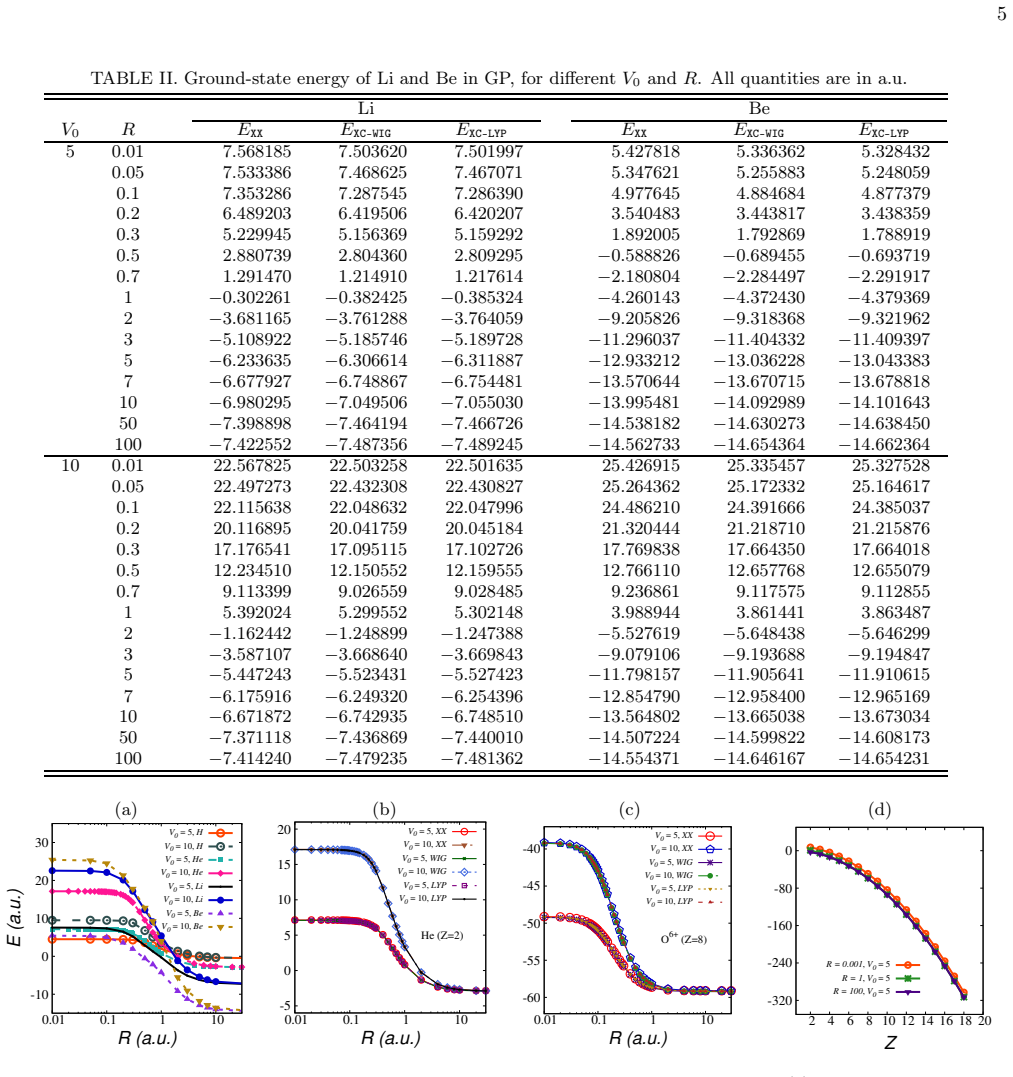
R and V0 are plotted; correlated results are omitted as they do not reflect much qualitative change in the pat- tern behavior
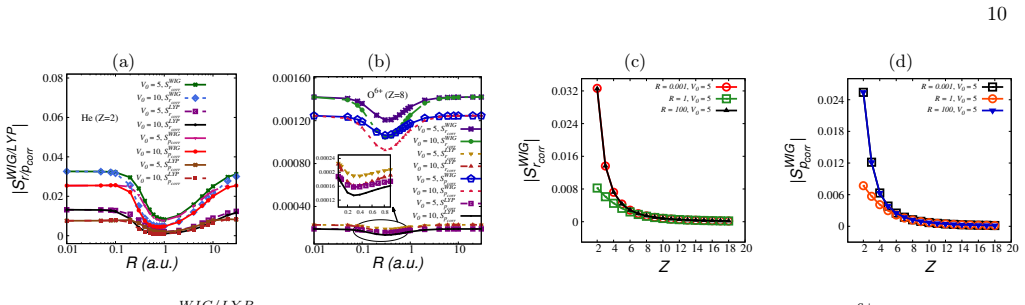
In panel (a), the XX energy of ground state for H, He, Li and Be, w.r.t. R and V0 are plotted; correlated results are omitted as they do not reflect much qualitative change in the pat- tern behavior. Note that the R axis in this and all other figures throughout the article, is plotted in logarithmic scale, for convenience. For a smaller R (⪅ 0. 1), individ-...
-
[2]
Finally for R ≳ 10, plots for individual atoms tend to merge and remain practically unaltered thereafter
25 < R <5. Finally for R ≳ 10, plots for individual atoms tend to merge and remain practically unaltered thereafter. Now to get a clearer picture, panel (b) de- picts the plots for He in case of V0 = 5 and 10 for XX, XC-WIG and XC-LYP calculations. It is noticed that the plots for two V0’s make two separate families, i.e., the three energies for a given V...
-
[3]
TABLE III
Apparently, the correlation effect seems to influence the intermediate region (characterized by a maximum) much more of the underlying confinement. TABLE III. Fitting parameters for E vs Z (Eq. ( 15), Sr vs Z (Eq. ( 20)), Srcorr vs Z (Eq. ( 23)), Sp vs Z (Eq. ( 21)), Spcorr vs Z (Eq. ( 24)) and Ir vs Z (Eq. ( 27)). R E 0 E1 — — χ 2 0.001 12.361764 0.970421 —...
-
[4]
(16) Thep-space wave function,φ i(⃗ p), likewise, is obtained by Fourier transforming the r-space counterpart, as follows: φ i(⃗ p) = ∫ R3 ψ i(⃗ r) ei⃗ p.⃗ rd⃗ r
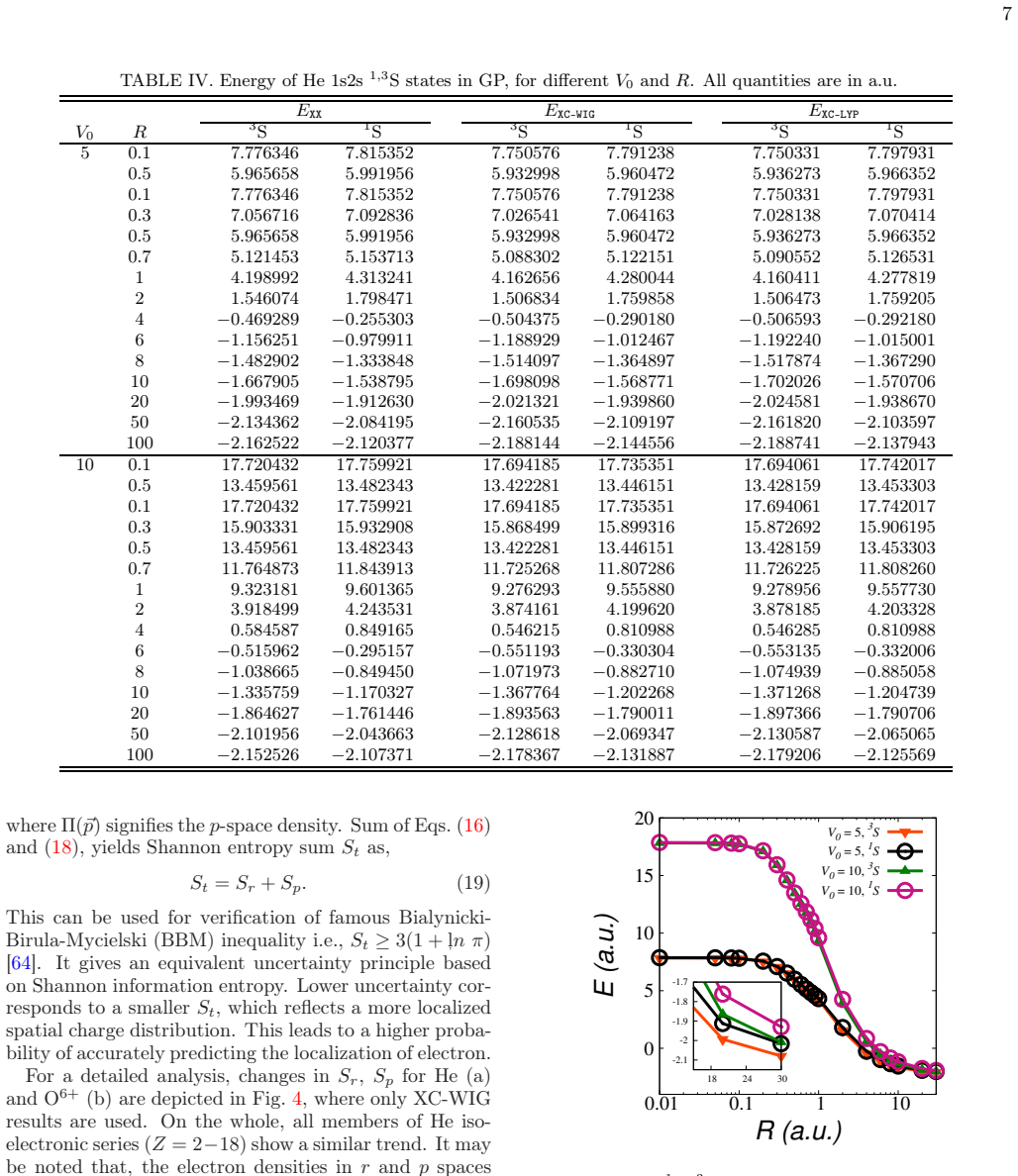
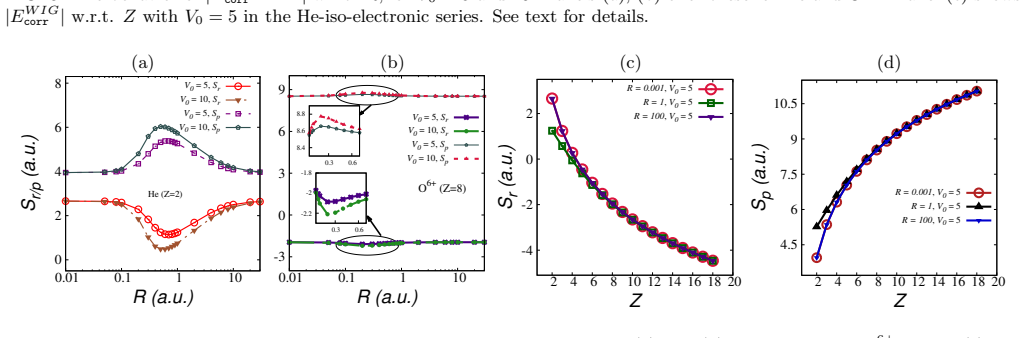
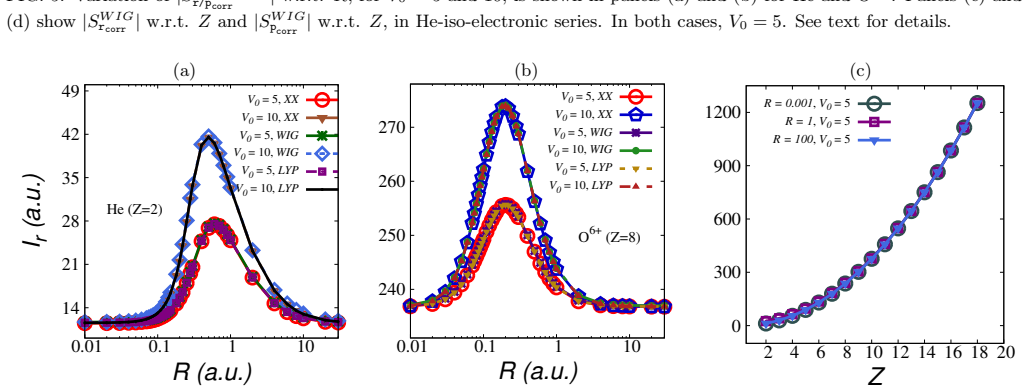
is used to quantify Sr as, Sr = − ∫ R3 ρ(⃗ r) lnρ(⃗ r)d⃗ r. (16) Thep-space wave function,φ i(⃗ p), likewise, is obtained by Fourier transforming the r-space counterpart, as follows: φ i(⃗ p) = ∫ R3 ψ i(⃗ r) ei⃗ p.⃗ rd⃗ r. (17) The corresponding Shannon entropy Sp, in p-space is: Sp = − ∫ R3 Π(⃗ p) ln[Π( ⃗ p)] d⃗ p, (18) 7 TABLE IV. Energy of He 1s2s 1,3S...
-
[5]
6, the density gradient increases sharply
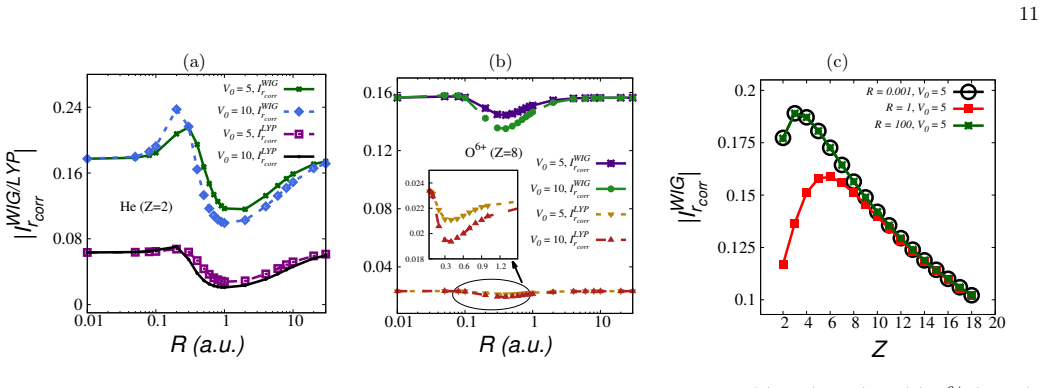
1 ≲ R ≲ 0. 6, the density gradient increases sharply. But for R ≳ 0. 6, the potential is not tight enough to cre- ate sharply rising slopes in density. Therefore Ir begins to diminish monotonically. For ions in He-like ( Z = 2 − 18) systems, the overall pattern remains quite similar as that for He. However, the Ir profile shifts toward the origin or low va...
-
[6]
The X-axis has been taken in logarithmic scale
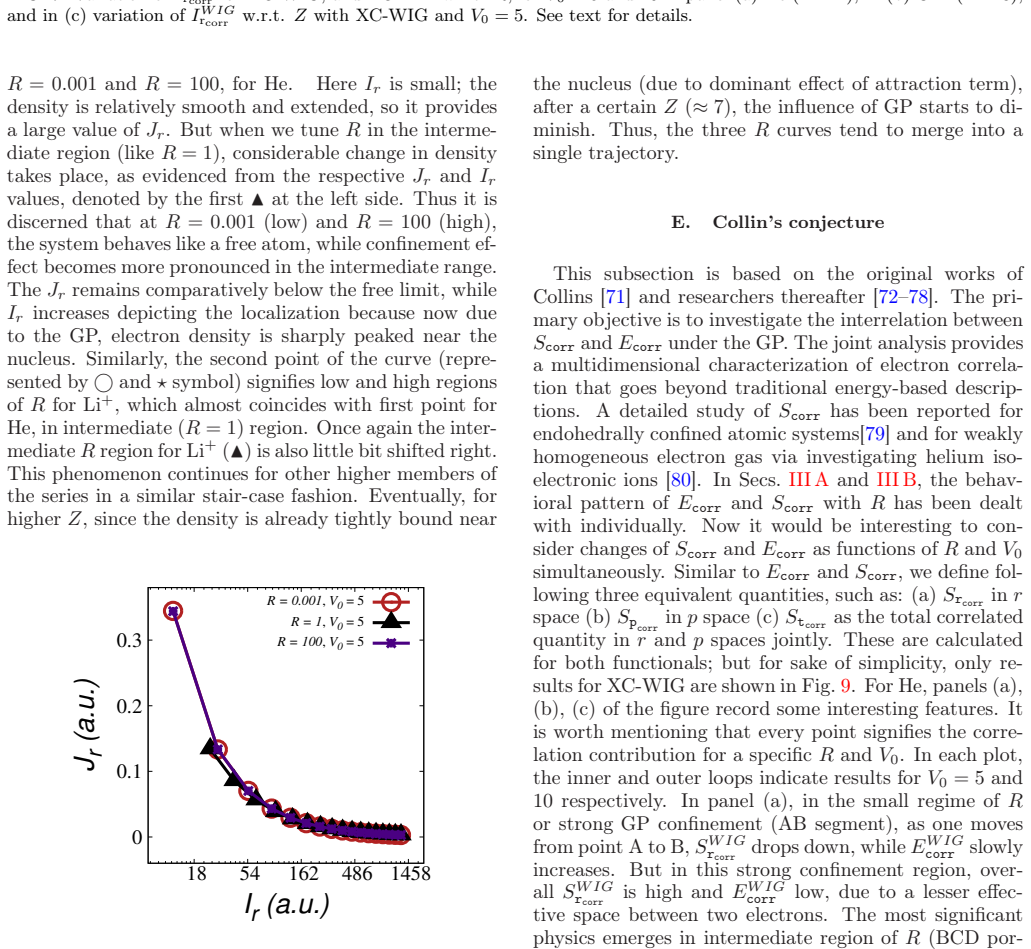
When viewed on this plane, the local and global mea- sure pair can be observed simultaneously, which captures the overall delocalization (spread) and localization (how sharply density changes in space). The X-axis has been taken in logarithmic scale. The first point at far top left end of the curve (denoted by ⃝ and ⋆) corresponds to 11 (a) (b) (c) 0 0.08 ...
-
[7]
It is worth mentioning that every point signifies the corre- lation contribution for a specific R andV0
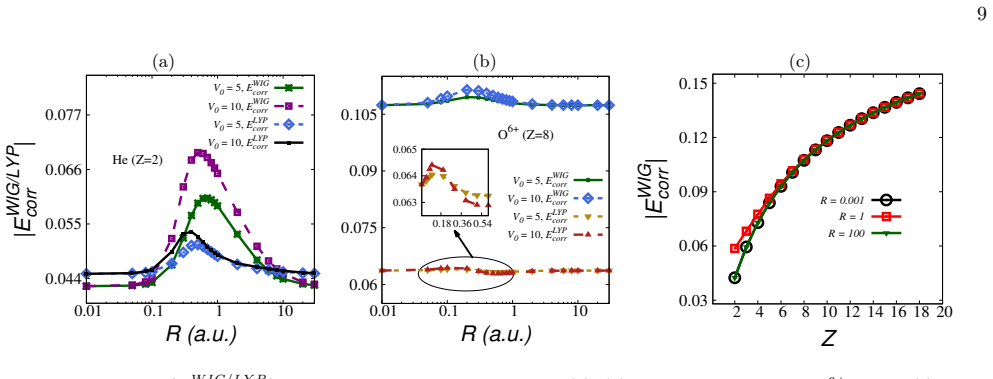
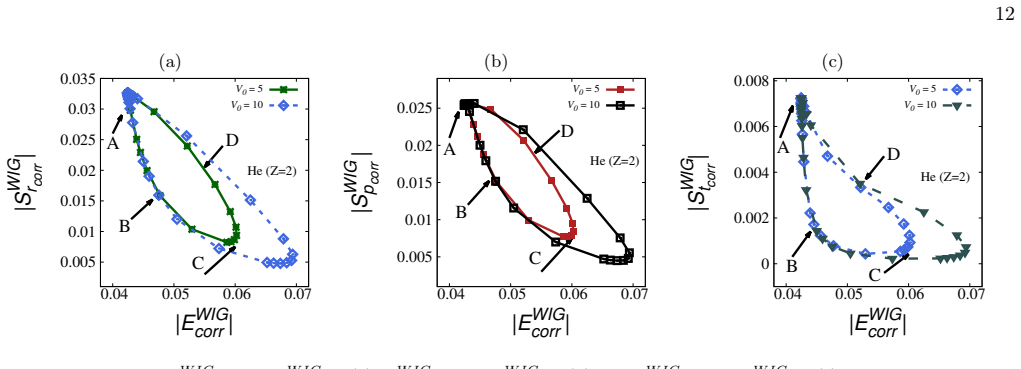
For He, panels (a), (b), (c) of the figure record some interesting features. It is worth mentioning that every point signifies the corre- lation contribution for a specific R andV0. In each plot, the inner and outer loops indicate results for V0 = 5 and 10 respectively. In panel (a), in the small regime of R or strong GP confinement (AB segment), as one moves...
2023
-
[8]
Mondal, R
J. Mondal, R. Lamba, Y. Yukta, R. Yadav, R. Kumar, B. Pani, and B. Singh, J. Mater. Chem. C 12, 10330 (2024)
2024
-
[9]
A. P. Alivisatos, Science 271, 933 (1996)
1996
-
[11]
Z. D. Kvon, Nanomaterials 13, 1924 (2023)
1924
-
[12]
B. T. Diroll, J. Mater. Chem. C 8, 10628 (2020)
2020
-
[13]
N. F. Johnson, J. Phys.: Condens. Matter 7, 965 (1995)
1995
-
[14]
Tarucha, D
S. Tarucha, D. G. Austing, T. Honda, R. J. van der Hage, and L. P. Kouwenhoven, Phys. Rev. Lett. 77, 3613 (1996)
1996
-
[15]
Singhal and H
P. Singhal and H. N. Ghosh, ChemNanoMat 5, 985 (2019). 13
2019
-
[16]
R. Ding, Y. Chen, Q. Wang, Z. Wu, X. Zhang, B. Li, and L. Lin, J. Pharm. Anal. 12, 355 (2022)
2022
-
[17]
Z. Liu, C. Sun, Q. Wang, W. Lu, Z. Liu, P. Li, Y. Chen, X. Hu, H. You, J. Zhang, X. Hou, B. Zeng, Q. Li, J. Zhu, N. Dai, and Y. Li, Nano Lett. 25, 13549 (2025)
2025
-
[18]
Shirasaki, G
Y. Shirasaki, G. J. Supran, M. G. Bawendi, and V. Bulović, Nat. Photon. 7, 13 (2013)
2013
-
[19]
A. R. Kirmani, J. M. Luther, M. Abolhasani, and A. Amassian, ACS Energy Lett. 5, 3069 (2020)
2020
-
[20]
Hao, X.-B
H.-M. Hao, X.-B. Su, J. Zhang, H.-Q. Ni, and Z.-C. Niu, Chin. Phys. B 28, 078104 (2019)
2019
-
[21]
Z. Yao, C. Jiang, X. Wang, H. Chen, H. Wang, L. Qin, and Z. Zhang, Nanomaterials 12 (2022)
2022
-
[22]
R. C. Ashoori, Nature 379, 413 (1996)
1996
-
[23]
Mondal, J
S. Mondal, J. K. Saha, and A. K. Roy, Int. J. Quant. Chem. 125, e70056 (2025)
2025
-
[24]
R. Arya, S. Mondal, and A. K. Roy, Supl. Rev. Mex. Fis. 6, 011310 (2025)
2025
-
[25]
R. K. Pandey, M. K. Harbola, and V. A. Singh, J. Phys.: Condens. Matter. 16, 1769 (2004)
2004
-
[26]
Boyacioglu, M
B. Boyacioglu, M. Saglam, and A. Chatterjee, J. Phys.: Condens. Matter 19, 456217 (2007)
2007
-
[27]
Gharaati and R
A. Gharaati and R. Khordad, Superlattices Microstruct. 48, 276 (2010)
2010
-
[28]
Winkler, Int
P. Winkler, Int. J. Quant. Chem. 100, 1122 (2004)
2004
-
[29]
Kimani, P
P. Kimani, P. Jones, and P. Winkler, Int. J. Quant. Chem. 108, 2763 (2008)
2008
-
[30]
J. K. Saha, S. Bhattacharyya, and T. Mukherjee, Com- mun. Theor. Phys. 65, 347 (2016)
2016
-
[31]
C. Cari, A. Suparmi, and S. Faniandari, AIP Conf. Proc. 2391, 090009 (2022)
2022
-
[32]
Khordad and B
R. Khordad and B. Mirhosseini, Commun. Theor. Phys. 62, 77 (2014)
2014
-
[33]
B. Buck, H. Friedrich, and C. Wheatley, Nucl. Phys. A 275, 246 (1977)
1977
-
[34]
L. A. Gribov, J. Struct. Chem. 59, 503 (2018)
2018
-
[35]
L. A. Gribov and I. V. Mikhailov, J. Appl. Spectrosc. 85, 823 (2018)
2018
-
[36]
E. M. Nascimento, F. V. Prudente, M. N. Guimarães, and A. M. Maniero, J. Phys. B 44, 015003 (2011)
2011
-
[37]
C. Y. Lin and Y. K. Ho, J. Phys. B 45, 145001 (2012)
2012
-
[38]
C. Y. Lin and Y. K. Ho, Few-Body Syst. 54, 425 (2013)
2013
-
[39]
Genkin and E
M. Genkin and E. Lindroth, Phys. Rev. B 81, 125315 (2010)
2010
-
[40]
S. Lumb, S. Lumb, and V. Prasad, Eur. Phys. J. Plus 130, 149 (2015)
2015
-
[41]
F. A. De Saavedra, E. Buendía, and F. J. Gálvez, Chem. Phys. Lett. 763, 138197 (2021)
2021
-
[42]
Kachu, N
A. Kachu, N. R. Chebrolu, and A. Boda, Micro and Nanostructures 186, 207733 (2024)
2024
-
[43]
M. A. Semina, A. A. Golovatenko, and A. V. Rodina, Phys. Rev. B 93, 045409 (2016)
2016
-
[44]
Chen, X.-H
Z.-B. Chen, X.-H. Long, Y.-J. Xu, and H. Zhu, Radiat. Phys. Chem. 240, 113381 (2026)
2026
-
[45]
Wen-Fang, Commun
X. Wen-Fang, Commun. Theor. Phys. 49, 1287 (2008)
2008
-
[46]
Laughlin and S.-I
C. Laughlin and S.-I. Chu, J. Phys. A: Math. Theor. 42, 265004 (2009)
2009
-
[47]
K. D. Sen, H. E. Montgomery Jr., B. Yu, and J. Katriel, Eur. Phys. J. D. 75 (2021)
2021
-
[48]
C. E. Shannon, Bell Syst. Tech. J. 27, 379 (1948)
1948
-
[49]
R. A. Fisher, Math. Proc. Camb. Philos. Soc. 22, 700 (1925)
1925
-
[50]
Majumdar and A
S. Majumdar and A. K. Roy, Quant. Rep. 2, 189 (2020)
2020
-
[51]
Sahni and M
V. Sahni and M. K. Harbola, Int. J. Quant. Chem. 38, 569 (1990)
1990
-
[52]
Sahni, Y
V. Sahni, Y. Li, and M. K. Harbola, Phys. Rev. A 45, 1434 (1992)
1992
-
[53]
A. K. Roy, R. Singh, and B. M. Deb, Int. J. Quant. Chem. 65, 317 (1997)
1997
-
[54]
A. K. Roy and S.-I. Chu, Phys. Rev. A 65, 052508 (2002)
2002
-
[55]
A. K. Roy, J. Phys. B 37, 4369 (2004)
2004
-
[56]
A. K. Roy, J. Phys. B 38, 1591 (2005)
2005
-
[57]
A. K. Roy and A. F. Jalbout, Chem. Phys. Lett. 445, 355 (2007)
2007
-
[58]
Majumdar, N
S. Majumdar, N. Mukherjee, and A. K. Roy, Eur. Phys. J. D 75, 86 (2021)
2021
-
[59]
Majumdar and A
S. Majumdar and A. K. Roy, Int. J. Quant. Chem. 121, e26630 (2021)
2021
-
[60]
J. Liu, X. Lai, X. H. Ji, A. Liu, H. E. Montgomery Jr., Y. K. Ho, and L. Jiao, J. Phys. B 57, 175002 (2024)
2024
-
[61]
Z. L. Zhou, X. H. Ji, H. E. Montgomery Jr., Y. K. Ho, A. Liu, and L. G. Jiao, Int. J. Quant. Chem. 125, e70051 (2025)
2025
-
[62]
Ma and Z
K. Ma and Z. B. Chen, Chem. Phys. 588, 112489 (2025)
2025
-
[63]
Brual, Jr and S
G. Brual, Jr and S. M. Rothstein, J. Chem. Phys. 69, 1177 (1978)
1978
-
[64]
C. Lee, W. Yang, and R. G. Parr, Phys. Rev. B 37, 785 (1988)
1988
-
[65]
Yakar, B
Y. Yakar, B. Çakir, and A. Özmen, Int. J. Quant. Chem. 111, 4139 (2011)
2011
-
[66]
Flores-Riveros and A
A. Flores-Riveros and A. Rodríguez-Contreras, Phys. Lett. A 372, 6175 (2008)
2008
-
[67]
Bhattacharyya, J
S. Bhattacharyya, J. K. Saha, P. K. Mukherjee, and T. K. Mukherjee, Phys. Scr. 87, 065305 (2013)
2013
-
[68]
A. K. Roy, Phys. Lett. A 321, 231 (2004)
2004
-
[69]
A. K. Roy, J. Phys. G: Nucl. Part. Phys. 30, 269 (2004)
2004
-
[70]
A. K. Roy, Mod. Phys. Lett. A 29, 1450104 (2014)
2014
-
[71]
Białynicki-Birula and J
I. Białynicki-Birula and J. Mycielski, Commun. Math. Phys. 44, 129 (1975)
1975
-
[72]
A. K. Roy and B. M. Deb, Phys. Lett. A 234, 465 (1997)
1997
-
[73]
R. D. Septianto, R. Miranti, T. Kikitsu, T. Hikima, D. Hashizume, N. Matsushita, Y. Iwasa, and S. Z. Bisri, Nat. Commun. 14, 2670 (2023)
2023
-
[74]
Romera and J
E. Romera and J. S. Dehesa, J. Chem. Phys. 120, 8906 (2004)
2004
-
[75]
Vignat and J.-F
C. Vignat and J.-F. Bercher, Phys. Lett. A 312, 27 (2003)
2003
-
[76]
K. D. Sen, J. Antolín, and J. C. Angulo, Phys. Rev. A 76, 032502 (2007)
2007
-
[77]
Dembo, T
A. Dembo, T. Cover, and J. Thomas, IEEE Trans. Inf. Theory 37, 1501 (1991)
1991
-
[78]
D. M. Collins, Z. Naturforsch. A 48, 68 (1993)
1993
-
[79]
Ziesche, V
P. Ziesche, V. H. Smith Jr., M. Hô, S. P. Rudin, P. Gers- dorf, and M. Taut, J. Chem. Phys. 110, 6135 (1999)
1999
-
[80]
L. D. Site, Int. J. Quant. Chem. 115, 1396 (2015)
2015
-
[81]
Flores-Gallegos, Chem
N. Flores-Gallegos, Chem. Phys. Lett. 692, 61 (2018)
2018
discussion (0)
Sign in with ORCID, Apple, or X to comment. Anyone can read and Pith papers without signing in.