Influence of Harris disorder on quantum-critical superconductivity
Pith reviewed 2026-06-26 06:14 UTC · model grok-4.3
The pith
Harris disorder in quantum-critical metals localizes bosonic modes and produces power-law tails in local pairing scales.
A machine-rendered reading of the paper's core claim, the machinery that carries it, and where it could break.
Core claim
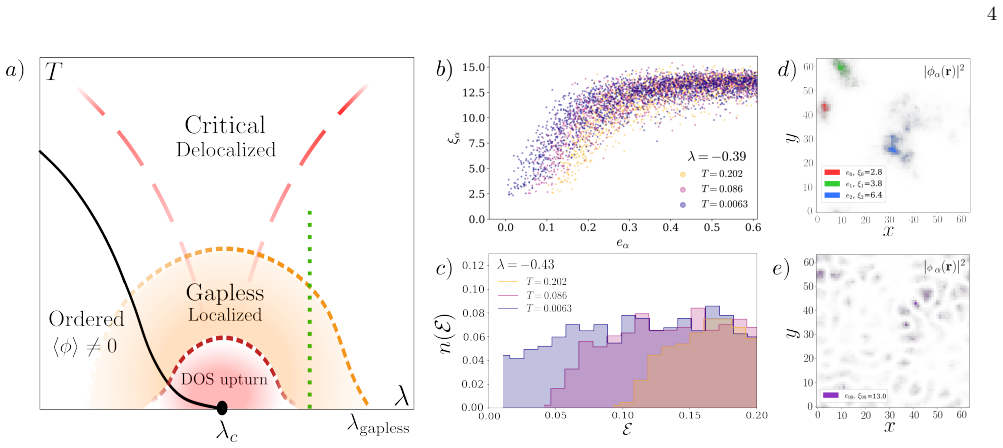
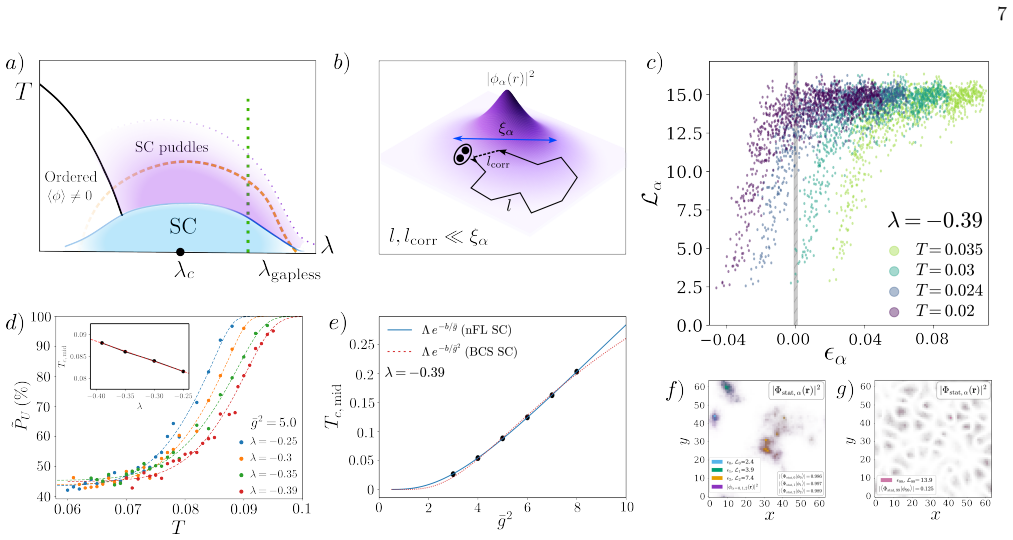
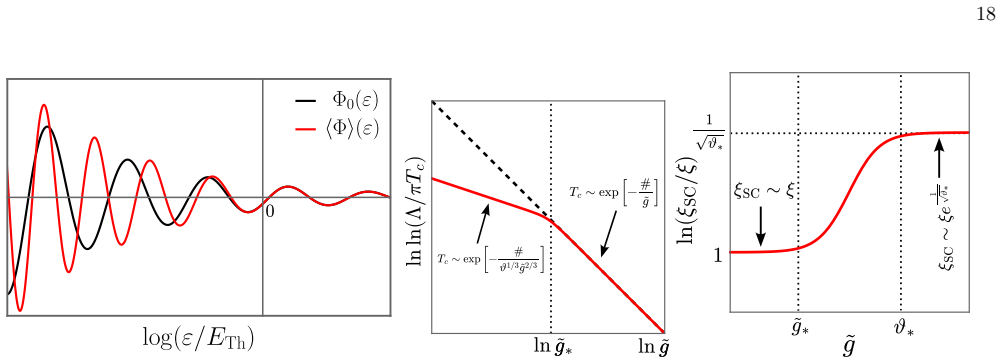
Localized overdamped bosonic modes generated by Harris disorder produce both a random pairing vertex and a random potential for Cooper pairs. Numerical solutions of the real-space Usadel equation, together with a self-consistent Born approximation and Lifshitz-tail analysis, identify two regimes: at higher temperatures pairing nucleates in compact puddles centered on the strongest localized modes; at lower temperatures an extended pairing eigenstate appears whose transition scale and spatial structure are shaped by mesoscopic returns to favorable regions. The distribution of local pairing scales therefore acquires a power-law tail.
What carries the argument
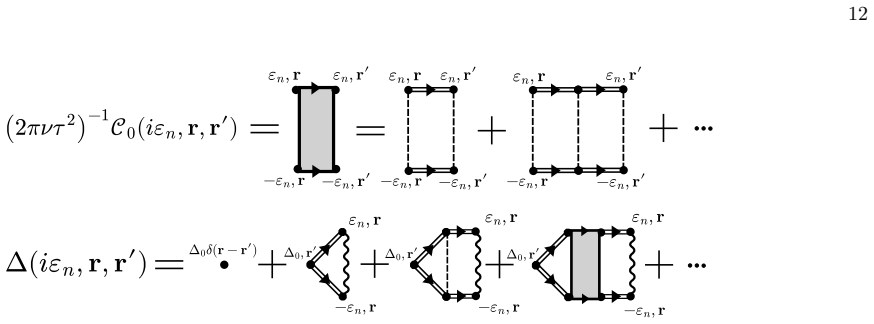
Localized low-energy overdamped bosonic modes from Harris disorder, which enter the real-space linearized Usadel equation for the two-particle propagator and generate a spatially random pairing vertex plus an effective random potential for Cooper pairs.
If this is right
- Pairing first appears in compact superconducting puddles nucleated on the strongest localized bosonic modes.
- An extended pairing eigenstate forms only at lower temperatures and remains spatially inhomogeneous due to mesoscopic correlation effects.
- The histogram of local pairing scales follows a power-law tail at low energies.
- Broad gap inhomogeneity and superconducting puddles arise in quantum-critical metals without requiring strong fermionic localization.
Where Pith is reading between the lines
- The same localized-mode mechanism could account for the inhomogeneous gaps seen in STM studies of the cuprates near their quantum critical point.
- Analogous power-law tails might appear in other disordered quantum-critical systems such as heavy-fermion or iron-based superconductors.
- A direct comparison of gap histograms between quantum-critical and conventional disordered superconductors could test whether the tail shape distinguishes the two classes.
Load-bearing premise
Fermionic states remain extended and continue to supply Landau damping of the bosonic modes even after the bosonic modes themselves localize.
What would settle it
STM measurements on a quantum-critical metal showing stretched-exponential rather than power-law tails in the histogram of local gap values would falsify the predicted distribution.
Figures
read the original abstract
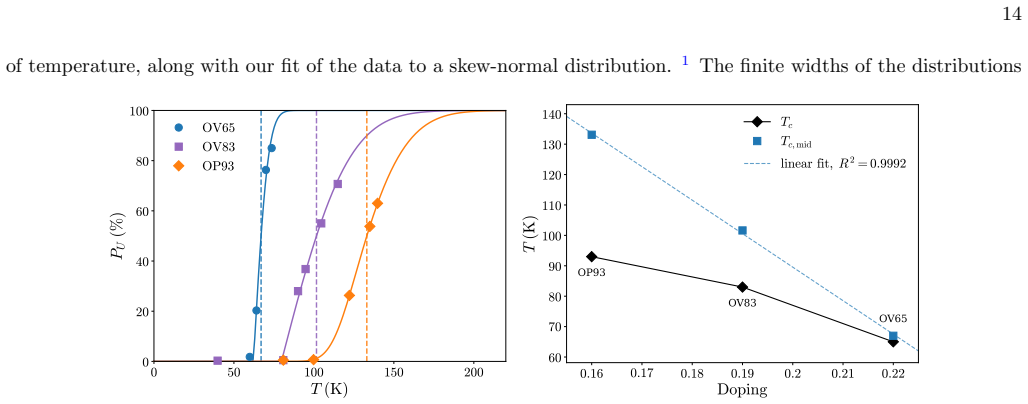
In the Hertz theory, a quantum critical metal is described by the coupling of a Fermi surface to fluctuations of a Landau-damped bosonic field $\phi$, which may represent either an order parameter or a Higgs field for a transition without symmetry breaking. Scattering from $\phi$ produces non-Fermi-liquid behavior in the normal state, while the same fluctuations mediate enhanced Cooper pairing. By the Harris criterion, symmetry-preserving disorder couples most strongly to the coefficient of the $\phi^2$ term, locally tuning the system toward or away from criticality. This random mass (``Harris disorder'') leads to a finite density of localized low-energy $\phi$ modes even when the fermionic states remain extended and continue to provide Landau damping. We study the onset of pairing mediated by these localized overdamped bosonic modes. Starting from a real-space linearized Usadel equation for the two-particle propagator, we show that the localized bosonic wave functions generate both a spatially random pairing vertex and an effective random potential for Cooper pairs. Numerical solution, a self-consistent Born approximation, and Lifshitz-tail analysis reveal two regimes of the pairing instability. At high temperatures, pairing nucleates compact superconducting puddles on the most localized bosonic modes. At lower temperatures, an extended pairing eigenstate appears, but its transition scale and spatial structure remain strongly affected by mesoscopic correlation effects and enhanced probability of returns to favorable regions of the localized bosonic glue. The resulting distribution of local pairing scales has a power-law tail, in contrast to the stretched-exponential tails of disordered BCS superconductors. This mechanism provides a route to broad gap inhomogeneity and superconducting puddles in quantum-critical metals, and offers an interpretation of STM measurements of the cuprates.
Editorial analysis
A structured set of objections, weighed in public.
Referee Report
Summary. The manuscript studies Harris disorder (random mass term for the bosonic field) in a quantum-critical metal described by Hertz theory. It claims that this disorder produces a finite density of localized low-energy bosonic modes even while fermionic states remain extended and supply Landau damping. Using a real-space linearized Usadel equation for the two-particle propagator, together with self-consistent Born approximation and Lifshitz-tail analysis, the authors identify two pairing regimes: high-T nucleation of compact superconducting puddles on the most localized bosonic modes, and a lower-T extended pairing eigenstate whose scale and structure are influenced by mesoscopic return probabilities. The resulting distribution of local pairing scales exhibits a power-law tail, in contrast to the stretched-exponential tails found in disordered BCS superconductors. This is proposed as a mechanism for broad gap inhomogeneity and puddles in quantum-critical metals, with possible relevance to cuprate STM data.
Significance. If the central results hold, the work supplies a concrete, disorder-driven route to power-law distributed pairing scales and mesoscopic inhomogeneity that is specific to the quantum-critical setting and does not require the fermions themselves to localize. The contrast with BCS tails is a clear, falsifiable distinction. The use of the standard Usadel framework and Lifshitz-tail methods is a methodological strength that keeps the calculation within established tools of the field.
major comments (2)
- [Abstract / model section] Abstract and model construction: the statement that 'fermionic states remain extended and continue to provide Landau damping' is introduced as an input rather than derived or verified within the disordered model. Because the entire subsequent analysis (localized bosonic modes, random pairing vertex, and power-law tail) rests on this premise, its consistency with Harris disorder should be demonstrated, for example by an explicit check that the fermionic self-energy remains non-localizing at the relevant energies.
- [Numerical / Lifshitz-tail analysis] Section on numerical solution and Lifshitz-tail analysis: the claim of a power-law tail in the distribution of local pairing scales is load-bearing for the central contrast with BCS superconductors. The manuscript should specify the fitting range, the extracted exponent, and how the tail is distinguished from possible stretched-exponential or other forms; without these quantitative details the distinction remains qualitative.
minor comments (2)
- [Introduction / model] Notation for the random mass term and the bosonic propagator should be introduced with an explicit equation early in the text to aid readability.
- [Figures] Figure captions for the spatial maps of pairing eigenstates should state the temperature or energy scale at which each map is evaluated.
Simulated Author's Rebuttal
We thank the referee for the positive assessment of the work's significance and for the constructive comments. We respond to each major point below.
read point-by-point responses
-
Referee: [Abstract / model section] Abstract and model construction: the statement that 'fermionic states remain extended and continue to provide Landau damping' is introduced as an input rather than derived or verified within the disordered model. Because the entire subsequent analysis (localized bosonic modes, random pairing vertex, and power-law tail) rests on this premise, its consistency with Harris disorder should be demonstrated, for example by an explicit check that the fermionic self-energy remains non-localizing at the relevant energies.
Authors: The assumption follows from the Harris criterion, under which disorder couples primarily to the bosonic mass term while fermionic states at the relevant energies remain extended due to weaker direct coupling. An explicit calculation of the fermionic self-energy in the disordered Hertz model to confirm this would require a separate, computationally intensive analysis outside the scope of the present work, which focuses on bosonic-mediated pairing. We will add a clarifying paragraph in the model section justifying the assumption via scaling arguments and literature references. revision: partial
-
Referee: [Numerical / Lifshitz-tail analysis] Section on numerical solution and Lifshitz-tail analysis: the claim of a power-law tail in the distribution of local pairing scales is load-bearing for the central contrast with BCS superconductors. The manuscript should specify the fitting range, the extracted exponent, and how the tail is distinguished from possible stretched-exponential or other forms; without these quantitative details the distinction remains qualitative.
Authors: We agree that quantitative details are needed to make the distinction rigorous. In the revised manuscript we will report the fitting range used for the tail, the extracted power-law exponent, and include a direct comparison (e.g., via log-log plots and goodness-of-fit metrics) showing that the distribution is inconsistent with stretched-exponential forms over the relevant range. revision: yes
- Explicit verification of fermionic non-localization via self-energy calculation under Harris disorder.
Circularity Check
No significant circularity identified
full rationale
The derivation proceeds from an explicit model premise (fermions remain extended and supply Landau damping) via standard tools: real-space linearized Usadel equation, self-consistent Born approximation, and Lifshitz-tail analysis. The power-law tail in local pairing scales is obtained as an output of these calculations on the localized bosonic modes; it is not presupposed by definition or by a fitted parameter renamed as a prediction. No self-citation chain is load-bearing for the central result, and the contrast with stretched-exponential BCS tails follows directly once the stated premise is granted. The paper is self-contained against external benchmarks with no reduction of claims to inputs by construction.
Axiom & Free-Parameter Ledger
axioms (2)
- domain assumption Landau damping of bosonic fluctuations by fermions in Hertz theory
- domain assumption Harris criterion for disorder coupling to phi^2 coefficient
Reference graph
Works this paper leans on
-
[1]
frequency cutoff
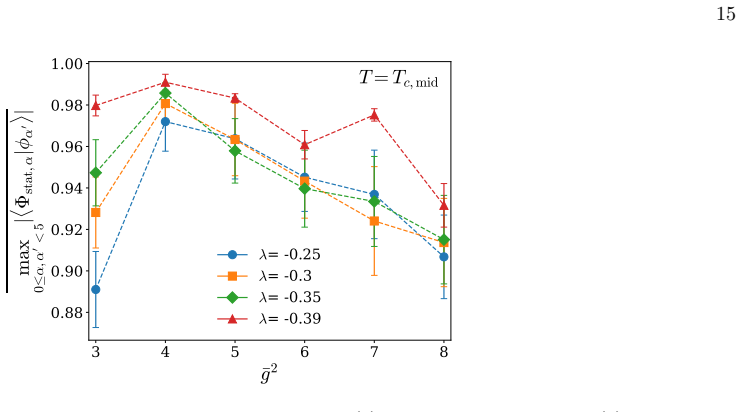
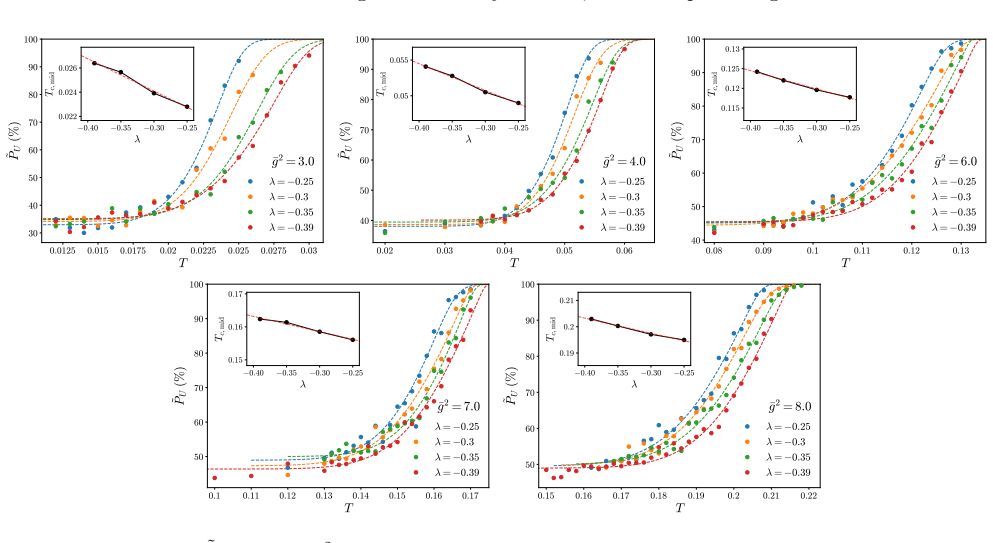
Numerical solution Here we provide the technical details of the numerical solution to Eq. (4.7), along with some additional data plots that did not fit into the main text. The dynamical Usadel equation in Eq. (4.7) is an eigenvalue equation, and can be solved efficiently using iterative methods. We write it again below, to make this more transparent, mmax...
-
[2]
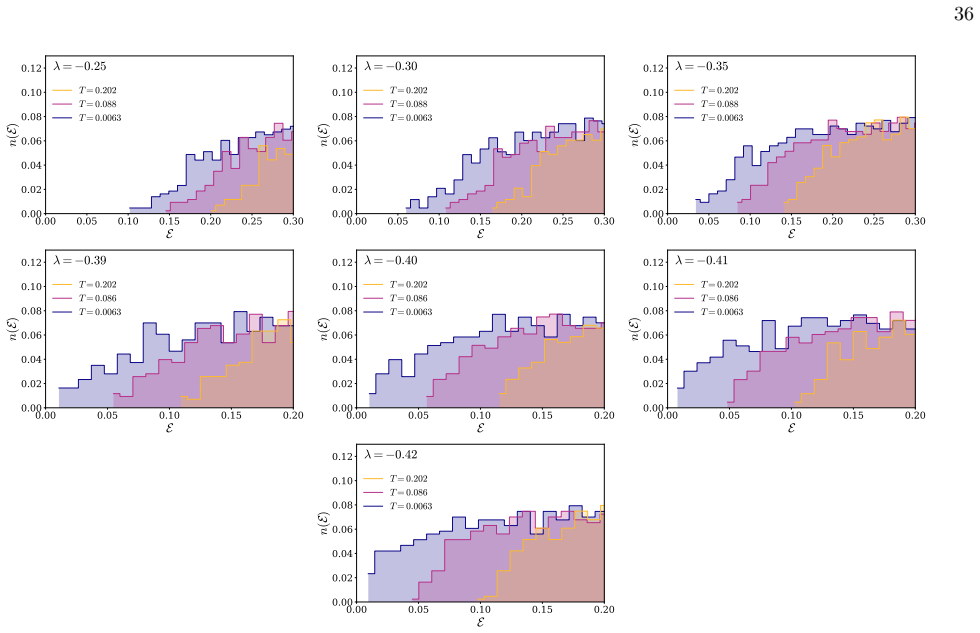
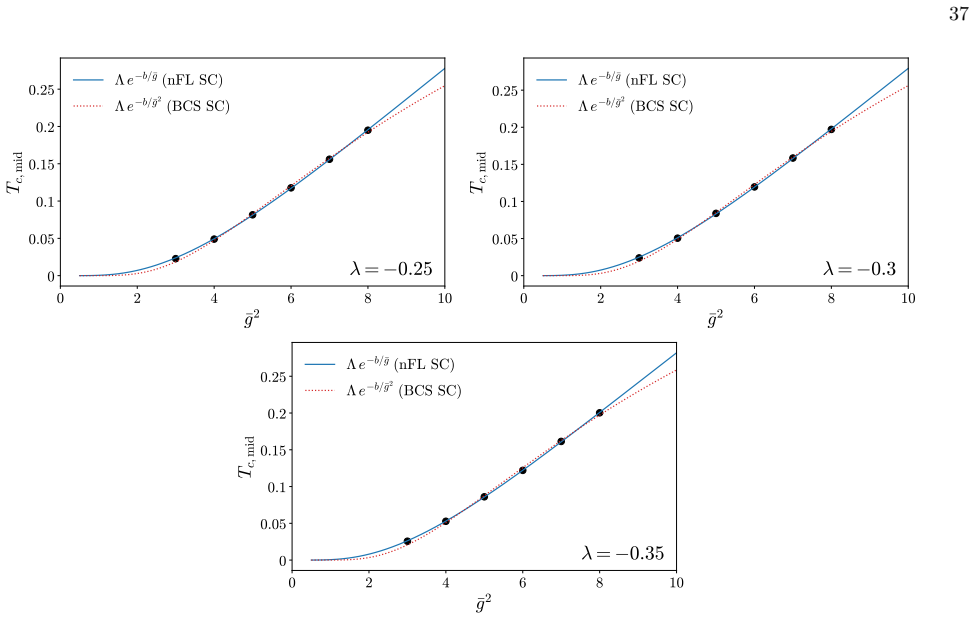
Additional plots Now we provide some additional figures that were too voluminous to include in the main text. In Fig. 7 we show the boson eigenmode DOS for many values ofλ, complementing Fig. 1c. 36 0.00 0.05 0.10 0.15 0.20 0.25 0.30 E 0.00 0.02 0.04 0.06 0.08 0.10 0.12 n(E) λ = −0.25 T = 0.202 T = 0.088 T = 0.0063 0.00 0.05 0.10 0.15 0.20 0.25 0.30 E 0.0...
-
[3]
Keimer, S
B. Keimer, S. A. Kivelson, M. R. Norman, S. Uchida, and J. Zaanen,From quantum matter to high-temperature super- conductivity in copper oxides, Nature518, 179 (2015)
2015
-
[4]
C. M. Varma, P. B. Littlewood, S. Schmitt-Rink, E. Abrahams, and A. E. Ruckenstein,Phenomenology of the normal state of Cu-O high-temperature superconductors, Phys. Rev. Lett.63, 1996 (1989)
1996
-
[5]
R. A. Cooper, Y. Wang, B. Vignolle, O. J. Lipscombe, S. M. Hayden, Y. Tanabe, T. Adachi, Y. Koike, M. Nohara, H. Takagi, C. Proust, and N. E. Hussey,Anomalous Criticality in the Electrical Resistivity of La 2−xSrxCuO4, Science 323, 603 (2009)
2009
-
[6]
N. E. Hussey, R. A. Cooper, X. Xu, Y. Wang, I. Mouzopoulou, B. Vignolle, and C. Proust,Dichotomy in the t-linear resistivity in hole-doped cuprates, Philosophical Transactions of the Royal Society A: Math- ematical, Physical and Engineering Sciences369, 1626 (2011), https://royalsocietypublishing.org/rsta/article- pdf/369/1941/1626/1346564/rsta.2010.0196.pdf
arXiv 2011
-
[7]
Kirchner, S
S. Kirchner, S. Paschen, Q. Chen, S. Wirth, D. Feng, J. D. Thompson, and Q. Si,Colloquium: Heavy-electron quantum criticality and single-particle spectroscopy, Rev. Mod. Phys.92, 011002 (2020)
2020
-
[8]
Ayres, M
J. Ayres, M. Berben, M. ˇCulo, Y. T. Hsu, E. van Heumen, Y. Huang, J. Zaanen, T. Kondo, T. Takeuchi, J. R. Cooper, C. Putzke, S. Friedemann, A. Carrington, and N. E. Hussey,Incoherent transport across the strange-metal regime of overdoped cuprates, Nature595, 661 (2021)
2021
-
[9]
S. A. Hartnoll and A. P. Mackenzie,Colloquium: Planckian dissipation in metals, Rev. Mod. Phys.94, 041002 (2022)
2022
-
[10]
Sachdev,Quantum Phase Transitions, 2nd ed
S. Sachdev,Quantum Phase Transitions, 2nd ed. (Cambridge University Press, 2011)
2011
-
[11]
Sachdev,The foot, the fan, and the cuprate phase diagram: Fermi-volume-changing quantum phase transitions, Physica C: Superconductivity and its Applications633, 1354707 (2025)
S. Sachdev,The foot, the fan, and the cuprate phase diagram: Fermi-volume-changing quantum phase transitions, Physica C: Superconductivity and its Applications633, 1354707 (2025)
2025
-
[12]
J. A. Hertz,Quantum critical phenomena, Phys. Rev. B14, 1165 (1976)
1976
-
[13]
Moriya and A
T. Moriya and A. Kawabata,Effect of spin fluctuations on itinerant electron ferromagnetism, Journal of the Physical Society of Japan34, 639 (1973)
1973
-
[14]
A. J. Millis,Effect of a nonzero temperature on quantum critical points in itinerant fermion systems, Phys. Rev. B48, 7183 (1993). 42
1993
-
[15]
Zhang and S
Y.-H. Zhang and S. Sachdev,From the pseudogap metal to the fermi liquid using ancilla qubits, Phys. Rev. Res.2, 023172 (2020)
2020
-
[16]
Zhang and S
Y.-H. Zhang and S. Sachdev,Deconfined criticality and ghost fermi surfaces at the onset of antiferromagnetism in a metal, Phys. Rev. B102, 155124 (2020)
2020
-
[17]
Mascot, A
E. Mascot, A. Nikolaenko, M. Tikhanovskaya, Y.-H. Zhang, D. K. Morr, and S. Sachdev,Electronic spectra with param- agnon fractionalization in the single-band hubbard model, Phys. Rev. B105, 075146 (2022)
2022
-
[18]
Nikolaenko, J
A. Nikolaenko, J. von Milczewski, D. G. Joshi, and S. Sachdev,Spin density wave, fermi liquid, and fractionalized phases in a theory of antiferromagnetic metals using paramagnons and bosonic spinons, Phys. Rev. B108, 045123 (2023)
2023
-
[19]
Lunts, A
P. Lunts, A. A. Patel, and S. Sachdev,Thermopower across fermi-volume-changing quantum phase transitions without translational symmetry breaking, Phys. Rev. B111, 245151 (2025)
2025
-
[20]
P. M. Bonetti, M. Christos, A. Nikolaenko, A. A. Patel, and S. Sachdev,Fractionalized fermi liquids and the cuprate phase diagram, Reports on Progress in Physics89, 044501 (2026)
2026
-
[21]
N. E. Bonesteel, I. A. McDonald, and C. Nayak,Gauge fields and pairing in double-layer composite fermion metals, Phys. Rev. Lett.77, 3009 (1996)
1996
-
[22]
D. T. Son,Superconductivity by long range color magnetic interaction in high density quark matter, Phys. Rev. D59, 094019 (1999), arXiv:hep-ph/9812287
Pith/arXiv arXiv 1999
-
[23]
A. Abanov, A. V. Chubukov, and A. M. Finkel’stein,Coherent vs. incoherent pairing in 2D systems near magnetic instability, EPL (Europhysics Letters)54, 488 (2001), arXiv:cond-mat/9911445 [cond-mat.supr-con]
Pith/arXiv arXiv 2001
-
[24]
A. Abanov, A. V. Chubukov, and J. Schmalian,Quantum-critical theory of the spin-fermion model and its application to cuprates. Normal state analysis, Advances in Physics52, 119 (2003), arXiv:cond-mat/0107421 [cond-mat.supr-con]
Pith/arXiv arXiv 2003
-
[25]
E.-G. Moon and A. Chubukov,Quantum-critical Pairing with Varying Exponents, Journal of Low Temperature Physics 161, 263 (2010), arXiv:1005.0356 [cond-mat.supr-con]
Pith/arXiv arXiv 2010
-
[26]
M. A. Metlitski and S. Sachdev,Quantum phase transitions of metals in two spatial dimensions. II. Spin density wave order, Phys. Rev. B82, 075128 (2010), arXiv:1005.1288 [cond-mat.str-el]
Pith/arXiv arXiv 2010
-
[27]
Y. Wang and A. V. Chubukov,Superconductivity at the Onset of Spin-Density-Wave Order in a Metal, Phys. Rev. Lett. 110, 127001 (2013), arXiv:1210.2408 [cond-mat.supr-con]
Pith/arXiv arXiv 2013
-
[28]
M. A. Metlitski, D. F. Mross, S. Sachdev, and T. Senthil,Cooper pairing in non-Fermi liquids, Phys. Rev. B91, 115111 (2015), arXiv:1403.3694 [cond-mat.str-el]
Pith/arXiv arXiv 2015
-
[29]
Raghu, G
S. Raghu, G. Torroba, and H. Wang,Metallic quantum critical points with finite bcs couplings, Phys. Rev. B92, 205104 (2015)
2015
-
[30]
I. Esterlis and J. Schmalian,Cooper pairing of incoherent electrons: an electron-phonon version of the Sachdev-Ye-Kitaev model, Phys. Rev. B100, 115132 (2019), arXiv:1906.04747 [cond-mat.str-el]
arXiv 2019
-
[31]
D. Chowdhury and E. Berg,The unreasonable effectiveness of Eliashberg theory for pairing of non-Fermi liquids, Annals of Physics417, 168125 (2020), arXiv:1912.07646 [cond-mat.supr-con]
arXiv 2020
- [32]
-
[33]
A. V. Chubukov, A. Abanov, Y. Wang, and Y.-M. Wu,The interplay between superconductivity and non-Fermi liquid at a quantum-critical point in a metal, Annals of Physics417, 168142 (2020), Eliashberg theory at 60: Strong-coupling superconductivity and beyond
2020
-
[34]
I. Esterlis, H. Guo, A. A. Patel, and S. Sachdev,LargeNtheory of critical Fermi surfaces, Phys. Rev. B103, 235129 (2021), arXiv:2103.08615 [cond-mat.str-el]
arXiv 2021
-
[35]
G. A. Inkof, K. Schalm, and J. Schmalian,Quantum critical Eliashberg theory, the Sachdev-Ye-Kitaev superconductor and their holographic duals, npj Quant. Mater.7, 56 (2022), arXiv:2108.11392 [cond-mat.str-el]
arXiv 2022
-
[36]
I. Esterlis and J. Schmalian,Quantum Critical Eliashberg Theory, arXiv e-prints , arXiv:2506.11952 (2025), arXiv:2506.11952 [cond-mat.str-el]
arXiv 2025
-
[37]
Chakravarty, L
S. Chakravarty, L. Yin, and E. Abrahams,Interactions and scaling in a disordered two-dimensional metal, Phys. Rev. B 58, R559(R) (1998)
1998
-
[38]
Rosch,Interplay of disorder and spin fluctuations in the resistivity near a quantum critical point, Phys
A. Rosch,Interplay of disorder and spin fluctuations in the resistivity near a quantum critical point, Phys. Rev. Lett.82, 4280 (1999)
1999
-
[39]
Maebashi, K
H. Maebashi, K. Miyake, and C. M. Varma,Singular effects of impurities near the ferromagnetic quantum-critical point, Phys. Rev. Lett.88, 226403 (2002)
2002
-
[40]
I. Paul, C. P´ epin, B. N. Narozhny, and D. L. Maslov,Quantum correction to conductivity close to a ferromagnetic quantum critical point in two dimensions, Phys. Rev. Lett.95, 017206 (2005)
2005
-
[41]
P. A. Nosov, I. S. Burmistrov, and S. Raghu,Interaction-induced metallicity in a two-dimensional disordered non-fermi liquid, Phys. Rev. Lett.125, 256604 (2020)
2020
-
[42]
Halbinger and M
J. Halbinger and M. Punk,Quenched disorder at antiferromagnetic quantum critical points in two-dimensional metals, Phys. Rev. B103, 235157 (2021)
2021
-
[43]
T. C. Wu, Y. Liao, and M. S. Foster,Quantum interference of hydrodynamic modes in a dirty marginal fermi liquid, Phys. Rev. B106, 155108 (2022)
2022
-
[44]
P. A. Nosov, I. S. Burmistrov, and S. Raghu,Interplay of superconductivity and localization near a two-dimensional ferromagnetic quantum critical point, Phys. Rev. B107, 144508 (2023), arXiv:2211.02668 [cond-mat.str-el]
arXiv 2023
-
[45]
T. C. Wu, P. A. Lee, and M. S. Foster,Enhancement of superconductivity in a dirty marginal fermi liquid, Phys. Rev. B 108, 214506 (2023). 43
2023
-
[46]
Kim and K.-S
K.-M. Kim and K.-S. Kim,Disordered non-Fermi liquid fixed point for two-dimensional metals at Ising-nematic quantum critical points, SciPost Phys.17, 059 (2024)
2024
-
[47]
A. B. Harris,Effect of random defects on the critical behaviour of Ising models, Journal of Physics C: Solid State Physics 7, 1671 (1974)
1974
-
[48]
E. E. Aldape, T. Cookmeyer, A. A. Patel, and E. Altman,Solvable theory of a strange metal at the breakdown of a heavy Fermi liquid, Phys. Rev. B105, 235111 (2022), arXiv:2012.00763 [cond-mat.str-el]
arXiv 2022
-
[49]
S. A. Hartnoll, R. Mahajan, M. Punk, and S. Sachdev,Transport near the Ising-nematic quantum critical point of metals in two dimensions, Phys. Rev. B89, 155130 (2014), arXiv:1401.7012 [cond-mat.str-el]
Pith/arXiv arXiv 2014
-
[50]
A. A. Patel and S. Sachdev,DC resistivity at the onset of spin density wave order in two-dimensional metals, Phys. Rev. B90, 165146 (2014), arXiv:1408.6549 [cond-mat.str-el]
Pith/arXiv arXiv 2014
-
[51]
Goldman, A
H. Goldman, A. Thomson, L. Nie, and Z. Bi,Interplay of interactions and disorder at the superfluid-insulator transition: A dirty two-dimensional quantum critical point, Phys. Rev. B101, 144506 (2020)
2020
-
[52]
A. A. Patel, H. Guo, I. Esterlis, and S. Sachdev,Universal theory of strange metals from spatially random interactions, Science381, abq6011 (2023), arXiv:2203.04990 [cond-mat.str-el]
arXiv 2023
-
[53]
C. Li, D. Valentinis, A. A. Patel, H. Guo, J. Schmalian, S. Sachdev, and I. Esterlis,Strange Metal and Superconductor in the Two-Dimensional Yukawa-Sachdev-Ye-Kitaev Model, Phys. Rev. Lett.133, 186502 (2024), arXiv:2406.07608 [cond- mat.str-el]
arXiv 2024
-
[54]
J. Kim and S. Chatterjee,Theory of Linear Magnetoresistance in a Strange Metal, Phys. Rev. Lett.136, 186301 (2026), arXiv:2504.01059 [cond-mat.str-el]
Pith/arXiv arXiv 2026
-
[55]
S.-J. Sin and Y.-L. Wang,Linear Resistivity from Spatially Random Interactions and the Uniqueness of Yukawa Coupling, arXiv e-prints , arXiv:2507.09442 (2025), arXiv:2507.09442 [hep-th]
Pith/arXiv arXiv 2025
-
[56]
A. Kleger, N. Gnezdilov, and R. Boyack,Universal Theory of Incoherent Metals, arXiv e-prints , arXiv:2605.03013 (2026), arXiv:2605.03013 [cond-mat.str-el]
Pith/arXiv arXiv 2026
-
[57]
A. A. Patel, P. Lunts, and S. Sachdev,Localization of overdamped bosonic modes and transport in strange metals, Pro- ceedings of the National Academy of Science121, e2402052121 (2024), arXiv:2312.06751 [cond-mat.str-el]
arXiv 2024
-
[58]
A. A. Patel, P. Lunts, and M. S. Albergo,Strange Metals and Planckian Transport in a Gapless Phase from Spatially Random Interactions, Physical Review X15, 031064 (2025), arXiv:2410.05365 [cond-mat.str-el]
arXiv 2025
-
[59]
R. L. Greene, P. R. Mandal, N. R. Poniatowski, and T. Sarkar,The Strange Metal State of the Electron-Doped Cuprates, Annual Review of Condensed Matter Physics11, 213 (2020), arXiv:1905.04998 [cond-mat.str-el]
arXiv 2020
-
[60]
J. Radaelli, O. J. Lipscombe, M. Zhu, J. R. Stewart, A. A. Patel, S. Sachdev, and S. M. Hayden,Critical spin fluctuations across the superconducting dome in La 2−xSrxCuO4, Nature Communications17, 4564 (2026), arXiv:2503.13600 [cond- mat.str-el]
Pith/arXiv arXiv 2026
-
[61]
M. P. A. Fisher, P. B. Weichman, G. Grinstein, and D. S. Fisher,Boson localization and the superfluid-insulator transition, Phys. Rev. B40, 546 (1989)
1989
-
[62]
L. N. Bulaevskii and M. V. Sadovskii,Localization and superconductivity, JETP Lett.39, 640 (1984)
1984
-
[63]
Ma and P
M. Ma and P. A. Lee,Localized superconductors, Phys. Rev. B32, 5658 (1985)
1985
-
[64]
Kapitulnik and G
A. Kapitulnik and G. Kotliar,Anderson Localization and the Theory of Dirty Superconductors, Phys. Rev. Lett.54, 473 (1985)
1985
-
[65]
Kotliar and A
G. Kotliar and A. Kapitulnik,Anderson localization and the theory of dirty superconductors. II, Phys. Rev. B33, 3146 (1986)
1986
-
[66]
M. V. Feigel’Man, L. B. Ioffe, V. E. Kravtsov, and E. A. Yuzbashyan,Eigenfunction Fractality and Pseudogap State near the Superconductor-Insulator Transition, Phys. Rev. Lett.98, 027001 (2007), arXiv:cond-mat/0610554 [cond-mat.supr- con]
Pith/arXiv arXiv 2007
-
[67]
M. V. Feigel’man, L. B. Ioffe, V. E. Kravtsov, and E. Cuevas,Fractal superconductivity near localization threshold, Annals of Physics325, 1390 (2010), arXiv:1002.0859 [cond-mat.supr-con]
Pith/arXiv arXiv 2010
-
[68]
I. S. Burmistrov, I. V. Gornyi, and A. D. Mirlin,Enhancement of the Critical Temperature of Superconductors by Anderson Localization, Phys. Rev. Lett.108, 017002 (2012), arXiv:1102.3323 [cond-mat.mes-hall]
Pith/arXiv arXiv 2012
-
[69]
I. S. Burmistrov, I. V. Gornyi, and A. D. Mirlin,Multifractally-enhanced superconductivity in thin films, Annals of Physics 435, 168499 (2021), arXiv:2101.12713 [cond-mat.mes-hall]
arXiv 2021
-
[70]
H. v. L¨ ohneysen, A. Rosch, M. Vojta, and P. W¨ olfle,Fermi-liquid instabilities at magnetic quantum phase transitions, Rev. Mod. Phys.79, 1015 (2007)
2007
-
[71]
Belitz, T
D. Belitz, T. R. Kirkpatrick, M. T. Mercaldo, and S. L. Sessions,Local field theory for disordered itinerant quantum ferromagnets, Phys. Rev. B63, 174427 (2001)
2001
-
[72]
Brando, D
M. Brando, D. Belitz, F. M. Grosche, and T. R. Kirkpatrick,Metallic quantum ferromagnets, Rev. Mod. Phys.88, 025006 (2016)
2016
-
[73]
A. Del Maestro, B. Rosenow, M. M¨ uller, and S. Sachdev,Infinite Randomness Fixed Point of the Superconductor-Metal Quantum Phase Transition, Phys. Rev. Lett.101, 035701 (2008), arXiv:0802.3900 [cond-mat.dis-nn]
Pith/arXiv arXiv 2008
-
[74]
Vojta,Rare region effects at classical, quantum and nonequilibrium phase transitions, Journal of Physics A: Mathe- matical and General39, R143 (2006)
T. Vojta,Rare region effects at classical, quantum and nonequilibrium phase transitions, Journal of Physics A: Mathe- matical and General39, R143 (2006)
2006
-
[75]
Vojta,Disorder-induced rounding of certain quantum phase transitions, Phys
T. Vojta,Disorder-induced rounding of certain quantum phase transitions, Phys. Rev. Lett.90, 107202 (2003)
2003
-
[76]
J. A. Hoyos, C. Kotabage, and T. Vojta,Effects of Dissipation on a Quantum Critical Point with Disorder, Phys. Rev. Lett.99, 230601 (2007), arXiv:0705.1865 [cond-mat.str-el]
Pith/arXiv arXiv 2007
-
[77]
Vojta, C
T. Vojta, C. Kotabage, and J. A. Hoyos,Infinite-randomness quantum critical points induced by dissipation, Phys. Rev. B79, 024401 (2009). 44
2009
-
[78]
Thill and D
M. Thill and D. Huse,Equilibrium behaviour of quantum ising spin glass, Physica A: Statistical Mechanics and its Applications214, 321 (1995)
1995
-
[79]
N. Read, S. Sachdev, and J. Ye,Landau theory of quantum spin glasses of rotors and Ising spins, Phys. Rev. B52, 384 (1995), arXiv:cond-mat/9412032 [cond-mat]
Pith/arXiv arXiv 1995
-
[80]
N. D. Mermin and H. Wagner,Absence of ferromagnetism or antiferromagnetism in one- or two-dimensional isotropic heisenberg models, Phys. Rev. Lett.17, 1133 (1966)
1966
discussion (0)
Sign in with ORCID, Apple, or X to comment. Anyone can read and Pith papers without signing in.