Physical properties of charged black holes from the nonlinear electrodynamics model based on electric potential regularization
Pith reviewed 2026-06-26 09:40 UTC · model grok-4.3
The pith
Nonlinear electrodynamics from a regularized point-charge potential produces charged black holes with up to three horizons and modified thermodynamics and shadows.
A machine-rendered reading of the paper's core claim, the machinery that carries it, and where it could break.
Core claim
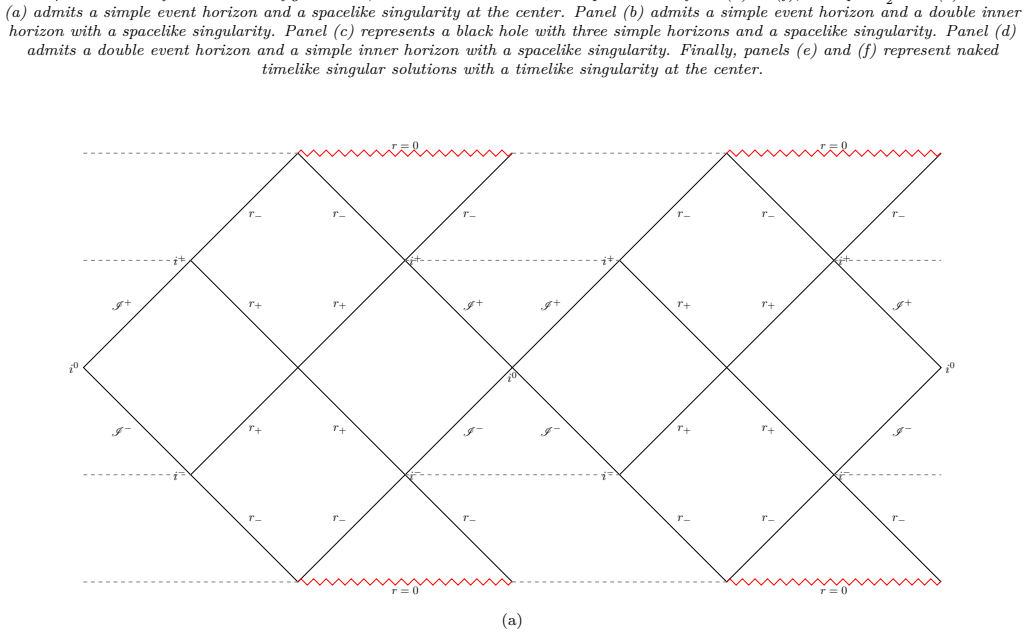
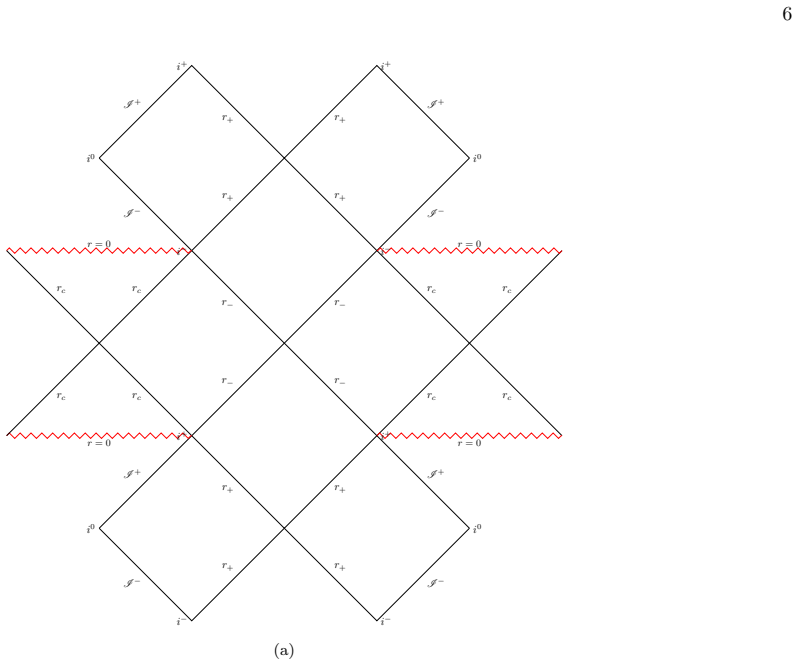
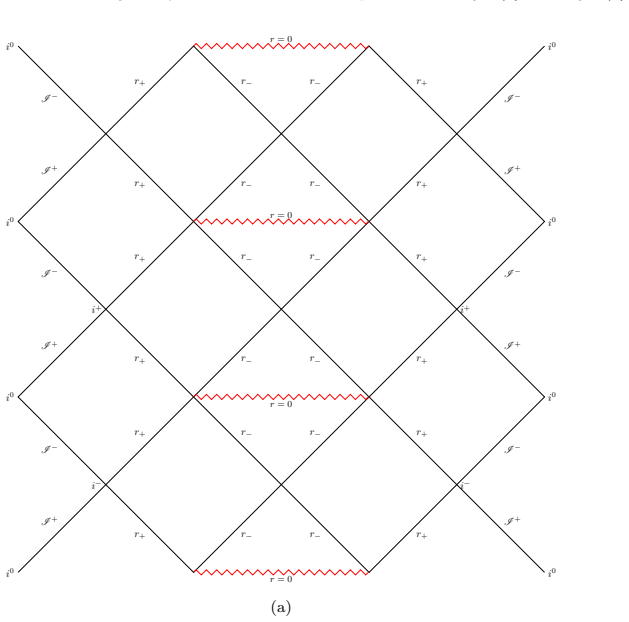
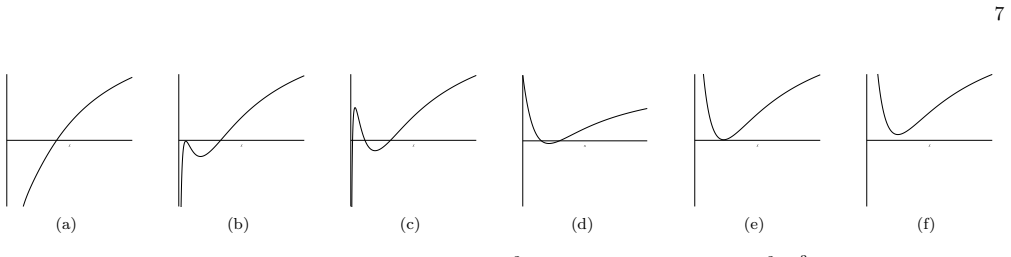
The nonlinear electrodynamics model constructed from a regularized electric potential yields static spherically symmetric black hole solutions characterized by ADM mass M, charge Q, and nonlinear scale r0; depending on the values of M and Q these solutions exhibit black holes with one, two or three horizons, naked singular geometries, and a central singularity whose character is fixed by m minus two-thirds q squared, while their thermodynamics are controlled by two critical charge parameters that determine the existence of stable phases and extremal configurations, and their null geodesics display noticeable deviations from the Reissner-Nordström case including the possible absence of a phot
What carries the argument
The regularized electric potential of a point charge that defines the NED Lagrangian and, after minimal coupling, integrates to the three-parameter family of metrics.
If this is right
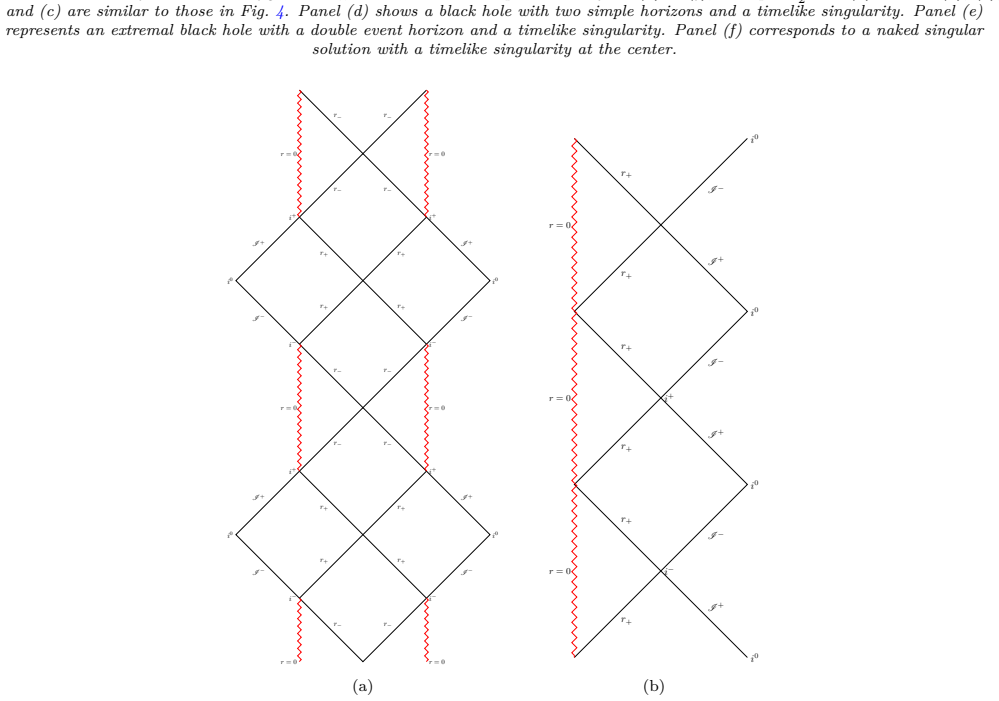
- Depending on M and Q the solutions exhibit single, double, and triple horizons as well as naked singular geometries.
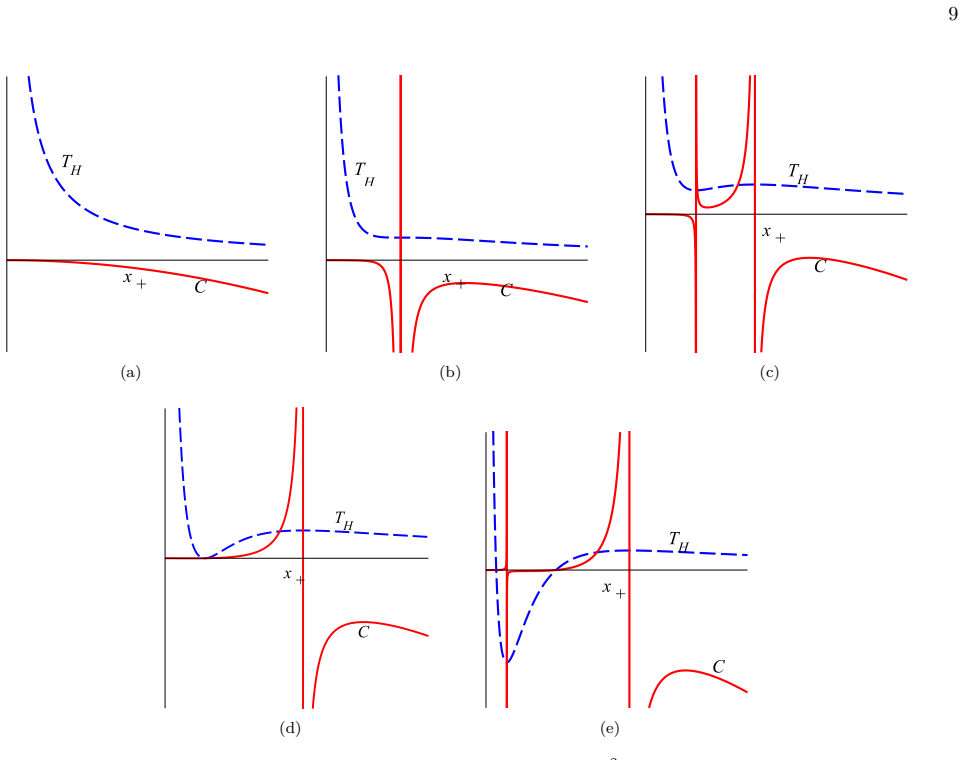
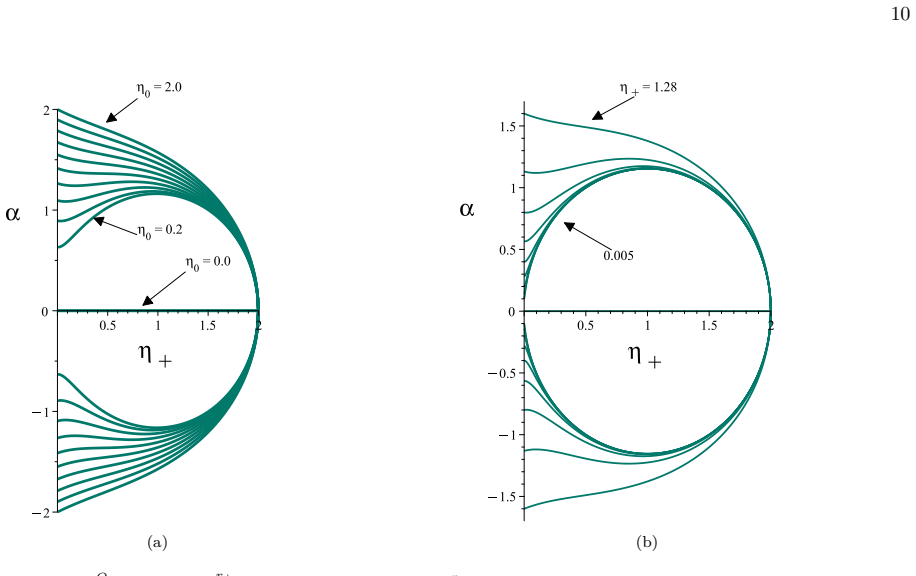
- Two critical charge parameters govern thermal behavior, with black holes unstable below the critical charge and a stable phase appearing above it within a finite horizon-radius range.
- For sufficiently large charge, extremal configurations with vanishing temperature arise.
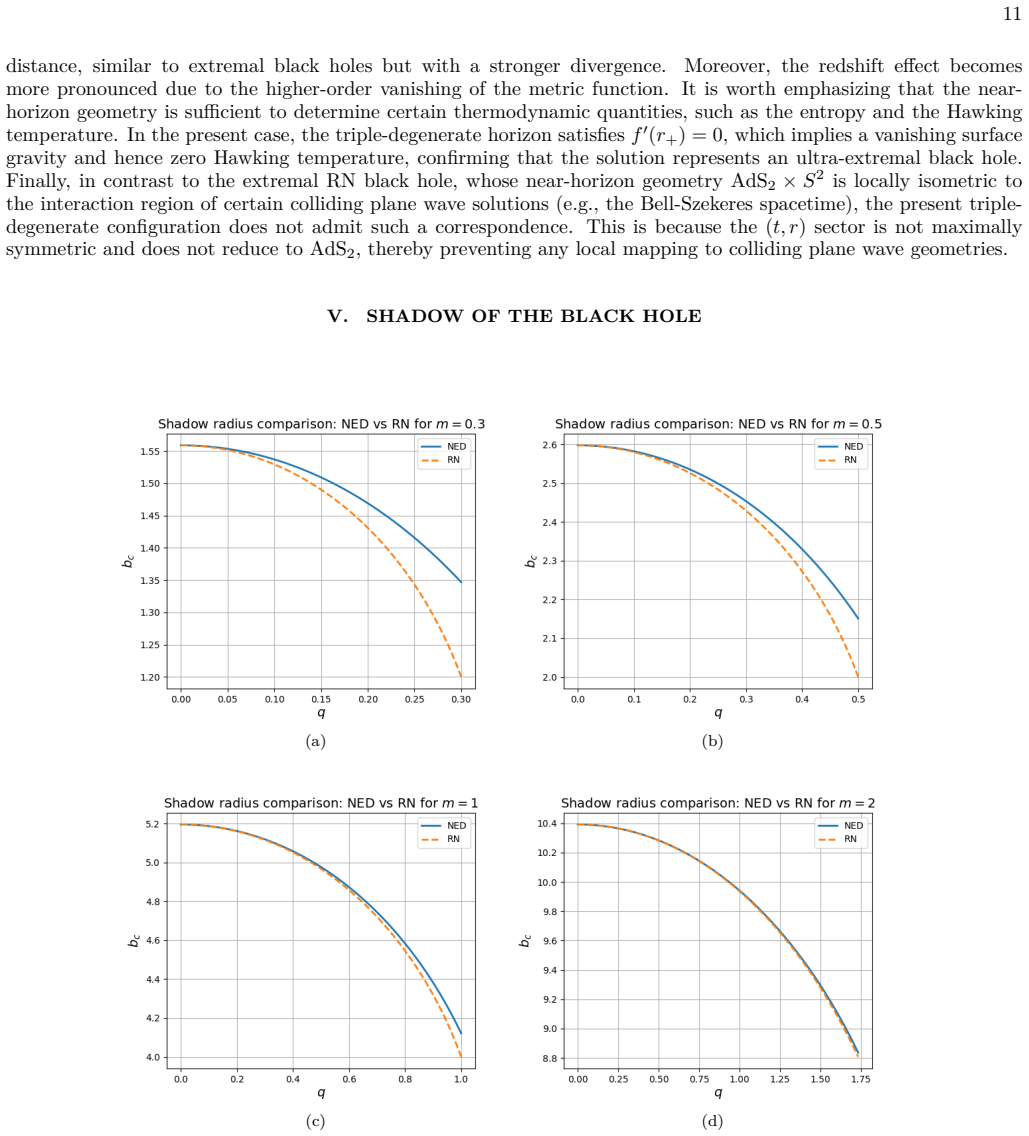
- Nonlinear corrections produce deviations in null geodesics and black hole shadows, including possible absence of a photon sphere beyond a critical charge.
- The central singularity is spacelike or timelike according to the sign of m minus two-thirds q squared.
Where Pith is reading between the lines
- Precise shadow observations could place upper bounds on the nonlinear scale r0 if the model applies to real black holes.
- The triple-horizon cases may produce distinctive quasinormal-mode spectra or perturbation dynamics not present in Reissner-Nordström geometry.
- The regularization procedure offers a minimal-coupling route to singularity resolution that could be compared with other regular black-hole constructions.
- Thermodynamic stability windows might affect the endpoint of Hawking evaporation or the accretion behavior of these objects.
Load-bearing premise
Regularizing the electric potential of a point charge produces a specific NED Lagrangian whose associated stress-energy tensor integrates to the claimed three-parameter metric family.
What would settle it
An astrophysical measurement of a charged black hole shadow whose size or shape either matches the Reissner-Nordström prediction for all observed charges or deviates in a manner that cannot be reproduced by any value of the nonlinear scale r0.
Figures
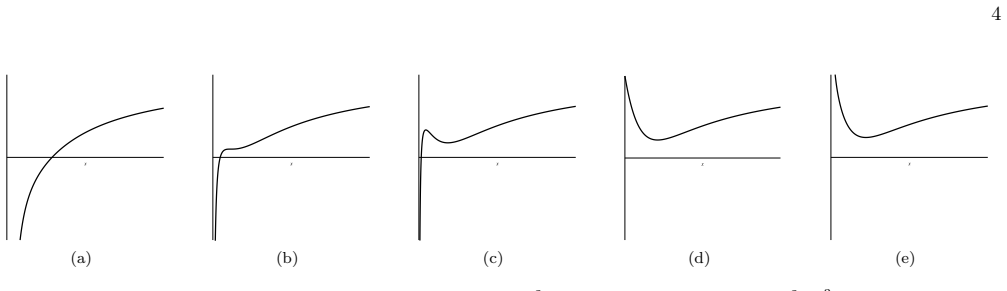
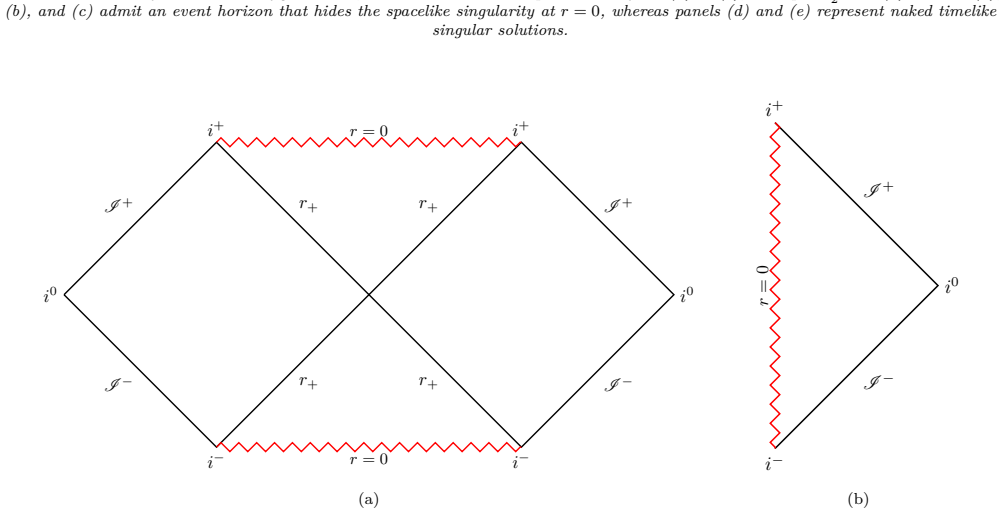
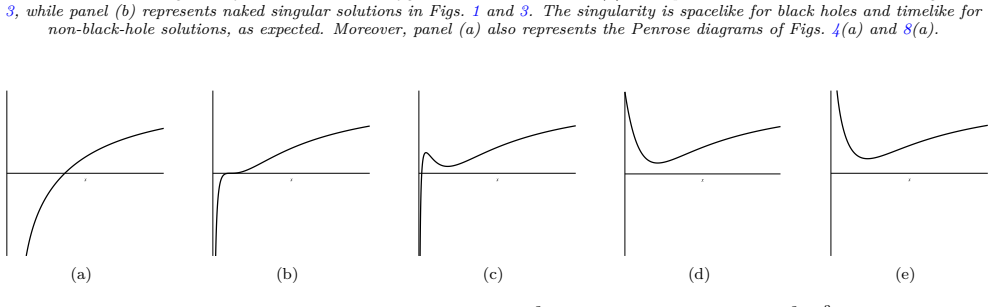
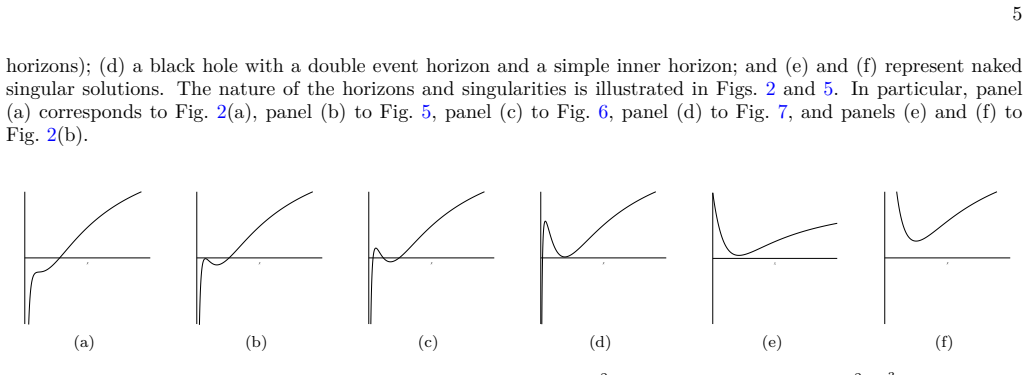
read the original abstract
We investigate static, spherically symmetric black hole solutions arising from Einstein gravity minimally coupled to a nonlinear electrodynamics (NED) model constructed from a regularized electric potential of a point charge. The resulting spacetime is characterized by three parameters, namely, the ADM mass $% M $, the electric charge $Q$, and the nonlinear scale $r_{0}$. We show that, depending on the values of $M$ and $Q$, the solutions exhibit a rich causal structure comprising black holes with single, double, and triple horizons, as well as naked singular geometries. The nature of the central singularity is determined by the combination $m-\frac{2}{3}q^{2}$, allowing for both spacelike and timelike singularities. We perform a detailed thermodynamic analysis by deriving the Hawking temperature and heat capacity, revealing the existence of two critical charge parameters that govern the thermal behavior. Below a critical charge, the black holes are thermally unstable, whereas above it a stable phase emerges within a finite range of horizon radii bounded by Davies points. For sufficiently large charge, extremal configurations with vanishing temperature arise, further constraining the stability region. We also investigate observational signatures by analyzing null geodesics and black hole shadows, showing that nonlinear electrodynamics corrections lead to noticeable deviations from the Reissner-Nordstr\"{o}m geometry, including the possible absence of a photon sphere beyond a critical charge. Our results highlight that nonlinear electrodynamics significantly enriches the causal structure, thermodynamic phase space, and dynamical response of charged black holes, providing potentially observable deviations from the Reissner-Nordstr\"{o}m paradigm.
Editorial analysis
A structured set of objections, weighed in public.
Referee Report
Summary. The manuscript constructs a nonlinear electrodynamics model by regularizing the electric potential of a point charge, minimally coupled to Einstein gravity. This produces a three-parameter family of static spherically symmetric metrics (M, Q, r0). The paper analyzes the resulting causal structures (single/double/triple horizons, naked singularities with nature set by m−(2/3)q²), thermodynamics (Hawking temperature, heat capacity, two critical charges, stability windows bounded by Davies points, extremal configurations), and null geodesics (shadows with possible absence of photon spheres beyond a critical charge), claiming these features enrich the Reissner-Nordström paradigm.
Significance. If the model derivation is consistent and the metrics solve the coupled equations, the work supplies a concrete NED example with multiple horizons, thermodynamic critical points, and observable shadow deviations. The identification of charge-dependent stability regions and the potential disappearance of photon spheres would be of interest for strong-field tests and modified electrodynamics phenomenology.
major comments (3)
- [§2] §2 (model construction): the regularization procedure applied to the point-charge potential is presented, but neither the explicit Lagrangian L(F) nor the integration steps yielding a divergence-free, minimally coupled T_{\mu\nu} that produces the claimed three-parameter metric are shown. This is load-bearing, as all horizon counts, critical charges, and shadow results presuppose that the geometry solves the Einstein-NED system rather than being an ansatz.
- [§3] §3 (metric and horizons): without the explicit metric function f(r) or the field equations, the statements that solutions exhibit single/double/triple horizons depending on M and Q, and that the central singularity type is controlled by m−(2/3)q², cannot be verified independently.
- [§4] §4 (thermodynamics): the two critical charge parameters and the stability windows bounded by Davies points are reported, but their derivation from the temperature and heat capacity expressions relies on the unshown metric; the claim that sufficiently large charge produces extremal configurations with vanishing temperature therefore remains unconfirmed.
minor comments (2)
- [Abstract] The abstract contains a typographical artifact ("$% M $"); this should be cleaned in the final version.
- Notation for the nonlinear scale is introduced as r0 but later appears as r_{0}; consistent usage throughout would improve readability.
Simulated Author's Rebuttal
We thank the referee for the careful reading and constructive comments on our manuscript. We address each major comment below and will revise the manuscript accordingly to ensure all derivations and expressions are explicitly presented for independent verification.
read point-by-point responses
-
Referee: [§2] §2 (model construction): the regularization procedure applied to the point-charge potential is presented, but neither the explicit Lagrangian L(F) nor the integration steps yielding a divergence-free, minimally coupled T_{\mu u} that produces the claimed three-parameter metric are shown. This is load-bearing, as all horizon counts, critical charges, and shadow results presuppose that the geometry solves the Einstein-NED system rather than being an ansatz.
Authors: We agree that the explicit Lagrangian L(F) and the detailed integration steps confirming a divergence-free T_{\mu u} were not presented with sufficient clarity. In the revised manuscript we will add the explicit form of L(F) derived from the regularized potential together with the integration steps showing that the resulting stress-energy tensor is divergence-free and yields the three-parameter metric through the Einstein equations. revision: yes
-
Referee: [§3] §3 (metric and horizons): without the explicit metric function f(r) or the field equations, the statements that solutions exhibit single/double/triple horizons depending on M and Q, and that the central singularity type is controlled by m−(2/3)q², cannot be verified independently.
Authors: We will include the explicit metric function f(r) and the relevant Einstein-NED field equations in the revised §3. This will enable direct verification of the single-, double-, and triple-horizon configurations as well as the classification of the central singularity according to the sign of m−(2/3)q². revision: yes
-
Referee: [§4] §4 (thermodynamics): the two critical charge parameters and the stability windows bounded by Davies points are reported, but their derivation from the temperature and heat capacity expressions relies on the unshown metric; the claim that sufficiently large charge produces extremal configurations with vanishing temperature therefore remains unconfirmed.
Authors: The thermodynamic quantities are obtained directly from the metric function. In the revised manuscript we will explicitly derive and display the Hawking temperature and heat-capacity expressions from f(r), thereby confirming the two critical charges, the stability windows delimited by Davies points, and the existence of extremal configurations with vanishing temperature for sufficiently large charge. revision: yes
Circularity Check
No significant circularity; derivation presented as independent construction
full rationale
The abstract describes a NED Lagrangian obtained via regularization of the point-charge potential, yielding a three-parameter (M, Q, r0) metric family whose causal structure, thermodynamics, and shadows are then analyzed. No equations, self-citations, or explicit reductions are supplied in the provided text that would make any reported feature (horizon multiplicity, critical charges, shadow size) equivalent by construction to the input regularization scale. The introduction of r0 as a model parameter and the subsequent study of its effects constitute standard parametric exploration rather than a fitted-input-called-prediction or self-definitional loop. Absent load-bearing self-citations or ansatz smuggling, the chain is self-contained against external benchmarks.
Axiom & Free-Parameter Ledger
free parameters (1)
- r0
axioms (2)
- domain assumption Einstein gravity is minimally coupled to the nonlinear electrodynamics stress-energy tensor
- standard math The spacetime is static and spherically symmetric
invented entities (1)
-
Regularized electric potential of a point charge
no independent evidence
Reference graph
Works this paper leans on
-
[1]
Schwarzschild, On the gravitational field of a mass point according to Einstein’s theory, Sitzungsber
K. Schwarzschild, On the gravitational field of a mass point according to Einstein’s theory, Sitzungsber. Preuss. Akad. Wiss. Berlin (Math. Phys.) , 189, 196 (1916)
1916
-
[2]
Reissner, Über die Eigengravitation des elektrischen Feldes nach der Einsteinschen Theorie, Ann
H. Reissner, Über die Eigengravitation des elektrischen Feldes nach der Einsteinschen Theorie, Ann. Phys. 355, 106 (1916)
1916
-
[3]
Nordström, On the energy of the gravitational field in Einstein’s theory, Proc
G. Nordström, On the energy of the gravitational field in Einstein’s theory, Proc. Kon. Ned. Akad. Wet. 20, 1238 (1918)
1918
-
[4]
S. W. Hawking and G. F. R. Ellis, The Large Scale Structure of Space-Time (Cambridge University Press, 1973)
1973
-
[5]
Born and L
M. Born and L. Infeld, Foundations of the new field theory, Proc. Roy. Soc. A 144, 425 (1934)
1934
-
[6]
J. M. Bardeen, Non-singular general-relativistic gravitational collapse, Proc. Int. Conf. GR5, 174 (1968)
1968
-
[7]
Ayón-Beato and A
E. Ayón-Beato and A. García, The Bardeen model as a nonlinear magnetic monopole, Phys. Lett. B 493, 149 (2000)
2000
-
[8]
Ayón-Beato and A
E. Ayón-Beato and A. García, Regular black hole in general relativity coupled to nonlinear electrodynamics, Phys. Rev. Lett. 80, 505 (1998)
1998
-
[9]
K. A. Bronnikov, Regular magnetic black holes and monopoles from nonlinear electrodynamics, Phys. Rev. D 63, 044005 (2001)
2001
-
[10]
Dymnikova, Regular electrically charged structures in nonlinear electrodynamics coupled to general relativity, Class
I. Dymnikova, Regular electrically charged structures in nonlinear electrodynamics coupled to general relativity, Class. Quantum Grav. 21, 4417 (2004)
2004
-
[11]
Z. Y. Fan and X. Wang, Construction of regular black holes in general relativity, Phys. Rev. D 94, 124027 (2016)
2016
-
[12]
Balart and E
L. Balart and E. C. Vagenas, Regular black holes with a nonlinear electrodynamics source, Phys. Rev. D 90, 124045 (2014)
2014
-
[13]
S. I. Kruglov, Nonlinear electrodynamics and black holes, Ann. Phys. 378, 59 (2017)
2017
-
[14]
S. H. Hendi, Black hole solutions in nonlinear electrodynamics, Eur. Phys. J. C 77, 296 (2017)
2017
-
[15]
S. A. Hayward, Formation and evaporation of regular black holes, Phys. Rev. Lett. 96, 031103 (2006)
2006
-
[16]
Bambi and L
C. Bambi and L. Modesto, Rotating regular black holes, Phys. Lett. B 721, 329 (2013)
2013
-
[17]
S. H. Mazharimousavi, Regular electric potential and nonlinear electrodynamics, Fortschritte der Physik (2026), submitted
2026
-
[18]
J. D. Bekenstein, Black holes and entropy, Phys. Rev. D 7, 2333 (1973) . 14
1973
-
[19]
S. W. Hawking, Particle creation by black holes, Commun. Math. Phys. 43, 199 (1975)
1975
-
[20]
P. C. W. Davies, Thermodynamics of black holes, Rep. Prog. Phys. 41, 1313 (1977)
1977
-
[21]
Chamblin et al., Charged AdS black holes and phase transitions, Phys
A. Chamblin et al., Charged AdS black holes and phase transitions, Phys. Rev. D 60, 064018 (1999)
1999
-
[22]
Perlick et al., Influence of a plasma on the shadow of a spherically symmetric black hole, Phys
V. Perlick et al., Influence of a plasma on the shadow of a spherically symmetric black hole, Phys. Rev. D 92, 104031 (2015)
2015
-
[23]
I., Astrophys
Event Horizon Telescope Collaboration, First M87 Event Horizon Telescope Results. I., Astrophys. J. Lett. 875, L1 (2019)
2019
-
[24]
VI., Astrophys
Event Horizon Telescope Collaboration, First M87 Event Horizon Telescope Results. VI., Astrophys. J. Lett. 875, L6 (2019)
2019
-
[25]
Regge and J
T. Regge and J. A. Wheeler, Stability of a Schwarzschild singularity, Phys. Rev. 108, 1063 (1957)
1957
-
[26]
F. J. Zerilli, Gravitational field of a particle falling in a Schwarzschild geometry, Phys. Rev. D 2, 2141 (1970)
1970
-
[27]
K. D. Kokkotas and B. G. Schmidt, Quasinormal modes of stars and black holes, Living Rev. Relativity 2, 2 (1999)
1999
-
[28]
Berti, V
E. Berti, V. Cardoso, and A. O. Starinets, Quasinormal modes of black holes and black branes, Class. Quantum Grav. 26, 163001 (2009)
2009
-
[29]
Cardoso et al., Geodesic stability, Lyapunov exponents and quasinormal modes, Phys
V. Cardoso et al., Geodesic stability, Lyapunov exponents and quasinormal modes, Phys. Rev. D 79, 064016 (2009)
2009
-
[30]
R. M. Wald, Black Hole Entropy is the Noether Charge, Phys. Rev. D 48, R3427 (1993)
1993
-
[31]
Iyer, and R
V. Iyer, and R. M. Wald, Some Properties of Noether Charge and a Proposal for Dynamical Black Hole Entropy, Phys. Rev. D 50, 846 (1994)
1994
-
[32]
D. A. Rasheed, Non-linear Electrodynamics: Zeroth and First Laws of Black Hole Mechanics, arXiv:hep-th/9702087v2
-
[33]
Breton, Smarr’s Formula for Black Holes with Nonlinear Electrodynamics, Gen
N. Breton, Smarr’s Formula for Black Holes with Nonlinear Electrodynamics, Gen. Relativ. Gravit. 37, 643 (2005)
2005
-
[34]
T. K. Dey, Born-Infeld Black Holes in the Presence of a Cosmological Constant, Phys. Lett. B 595, 484 (2004)
2004
-
[35]
S. H. Hendi, Asymptotic Reissner-Nordström black holes, Ann. Phys. 333, 282 (2013)
2013
discussion (0)
Sign in with ORCID, Apple, or X to comment. Anyone can read and Pith papers without signing in.