SN1987A Constraints of Light boldsymbol{Z'} with Non-Mixing Polarisations
Pith reviewed 2026-06-26 08:03 UTC · model grok-4.3
The pith
Treating longitudinal and transverse polarizations of light gauge bosons as independent carriers revises the SN1987A bounds because their mixing is suppressed at weak couplings.
A machine-rendered reading of the paper's core claim, the machinery that carries it, and where it could break.
Core claim
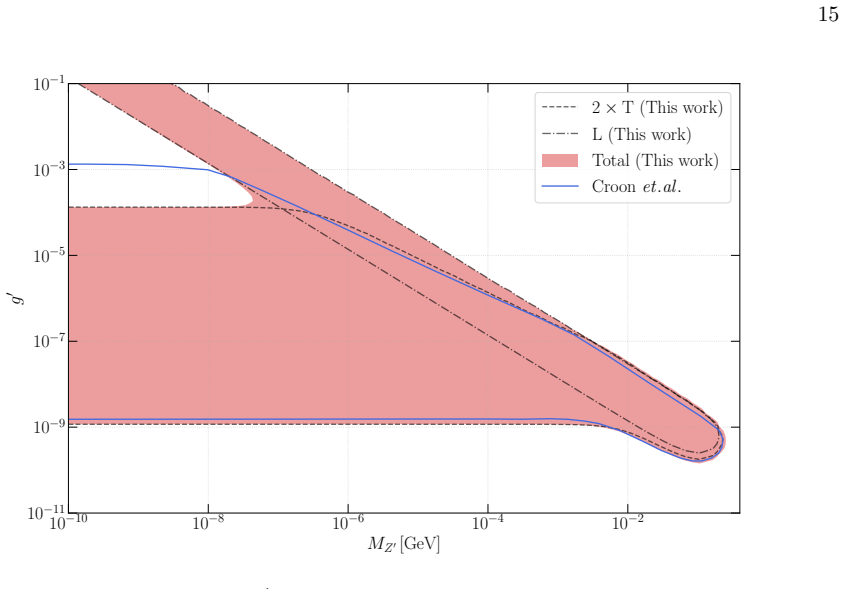
The intermixing between different polarisation modes is suppressed in the low coupling regime. Using the light gauge boson in the Lμ-Lτ model as an example, considering the independent energy transport of longitudinal and transverse polarisations can lead to significant modifications of the SN1987A bounds on the parameter space.
What carries the argument
Independent energy transport by longitudinal and transverse polarization modes of a light gauge boson, justified by suppressed intermixing at low coupling.
If this is right
- The allowed range of masses and couplings for the Lμ-Lτ Z' changes compared with earlier SN1987A analyses.
- Regions of parameter space previously ruled out by combined polarization transport may open up or close.
- Any supernova-cooling bound on a light vector boson must be recomputed once polarization modes are treated separately.
- The same separation of modes applies to energy-loss calculations in other dense astrophysical environments.
Where Pith is reading between the lines
- The revised bounds could alter the interpretation of terrestrial searches for the same Z' boson.
- Similar polarization accounting might tighten or loosen constraints from neutron-star cooling or white-dwarf evolution.
- Future high-statistics supernova neutrino data could test the independent-transport prediction directly.
- The approach invites re-examination of bounds on other light vectors that couple through currents with distinct longitudinal behavior.
Load-bearing premise
Intermixing between different polarisation modes is suppressed in the low coupling regime.
What would settle it
A plasma calculation that finds the polarization-flip rate comparable to the boson production rate inside the supernova core at the couplings under study.
Figures
read the original abstract
The observation of supernova 1987A (SN1987A) provides a unique opportunity to explore new physics beyond the Standard Model (BSM). The production of new particles in the supernova core could accelerate the cooling process, leading to additional energy loss and consequently reducing the duration of the observed neutrino burst at detectors. Therefore, any BSM interactions that affect supernova cooling are subject to stringent constraints from SN1987A observations. In this paper, we revisit the constraints on light gauge bosons (LGBs) by reassessing the validity of underlying assumptions about the polarisation intermixing. We argue that the intermixing between different polarisation modes is suppressed in the low coupling regime. Using the light gauge boson in the $L_\mu-L_\tau$ model as an example, we find that considering the independent energy transport of longitudinal and transverse polarisations can lead to significant modifications of the SN1987A bounds on the parameter space.
Editorial analysis
A structured set of objections, weighed in public.
Referee Report
Summary. The paper claims that in the low-coupling regime relevant to SN1987A, intermixing between polarization modes of a light Z' is suppressed, permitting independent energy transport for longitudinal and transverse polarizations. Using the L_μ-L_τ model as an example, this leads to significant modifications of the SN1987A exclusion bounds on the gauge coupling and mass parameter space relative to standard treatments that assume rapid mixing.
Significance. If the independent-polarization treatment is justified by explicit rate comparisons, the result would revise astrophysical constraints on a well-studied BSM scenario, potentially reopening regions of parameter space previously excluded by SN1987A. The emphasis on polarization-dependent transport provides a concrete, falsifiable adjustment to existing cooling bounds and could influence similar analyses for other light vectors.
major comments (1)
- [Abstract] Abstract: the central claim that polarization intermixing is suppressed (allowing independent longitudinal/transverse transport) rests on the unshown assertion that the mixing rate Γ_mix remains parametrically smaller than production and transport rates throughout the low-coupling regime. No comparison of Γ_mix to the inverse mean free path or production rate is provided under the stated SN core conditions (T ≈ 30 MeV, n_B ≈ 10^14 g cm^{-3}), which is load-bearing for the reported modification of the bounds.
Simulated Author's Rebuttal
We thank the referee for their careful review and for identifying the need for explicit rate comparisons to support the central claim. We have revised the manuscript to include these comparisons under the specified supernova core conditions and updated the abstract accordingly.
read point-by-point responses
-
Referee: [Abstract] Abstract: the central claim that polarization intermixing is suppressed (allowing independent longitudinal/transverse transport) rests on the unshown assertion that the mixing rate Γ_mix remains parametrically smaller than production and transport rates throughout the low-coupling regime. No comparison of Γ_mix to the inverse mean free path or production rate is provided under the stated SN core conditions (T ≈ 30 MeV, n_B ≈ 10^14 g cm^{-3}), which is load-bearing for the reported modification of the bounds.
Authors: We agree that the manuscript did not include an explicit numerical comparison of Γ_mix to the production rate and inverse mean free path under the quoted SN1987A conditions, which is required to substantiate the suppression of intermixing. In the revised version we have added Section 3.2, which derives Γ_mix from the L_μ-L_τ interaction Lagrangian, evaluates it at T = 30 MeV and n_B ≈ 10^14 g cm^{-3}, and directly compares the resulting values to the production and transport rates across the low-coupling regime of interest. The comparison shows Γ_mix remains parametrically smaller, justifying the independent-polarization treatment. The abstract has been updated to reference this new subsection. revision: yes
Circularity Check
No significant circularity; derivation is self-contained
full rationale
The paper states its central premise as an argument that polarization intermixing is suppressed in the low-coupling regime and then explores consequences for SN1987A bounds under independent longitudinal/transverse transport. No equations, parameter fits, or self-citations are exhibited in the provided text that would reduce any claimed prediction or bound modification to an input by construction. The assumption is presented explicitly rather than smuggled via prior self-work or renamed empirical pattern. This is the common case of an independent (if debatable) physical assumption driving the result, with no load-bearing reduction to tautology.
Axiom & Free-Parameter Ledger
axioms (1)
- domain assumption intermixing between different polarisation modes is suppressed in the low coupling regime
Reference graph
Works this paper leans on
-
[1]
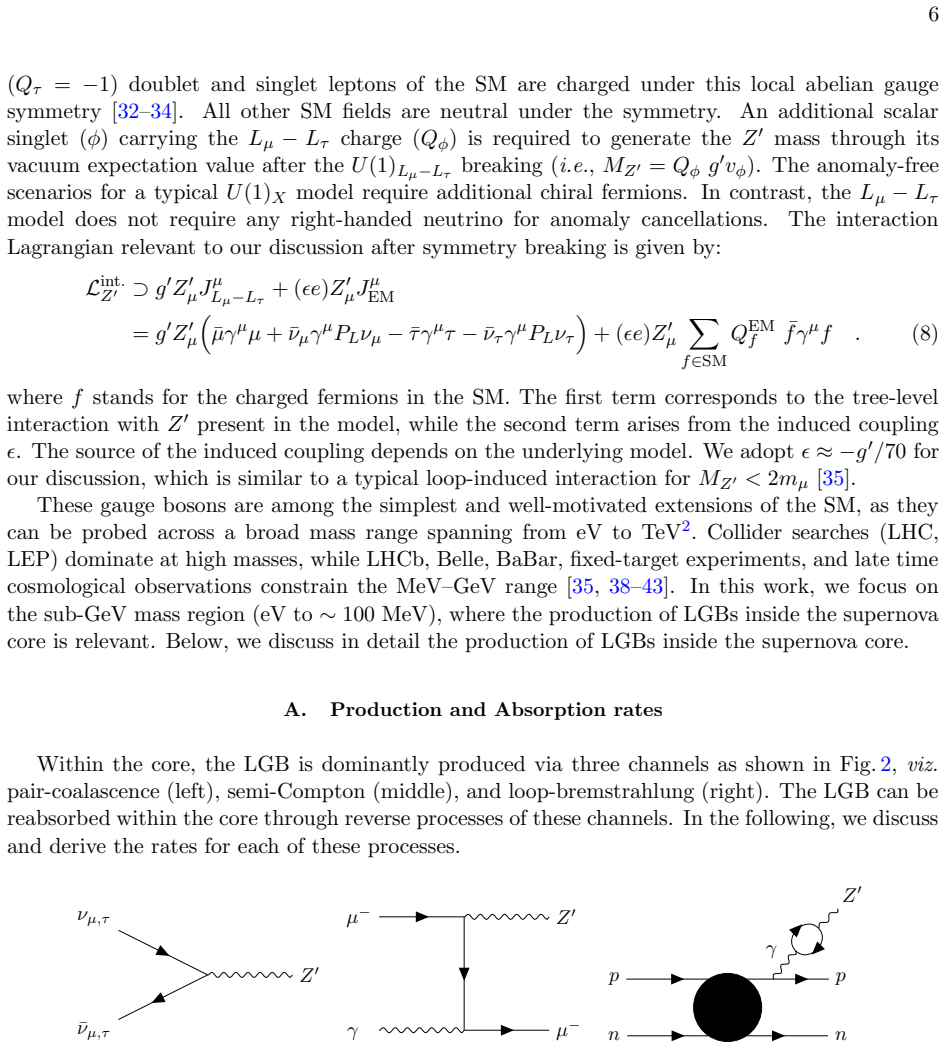
Pair-coalescence In earlier studies, the rate of the pair-coalescence (PC) and inverse PC (decay) process is gen- erally evaluated assuming non-degenerate neutrinos [11, 12]. However, within the neutrinosphere, 2 The development of grand unified theories (GUTs) that go beyond the originalSU(5) model, such as those based onSO(10) orE 6 provides strong moti...
-
[2]
Semi-Compton We first derive the expressions for the absorption rates of the LGB polarisations through the semi-Compton (SC) process and then employ the principle of detailed balance to evaluate the production rate. This absorption rate is expressed as [11], Γλ,SC abs = 1 1−e −ω/T ×n µFdeg × s 1− M 2 Z′ ω2 σλ SC .(13) The cross-section for individual pola...
-
[3]
However, the LGB can couple to electromagnetic currents through an induced coupling (ϵ), specifically via a muon-induced loop in our discussion
Loop-bremsstrahlung In theL µ −L τ model, the LGB does not interact with the proton at tree level. However, the LGB can couple to electromagnetic currents through an induced coupling (ϵ), specifically via a muon-induced loop in our discussion. The loop suppression can be overcome by the large densities of neutrons (n n) and protons (n p) available in the ...
-
[4]
Observation of a Neutrino Burst in Coincidence with Supernova SN 1987a in the Large Magellanic Cloud,
R. M. Biontaet al., “Observation of a Neutrino Burst in Coincidence with Supernova SN 1987a in the Large Magellanic Cloud,”Phys. Rev. Lett.58(1987) 1494. [2]Kamiokande-IICollaboration, K. Hirataet al., “Observation of a Neutrino Burst from the Supernova SN 1987a,”Phys. Rev. Lett.58(1987) 1490–1493
1987
-
[5]
Constraints on Light Magnetic Dipole Dark Matter from the ILC and SN 1987A,
K. Kadota and J. Silk, “Constraints on Light Magnetic Dipole Dark Matter from the ILC and SN 1987A,”Phys. Rev. D89no. 10, (2014) 103528,arXiv:1402.7295 [hep-ph]
Pith/arXiv arXiv 2014
-
[6]
Toward Powerful Probes of Neutrino Self-Interactions in Supernovae,
P.-W. Chang, I. Esteban, J. F. Beacom, T. A. Thompson, and C. M. Hirata, “Toward Powerful Probes of Neutrino Self-Interactions in Supernovae,”Phys. Rev. Lett.131no. 7, (2023) 071002, arXiv:2206.12426 [hep-ph]
arXiv 2023
-
[7]
Self-interacting dark sectors in supernovae are fluid,
D. F. G. Fiorillo and E. Vitagliano, “Self-interacting dark sectors in supernovae are fluid,” arXiv:2404.07714 [hep-ph]
-
[8]
Theory of Core-Collapse Supernovae,
H.-T. Janka, K. Langanke, A. Marek, G. Martinez-Pinedo, and B. Mueller, “Theory of Core-Collapse Supernovae,”Phys. Rept.442(2007) 38–74,arXiv:astro-ph/0612072
Pith/arXiv arXiv 2007
-
[9]
New constraint from supernova explosions on light particles beyond the Standard Model,
A. Sung, H. Tu, and M.-R. Wu, “New constraint from supernova explosions on light particles beyond the Standard Model,”Phys. Rev. D99no. 12, (2019) 121305,arXiv:1903.07923 [hep-ph]. 19
arXiv 2019
-
[10]
Muon Creation in Supernova Matter Facilitates Neutrino-driven Explosions,
R. Bollig, H. T. Janka, A. Lohs, G. Martinez-Pinedo, C. J. Horowitz, and T. Melson, “Muon Creation in Supernova Matter Facilitates Neutrino-driven Explosions,”Phys. Rev. Lett.119no. 24, (2017) 242702,arXiv:1706.04630 [astro-ph.HE]
Pith/arXiv arXiv 2017
-
[11]
G. G. Raffelt,Stars as laboratories for fundamental physics: The astrophysics of neutrinos, axions, and other weakly interacting particles. University of Chicago Press, 5, 1996
1996
-
[12]
Revisiting Supernova 1987A Constraints on Dark Photons,
J. H. Chang, R. Essig, and S. D. McDermott, “Revisiting Supernova 1987A Constraints on Dark Photons,”JHEP01(2017) 107,arXiv:1611.03864 [hep-ph]
Pith/arXiv arXiv 2017
-
[13]
Supernova Muons: New Constraints onZ’ Bosons, Axions and ALPs,
D. Croon, G. Elor, R. K. Leane, and S. D. McDermott, “Supernova Muons: New Constraints onZ’ Bosons, Axions and ALPs,”JHEP01(2021) 107,arXiv:2006.13942 [hep-ph]
arXiv 2021
-
[14]
K.-C. Lai, C. S. J. Leung, and G.-L. Lin, “SN1987A constraints to BSM models with extra neutral bosons near the trapping regime: U(1)Lµ-Lτmodel as an illustrative example,”Phys. Rev. D110 no. 10, (2024) 103023,arXiv:2401.16023 [hep-ph]
arXiv 2024
-
[15]
Limits on heavy neutral leptons, Z ′ bosons and majorons from high-energy supernova neutrinos,
K. Akita, S. H. Im, M. Masud, and S. Yun, “Limits on heavy neutral leptons, Z ′ bosons and majorons from high-energy supernova neutrinos,”JHEP07(2024) 057,arXiv:2312.13627 [hep-ph]
arXiv 2024
-
[16]
L µ −L τ gauge bosons in beam dumps and supernovae,
N. Blinov, P. J. Fox, K. J. Kelly, R. Plestid, and T. Zhou, “L µ −L τ gauge bosons in beam dumps and supernovae,”JHEP06(2026) 155,arXiv:2511.09619 [hep-ph]
Pith/arXiv arXiv 2026
-
[17]
G. Lucente, P. Carenza, T. Fischer, M. Giannotti, and A. Mirizzi, “Heavy axion-like particles and core-collapse supernovae: constraints and impact on the explosion mechanism,”JCAP12(2020) 008, arXiv:2008.04918 [hep-ph]
arXiv 2020
-
[18]
Supernova constraints on an axion-photon-dark photon interaction,
A. Hook, G. Marques-Tavares, and C. Ristow, “Supernova constraints on an axion-photon-dark photon interaction,”JHEP06(2021) 167,arXiv:2105.06476 [hep-ph]
arXiv 2021
-
[19]
Revisiting Supernova 1987A Limits on Axion-Like-Particles,
J. S. Lee, “Revisiting Supernova 1987A Limits on Axion-Like-Particles,”arXiv:1808.10136 [hep-ph]
-
[20]
Low-energy supernovae bounds on sterile neutrinos,
G. Chauhan, S. Horiuchi, P. Huber, and I. M. Shoemaker, “Low-energy supernovae bounds on sterile neutrinos,”JCAP03(2025) 052,arXiv:2309.05860 [hep-ph]
arXiv 2025
-
[21]
Comprehensive constraints on heavy sterile neutrinos from core-collapse supernovae,
P. Carenza, G. Lucente, L. Mastrototaro, A. Mirizzi, and P. D. Serpico, “Comprehensive constraints on heavy sterile neutrinos from core-collapse supernovae,”Phys. Rev. D109no. 6, (2024) 063010, arXiv:2311.00033 [hep-ph]
arXiv 2024
-
[22]
Supernova limits on muonic dark forces,
C. A. Manzari, J. Martin Camalich, J. Spinner, and R. Ziegler, “Supernova limits on muonic dark forces,”Phys. Rev. D108no. 10, (2023) 103020,arXiv:2307.03143 [hep-ph]
arXiv 2023
-
[23]
Supernova Constraint on Self-Interacting Dark Sector Particles,
A. Sung, G. Guo, and M.-R. Wu, “Supernova Constraint on Self-Interacting Dark Sector Particles,” Phys. Rev. D103no. 10, (2021) 103005,arXiv:2102.04601 [hep-ph]
arXiv 2021
-
[24]
New Supernova Constraints on Neutrinophilic Dark Sector,
C. V. Cappiello, P. S. B. Dev, and A. V. Patwardhan, “New Supernova Constraints on Neutrinophilic Dark Sector,”arXiv:2503.09691 [hep-ph]
-
[25]
Decay photons from the axionlike particles burst of type II supernovae,
J. Jaeckel, P. C. Malta, and J. Redondo, “Decay photons from the axionlike particles burst of type II supernovae,”Phys. Rev. D98no. 5, (2018) 055032,arXiv:1702.02964 [hep-ph]
Pith/arXiv arXiv 2018
-
[26]
Observable signatures of dark photons from supernovae,
W. DeRocco, P. W. Graham, D. Kasen, G. Marques-Tavares, and S. Rajendran, “Observable signatures of dark photons from supernovae,”JHEP02(2019) 171,arXiv:1901.08596 [hep-ph]
arXiv 2019
-
[27]
Low-Energy Supernovae Severely Constrain Radiative Particle Decays,
A. Caputo, H.-T. Janka, G. Raffelt, and E. Vitagliano, “Low-Energy Supernovae Severely Constrain Radiative Particle Decays,”Phys. Rev. Lett.128no. 22, (2022) 221103,arXiv:2201.09890 [astro-ph.HE]
arXiv 2022
-
[28]
Supernova production of axion-like particles coupling to electrons, reloaded,
D. F. G. Fiorillo, T. Pitik, and E. Vitagliano, “Supernova production of axion-like particles coupling to electrons, reloaded,”arXiv:2503.15630 [hep-ph]
-
[29]
Stellar cooling bounds on new light particles: plasma mixing effects,
E. Hardy and R. Lasenby, “Stellar cooling bounds on new light particles: plasma mixing effects,” JHEP02(2017) 033,arXiv:1611.05852 [hep-ph]
Pith/arXiv arXiv 2017
-
[30]
Muonic boson limits: Supernova redux,
A. Caputo, G. Raffelt, and E. Vitagliano, “Muonic boson limits: Supernova redux,”Phys. Rev. D 105no. 3, (2022) 035022,arXiv:2109.03244 [hep-ph]
Pith/arXiv arXiv 2022
-
[31]
Nucleon-nucleon bremsstrahlung of dark gauge bosons and revised supernova constraints,
E. Rrapaj and S. Reddy, “Nucleon-nucleon bremsstrahlung of dark gauge bosons and revised supernova constraints,”Phys. Rev. C94no. 4, (2016) 045805,arXiv:1511.09136 [nucl-th]
Pith/arXiv arXiv 2016
-
[32]
The birth of neutron stars,
A. Burrows and J. M. Lattimer, “The birth of neutron stars,”Astrophys. J.307(1986) 178–196
1986
-
[33]
Neutrinos from SN 1987A,
A. Burrows and J. M. Lattimer, “Neutrinos from SN 1987A,”Astrophys. J. Lett.318(1987) L63–L68
1987
-
[34]
NEW Z-prime PHENOMENOLOGY,
X. G. He, G. C. Joshi, H. Lew, and R. R. Volkas, “NEW Z-prime PHENOMENOLOGY,”Phys. Rev. D43(1991) 22–24
1991
-
[35]
E. Ma, D. P. Roy, and S. Roy, “Gauged L(mu) - L(tau) with large muon anomalous magnetic moment and the bimaximal mixing of neutrinos,”Phys. Lett. B525(2002) 101–106,arXiv:hep-ph/0110146. 20
Pith/arXiv arXiv 2002
-
[36]
Muon anomalous g-2 and gauged L(muon) - L(tau) models,
S. Baek, N. G. Deshpande, X. G. He, and P. Ko, “Muon anomalous g-2 and gauged L(muon) - L(tau) models,”Phys. Rev. D64(2001) 055006,arXiv:hep-ph/0104141
Pith/arXiv arXiv 2001
-
[37]
Cosmology with A Very Light L µ −L τ Gauge Boson,
M. Escudero, D. Hooper, G. Krnjaic, and M. Pierre, “Cosmology with A Very Light L µ −L τ Gauge Boson,”JHEP03(2019) 071,arXiv:1901.02010 [hep-ph]
Pith/arXiv arXiv 2019
-
[38]
Low-Energy Phenomenology of Superstring Inspired E(6) Models,
J. L. Hewett and T. G. Rizzo, “Low-Energy Phenomenology of Superstring Inspired E(6) Models,” Phys. Rept.183(1989) 193
1989
-
[39]
The Physics of HeavyZ ′ Gauge Bosons,
P. Langacker, “The Physics of HeavyZ ′ Gauge Bosons,”Rev. Mod. Phys.81(2009) 1199–1228, arXiv:0801.1345 [hep-ph]. [38]A TLASCollaboration, G. Aadet al., “Search for high-mass dilepton resonances using 139 fb −1 ofpp collision data collected at √s=13 TeV with the ATLAS detector,”Phys. Lett. B796(2019) 68–87, arXiv:1903.06248 [hep-ex]
Pith/arXiv arXiv 2009
-
[40]
Probing Dark Forces and Light Hidden Sectors at Low-Energy e+e- Colliders,
R. Essig, P. Schuster, and N. Toro, “Probing Dark Forces and Light Hidden Sectors at Low-Energy e+e- Colliders,”Phys. Rev. D80(2009) 015003,arXiv:0903.3941 [hep-ph]. [40]LHCbCollaboration, R. Aaijet al., “Search for Dark Photons Produced in 13 TeVppCollisions,” Phys. Rev. Lett.120no. 6, (2018) 061801,arXiv:1710.02867 [hep-ex]. [41]BaBarCollaboration, J. P...
Pith/arXiv arXiv 2009
-
[41]
A Search for Shortlived Particles Produced in an Electron Beam Dump,
A. Bross, M. Crisler, S. H. Pordes, J. Volk, S. Errede, and J. Wrbanek, “A Search for Shortlived Particles Produced in an Electron Beam Dump,”Phys. Rev. Lett.67(1991) 2942–2945
1991
-
[42]
Neff at CMB challenges U(1)X light gauge boson scenarios,
D. K. Ghosh, P. Ghosh, S. Jeesun, and R. Srivastava, “Neff at CMB challenges U(1)X light gauge boson scenarios,”Phys. Rev. D110no. 7, (2024) 075032,arXiv:2404.10077 [hep-ph]
arXiv 2024
-
[43]
Core-collapse supernova equations of state based on neutron star observations,
A. W. Steiner, M. Hempel, and T. Fischer, “Core-collapse supernova equations of state based on neutron star observations,”Astrophys. J.774(2013) 17,arXiv:1207.2184 [astro-ph.SR]
Pith/arXiv arXiv 2013
-
[44]
Muons in Supernovae: Implications for the Axion-Muon Coupling,
R. Bollig, W. DeRocco, P. W. Graham, and H.-T. Janka, “Muons in Supernovae: Implications for the Axion-Muon Coupling,”Phys. Rev. Lett.125no. 5, (2020) 051104,arXiv:2005.07141 [hep-ph]. [Erratum: Phys.Rev.Lett. 126, 189901 (2021)]
arXiv 2020
-
[45]
New stellar constraints on dark photons,
H. An, M. Pospelov, and J. Pradler, “New stellar constraints on dark photons,”Phys. Lett. B725 (2013) 190–195,arXiv:1302.3884 [hep-ph]
Pith/arXiv arXiv 2013
-
[46]
Approximation of scattering phases for reid93 potential,
V. Zhaba, “Approximation of scattering phases for reid93 potential,”International Journal of Advanced Research in Physical Science (IJARPS)5no. 8, (2018) 1–6
2018
-
[47]
Nucleon-nucleon scattering observables,
Theoretical High Energy Physics Group, Radboud University Nijmegen, “Nucleon-nucleon scattering observables,” Feb., 2026.https://nn-online.org/. Accessed: 9 Feb 2026
2026
discussion (0)
Sign in with ORCID, Apple, or X to comment. Anyone can read and Pith papers without signing in.