Characterising magnetic fields at the onset of star cluster formation: From giant molecular clouds to infrared dark clumps
Pith reviewed 2026-06-26 07:44 UTC · model grok-4.3
The pith
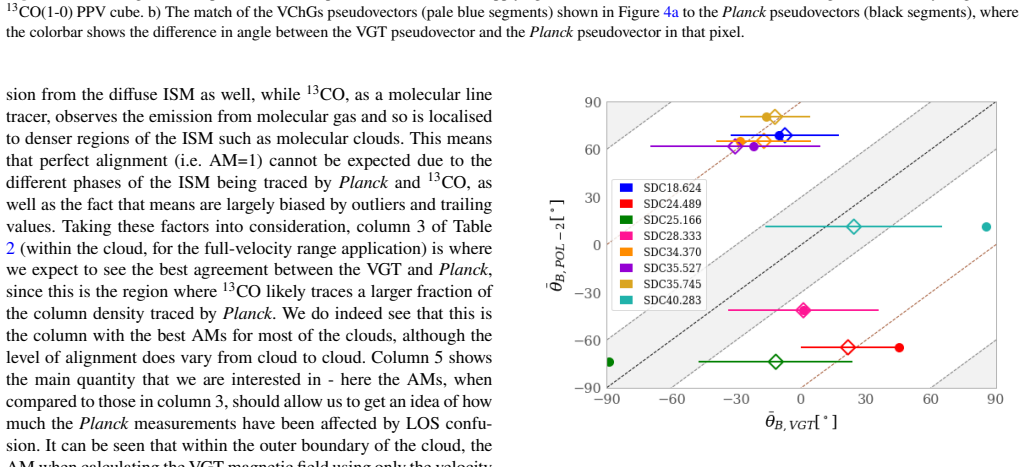
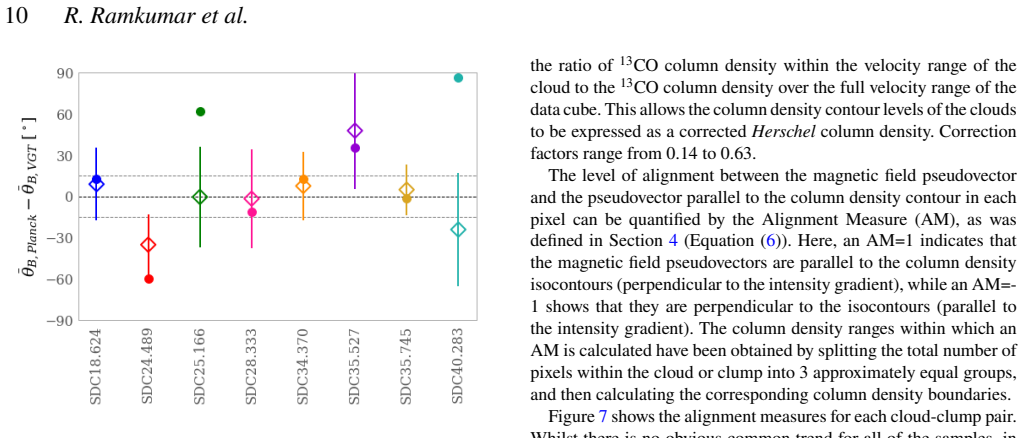
Magnetic field morphologies differ systematically between infrared dark clumps and their parent molecular clouds.
A machine-rendered reading of the paper's core claim, the machinery that carries it, and where it could break.
Core claim
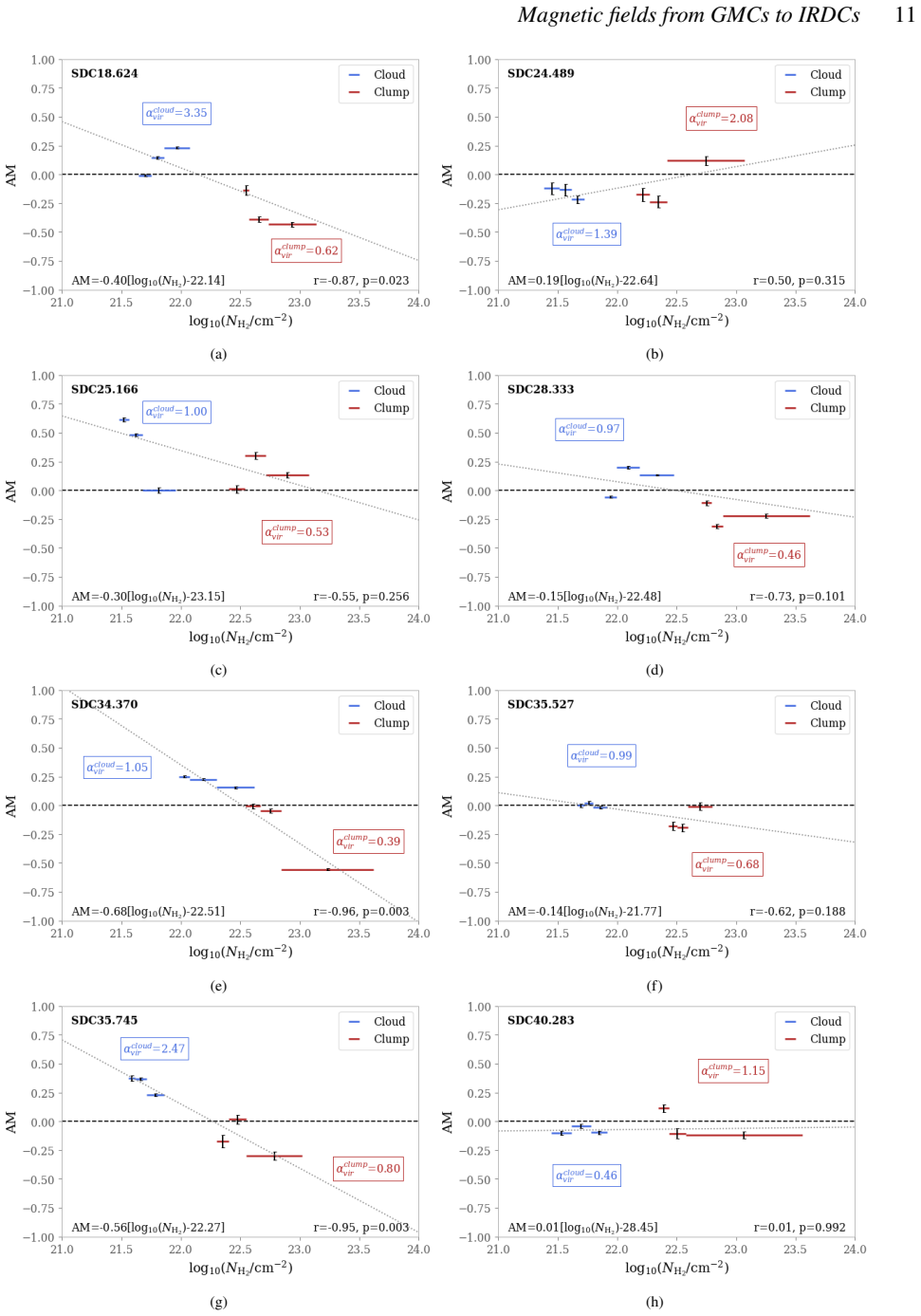
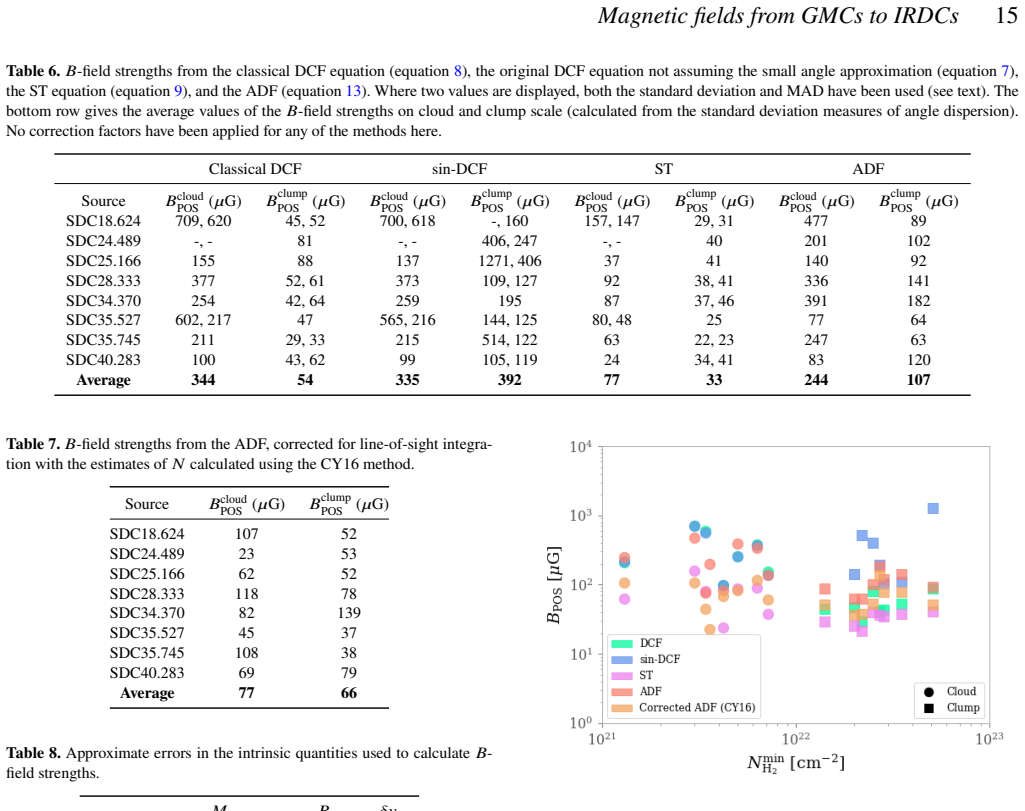
The morphologies of magnetic fields in clumps and their parent molecular clouds systematically and significantly differ, supported by a line-of-sight correction of the cloud-scale magnetic fields using the velocity gradient technique. A strong correlation exists between gas velocity dispersion and the alignment of magnetic field lines with column density gradients from tens of parsecs to a few parsecs. Higher magnetic field strengths measured on cloud scale than on clump scale contradict magnetic flux conservation and highlight the unreliability of such measurements. The analysis supports a picture in which magnetic fields have little impact on the dynamical evolution of cluster-forming clum
What carries the argument
Plane-of-sky magnetic field morphologies derived from Planck and JCMT POL-2 dust polarization data, with velocity gradient technique supplying the line-of-sight correction to compare cloud and clump scales.
Load-bearing premise
The velocity gradient technique supplies an accurate line-of-sight correction for cloud-scale fields and the polarization measurements trace the true plane-of-sky field morphology without dominant projection or contamination effects.
What would settle it
A set of observations in which the magnetic field morphologies in clumps and clouds remain statistically similar after independent line-of-sight corrections, or in which measured field strengths on both scales satisfy magnetic flux conservation within uncertainties.
Figures
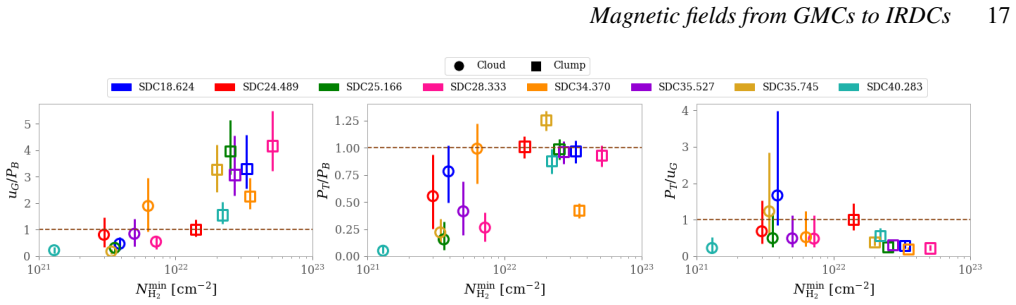
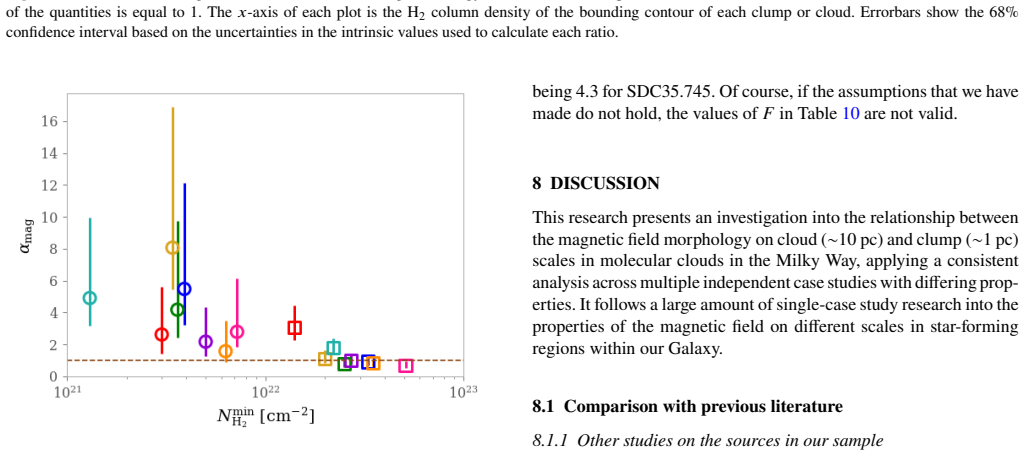
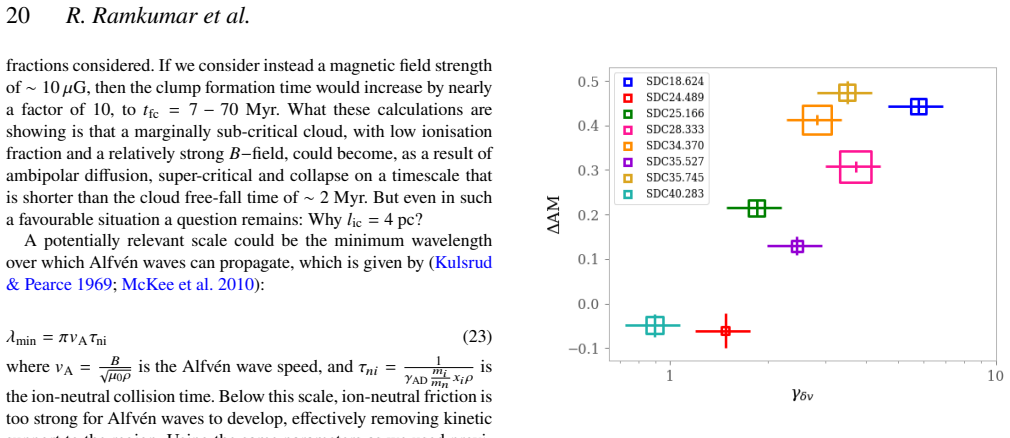
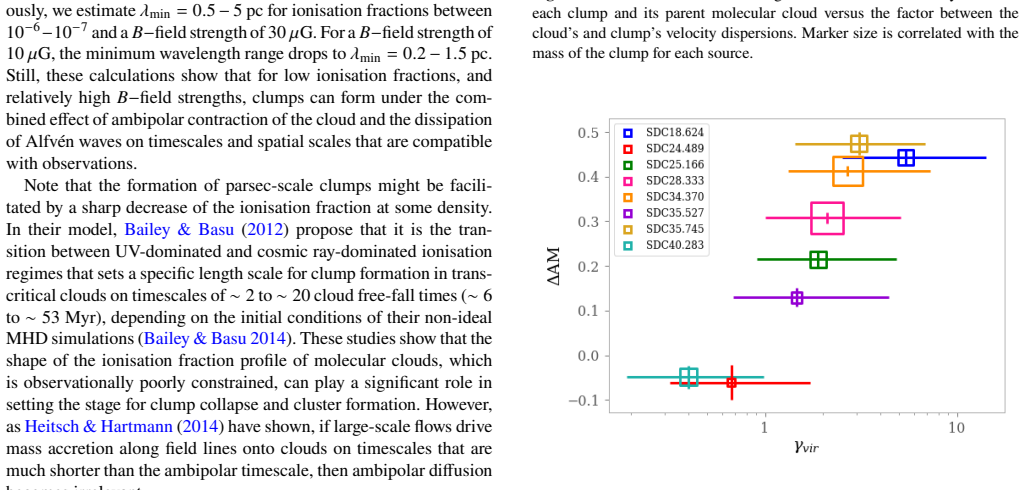
read the original abstract
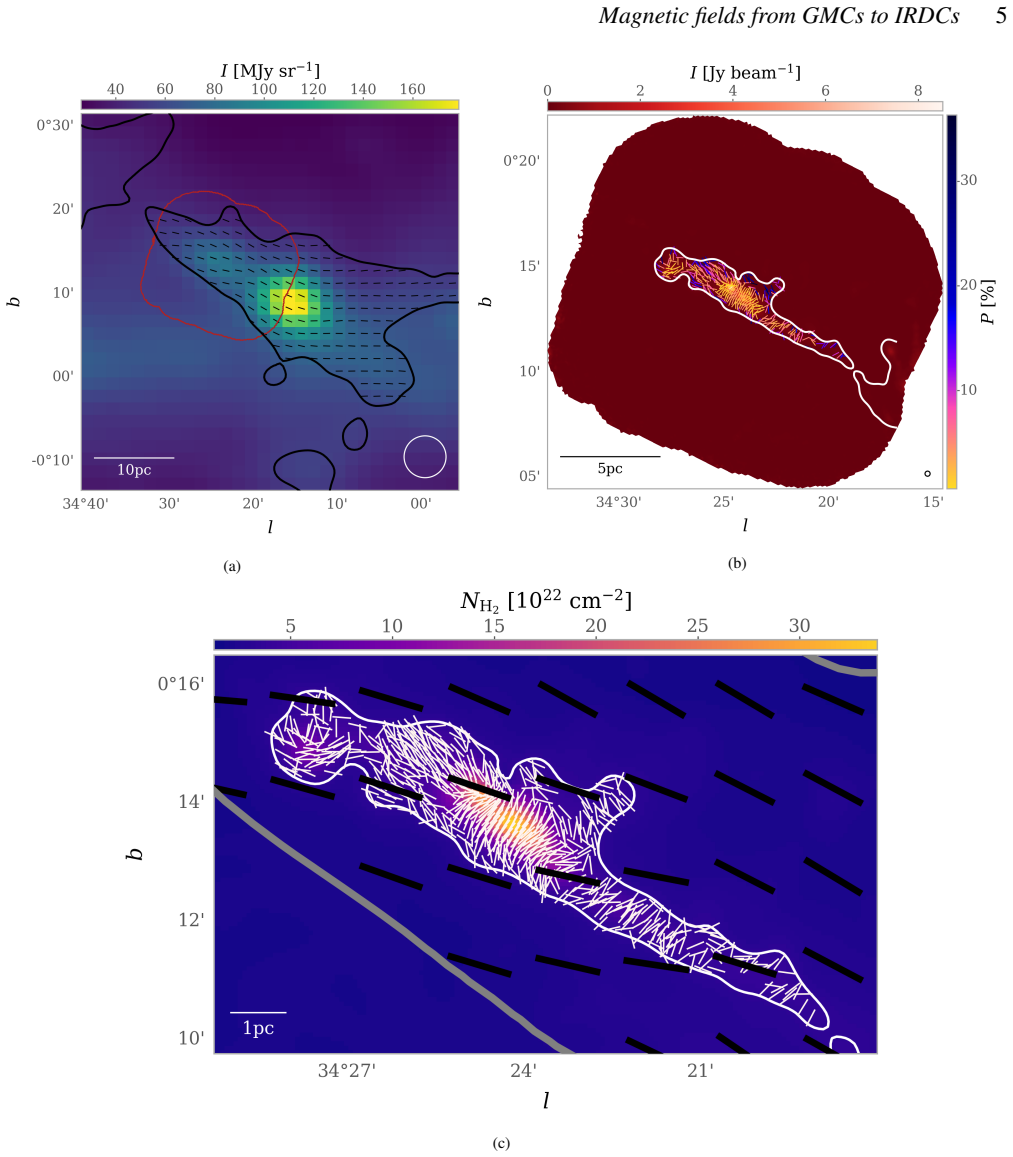
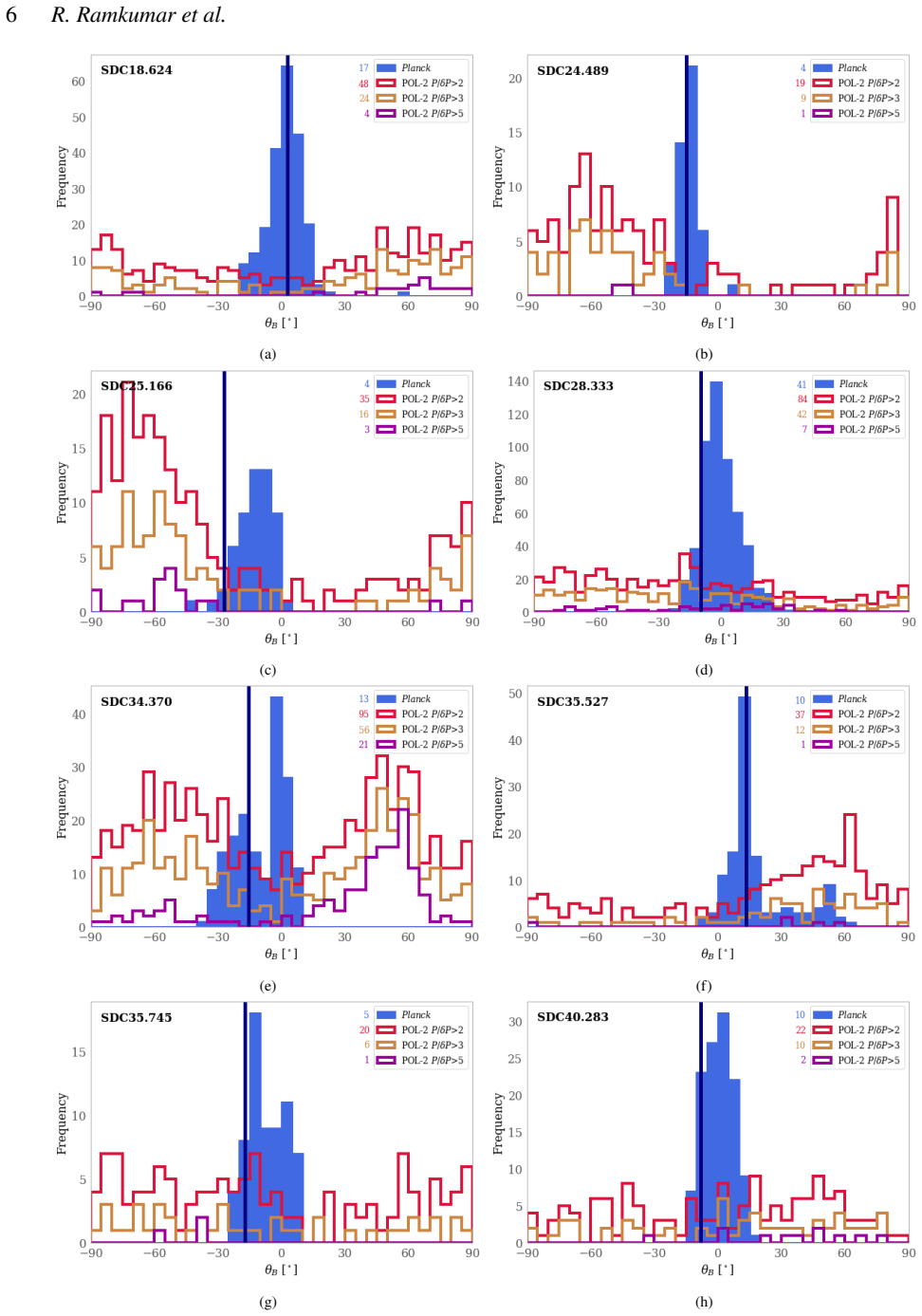
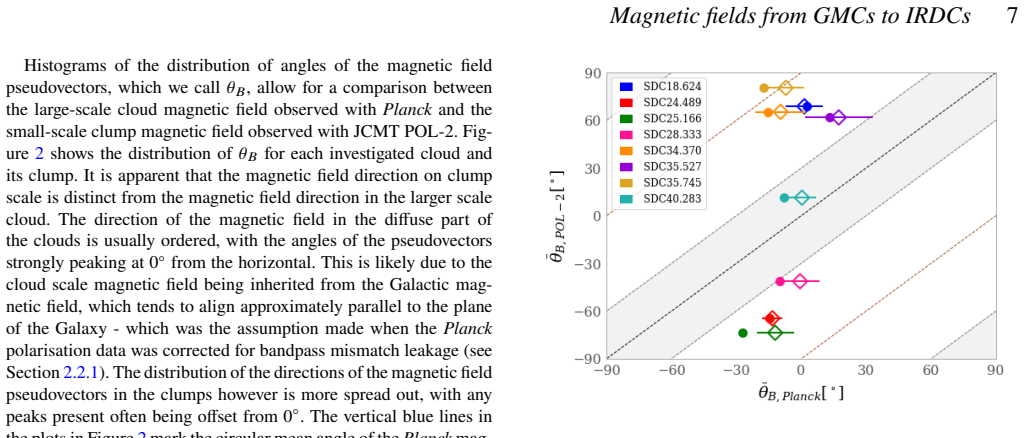
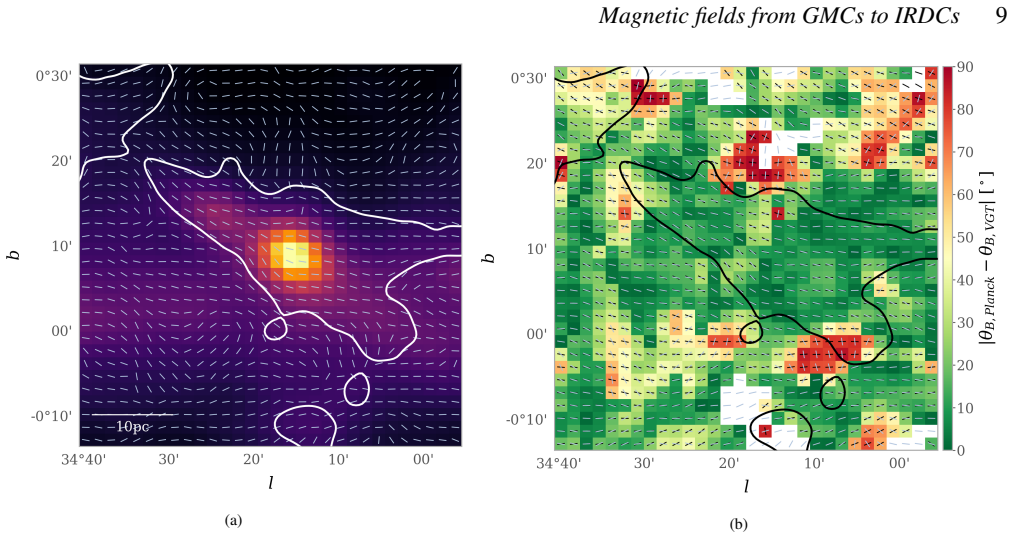
The role of magnetic fields in the observed inefficiency of star formation in Galactic molecular clouds is a widely debated topic, with the past decade seeing an explosion of observational characterisation of magnetic fields in star-forming regions. However, few have studied the spatial evolution of magnetic fields from entire molecular clouds down to parsec-size cluster-forming clumps. In this work, the plane-of-sky morphology of the magnetic fields of eight infrared dark clumps and their parent molecular clouds are derived from Planck and JCMT POL-2 polarisation data (including some from the BISTRO survey). We also use this data to test multiple methods of calculating B-field strengths. Our study shows that the morphologies of magnetic fields in clumps and their parent molecular clouds systematically, and significantly, differ, supported by a line-of-sight correction of the cloud-scale magnetic fields using the velocity gradient technique. We find a strong correlation between gas velocity dispersion and the alignment of magnetic field lines with column density gradients from scales of tens of parsecs to a few parsecs. This correlation is clear evidence of a link between the kinematic properties of the gas and the dynamical importance of magnetic fields. Conversely, the higher magnetic field strengths we measure on cloud scale compared to clump scale contradict magnetic flux conservation and thus highlight the unreliability of such measurements. Altogether, our analysis supports a picture in which magnetic fields have little impact on the dynamical evolution of cluster-forming clumps but do play a role in providing support on larger scales.
Editorial analysis
A structured set of objections, weighed in public.
Referee Report
Summary. The manuscript analyzes the plane-of-sky magnetic field morphologies in eight infrared dark clumps and their parent giant molecular clouds using Planck and JCMT POL-2 polarization data. It applies the velocity gradient technique (VGT) to correct for line-of-sight effects at cloud scales and reports that the morphologies differ systematically and significantly between scales. A correlation is found between gas velocity dispersion and the alignment of magnetic fields with column density gradients. B-field strength estimates are tested but found to contradict flux conservation on cloud scales, leading to the conclusion that magnetic fields support larger scales but have little dynamical impact on clump scales.
Significance. If the VGT-based correction is robust, the results would strengthen the case for scale-dependent roles of magnetic fields in regulating star formation, particularly by providing support against collapse on molecular cloud scales while being less influential in cluster-forming clumps. The correlation with kinematics offers a potential observational link between turbulence and magnetic field dynamics.
major comments (2)
- [Abstract (line-of-sight correction paragraph)] The central claim that morphologies 'systematically and significantly differ' (abstract) is supported only after applying the VGT line-of-sight correction to cloud-scale fields. The manuscript must demonstrate that VGT yields unbiased inclinations in these IRDC environments, e.g., via forward-modelled synthetic observations or cross-checks with independent tracers, because unresolved velocity gradients or shock kinematics could introduce systematic projection artifacts that erase the reported difference.
- [Abstract (B-field strength tests)] The same data-reduction and projection issues that lead the authors to reject their own cloud-scale B-strength estimates on flux-conservation grounds (abstract) may also affect the VGT-derived orientations used for the morphology comparison; a quantitative assessment of whether these systematics are independent is required.
minor comments (2)
- The abstract states a 'strong correlation' between velocity dispersion and B-field alignment but supplies no sample statistics, error bars, or significance values; these must be reported explicitly in the results section.
- Clarify the precise procedure for combining Planck and JCMT data and any assumptions about polarization fraction or contamination that could affect the claimed morphology differences.
Simulated Author's Rebuttal
We thank the referee for their constructive and detailed report. We address each major comment below, indicating planned revisions where appropriate to improve the clarity and robustness of the manuscript.
read point-by-point responses
-
Referee: [Abstract (line-of-sight correction paragraph)] The central claim that morphologies 'systematically and significantly differ' (abstract) is supported only after applying the VGT line-of-sight correction to cloud-scale fields. The manuscript must demonstrate that VGT yields unbiased inclinations in these IRDC environments, e.g., via forward-modelled synthetic observations or cross-checks with independent tracers, because unresolved velocity gradients or shock kinematics could introduce systematic projection artifacts that erase the reported difference.
Authors: We agree that the reliability of the VGT correction is central to the reported scale-dependent difference in morphologies. The VGT is applied following established procedures validated in prior studies of molecular clouds. In the revised manuscript we will expand the relevant methods and discussion sections to include additional justification for its use in IRDC environments, referencing supporting literature on its performance in regions with comparable densities and kinematics. We will also explicitly discuss the possible influence of unresolved velocity gradients and shock-driven motions as a caveat, while noting that the strong observed correlation between velocity dispersion and magnetic field–density gradient alignment across scales offers indirect empirical support for the VGT orientations. Performing dedicated forward-modelled synthetic observations lies outside the scope of this observational paper; the revision will therefore be partial and focused on textual clarification and caveats rather than new simulations. revision: partial
-
Referee: [Abstract (B-field strength tests)] The same data-reduction and projection issues that lead the authors to reject their own cloud-scale B-strength estimates on flux-conservation grounds (abstract) may also affect the VGT-derived orientations used for the morphology comparison; a quantitative assessment of whether these systematics are independent is required.
Authors: We thank the referee for highlighting this possible overlap. The cloud-scale B-field strength estimates that contradict flux conservation were obtained with the Davis-Chandrasekhar-Fermi method, which depends on the dispersion of polarization position angles. The VGT, by contrast, infers orientations from velocity gradients measured in spectral-line data and rests on different physical assumptions. The flux-conservation inconsistency is therefore interpreted as a limitation of the DCF assumptions rather than a data-reduction artifact common to the polarization maps. In the revised manuscript we will insert a new paragraph in the discussion that provides a qualitative assessment (and limited quantitative comparison where the data permit) of the independence of the two techniques, clarifying why projection or reduction effects affecting DCF strength estimates do not directly compromise the velocity-gradient directions. This will constitute a partial revision consisting of added explanatory text. revision: partial
Circularity Check
No circularity: direct observational comparison of B-field morphologies
full rationale
The paper derives its central claims (systematic morphology differences between cloud and clump scales, velocity-dispersion correlation, and B-strength unreliability) from direct application of Planck/JCMT polarization data plus the standard velocity-gradient technique for line-of-sight correction. No equations redefine a fitted parameter as a prediction, no self-citation chain supplies a uniqueness theorem or ansatz, and the flux-conservation contradiction is presented as evidence against the measurements rather than as a derived result. The analysis is therefore self-contained against the input datasets.
Axiom & Free-Parameter Ledger
Reference graph
Works this paper leans on
-
[1]
Star cluster progenitors are dynamically decoupled from their parent molecular clouds. , keywords =. doi:10.1093/mnras/stad2453 , archivePrefix =. 2305.02701 , primaryClass =
-
[2]
Planck intermediate results. XIX. An overview of the polarized thermal emission from Galactic dust. , keywords =. doi:10.1051/0004-6361/201424082 , archivePrefix =. 1405.0871 , primaryClass =
work page internal anchor Pith review Pith/arXiv arXiv doi:10.1051/0004-6361/201424082
-
[3]
, year = 1953, month = jul, volume =
Magnetic Fields in Spiral Arms. , year = 1953, month = jul, volume =. doi:10.1086/145731 , adsurl =
-
[4]
Magnetic Field Strength Maps for Molecular Clouds: A New Method Based on a Polarization-Intensity Gradient Relation. , keywords =. doi:10.1088/0004-637X/747/1/79 , archivePrefix =. 1201.4263 , primaryClass =
work page internal anchor Pith review Pith/arXiv arXiv doi:10.1088/0004-637x/747/1/79
-
[5]
Velocity Gradients as a Tracer for Magnetic Fields
Velocity Gradients as a Tracer for Magnetic Fields. , keywords =. doi:10.3847/1538-4357/835/1/41 , archivePrefix =. 1608.06867 , primaryClass =
work page internal anchor Pith review Pith/arXiv arXiv doi:10.3847/1538-4357/835/1/41
-
[6]
Physical Review , year = 1951, month = mar, volume =
The Strength of Interstellar Magnetic Fields. Physical Review , year = 1951, month = mar, volume =. doi:10.1103/PhysRev.81.890.2 , adsurl =
-
[7]
and Cole, Shaun and Eisenstein, Daniel J
Radiative torques: analytical model and basic properties. , keywords =. doi:10.1111/j.1365-2966.2007.11817.x , archivePrefix =. 0707.0886 , primaryClass =
-
[8]
Frontiers in Astronomy and Space Sciences , keywords =
Submillimeter and Far-infrared Polarimetric Observations of Magnetic Fields in Star-Forming Regions. Frontiers in Astronomy and Space Sciences , keywords =. doi:10.3389/fspas.2019.00015 , archivePrefix =. 1904.04826 , primaryClass =
-
[9]
D. Elia and S. Molinari and E. Schisano and J. D. Soler and M. Merello and D. Russeil and M. Veneziani and A. Zavagno and A. Noriega-Crespo and L. Olmi and M. Benedettini and P. Hennebelle and R. S. Klessen and S. Leurini and R. Paladini and S. Pezzuto and A. Traficante and D. J. Eden and P. G. Martin and M. Sormani and A. Coletta and T. Colman and R. Plu...
-
[10]
The Present-Day Star Formation Rate of the Milky Way Determined from Spitzer-Detected Young Stellar Objects. , keywords =. doi:10.1088/2041-8205/710/1/L11 , archivePrefix =. 1001.3672 , primaryClass =
work page internal anchor Pith review Pith/arXiv arXiv doi:10.1088/2041-8205/710/1/l11 2041
-
[11]
Protostars and Planets VII , year = 2023, editor =
Magnetic Fields in Star Formation: from Clouds to Cores. Protostars and Planets VII , year = 2023, editor =. doi:10.48550/arXiv.2203.11179 , archivePrefix =. 2203.11179 , primaryClass =
-
[12]
Velocity Gradient in the Presence of Self-gravity: Identifying Gravity-induced Inflow and Determining Collapsing Stage. , keywords =. doi:10.3847/1538-4357/ab9948 , archivePrefix =. 2002.06754 , primaryClass =
-
[13]
and Federrath, Christoph , TITLE=
Krumholz, Mark R. and Federrath, Christoph , TITLE=. Frontiers in Astronomy and Space Sciences , VOLUME=. 2019 , URL=. doi:10.3389/fspas.2019.00007 , ISSN=
-
[14]
, year = 1956, month = jan, volume =
Star formation in magnetic dust clouds. , year = 1956, month = jan, volume =. doi:10.1093/mnras/116.5.503 , adsurl =
-
[15]
Ambipolar Diffusion, Cloud Cores, and Star Formation: Two-dimensional, Cylindrically Symmetric Contraction. I. The Issues, Formulation of the Problem, and Method of Solution. , keywords =. doi:10.1086/169893 , adsurl =
-
[16]
S. J. Desch and Telemachos Ch. Mouschovias , title =. The Astrophysical Journal , abstract =. 2001 , month =. doi:10.1086/319703 , url =
-
[17]
Matthew W. Kunz and Telemachos Ch. Mouschovias , title =. The Astrophysical Journal , abstract =. 2009 , month =. doi:10.1088/0004-637X/693/2/1895 , url =
-
[18]
Pressure-confined Clumps in Magnetized Molecular Clouds. , keywords =. doi:10.1086/171638 , adsurl =
-
[19]
Tracing interstellar magnetic field using the velocity gradient technique in shock and self-gravitating media. arXiv e-prints , keywords =. doi:10.48550/arXiv.1703.03026 , archivePrefix =. 1703.03026 , primaryClass =
work page internal anchor Pith review Pith/arXiv arXiv doi:10.48550/arxiv.1703.03026
-
[20]
Tracing magnetic fields with spectroscopic channel maps
Tracing Magnetic Fields with Spectroscopic Channel Maps. , keywords =. doi:10.3847/1538-4357/aaa241 , archivePrefix =. 1703.03119 , primaryClass =
work page internal anchor Pith review Pith/arXiv arXiv doi:10.3847/1538-4357/aaa241
-
[21]
Improving the Accuracy of Magnetic Field Tracing by Velocity Gradients: Principal Component Analysis
Improving the accuracy of magnetic field tracing by velocity gradients: principal component analysis. , keywords =. doi:10.1093/mnras/sty1807 , archivePrefix =. 1802.08772 , primaryClass =
work page internal anchor Pith review Pith/arXiv arXiv doi:10.1093/mnras/sty1807
-
[22]
Magnetic field morphology in interstellar clouds with the velocity gradient technique. Nature Astronomy , keywords =. doi:10.1038/s41550-019-0769-0 , archivePrefix =. 2002.09948 , primaryClass =
-
[23]
Models of Massive Molecular Clouds. , keywords =. doi:10.1086/181613 , adsurl =
-
[24]
Frontiers in Astronomy and Space Sciences , keywords =
2a Results: galaxy to cloud scales. Frontiers in Astronomy and Space Sciences , keywords =. doi:10.3389/fspas.2023.1272771 , archivePrefix =. 2312.01854 , primaryClass =
-
[25]
Monthly Notices of the Royal Astronomical Society , volume =
Whitworth, David J and Smith, Rowan J and Klessen, Ralf S and Mac Low, Mordecai-Mark and Glover, Simon C O and Tress, Robin and Pakmor, Rüdiger and Soler, Juan D , title = ". Monthly Notices of the Royal Astronomical Society , volume =. 2023 , month =. doi:10.1093/mnras/stad105 , url =
-
[26]
An Imprint of Molecular Cloud Magnetization in the Morphology of the Dust Polarized Emission
An Imprint of Molecular Cloud Magnetization in the Morphology of the Dust Polarized Emission. , keywords =. doi:10.1088/0004-637X/774/2/128 , archivePrefix =. 1303.1830 , primaryClass =
work page internal anchor Pith review Pith/arXiv arXiv doi:10.1088/0004-637x/774/2/128
-
[27]
Li, Pak Shing and Klein, Richard I. , year =. Magnetized Interstellar Molecular Clouds -. Monthly Notices of the Royal Astronomical Society , volume =. doi:10.1093/mnras/stz653 , urldate =
-
[28]
The initial conditions for stellar protocluster formation. III. The Herschel counterparts of the Spitzer Dark Cloud catalogue. , keywords =. doi:10.1051/0004-6361/201527064 , archivePrefix =. 1602.03234 , primaryClass =
work page internal anchor Pith review Pith/arXiv arXiv doi:10.1051/0004-6361/201527064
-
[29]
Frontiers in Astronomy and Space Sciences , keywords =
Magnetic field properties in star formation: A review of their analysis methods and interpretation. Frontiers in Astronomy and Space Sciences , keywords =. doi:10.3389/fspas.2022.943556 , archivePrefix =. 2208.06492 , primaryClass =
-
[30]
The JCMT BISTRO-3 Survey: Variation of Magnetic Field Orientations on Parsec and Subparsec Scales in the Massive Star-forming Region G28.34+0.06. , keywords =. doi:10.3847/1538-4357/adce80 , adsurl =
-
[31]
Magnetic Fields in the Infrared Dark Cloud G34.43+0.24. , keywords =. doi:10.3847/1538-4357/ab39dd , archivePrefix =. 1908.03624 , primaryClass =
-
[32]
Gravity, Magnetic Field, and Turbulence: Relative Importance and Impact on Fragmentation in the Infrared Dark Cloud G34.43+00.24. , keywords =. doi:10.3847/1538-4357/ab1484 , archivePrefix =. 1903.12397 , primaryClass =
work page internal anchor Pith review Pith/arXiv arXiv doi:10.3847/1538-4357/ab1484 1903
-
[33]
, year = 2012, month = sep, volume =
Magnetic Fields in Molecular Clouds. , year = 2012, month = sep, volume =. doi:10.1146/annurev-astro-081811-125514 , adsurl =
-
[34]
Formation of the Hub-Filament System G33.92+0.11: Local Interplay between Gravity, Velocity, and Magnetic Field. , keywords =. doi:10.3847/1538-4357/abc74e , archivePrefix =. 2011.01555 , primaryClass =
-
[35]
Understanding the relative importance of magnetic field, gravity, and turbulence in star formation at the hub of the giant molecular cloud G148.24+00.41. , keywords =. doi:10.1093/mnras/stae053 , archivePrefix =. 2401.05310 , primaryClass =
-
[36]
Dark Dragon Breaks Magnetic Chain: Dynamical Substructures of IRDC G28.34 Form in Supported Environments. , keywords =. doi:10.3847/1538-4357/ad3105 , archivePrefix =. 2403.03437 , primaryClass =
-
[37]
The Magnetic Field in Quiescent Star-forming Filament G16.96+0.27. , keywords =. doi:10.3847/1538-4357/ad8912 , archivePrefix =. 2410.15913 , primaryClass =
-
[38]
From filament to clumps and cores: A multiscale study of fragmentation and the role of the magnetic field and gas velocity in the infrared dark cloud SDC18.624-0.070. , keywords =. doi:10.1051/0004-6361/202452974 , adsurl =
-
[39]
A Holistic Perspective on the Dynamics of G035.39-00.33: The Interplay between Gas and Magnetic Fields. , keywords =. doi:10.3847/1538-4357/aac025 , archivePrefix =. 1803.09457 , primaryClass =
work page internal anchor Pith review Pith/arXiv arXiv doi:10.3847/1538-4357/aac025
-
[40]
Filamentary Network and Magnetic Field Structures Revealed with BISTRO in the High-mass Star-forming Region NGC 2264: Global Properties and Local Magnetogravitational Configurations. , keywords =. doi:10.3847/1538-4357/ad165b , archivePrefix =. 2401.12728 , primaryClass =
-
[41]
Planck intermediate results. XXXII. The relative orientation between the magnetic field and structures traced by interstellar dust. , keywords =. doi:10.1051/0004-6361/201425044 , archivePrefix =. 1409.6728 , primaryClass =
work page internal anchor Pith review Pith/arXiv arXiv doi:10.1051/0004-6361/201425044
-
[42]
Relative Alignment between the Magnetic Field and Molecular Gas Structure in the Vela C Giant Molecular Cloud Using Low- and High-density Tracers. , keywords =. doi:10.3847/1538-4357/ab1eb0 , archivePrefix =. 1804.08979 , primaryClass =
work page internal anchor Pith review Pith/arXiv arXiv doi:10.3847/1538-4357/ab1eb0
-
[43]
Using Herschel and Planck observations to delineate the role of magnetic fields in molecular cloud structure. , keywords =. doi:10.1051/0004-6361/201935779 , archivePrefix =. 1909.04862 , primaryClass =
-
[44]
Mapping and characterizing magnetic fields in the Rho Ophiuchus-A molecular cloud with SOFIA/HAWC+. , keywords =. doi:10.1051/0004-6361/202348008 , archivePrefix =. 2408.17122 , primaryClass =
-
[45]
Be. The Magnetic Field in the. 2024 , month = apr, journal =. doi:10.1051/0004-6361/202348376 , urldate =
-
[46]
Dust spectrum and polarisation at 850 um in the massive IRDC G035.39-00.33
Dust spectrum and polarisation at 850 m in the massive IRDC G035.39-00.33. , keywords =. doi:10.1051/0004-6361/201833245 , archivePrefix =. 1809.00864 , primaryClass =
work page internal anchor Pith review Pith/arXiv arXiv doi:10.1051/0004-6361/201833245
-
[47]
and Xie, Jinjin and Jiao, Sihan and Yang, Aiyuan and Koch, Patrick M
Shen, Xianjin and Liu, Hong-Li and Ren, Zhiyuan and Tej, Anandmayee and Li, Di and Liu, Hauyu Baobab and Fuller, Gary A. and Xie, Jinjin and Jiao, Sihan and Yang, Aiyuan and Koch, Patrick M. and Xu, Fengwei and Sanhueza, Patricio and Diep, Pham Ngoc and Peretto, Nicolas and Yadav, R. K. and Kramer, Busaba H. and Sugiyama, Koichiro and Rawlings, Mark G. an...
-
[48]
Dispersion of Magnetic Fields in Molecular Clouds. II. , keywords =. doi:10.1088/0004-637X/706/2/1504 , archivePrefix =. 0909.5227 , primaryClass =
work page internal anchor Pith review Pith/arXiv arXiv doi:10.1088/0004-637x/706/2/1504
-
[49]
Liu, Junhao and Zhang, Qizhou and Commer. Calibrating the. The Astrophysical Journal , volume =. doi:10.3847/1538-4357/ac0cec , urldate =
-
[50]
Cho, Jungyeon and Yoo, Hyunju , year = 2016, month = apr, journal =. A. doi:10.3847/0004-637X/821/1/21 , urldate =
-
[51]
Pillai, T. and Kauffmann, J. and Tan, J. C. and Goldsmith, P. F. and Carey, S. J. and Menten, K. M. , year = 2015, month = jan, journal =. doi:10.1088/0004-637X/799/1/74 , urldate =
-
[52]
High-accuracy estimation of magnetic field strength in the interstellar medium from dust polarization. , keywords =. doi:10.1051/0004-6361/202039779 , archivePrefix =. 2010.15141 , primaryClass =
-
[53]
Density, Velocity, and Magnetic Field Structure in Turbulent Molecular Cloud Models
Density, Velocity, and Magnetic Field Structure in Turbulent Molecular Cloud Models. , keywords =. doi:10.1086/318290 , archivePrefix =. astro-ph/0008454 , primaryClass =
work page internal anchor Pith review Pith/arXiv arXiv doi:10.1086/318290
-
[54]
Barnes, A. T. and Liu, J. and Zhang, Q. and Tan, J. C. and Bigiel, F. and Caselli, P. and Cosentino, G. and Fontani, F. and Henshaw, J. D. and. Mother of Dragons. Astronomy and Astrophysics , volume =. doi:10.1051/0004-6361/202245668 , urldate =
-
[55]
and Skalidis, Raphael and Morgan, Larry and Xu, Duo and
Law, Chi-Yan and Tan, Jonathan C. and Skalidis, Raphael and Morgan, Larry and Xu, Duo and. Polarized. The Astrophysical Journal , volume =. doi:10.3847/1538-4357/ad39e0 , urldate =
-
[56]
HAWC+/SOFIA Polarimetry in L1688: Relative Orientation of Magnetic Field and Elongated Cloud Structure. , keywords =. doi:10.3847/1538-4357/ac0cf2 , archivePrefix =. 2106.13795 , primaryClass =
-
[57]
Multi-scale Physical Properties of NGC 6334 as Revealed by Local Relative Orientations between Magnetic Fields, Density Gradients, Velocity Gradients, and Gravity. , keywords =. doi:10.3847/1538-4357/acb540 , archivePrefix =. 2211.00152 , primaryClass =
-
[58]
Planck intermediate results. XXXV. Probing the role of the magnetic field in the formation of structure in molecular clouds. , keywords =. doi:10.1051/0004-6361/201525896 , archivePrefix =. 1502.04123 , primaryClass =
work page internal anchor Pith review Pith/arXiv arXiv doi:10.1051/0004-6361/201525896
-
[59]
Relative alignment between dense molecular cores and ambient magnetic field: the synergy of numerical models and observations. , keywords =. doi:10.1093/mnras/staa835 , archivePrefix =. 2003.11033 , primaryClass =
-
[60]
Relative alignment between gas structures and magnetic field in Orion A at different scales using different molecular gas tracers. , keywords =. doi:10.1051/0004-6361/202449182 , archivePrefix =. 2403.04274 , primaryClass =
-
[61]
Relative alignments between magnetic fields, velocity gradients, and dust emission gradients in NGC 1333. , keywords =. doi:10.1093/mnras/stae1829 , archivePrefix =. 2407.18375 , primaryClass =
-
[62]
SOFIA and ALMA Investigate Magnetic Fields and Gas Structures in Massive Star Formation: The Case of the Masquerading Monster in BYF 73. , keywords =. doi:10.3847/1538-4357/acac27 , archivePrefix =. 2301.03618 , primaryClass =
-
[63]
SF2A-2023: Proceedings of the Annual meeting of the French Society of Astronomy and Astrophysics , year = 2023, editor =
Statistical analysis of the relative orientations between filaments and magnetic fields in star forming regions. SF2A-2023: Proceedings of the Annual meeting of the French Society of Astronomy and Astrophysics , year = 2023, editor =
2023
-
[64]
The link between magnetic fields and filamentary clouds II: Bimodal linear mass distributions
The link between magnetic fields and filamentary clouds - II. Bimodal linear mass distributions. , keywords =. doi:10.1093/mnras/stz244 , archivePrefix =. 1906.09760 , primaryClass =
work page internal anchor Pith review Pith/arXiv arXiv doi:10.1093/mnras/stz244 1906
-
[65]
Towards a comprehensive scenario
Global hierarchical collapse in molecular clouds. Towards a comprehensive scenario. , keywords =. doi:10.1093/mnras/stz2736 , archivePrefix =. 1903.11247 , primaryClass =
-
[66]
Self-similar collapse of isothermal spheres and star formation. , keywords =. doi:10.1086/155274 , adsurl =
-
[67]
Modeling Dust Polarization Observations of Molecular Clouds through MHD Simulations
Modelling dust polarization observations of molecular clouds through MHD simulations. , keywords =. doi:10.1093/mnras/stx3096 , archivePrefix =. 1709.08641 , primaryClass =
work page internal anchor Pith review Pith/arXiv arXiv doi:10.1093/mnras/stx3096
-
[68]
From parallel to perpendicular - On the orientation of magnetic fields in molecular clouds. , keywords =. doi:10.1093/mnras/staa2231 , archivePrefix =. 2003.00017 , primaryClass =
-
[69]
Magnetic Fields in Star Formation: A Complete Compilation of All the DCF Estimations. , keywords =. doi:10.3847/1538-4357/ac3911 , archivePrefix =. 2111.05836 , primaryClass =
-
[70]
What are we learning from the relative orientation between density structures and the magnetic field in molecular clouds?. , keywords =. doi:10.1051/0004-6361/201731049 , archivePrefix =. 1705.00477 , primaryClass =
work page internal anchor Pith review Pith/arXiv arXiv doi:10.1051/0004-6361/201731049
-
[71]
Alignment of the magnetic field in star-forming regions and why it might be difficult to observe. , keywords =. doi:10.1093/mnras/stab2157 , archivePrefix =. 2106.12596 , primaryClass =
-
[72]
Relative alignment between magnetic fields and molecular gas structure in molecular clouds. , keywords =. doi:10.1093/mnras/stad733 , archivePrefix =. 2303.07410 , primaryClass =
-
[73]
The relative orientation between the magnetic field and gas density structures in non-gravitating turbulent media. , keywords =. doi:10.1093/mnras/staa3078 , archivePrefix =. 2010.01178 , primaryClass =
-
[74]
Theoretical Models of Polarized Dust Emission from Protostellar Cores
Theoretical Models of Polarized Dust Emission from Protostellar Cores. , keywords =. doi:10.1086/322504 , archivePrefix =. astro-ph/0104231 , primaryClass =
work page internal anchor Pith review Pith/arXiv arXiv doi:10.1086/322504
-
[75]
SCUBA Polarization Measurements of the Magnetic Field Strengths in the L183, L1544, and L43 Prestellar Cores. , keywords =. doi:10.1086/379705 , archivePrefix =. astro-ph/0305604 , primaryClass =
work page internal anchor Pith review Pith/arXiv arXiv doi:10.1086/379705
-
[76]
Planck 2013 results. IX. HFI spectral response. , keywords =. doi:10.1051/0004-6361/201321531 , archivePrefix =. 1303.5070 , primaryClass =
work page internal anchor Pith review Pith/arXiv arXiv doi:10.1051/0004-6361/201321531 2013
-
[77]
Magnetic Fields in Interstellar Clouds from Zeeman Observations: Inference of Total Field Strengths by Bayesian Analysis. , keywords =. doi:10.1088/0004-637X/725/1/466 , adsurl =
-
[78]
The magnetic field of a contracting gas cloud. I,Strict flux-freezing. , year = 1966, month = jan, volume =. doi:10.1093/mnras/133.2.265 , adsurl =
-
[79]
Ambipolar Diffusion and Star Formation: Formation and Contraction of Axisymmetric Cloud Cores. II. Results. , keywords =. doi:10.1086/173193 , adsurl =
-
[80]
The non-isothermal stage of magnetic star formation - II. Results. , keywords =. doi:10.1111/j.1365-2966.2010.17110.x , archivePrefix =. 1003.2722 , primaryClass =
discussion (0)
Sign in with ORCID, Apple, or X to comment. Anyone can read and Pith papers without signing in.