Non-adiabatic Effects Induced by Strong Light-Matter Coupling in Cavity QED
Pith reviewed 2026-06-26 05:51 UTC · model grok-4.3
The pith
Cavity-induced modifications to the diagonal Born-Oppenheimer correction shift molecular dissociation energies by a few inverse centimeters.
A machine-rendered reading of the paper's core claim, the machinery that carries it, and where it could break.
Core claim
By explicitly evaluating the nuclear kinetic energy operator within a QED-CI framework built on QED-HF and SC-QED-HF reference states, the presence of the cavity leads to shifts in molecular dissociation energies on the order of a few inverse centimeters. For several atomic systems, the inclusion of the DBOC yields a pronounced effect, with the correction magnitude reaching the experimental resolution. These findings reveal finite nuclear mass effects as an essential component of nuclear dynamics in cavity QED.
What carries the argument
QED-CI framework on QED-HF and SC-QED-HF references for computing cavity-induced modifications to the diagonal Born-Oppenheimer correction via the nuclear kinetic energy operator
If this is right
- Cavity-modified DBOC shifts dissociation energies by a few inverse centimeters in molecules.
- DBOC corrections in atomic systems reach sizes relevant to experimental resolution.
- Finite nuclear mass effects are necessary for accurate nuclear dynamics modeling in strong-coupling cavity QED.
- Precision analysis of strongly coupled light-matter systems must include these non-adiabatic contributions.
Where Pith is reading between the lines
- Cavity QED experiments may require these corrections for accurate comparison with measurements.
- The effects could influence interpretations of cavity-modified chemical processes.
- Testing in other systems or with varying cavity parameters could reveal larger impacts.
Load-bearing premise
The QED-HF and SC-QED-HF reference states plus the QED-CI expansion capture the dominant cavity-induced modifications to the nuclear kinetic energy operator without significant higher-order or basis-set errors for the listed systems.
What would settle it
Spectroscopic measurement of dissociation energy differences for a molecule such as HF with and without the cavity to verify the few inverse centimeters shift.
Figures

read the original abstract
We present a systematic study of the diagonal Born-Oppenheimer correction (DBOC) for atoms and molecules embedded in optical cavities and interacting with a quantized electromagnetic field. By explicitly evaluating the nuclear kinetic energy operator, we analyze cavity-induced modifications of DBOC within a quantum electrodynamics configuration-interaction (QED-CI) framework built on quantum electrodynamics Hartree-Fock (QED-HF) and strong-coupling quantum electrodynamics Hartree-Fock (SC-QED-HF) reference states. The analysis covers a diverse set of atomic and molecular systems, including He, H-, Be, H2, LiH, HF, ammonia (NH3), and formaldehyde (CH2O). We show that the presence of the cavity leads to shifts in molecular dissociation energies on the order of a few inverse centimeters. For several atomic systems, the inclusion of the DBOC yields a pronounced effect, with the correction magnitude reaching the experimental resolution. These findings reveal finite nuclear mass effects as an essential component of nuclear dynamics in cavity QED and suggest their relevance for precision analysis in strongly coupled light-matter systems.
Editorial analysis
A structured set of objections, weighed in public.
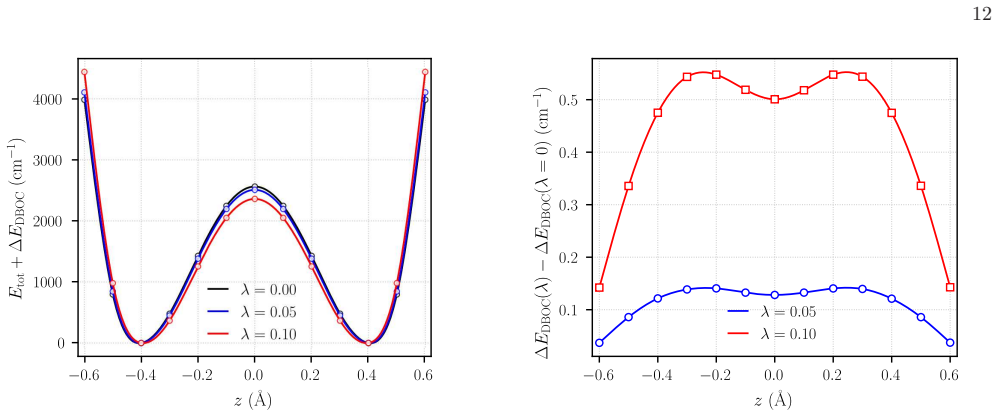
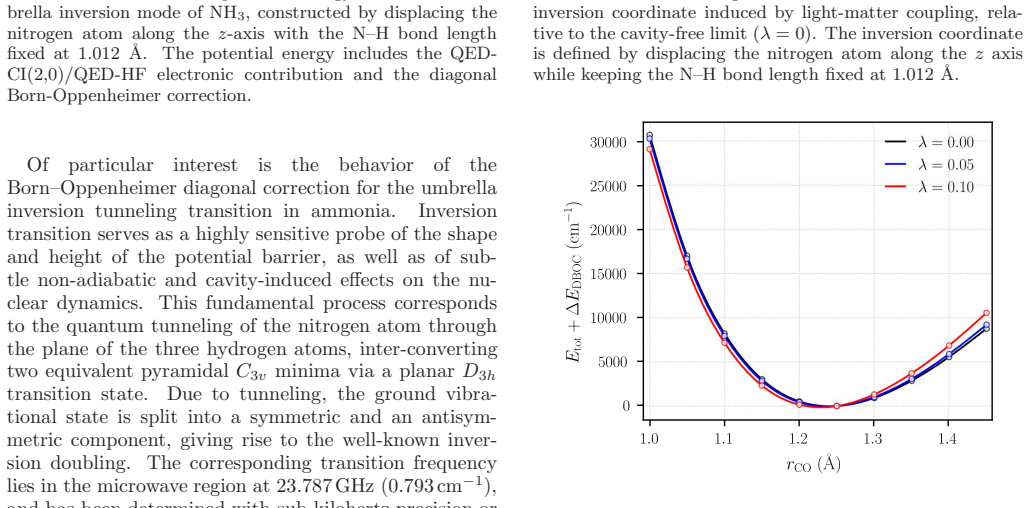
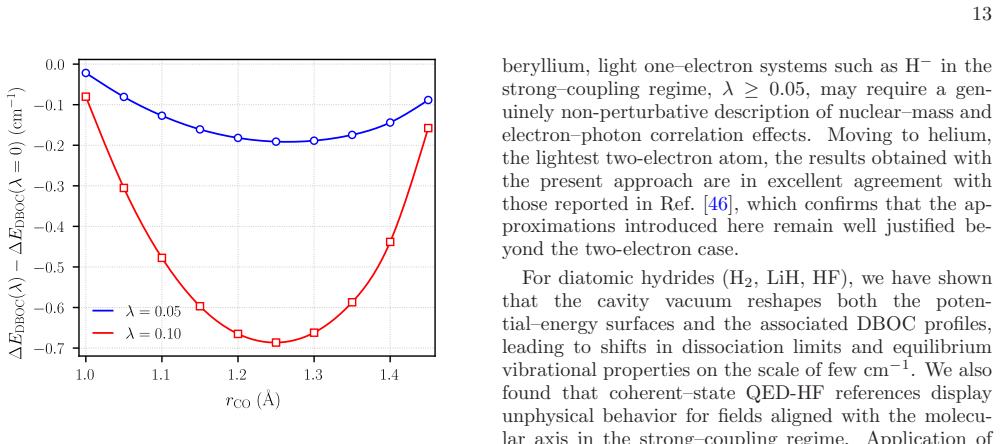
Referee Report
Summary. The manuscript presents a systematic study of cavity-induced modifications to the diagonal Born-Oppenheimer correction (DBOC) for atoms and molecules (He, H-, Be, H2, LiH, HF, NH3, CH2O) inside optical cavities. Using explicit evaluation of the nuclear kinetic energy operator within a QED-CI framework built on QED-HF and SC-QED-HF references, it reports shifts in molecular dissociation energies of a few cm^{-1} and states that DBOC corrections for several atomic systems reach experimental resolution.
Significance. If the reported cm^{-1}-scale shifts are robust, the work would establish finite-nuclear-mass effects as a necessary component of nuclear dynamics under strong light-matter coupling, with direct relevance to precision spectroscopy in cavity QED. The explicit operator evaluation and coverage of both atomic and molecular cases are positive features.
major comments (1)
- [Methods / Results] The headline claim of cavity-induced dissociation-energy shifts of a few cm^{-1} and DBOC reaching experimental resolution rests on the accuracy of the nuclear kinetic energy operator evaluated inside the QED-CI expansion. No convergence data (basis-set incompleteness, CI truncation level, or residual higher-order non-adiabatic contributions) are provided for the full set of systems, so it is impossible to confirm that the reported magnitudes are free of errors comparable to the effect size itself.
minor comments (1)
- A summary table collecting all computed DBOC shifts, cavity parameters, and reference-state choices would make the numerical results easier to assess.
Simulated Author's Rebuttal
We thank the referee for the careful review and for highlighting the importance of convergence checks. We address the single major comment below and commit to revisions that will strengthen the manuscript.
read point-by-point responses
-
Referee: [Methods / Results] The headline claim of cavity-induced dissociation-energy shifts of a few cm^{-1} and DBOC reaching experimental resolution rests on the accuracy of the nuclear kinetic energy operator evaluated inside the QED-CI expansion. No convergence data (basis-set incompleteness, CI truncation level, or residual higher-order non-adiabatic contributions) are provided for the full set of systems, so it is impossible to confirm that the reported magnitudes are free of errors comparable to the effect size itself.
Authors: We agree that systematic convergence data would increase in the reported cm^{-1}-scale shifts. The original manuscript emphasized the explicit evaluation of the nuclear kinetic energy operator within the QED-CI framework but omitted dedicated convergence tables. In the revision we will add (i) basis-set convergence results for representative atomic (He) and molecular (H2) cases, (ii) a statement of the CI truncation level employed for each system together with a brief test of enlarging the active space for the smallest systems, and (iii) a short discussion noting that, for the molecules studied, residual non-adiabatic couplings beyond DBOC are typically an order of magnitude smaller than the cavity-induced DBOC changes according to established molecular benchmarks. These additions will allow readers to assess that the reported effects exceed the estimated numerical uncertainties. revision: yes
Circularity Check
No circularity: explicit operator evaluation in QED-CI framework
full rationale
The paper's central results (cavity-induced DBOC shifts of a few cm⁻¹) are obtained by direct numerical evaluation of the nuclear kinetic energy operator inside a QED-CI expansion built on QED-HF/SC-QED-HF references. No fitted parameters are renamed as predictions, no self-citation chain is invoked to justify uniqueness or ansatz choices, and the derivation does not reduce to its own inputs by construction. The listed systems and reported magnitudes are outputs of the explicit computation rather than tautological re-statements of inputs.
Axiom & Free-Parameter Ledger
Reference graph
Works this paper leans on
-
[1]
However, con- vergence with respect to Nmax is notoriously slow, often requiring Nmax ∼ 20 or more photon states to achieve sub-Hartree accuracy [ 20]
allows incorporation of virtual photon excitations (fluctuations away from the vacuum state |0⟩) at the mean-field level. However, con- vergence with respect to Nmax is notoriously slow, often requiring Nmax ∼ 20 or more photon states to achieve sub-Hartree accuracy [ 20]. More critically, for charged molecular systems, the Fock-state expansion leads to an ...
-
[2]
the displacement parameter z is given by z = − λ · ⟨ˆd⟩√ 2ω cav , (5) where ⟨ ˆd⟩ is the expectation value of the dipole operator with respect to the electronic state |Φ e 0⟩. This trans- formation diagonalizes the photonic part of the Hamil- tonian ˆHPF and shifts the photon creation and anni- hilation operators according to ˆU † CSˆb ˆUCS = ˆb − z and ˆ...
-
[3]
The molecular orbital coefficients {Cµp } and the dressing parameters {ηpσ } are obtained from the coupled nonlinear equations F(C, η ) C = S C ε
and factorizing the resulting density matrices leads to a modified Fock operator containing the standard electronic terms together with additional cavity-induced one- and two-electron contributions [ 15]. The molecular orbital coefficients {Cµp } and the dressing parameters {ηpσ } are obtained from the coupled nonlinear equations F(C, η ) C = S C ε. (11) Her...
-
[4]
This ap- proach enables a consistent treatment of electron corre- lation effects in both energies and the required molecular properties
not only for a single-determinant SCF wave function but also for a multi-determinant expansion obtained within the configuration interaction method in- cluding single and double excitations (CISD). This ap- proach enables a consistent treatment of electron corre- lation effects in both energies and the required molecular properties. The computation proceeds...
-
[5]
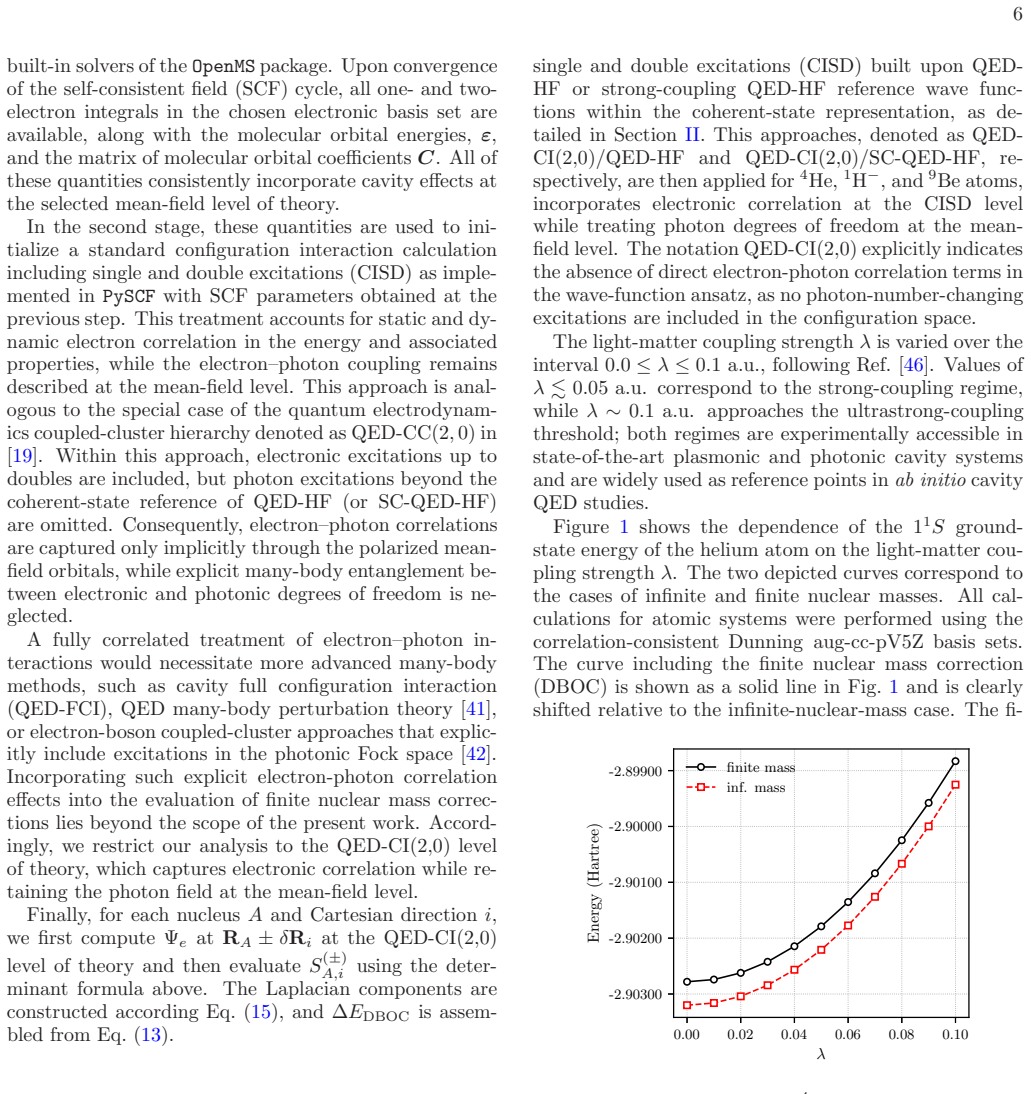
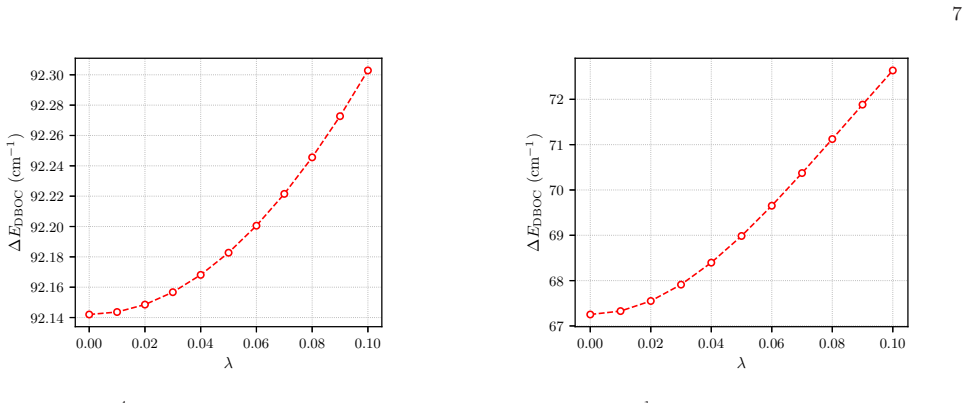
00 0 . 02 0 . 04 0 . 06 0 . 08 0 . 10 λ -2.90300 -2.90200 -2.90100 -2.90000 -2.89900Energy (Hartree) finite mass inf. mass FIG. 1. Mass dependence of the 4He energy as a function of the light–matter coupling strength λ . nite nuclear mass correction (DBOC) itself is shown in more detail in Fig. 2. It is important to note that, at zero light–matter coupling...
-
[7]
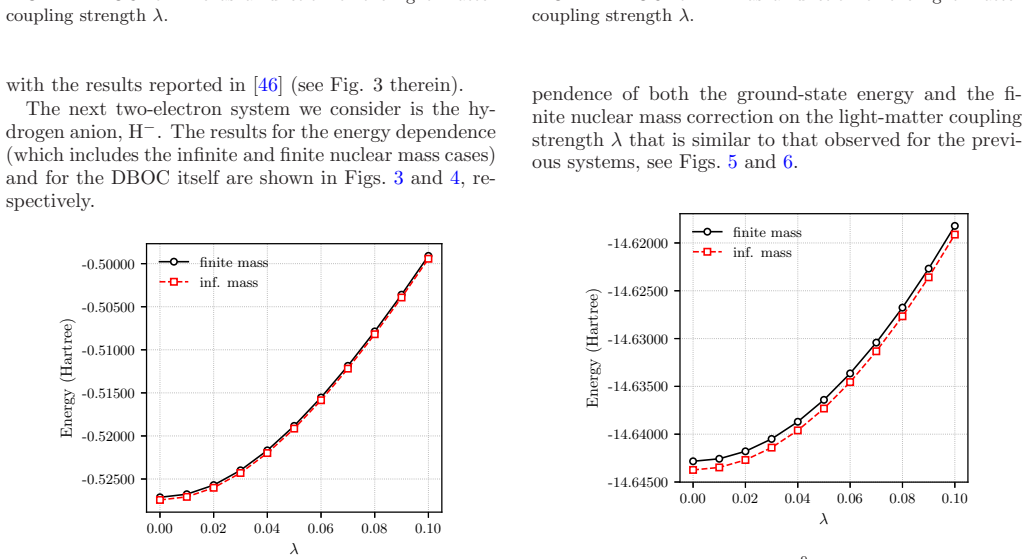
30 ∆ EDBOC (cm− 1) FIG. 2. DBOC for 4He as a function of the light–matter coupling strength λ . with the results reported in [ 46] (see Fig. 3 therein). The next two-electron system we consider is the hy- drogen anion, H − . The results for the energy dependence (which includes the infinite and finite nuclear mass cases) and for the DBOC itself are shown in...
-
[8]
00 0 . 02 0 . 04 0 . 06 0 . 08 0 . 10 λ -0.52500 -0.52000 -0.51500 -0.51000 -0.50500 -0.50000Energy (Hartree) finite mass inf. mass FIG. 3. Mass dependence of the 1H− energy as a function of the light–matter coupling strength λ . Upon detailed comparison of the calculated values with the results of Ref. [ 46], a slight deviation is observed starting at cou...
-
[9]
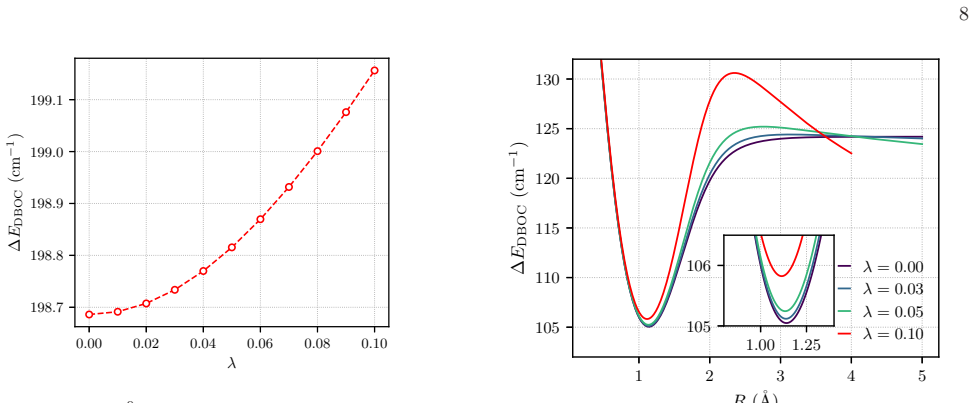
00 0 . 02 0 . 04 0 . 06 0 . 08 0 . 10 λ 67 68 69 70 71 72∆ EDBOC (cm− 1) FIG. 4. DBOC for 1H− as a function of the light–matter coupling strength λ . pendence of both the ground-state energy and the fi- nite nuclear mass correction on the light-matter coupling strength λ that is similar to that observed for the previ- ous systems, see Figs. 5 and 6
-
[10]
00 0 . 02 0 . 04 0 . 06 0 . 08 0 . 10 λ -14.64500 -14.64000 -14.63500 -14.63000 -14.62500 -14.62000Energy (Hartree) finite mass inf. mass FIG. 5. Mass dependence of the 9Be energy as a function of the light–matter coupling strength λ . At zero coupling, λ = 0 . 0, the computed DBOC is consistent with the established reference value for beryl- lium [ 49]. A...
-
[11]
00 0 . 02 0 . 04 0 . 06 0 . 08 0 . 10 λ
-
[12]
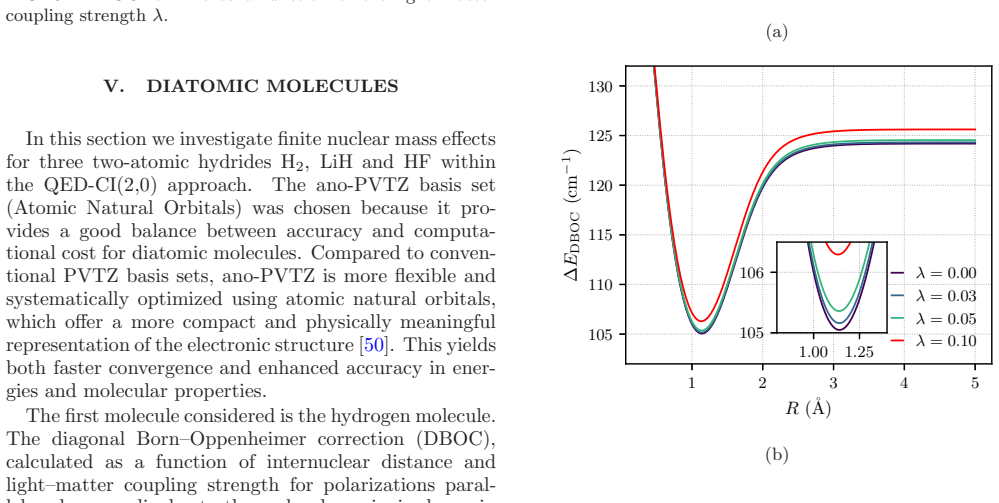
1 ∆ EDBOC (cm− 1) FIG. 6. DBOC for 9Be as a function of the light–matter coupling strength λ . V. DIATOMIC MOLECULES In this section we investigate finite nuclear mass effects for three two-atomic hydrides H 2, LiH and HF within the QED-CI(2,0) approach. The ano-PVTZ basis set (Atomic Natural Orbitals) was chosen because it pro- vides a good balance between...
-
[13]
50 0 . 75 1 . 00 − 1. 17 − 1. 16 − 1. 15 (a) 1 2 3 4 5 R (˚ A) − 1. 1 − 1. 0 − 0. 9 − 0. 8 − 0. 7 Energy (Hartree) λ = 0. 00 λ = 0. 03 λ = 0. 05 λ = 0. 10
-
[14]
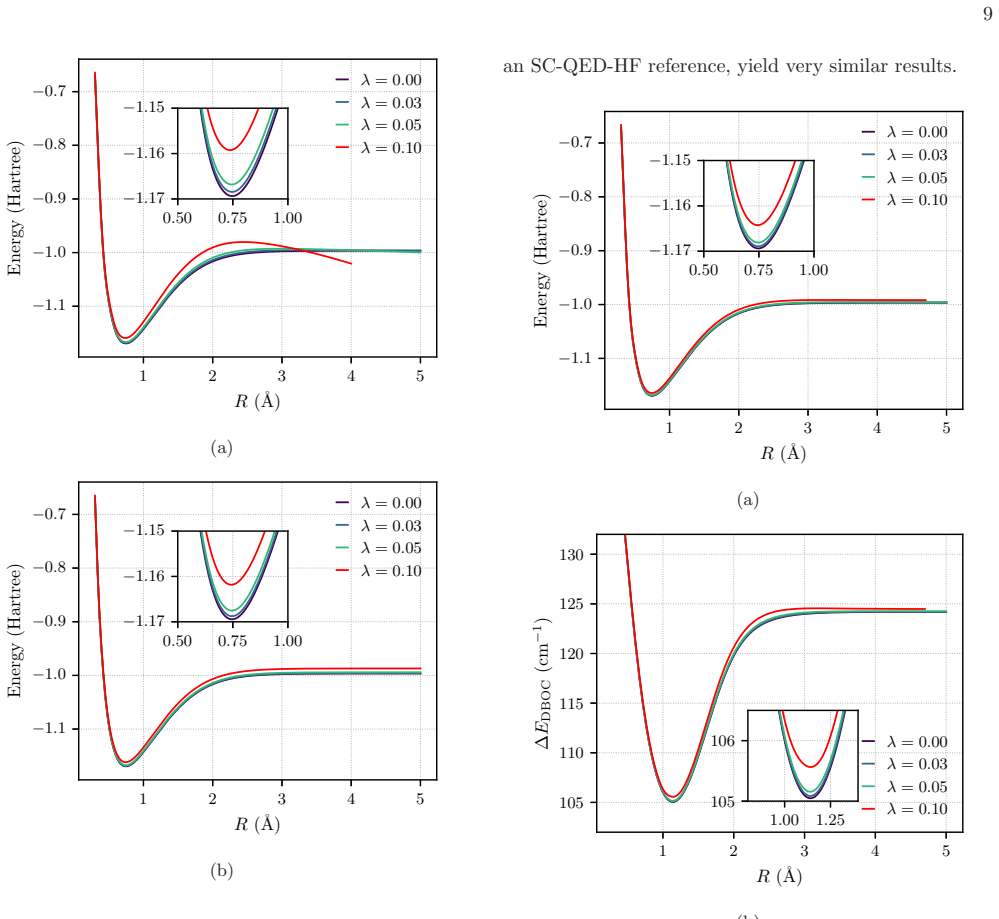
50 0 . 75 1 . 00 − 1. 17 − 1. 16 − 1. 15 (b) FIG. 8. Potential energy curves for the H 2 molecule cou- pled to a single-mode cavity, with the cavity field polarized along (a) and perpendicular (b) to the molecular axis. Re- sults obtained at the QED-CI(2,0)/QED-HF level of theory. The insets in the figures reveal the finer details of the curve behavior in th...
-
[15]
Within the SC-QED-HF framework, this trans- formation acts on each orbital individually, exactly as in the GIAO approach
(which is essentially analogous to the introduction of London orbitals) is applied globally to all electronic orbitals. Within the SC-QED-HF framework, this trans- formation acts on each orbital individually, exactly as in the GIAO approach. Subsequent CI calculations built on top of the SC-QED-HF reference resolve the problem for strong coupling in the p...
-
[16]
1 2 3 4 5 R (˚ A) − 1
Notably, at the equilibrium geometry Req, both CI approaches, employing either a QED-HF or an SC-QED-HF reference, yield very similar results. 1 2 3 4 5 R (˚ A) − 1. 1 − 1. 0 − 0. 9 − 0. 8 − 0. 7 Energy (Hartree) λ = 0. 00 λ = 0. 03 λ = 0. 05 λ = 0. 10
-
[17]
50 0 . 75 1 . 00 − 1. 17 − 1. 16 − 1. 15 (a) 1 2 3 4 5 R (˚ A) 105 110 115 120 125 130∆ EDBOC (cm− 1) λ = 0. 00 λ = 0. 03 λ = 0. 05 λ = 0. 101. 00 1 . 25 105 106 (b) FIG. 9. PEC (a) and the corresponding DBOC (b) as a func- tion of internuclear distance R for H 2 molecule in a single- mode cavity and field polarized along the molecular axis. Re- sults obta...
-
[18]
0 1 . 5 2 . 0 − 8. 05 − 8. 00 (a) 1 2 3 4 5 R (˚ A) − 8. 0 − 7. 8 − 7. 6 − 7. 4 − 7. 2 Energy (Hartree) λ = 0. 00 λ = 0. 03 λ = 0. 05 λ = 0. 10
-
[19]
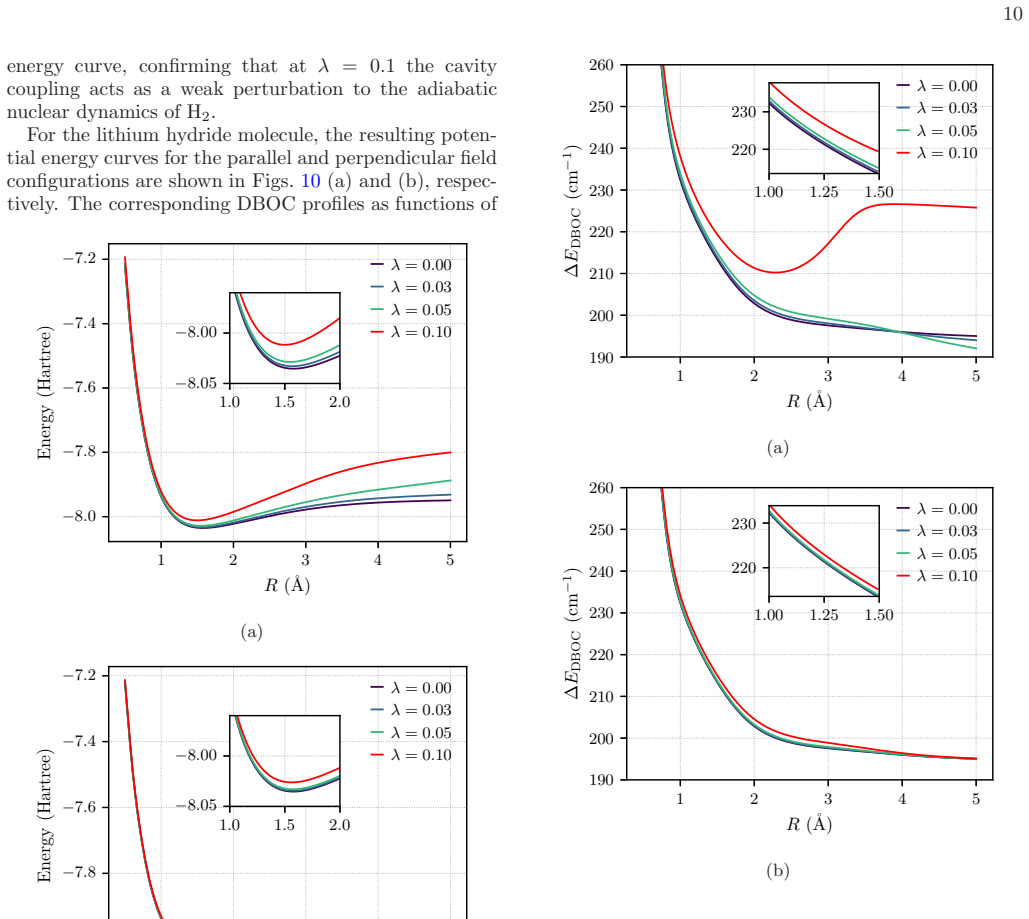
0 1 . 5 2 . 0 − 8. 05 − 8. 00 (b) FIG. 10. Potential energy curves for the LiH molecule couple d to a single-mode cavity with field polarized along (a) and perpendicular (b) to the molecular axis. Results obtained a t the QED-CI(2,0)/QED-HF level of theory. the internuclear distance for different values of the cou- pling strength λ are presented in Fig
-
[20]
05, the use of a QED-HF reference leads to an incorrect behavior in the dissociation limit for the parallel configuration
As in the case of the hydrogen molecule, starting from λ ≈ 0. 05, the use of a QED-HF reference leads to an incorrect behavior in the dissociation limit for the parallel configuration. The maximum difference in the DBOC between the zero-coupling limit and the strongest cavity coupling con- sidered here remains on the order of 1 cm − 1, see Fig. 11 1 2 3 4 5...
-
[21]
00 1 . 25 1 . 50 220 230 (a) 1 2 3 4 5 R (˚ A) 190 200 210 220 230 240 250 260∆ EDBOC (cm− 1) λ = 0. 00 λ = 0. 03 λ = 0. 05 λ = 0. 10
-
[22]
00 1 . 25 1 . 50 220 230 (b) FIG. 11. DBOC as a function of internuclear distance R for LiH molecule in a single-mode cavity and field polarized alon g (a) and perpendicular (b) to the molecular axis. Results ob- tained at the QED-CI(2,0)/QED-HF level of theory. (b). While this is a small correction in absolute terms, it is worth emphasizing that for H 2 a...
-
[23]
5 1 . 0 1 . 5 2 . 0 2 . 5 3 . 0 R (˚ A) − 100. 3 − 100. 2 − 100. 1 − 100. 0 − 99. 9 − 99. 8 − 99. 7 − 99. 6 Energy (Hartree) λ = 0. 00 λ = 0. 03 λ = 0. 05 λ = 0. 10
-
[24]
00 − 100
75 1 . 00 − 100. 300 − 100. 275 − 100. 250 − 100. 225 − 100. 200 (a)
-
[25]
5 1 . 0 1 . 5 2 . 0 2 . 5 3 . 0 R (˚ A) 615 620 625 630 635 640∆ EDBOC (cm− 1) λ = 0. 00 λ = 0. 03 λ = 0. 05 λ = 0. 10
-
[26]
umbrella
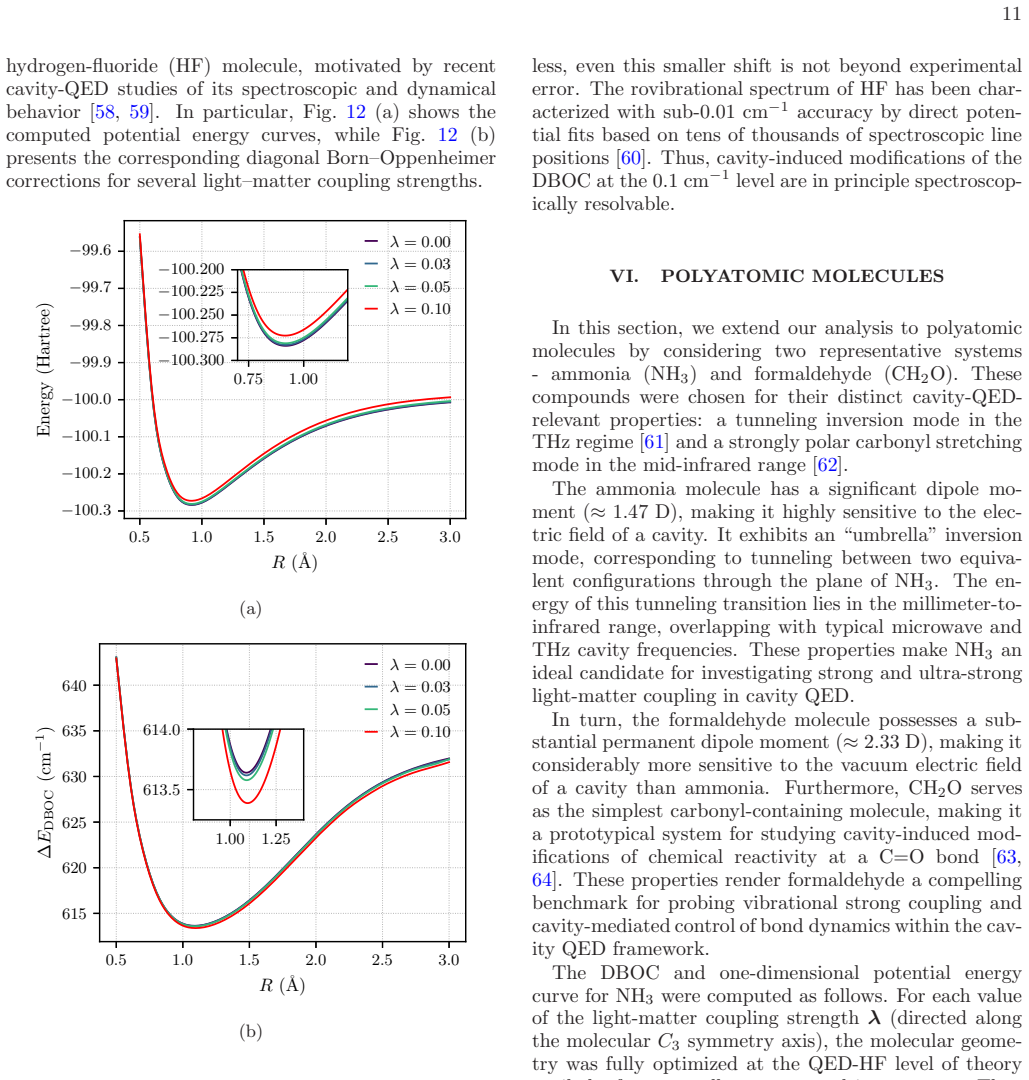
0 (b) FIG. 12. PECs (a) and DBOCs (b) for the HF molecule coupled to a single-mode cavity with the cavity field polariz ed perpendicular to the molecular axis. Results obtained at th e QED-CI(2,0)/QED-HF level of theory. For the HF molecule, the situation is similar to the pre- vious cases, but the absolute effect is smaller. The max- imum difference in the ...
-
[27]
The cor- responding DBOC contribution is presented in Fig. 16. FIG. 14. Absolute change in DBOC for the NH 3 umbrella- inversion coordinate induced by light-matter coupling, re la- tive to the cavity-free limit ( λ = 0). The inversion coordinate is defined by displacing the nitrogen atom along the z axis while keeping the N–H bond length fixed at 1 . 012 ˚ ...
-
[28]
J. A. Hutchison, T. Schwartz, C. Genet, et al. , Angew. Chem. Int. Ed. 51, 1592 (2012)
2012
-
[29]
T. W. Ebbesen, Acc. Chem. Res. 49, 2403 (2016)
2016
-
[30]
F. J. Garc ´ ıa-Vidal, C. Ciuti, and T. W. Ebbesen, Science 373, eabd0336 (2021)
2021
-
[31]
K. Stranius, M. Hertzog, and K. B¨ orjesson, Nature Communications 9 (2018), 10.1038/s41467-018-04736-1
-
[32]
F. Schlawin, D. M. Kennes, and M. A. Sentef, Applied Physics Reviews 9 (2022), 10.1063/5.0083825
-
[33]
Thomas, J
A. Thomas, J. George, A. Shalabney, et al. , Angew. Chem. Int. Ed. 55, 11462 (2016)
2016
-
[34]
Thomas, L
A. Thomas, L. Lethuillier-Karl, K. Nagarajan, et al. , Science 363, 615 (2019)
2019
-
[35]
W. Ahn, J. F. Triana, F. Recabal, et al. , Science 380, 1165 (2023)
2023
-
[36]
Nagarajan, A
K. Nagarajan, A. Thomas, and T. W. Ebbesen, J. Am. Chem. Soc. 143, 16877 (2021)
2021
-
[37]
Feist, J
J. Feist, J. Galego, and F. J. Garcia-Vidal, ACS Photonics 5, 205 (2018)
2018
-
[38]
Flick, M
J. Flick, M. Ruggenthaler, H. Appel, et al. , Proc. Natl. Acad. Sci. USA 114, 3026 (2017)
2017
-
[39]
Mandal, M
A. Mandal, M. A. Taylor, B. M. Weight, et al. , Chem. Rev. 123, 9786 (2023)
2023
-
[40]
T. E. Li, B. Cui, J. E. Subotnik, et al. , Annu. Rev. Phys. Chem. 73, 43 (2022)
2022
-
[41]
Ruggenthaler, D
M. Ruggenthaler, D. Sidler, and A. Rubio, Chem. Rev. 123, 11191 (2023)
2023
-
[42]
R. R. Riso, T. S. Haugland, E. Ronca, et al. , Nat. Commun. 13, 1368 (2022)
2022
-
[43]
Ruggenthaler, J
M. Ruggenthaler, J. Flick, C. Pellegrini, et al. , Phys. Rev. A 90, 012508 (2014)
2014
-
[44]
Ruggenthaler, N
M. Ruggenthaler, N. Tancogne-Dejean, J. Flick, et al. , Nat. Rev. Chem. 2, 0118 (2018)
2018
-
[45]
Flick, C
J. Flick, C. Sch¨ afer, M. Ruggenthaler, et al. , ACS Photonics 5, 992 (2018)
2018
-
[46]
T. S. Haugland, E. Ronca, E. F. Kjønstad, et al. , Phys. Rev. X 10, 041043 (2020)
2020
-
[47]
J. J. Foley, J. F. McTague, and A. E. DePrince, Chemical Physics Reviews 4 (2023), 10.1063/5.0167243
-
[48]
M. Ruggenthaler, N. Tancogne-Dejean, J. Flick, et al. , Nature Reviews Chemistry 2 (2018), 10.1038/s41570-018-0118
-
[49]
R. G. Woolley, Phys. Rev. Res. 2, 013206 (2020)
2020
-
[50]
Bauman, L
N. Bauman, L. A. Cunha, A. E. DePrince, et al. , Journal of Chemical Theory and Computation 21, 10035–10067 (2025)
2025
-
[51]
N. Vu, G. M. McLeod, K. Hanson, et al. , The Journal of Physical Chemistry A 126, 9303 (2022)
2022
-
[52]
McTague and J
J. McTague and J. J. Foley IV, The Journal of Chemical Physics 156, 154103 (2022)
2022
-
[53]
A. E. DePrince III, The Journal of Chemical Physics 154, 094112 (2021)
2021
-
[54]
J. D. Mallory and A. E. DePrince III, Physical Review A 106, 053710 (2022)
2022
-
[55]
M. D. Liebenthal, N. Vu, and A. E. DePrince III, The Journal of Chemical Physics 156, 054105 (2022)
2022
-
[56]
J. McTague and J. J. Foley, The Journal of Chemical Physics 156 (2022), 10.1063/5.0091953
-
[57]
N. Vu, D. Mejia-Rodriguez, N. P. Bauman, et al. , Journal of Chemical Theory and Computation 20, 1214–1227 (2024)
2024
-
[58]
Aklilu, M
Y. Aklilu, M. Shepherd, C. L. Covington, et al. , Journal of Chemical Theory and Computation 22, 2267–2281 (2026)
2026
-
[59]
S. D. Folkestad, E. F. Kjønstad, R. H. Myhre, et al. , The Journal of Chemical Physics 152 (2020), 10.1063/5.0004713
-
[60]
Kowalski, R
K. Kowalski, R. Bair, N. P. Bauman, et al. , Chemical Reviews 121, 4962–4998 (2021)
2021
-
[61]
N. Tancogne-Dejean, M. J. T. Oliveira, X. Andrade, et al. , The Journal of Chemical Physics 152 (2020), 10.1063/1.5142502
-
[62]
A. E. DePrince III, “Hilbert: a space for quantum chemistry plugins to repository (2020), last accessed January, 2026
2020
-
[63]
D. G. A. Smith, L. A. Burns, A. C. Simmonett, et al. , The Journal of Chemical Physics 152, 184108 (2020)
2020
-
[64]
Zhang, “Openms: A multiscale ecosystem for solving coupled maxw
Y. Zhang, “Openms: A multiscale ecosystem for solving coupled maxw
-
[65]
Q. Sun, T. C. Berkelbach, N. S. Blunt, et al. , WIREs Computational Molecular Science 8 (2017), 10.1002/wcms.1340
-
[66]
E. F. Valeev and C. D. Sherrill, The Journal of Chemical Physics 118, 3921–3927 (2003)
2003
-
[67]
J. Gauss, A. Tajti, M. K´ allay, et al. , The Journal of Chemical Physics 125 (2006), 10.1063/1.2356465
-
[68]
El Moutaoukal, R
Y. El Moutaoukal, R. R. Riso, M. Castagnola, et al. , Journal of Chemical Theory and Computation 21, 3981–3992 (2025)
2025
-
[69]
Mordovina, C
U. Mordovina, C. Bungey, H. Appel, et al. , Phys. Rev. Res. 2, 023262 (2020)
2020
-
[70]
V. M. Shabaev, Theoretical and Mathematical Physics 63, 588 (1985)
1985
-
[71]
V. M. Shabaev, Phys. Rev. A 57, 59 (1998)
1998
-
[72]
A. Ahrens, C. Huang, M. Beutel, et al. , Physical Review Letters 127 (2021), 10.1103/physrevlett.127.273601
-
[73]
A. Nair, V. Bharti, Y. S. Aklilu, et al. , AIP Advances 15 (2025), 10.1063/5.0257034
-
[74]
Springer handbook of atomic, molecular, and optical physi cs,
“Springer handbook of atomic, molecular, and optical physi cs,” (2006)
2006
-
[75]
N. C. Handy, Y. Yamaguchi, and H. F. Schaefer, The Journal of Chemical Physics 84, 4481–4484 (1986)
1986
-
[76]
Stanke, J
M. Stanke, J. Komasa, S. Bubin, and L. Adamowicz, Phys. Rev. A 80, 022514 (2009)
2009
-
[77]
Neese and E
F. Neese and E. F. Valeev, Journal of Chemical Theory and Computation 7, 33–43 (2010)
2010
-
[78]
Stopkowicz, J
S. Stopkowicz, J. Gauss, K. K. Lange, et al. , The Journal of Chemical Physics 143, 074110 (2015)
2015
-
[79]
Zalialiutdinov and D
T. Zalialiutdinov and D. Solovyev, The Journal of Chemical Physics 163, 034115 (2025) , published online: 17 July 2025
2025
-
[80]
London, Journal de Physique et le Radium 8, 397–409 (1937)
F. London, Journal de Physique et le Radium 8, 397–409 (1937)
1937
-
[81]
T. J. P. Irons, J. Zemen, and A. M. Teale, J. Chem. Theory Comput. 13, 3636 (2017)
2017
discussion (0)
Sign in with ORCID, Apple, or X to comment. Anyone can read and Pith papers without signing in.