Detection of relativistic orbital deformation from improved timing of PSR J1757-1854
Pith reviewed 2026-06-26 06:54 UTC · model grok-4.3
The pith
Improved timing detects relativistic angular deformation in a double neutron star binary.
A machine-rendered reading of the paper's core claim, the machinery that carries it, and where it could break.
Core claim
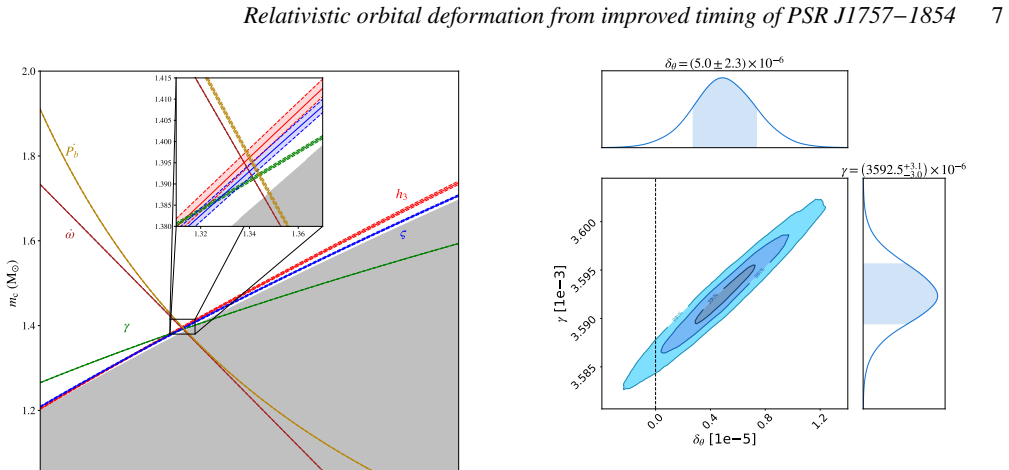
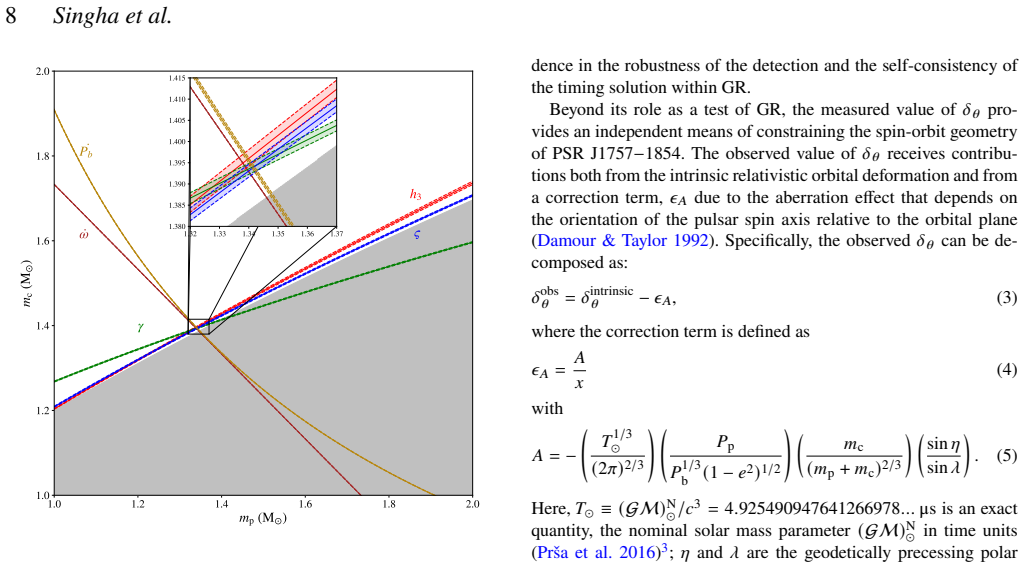
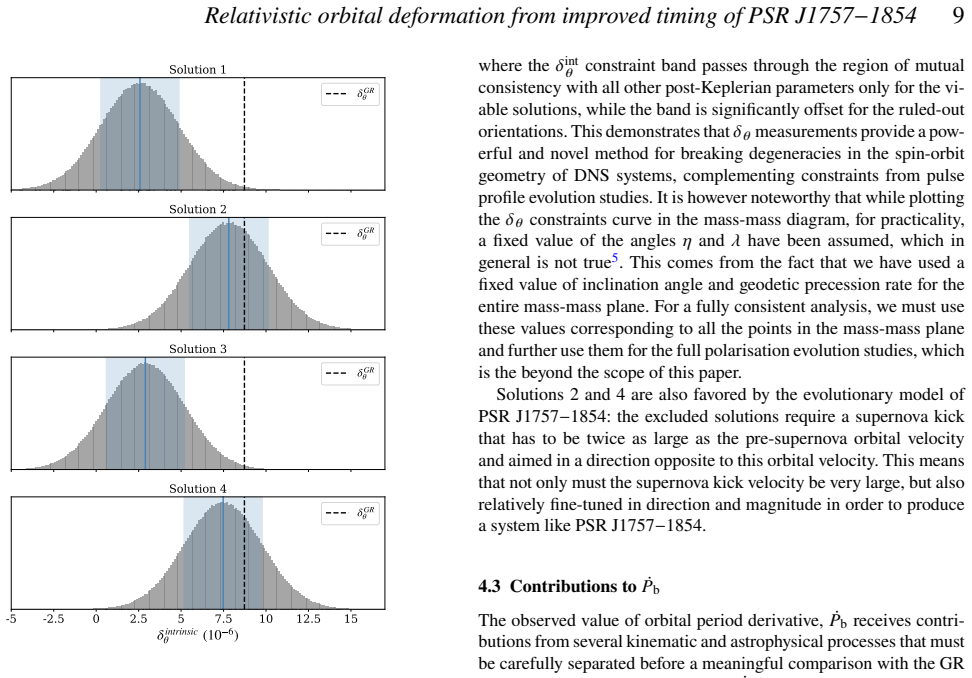
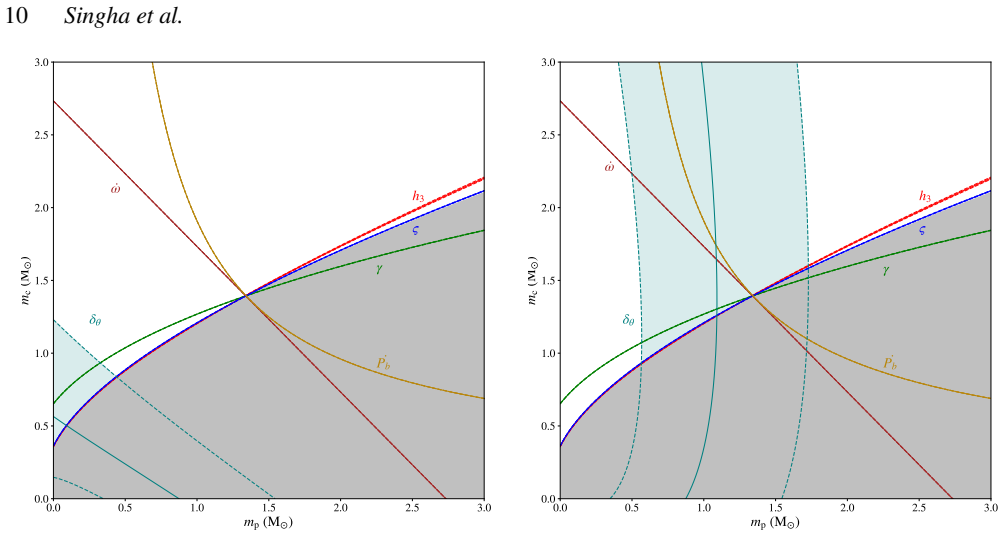
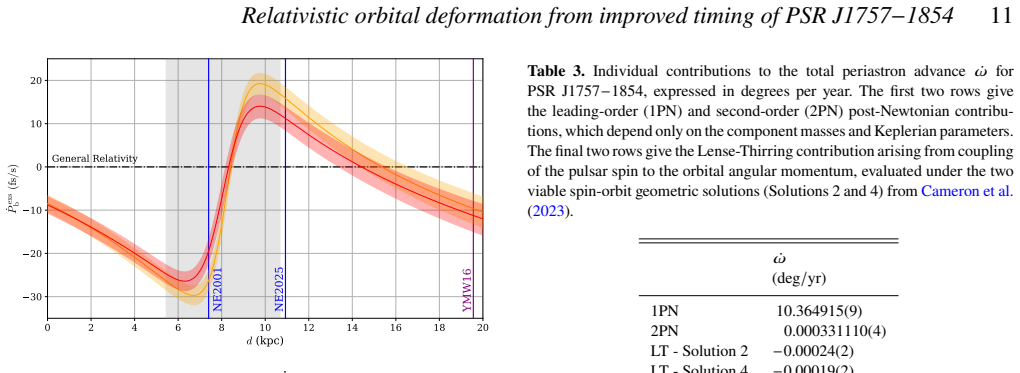
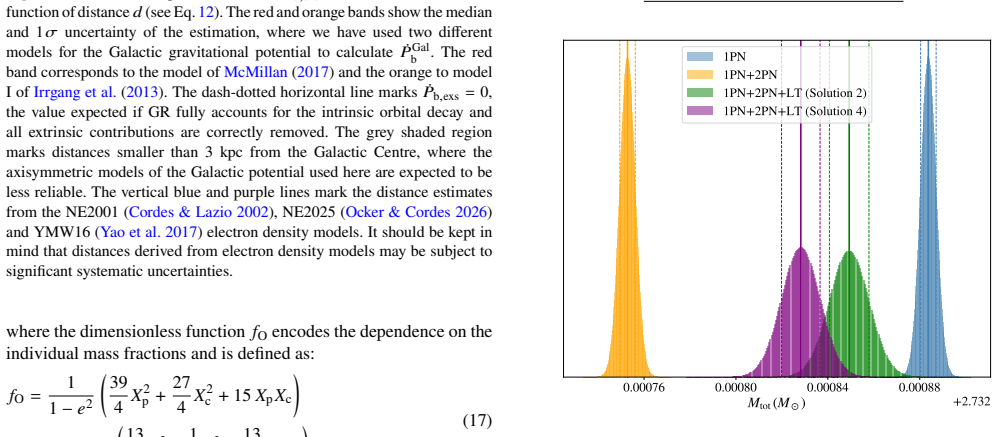
The central claim is the first measurement of δ_θ in PSR J1757-1854. This post-Keplerian parameter was extracted from an extended timing baseline that improved prior post-Keplerian parameters by a factor of roughly two. The measured δ_θ rules out two of four spin-orbit geometric solutions while remaining consistent with general relativity. Higher-order terms in periastron advance produce a measurable systematic shift in the inferred total mass, and the orbital period derivative matches the general relativity prediction for gravitational wave damping across a wide range of distances.
What carries the argument
The relativistic angular deformation δ_θ, a post-Keplerian timing parameter that encodes the angular distortion of the pulsar's periastron passage arising from relativistic effects and is fitted directly to the pulse arrival times.
If this is right
- The δ_θ detection rules out two of the four spin-orbit geometric solutions identified in earlier work.
- Inclusion of second post-Newtonian and Lense-Thirring contributions to periastron advance produces a measurable systematic shift in the derived total system mass.
- The observed orbital period derivative remains consistent with the general relativity prediction for gravitational wave damping.
- The extended high-sensitivity data set improves the precision of previously measured post-Keplerian parameters by a factor of about two or more.
Where Pith is reading between the lines
- The rapid detection with MeerKAT suggests that similar δ_θ measurements may become feasible for additional relativistic DNS systems on decade timescales rather than requiring multiple decades of data.
- Geometric constraints from δ_θ could be combined with future proper-motion or scintillation measurements to further limit the system's three-dimensional orientation.
- If higher-precision timing reveals a δ_θ value inconsistent with the two remaining solutions, it would open a direct test of general relativity in the strong-field regime beyond the current consistency check.
Load-bearing premise
The observed timing residuals are fully explained by the standard post-Keplerian model once the δ_θ term is included, with no significant unmodeled systematics or parameter covariances that could produce a spurious detection.
What would settle it
An independent measurement of the pulsar's spin axis orientation or orbital inclination that lies outside the two geometric solutions still allowed by the reported δ_θ value would falsify the claimed detection and geometric constraints.
Figures
read the original abstract
PSR~J1757$-$1854, a 21.5\,ms pulsar, is a highly relativistic double neutron star (DNS) system in a tight eccentric ($e = 0.61$) 4.4\,hr orbit. With extremely large gravitational wave luminosity and one of the fastest orbital decay rates of any known DNS system, it is ideal for testing general relativity (GR) in the strong-field regime. Here we present results from a high-precision timing campaign combining archival data from the Murriyang telescope and Green Bank Telescope (GBT) with new high-sensitivity observations from the MeerKAT radio telescope and additional observations from the GBT. The extended baseline and superior sensitivity of MeerKAT have yielded substantial improvements to previously measured post-Keplerian parameters by a factor of around $\sim2$ or more. We report the first detection of the relativistic angular deformation, $\delta_\theta$ in this system, making PSR~J1757$-$1854 only the third DNS system for which $\delta_\theta$ has been measured, achieved here in just 9 yrs compared to the decades of timing required for both the double pulsar and the Hulse-Taylor binary. We demonstrate how $\delta_\theta$ can be used to constrain the spin-orbit geometry of the system, ruling out two of the four geometric solutions previously identified, while remaining consistent with GR. We also evaluate higher-order contributions to the periastron advance $\dot{\omega}$, including the second post-Newtonian correction and the Lense-Thirring term, and show that these have a measurable systematic effect on the inferred total system mass. The observed orbital period derivative, $\dot{P}_\mathrm{b}$ remains consistent with the GR prediction for gravitational-wave damping across a wide range of plausible distances.
Editorial analysis
A structured set of objections, weighed in public.
Referee Report
Summary. The paper presents high-precision timing results for the double neutron star system PSR J1757−1854 combining archival Murriyang/GBT data with new MeerKAT and GBT observations. It reports a factor-of-two improvement in post-Keplerian parameters, the first detection of the relativistic angular deformation δ_θ (making this only the third DNS system with such a measurement, achieved in 9 years), use of δ_θ to rule out two of four geometric solutions while remaining GR-consistent, evaluation of 2PN and Lense-Thirring contributions to ω̇ and their effect on total mass, and consistency of Ṗ_b with GR gravitational-wave damping across plausible distances.
Significance. If the δ_θ detection and associated geometric constraints hold, the result adds a valuable third system for testing strong-field GR and spin-orbit coupling, with the short 9-year baseline demonstrating the impact of sensitive wide-band instruments like MeerKAT. The explicit accounting for higher-order ω̇ terms and distance-dependent Ṗ_b checks are positive features that strengthen the GR-consistency claim.
major comments (2)
- [timing analysis] Timing analysis section: the first-detection claim for δ_θ requires explicit quantification of its significance (e.g., Δχ² upon inclusion, posterior odds, or covariance-matrix inspection) to demonstrate that the parameter is not absorbed by correlations with other PK terms or unmodeled systematics; the abstract and summary statements alone do not supply these statistics.
- [higher-order contributions] Periastron-advance discussion: the statement that 2PN and Lense-Thirring terms produce a 'measurable systematic effect' on total mass should be accompanied by the numerical size of the shift in M_tot (with and without the terms) and the resulting change in the inferred component masses, so that readers can judge whether the correction is load-bearing for the GR test.
minor comments (2)
- [results] The abstract states 'factor of around ∼2 or more'; the results section should tabulate the pre- and post-MeerKAT uncertainties for each PK parameter so the improvement factor is directly verifiable.
- [introduction] Notation for δ_θ should be cross-referenced to the standard definition in the timing model (e.g., Damour & Taylor 1992) to avoid ambiguity with other angular parameters.
Simulated Author's Rebuttal
We thank the referee for their constructive review and recommendation for minor revision. We address the two major comments point by point below.
read point-by-point responses
-
Referee: [timing analysis] Timing analysis section: the first-detection claim for δ_θ requires explicit quantification of its significance (e.g., Δχ² upon inclusion, posterior odds, or covariance-matrix inspection) to demonstrate that the parameter is not absorbed by correlations with other PK terms or unmodeled systematics; the abstract and summary statements alone do not supply these statistics.
Authors: We agree that explicit statistical quantification is required to support the first-detection claim. In the revised manuscript we will add the Δχ² value for the inclusion of δ_θ, together with an inspection of the covariance matrix with other post-Keplerian parameters, to demonstrate that the detection is not absorbed by correlations or unmodeled systematics. revision: yes
-
Referee: [higher-order contributions] Periastron-advance discussion: the statement that 2PN and Lense-Thirring terms produce a 'measurable systematic effect' on total mass should be accompanied by the numerical size of the shift in M_tot (with and without the terms) and the resulting change in the inferred component masses, so that readers can judge whether the correction is load-bearing for the GR test.
Authors: We agree that readers need the numerical magnitude of the effect. The revised periastron-advance section will report the specific shift in M_tot (with versus without the 2PN and Lense-Thirring terms) and the resulting changes in the inferred component masses. revision: yes
Circularity Check
No significant circularity detected
full rationale
The paper reports a direct observational measurement of the post-Keplerian parameter δ_θ via least-squares fitting of the standard timing model to pulsar arrival-time data. Subsequent steps (ruling out geometric solutions, checking GR consistency, and evaluating higher-order ω̇ terms) are downstream applications of the fitted value rather than inputs that are redefined or renamed as outputs. No self-definitional equations, fitted quantities relabeled as predictions, or load-bearing self-citations appear in the abstract or described derivation chain. The result is therefore self-contained against external timing data and does not reduce to its own inputs by construction.
Axiom & Free-Parameter Ledger
free parameters (1)
- fitted post-Keplerian parameters (including δ_θ)
axioms (1)
- domain assumption The observed timing residuals are produced solely by Keplerian motion plus the post-Keplerian effects predicted by general relativity.
Reference graph
Works this paper leans on
-
[1]
, year = 1964, month = dec, volume =
Fourth Test of General Relativity. , year = 1964, month = dec, volume =. doi:10.1103/PhysRevLett.13.789 , adsurl =
-
[2]
An improved test of the strong equivalence principle with the pulsar in a triple star system. , keywords =. doi:10.1051/0004-6361/202038104 , archivePrefix =. 2005.01388 , primaryClass =
-
[3]
Masses and tests of general relativity
The double neutron star PSR J1946+2052: I. Masses and tests of general relativity. , keywords =. doi:10.1051/0004-6361/202555689 , archivePrefix =. 2510.12506 , primaryClass =
-
[4]
Classical and Quantum Gravity , keywords =
Closing a spontaneous-scalarization window with binary pulsars. Classical and Quantum Gravity , keywords =. doi:10.1088/1361-6382/ac69a3 , archivePrefix =. 2201.03771 , primaryClass =
-
[5]
Monthly Notices of the Royal Astronomical Society , keywords =
Searches for Shapiro delay in seven binary pulsars using the MeerKAT telescope. Monthly Notices of the Royal Astronomical Society , keywords =. doi:10.1093/mnras/stac3719 , archivePrefix =. 2212.04051 , primaryClass =
-
[6]
Monthly Notices of the Royal Astronomical Society , keywords =
A precise mass measurement of PSR J2045 + 3633. Monthly Notices of the Royal Astronomical Society , keywords =. doi:10.1093/mnras/staa2994 , archivePrefix =. 2009.12283 , primaryClass =
-
[7]
Physical Review X , keywords =
Strong-Field Gravity Tests with the Double Pulsar. Physical Review X , keywords =. doi:10.1103/PhysRevX.11.041050 , archivePrefix =. 2112.06795 , primaryClass =
-
[8]
PSR J2222 - 0137. I. Improved physical parameters for the system. , keywords =. doi:10.1051/0004-6361/202141450 , archivePrefix =. 2107.09474 , primaryClass =
-
[9]
Radio timing constraints on the mass of the binary pulsar PSR J1528 - 3146. , keywords =. doi:10.1051/0004-6361/202346228 , archivePrefix =. 2304.06578 , primaryClass =
-
[10]
The Masses of Two Binary Neutron Star Systems
The Masses of Two Binary Neutron Star Systems. The Astrophysical Journal Letters , keywords =. doi:10.1086/186758 , archivePrefix =. astro-ph/9303002 , primaryClass =
work page internal anchor Pith review Pith/arXiv arXiv doi:10.1086/186758
-
[11]
On the evolution of rapidly rotating massive white dwarfs towards supernovae or collapses
On the evolution of rapidly rotating massive white dwarfs towards supernovae or collapses. , keywords =. doi:10.1051/0004-6361:20042542 , archivePrefix =. astro-ph/0502133 , primaryClass =
work page internal anchor Pith review Pith/arXiv arXiv doi:10.1051/0004-6361:20042542
-
[12]
Mass of highly magnetized white dwarfs exceeding the Chandrasekhar limit: An analytical view
Mass of Highly Magnetized White Dwarfs Exceeding the Chandrasekhar Limit:. AN Analytical View. Modern Physics Letters A , keywords =. doi:10.1142/S0217732312500848 , archivePrefix =. 1204.1463 , primaryClass =
work page internal anchor Pith review Pith/arXiv arXiv doi:10.1142/s0217732312500848
-
[13]
Timing of a Young Mildly Recycled Pulsar with a Massive White Dwarf Companion
Timing of a young mildly recycled pulsar with a massive white dwarf companion. Monthly Notices of the Royal Astronomical Society , keywords =. doi:10.1093/mnras/stt1996 , archivePrefix =. 1310.5857 , primaryClass =
work page internal anchor Pith review Pith/arXiv arXiv doi:10.1093/mnras/stt1996
-
[14]
Masses, Radii, and Equation of State of Neutron Stars
Masses, Radii, and the Equation of State of Neutron Stars. , keywords =. doi:10.1146/annurev-astro-081915-023322 , archivePrefix =. 1603.02698 , primaryClass =
work page internal anchor Pith review Pith/arXiv arXiv doi:10.1146/annurev-astro-081915-023322
-
[15]
The Astrophysical Journal , keywords =
A new test of general relativity - Gravitational radiation and the binary pulsar PSR 1913+16. The Astrophysical Journal , keywords =. doi:10.1086/159690 , adsurl =
-
[16]
Determination of the geometry of the PSR B1913+16 system by geodetic precession
Determination of the Geometry of the PSR B1913+16 System by Geodetic Precession. The Astrophysical Journal , keywords =. doi:10.1086/306535 , archivePrefix =. astro-ph/9808127 , primaryClass =
work page internal anchor Pith review Pith/arXiv arXiv doi:10.1086/306535
-
[17]
Geodetic Precession in PSR B1913+16
Geodetic Precession in PSR B1913+16. Radio Pulsars , year = 2003, editor =. doi:10.48550/arXiv.astro-ph/0301146 , archivePrefix =. astro-ph/0301146 , primaryClass =
work page internal anchor Pith review Pith/arXiv arXiv doi:10.48550/arxiv.astro-ph/0301146 2003
-
[18]
Relativistic Spin Precession in the Double Pulsar
Relativistic Spin Precession in the Double Pulsar. Science , keywords =. doi:10.1126/science.1159295 , archivePrefix =. 0807.2644 , primaryClass =
work page internal anchor Pith review Pith/arXiv arXiv doi:10.1126/science.1159295
-
[19]
Twelfth Marcel Grossmann Meeting on General Relativity , year = 2012, editor =
Geometry of the Young Relativistic Binary Pulsar J1906+0746 from Geodetic Precession Observation. Twelfth Marcel Grossmann Meeting on General Relativity , year = 2012, editor =. doi:10.1142/9789814374552_0270 , adsurl =
-
[21]
Classical and Quantum Gravity , year = 1995, month = apr, volume =
The second post-Newtonian motion of compact binary-star systems with spin. Classical and Quantum Gravity , year = 1995, month = apr, volume =. doi:10.1088/0264-9381/12/4/009 , adsurl =
-
[22]
Formation of Double Neutron Star Systems
Formation of Double Neutron Star Systems. The Astrophysical Journal , keywords =. doi:10.3847/1538-4357/aa7e89 , archivePrefix =. 1706.09438 , primaryClass =
work page internal anchor Pith review Pith/arXiv arXiv doi:10.3847/1538-4357/aa7e89
-
[23]
The MPIfR-MeerKAT Galactic Plane Survey. II. The eccentric double neutron star system PSR J1208 - 5936 and a neutron star merger rate update. , keywords =. doi:10.1051/0004-6361/202346953 , archivePrefix =. 2308.16802 , primaryClass =
-
[24]
The High Time Resolution Universe Pulsar Survey - XIII. PSR J1757-1854, the most accelerated binary pulsar. Monthly Notices of the Royal Astronomical Society , keywords =. doi:10.1093/mnrasl/sly003 , archivePrefix =. 1711.07697 , primaryClass =
work page internal anchor Pith review Pith/arXiv arXiv doi:10.1093/mnrasl/sly003
-
[25]
& Barniol Duran, R.\ 2010, , 409, 226
The orthometric parametrization of the Shapiro delay and an improved test of general relativity with binary pulsars. Monthly Notices of the Royal Astronomical Society , keywords =. doi:10.1111/j.1365-2966.2010.17319.x , archivePrefix =. 1007.0933 , primaryClass =
-
[26]
Monthly Notices of the Royal Astronomical Society , keywords =
New constraints on the kinematic, relativistic, and evolutionary properties of the PSR J1757-1854 double neutron star system. Monthly Notices of the Royal Astronomical Society , keywords =. doi:10.1093/mnras/stad1712 , archivePrefix =. 2305.14733 , primaryClass =
-
[27]
Physical Review D , keywords =
Strong-field tests of relativistic gravity and binary pulsars. Physical Review D , keywords =. doi:10.1103/PhysRevD.45.1840 , adsurl =
-
[28]
Living Reviews in Relativity , keywords =
Gravity experiments with radio pulsars. Living Reviews in Relativity , keywords =. doi:10.1007/s41114-024-00051-y , archivePrefix =. 2407.16540 , primaryClass =
-
[29]
Monthly Notices of the Royal Astronomical Society , keywords =
The relativistic binary programme on MeerKAT: science objectives and first results. Monthly Notices of the Royal Astronomical Society , keywords =. doi:10.1093/mnras/stab375 , archivePrefix =. 2102.05160 , primaryClass =
-
[30]
Prospects of Constraining the Dense Matter Equation of State from Timing Analysis of Pulsars in Double Neutron Star Binaries: The Cases of PSR J0737 ‒ 3039A and PSR J1757 ‒ 1854. Universe , keywords =. doi:10.3390/universe4020036 , archivePrefix =. 1712.02632 , primaryClass =
work page internal anchor Pith review Pith/arXiv arXiv doi:10.3390/universe4020036
-
[31]
Measuring the Lense─Thirring Orbital Precession and the Neutron Star Moment of Inertia with Pulsars. Universe , keywords =. doi:10.3390/universe10040160 , archivePrefix =. 2403.18785 , primaryClass =
-
[32]
Publications of the Astronomical Society of Australia , keywords =
The MeerKAT telescope as a pulsar facility: System verification and early science results from MeerTime. Publications of the Astronomical Society of Australia , keywords =. doi:10.1017/pasa.2020.19 , archivePrefix =. 2005.14366 , primaryClass =
-
[33]
TEMPO2, a new pulsar-timing package - I. An overview. Monthly Notices of the Royal Astronomical Society , keywords =. doi:10.1111/j.1365-2966.2006.10302.x , archivePrefix =. astro-ph/0603381 , primaryClass =
-
[34]
PSRCHIVE and PSRFITS An Open Approach to Radio Pulsar Data Storage and Analysis
PSRCHIVE and PSRFITS: An Open Approach to Radio Pulsar Data Storage and Analysis. Publications of the Astronomical Society of Australia , keywords =. doi:10.1071/AS04022 , archivePrefix =. astro-ph/0404549 , primaryClass =
work page internal anchor Pith review Pith/arXiv arXiv doi:10.1071/as04022
-
[35]
TempoNest: A Bayesian approach to pulsar timing analysis
TEMPONEST: a Bayesian approach to pulsar timing analysis. Monthly Notices of the Royal Astronomical Society , keywords =. doi:10.1093/mnras/stt2122 , archivePrefix =. 1310.2120 , primaryClass =
work page internal anchor Pith review Pith/arXiv arXiv doi:10.1093/mnras/stt2122
-
[36]
2016, in MeerKAT Science: On the Pathway to the SKA, 1, doi: 10.22323/1.277.0001
The MeerKAT Radio Telescope. MeerKAT Science: On the Pathway to the SKA , year = 2016, month = jan, eid =. doi:10.22323/1.277.0001 , adsurl =
-
[37]
& Barniol Duran, R.\ 2010, , 409, 226
The High Time Resolution Universe Pulsar Survey - I. System configuration and initial discoveries. Monthly Notices of the Royal Astronomical Society , keywords =. doi:10.1111/j.1365-2966.2010.17325.x , archivePrefix =. 1006.5744 , primaryClass =
-
[38]
The Astrophysical Journal , keywords =
Further Experimental Tests of Relativistic Gravity Using the Binary Pulsar PSR 1913+16. The Astrophysical Journal , keywords =. doi:10.1086/167917 , adsurl =
-
[39]
Tempo: Pulsar timing data analysis
-
[40]
The Journal of Open Source Software , year = 2016, month = aug, volume = 1, eid =
ChainConsumer. The Journal of Open Source Software , year = 2016, month = aug, volume = 1, eid =. doi:10.21105/joss.00045 , adsurl =
-
[41]
A glitch in the millisecond pulsar J0900 - 3144. , keywords =. doi:10.1093/mnras/staf2034 , archivePrefix =. 2511.11336 , primaryClass =
-
[42]
Relativistic Measurements from Timing the Binary Pulsar PSR B1913+16
Relativistic Measurements from Timing the Binary Pulsar PSR B1913+16. , keywords =. doi:10.3847/0004-637X/829/1/55 , archivePrefix =. 1606.02744 , primaryClass =
work page internal anchor Pith review Pith/arXiv arXiv doi:10.3847/0004-637x/829/1/55
-
[43]
The Journal of Open Source Software , keywords =
emcee v3: A Python ensemble sampling toolkit for affine-invariant MCMC. The Journal of Open Source Software , keywords =. doi:10.21105/joss.01864 , archivePrefix =. 1911.07688 , primaryClass =
-
[44]
On the Orbital Period Change of the Binary Pulsar PSR 1913+16. , keywords =. doi:10.1086/169585 , adsurl =
-
[45]
, year = 1970, month = feb, volume =
Possible Causes of the Secular Increase in Pulsar Periods. , year = 1970, month = feb, volume =
1970
-
[46]
Handbook of pulsar astronomy, by D.R
Handbook of Pulsar Astronomy. Handbook of pulsar astronomy, by D.R. Lorimer and M. Kramer. Cambridge observing handbooks for research astronomers, Vol. 4. Cambridge, UK: Cambridge University Press, 2004 , year = 2005, month = dec, publisher = "
2004
-
[47]
Robertson, H P , journal =
-
[48]
General relativistic celestial mechanics of binary systems. I. The post-Newtonian motion. Ann. Inst. Henri Poincar
-
[49]
General relativistic celestial mechanics of binary systems. II. The post-Newtonian timing formula. Ann. Inst. Henri Poincar
-
[50]
Academie des Sciences Paris Comptes Rendus Serie B Sciences Physiques , keywords =
The two-body problem in general relativity. Academie des Sciences Paris Comptes Rendus Serie B Sciences Physiques , keywords =
-
[51]
Nuovo Cimento B Serie , keywords =
Higher-order relativistic periastron advances and binary pulsars. Nuovo Cimento B Serie , keywords =. doi:10.1007/BF02828697 , adsurl =
-
[52]
, year = 1975, month = jul, volume =
Gravitational two-body problem with arbitrary masses, spins, and quadrupole moments. , year = 1975, month = jul, volume =. doi:10.1103/PhysRevD.12.329 , adsurl =
-
[53]
DSPSR: Digital Signal Processing Software for Pulsar Astronomy
-
[54]
Testing General Relativity with Pulsar Timing
Testing General Relativity with Pulsar Timing. Living Reviews in Relativity , keywords =. doi:10.12942/lrr-2003-5 , archivePrefix =. astro-ph/0307536 , primaryClass =
work page internal anchor Pith review Pith/arXiv arXiv doi:10.12942/lrr-2003-5 2003
-
[55]
A new class of radio pulsars. , keywords =. doi:10.1038/300728a0 , adsurl =
-
[56]
, year = 1991, month = jan, volume =
Formation and evolution of binary and millisecond radio pulsars. , year = 1991, month = jan, volume =. doi:10.1016/0370-1573(91)90064-S , adsurl =
-
[57]
On the formation history of Galactic double neutron stars
On the formation history of Galactic double neutron stars. , keywords =. doi:10.1093/mnras/sty2463 , archivePrefix =. 1805.07974 , primaryClass =
work page internal anchor Pith review Pith/arXiv arXiv doi:10.1093/mnras/sty2463
-
[58]
Double Neutron Star Populations and Formation Channels. , keywords =. doi:10.3847/2041-8213/ab2ed1 , archivePrefix =. 1904.12745 , primaryClass =
-
[59]
Ultra-stripped supernovae: progenitors and fate
Ultra-stripped supernovae: progenitors and fate. , keywords =. doi:10.1093/mnras/stv990 , archivePrefix =. 1505.00270 , primaryClass =
work page internal anchor Pith review Pith/arXiv arXiv doi:10.1093/mnras/stv990
-
[60]
Neutron Star Structure and the Equation of State
Neutron Star Structure and the Equation of State. , keywords =. doi:10.1086/319702 , archivePrefix =. astro-ph/0002232 , primaryClass =
work page internal anchor Pith review Pith/arXiv arXiv doi:10.1086/319702
-
[61]
Physical Review , year = 1964, month = nov, volume =
Gravitational Radiation and the Motion of Two Point Masses. Physical Review , year = 1964, month = nov, volume =. doi:10.1103/PhysRev.136.B1224 , adsurl =
-
[62]
The mass distribution and gravitational potential of the Milky Way
The mass distribution and gravitational potential of the Milky Way. , keywords =. doi:10.1093/mnras/stw2759 , archivePrefix =. 1608.00971 , primaryClass =
work page internal anchor Pith review Pith/arXiv arXiv doi:10.1093/mnras/stw2759
-
[63]
Milky Way Mass Models for Orbit Calculations
Milky Way mass models for orbit calculations. , keywords =. doi:10.1051/0004-6361/201220540 , archivePrefix =. 1211.4353 , primaryClass =
work page internal anchor Pith review Pith/arXiv arXiv doi:10.1051/0004-6361/201220540
-
[64]
From existing and new nuclear and astrophysical constraints to stringent limits on the equation of state of neutron-rich dense matter. arXiv e-prints , keywords =. doi:10.48550/arXiv.2402.04172 , archivePrefix =. 2402.04172 , primaryClass =
-
[65]
Constraints on a phenomenologically parameterized neutron-star equation of state
Constraints on a phenomenologically parametrized neutron-star equation of state. , keywords =. doi:10.1103/PhysRevD.79.124032 , archivePrefix =. 0812.2163 , primaryClass =
work page internal anchor Pith review Pith/arXiv arXiv doi:10.1103/physrevd.79.124032
-
[66]
Inferring neutron star properties from GW170817 with universal relations
Inferring neutron star properties from GW170817 with universal relations. , keywords =. doi:10.1103/PhysRevD.99.123026 , archivePrefix =. 1902.04557 , primaryClass =
work page internal anchor Pith review Pith/arXiv arXiv doi:10.1103/physrevd.99.123026 1902
-
[67]
Refined Mass and Geometric Measurements of the High-mass PSR J0740+6620. , keywords =. doi:10.3847/2041-8213/ac03b8 , archivePrefix =. 2104.00880 , primaryClass =
-
[68]
PSR J0952-0607: The Fastest and Heaviest Known Galactic Neutron Star. , keywords =. doi:10.3847/2041-8213/ac8007 , archivePrefix =. 2207.05124 , primaryClass =
-
[69]
NE2001.I. A New Model for the Galactic Distribution of Free Electrons and its Fluctuations
NE2001.I. A New Model for the Galactic Distribution of Free Electrons and its Fluctuations. arXiv e-prints , volume =. doi:10.48550/arXiv.astro-ph/0207156 , archivePrefix =. astro-ph/0207156 , primaryClass =
work page internal anchor Pith review Pith/arXiv arXiv doi:10.48550/arxiv.astro-ph/0207156
-
[70]
A New Electron Density Model for Estimation of Pulsar and FRB Distances
A New Electron-density Model for Estimation of Pulsar and FRB Distances. , keywords =. doi:10.3847/1538-4357/835/1/29 , archivePrefix =. 1610.09448 , primaryClass =
work page internal anchor Pith review Pith/arXiv arXiv doi:10.3847/1538-4357/835/1/29
-
[71]
NE2025: An Updated Electron Density Model for the Galactic Interstellar Medium
NE2025: An Updated Electron Density Model for the Galactic Interstellar Medium. arXiv e-prints , keywords =. doi:10.48550/arXiv.2602.11838 , archivePrefix =. 2602.11838 , primaryClass =
work page internal anchor Pith review Pith/arXiv arXiv doi:10.48550/arxiv.2602.11838
-
[72]
Measurements of general relativistic effects in the binary pulsar PSR1913 + 16. , keywords =. doi:10.1038/277437a0 , adsurl =
-
[73]
Taylor, J. H. , title =. 1993 , month = dec, day =
1993
-
[74]
Nominal values for selected solar and planetary quantities: IAU 2015 Resolution B3
Nominal Values for Selected Solar and Planetary Quantities: IAU 2015 Resolution B3. , keywords =. doi:10.3847/0004-6256/152/2/41 , archivePrefix =. 1605.09788 , primaryClass =
work page internal anchor Pith review Pith/arXiv arXiv doi:10.3847/0004-6256/152/2/41 2015
-
[75]
TEMPO2, a new pulsar timing package - II. The timing model and precision estimates. , keywords =. doi:10.1111/j.1365-2966.2006.10870.x , archivePrefix =. astro-ph/0607664 , primaryClass =
-
[76]
From Stars to X-ray Binaries and Gravitational Wave Sources
Physics of Binary Star Evolution. From Stars to X-ray Binaries and Gravitational Wave Sources. doi:10.48550/arXiv.2305.09388 , adsurl =
discussion (0)
Sign in with ORCID, Apple, or X to comment. Anyone can read and Pith papers without signing in.