Biophysical EPR Using Superconducting Resonators
Pith reviewed 2026-06-26 07:48 UTC · model grok-4.3
The pith
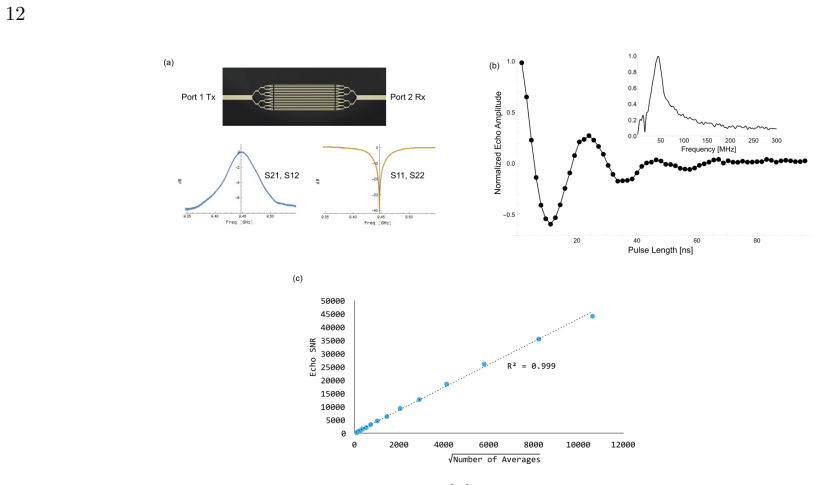
A novel patterned thin film superconducting microstrip resonator achieves 6 ns pi/2 Gaussian pulses for DEER measurements on spin-labeled proteins below 10 uM.
A machine-rendered reading of the paper's core claim, the machinery that carries it, and where it could break.
Core claim
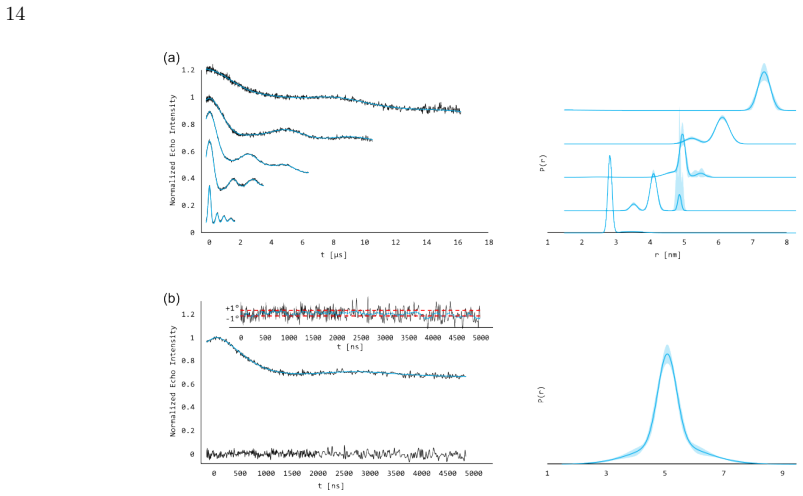
The novel patterned thin film planar superconducting microstrip resonator is capable of generating Rabi fields sufficient to achieve 6 ns pi/2 Gaussian pulses using a 100 W solid-state HPA, with the overall system enabling validated DEER distance measurements in spin-labeled protein samples at biologically relevant concentrations including below 10 uM, while supporting automated sequential calibration, measurement, and analysis of five 3.5 uL samples contained in a sample cartridge.
What carries the argument
patterned thin film planar superconducting microstrip resonator that generates the required Rabi fields for short pulses
If this is right
- Validated DEER distance measurements become possible at protein concentrations below 10 uM.
- Five 3.5 uL samples can be calibrated, measured, and analyzed automatically in one cartridge.
- Pulsed EPR on biological samples gains higher bandwidth and stability through the superconducting resonator.
- Applications of both superconducting resonators and EPR expand into biotechnology settings.
Where Pith is reading between the lines
- The same resonator approach may support other pulsed EPR sequences beyond DEER on similar low-volume samples.
- Reduced sample volume requirements could enable EPR studies on proteins that are difficult to produce in large quantities.
- Automated multi-sample handling might scale to screening applications in structural biology.
- Integration with existing solid-state amplifiers could lower barriers for labs adopting the method.
Load-bearing premise
The custom spectrometer, FPGA control, and resonator can be stably integrated with biological samples to reach the stated pulse lengths and measurement sensitivity without unstated limits on sample integrity or resonator performance.
What would settle it
Failure to produce reliable DEER signals or pulse lengths longer than 6 ns when the resonator is loaded with spin-labeled protein samples at concentrations below 10 uM.
Figures



read the original abstract
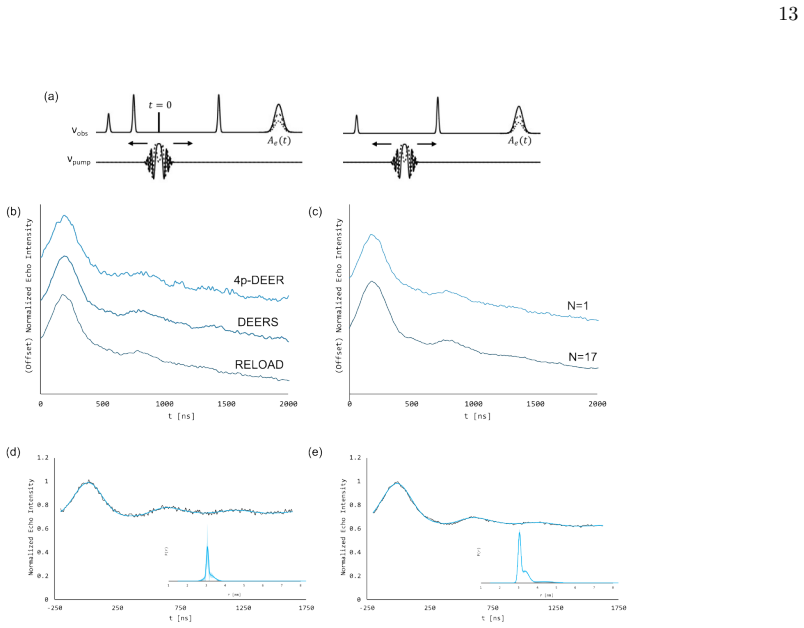
We present innovations that enable the use of superconducting resonators for high sensitivity, high bandwidth pulsed electron paramagnetic resonance (EPR) measurements on biologically relevant samples with enhanced stability and throughput. A custom-built X-band pulsed EPR spectrometer with AWG and digital IF capability generated by an FPGA was used to control a novel patterned thin film planar superconducting microstrip resonator capable of generating Rabi fields sufficient to achieve 6 ns pi/2 Gaussian pulses using a 100 W solid-state HPA. The system allows automated sequential calibration, measurement, and analysis of five 3.5 uL samples contained in a sample cartridge. Performance was validated through measurements of double electron-electron resonance (DEER) distances in a variety of spin-labeled protein samples with biologically relevant concentrations, including measurements below 10 uM. The results enable broadening the scope of applications for both superconducting resonators and the use of EPR in biotechnology.
Editorial analysis
A structured set of objections, weighed in public.
Referee Report
Summary. The manuscript presents a custom-built X-band pulsed EPR spectrometer incorporating an FPGA-controlled AWG with digital IF, paired with a novel patterned thin film planar superconducting microstrip resonator. It claims this system generates Rabi fields sufficient for 6 ns π/2 Gaussian pulses using a 100 W solid-state HPA, supports automated sequential calibration and measurement of five 3.5 µL samples, and has its performance validated via DEER distance measurements on spin-labeled protein samples at biologically relevant concentrations including below 10 µM.
Significance. If the experimental claims are substantiated with data, the work could meaningfully extend the applicability of superconducting resonators to biophysical EPR by improving sensitivity and sample throughput at low concentrations, thereby broadening EPR's utility in biotechnology.
major comments (2)
- [Abstract] Abstract: The central claim that 'Performance was validated through measurements of double electron-electron resonance (DEER) distances in a variety of spin-labeled protein samples...' is unsupported because the manuscript provides no accompanying data, figures, error bars, statistical analysis, or detailed methods sections describing these measurements.
- [Abstract] Abstract: The headline performance metrics (6 ns π/2 pulses and DEER sensitivity below 10 µM) rest on the unshown assumption that the resonator maintains sufficient Q-factor and power handling after introduction of lossy 3.5 µL protein/buffer samples; no before/after Q values, critical-current limits, or heating data under load are reported, leaving the integration step unverified.
minor comments (1)
- [Abstract] Abstract: The acronym 'HPA' appears without prior expansion (high-power amplifier), which is a minor clarity issue.
Simulated Author's Rebuttal
We thank the referee for their constructive comments on our manuscript describing the superconducting resonator-based X-band pulsed EPR system. We address each major comment point by point below and will revise the manuscript to better substantiate the claims.
read point-by-point responses
-
Referee: [Abstract] Abstract: The central claim that 'Performance was validated through measurements of double electron-electron resonance (DEER) distances in a variety of spin-labeled protein samples...' is unsupported because the manuscript provides no accompanying data, figures, error bars, statistical analysis, or detailed methods sections describing these measurements.
Authors: We agree that the abstract claim requires explicit supporting evidence within the manuscript. The current version does not sufficiently present the DEER data, figures, error bars, statistical analysis, or detailed methods. In the revised manuscript we will add the missing DEER results (including traces, distance distributions with error bars, and statistical details) for the spin-labeled protein samples at concentrations including below 10 µM, expand the methods section, and ensure the abstract directly references these additions. revision: yes
-
Referee: [Abstract] Abstract: The headline performance metrics (6 ns π/2 pulses and DEER sensitivity below 10 µM) rest on the unshown assumption that the resonator maintains sufficient Q-factor and power handling after introduction of lossy 3.5 µL protein/buffer samples; no before/after Q values, critical-current limits, or heating data under load are reported, leaving the integration step unverified.
Authors: We acknowledge this is a valid concern; the manuscript does not report before/after Q-factor values, critical-current limits, or heating data under load with the protein/buffer samples. The successful 6 ns pulses and DEER results provide indirect evidence of adequate performance, but this is insufficient. In the revised manuscript we will add the requested Q-factor measurements, power-handling details, critical-current information, and any available heating data under load to directly verify the resonator integration with lossy samples. revision: yes
Circularity Check
No circularity: experimental validation only
full rationale
The paper reports construction and experimental testing of a custom EPR spectrometer and superconducting resonator, with performance claims supported by direct DEER distance measurements on spin-labeled protein samples. No equations, fitted parameters, predictions, or self-citations appear in the provided text that reduce any result to its own inputs by construction. The work is self-contained as an instrumentation report whose central claims rest on external sample measurements rather than internal redefinitions or ansatzes.
Axiom & Free-Parameter Ledger
Reference graph
Works this paper leans on
-
[1]
Shaped Pulse 4p-DEER 20
-
[2]
RELOAD DEER-Stitch (RDS) 73
-
[3]
All sequences use Gaussian observe pulses
RELOAD DEER-Stitch with Echo Train (RDSE) 128 SNR performance of various modified DEER sequences that enhance SNR. All sequences use Gaussian observe pulses
-
[4]
and adiabatic pump pulses [65]. Automation The high stability of our system and the dielectric similarity of each sample in our cartridges enable automated calibration routines, experiment setup, and data collection to run reliably without user input. Often, experiment setup and system tuning are the most time-consuming parts of a distance measurement, re...
-
[5]
Bienfait, J
A. Bienfait, J. J. Pla, Y. Kubo, M. Stern, X. Zhou, C. C. Lo, C. D. Weis, T. Schenkel, M. L. W. Thewalt, D. Vion, D. Esteve, B. Julsgaard, K. Mølmer, J. J. L. Morton, and P. Bertet, Reaching the quantum limit of sensitivity in electron spin resonance, Nature Nanotechnology11, 253 (2016)
2016
-
[6]
Ranjan, S
V. Ranjan, S. Probst, B. Albanese, T. Schenkel, D. Vion, D. Esteve, J. J. L. Morton, and P. Bertet, Electron spin resonance spectroscopy with femtoliter detection volume, Applied Physics Letters116, 184002 (2020)
2020
-
[7]
Jeschke, The contribution of modern EPR to structural biology, Emerging Topics in Life Sciences , ETLS20170143 (2018)
G. Jeschke, The contribution of modern EPR to structural biology, Emerging Topics in Life Sciences , ETLS20170143 (2018)
2018
-
[8]
Wunnicke and I
D. Wunnicke and I. H¨ anelt, The Synergetic Effects of Combining Structural Biology and EPR Spectroscopy on Membrane Proteins, Crystals7, 117 (2017)
2017
-
[9]
de Val, Understanding cell biology using cryo-electron microscopy, Biophysical Journal122, 542a (2023)
N. de Val, Understanding cell biology using cryo-electron microscopy, Biophysical Journal122, 542a (2023)
2023
-
[10]
Stock, L
C. Stock, L. Hielkema, I. Tasc´ on, D. Wunnicke, G. T. Oostergetel, M. Azkargorta, C. Paulino, and I. H¨ anelt, Cryo-EM structures of KdpFABC suggest a K+ transport mechanism via two inter-subunit half-channels, Nature Communications9, 4971 (2018)
2018
-
[11]
T. W. M. Fan and A. N. Lane, Applications of NMR spectroscopy to systems biochemistry, Progress in Nuclear Magnetic Resonance Spectroscopy92-93, 18 (2016)
2016
-
[12]
Klose, A
D. Klose, A. Holla, C. Gmeiner, D. Nettels, I. Ritsch, N. Bross, M. Yulikov, F. H.-T. Allain, B. Schuler, and G. Jeschke, Resolving distance variations by single-molecule FRET and EPR spectroscopy using rotamer libraries, Biophysical Journal120, 4842 (2021)
2021
-
[13]
T. Wu, R. A. Stein, T.-Y. Kao, B. Brown, and H. S. Mchaourab, Modeling protein conformational ensembles by guid- ing AlphaFold2 with Double Electron Electron Resonance (DEER) distance distributions, Nature Communications 16, 7107 (2025)
2025
-
[14]
del Alamo, L
D. del Alamo, L. DeSousa, R. M. Nair, S. Rahman, J. Meiler, and H. S. Mchaourab, Integrated AlphaFold2 and DEER investigation of the conformational dynamics of a pH-dependent APC antiporter, Proceedings of the National Academy of Sciences119, e2206129119 (2022)
2022
-
[15]
T. W. Ettema, S. Inaba-Inoue, C. Thangaratnarajah, L. Alves da Silva, N. Senning, A. Clarke, P. Stepien, A. Shah, Y. Ma, K. Hardman, S. David, H. El Mkami, J. G. Heddle, N. Nomura, S. Ogasawara, S. Iwata, D. Ghilarov, C. Pliotas, T. Stockner, D. J. Slotboom, and K. Beis, Shared structural mechanisms of alternating access between the secondary peptide tran...
-
[16]
Y. Ma, K. Ackermann, Q. Waheed, V. Postis, T. K. Smith, B. E. Bode, and C. Pliotas, Swapped and non-swapped TRAAK states co-exist in membranes at a ratio influenced by temperature, Nature Communications17, 3522 (2026)
2026
-
[17]
Bonucci, O
A. Bonucci, O. Ouari, B. Guigliarelli, V. Belle, and E. Mileo, In-cell EPR: progress towards structural studies inside cells, ChemBioChem21, 451 (2020)
2020
-
[18]
Reichenwallner, B
J. Reichenwallner, B. Liu, A. R. Balo, W.-L. Ou, and O. P. Ernst, Electron paramagnetic resonance spectroscopy on G-protein-coupled receptors: Adopting strategies from related model systems, Current Opinion in Structural Biology69, 177 (2021)
2021
-
[19]
Hofmann, A
L. Hofmann, A. Mandato, S. Saxena, and S. Ruthstein, The use of EPR spectroscopy to study transcription mech- anisms, Biophysical Reviews14, 1141 (2022)
2022
-
[20]
J. J. L. Morton and P. Bertet, Storing quantum information in spins and high-sensitivity ESR, Journal of Magnetic Resonance287, 128 (2018)
2018
-
[21]
Artzi, Y
Y. Artzi, Y. Yishay, M. Fanciulli, M. Jbara, and A. Blank, Superconducting micro-resonators for electron spin resonance - the good, the bad, and the future, Journal of Magnetic Resonance334, 107102 (2022)
2022
-
[22]
Akhmetzyanov, T
D. Akhmetzyanov, T. W. Borneman, I. Taminiau, S. Sadeghi, H. R. Mohebbi, and D. G. Cory, Electron spin resonance spectroscopy using a Nb superconducting resonator, Applied Physics Letters123, 224002 (2023)
2023
-
[23]
Jeschke, DEER Distance Measurements on Proteins, Annual Review of Physical Chemistry63, 419 (2012)
G. Jeschke, DEER Distance Measurements on Proteins, Annual Review of Physical Chemistry63, 419 (2012)
2012
-
[24]
Schmidt, J
T. Schmidt, J. Jeon, W.-M. Yau, C. D. Schwieters, R. Tycko, and G. M. Clore, Time-resolved DEER EPR and solid- state NMR afford kinetic and structural elucidation of substrate binding to Ca2+-ligated calmodulin, Proceedings of the National Academy of Sciences119, e2122308119 (2022)
2022
-
[25]
Kaufmann, T
T. Kaufmann, T. J. Keller, J. M. Franck, R. P. Barnes, S. J. Glaser, J. M. Martinis, and S. Han, DAC-board based X-band EPR spectrometer with arbitrary waveform control, Journal of Magnetic Resonance235, 95 (2013)
2013
-
[26]
Z. Shi, S. Mu, X. Qin, Y. Dai, X. Rong, and J. Du, An X-band pulsed electron paramagnetic resonance spectrom- eter with time resolution improved by a field-programmable-gate-array based pulse generator, Review of Scientific Instruments89, 125104 (2018)
2018
-
[27]
Kalendra, J
V. Kalendra, J. Turˇ cak, J. Banys, J. J. L. Morton, and M. ˇSim˙ enas, X- and Q-band EPR with cryogenic amplifiers independent of sample temperature, Journal of Magnetic Resonance346, 107356 (2023)
2023
-
[28]
Kalendra, J
V. Kalendra, J. Turˇ cak, G. Useviˇ cius, H. Karas, M. H¨ ulsmann, A. Godt, G. Jeschke, J. Banys, J. J. L. Morton, and M. ˇSim˙ enas, Q-band EPR cryoprobe, Journal of Magnetic Resonance356, 107573 (2023). 9
2023
-
[29]
ˇSim˙ enas, J
M. ˇSim˙ enas, J. O’Sullivan, C. W. Zollitsch, O. Kennedy, M. Seif-Eddine, I. Ritsch, M. H¨ ulsmann, M. Qi, A. Godt, M. M. Roessler, G. Jeschke, and J. J. L. Morton, A sensitivity leap for X-band EPR using a probehead with a cryogenic preamplifier, Journal of Magnetic Resonance322, 106876 (2021)
2021
-
[30]
Y. Twig, E. Dikarov, and A. Blank, Cryogenic electron spin resonance microimaging probe, Journal of Magnetic Resonance218, 22 (2012)
2012
-
[31]
Pfenninger, W
S. Pfenninger, W. Froncisz, and J. S. Hyde, Noise Analysis of EPR Spectrometers with Cryogenic Microwave Preamplifiers, Journal of Magnetic Resonance, Series A113, 32 (1995)
1995
-
[32]
Narkowicz, H
R. Narkowicz, H. Ogata, E. Reijerse, and D. Suter, A cryogenic receiver for EPR, Journal of Magnetic Resonance 237, 79 (2013)
2013
-
[33]
D. I. Hoult and R. E. Richards, The signal-to-noise ratio of the nuclear magnetic resonance experiment, Journal of Magnetic Resonance (1969)24, 71 (1976)
1969
-
[34]
G. A. Rinard, R. W. Quine, R. Song, G. R. Eaton, and S. S. Eaton, Absolute EPR Spin Echo and Noise Intensities, Journal of Magnetic Resonance140, 69 (1999)
1999
-
[35]
Albertinale, L
E. Albertinale, L. Balembois, E. Billaud, V. Ranjan, D. Flanigan, T. Schenkel, D. Est` eve, D. Vion, P. Bertet, and E. Flurin, Detecting spins by their fluorescence with a microwave photon counter, Nature600, 434 (2021)
2021
-
[36]
Ranjan, S
V. Ranjan, S. Probst, B. Albanese, A. Doll, O. Jacquot, E. Flurin, R. Heeres, D. Vion, D. Esteve, J. J. L. Morton, and P. Bertet, Pulsed electron spin resonance spectroscopy in the Purcell regime, Journal of Magnetic Resonance 310, 106662 (2020)
2020
-
[37]
Z. Wang, L. Balembois, M. Ranˇ ci´ c, E. Billaud, M. Le Dantec, A. Ferrier, P. Goldner, S. Bertaina, T. Chaneli` ere, D. Esteve, D. Vion, P. Bertet, and E. Flurin, Single-electron spin resonance detection by microwave photon counting, Nature619, 276 (2023)
2023
-
[38]
Albanese, S
B. Albanese, S. Probst, V. Ranjan, C. W. Zollitsch, M. Pechal, A. Wallraff, J. J. L. Morton, D. Vion, D. Esteve, E. Flurin, and P. Bertet, Radiative cooling of a spin ensemble, Nature Physics , 1 (2020)
2020
-
[39]
Alsing and H
P. Alsing and H. J. Carmichael, Spontaneous dressed-state polarization of a coupled atom and cavity mode, Quantum Optics: Journal of the European Optical Society Part B3, 13 (1991)
1991
-
[40]
Blank, Y
A. Blank, Y. Twig, and Y. Ishay, Recent trends in high spin sensitivity magnetic resonance, Journal of Magnetic Resonance Special Issue on Methodological advances in EPR spectroscopy and imaging,280, 20 (2017)
2017
-
[41]
Tavis and F
M. Tavis and F. W. Cummings, Exact Solution for an N-Molecule Radiation-Field Hamiltonian, Physical Review 170, 379 (1968)
1968
-
[42]
L. G. Gunderman, A. Stasiuk, M. E. Mandouh, T. W. Borneman, and D. G. Cory, Lamb shift statistics in mesoscopic quantum ensembles, Quantum Information Processing21, 26 (2021)
2021
-
[43]
H. R. Mohebbi, O. W. B. Benningshof, I. a. J. Taminiau, G. X. Miao, and D. G. Cory, Composite arrays of superconducting microstrip line resonators, Journal of Applied Physics115, 094502 (2014)
2014
-
[44]
O. W. B. Benningshof, H. R. Mohebbi, I. A. J. Taminiau, G. X. Miao, and D. G. Cory, Superconducting microstrip resonator for pulsed ESR of thin films, Journal of Magnetic Resonance230, 84 (2013)
2013
-
[45]
Bachar, O
G. Bachar, O. Suchoi, O. Shtempluck, A. Blank, and E. Buks, Nonlinear induction detection of electron spin resonance, Applied Physics Letters101, 022602 (2012)
2012
-
[46]
Bonizzoni, F
C. Bonizzoni, F. Troiani, A. Ghirri, and M. Affronte, Microwave dual-mode resonators for coherent spin-photon coupling, Journal of Applied Physics124, 194501 (2018)
2018
-
[47]
Velluire Pellat, E
Z. Velluire Pellat, E. Mar´ echal, N. Moulonguet, G. Sa¨ ız, G. C. M´ enard, S. Kozlov, F. Cou¨ edo, P. Amari, C. Medous, J. Paris, R. Hostein, J. Lesueur, C. Feuillet-Palma, and N. Bergeal, Hybrid quantum systems with high-Tc super- conducting resonators, Scientific Reports13, 14366 (2023)
2023
-
[48]
Hincks, C
I. Hincks, C. Granade, T. Borneman, and D. Cory, Controlling Quantum Devices with Nonlinear Hardware, Physical Review Applied4, 024012 (2015)
2015
-
[49]
G. A. Rinard, R. W. Quine, S. S. Eaton, G. R. Eaton, and W. Froncisz, Relative Benefits of Overcoupled Resonators vs Inherently Low-Q Resonators for Pulsed Magnetic Resonance, Journal of Magnetic Resonance, Series A108, 71 (1994)
1994
-
[50]
L. G. Gunderman, T. W. Borneman, and D. G. Cory, Thermal state structure in the Tavis-Cummings model and rapid simulations in mesoscopic quantum ensembles, Physical Review Research7, 023155 (2025)
2025
-
[51]
Polyhach, E
Y. Polyhach, E. Bordignon, R. Tschaggelar, S. Gandra, A. Godt, and G. Jeschke, High sensitivity and versatility of the DEER experiment on nitroxide radical pairs at Q-band frequencies, Physical Chemistry Chemical Physics14, 10762 (2012)
2012
-
[52]
S. Kwon, A. Fadavi Roudsari, O. W. B. Benningshof, Y.-C. Tang, H. R. Mohebbi, I. A. J. Taminiau, D. Langenberg, S. Lee, G. Nichols, D. G. Cory, and G.-X. Miao, Magnetic field dependent microwave losses in superconducting niobium microstrip resonators, Journal of Applied Physics124, 033903 (2018)
2018
-
[53]
A. D. Milov, K. Salikhov, and M. Shchirov, Application of the double resonance method to electron spin echo in a study of the spatial distribution of paramagnetic centers in solids, Sovietscaya Physics Solid Stated23, 565 (1981)
1981
-
[54]
A. D. Milov, A. B. Ponomarev, and Y. D. Tsvetkov, Electron-electron double resonance in electron spin echo: Model biradical systems and the sensitized photolysis of decalin, Chemical Physics Letters110, 67 (1984)
1984
-
[55]
R. E. Martin, M. Pannier, F. Diederich, V. Gramlich, M. Hubrich, and H. W. Spiess, Determination of End-to-End Distances in a Series of TEMPO Diradicals of up to 2.8 nm Length with a New Four-Pulse Double Electron Electron Resonance Experiment, Angewandte Chemie International Edition37, 2833 (1998)
1998
-
[56]
Pannier, S
M. Pannier, S. Veit, A. Godt, G. Jeschke, and H. W. Spiess, Dead-Time Free Measurement of Dipole–Dipole Interactions between Electron Spins, Journal of Magnetic Resonance142, 331 (2000). 10
2000
-
[57]
Bahrenberg, S
T. Bahrenberg, S. M. Jahn, A. Feintuch, S. Stoll, and D. Goldfarb, The decay of the refocused Hahn echo in double electron–electron resonance (DEER) experiments, Magnetic Resonance2, 161 (2021)
2021
-
[58]
Milikisiyants, M
S. Milikisiyants, M. A. Voinov, A. Marek, M. Jafarabadi, J. Liu, R. Han, S. Wang, and A. I. Smirnov, Enhanc- ing sensitivity of Double Electron-Electron Resonance (DEER) by using Relaxation-Optimized Acquisition Length Distribution (RELOAD) scheme, Journal of Magnetic Resonance298, 115 (2019)
2019
-
[59]
J. E. Lovett, B. W. Lovett, and J. Harmer, DEER-Stitch: Combining three- and four-pulse DEER measurements for high sensitivity, deadtime free data, Journal of Magnetic Resonance223, 98 (2012)
2012
-
[60]
Mentink-Vigier, A
F. Mentink-Vigier, A. Collauto, A. Feintuch, I. Kaminker, V. Tarle, and D. Goldfarb, Increasing sensitivity of pulse EPR experiments using echo train detection schemes, Journal of Magnetic Resonance236, 117 (2013)
2013
-
[61]
Probst, A
S. Probst, A. Bienfait, P. Campagne-Ibarcq, J. J. Pla, B. Albanese, J. F. Da Silva Barbosa, T. Schenkel, D. Vion, D. Esteve, K. Mølmer, J. J. L. Morton, R. Heeres, and P. Bertet, Inductive-detection electron-spin resonance spectroscopy with 65 spins/ Hz sensitivity, Applied Physics Letters111, 202604 (2017)
2017
-
[62]
T. W. Borneman, M. D. H¨ urlimann, and D. G. Cory, Application of optimal control to CPMG refocusing pulse design, Journal of Magnetic Resonance207, 220 (2010)
2010
-
[63]
Endeward, M
B. Endeward, M. Bretschneider, P. Trenkler, and T. F. Prisner, Implementation and applications of shaped pulses in EPR, Progress in Nuclear Magnetic Resonance Spectroscopy136-137, 61 (2023)
2023
-
[64]
E. R. Lowe, S. Stoll, and J. P. Kestner, Optimizing EPR pulses for broadband excitation and refocusing, Journal of Magnetic Resonance369, 107807 (2024)
2024
-
[65]
A. R. Balo, H. Feyrer, and O. P. Ernst, Toward Precise Interpretation of DEER-Based Distance Distributions: Insights from Structural Characterization of V1 Spin-Labeled Side Chains, Biochemistry55, 5256 (2016)
2016
-
[66]
H. S. Mchaourab, M. A. Lietzow, K. Hideg, and W. L. Hubbell, Motion of Spin-Labeled Side Chains in T4 Lysozyme. Correlation with Protein Structure and Dynamics, Biochemistry35, 7692 (1996)
1996
-
[67]
P. P. Borbat, H. S. Mchaourab, and J. H. Freed, Protein Structure Determination Using Long Distance Constraints from Double Quantum Coherence ESR: Study of T4 Lysozyme, Journal of the American Chemical Society124, 5304 (2002)
2002
-
[68]
Teucher and E
M. Teucher and E. Bordignon, Improved signal fidelity in 4-pulse DEER with Gaussian pulses, Journal of Magnetic Resonance296, 103 (2018)
2018
-
[69]
A. Doll, S. Pribitzer, R. Tschaggelar, and G. Jeschke, Adiabatic and fast passage ultra-wideband inversion in pulsed EPR, Journal of Magnetic Resonance230, 27 (2013)
2013
-
[70]
Schiemann, C
O. Schiemann, C. A. Heubach, D. Abdullin, K. Ackermann, M. Azarkh, E. G. Bagryanskaya, M. Drescher, B. En- deward, J. H. Freed, L. Galazzo, D. Goldfarb, T. Hett, L. Esteban Hofer, L. F´ abregas Ib´ a˜ nez, E. J. Hustedt, S. Kucher, I. Kuprov, J. E. Lovett, A. Meyer, S. Ruthstein, S. Saxena, S. Stoll, C. R. Timmel, M. Di Valentin, H. S. Mchaourab, T. F. Pr...
2021
-
[71]
P. E. Spindler, Y. Zhang, B. Endeward, N. Gershernzon, T. E. Skinner, S. J. Glaser, and T. F. Prisner, Shaped optimal control pulses for increased excitation bandwidth in EPR, Journal of Magnetic Resonance218, 49 (2012)
2012
-
[72]
Doll and G
A. Doll and G. Jeschke, Fourier-transform electron spin resonance with bandwidth-compensated chirp pulses, Journal of Magnetic Resonance246, 18 (2014)
2014
-
[73]
T. W. Borneman and D. G. Cory, Bandwidth-limited control and ringdown suppression in high-Q resonators, Journal of Magnetic Resonance225, 120 (2012)
2012
-
[74]
Mandato, Z
A. Mandato, Z. Hasanbasri, and S. Saxena, Double Quantum Coherence ESR at Q-Band Enhances the Sensitivity of Distance Measurements at Submicromolar Concentrations, The Journal of Physical Chemistry Letters14, 8909 (2023)
2023
-
[75]
Milikisyants, F
S. Milikisyants, F. Scarpelli, M. G. Finiguerra, M. Ubbink, and M. Huber, A pulsed EPR method to determine distances between paramagnetic centers with strong spectral anisotropy and radicals: The dead-time free RIDME sequence, Journal of Magnetic Resonance201, 48 (2009)
2009
-
[76]
Jeschke, M
G. Jeschke, M. Pannier, A. Godt, and H. W. Spiess, Dipolar spectroscopy and spin alignment in electron paramag- netic resonance, Chemical Physics Letters331, 243 (2000)
2000
-
[77]
Meyer, J
A. Meyer, J. J. Jassoy, S. Spicher, A. Berndh¨ auser, and O. Schiemann, Performance of PELDOR, RIDME, SIFTER, and DQC in measuring distances in trityl based bi- and triradicals: exchange coupling, pseudosecular coupling and multi-spin effects, Physical Chemistry Chemical Physics20, 13858 (2018)
2018
-
[78]
Gamble Jarvi, X
A. Gamble Jarvi, X. Bogetti, K. Singewald, S. Ghosh, and S. Saxena, Going the dHis-tance: Site-Directed Cu2+ Labeling of Proteins and Nucleic Acids, Accounts of Chemical Research54, 1481 (2021)
2021
-
[79]
C. E. Tait and S. Stoll, Coherent pump pulses in Double Electron Electron Resonance spectroscopy, Physical Chemistry Chemical Physics18, 18470 (2016)
2016
-
[80]
Mandal, V
S. Mandal, V. D. M. Koroleva, T. W. Borneman, Y.-Q. Song, and M. D. H¨ urlimann, Axis-matching excitation pulses for CPMG-like sequences in inhomogeneous fields, Journal of Magnetic Resonance237, 1 (2013)
2013
discussion (0)
Sign in with ORCID, Apple, or X to comment. Anyone can read and Pith papers without signing in.