Measurements of Bremsstrahlung-Averaged Cross Sections for Reactions on Natural Nickel Targets at Eendpoint = 40MeV
Pith reviewed 2026-06-26 01:40 UTC · model grok-4.3
The pith
Bremsstrahlung-averaged cross section for 58Ni(gamma,p)57Co measured at 9.192 mb, twice the JENDL-5 value but matching TALYS-2.2
A machine-rendered reading of the paper's core claim, the machinery that carries it, and where it could break.
Core claim
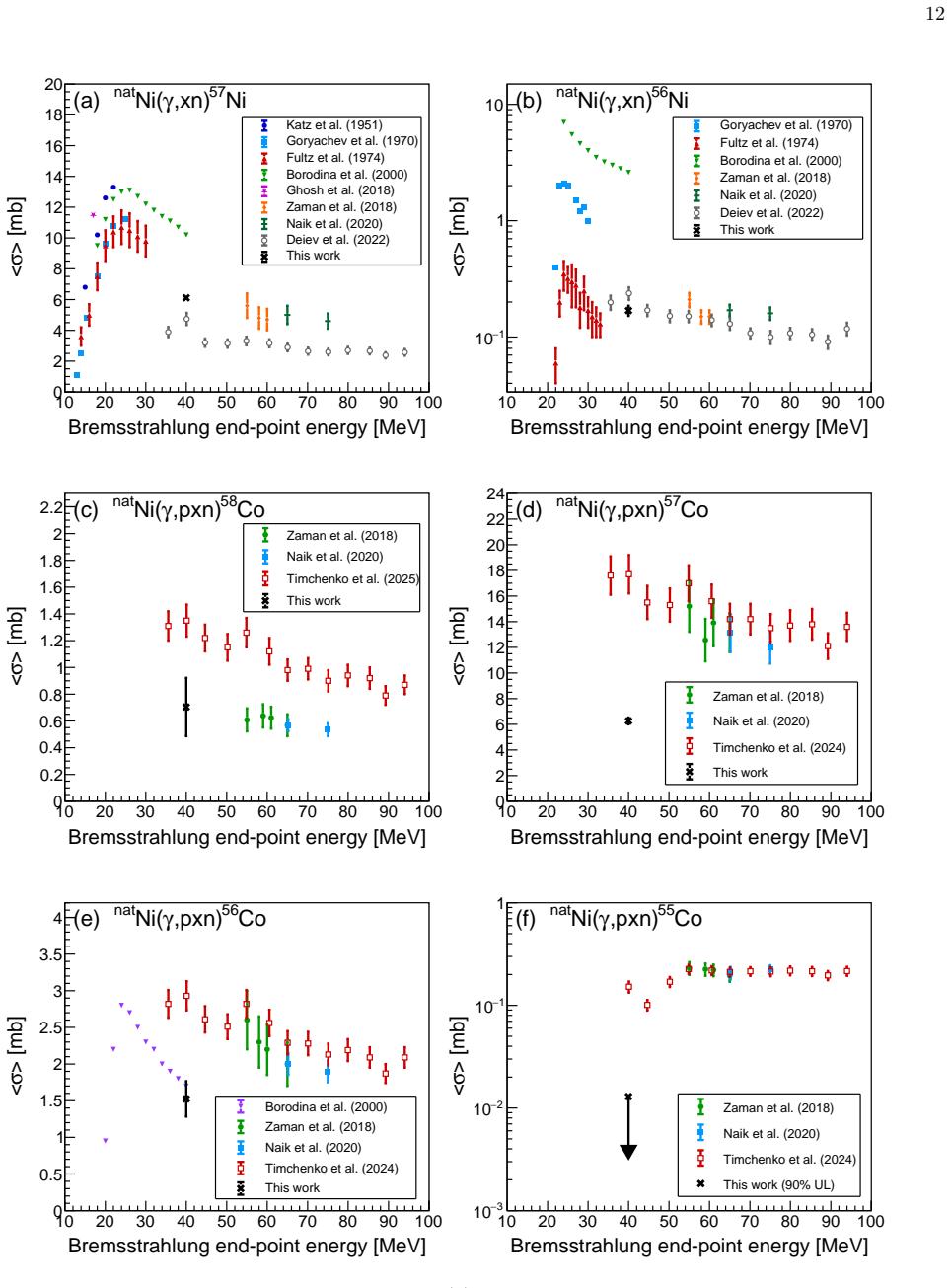
Bremsstrahlung activation measurements on natural nickel targets at 40 MeV endpoint yield a bremsstrahlung-averaged cross section of 9.192 ± 0.386 mb for the 58Ni(γ,p)57Co reaction, which exceeds the JENDL-5 prediction by approximately a factor of two, whereas TALYS-2.2 calculations reproduce the experimental value. Similar measurements for other channels show varying levels of agreement with evaluations, with the (γ,pn) channel also higher than both predictions.
What carries the argument
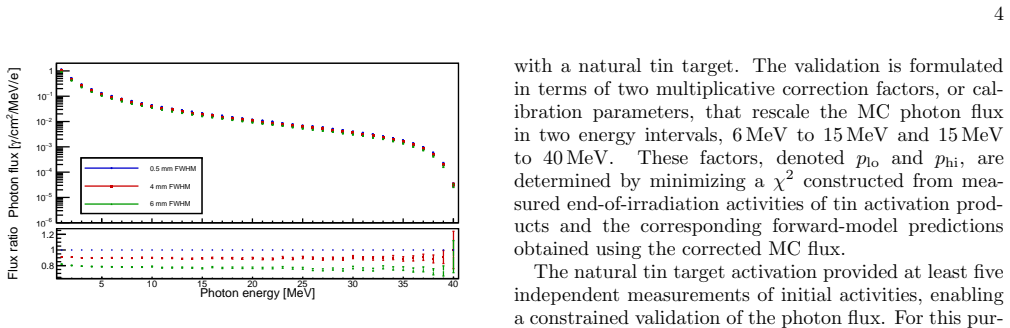
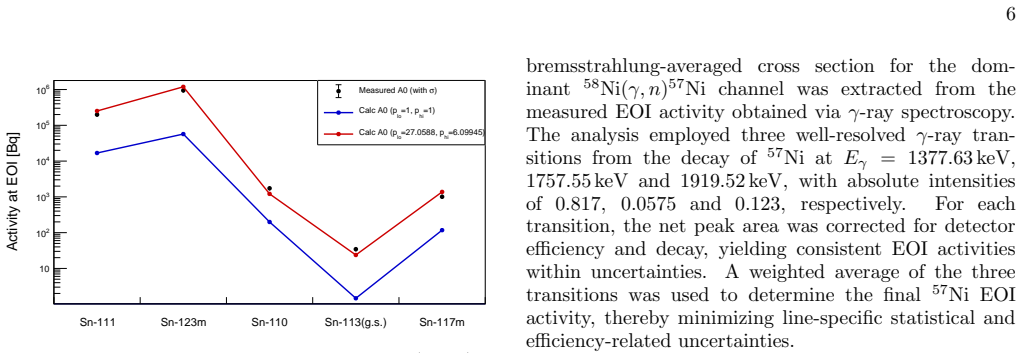
Bremsstrahlung-averaged cross sections extracted from measured end-of-irradiation activities of the product nuclei, using MCNP6.3 modeled spectra validated by tin activation.
If this is right
- JENDL-5 underestimates the strength of the (γ,p) channel under bremsstrahlung conditions for nickel.
- TALYS-2.2 provides a better match to the measured (γ,p) cross section.
- Channel-dependent agreement suggests specific adjustments may be needed for charged-particle emission reactions in evaluations.
- The upper limit on the (γ,p2n) channel constrains high-energy photon reactions on nickel.
Where Pith is reading between the lines
- These measurements could inform updates to nuclear data libraries for photonuclear reactions on medium-mass nuclei.
- Discrepancies might affect predictions for medical isotope production using photon beams on nickel.
- Further measurements on other targets could test if the JENDL-5 underestimation is general for (γ,p) channels.
Load-bearing premise
The MCNP6.3-modeled bremsstrahlung spectrum accurately represents the photon flux on the nickel targets.
What would settle it
An independent measurement of the bremsstrahlung spectrum shape using a different detector or code, or a comparison with monoenergetic photon cross-section data for the same reaction.
Figures
read the original abstract
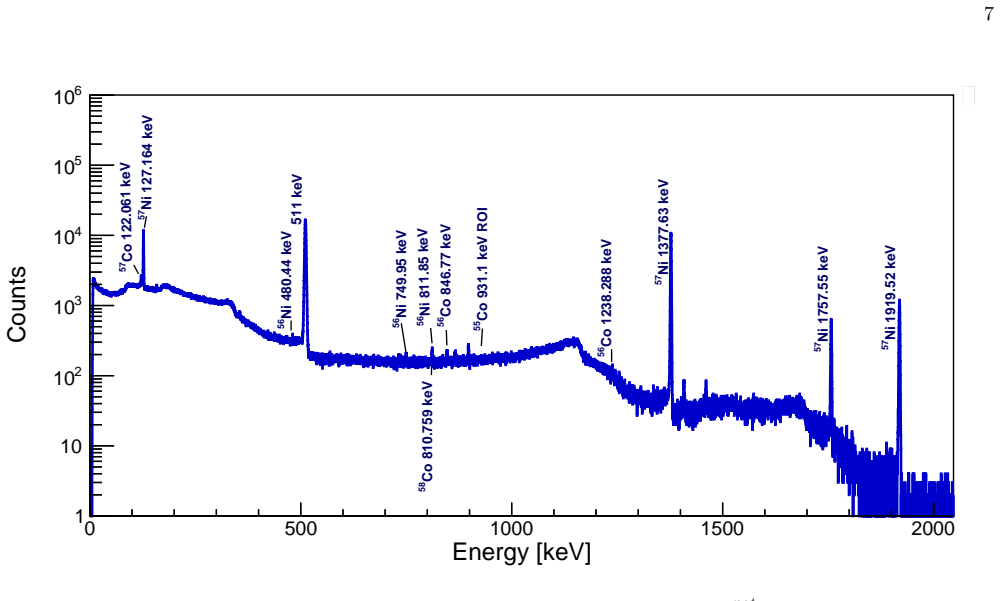
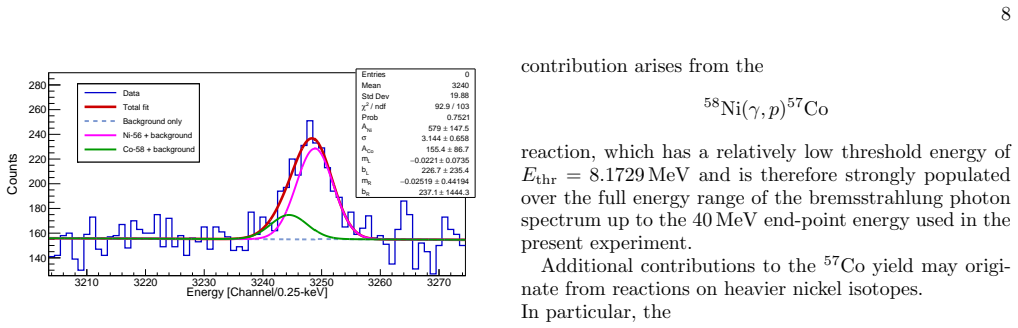
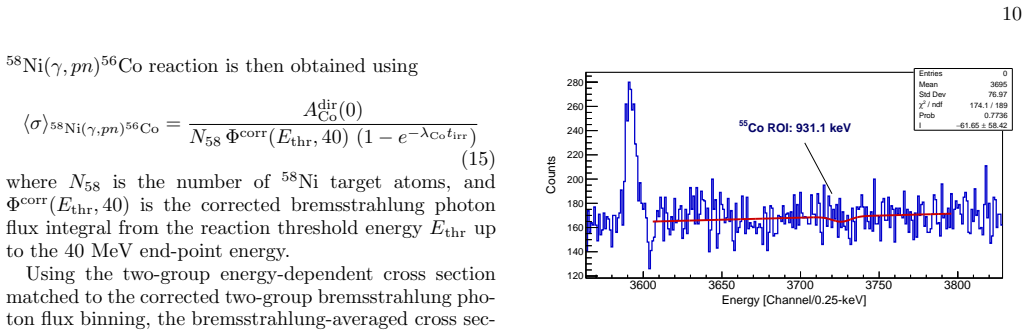
Bremsstrahlung activation measurements were performed to study the production of $^{57}\mathrm{Ni}$, $^{56}\mathrm{Ni}$, $^{58}\mathrm{Co}$, $^{57}\mathrm{Co}$, $^{56}\mathrm{Co}$, and $^{55}\mathrm{Co}$ from natural nickel targets irradiated with photons generated by \SI{40}{MeV} electrons incident on a tantalum converter. Bremsstrahlung spectra were modeled using MCNP6.3\texttrademark{} and experimentally validated through activation of natural tin. Bremsstrahlung-averaged cross sections were extracted from end-of-irradiation activities, yielding $\langle\sigma\rangle = 8.983~\pm~0.028$~mb for $^{58}\mathrm{Ni}(\gamma,n)^{57}\mathrm{Ni}$, $0.248~\pm~0.025$~mb for $^{58}\mathrm{Ni}(\gamma,2n)^{56}\mathrm{Ni}$, $0.704~\pm~0.218$~mb for $^{nat}\mathrm{Ni}(\gamma,pxn)^{58}\mathrm{Co}$, $9.192~\pm~0.386$~mb for $^{58}\mathrm{Ni}(\gamma,p)^{57}\mathrm{Co}$, and $2.239~\pm~0.355$~mb for $^{58}\mathrm{Ni}(\gamma,pn)^{56}\mathrm{Co}$. A $90\%$ confidence-level upper limit of $\langle\sigma\rangle < 0.021$~mb is established for the $^{58}\mathrm{Ni}(\gamma,p2n)^{55}\mathrm{Co}$ channel. Comparison with JENDL-5 evaluations and prior studies indicates channel-dependent agreement, with residual discrepancies observed for selected charged-particle emission reactions. In particular, the measured $^{58}\mathrm{Ni}(\gamma,p)^{57}\mathrm{Co}$ cross section exceeds the JENDL-5 prediction by approximately a factor of two, whereas TALYS-2.2 calculations reproduce the experimental value, suggesting an underestimation of the $(\gamma,p)$ channel strength in JENDL-5 under bremsstrahlung conditions. For the $^{58}\mathrm{Ni}(\gamma,pn)^{56}\mathrm{Co}$ channel, both TALYS-2.2 and JENDL-5 predictions are in reasonable agreement, while the present measurement is higher by approximately a factor of two, though with larger associated uncertainty.
Editorial analysis
A structured set of objections, weighed in public.
Referee Report
Summary. The manuscript reports bremsstrahlung-averaged cross sections extracted from activation measurements on natural nickel targets irradiated at a 40 MeV electron endpoint on a Ta converter. Spectra are obtained from MCNP6.3 modeling and stated to be validated by natural tin activation. Reported values include ⟨σ⟩ = 8.983 ± 0.028 mb for 58Ni(γ,n)57Ni, 9.192 ± 0.386 mb for 58Ni(γ,p)57Co (approximately twice the JENDL-5 value but reproduced by TALYS-2.2), and upper limits or other channels, with comparisons indicating channel-dependent agreement with evaluations.
Significance. If the spectrum modeling and activity-to-cross-section conversion hold, the work supplies new experimental constraints on photonuclear reactions at 40 MeV, particularly highlighting a possible underestimation of the (γ,p) channel strength in JENDL-5 under bremsstrahlung conditions. Such data are relevant for nuclear data libraries used in isotope production and radiation transport applications. The direct extraction from measured end-of-irradiation activities is a standard strength of the approach.
major comments (2)
- [Methods (spectrum validation)] Methods (bremsstrahlung spectrum validation): The claim that MCNP6.3 spectra were 'experimentally validated through activation of natural tin' provides no quantitative metrics (e.g., per-channel agreement ratios, residual spectrum uncertainty, or coverage of the high-energy tail above ~20 MeV). Because the 58Ni(γ,p)57Co threshold and excitation function differ from typical Sn monitor reactions, any mismatch in the modeled flux directly scales the reported ⟨σ⟩ = 9.192 ± 0.386 mb and the factor-of-two discrepancy with JENDL-5.
- [Results and error analysis] Results and error analysis: Full propagation of uncertainties from target characterization, HPGe efficiency, decay data, and activity fitting is not described, leaving the quoted uncertainties (e.g., ±0.386 mb on the (γ,p) channel) difficult to evaluate for robustness against the central claim of discrepancy.
minor comments (1)
- [Abstract] Abstract: The notation ⟨σ⟩ is used without an explicit definition of the averaging procedure (integral of σ(E)Φ(E)dE / integral Φ(E)dE) at first use.
Simulated Author's Rebuttal
We thank the referee for their thorough review and valuable comments on our manuscript. We address each of the major comments below and indicate the revisions we will make to improve the clarity and robustness of the presented results.
read point-by-point responses
-
Referee: Methods (bremsstrahlung spectrum validation): The claim that MCNP6.3 spectra were 'experimentally validated through activation of natural tin' provides no quantitative metrics (e.g., per-channel agreement ratios, residual spectrum uncertainty, or coverage of the high-energy tail above ~20 MeV). Because the 58Ni(γ,p)57Co threshold and excitation function differ from typical Sn monitor reactions, any mismatch in the modeled flux directly scales the reported ⟨σ⟩ = 9.192 ± 0.386 mb and the factor-of-two discrepancy with JENDL-5.
Authors: We agree that additional quantitative information on the spectrum validation would strengthen the manuscript. The tin activation was used to confirm the overall shape of the bremsstrahlung spectrum, but we did not include detailed metrics in the original submission. In the revised manuscript, we will add a new subsection or table detailing the comparison between measured and simulated activities for the tin reactions, including agreement ratios and an estimate of the uncertainty in the high-energy tail. This will allow readers to better assess the impact on the nickel cross sections, particularly the (γ,p) channel. revision: yes
-
Referee: Results and error analysis: Full propagation of uncertainties from target characterization, HPGe efficiency, decay data, and activity fitting is not described, leaving the quoted uncertainties (e.g., ±0.386 mb on the (γ,p) channel) difficult to evaluate for robustness against the central claim of discrepancy.
Authors: The referee correctly identifies that the uncertainty analysis is not fully detailed in the manuscript. The reported uncertainties incorporate contributions from counting statistics, detector efficiency, target mass, and nuclear data, but the propagation method was not explicitly described. We will revise the manuscript to include a comprehensive description of the uncertainty budget and propagation procedure, ensuring the quoted values can be properly evaluated. revision: yes
Circularity Check
No significant circularity; pure experimental extraction from measured activities
full rationale
This paper reports direct experimental measurements of bremsstrahlung-averaged cross sections extracted from end-of-irradiation activities on nickel targets, using an MCNP6.3-modeled spectrum validated via separate tin activation. No equations, fits, or self-citations reduce the reported <sigma> values (e.g., 9.192 ± 0.386 mb for 58Ni(gamma,p)57Co) to inputs by construction. The derivation chain consists of standard activity-to-cross-section conversion with an external Monte Carlo spectrum; comparisons to JENDL-5 and TALYS are post-hoc benchmarks, not load-bearing premises. The paper is self-contained against external data and contains none of the enumerated circularity patterns.
Axiom & Free-Parameter Ledger
axioms (1)
- domain assumption MCNP6.3 simulation correctly reproduces the bremsstrahlung photon spectrum incident on the targets
Reference graph
Works this paper leans on
-
[1]
D. A. Brown, M. B. Chadwick, R. Capote, A. C. Kahler, A. Trkov, M. W. Herman, A. A. Sonzogni, Y. Danon, A. D. Carlson, M. Dunn, D. L. Smith, G. M. Hale, G. Arbanas, R. Arcilla, C. R. Bates, B. Beck, B. Becker, F. Brown, R. J. Casperson, J. Conlin, D. E. Cullen, M.-A. Descalle, R. Firestone, T. Gaines, K. H. Guber, A. I. Hawari, J. Holmes, T. D. Johnson, T...
-
[2]
A. J. Koning, D. Rochman, J.-Ch. Sublet, N. Dzysiuk, M. Fleming, and S. van der Marck. TENDL: complete nuclear data library for innovative nuclear science and technology.Nuclear Data Sheets, 155:1–55, 2019.doi: 14 10.1016/j.nds.2019.01.002
-
[3]
IAEA Photonuclear Data Library 2019 , journal =
T. Kawano, Y. S. Cho, P. Dimitriou, D. Filipescu, N. Iwamoto, V. Plujko, X. Tao, H. Utsunomiya, V. Var- lamov, R. Xu, R. Capote, I. Gheorghe, O. Gorbachenko, Y.L. Jin, T. Renstrøm, M. Sin, K. Stopani, Y. Tian, G. M. Tveten, J. M. Wang, T. Belgya, R. Firestone, S. Goriely, J. Kopecky, M. Krtiˇ cka, R. Schwengner, S. Siem, and M. Wiedeking. Iaea photonuclea...
-
[4]
Osamu Iwamoto, Nobuyuki Iwamoto, Satoshi Kunieda, Futoshi Minato, Shinsuke Nakayama, Yutaka Abe, Kohsuke Tsubakihara, Shin Okumura, Chikako Ishizuka, Tadashi Yoshida, Satoshi Chiba, Naohiko Otuka, Jean- Christophe Sublet, Hiroki Iwamoto, Kazuyoshi Ya- mamoto, Yasunobu Nagaya, Kenichi Tada, Chikara Konno, Norihiro Matsuda, Kenji Yokoyama, Hiroshi Tan- inak...
-
[5]
S. Spellerberg, P. Reimer, G. Blessing, H. H. Coenen, and S. M. Qaim. Production of 55co and 57co via pro- ton induced reactions on highly enriched 58ni.Applied Radiation and Isotopes, 49(12):1519–1522, 1998.doi: 10.1016/S0969-8043(97)10119-1
-
[6]
Hiroshi Miyahara, Atsushi Yoshida, Naoomi Ishikawa, and Chizuo Mori. Simple source preparation and dis- integration rate measurement of 56co and its use for effi- ciency calibration.Applied Radiation and Isotopes, 49(9– 11):1159–1164, 1998.doi:10.1016/S0969-8043(97) 10038-0
-
[7]
Mayeen UUddin Khandaker, Kwangsoo Kim, Manwoo Lee, Kyung Sook Kim, and Guinyun Kim. Excita- tion functions of (p,x) reactions on natural nickel up to 40 mev.Nuclear Instruments and Methods in Physics Research Section B: Beam Interactions with Materials and Atoms, 269:1140–1146, 2011.doi:10.1016/j.nimb. 2011.02.082
-
[8]
O. S. Deiev, I. S. Timchenko, S. N. Olejnik, S. M. Potin, V. A. Kushnir, V. V. Mytrochenko, S. A. Perezhogin, and V. A. Bocharov. Photonuclear reactions natni(γ, xn) 57ni and natni(γ, xn) 56ni in the energy rangee max γ = 35– 94 mev.Nuclear Physics A, 1028:122542, 2022.doi: 10.1016/j.nuclphysa.2022.122542
-
[9]
M. Zaman, G. Kim, H. Naik, K. Kim, M. Shahid, M. Nadeem, S.-G. Shin, and M.-H. Cho. Flux-weighted average cross sections of natni(γ, x) reactions with bremsstrahlung end-point energies of 55, 59, 61, and 65 mev.Nuclear Physics A, 978:173–183, 2018.doi: 10.1016/j.nuclphysa.2018.07.017
-
[10]
H. Naik, G. Kim, T. H. Nguyen, K. Kim, S.- G. Shin, Y. Kye, and M.-H. Cho. Measurement of natni(γ, xn) 56,57ni and natni(γ, pxn) 58−55co reaction cross sections with bremsstrahlung end-point energies of 65 and 75 mev.Journal of Radioanalytical and Nuclear Chemistry, 324:837–846, 2020.doi:10.1007/ s10967-020-07105-9
2020
-
[11]
I. S. Timchenko, O. S. Deiev, S. M. Olejnik, S. M. Potin, V. A. Kushnir, V. V. Mytrochenko, S. A. Perezhogin, and A. Herz´ aˇ n. Cross section of the natni(γ, pxn)58co reaction at the bremsstrahlung end-point energy of 35– 94 mev.The European Physical Journal A, 61:199, 2025. doi:10.1140/epja/s10050-025-01666-7
-
[12]
V. V. Varlamov, B. S. Ishkhanov, V. N. Orlin, and V. A. Chetvertkova. Evaluated cross sec- tions of theσ(γ, nx) andσ(γ,2nx) reactions on 112,114,116,117,118,119,120,122,124sn isotopes.Bulletin of the Russian Academy of Sciences: Physics, 74(6):833–841, 2010.doi:10.3103/S1062873810060225
-
[13]
S. C. Fultz, B. L. Berman, J. T. Caldwell, R. L. Bram- blett, and M. A. Kelly. Photoneutron cross sections for 116,117,118,119,120,124sn and indium.Physical Re- view, 186(4):1255–1270, 1969.doi:10.1103/PhysRev. 186.1255
-
[14]
H. Utsunomiya, S. Goriely, M. Kamata, H. Akimune, T. Kondo, O. Itoh, C. Iwamoto, T. Yamagata, H. Toyokawa, Y.-W. Lui, H. Harada, F. Kitatani, S. Goko, S. Hilaire, and A. J. Koning. Photoneutron cross sections for 118–124sn and theγ-ray strength func- tion method.Physical Review C, 84(5):055805, 2011. doi:10.1103/PhysRevC.84.055805
-
[15]
Kulesza, Terry R
Joel A. Kulesza, Terry R. Adams, Jerawan Chudoung Armstrong, Simon R. Bolding, Forrest B. Brown, Jef- frey S. Bull, Timothy Patrick Burke, Alexander Rich Clark, Robert Arthur III Forster, Jesse Frank Giron, Tristan Sumner Grieve, Colin James Josey, Roger L. Martz, Gregg W. McKinney, Eric John Pearson, Michael Evan Rising, Clell Jeffrey Solomon Jr., Sriram...
-
[16]
URL:https://www.osti.gov/ biblio/1889957,doi:10.2172/1889957
OSTI ID: 1889957. URL:https://www.osti.gov/ biblio/1889957,doi:10.2172/1889957
-
[17]
Attila/Attila4MC: Deterministic transport and mcnp coupling software, version 10.3
Silver Fir Software. Attila/Attila4MC: Deterministic transport and mcnp coupling software, version 10.3. Computer software, 2024. Silver Fir Software
2024
-
[18]
M. J. Berger, J. S. Coursey, M. A. Zucker, and J. Chang. ESTAR, PSTAR, and ASTAR: Computer programs for calculating stopping-power and range tables for elec- trons, protons, and helium ions (version 1.2.3). [Online],
-
[19]
Ac- cessed: 2026-02-16
Available:http://physics.nist.gov/Star. Ac- cessed: 2026-02-16. National Institute of Standards and Technology, Gaithersburg, MD. URL:http://physics. nist.gov/Star
2026
-
[20]
Nusair, D
O. Nusair, D. DeVries, and M. Toro-Gonzalez. Half-life measurements of 110sn, 113sn, 117msn, and 123msn pro- duced via photon activation of natural tin.submitted to Nuclear Physics, Section A, 2026
2026
-
[21]
ROOT — An object oriented data analysis framework
Rene Brun and Fons Rademakers. ROOT – an object- oriented data analysis framework.Nuclear Instruments and Methods in Physics Research Section A, 389:81–86, 1997.doi:10.1016/S0168-9002(97)00048-X
-
[22]
I. S. Timchenko, O. S. Deiev, S. M. Olejnik, S. M. Potin, V. A. Kushnir, V. V. Mytrochenko, S. A. Perezhogin, and A. Herz´ aˇ n. Photoproduction of the 55–57co nu- clei on natni at the bremsstrahlung end-point energy of 35–94 mev.Atomic Data and Nuclear Data Tables, 160:101674, 2024.doi:10.1016/j.adt.2024.101674
-
[23]
H. Bethe and W. Heitler. On the stopping of fast particles and on the creation of positive electrons.Proceedings of the Royal Society of London. Series A, 146(856):83–112, 1934.doi:10.1098/rspa.1934.0140
-
[24]
L. Katz and A. G. W. Cameron. The solution of x- ray activation curves for photonuclear cross sections. 15 Canadian Journal of Physics, 29:518–528, 1951.doi: 10.1139/p51-056
-
[25]
B. I. Goryachev, B. S. Ishkhanov, I. M. Kapitonov, I. M. Piskarev, V. G. Shevchenko, and O. A. Shevchenko.So- viet Journal of Nuclear Physics, 11:141, 1970
1970
-
[26]
S. C. Fultz, R. A. Alvarez, B. L. Berman, and P. Meyer. Photonuclear reactions in nickel.Physical Review C, 10:608–615, 1974.doi:10.1103/PhysRevC.10.608
-
[27]
S. S. Borodina, A. V. Varlamov, V. V. Varlamov, B. S. Ishkhanov, V. I. Mokeev, and S. I. Pavlov. 54,56fe and 58,60ni (γ, n), (γ, p), (γ, np), and (γ,2n) reaction cross sections evaluation using the model of the gdr state de- cay channel competition phenomenological description. Technical Report MSU-INP-2000-6/610, Skobeltsyn In- stitute of Nuclear Physics...
2000
-
[28]
Patil, Yeshwant Naik, Saraswatula Venkata Suryanarayana, Betylda Jyrwa, and Srinivasan Gane- san
Reetuparna Ghosh, Bioletty Lawriniang, Sylvia Badwar, Santhi Sheela Yerraguntla, Haladhara Naik, Bhushanku- mar J. Patil, Yeshwant Naik, Saraswatula Venkata Suryanarayana, Betylda Jyrwa, and Srinivasan Gane- san. Measurement and uncertainty propagation of the (γ, n) reaction cross-section of 58ni and 59co at 15 mev bremsstrahlung.Radiochimica Acta, 106(5)...
discussion (0)
Sign in with ORCID, Apple, or X to comment. Anyone can read and Pith papers without signing in.