Null limit of large-charge correlators in planar mathcal{N}=4 Super-Yang-Mills theory
Pith reviewed 2026-06-26 06:48 UTC · model grok-4.3
The pith
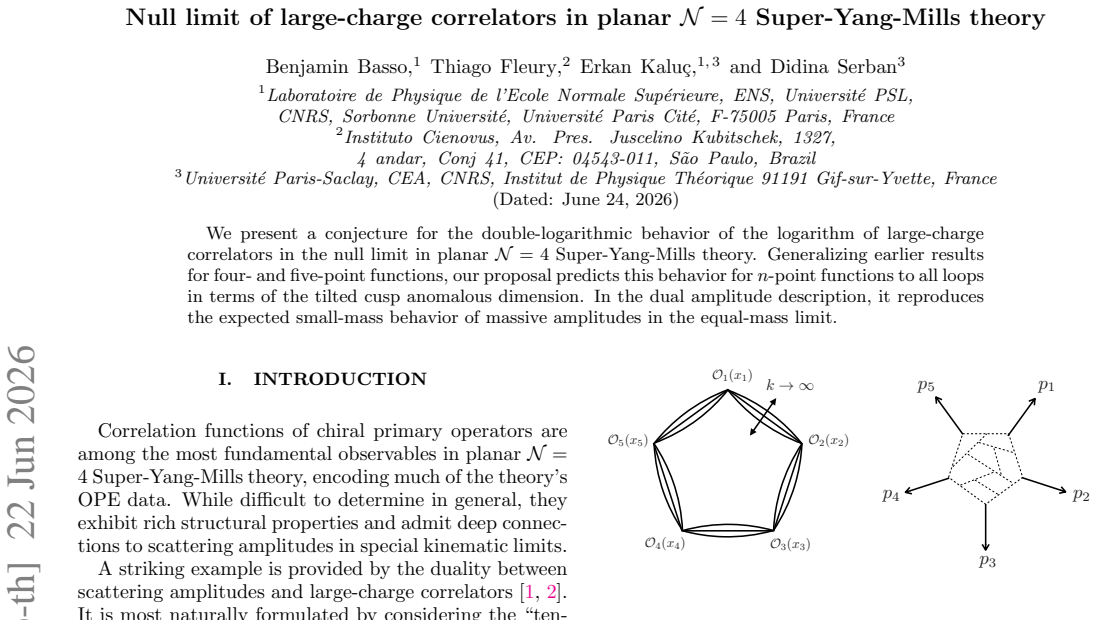
The double-logarithmic behavior of the log of large-charge n-point correlators in the null limit is given by the tilted cusp anomalous dimension at all loops.
A machine-rendered reading of the paper's core claim, the machinery that carries it, and where it could break.
Core claim
The authors conjecture that the double-logarithmic behavior of the logarithm of n-point large-charge correlators in the null limit is controlled by the tilted cusp anomalous dimension to all loop orders, extending the pattern found for four- and five-point functions and reproducing the expected small-mass limit of massive amplitudes in the equal-mass case.
What carries the argument
The tilted cusp anomalous dimension, which supplies the coefficient of the double logarithm in the null-limit expansion.
If this is right
- The double-logarithmic form holds for all n greater than or equal to six.
- No additional loop-order corrections appear beyond those already captured by the tilted cusp anomalous dimension.
- The same expression governs the small-mass limit of equal-mass massive amplitudes in the dual channel.
Where Pith is reading between the lines
- Higher-point null-limit correlators could be resummed using only known cusp data if the pattern persists.
- The conjecture points to a possible common organizing principle for both correlator and amplitude limits that has not yet been derived from first principles.
- A mismatch at six points would require either new terms in the conjecture or a breakdown of the equal-mass duality mapping.
Load-bearing premise
The pattern seen in four- and five-point functions continues without modification or extra terms for arbitrary n-point functions at every loop order.
What would settle it
An explicit two-loop computation of the six-point large-charge correlator in the null limit whose logarithm deviates from the double-log form predicted by the tilted cusp anomalous dimension.
Figures
read the original abstract
We present a conjecture for the double-logarithmic behavior of the logarithm of large-charge correlators in the null limit in planar $\mathcal{N} = 4$ Super-Yang-Mills theory. Generalizing earlier results for four- and five-point functions, our proposal predicts this behavior for $n$-point functions to all loops in terms of the tilted cusp anomalous dimension. In the dual amplitude description, it reproduces the expected small-mass behavior of massive amplitudes in the equal-mass limit.
Editorial analysis
A structured set of objections, weighed in public.
Referee Report
Summary. The manuscript presents a conjecture for the double-logarithmic term appearing in the logarithm of large-charge n-point correlators in the null limit of planar N=4 SYM. Generalizing explicit four- and five-point results, the proposal expresses this term for arbitrary n at all loop orders in terms of the tilted cusp anomalous dimension; the same functional form is shown to reproduce the expected small-mass limit of the dual massive amplitudes in the equal-mass case.
Significance. If the conjecture is correct, it supplies an all-loop prediction for the leading null-limit behavior of higher-point correlators directly in terms of a known integrability datum. This would tighten the connection between large-charge correlators and cusp anomalous dimensions and furnish a concrete target for future integrability or bootstrap analyses.
major comments (1)
- [Abstract and conjecture section] Abstract (final sentence) and the statement of the conjecture (presumably the section following the 4- and 5-point reviews): the claim that the double-logarithmic coefficient and its n-dependence remain unmodified for arbitrary n rests solely on the pattern observed for n=4,5. No derivation from integrability data, OPE coefficients, or higher-n checks is supplied, so the extrapolation itself is the unsupported step for the general-n assertion.
minor comments (1)
- [Conjecture statement] The tilted cusp anomalous dimension should be recalled or referenced with an equation number at the point where the conjecture is written, to make the all-loop expression self-contained.
Simulated Author's Rebuttal
We thank the referee for their report and for highlighting the conjectural nature of the general-n claim. We address the single major comment below.
read point-by-point responses
-
Referee: [Abstract and conjecture section] Abstract (final sentence) and the statement of the conjecture (presumably the section following the 4- and 5-point reviews): the claim that the double-logarithmic coefficient and its n-dependence remain unmodified for arbitrary n rests solely on the pattern observed for n=4,5. No derivation from integrability data, OPE coefficients, or higher-n checks is supplied, so the extrapolation itself is the unsupported step for the general-n assertion.
Authors: We agree that the general-n statement is a conjecture extrapolated from the explicit four- and five-point results. The manuscript already frames the proposal explicitly as a conjecture (both in the title and abstract) rather than a derived result. The supporting evidence consists of (i) the matching functional form observed for n=4 and n=5 and (ii) the fact that the same expression reproduces the expected small-mass limit of the dual equal-mass massive amplitudes. No first-principles derivation from integrability data or OPE data is provided, precisely because the work is intended to formulate a concrete all-loop prediction that can be tested by future integrability or bootstrap methods. We therefore do not view the extrapolation as an unsupported claim but as the content of the conjecture itself. revision: no
Circularity Check
Conjecture extrapolates 4-/5-point pattern to n-point functions without self-referential reduction
full rationale
The manuscript explicitly frames its central result as a conjecture obtained by generalizing explicit computations for four- and five-point functions. The double-logarithmic term is expressed in terms of the tilted cusp anomalous dimension, a quantity defined and computed in independent prior literature. No equation in the provided abstract or description reduces the proposed functional form to a fitted parameter, a self-definition, or a load-bearing self-citation chain; the extrapolation step is stated as an assumption rather than derived from the inputs by construction. The derivation chain therefore remains self-contained against external benchmarks.
Axiom & Free-Parameter Ledger
axioms (1)
- domain assumption The double-logarithmic null-limit behavior observed for four- and five-point large-charge correlators extends unchanged to n-point functions at all loop orders
Reference graph
Works this paper leans on
-
[1]
S. Caron-Huot and F. Coronado, JHEP03, 151 (2022), arXiv:2106.03892 [hep-th]
arXiv 2022
-
[2]
T. Bargheer, A. Bekov, C. Bercini, and F. Coronado, (2025), arXiv:2512.19780 [hep-th]
Pith/arXiv arXiv 2025
-
[3]
L. F. Alday, B. Eden, G. P. Korchemsky, J. Maldacena, and E. Sokatchev, JHEP09, 123 (2011), arXiv:1007.3243 [hep-th]
Pith/arXiv arXiv 2011
-
[4]
L. F. Alday and J. M. Maldacena, JHEP06, 064 (2007), arXiv:0705.0303 [hep-th]. 10
Pith/arXiv arXiv 2007
-
[5]
J. M. Drummond, G. P. Korchemsky, and E. Sokatchev, Nucl. Phys. B795, 385 (2008), arXiv:0707.0243 [hep-th]
Pith/arXiv arXiv 2008
-
[6]
A. Brandhuber, P. Heslop, and G. Travaglini, Nucl. Phys. B794, 231 (2008), arXiv:0707.1153 [hep-th]
Pith/arXiv arXiv 2008
-
[7]
J. M. Drummond, J. Henn, G. P. Korchemsky, and E. Sokatchev, Nucl. Phys. B826, 337 (2010), arXiv:0712.1223 [hep-th]
Pith/arXiv arXiv 2010
-
[8]
Z. Bern, L. J. Dixon, and V. A. Smirnov, Phys. Rev. D72, 085001 (2005), arXiv:hep-th/0505205
Pith/arXiv arXiv 2005
-
[9]
L. F. Alday, J. M. Henn, J. Plefka, and T. Schuster, JHEP01, 077 (2010), arXiv:0908.0684 [hep-th]
Pith/arXiv arXiv 2010
-
[10]
J. M. Henn, S. Moch, and S. G. Naculich, JHEP12, 024 (2011), arXiv:1109.5057 [hep-th]
Pith/arXiv arXiv 2011
-
[11]
L. F. Alday, E. Armanini, A. V. Belitsky, K. H¨ aring, and A. Zhiboedov, (2026), arXiv:2605.16034 [hep-th]
Pith/arXiv arXiv 2026
-
[12]
F. Coronado, Phys. Rev. Lett.124, 171601 (2020), arXiv:1811.03282 [hep-th]
arXiv 2020
-
[13]
I. Kostov, V. B. Petkova, and D. Serban, Phys. Rev. Lett.122, 231601 (2019), arXiv:1903.05038 [hep-th]
Pith/arXiv arXiv 2019
-
[14]
A. V. Belitsky and G. P. Korchemsky, JHEP07, 219 (2020), arXiv:2003.01121 [hep-th]
arXiv 2020
-
[15]
A. V. Belitsky and G. P. Korchemsky, JHEP05, 070 (2020), arXiv:1907.13131 [hep-th]
arXiv 2020
-
[16]
N. Drukker and J. Plefka, JHEP04, 001 (2009), arXiv:0812.3341 [hep-th]
Pith/arXiv arXiv 2009
-
[17]
T. Bargheer, J. Caetano, T. Fleury, S. Komatsu, and P. Vieira, JHEP11, 095 (2018), arXiv:1809.09145 [hep-th]
Pith/arXiv arXiv 2018
-
[18]
L. V. Bork, N. B. Muzhichkov, and E. S. Sozinov, JHEP08, 173 (2022), arXiv:2201.08762 [hep-th]
arXiv 2022
-
[19]
C. Bercini, B. Fernandes, and V. Gon¸ calves, JHEP10, 242 (2024), arXiv:2401.06099 [hep-th]
arXiv 2024
-
[20]
A. V. Belitsky, L. V. Bork, R. N. Lee, A. I. Onishchenko, and V. A. Smirnov, (2025), arXiv:2510.16471 [hep-th]
arXiv 2025
-
[21]
A. V. Belitsky, L. V. Bork, R. N. Lee, and V. A. Smirnov, (2026), arXiv:2605.17056 [hep-th]
Pith/arXiv arXiv 2026
-
[22]
A. V. Belitsky, L. V. Bork, R. N. Lee, A. I. Onishchenko, and V. A. Smirnov, (2026), arXiv:2605.17057 [hep-th]
Pith/arXiv arXiv 2026
- [23]
- [24]
-
[25]
N. Beisert, B. Eden, and M. Staudacher, J. Stat. Mech.0701, P01021 (2007), arXiv:hep-th/0610251
Pith/arXiv arXiv 2007
-
[26]
L. F. Alday, D. Gaiotto, and J. Maldacena, JHEP09, 032 (2011), arXiv:0911.4708 [hep-th]
Pith/arXiv arXiv 2011
-
[27]
G. P. Korchemsky, Phys. Lett. B220, 629 (1989)
1989
-
[28]
A. V. Belitsky, L. V. Bork, A. F. Pikelner, and V. A. Smirnov, Phys. Rev. Lett.130, 091605 (2023), arXiv:2209.09263 [hep-th]
arXiv 2023
- [29]
-
[30]
T. Bargheer, A. Bekov, C. Bercini, and F. Coronado, (2025), arXiv:2509.14332 [hep-th]
Pith/arXiv arXiv 2025
-
[31]
C.-K. Kuo and Q. Yang, Phys. Rev. D113, 105022 (2026), arXiv:2512.21947 [hep-th]
Pith/arXiv arXiv 2026
-
[32]
Basso, T
B. Basso, T. Fleury, E. Kalu¸ c, and D. Serban, (2026), in preparation
2026
-
[33]
L. F. Alday and A. Bissi, JHEP10, 202 (2013), arXiv:1305.4604 [hep-th]
Pith/arXiv arXiv 2013
-
[34]
C. Bercini, V. Gon¸ calves, and P. Vieira, Phys. Rev. Lett.126, 121603 (2021), arXiv:2008.10407 [hep-th]
arXiv 2021
-
[35]
H. Chen, P. F. Monni, Z. Pang, G. Vita, and H. X. Zhu, (2025), arXiv:2510.07377 [hep-th]
arXiv 2025
-
[36]
S. Caron-Huot, L. J. Dixon, A. McLeod, and M. von Hippel, Phys. Rev. Lett.117, 241601 (2016), arXiv:1609.00669 [hep-th]
Pith/arXiv arXiv 2016
-
[37]
A. V. Belitsky, (2025), arXiv:2511.20828 [hep-th]
arXiv 2025
-
[38]
J. M. Drummond, J. Henn, G. P. Korchemsky, and E. Sokatchev, Phys. Lett. B662, 456 (2008), arXiv:0712.4138 [hep-th]
Pith/arXiv arXiv 2008
-
[39]
Z. Bern, L. J. Dixon, D. A. Kosower, R. Roiban, M. Spradlin, C. Vergu, and A. Volovich, Phys. Rev. D78, 045007 (2008), arXiv:0803.1465 [hep-th]
Pith/arXiv arXiv 2008
-
[40]
J. M. Drummond, J. Henn, G. P. Korchemsky, and E. Sokatchev, Nucl. Phys. B815, 142 (2009), arXiv:0803.1466 [hep-th]
Pith/arXiv arXiv 2009
-
[41]
A. B. Goncharov, M. Spradlin, C. Vergu, and A. Volovich, Phys. Rev. Lett.105, 151605 (2010), arXiv:1006.5703 [hep-th]
Pith/arXiv arXiv 2010
-
[42]
L. F. Alday, E. Armanini, K. H¨ aring, and A. Zhiboedov, (2025), arXiv:2510.19909 [hep-th]
arXiv 2025
- [43]
-
[44]
E. Olivucci and P. Vieira, Phys. Rev. Lett.129, 221601 (2022), arXiv:2205.04476 [hep-th]
arXiv 2022
-
[45]
T. Fleury and S. Komatsu, JHEP02, 177 (2018), arXiv:1711.05327 [hep-th]
Pith/arXiv arXiv 2018
-
[46]
L. Freyhult and S. Zieme, Phys. Rev. D79, 105009 (2009), arXiv:0901.2749 [hep-th]
Pith/arXiv arXiv 2009
-
[47]
D. Fioravanti, P. Grinza, and M. Rossi, Phys. Lett. B675, 137 (2009), arXiv:0901.3161 [hep-th]
Pith/arXiv arXiv 2009
discussion (0)
Sign in with ORCID, Apple, or X to comment. Anyone can read and Pith papers without signing in.