The MASSIVE SURVEY XXI: Local Variations in the Stellar Initial Mass Function of MASSIVE Early-Type Galaxies
Pith reviewed 2026-06-26 00:16 UTC · model grok-4.3
The pith
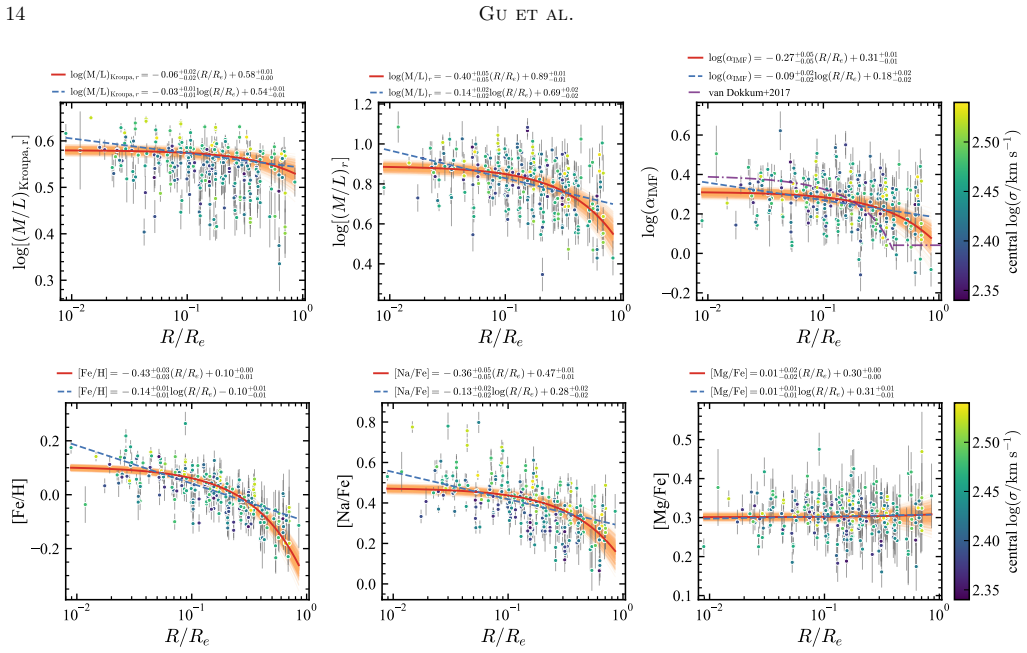
In massive early-type galaxies the radial change in mass-to-light ratio is driven mainly by changes in the initial mass function rather than by changes in stellar populations.
A machine-rendered reading of the paper's core claim, the machinery that carries it, and where it could break.
Core claim
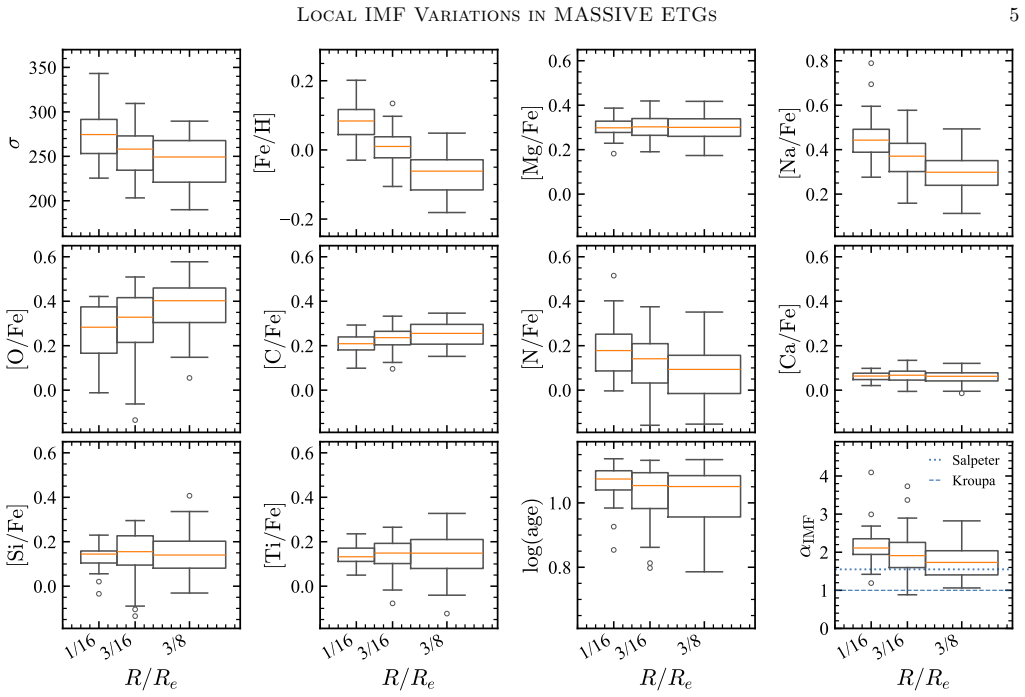
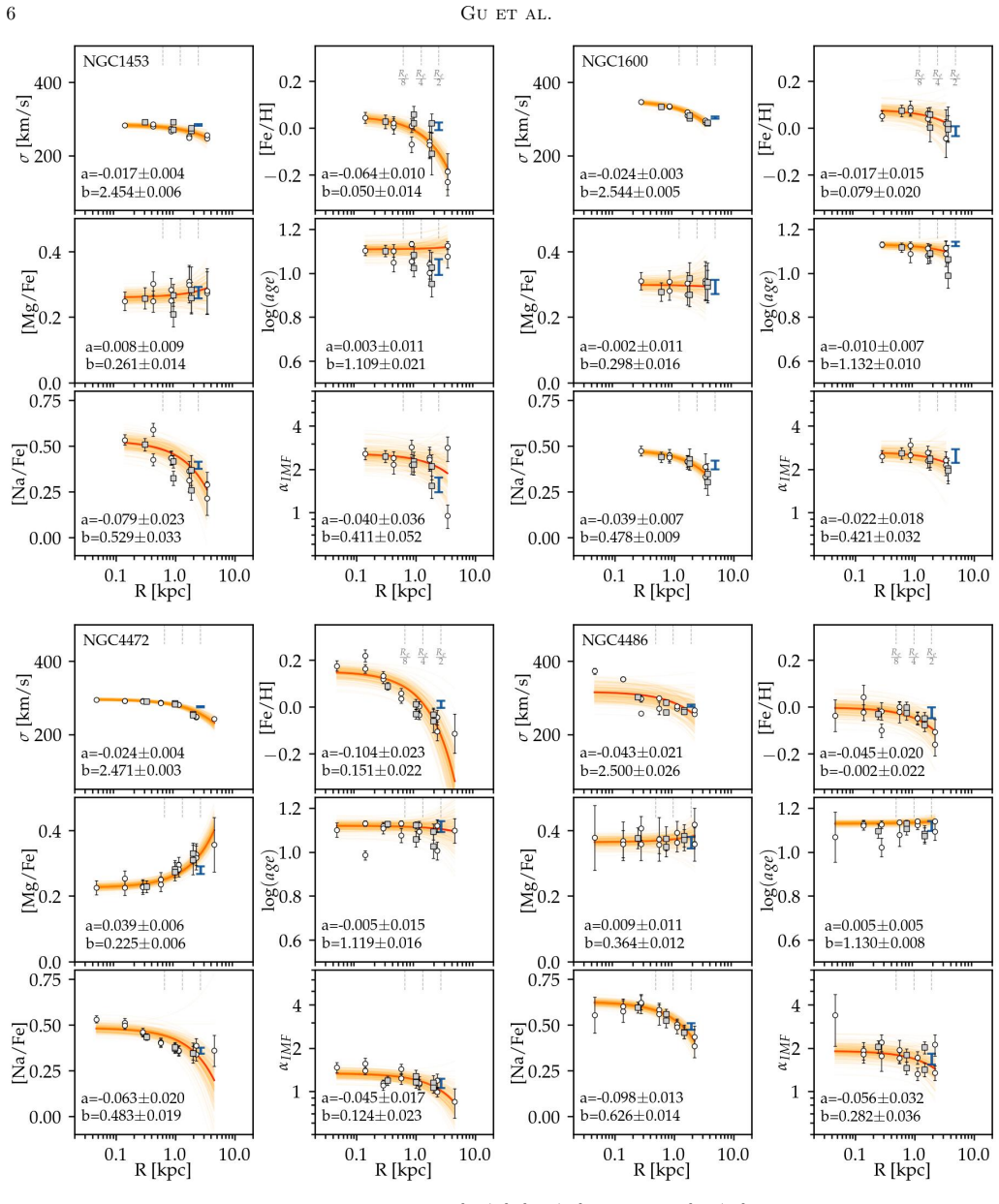
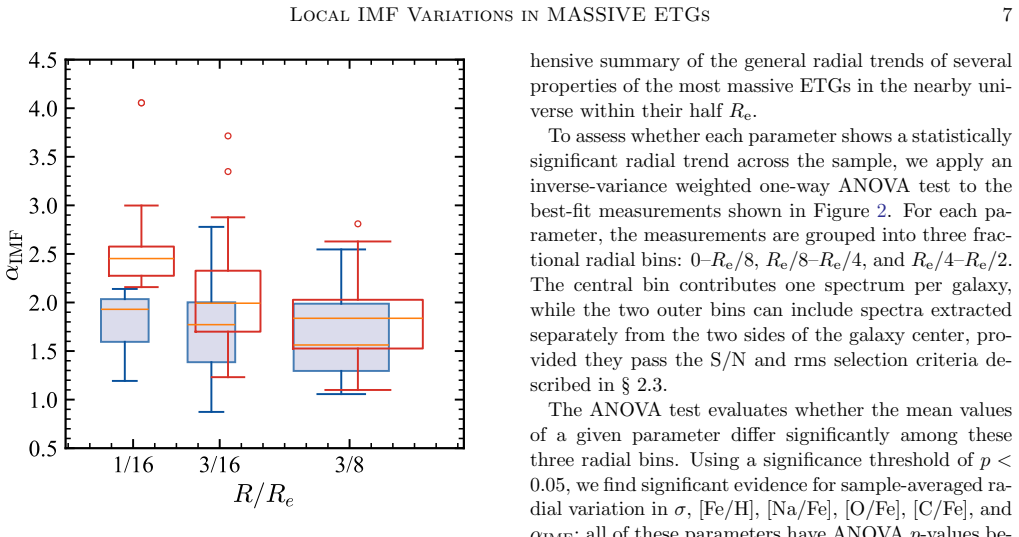
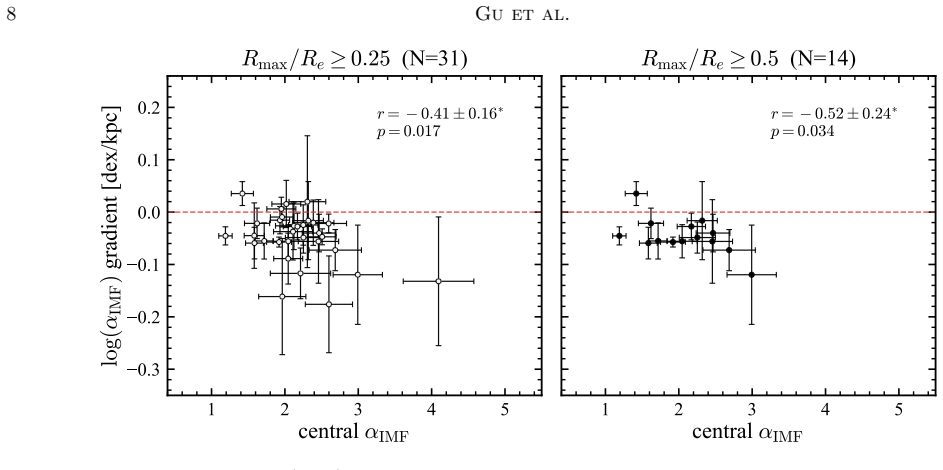
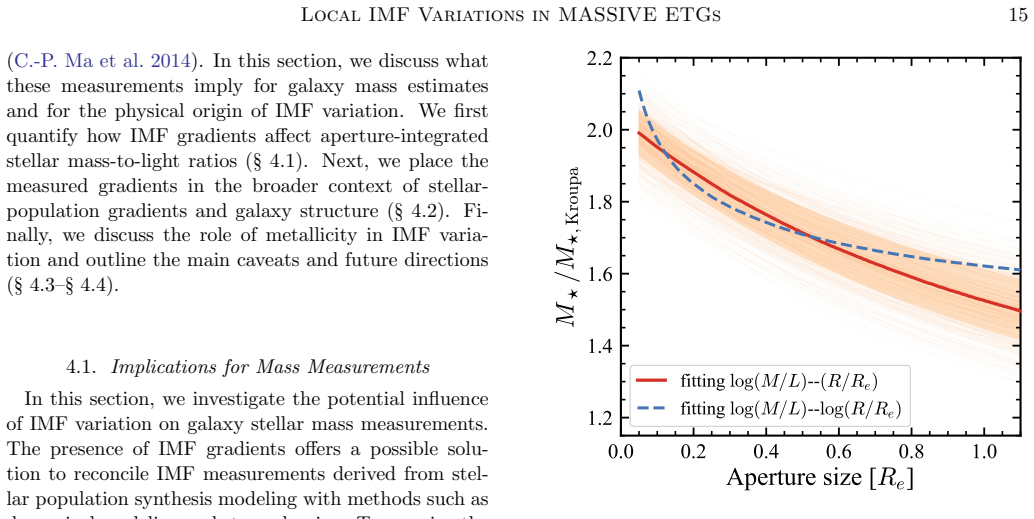
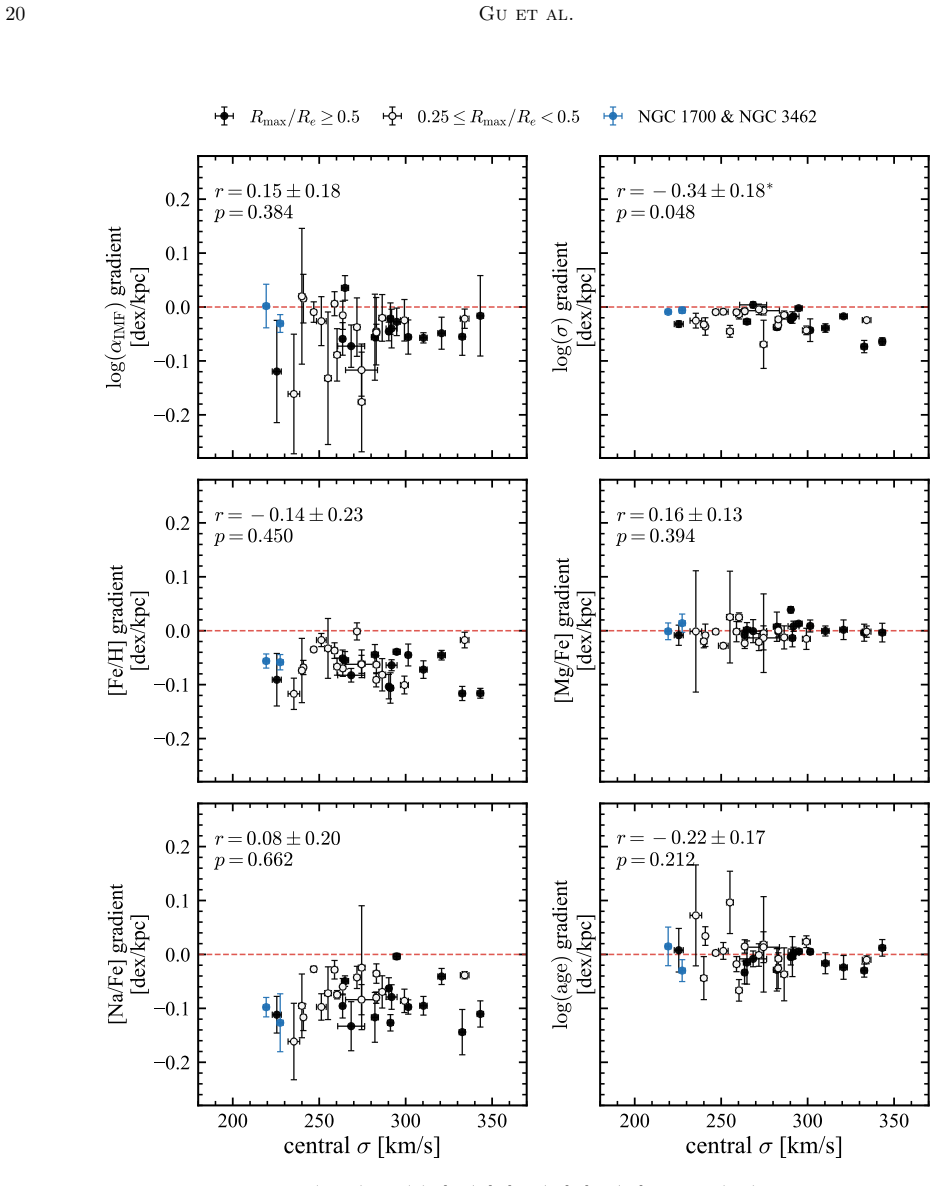
The sample-averaged IMF mismatch parameter α_IMF decreases from 2.16 within Re/8 to 1.74 in the Re/4-Re/2 bin, remaining more bottom-heavy than Kroupa and approximately Salpeter-like over these radii. Radial gradients of log(α_IMF) anti-correlate with the central value of α_IMF. The radial variation in stellar M/L_r is dominated by the IMF gradient rather than by the stellar-population gradient, so that a fixed Kroupa IMF underestimates stellar masses by factors of 1.7 and 1.5 within Re/2 and Re.
What carries the argument
The IMF mismatch parameter α_IMF, defined as the ratio of the observed stellar mass-to-light ratio to the value expected for a Kroupa IMF, which isolates the contribution of low-mass stars.
If this is right
- Galaxies with more bottom-heavy central IMFs exhibit steeper radial declines toward less bottom-heavy, Salpeter-like values.
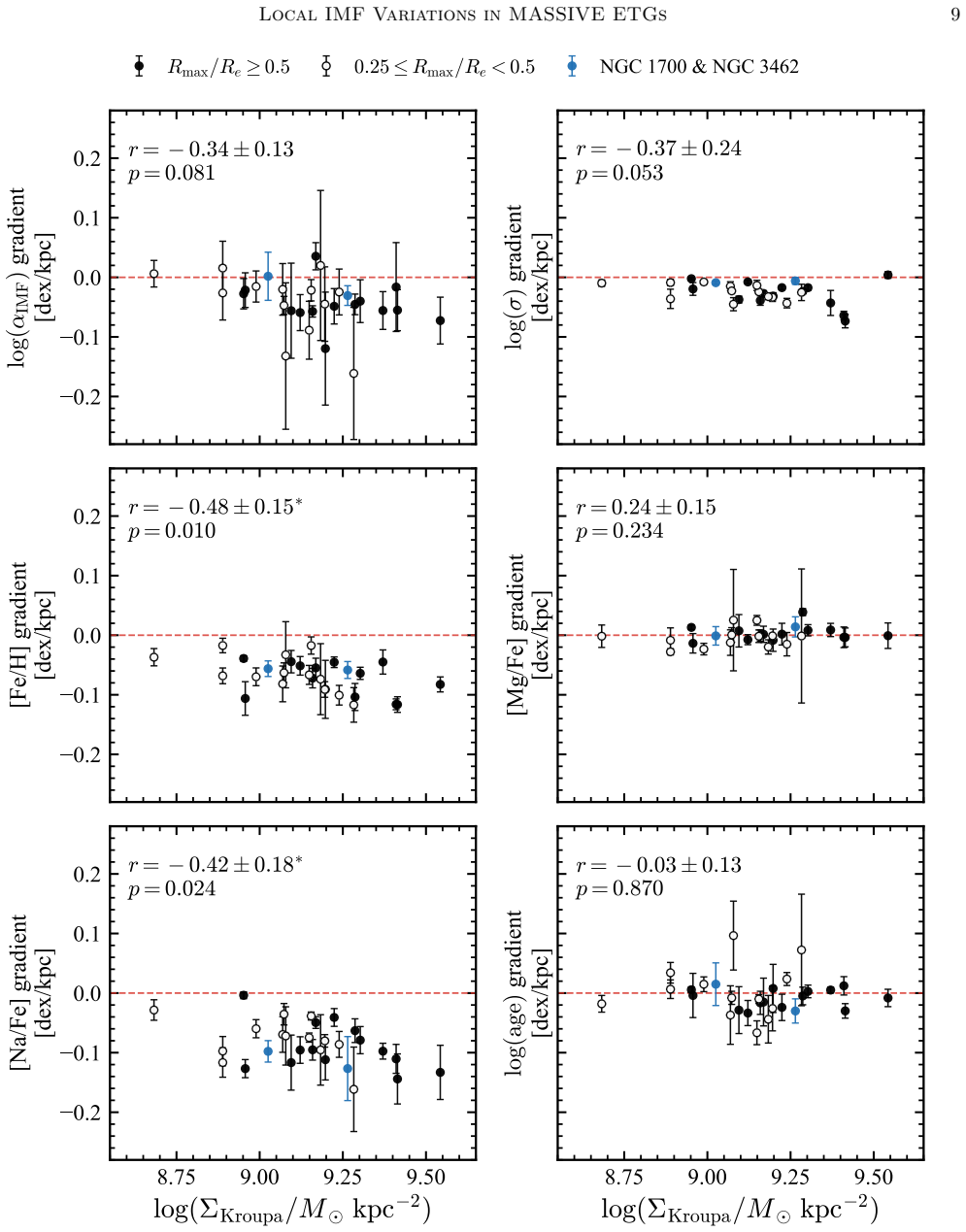
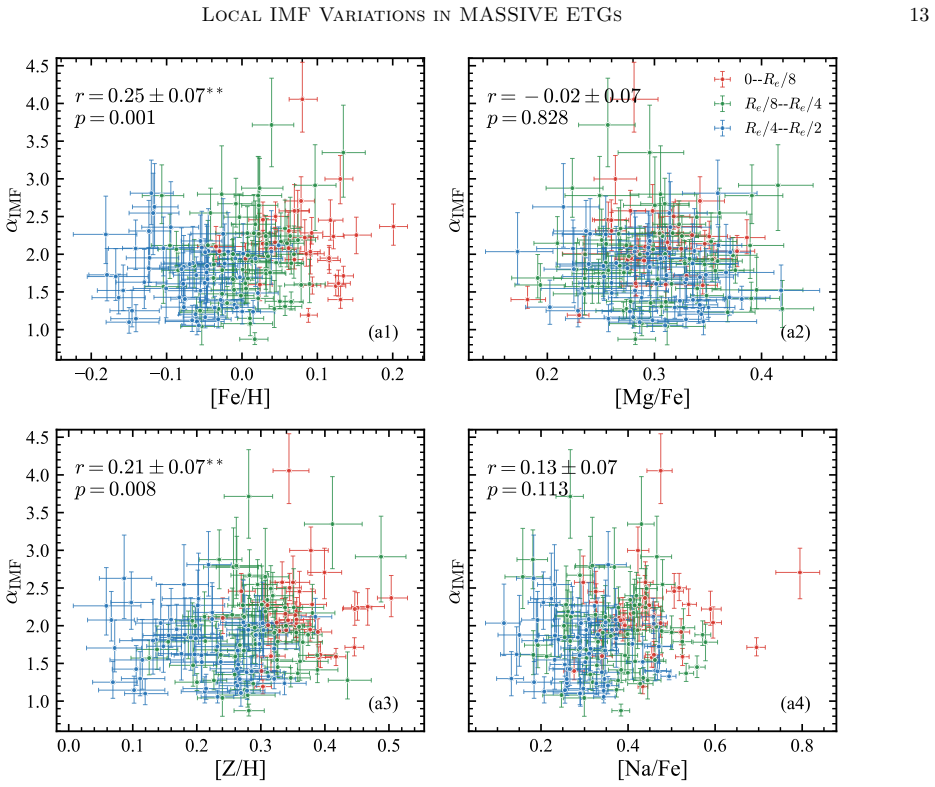
- IMF variation correlates mildly with local stellar metallicity but shows no significant local correlation with [Mg/Fe] or [Na/Fe].
- Stellar masses within Re/2 and Re are underestimated by factors of 1.7 and 1.5 when a fixed Kroupa IMF is assumed.
- The approximately flat profiles of several [α/Fe] elements indicate that IMF changes track metallicity more closely than star-formation timescale.
Where Pith is reading between the lines
- Models of massive galaxy assembly must allow the IMF to vary with local density or metallicity to match observed stellar masses.
- The anti-correlation between central α_IMF and its gradient suggests a regulatory process that sets a common outer IMF value across galaxies.
- Extending the same analysis to lower-mass or later-type galaxies could test whether the IMF-metallicity link is universal.
Load-bearing premise
The spectral fitting procedure in the 0.4-1.01 μm range accurately isolates the low-mass IMF contribution from degeneracies with age, metallicity, and abundance ratios across all radial bins.
What would settle it
A direct measurement in which the radial stellar mass-to-light gradient matches the one predicted from the stellar-population gradient alone, with no additional contribution from an IMF gradient, would falsify the dominance claim.
Figures
read the original abstract
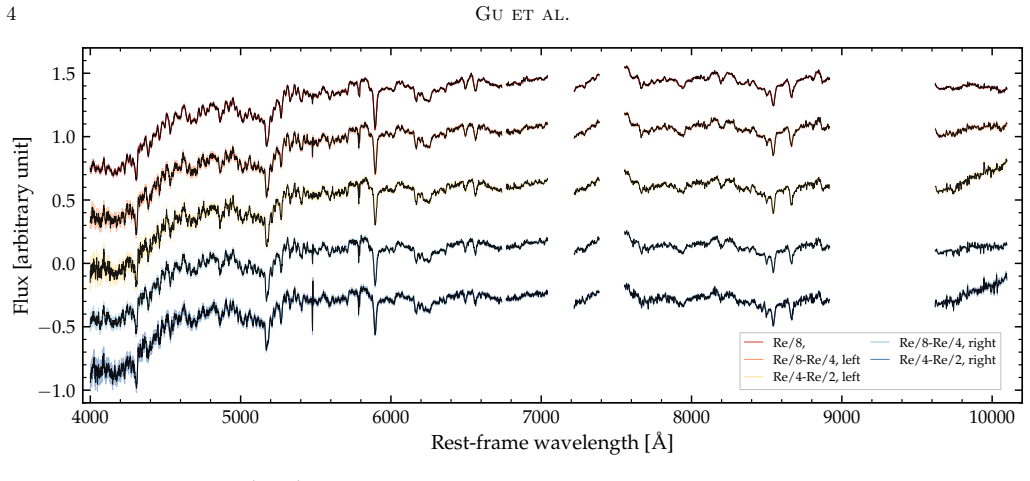
Extensive evidence suggests that the stellar initial mass function (IMF) varies among early-type galaxies (ETGs), but spatially resolved studies within individual galaxies are limited in sample size. We investigate radial variations in the low-mass ($\leq1M_{\odot}$) IMF and its connection to stellar populations in 37 nearby massive ETGs from the MASSIVE survey. Using high-quality Magellan/LDSS-3 long-slit spectroscopy spanning $0.4\mu$m$-1.01\mu$m, we extract spectra in radial bins reaching outermost radii of 0.2-1.1Re across the sample. We find that the IMF becomes less bottom-heavy with increasing radius in most galaxies. The sample-averaged IMF mismatch parameter, $\alpha_{\rm IMF}=(M/L)/(M/L)_{\rm Kroupa}$, decreases from 2.16 within Re/8 to 1.74 in the Re/4-Re/2 bin, with galaxy-to-galaxy scatters of 0.50 and 0.42, respectively. Thus, the average IMF remains more bottom-heavy than Kroupa and approximately Salpeter-like or more bottom-heavy over these radii. The radial gradients of $\log(\alpha_{\rm IMF})$ anti-correlate with the central value of $\alpha_{\rm IMF}$, indicating that galaxies with more bottom-heavy central IMFs decline more steeply toward less bottom-heavy, approximately Salpeter-like values at larger radii. We find mild positive local correlations between $\alpha_{\rm IMF}$ and stellar metallicity, but no significant local correlation with [Mg/Fe] or [Na/Fe]. Together with the approximately flat profiles of several [$\alpha$/Fe], this suggests that IMF variation in massive ETGs is more closely linked to metallicity than to the star-formation timescale traced by [$\alpha$/Fe]. Finally, the radial variation in stellar $M/L_r$ is dominated by the IMF gradient rather than by the stellar-population gradient. A fixed Kroupa IMF underestimates stellar masses by factors of 1.7 and 1.5 within Re/2 and Re in massive ETGs.
Editorial analysis
A structured set of objections, weighed in public.
Referee Report
Summary. The paper analyzes radial variations in the low-mass IMF for 37 massive ETGs from the MASSIVE survey using Magellan/LDSS-3 long-slit spectra (0.4-1.01 μm). It reports that the sample-averaged IMF mismatch parameter α_IMF decreases from 2.16 within Re/8 to 1.74 in the Re/4-Re/2 bin, with gradients anti-correlating with central α_IMF values; mild positive local correlations exist between α_IMF and metallicity but not with [Mg/Fe] or [Na/Fe]; and radial M/L_r variations are dominated by the IMF gradient rather than stellar-population gradients, implying fixed Kroupa IMF underestimates masses by factors of 1.7 (within Re/2) and 1.5 (within Re).
Significance. If the spectral decomposition holds, the large sample and radial coverage would provide valuable constraints on spatially resolved IMF variations in ETGs and their connection to metallicity rather than [α/Fe]-traced star-formation timescales. The anti-correlation of gradients with central α_IMF and the mass-underestimate quantification are potentially impactful for dynamical modeling of ETGs.
major comments (1)
- [Abstract / spectral analysis description] The claim that radial M/L_r variation is dominated by the IMF gradient (Abstract) requires that the LDSS-3 spectral fits accurately recover α_IMF independently in each radial bin by breaking degeneracies with age, [Z/H], [Mg/Fe], [Na/Fe] and other parameters. The manuscript supplies no details on the fitting procedure, model grids, regularization, error budgets, or systematic tests (e.g., mock spectra or covariance with population parameters), which is load-bearing for the dominance conclusion and for the outer-bin results where S/N is lower.
Simulated Author's Rebuttal
We thank the referee for their constructive and detailed review of our manuscript. We address the single major comment below and agree that additional methodological details are warranted to support the key claims.
read point-by-point responses
-
Referee: [Abstract / spectral analysis description] The claim that radial M/L_r variation is dominated by the IMF gradient (Abstract) requires that the LDSS-3 spectral fits accurately recover α_IMF independently in each radial bin by breaking degeneracies with age, [Z/H], [Mg/Fe], [Na/Fe] and other parameters. The manuscript supplies no details on the fitting procedure, model grids, regularization, error budgets, or systematic tests (e.g., mock spectra or covariance with population parameters), which is load-bearing for the dominance conclusion and for the outer-bin results where S/N is lower.
Authors: We agree that the submitted manuscript does not contain sufficient detail on the spectral fitting procedure, model grids, regularization, error budgets, or systematic tests such as mock spectra and parameter covariances. This information is necessary to fully support the conclusion that IMF gradients dominate the radial M/L_r variations and to validate results in the lower-S/N outer bins. In the revised version we will add a dedicated methods subsection that describes the full fitting procedure, the specific stellar population model grids, any regularization employed, the error budget, and results from mock-spectrum tests demonstrating recovery of α_IMF and its covariances with age, [Z/H], [Mg/Fe], and [Na/Fe]. revision: yes
Circularity Check
No circularity: α_IMF measured directly from spectra; M/L dominance follows from comparison to independent population parameters
full rationale
The paper extracts radial spectra, performs spectral fitting to recover α_IMF = (M/L)/(M/L)_Kroupa in each bin relative to an external Kroupa reference, then compares the resulting α_IMF gradients against separately fitted age, [Z/H], and abundance profiles. No equation defines α_IMF in terms of the reported M/L gradient or renames a fit as a prediction; the dominance claim is a post-measurement comparison, not a self-definition. Self-citations are not load-bearing for the core result. This is the normal case of a self-contained empirical analysis against external benchmarks.
Axiom & Free-Parameter Ledger
axioms (1)
- domain assumption The Kroupa IMF is the reference for the mismatch parameter α_IMF = (M/L) / (M/L)_Kroupa
Reference graph
Works this paper leans on
-
[1]
The Effect of Spatial Gradients in Stellar Mass-to-Light Ratio on Black Hole Mass Measurements
The Effect of Spatial Gradients in Stellar Mass-to-light Ratio on Black Hole Mass Measurements. , keywords =. doi:10.1088/2041-8205/768/1/L21 , archivePrefix =. 1303.4393 , primaryClass =
work page internal anchor Pith review Pith/arXiv arXiv doi:10.1088/2041-8205/768/1/l21 2041
-
[2]
Big Galaxies and Big Black Holes: The Massive Ends of the Local Stellar and Black Hole Mass Functions and the Implications for Nanohertz Gravitational Waves. , keywords =. doi:10.3847/2041-8213/ad66b8 , archivePrefix =. 2407.14595 , primaryClass =
-
[3]
Millimetre continuum mapping of pre-stellar cores
Ram pressure stripping of spiral galaxies in clusters. , keywords =. 1999. doi:10.1046/j.1365-8711.1999.02715.x , archivePrefix =. astro-ph/9903436 , primaryClass =
-
[4]
Abolfathi, Bela and Aguado, D S and Aguilar, Gabriela and Prieto, Carlos Allende and Almeida, Andres and Ananna, Tonima Tasnim and Anders, Friedrich and Anderson, Scott F and Andrews, Brett H and Anguiano, Borja and Arag
-
[5]
Abraham, Roberto G and van Dokkum, Pieter G , year = 2014, month = jan, journal =
2014
-
[6]
Adami, C and Biviano, A and Durret, F and Mazure, A , year = 2005, month = oct, journal =
2005
-
[7]
, volume = 592, pages =. doi:10.1051/0004-6361/201526831 , archiveprefix =. 1601.00520 , keywords =
work page internal anchor Pith review Pith/arXiv arXiv doi:10.1051/0004-6361/201526831
-
[8]
IEEE Transactions on Automatic Control , keywords =
A New Look at the Statistical Model Identification. IEEE Transactions on Automatic Control , keywords =
-
[9]
Amorisco, N C and Loeb, A , year = 2016, month = jun, journal =
2016
-
[10]
KINETyS: Constraining spatial variations of the stellar initial mass function in early-type galaxies
KINETyS: constraining spatial variations of the stellar initial mass function in early-type galaxies ^ ★. , keywords =. doi:10.1093/mnras/stx464 , archivePrefix =. 1702.05485 , primaryClass =
work page internal anchor Pith review Pith/arXiv arXiv doi:10.1093/mnras/stx464
-
[11]
KINETyS II: Constraints on spatial variations of the stellar initial mass function from K-band spectroscopy. , keywords =. doi:10.1093/mnras/sty1242 , archivePrefix =. 1805.05964 , primaryClass =
work page internal anchor Pith review Pith/arXiv arXiv doi:10.1093/mnras/sty1242
-
[12]
Arnaboldi, Magda , year = 2016, month = jan, journal =. 1601.00555v1 , eprinttype =
Pith/arXiv arXiv 2016
-
[13]
Arnaboldi, Magda and Gerhard, Ortwin and Aguerri, J Alfonso L and Freeman, Kenneth C and Napolitano, Nicola R and Okamura, Sadanori and Yasuda, Naoki , year = 2004, month = oct, journal =
2004
-
[14]
Arnaboldi, M and Freeman, K C and Okamura, S and Yasuda, N and Gerhard, O and Napolitano, N R and Pannella, M and Ando, H and Doi, M and Furusawa, H and Hamabe, M and Kimura, M and Kajino, T and Komiyama, Y and Miyazaki, S and Nakata, F and Ouchi, M and Sekiguchi, M and Shimasaku, K and Yagi, M , year = 2003, month = feb, journal =
2003
-
[15]
Dark Matter Contraction and the Stellar Content of Massive Early-type Galaxies: Disfavoring ``Light'' Initial Mass Functions. , keywords =. doi:10.1088/2041-8205/721/2/L163 , archivePrefix =. 1007.2409 , primaryClass =
work page internal anchor Pith review Pith/arXiv arXiv doi:10.1088/2041-8205/721/2/l163 2041
-
[16]
The SAURON project - I. The panoramic integral-field spectrograph. , keywords =. doi:10.1046/j.1365-8711.2001.04612.x , archivePrefix =. astro-ph/0103451 , primaryClass =
-
[17]
SPIE Astronomical Telescopes + Instrumentation , publisher =
Bacon, R and Accardo, M and Adjali, L and Anwand, H and Bauer, S and Biswas, I and Blaizot, J and Boudon, D and Brau-Nogue, S and Brinchmann, J and Caillier, P and Capoani, L and Carollo, C M and Contini, T and Couderc, P and Daguis. SPIE Astronomical Telescopes + Instrumentation , publisher =
-
[18]
Metallicity and age gradients in round elliptical galaxies
Metallicity and age gradients in round elliptical galaxies. , keywords =. doi:10.1051/0004-6361:20066758 , archivePrefix =. astro-ph/0702605 , primaryClass =
work page internal anchor Pith review Pith/arXiv arXiv doi:10.1051/0004-6361:20066758
-
[19]
Disruption of satellite galaxies in simulated groups and clusters: the roles of accretion time, baryons, and pre-processing. , keywords =. doi:10.1093/mnras/stz361 , archivePrefix =. 1901.03336 , primaryClass =
work page internal anchor Pith review Pith/arXiv arXiv doi:10.1093/mnras/stz361 1901
-
[20]
Michael L. Balogh and Julio F. Navarro and Simon L. Morris , title =. doi:10.1086/309323 , url =
-
[21]
Implications of the remarkable homogeneity of galaxy groups and clusters. , keywords =. doi:10.1111/j.1745-3933.2009.00800.x , archivePrefix =. 0912.0938 , primaryClass =
-
[22]
Calibrated, cosmological hydrodynamical simulations with variable IMFs I: method and effect on global galaxy scaling relations. , keywords =. doi:10.1093/mnras/sty1826 , archivePrefix =. 1804.09079 , primaryClass =
work page internal anchor Pith review Pith/arXiv arXiv doi:10.1093/mnras/sty1826
-
[23]
What does (not) drive the variation of the low-mass end of the stellar initial mass function of early-type galaxies. , keywords =. doi:10.1051/0004-6361/202039810 , archivePrefix =. 2012.01431 , primaryClass =
-
[24]
The SAMI Galaxy Survey: Gravitational Potential and Surface Density Drive Stellar Populations. I. Early-type Galaxies. , keywords =. doi:10.3847/1538-4357/aaaf6e , archivePrefix =. 1802.04807 , primaryClass =
work page internal anchor Pith review Pith/arXiv arXiv doi:10.3847/1538-4357/aaaf6e
-
[25]
$M_*/L$ gradients driven by IMF variation: Large impact on dynamical stellar mass estimates
M _ * /L gradients driven by IMF variation: large impact on dynamical stellar mass estimates. , keywords =. doi:10.1093/mnras/sty781 , archivePrefix =. 1712.05414 , primaryClass =
work page internal anchor Pith review Pith/arXiv arXiv doi:10.1093/mnras/sty781
-
[26]
A Universal Stellar Initial Mass Function? A Critical Look at Variations
A Universal Stellar Initial Mass Function? A Critical Look at Variations. , keywords =. doi:10.1146/annurev-astro-082708-101642 , archivePrefix =. 1001.2965 , primaryClass =
work page internal anchor Pith review Pith/arXiv arXiv doi:10.1146/annurev-astro-082708-101642
-
[27]
doi:10.1088/0034-4885/69/12/R02 , eprint =
Reports on Progress in Physics , volume = 69, pages =. doi:10.1088/0034-4885/69/12/R02 , eprint =
-
[28]
, year = 1959, month = apr, volume = 71, pages =
Population Inferences from Star Counts, Surface Brightness and Colors. , year = 1959, month = apr, volume = 71, pages =. doi:10.1086/127346 , adsurl =
-
[29]
Beasley, Michael A and Romanowsky, Aaron J and Pota, Vincenzo and Navarro, Ignacio Martin and Delgado, David Martinez and Neyer, Fabian and Deich, Aaron L , year = 2016, month = mar, journal =
2016
-
[30]
Beasley, Michael A and Trujillo, Ignacio , year = 2016, month = oct, journal =
2016
-
[31]
Major Mergers Going Notts: Challenges for Modern Halo Finders
, volume = 454, pages =. doi:10.1093/mnras/stv2046 , archiveprefix =. 1506.01405 , keywords =
work page internal anchor Pith review Pith/arXiv arXiv doi:10.1093/mnras/stv2046
-
[32]
A Comprehensive Analysis of Uncertainties Affecting the Stellar Mass - Halo Mass Relation for 0<z<4
, volume = 717, pages =. doi:10.1088/0004-637X/717/1/379 , archiveprefix =. 1001.0015 , primaryclass =
work page internal anchor Pith review Pith/arXiv arXiv doi:10.1088/0004-637x/717/1/379
-
[33]
JCAP , volume = 6, pages = 19, doi =
-
[34]
doi:10.1088/2041-8205/777/1/L10 , archiveprefix =
, volume = 777, pages =. doi:10.1088/2041-8205/777/1/L10 , archiveprefix =. 1308.3232 , primaryclass =
-
[35]
, volume = 770, pages = 57, doi =
-
[36]
, volume = 762, pages = 109, doi =
-
[37]
, volume = 763, pages = 18, doi =
-
[38]
Stellar Populations in Gas-rich Galaxy Mergers. II. Feedback Effects of Type IA and Type II Supernovae. , keywords =. 1999. doi:10.1086/306833 , archivePrefix =. astro-ph/9811124 , primaryClass =
work page internal anchor Pith review Pith/arXiv arXiv doi:10.1086/306833 1999
-
[39]
Bellazzini, M and Belokurov, V and Magrini, L and Fraternali, F and Testa, V and Beccari, G and Marchetti, A and Carini, R , year = 2017, month = jan, journal =
2017
-
[40]
, volume = 807, pages = 56, doi =
-
[41]
Bertin, E and Arnouts, S , year = 1996, month = jun, journal =
1996
-
[42]
, volume = 697, pages =. doi:10.1088/0004-637X/697/2/1290 , archiveprefix =. 0903.2044 , primaryclass =
work page internal anchor Pith review Pith/arXiv arXiv doi:10.1088/0004-637x/697/2/1290 2044
-
[43]
Binney, James and Tremaine, Scott , year = 1987, journal =
1987
-
[44]
Blanton, Michael R and Bershady, Matthew A and Abolfathi, Bela and Albareti, Franco D and Allende Prieto, Carlos and Almeida, Andres and Alonso-Garc
-
[45]
Blanton, Michael R and Hogg, David W and Bahcall, Neta A and Brinkmann, J and Britton, Malcolm and Connolly, Andrew J and Csabai, Istvan and Fukugita, Masataka and Loveday, Jon and Meiksin, Avery and Munn, Jeffrey A and Nichol, R C and Okamura, Sadanori and Quinn, Thomas and Schneider, Donald P and Shimasaku, Kazuhiro and Strauss, Michael A and Tegmark, M...
2003
-
[46]
Blumenthal, G R and Faber, S M and Primack, J R and Rees, M J , year = 1984, month = oct, journal =
1984
-
[47]
Bothun, Gregory D and Impey, Christopher D and Malin, David F , year = 1991, month = aug, journal =
1991
-
[48]
Bouche, N. and Cresci, G. and Davies, R. and Eisenhauer, F. and Forster Schreiber, N. M. and Genzel, R. and Gillessen, S. and Lehnert, M. and Lutz, D. and Nesvadba, N. and Shapiro, K. L. and Sternberg, A. and Tacconi, L. J. and Verma, A. and Cimatti, A. and Daddi, E. and Renzini, A. and Erb, D. K. and Shapley, A. and Steidel, C. C. , year =. Dynamical. Th...
-
[49]
Boylan-Kolchin, Michael and Bullock, James S and Kaplinghat, Manoj , year = 2012, month = may, journal =
2012
-
[50]
, volume = 495, pages =. doi:10.1086/305262 , eprint =
work page internal anchor Pith review doi:10.1086/305262
-
[51]
Size evolution of the most massive galaxies at 1.7<z<3 from GOODS NICMOS survey imaging
, volume = 687, pages =. doi:10.1086/592836 , archiveprefix =. 0807.4141 , keywords =
work page internal anchor Pith review Pith/arXiv arXiv doi:10.1086/592836
-
[52]
The cosmic assembly of stellar haloes in massive Early-Type Galaxies
, volume = 466, pages =. doi:10.1093/mnras/stw3382 , archiveprefix =. 1602.01846 , keywords =
work page internal anchor Pith review Pith/arXiv arXiv doi:10.1093/mnras/stw3382
-
[53]
Bundy, Kevin and Bershady, Matthew A and Law, David R and Yan, Renbin and Drory, Niv and MacDonald, Nicholas and Wake, David A and Cherinka, Brian and S
-
[54]
Co-evolution of BCGs and ICL using CLASH
, volume = 449, pages =. doi:10.1093/mnras/stv450 , archiveprefix =. 1503.04321 , keywords =
work page internal anchor Pith review Pith/arXiv arXiv doi:10.1093/mnras/stv450
-
[55]
Old stellar populations. I - A spectroscopic comparison of galactic globular clusters, M31 globular clusters, and elliptical galaxies. , keywords =. doi:10.1086/162718 , adsurl =
-
[56]
Caldwell, Nelson , year = 2006, month = nov, journal =
2006
-
[57]
Caldwell, Nelson and Rose, James A and Concannon, Kristi Dendy , year = 2003, month = jun, journal =
2003
-
[58]
Cappellari, Michele and Copin, Yannick , year = 2003, month = jun, journal =
2003
-
[59]
Supernova remnants and their environments
The SAURON project - IV. The mass-to-light ratio, the virial mass estimator and the Fundamental Plane of elliptical and lenticular galaxies. , keywords =. doi:10.1111/j.1365-2966.2005.09981.x , archivePrefix =. astro-ph/0505042 , primaryClass =
-
[60]
Measuring the inclination and mass-to-light ratio of axisymmetric galaxies via anisotropic Jeans models of stellar kinematics. , keywords =. doi:10.1111/j.1365-2966.2008.13754.x , archivePrefix =. 0806.0042 , primaryClass =
-
[61]
, archivePrefix = "arXiv", eprint =
Dynamical Masses of Early-Type Galaxies at z \ 2: Are they Truly Superdense?. , archivePrefix = "arXiv", eprint =. doi:10.1088/0004-637X/704/1/L34 , adsurl =
-
[62]
Monthly Notices of the Royal Astronomical Society , volume=
The ATLAS ^ 3D project - I. A volume-limited sample of 260 nearby early-type galaxies: science goals and selection criteria. , keywords =. doi:10.1111/j.1365-2966.2010.18174.x , archivePrefix =. 1012.1551 , primaryClass =
-
[63]
A systematic variation of the stellar initial mass function in early-type galaxies
Systematic variation of the stellar initial mass function in early-type galaxies. , keywords =. doi:10.1038/nature10972 , archivePrefix =. 1202.3308 , primaryClass =
work page internal anchor Pith review Pith/arXiv arXiv doi:10.1038/nature10972
-
[64]
The ATLAS ^ 3D project - XV. Benchmark for early-type galaxies scaling relations from 260 dynamical models: mass-to-light ratio, dark matter, Fundamental Plane and Mass Plane. , keywords =. doi:10.1093/mnras/stt562 , archivePrefix =. 1208.3522 , primaryClass =
work page internal anchor Pith review Pith/arXiv arXiv doi:10.1093/mnras/stt562
-
[65]
The ATLAS ^ 3D project - XX. Mass-size and mass- distributions of early-type galaxies: bulge fraction drives kinematics, mass-to-light ratio, molecular gas fraction and stellar initial mass function. , keywords =. doi:10.1093/mnras/stt644 , archivePrefix =. 1208.3523 , primaryClass =
work page internal anchor Pith review Pith/arXiv arXiv doi:10.1093/mnras/stt644
-
[66]
MNRAS , eprint =
Improving the full spectrum fitting method: accurate convolution with Gauss-Hermite functions. MNRAS , eprint =
-
[67]
Dissipative formation of an elliptical galaxy. , keywords =. doi:10.1086/162615 , adsurl =
-
[68]
Cosmological parameters from the comparison of peculiar velocities with predictions from the 2M++ density field. , keywords =. doi:10.1093/mnras/stv547 , archivePrefix =. 1504.04627 , primaryClass =
work page internal anchor Pith review Pith/arXiv arXiv doi:10.1093/mnras/stv547
-
[69]
Athanassoula , Monthly Notices Royal Astron
Near-infrared line-strengths in elliptical galaxies: evidence for initial mass function variations?. , keywords =. doi:10.1046/j.1365-8711.2003.06360.x , archivePrefix =. astro-ph/0212426 , primaryClass =
-
[70]
Galactic Stellar and Substellar Initial Mass Function
Galactic Stellar and Substellar Initial Mass Function. , keywords =. doi:10.1086/376392 , archivePrefix =. astro-ph/0304382 , primaryClass =
work page internal anchor Pith review Pith/arXiv arXiv doi:10.1086/376392
-
[71]
Variations of the Stellar Initial Mass Function in the Progenitors of Massive Early-type Galaxies and in Extreme Starburst Environments. , keywords =. doi:10.1088/0004-637X/796/2/75 , archivePrefix =. 1409.8466 , primaryClass =
work page internal anchor Pith review Pith/arXiv arXiv doi:10.1088/0004-637x/796/2/75
-
[72]
Initial mass function variability from the integrated light of diverse stellar systems. , keywords =. doi:10.1093/mnras/stad2967 , archivePrefix =. 2309.14415 , primaryClass =
-
[73]
Formation and evolution of elliptical galaxies. , keywords =. doi:10.1046/j.1365-8711.2002.05590.x , adsurl =
-
[74]
Choi, Jieun and Conroy, Charlie and Moustakas, John and Graves, Genevieve J and Holden, Bradford P and Brodwin, Mark and Brown, Michael J I and van Dokkum, Pieter G , year = 2014, month = sep, journal =
2014
-
[75]
Choi, Jieun and Dotter, Aaron and Conroy, Charlie and Cantiello, Matteo and Paxton, Bill and Johnson, Benjamin D , year = 2016, month = jun, journal =
2016
-
[76]
arXiv e-prints , keywords =
Transition of the initial mass function in the metal-poor environments. arXiv e-prints , keywords =
-
[77]
, volume = 482, pages =. doi:10.1051/0004-6361:20078739 , archiveprefix =. 0801.1184 , keywords =
work page internal anchor Pith review Pith/arXiv arXiv doi:10.1051/0004-6361:20078739
-
[78]
, year = 1991, month = jul, volume =
Stellar systems following the R^ 1/m luminosity law. , year = 1991, month = jul, volume =
1991
-
[79]
doi:10.1111/j.1745-3933.2010.00897.x , archiveprefix =
, volume = 407, pages =. doi:10.1111/j.1745-3933.2010.00897.x , archiveprefix =. 1006.2382 , keywords =
-
[80]
, volume = 533, pages =. doi:10.1051/0004-6361/201117546 , archiveprefix =. 1108.3834 , keywords =
work page internal anchor Pith review Pith/arXiv arXiv doi:10.1051/0004-6361/201117546
discussion (0)
Sign in with ORCID, Apple, or X to comment. Anyone can read and Pith papers without signing in.