Reversible non-equilibrium phase transformation in amorphous germanium
Pith reviewed 2026-06-25 23:45 UTC · model grok-4.3
The pith
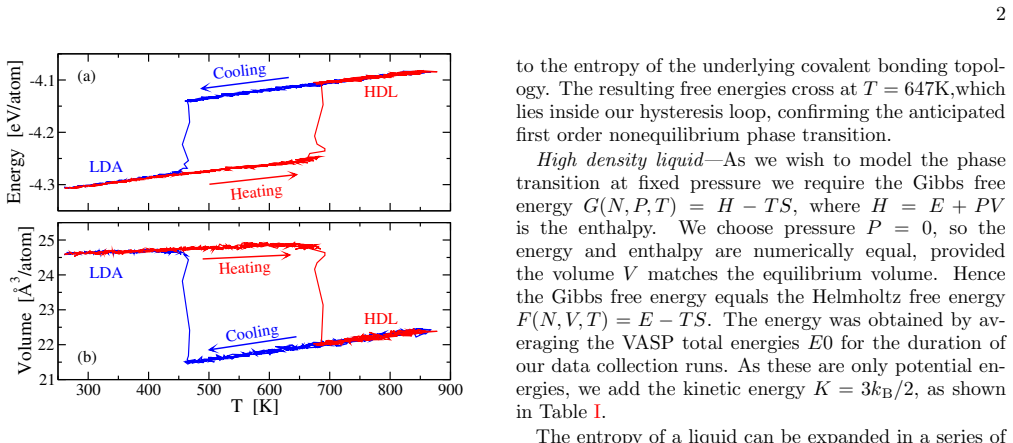
First-principles simulations show amorphous germanium undergoes a reversible first-order transition to a metastable liquid below the melting point.
A machine-rendered reading of the paper's core claim, the machinery that carries it, and where it could break.
Core claim
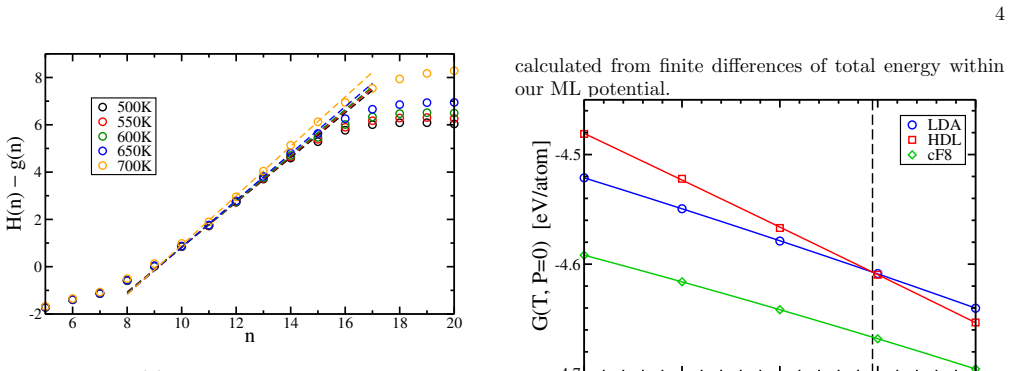
Direct calculation of the liquid and amorphous state free energies, enabled by absolute entropy calculations, verify that the transition is first order in character between two metastable phases.
What carries the argument
Absolute entropy calculations within first-principles molecular dynamics simulations that permit direct free-energy comparison between the liquid and amorphous states.
If this is right
- The calculated free-energy ordering supports models of explosive recrystallization in amorphous Ge films that proceed through a metastable liquid intermediate.
- Both the amorphous solid and the liquid remain metastable relative to the crystal below the equilibrium melting temperature.
- The wide hysteresis loop indicates kinetic barriers that allow the liquid-glass transition to be observed reversibly on simulation timescales.
- The same absolute-entropy method supplies a route to map non-equilibrium phase boundaries for other covalently bonded amorphous materials.
Where Pith is reading between the lines
- Similar absolute-entropy techniques could test whether other group-IV amorphous semiconductors also host first-order liquid-glass lines.
- The existence of a first-order line between two metastable phases implies that glass-transition diagrams may contain sharp boundaries rather than purely continuous crossovers.
- Calorimetric or in-situ diffraction experiments that track latent heat or order-parameter jumps during rapid heating of amorphous Ge would provide direct experimental tests.
Load-bearing premise
The first-principles molecular dynamics simulations and absolute entropy calculations provide accurate thermodynamic descriptions of the liquid and amorphous states.
What would settle it
A continuous rather than discontinuous change in the free-energy difference or structural order parameter across the observed transition temperature would falsify the first-order claim.
Figures
read the original abstract
First principles molecular dynamics simulations of germanium reveal a reversible liquid-glass transition below the equilibrium melting point with a wide hysteresis loop. Direct calculation of the liquid and amorphous state free energies, enabled by absolute entropy calculations, verify that the transition is first order in character between two metastable phases. These results lend credence to models of explosive recrystallization from amorphous Ge thin films, through a metastable liquid state and finally reaching the low temperature crystalline structure.
Editorial analysis
A structured set of objections, weighed in public.
Referee Report
Summary. The manuscript reports first-principles molecular dynamics simulations of germanium that identify a reversible liquid-glass transition below the equilibrium melting point, accompanied by a wide hysteresis loop. Absolute entropy calculations are used to compute the free energies of the liquid and amorphous states directly, confirming that the transition is first-order in character between two metastable phases. The results are presented as support for models of explosive recrystallization in amorphous Ge thin films proceeding through a metastable liquid intermediate.
Significance. If the underlying calculations hold, the work supplies direct thermodynamic evidence distinguishing a first-order transition from purely kinetic glass formation in a semiconductor system. The absolute-entropy route to free-energy comparison is a methodological strength that avoids reliance on fitting or reference states, lending weight to the interpretation of the observed hysteresis as a true phase coexistence between metastable liquid and amorphous phases.
major comments (1)
- [Abstract] Abstract and Methods (implied): the central claim that absolute-entropy-enabled free-energy calculations verify a first-order transition rests on the accuracy of the underlying first-principles MD trajectories. However, no information is supplied on the DFT functional, pseudopotentials, plane-wave cutoff, system sizes, equilibration times, or statistical uncertainties in the entropy and free-energy values. These omissions prevent assessment of whether the reported hysteresis and free-energy crossing are robust or sensitive to technical choices.
Simulated Author's Rebuttal
We thank the referee for the detailed review and constructive feedback. The single major comment highlights a genuine omission in the manuscript that we will correct. Our point-by-point response follows.
read point-by-point responses
-
Referee: [Abstract] Abstract and Methods (implied): the central claim that absolute-entropy-enabled free-energy calculations verify a first-order transition rests on the accuracy of the underlying first-principles MD trajectories. However, no information is supplied on the DFT functional, pseudopotentials, plane-wave cutoff, system sizes, equilibration times, or statistical uncertainties in the entropy and free-energy values. These omissions prevent assessment of whether the reported hysteresis and free-energy crossing are robust or sensitive to technical choices.
Authors: We agree that the manuscript as submitted lacks the necessary technical specifications. In the revised version we will add a dedicated Computational Methods section that reports the DFT functional, pseudopotentials, plane-wave cutoff, system sizes, equilibration and production run lengths, and the statistical uncertainties (obtained via block averaging) on the entropy and free-energy values. These additions will enable readers to judge the robustness of the reported hysteresis and free-energy crossing. revision: yes
Circularity Check
No significant circularity
full rationale
The derivation rests on direct first-principles MD simulations yielding absolute entropies and free energies for liquid and amorphous Ge phases. These outputs are computed from the underlying potential and trajectories without reduction to fitted parameters, self-definitions, or self-citation chains. The first-order character follows from comparing the independently obtained G(T) curves; no equation or premise collapses to its own input by construction. This is the standard, self-contained computational route to the claimed result.
Axiom & Free-Parameter Ledger
axioms (2)
- domain assumption First-principles molecular dynamics simulations accurately capture the atomic interactions and dynamics in both liquid and amorphous germanium.
- domain assumption Absolute entropy calculations can be reliably performed to enable direct free-energy comparison between the liquid and amorphous states.
Reference graph
Works this paper leans on
-
[1]
Pauling, The structure and entropy of ice and of other crystals with some randomness of atomic arrangement, J
L. Pauling, The structure and entropy of ice and of other crystals with some randomness of atomic arrangement, J. Am. Chem. Soc.57, 2680 (1935)
1935
-
[2]
P. H. Poole, F. Sciortino, U. Essmann, and H. E. Stanley, Phase behaviour of metastable water, Nature360, 324 (1992)
1992
-
[3]
Galloet al., Water: A tale of two liquids, Chem
P. Galloet al., Water: A tale of two liquids, Chem. Rev. 116, 7463 (2016)
2016
-
[4]
van Thiel and F
M. van Thiel and F. H. Ree, High-pressure liquid-liquid phase change in carbon, Phys. Rev. B48, 3591 (1993)
1993
-
[5]
M. W. C. Dharma-Wardana and D. D. Klug, Evidence for multiple liquid–liquid phase transitions in carbon, and the friedel ordering of its liquid state, Phys. Plasmas29, 022108 (2022)
2022
-
[6]
Sastry and C
S. Sastry and C. A. Angell, Liquid–liquid phase transition in supercooled silicon, Nat. Mat.2, 739 (2003)
2003
-
[7]
Ganesh and M
P. Ganesh and M. Widom, Liquid-liquid transition in su- percooled silicon determined by first-principles simula- tion, Phys. Rev. Lett.102, 075701 (2009)
2009
-
[8]
M. H. Bhat, E. S. V. Molinero, V. C. Solomon, S. Sas- try, J. L. Yarger, and C. A. Angel, Vitrification of a monatomic metallic liquid, Nature448, 787 (2007)
2007
-
[9]
L. Xu, Z. Wang, J. Chen, S. Chen, W. Yang, Y. Ren, X. Zuo, J. Zeng, Q. Wu, and H. Sheng, Folded network and structural transition in molten tin, Nat. comm.13, 126 (2022)
2022
-
[10]
Mishima, L
O. Mishima, L. D. Calvert, and E. Whalley, An ap- parently first-order transition between two amorphous phases of ice induced by pressure, Nature314, 76 (1985)
1985
-
[11]
P. F. McMillan, M. Wilson, D. Daisenberger, and D. Ma- chon, A density-driven phase transition between semicon- ducting and metallic polyamorphs of silicon, Nat. Mater. 4, 680 (2005)
2005
-
[12]
Coppari, J
F. Coppari, J. C. Chervin, A. Congeduti, M. Lazzeri, A. Polian, E. Principi, and A. Di Cicco, Pressure- induced phase transitions in amorphous and metastable crystalline germanium by raman scattering, x-ray spec- troscopy, and ab initio calculations, Phys. Rev. B80, 115213 (2009)
2009
-
[13]
J. Tauc, R. Grigorovici, and A. Vancu, Optical properties and electronic structure of amorphous germanium, Phys. Stat. Solidi (1966)
1966
-
[14]
explosively
T. Takamori, R. Messier, and R. Roy, New noncrystalline germanium which crystallizes “explosively” at room tem- perature, Appl. Phys. Lett.20, 201 (1972)
1972
-
[15]
R. L. Chapman, J. C. C. Fan, H. J. Zeiger, and R. P. Gale, Crystallization-front velocity during scanned laser crystallization of amorphous Ge films, Appl. Phys. Lett. 37, 292 (1980)
1980
-
[16]
H. J. Leamy, W. L. Brown, G. K. Celler, G. Foti, G. H. Gilmer, and J. C. C. Fan, Explosive crystallization of amorphous germanium, Appl. Phys. Lett.38, 137 (1981)
1981
-
[17]
Nikolova, M
L. Nikolova, M. J. Stern, J. M. MacLeod, B. W. Reed, H. Ibrahim, G. H. Campbell, F. Rosei, T. LaGrange, and B. J. Siwick, In situ investigation of explosive crys- tallization in a-Ge: Experimental determination of the interface response function using dynamic transmission electron microscopy, J. Appl. Phys.116, 093512 (2014)
2014
-
[18]
B. G. Bagley and H. S. Chen, A calculation of the thermo- dynamic first order amorphous semiconductor to metal- lic liquid transition temperature, AIP Conf. Proc.50, 97 (1979)
1979
-
[19]
Kresse and J
G. Kresse and J. Hafner, Ab initio molecular-dynamics simulation of the liquid-metal–amorphous-semiconductor transition in germanium, Phys. Rev. B49, 14251 (1994)
1994
-
[20]
J. W. Gibbs,Elementary principles in statistical mechan- ics(Dover, New York, 1960)
1960
-
[21]
C. E. Shannon, A Mathematical Theory of Communica- tion, Bell System Tech. J.27, 379 (1948)
1948
-
[22]
R. E. Nettleton and M. S. Green, Expression in Terms of Molecular Distribution Functions for the Entropy Den- sity in an Infinite System, J. Chem. Phys.29, 1365 (1958)
1958
-
[23]
H. J. Raveche, Entropy and Molecular Correlation Func- tions in Open Systems. I. Derivation, J. Chem. Phys.55, 2242 (1971)
1971
-
[24]
Baranyai and D
A. Baranyai and D. J. Evans, Direct entropy calculation from computer simulation of liquids, Phys. Rev. A40, 3817 (1989)
1989
-
[25]
M. C. Gao and M. Widom, Information entropy of liquid metals, J. Phys. Chem. B122, 3550 (2018)
2018
-
[26]
Widom and M
M. Widom and M. Gao, First principles calculation of the entropy of liquid aluminum, Entropy21(2019)
2019
-
[27]
Huang and M
Y. Huang and M. Widom, Entropy approximations for simple fluids, Phys. Rev. E109, 034130 (2024)
2024
-
[28]
L. F. Richardson, The approximate arithmetical solution by finite differences of physical problems involving dif- ferential equations, with an application to the stresses in a masonry dam, Phil. Trans. R. Soc. Lond. A210, 307 (1911)
1911
-
[29]
Widom, High entropy alloys: fundamentals and ap- plications (Springer, Berlin, 2015) Chap
M. Widom, High entropy alloys: fundamentals and ap- plications (Springer, Berlin, 2015) Chap. 8. Prediction of structure and phase transformations
2015
-
[30]
R. L. C. Vink and G. T. Barkema, Configurational en- tropy of network-forming materials, Phys. Rev. Lett.89, 076405 (2002)
2002
-
[31]
Kresse and D
G. Kresse and D. Joubert, From ultrasoft pseudopoten- tials to the projector augmented-wave method, Phys. Rev. B59, 1758 (1999)
1999
-
[32]
J. P. Perdew, K. Burke, and M. Ernzerhof, Generalized gradient approximation made simple, Phys. Rev. Lett. 77, 3865 (1996)
1996
-
[33]
Baldereschi, Mean-value point in the Brillouin zone, Phys
A. Baldereschi, Mean-value point in the Brillouin zone, Phys. Rev. B7, 5212 (1973)
1973
-
[34]
I. S. Galtsov, V. B. Fokin, A. V. Dorovatovsky, M. A. Paramonov, G. S. Demyanov, D. V. Minakov, M. A. Sheindlin, and P. R. Levashov, Thermophysical proper- ties of solid and liquid nickel near melting point, J. Appl. Phys.136, 145104 (2024)
2024
-
[35]
Jinnouchi, F
R. Jinnouchi, F. Karsai, and G. Kresse, On-the-fly ma- chine learning force field generation: Application to melt- ing points, Phys. Rev. B100, 014105 (2019)
2019
-
[36]
B. D. McKay and A. Piperno, Practical graph isomor- phism, ii, J. Symb. Comp.60, 94 (2014). 6 Appendix A: End Matter first principles calculations—Our molecular dynamics and phonon calculations utilize the VASP code [31] in the PBE generalized gradient approximation [32] using the supplied projector augmented wave potentials for Ge with valence 4 at the d...
2014
discussion (0)
Sign in with ORCID, Apple, or X to comment. Anyone can read and Pith papers without signing in.