Fluctuation exchange study on the electron-hole asymmetry of the superconductivity across 1/3 filling in the trilayer Hubbard model
Pith reviewed 2026-06-25 23:16 UTC · model grok-4.3
The pith
In the trilayer Hubbard model, superconductivity near 1/3 filling becomes electron-hole asymmetric for large U, favoring the hole-doped side due to asymmetric band renormalization.
A machine-rendered reading of the paper's core claim, the machinery that carries it, and where it could break.
Core claim
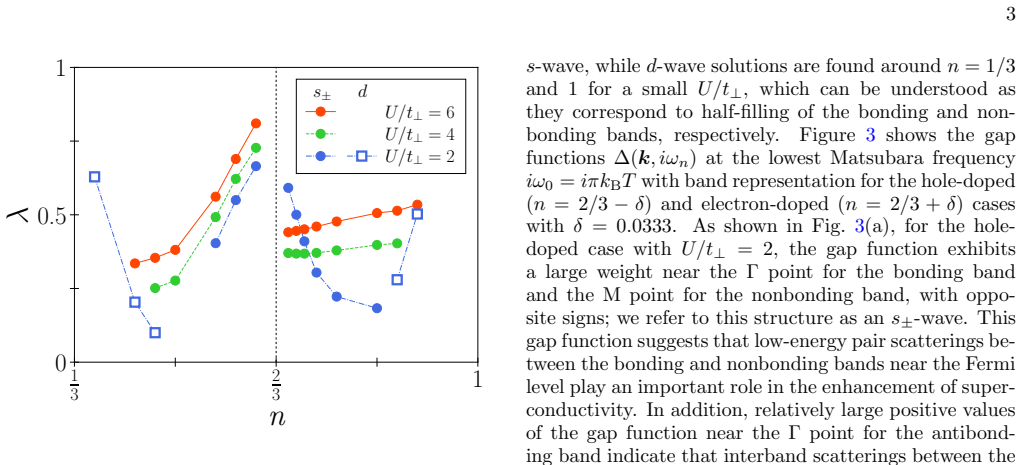
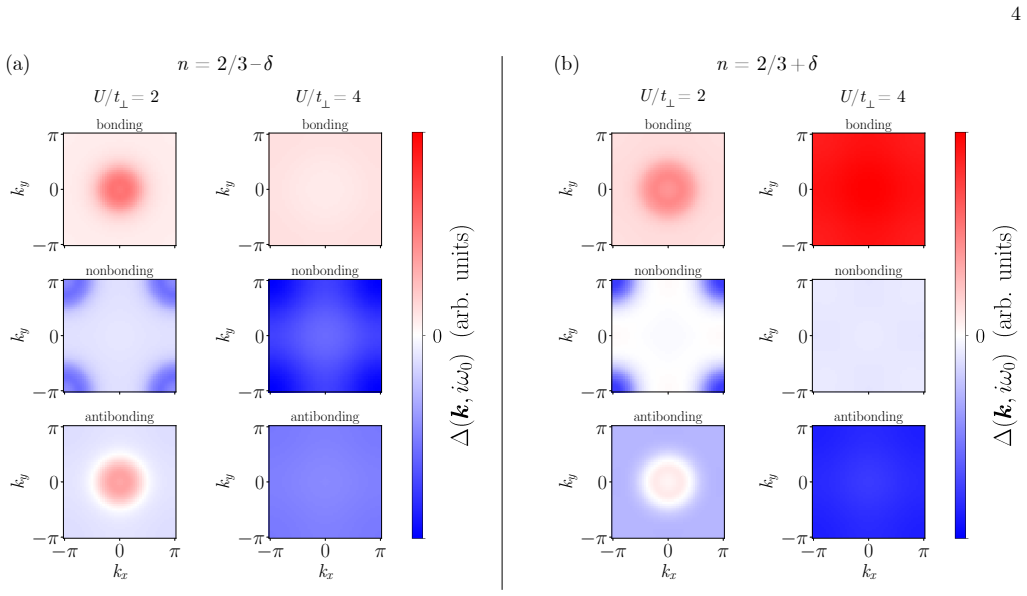
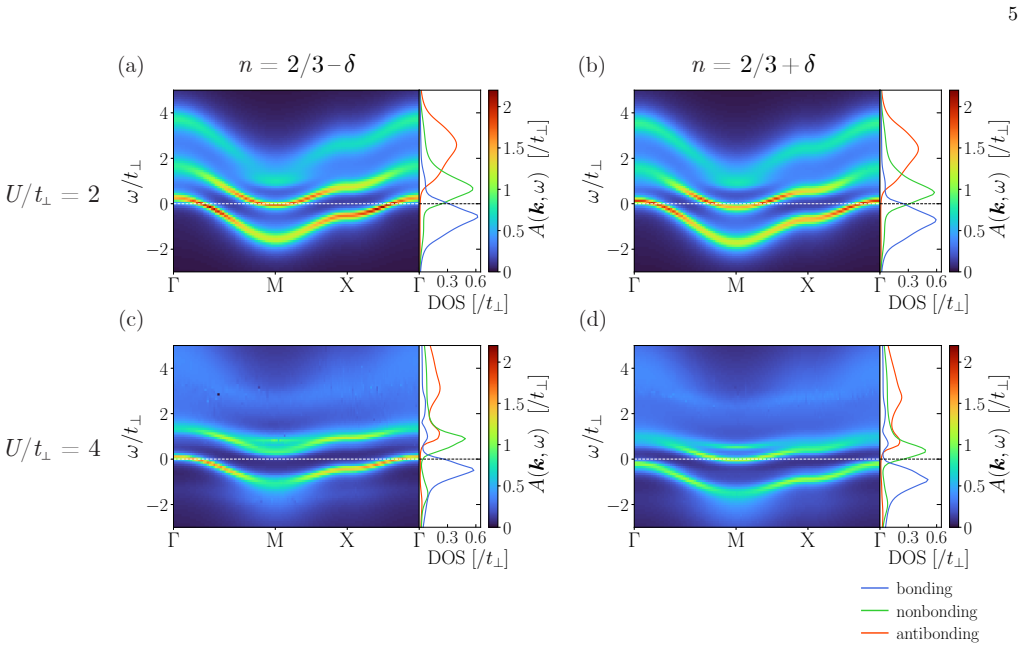
Within the fluctuation exchange approximation applied to the trilayer Hubbard model, superconductivity near 1/3 filling is electron-hole symmetric at small U but becomes asymmetric at large U, with the hole-doped side (electrons removed from 1/3 filling) showing stronger pairing; this arises from the asymmetric renormalization of the bonding, nonbonding, and antibonding bands.
What carries the argument
Asymmetric renormalization of the bonding, nonbonding, and antibonding bands under large onsite U within the fluctuation exchange approximation.
If this is right
- Superconducting transition temperatures or pairing strengths become higher when doping removes electrons from 1/3 filling than when it adds electrons.
- The effective bandwidths and fillings of the bonding and nonbonding bands diverge from each other as U grows.
- The antibonding band plays a secondary role in the pairing asymmetry at large U.
- Electron-hole symmetry holds only in the weak-coupling regime where band renormalization remains symmetric.
Where Pith is reading between the lines
- If the asymmetry survives in more exact methods, it could guide the search for higher-Tc superconductivity in multilayer materials by choosing the doping direction.
- Varying the interlayer hopping strength might tune the size of the asymmetry, providing a testable prediction for model extensions.
Load-bearing premise
The fluctuation exchange approximation remains quantitatively reliable for large values of U in this three-band system with the chosen interlayer hoppings.
What would settle it
A calculation or measurement that finds stronger superconductivity on the electron-doped side of 1/3 filling, or equal strength on both sides, for large U in a trilayer geometry with similar interlayer hoppings.
Figures
read the original abstract
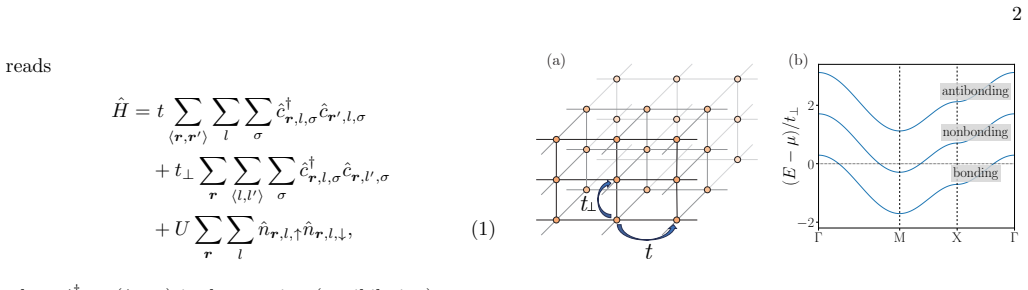
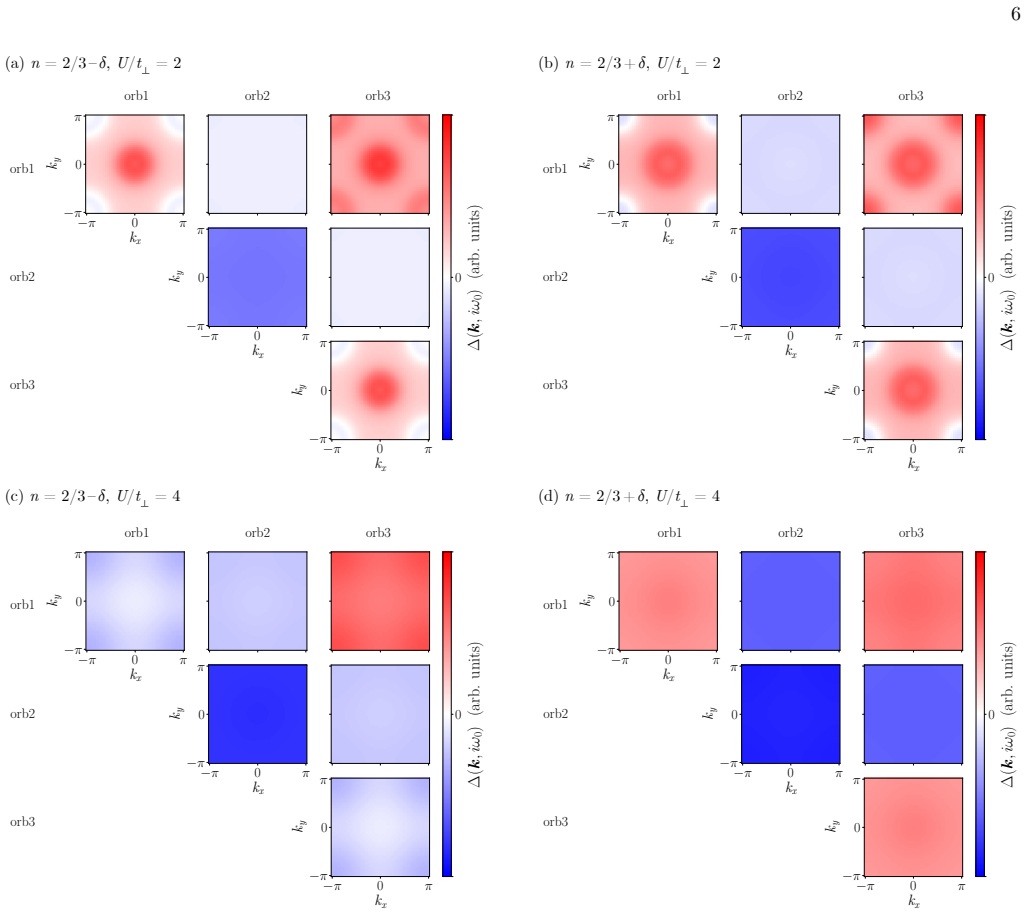
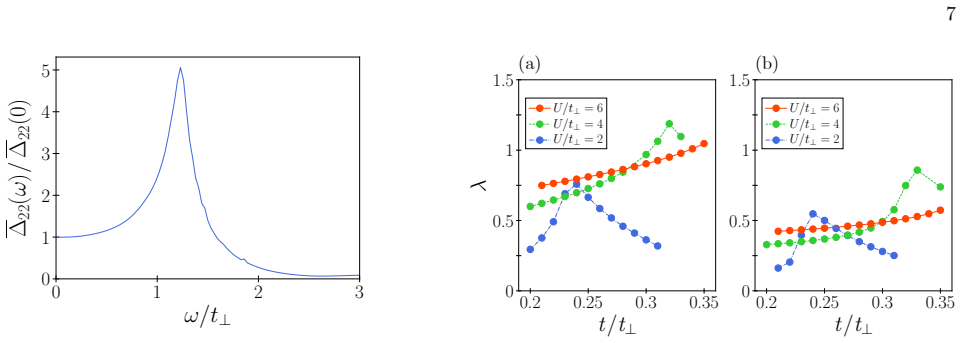
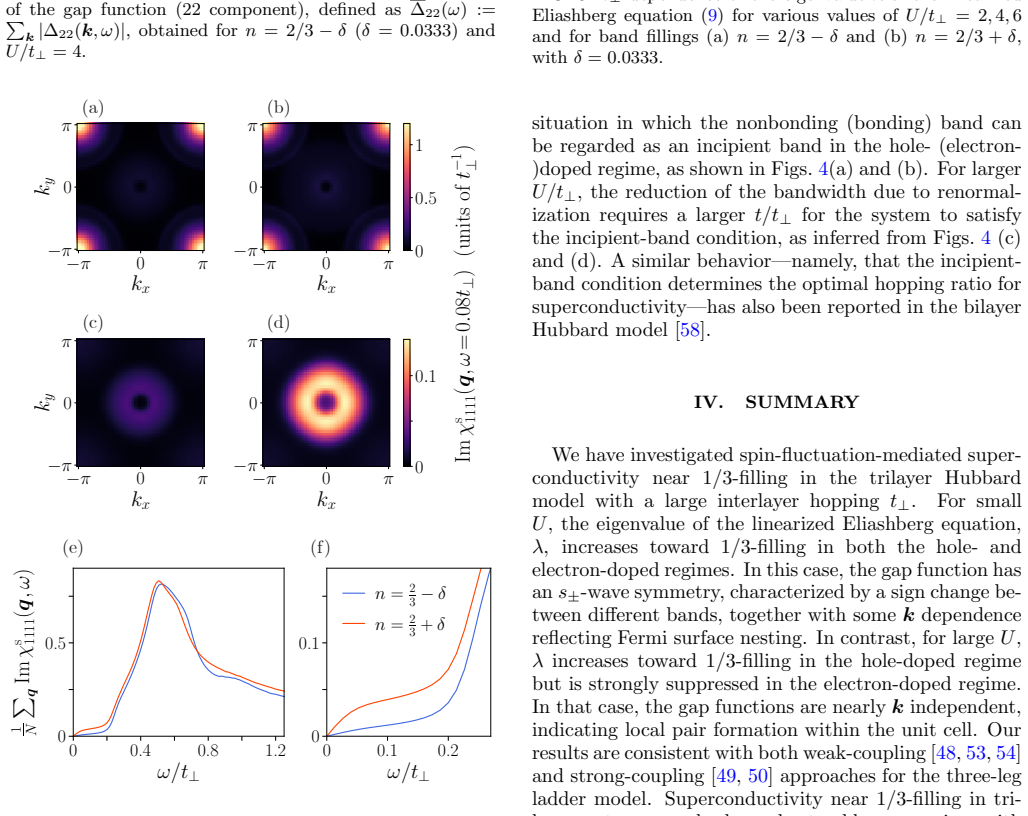
We study within the fluctuation exchange approximation the trilayer Hubbard model where three layers of the Hubbard model are coupled by large interlayer hoppings so that the overlap of the bonding, nonbonding, and antibonding bands is relatively small. We pay special attention to the band fillings close to 1/3, for which the bonding and nonbonding bands as a whole are close to half filling. For relatively small values of the onsite $U$, superconductivity roughly exhibits electron-hole symmetric behavior, as expected for a nearly half-filled two-band system. By contrast, an asymmetry appears when $U$ becomes large, where superconductivity is more favored in the hole-doped regime, i.e., in the regime where electrons are removed from 1/3 filling. We attribute this asymmetry to the asymmetric renormalization of the bonding, nonbonding, and antibonding bands when $U$ is large.
Editorial analysis
A structured set of objections, weighed in public.
Referee Report
Summary. The manuscript studies superconductivity in the trilayer Hubbard model (with large interlayer hoppings yielding separated bonding/nonbonding/antibonding bands) near 1/3 filling using the fluctuation exchange (FLEX) approximation. It reports roughly electron-hole symmetric Tc behavior at small U, but an asymmetry at large U that favors the hole-doped side; this is attributed to asymmetric renormalization of the three bands.
Significance. If the FLEX results hold, the work supplies a concrete illustration of how strong-coupling effects can generate doping asymmetry via differential band renormalizations in a multi-band Hubbard system. This is potentially relevant to layered correlated materials. The study employs a standard diagrammatic method on a standard model, but the absence of non-perturbative benchmarks limits the strength of the conclusions.
major comments (2)
- [Abstract] Abstract and main results: the headline asymmetry is reported only for large U, yet the manuscript provides no comparison of FLEX results to non-perturbative methods (DMFT, QMC, or exact diagonalization) at the same parameters. Because FLEX is a perturbative resummation whose controlled regime is weak-to-intermediate coupling, and because the effective interaction strength approaches the bandwidth at large U, the reported band renormalizations and resulting Tc asymmetry rest on an uncontrolled extrapolation.
- [Abstract] Abstract: the mechanism is stated as 'asymmetric renormalization of the bonding, nonbonding, and antibonding bands,' but no quantitative measure (e.g., extracted quasiparticle weights, band shifts, or widths versus filling) is supplied to demonstrate that the renormalization is in fact asymmetric in the manner required to produce the claimed Tc asymmetry.
minor comments (1)
- [Abstract] The abstract would be clearer if it specified the numerical ranges used for 'relatively small' and 'large' values of U.
Simulated Author's Rebuttal
We thank the referee for the careful reading and constructive comments. We respond point-by-point to the major comments below.
read point-by-point responses
-
Referee: [Abstract] Abstract and main results: the headline asymmetry is reported only for large U, yet the manuscript provides no comparison of FLEX results to non-perturbative methods (DMFT, QMC, or exact diagonalization) at the same parameters. Because FLEX is a perturbative resummation whose controlled regime is weak-to-intermediate coupling, and because the effective interaction strength approaches the bandwidth at large U, the reported band renormalizations and resulting Tc asymmetry rest on an uncontrolled extrapolation.
Authors: We acknowledge that FLEX is a perturbative method whose validity at large U (where U approaches the bandwidth) is not rigorously controlled. The trilayer model with the chosen interlayer hoppings makes non-perturbative benchmarks (DMFT, QMC, or ED) computationally demanding at the required system sizes and parameter points, which is why we employed FLEX as a standard diagrammatic approach for multi-band Hubbard superconductivity. In the revision we will add an explicit discussion of the approximation's regime of applicability and emphasize the qualitative character of the reported asymmetry. revision: partial
-
Referee: [Abstract] Abstract: the mechanism is stated as 'asymmetric renormalization of the bonding, nonbonding, and antibonding bands,' but no quantitative measure (e.g., extracted quasiparticle weights, band shifts, or widths versus filling) is supplied to demonstrate that the renormalization is in fact asymmetric in the manner required to produce the claimed Tc asymmetry.
Authors: We agree that explicit quantitative measures would make the claimed mechanism more transparent. Although the main text discusses the band renormalizations, we will add figures (or tables) in the revised manuscript that extract and plot quasiparticle weights, effective band shifts, and widths as functions of filling for representative U values, directly illustrating the asymmetry between the bonding, nonbonding, and antibonding bands. revision: yes
Circularity Check
No circularity; asymmetry is computed output of FLEX on standard model
full rationale
The paper applies the fluctuation exchange approximation to the trilayer Hubbard model and reports an electron-hole asymmetry in superconductivity that emerges at large U, attributed to band renormalizations. No quoted step defines a quantity in terms of itself, renames a fitted parameter as a prediction, or reduces the central claim to a self-citation chain. The derivation chain consists of standard diagrammatic equations whose outputs (Tc values and band shifts) are independent of the target asymmetry; the result is therefore self-contained against external benchmarks.
Axiom & Free-Parameter Ledger
axioms (1)
- domain assumption The fluctuation exchange approximation accurately captures the superconducting instability in the trilayer Hubbard model for the U values studied.
Reference graph
Works this paper leans on
-
[1]
Kuroki, T
K. Kuroki, T. Kimura, and R. Arita, High-temperature superconductivity in dimer array systems, Phys. Rev. B 66, 184508 (2002)
2002
-
[2]
T. A. Maier and D. J. Scalapino, Pair structure and the pairing interaction in a bilayer Hubbard model for un- conventional superconductivity, Phys. Rev. B84, 180513 (2011)
2011
-
[3]
Nakata, D
M. Nakata, D. Ogura, H. Usui, and K. Kuroki, Finite- energy spin fluctuations as a pairing glue in systems with coexisting electron and hole bands, Phys. Rev. B95, 214509 (2017)
2017
-
[4]
Nomura, M
Y. Nomura, M. Kitatani, S. Sakai, and R. Arita, Strong- coupling high-T c superconductivity in doped correlated band insulators, Phys. Rev. B112, L020504 (2025)
2025
-
[5]
H. Sun, M. Huo, X. Hu, J. Li, Z. Liu, Y. Han, L. Tang, Z. Mao, P. Yang, B. Wang, J. Cheng, D.-X. Yao, G.- M. Zhang, and M. Wang, Signatures of superconductiv- ity near 80 K in a nickelate under high pressure, Nature (London)621, 493 (2023)
2023
-
[6]
Hou, P.-T
J. Hou, P.-T. Yang, Z.-Y. Liu, J.-Y. Li, P.-F. Shan, L. Ma, G. Wang, N.-N. Wang, H.-Z. Guo, J.-P. Sun, Y. Uwatoko, M. Wang, G.-M. Zhang, B.-S. Wang, and J.-G. Cheng, Emergence of High-Temperature Supercon- ducting Phase in Pressurized La 3Ni2O7 Crystals, Chin. Phys. Lett.40, 117302 (2023)
2023
-
[7]
G. Wang, N. N. Wang, X. L. Shen, J. Hou, L. Ma, L. F. Shi, Z. A. Ren, Y. D. Gu, H. M. Ma, P. T. Yang, Z. Y. Liu, H. Z. Guo, J. P. Sun, G. M. Zhang, S. Calder, J.-Q. Yan, B. S. Wang, Y. Uwatoko, and J.-G. Cheng, Pressure-Induced Superconductivity In Polycrys- talline La3Ni2O7−δ, Phys. Rev. X14, 011040 (2024)
2024
-
[8]
Zhang, D
Y. Zhang, D. Su, Y. Huang, Z. Shan, H. Sun, M. Huo, K. Ye, J. Zhang, Z. Yang, Y. Xu, Y. Su, R. Li, M. Smid- man, M. Wang, L. Jiao, and H. Yuan, High-temperature superconductivity with zero resistance and strange-metal behaviour in La 3Ni2O7−δ, Nat. Phys.20, 1269 (2024)
2024
-
[9]
N. Wang, G. Wang, X. Shen, J. Hou, J. Luo, X. Ma, H. Yang, L. Shi, J. Dou, J. Feng, J. Yang, Y. Shi, Z. Ren, H. Ma, P. Yang, Z. Liu, Y. Liu, H. Zhang, X. Dong, Y. Wang, K. Jiang, J. Hu, S. Nagasaki, K. Kitagawa, S. Calder, J. Yan, J. Sun, B. Wang, R. Zhou, Y. Uwatoko, and J. Cheng, Bulk high-temperature superconductivity in pressurized tetragonal La 2PrNi...
2024
-
[10]
F. Li, Z. Xing, D. Peng, J. Dou, N. Guo, L. Ma, Y. Zhang, L. Wang, J. Luo, J. Yang, J. Zhang, T. Chang, Y.-S. Chen, W. Cai, J. Cheng, Y. Wang, Y. Liu, T. Luo, N. Hi- rao, T. Matsuoka, H. Kadobayashi, Z. Zeng, Q. Zheng, R. Zhou, Q. Zeng, X. Tao, and J. Zhang, Bulk super- conductivity up to 96 K in pressurized nickelate single crystals, Nature (London)649, ...
2026
-
[11]
E. K. Ko, Y. Yu, Y. Liu, L. Bhatt, J. Li, V. Thampy, C.-T. Kuo, B. Y. Wang, Y. Lee, K. Lee, J.-S. Lee, B. H. Goodge, D. A. Muller, and H. Y. Hwang, Signa- tures of ambient pressure superconductivity in thin film La3Ni2O7, Nature (London)638, 935 (2025)
2025
-
[12]
G. Zhou, W. Lv, H. Wang, Z. Nie, Y. Chen, Y. Li, H. Huang, W.-Q. Chen, Y.-J. Sun, Q.-K. Xue, and Z. Chen, Ambient-pressure superconductivity on- set above 40 K in (La,Pr)3Ni2O7 films, Nature (London) 640, 641 (2025)
2025
-
[13]
G. Zhou, H. Wang, H. Huang, Y. Chen, F. Peng, W. Lv, Z. Nie, W. Wang, J.-F. Jia, Q.-K. Xue, and Z. Chen, Superconductivity onset above 60 K in ambient-pressure nickelate films, Natl. Sci. Rev.13, nwag151 (2026)
2026
-
[14]
Z. Luo, X. Hu, M. Wang, W. W´ u, and D.-X. Yao, Bilayer Two-Orbital Model of La 3Ni2O7 under Pressure, Phys. Rev. Lett.131, 126001 (2023)
2023
-
[15]
Q.-G. Yang, D. Wang, and Q.-H. Wang, Possibles ±- wave superconductivity in La3Ni2O7, Phys. Rev. B108, L140505 (2023)
2023
-
[16]
Sakakibara, N
H. Sakakibara, N. Kitamine, M. Ochi, and K. Kuroki, Possible HighT c Superconductivity in La 3Ni2O7 under High Pressure through Manifestation of a Nearly Half- Filled Bilayer Hubbard Model, Phys. Rev. Lett.132, 106002 (2024)
2024
-
[17]
Christiansson, F
V. Christiansson, F. Petocchi, and P. Werner, Correlated Electronic Structure of La 3Ni2O7 under Pressure, Phys. Rev. Lett.131, 206501 (2023)
2023
-
[18]
Lechermann, J
F. Lechermann, J. Gondolf, S. B¨ otzel, and I. M. Eremin, Electronic correlations and superconducting instability in La 3Ni2O7 under high pressure, Phys. Rev. B108, L201121 (2023)
2023
-
[19]
Y. Shen, M. Qin, and G.-M. Zhang, Effective Bi-Layer Model Hamiltonian and Density-Matrix Renormaliza- tion Group Study for the High-T c Superconductivity in La3Ni2O7 under High Pressure, Chin. Phys. Lett.40, 127401 (2023)
2023
-
[20]
Liu, J.-W
Y.-B. Liu, J.-W. Mei, F. Ye, W.-Q. Chen, and F. Yang, s±-Wave Pairing and the Destructive Role of Apical- Oxygen Deficiencies in La 3Ni2O7 under Pressure, Phys. Rev. Lett.131, 236002 (2023)
2023
-
[21]
C. Lu, Z. Pan, F. Yang, and C. Wu, Interlayer- Coupling-Driven High-Temperature Superconductivity in La 3Ni2O7 under Pressure, Phys. Rev. Lett.132, 146002 (2024)
2024
-
[22]
Oh and Y.-H
H. Oh and Y.-H. Zhang, Type-IIt−Jmodel and shared superexchange coupling from Hund’s rule in supercon- 9 ducting La3Ni2O7, Phys. Rev. B108, 174511 (2023)
2023
-
[23]
Qu, D.-W
X.-Z. Qu, D.-W. Qu, J. Chen, C. Wu, F. Yang, W. Li, and G. Su, Bilayert−J−J ⊥ Model and Magnetically Me- diated Pairing in the Pressurized Nickelate La 3Ni2O7, Phys. Rev. Lett.132, 036502 (2024)
2024
-
[24]
Kaneko, H
T. Kaneko, H. Sakakibara, M. Ochi, and K. Kuroki, Pair correlations in the two-orbital Hubbard ladder: Im- plications for superconductivity in the bilayer nickelate La3Ni2O7, Phys. Rev. B109, 045154 (2024)
2024
-
[25]
Kakoi, T
M. Kakoi, T. Kaneko, H. Sakakibara, M. Ochi, and K. Kuroki, Pair correlations of the hybridized orbitals in a ladder model for the bilayer nickelate La 3Ni2O7, Phys. Rev. B109, L201124 (2024)
2024
-
[26]
Kaneko, M
T. Kaneko, M. Kakoi, and K. Kuroki,t−Jmodel for strongly correlated two-orbital systems: Application to bilayer nickelate superconductors, Phys. Rev. B112, 075143 (2025)
2025
-
[27]
Kamiyama, T
S. Kamiyama, T. Kaneko, K. Kuroki, and M. Ochi, Opti- cal control of the crystal structure in the bilayer nickelate superconductor La3Ni2O7 via nonlinear phononics, Phys. Rev. B112, 094115 (2025)
2025
-
[28]
Ushio, S
K. Ushio, S. Kamiyama, Y. Hoshi, R. Mizuno, M. Ochi, K. Kuroki, and H. Sakakibara, Theoretical study on ambient-pressure superconductivity in La 3Ni2O7 thin films: Structural analysis, model construction, and ro- bustness ofs ±-wave pairing, Phys. Rev. B (2026)
2026
-
[29]
R. Asai, R. Arita, T. Chida, R. Masuki, K. Kuroki, and T. Tadano, Finite-Temperatureab initioStructural Optimization of the Bilayer Nickelate Superconductor La3Ni2O7, arXiv:2512.08251
-
[30]
H. Watanabe, H. Sakakibara, and K. Kuroki, Hi- erarchical structure of primary and hybridization- induced superconducting correlations in bilayer nicke- lates, arXiv:2603.13604
-
[31]
Sakakibara, M
H. Sakakibara, M. Ochi, H. Nagata, Y. Ueki, H. Saku- rai, R. Matsumoto, K. Terashima, K. Hirose, H. Ohta, M. Kato, Y. Takano, and K. Kuroki, Theoretical analy- sis on the possibility of superconductivity in the trilayer Ruddlesden-Popper nickelate La 4Ni3O10 under pressure and its experimental examination: Comparison with La3Ni2O7, Phys. Rev. B109, 144511 (2024)
2024
-
[32]
Li, Y.-J
Q. Li, Y.-J. Zhang, Z.-N. Xiang, Y. Zhang, X. Zhu, and H.-H. Wen, Signature of Superconductivity in Pressur- ized La4Ni3O10, Chin. Phys. Lett.41(2024)
2024
-
[33]
Y. Zhu, D. Peng, E. Zhang, B. Pan, X. Chen, L. Chen, H. Ren, F. Liu, Y. Hao, N. Li, Z. Xing, F. Lan, J. Han, J. Wang, D. Jia, H. Wo, Y. Gu, Y. Gu, L. Ji, W. Wang, H. Gou, Y. Shen, T. Ying, X. Chen, W. Yang, H. Cao, C. Zheng, Q. Zeng, J.-g. Guo, and J. Zhao, Superconduc- tivity in pressurized trilayer La4Ni3O10−δ single crystals, Nature (London)631, 531 (2024)
2024
-
[34]
Nagata, H
H. Nagata, H. Sakurai, Y. Ueki, K. Yamane, R. Mat- sumoto, K. Terashima, K. Hirose, H. Ohta, M. Kato, and Y. Takano, Pressure-Induced Superconductivity in La4Ni3O10+δ (δ= 0.04 and−0.01), J. Phys. Soc. Jpn. 93, 095003 (2024)
2024
-
[35]
Zhang, C
M. Zhang, C. Pei, D. Peng, X. Du, W. Hu, Y. Cao, Q. Wang, J. Wu, Y. Li, H. Liu, C. Wen, J. Song, Y. Zhao, C. Li, W. Cao, S. Zhu, Q. Zhang, N. Yu, P. Cheng, L. Zhang, Z. Li, J. Zhao, Y. Chen, C. Jin, H. Guo, C. Wu, F. Yang, Q. Zeng, S. Yan, L. Yang, and Y. Qi, Superconductivity in Trilayer Nickelate La4Ni3O10 under Pressure, Phys. Rev. X15, 021005 (2025)
2025
-
[36]
Zhang, D
E. Zhang, D. Peng, Y. Zhu, L. Chen, B. Cui, X. Wang, W. Wang, Q. Zeng, and J. Zhao, Bulk Superconductivity in Pressurized Trilayer Nickelate Pr4Ni3O10 Single Crys- tals, Phys. Rev. X15, 021008 (2025)
2025
-
[37]
D. Peng, Y. Bian, Z. Xing, L. Chen, J. Cai, T. Luo, F. Lan, Y. Liu, Y. Zhu, E. Zhang, Z. Wang, Y. Sun, Y. Wang, X. Wang, C. Wang, Y. Yang, Y. Yang, H. Dong, H. Lou, Z. Zeng, Z. Zeng, M. Tian, J. Zhao, Q. Zeng, J. Zhang, and H.-k. Mao, Nearly Isotropic Upper Critical Field in Pressurized Trilayer Nickelate La4Ni3O10−δ, Phys. Rev. X16, 021008 (2026)
2026
-
[38]
Tian, H.-T
P.-F. Tian, H.-T. Ma, X. Ming, X.-J. Zheng, and H. Li, Effective model and electron correlations in trilayer nicke- late superconductor La4Ni3O10, J. Phys.: Condens. Mat- ter36, 355602 (2024)
2024
-
[39]
Q. Qin, J. Wang, and Y. feng Yang, Frustrated supercon- ductivity and intrinsic reduction ofT c in trilayer nicke- late, Innov. Mater.2, 100102 (2024)
2024
-
[40]
C.-Q. Chen, Z. Luo, M. Wang, W. W´ u, and D.-X. Yao, Trilayer multiorbital models of La4Ni3O10, Phys. Rev. B 110, 014503 (2024)
2024
-
[41]
Huang and T
J. Huang and T. Zhou, Interlayer pairing-induced par- tially gapped Fermi surface in trilayer La 4Ni3O10 super- conductors, Phys. Rev. B110, L060506 (2024)
2024
-
[42]
Zhang, H
M. Zhang, H. Sun, Y.-B. Liu, Q. Liu, W.-Q. Chen, and F. Yang,s ±-wave superconductivity in pressurized La4Ni3O10, Phys. Rev. B110, L180501 (2024)
2024
-
[43]
LaBollita, J
H. LaBollita, J. Kapeghian, M. R. Norman, and A. S. Botana, Electronic structure and magnetic tendencies of trilayer La4Ni3O10 under pressure: Structural transition, molecular orbitals, and layer differentiation, Phys. Rev. B109, 195151 (2024)
2024
-
[44]
Zhang, H
M. Zhang, H. Sun, Y.-B. Liu, Q. Liu, W.-Q. Chen, and F. Yang, Spin-density wave and superconductivity in La4Ni3O10 under ambient pressure, Phys. Rev. B111, 144502 (2025)
2025
-
[45]
C. Lu, Z. Pan, F. Yang, and C. Wu, Superconductivity in La4Ni3O10 under pressure, Phys. Rev. B111, 134515 (2025)
2025
-
[46]
Zheng and T
S. Zheng and T. Zhou, Layer-resolved impurity states reveal competing pairing mechanisms in trilayer nickelate superconductor La 4Ni3O10, Phys. Rev. B113, 024504 (2026)
2026
-
[47]
J. Chen, C. Xu, Q. Li, and W. Li, Magnetically medi- ated cross-layer pairing in pressurized trilayer nickelate La4Ni3O10, Sci. China Phys. Mech. Astron.69, 247413 (2026)
2026
-
[48]
Arrigoni, Spin and charge excitations in a three-legs fermionic ladder: a renormalization-group study, Phys
E. Arrigoni, Spin and charge excitations in a three-legs fermionic ladder: a renormalization-group study, Phys. Lett. A215, 91 (1996); Phase diagram of three fermionic chains: A renormalization-group study, Phys. Status So- lidi B195, 425 (1996)
1996
-
[49]
M. Y. Kagan, S. Haas, and T. Rice, Phase diagram of three-leg ladders at strong coupling along the rungs, Physica C: Supercond.317-318, 185 (1999)
1999
-
[50]
Y. Yamada, T. Kaneko, M. Kakoi, R. Ueda, and K. Kuroki, Pairing properties of correlated three-leg lad- ders with strong interchain couplings near 1/3 filling, arXiv:2604.17812
-
[51]
N. E. Bickers, D. J. Scalapino, and S. R. White, Con- serving Approximations for Strongly Correlated Electron Systems: Bethe-Salpeter Equation and Dynamics for the Two-Dimensional Hubbard Model, Phys. Rev. Lett.62, 961 (1989)
1989
-
[52]
Dahm and L
T. Dahm and L. Tewordt, Quasiparticle and Spin Exci- 10 tation Spectra in the Normal andd-Wave Superconduct- ing State of the Two-Dimensional Hubbard Model, Phys. Rev. Lett.74, 793 (1995)
1995
-
[53]
Kimura, K
T. Kimura, K. Kuroki, and H. Aoki, Correlation func- tions in the three-chain Hubbard ladder, Phys. Rev. B 54, R9608 (1996); Pairing Correlation in the Three-Leg Hubbard Ladder – Renormalization Group and Quantum Monte Carlo Studies, J. Phys. Soc. Jpn.67, 1377 (1998)
1996
-
[54]
H.-H. Lin, L. Balents, and M. P. A. Fisher,N-chain Hub- bard model in weak coupling, Phys. Rev. B56, 6569 (1997)
1997
-
[55]
Kuroki, T
K. Kuroki, T. Higashida, and R. Arita, High-T c super- conductivity due to coexisting wide and narrow bands: A fluctuation exchange study of the Hubbard ladder as a test case, Phys. Rev. B72, 212509 (2005)
2005
-
[56]
Mishra, D
V. Mishra, D. J. Scalapino, and T. A. Maier, s±pairing near a Lifshitz transition, Sci. Rep.6, 32078 (2016)
2016
-
[57]
T. A. Maier, V. Mishra, G. Balduzzi, and D. J. Scalapino, Effective pairing interaction in a system with an incipient band, Phys. Rev. B99, 140504 (2019)
2019
-
[58]
Matsumoto, D
K. Matsumoto, D. Ogura, and K. Kuroki, Strongly En- hanced Superconductivity Due to Finite Energy Spin Fluctuations Induced by an Incipient Band: A FLEX Study on the Bilayer Hubbard Model with Vertical and Diagonal Interlayer Hoppings, J. Phys. Soc. Jpn.89, 044709 (2020)
2020
-
[59]
Kato and K
D. Kato and K. Kuroki, Many-variable variational Monte Carlo study of superconductivity in two-band Hubbard models with an incipient band, Phys. Rev. Res.2, 023156 (2020)
2020
-
[60]
Kobayashi, M
K. Kobayashi, M. Okumura, S. Yamada, M. Machida, and H. Aoki, Superconductivity in repulsively interacting fermions on a diamond chain: Flat-band-induced pairing, Phys. Rev. B94, 214501 (2016)
2016
-
[61]
T. Aida, K. Matsumoto, D. Ogura, M. Ochi, and K. Kuroki, Theoretical study of spin-fluctuation- mediated superconductivity in two-dimensional Hubbard models with an incipient flat band, Phys. Rev. B110, 054516 (2024)
2024
-
[62]
Kakoi and K
M. Kakoi and K. Kuroki, Spin-fluctuation-mediated chi- rald+id ′-wave superconductivity in theα–T3 lattice with an incipient flat band, Phys. Rev. B113, 165104 (2026)
2026
-
[63]
A. J. Millis, S. Sachdev, and C. M. Varma, Inelastic scat- tering and pair breaking in anisotropic and isotropic su- perconductors, Phys. Rev. B37, 4975 (1988)
1988
-
[64]
Kouchi, S
T. Kouchi, S. Nishioka, K. Suzuki, M. Yashima, H. Mukuda, T. Kawashima, H. Tsuji, K. Kuroki, S. Miyasaka, and S. Tajima, Enhanced superconductiv- ity and moderate spin fluctuations suppressed at low en- ergies in heavily electron-doped La1111-based supercon- ductor, Phys. Rev. B105, 144510 (2022)
2022
discussion (0)
Sign in with ORCID, Apple, or X to comment. Anyone can read and Pith papers without signing in.