Towards Federated Long-Tailed Graph Learning: An Energy-Guided Dual Decoupling Approach
Pith reviewed 2026-06-26 00:11 UTC · model grok-4.3
The pith
FedEPD separates topological edge pruning from prototype injection to fix bias and isolation in federated long-tailed graphs.
A machine-rendered reading of the paper's core claim, the machinery that carries it, and where it could break.
Core claim
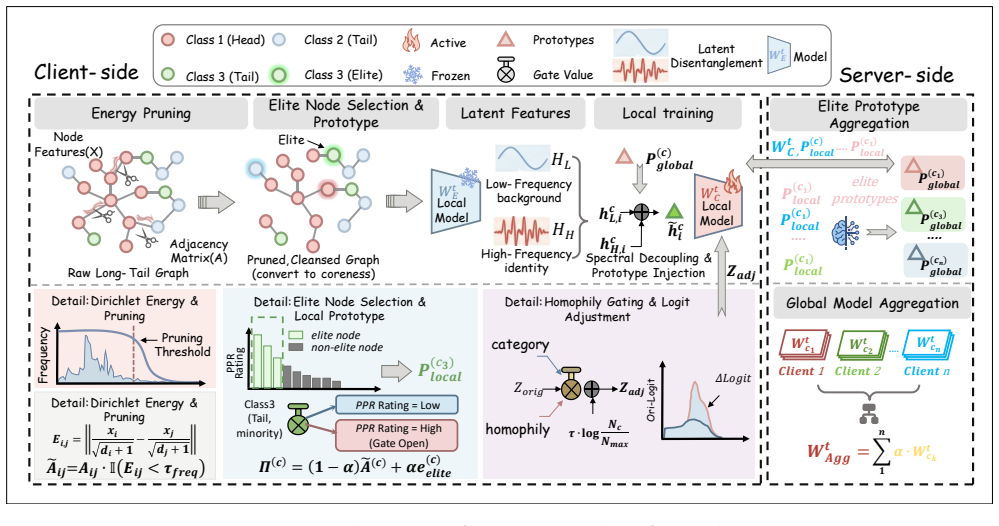
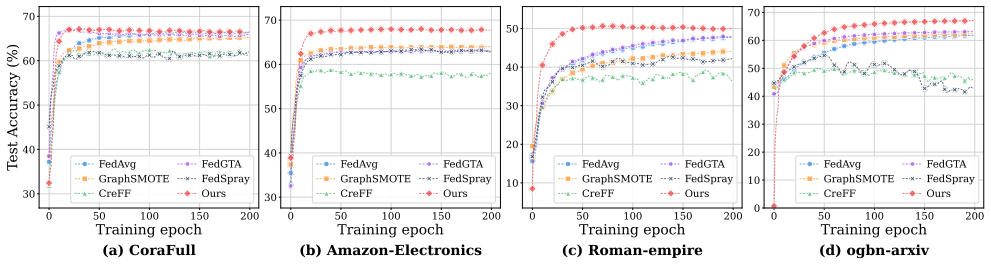
FedEPD applies distribution-aware Dirichlet energy pruning to remove spatial heterophilic edges, then extracts global prototypes from topologically central nodes and injects them into local representations via spatial low-pass filtering; a two-stage alternating optimization protects majority boundaries while raising minority performance under Non-IID shifts.
What carries the argument
Dual decoupling paradigm that isolates topological purification (Dirichlet energy pruning) from semantic recalibration (central-node prototype injection).
If this is right
- Minority nodes receive cleaner neighborhoods once heterophilic edges are filtered by energy scores.
- Global prototypes drawn from central nodes remain usable across clients despite distribution shifts.
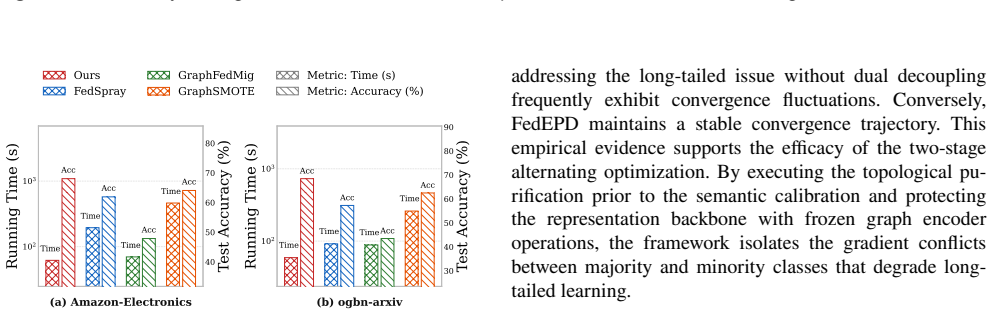
- Majority-class boundaries stay stable because the two-stage optimizer alternates between the two decoupling steps.
- The framework produces measurable lifts in both Accuracy and Macro-F1 on multiple long-tailed graph benchmarks.
Where Pith is reading between the lines
- The same pruning-plus-prototype pattern could be tested on temporal or heterogeneous graphs where edge noise also follows degree imbalance.
- If central-node prototypes prove reliable, federated systems might reduce communication rounds by sending only prototype summaries instead of full model updates.
- The method implicitly assumes static graphs; extensions to dynamic settings would need to recompute energy scores after each edge arrival.
Load-bearing premise
Distribution-aware Dirichlet energy pruning reliably removes heterophilic edges without losing useful structure for minority nodes, and topologically central nodes supply stable global prototypes even under Non-IID client shifts.
What would settle it
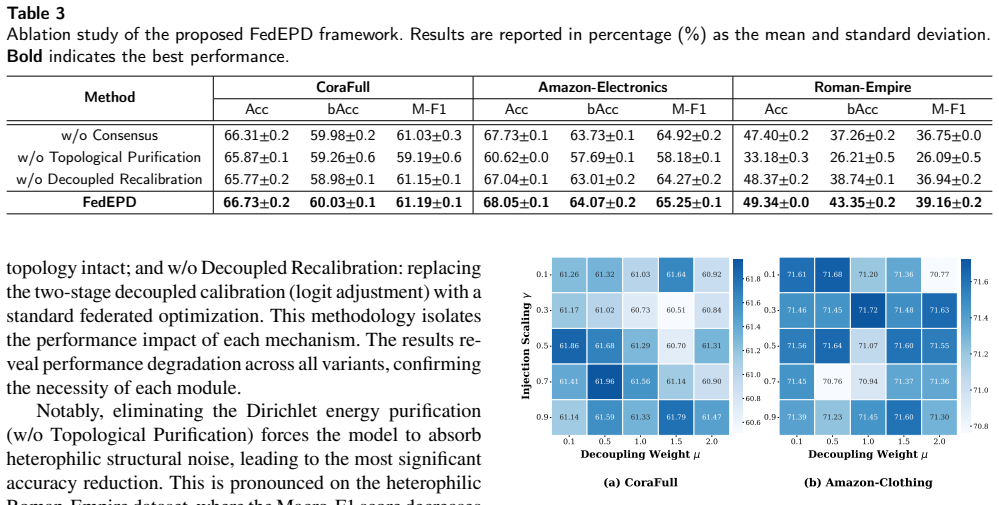
A controlled ablation in which removing the energy-pruning step drops minority-node accuracy below the best baseline on the same long-tailed graph datasets, or in which prototype injection from central nodes fails to improve results under stronger Non-IID partitions.
Figures
read the original abstract
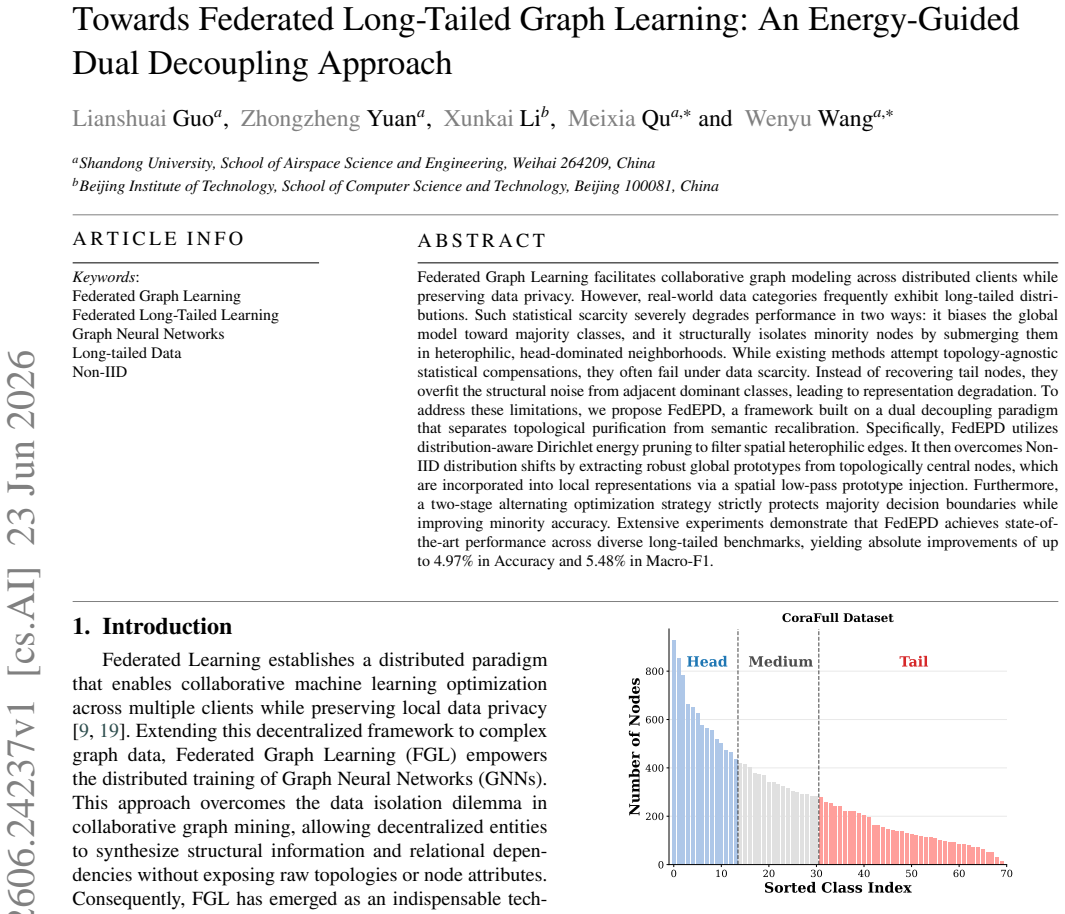
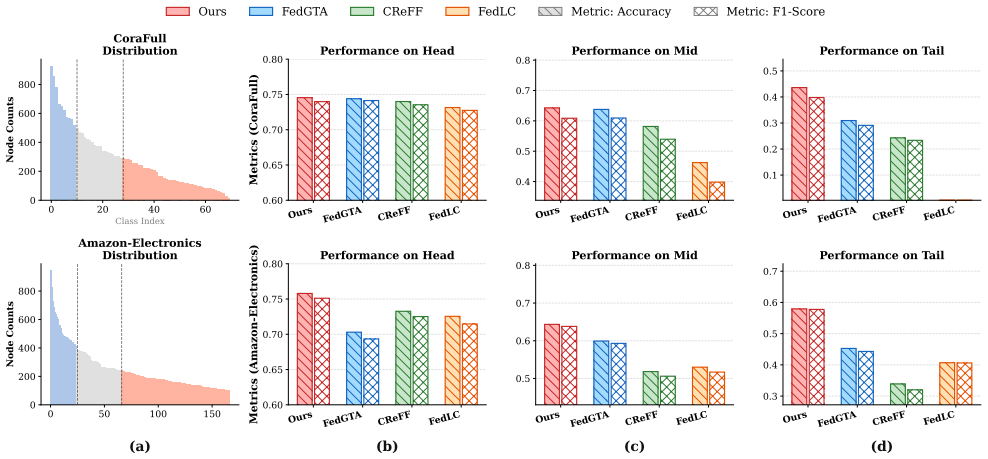
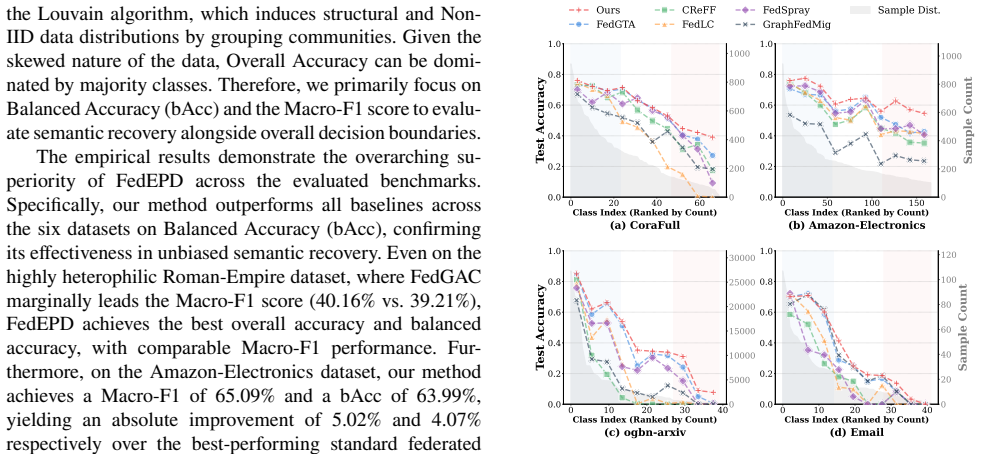
Federated Graph Learning facilitates collaborative graph modeling across distributed clients while preserving data privacy. However, real-world data categories frequently exhibit long-tailed distributions. Such statistical scarcity severely degrades performance in two ways: it biases the global model toward majority classes, and it structurally isolates minority nodes by submerging them in heterophilic, head-dominated neighborhoods. While existing methods attempt topology-agnostic statistical compensations, they often fail under data scarcity. Instead of recovering tail nodes, they overfit the structural noise from adjacent dominant classes, leading to representation degradation. To address these limitations, we propose FedEPD, a framework built on a dual decoupling paradigm that separates topological purification from semantic recalibration. Specifically, FedEPD utilizes distribution-aware Dirichlet energy pruning to filter spatial heterophilic edges. It then overcomes Non-IID distribution shifts by extracting robust global prototypes from topologically central nodes, which are incorporated into local representations via a spatial low-pass prototype injection. Furthermore, a two stage alternating optimization strategy strictly protects majority decision boundaries while improving minority accuracy. Extensive experiments demonstrate that FedEPD achieves state-of-the-art performance across diverse long-tailed benchmarks, yielding absolute improvements of up to 4.97% in Accuracy and 5.48% in Macro-F1.
Editorial analysis
A structured set of objections, weighed in public.
Referee Report
Summary. The paper proposes FedEPD, a federated graph learning framework for long-tailed distributions that employs a dual decoupling paradigm: distribution-aware Dirichlet energy pruning to filter heterophilic edges, followed by extraction of global prototypes from topologically central nodes that are injected into local representations via spatial low-pass filtering, protected by a two-stage alternating optimization strategy. The central empirical claim is that FedEPD achieves state-of-the-art performance across diverse long-tailed benchmarks, with absolute improvements of up to 4.97% in Accuracy and 5.48% in Macro-F1.
Significance. If the performance gains are reproducible and the method generalizes beyond the reported benchmarks, the dual-decoupling strategy could meaningfully advance handling of both statistical scarcity and structural heterophily in federated graph neural networks. The separation of topological purification from semantic recalibration addresses a recognized gap in existing topology-agnostic compensations.
major comments (1)
- Abstract: The claim that FedEPD achieves state-of-the-art performance with absolute improvements of up to 4.97% in Accuracy and 5.48% in Macro-F1 is presented without any experimental details, baselines, ablation studies, datasets, or error bars. This makes the central performance claim impossible to evaluate from the provided text.
Simulated Author's Rebuttal
We thank the referee for their constructive feedback. We address the single major comment below.
read point-by-point responses
-
Referee: Abstract: The claim that FedEPD achieves state-of-the-art performance with absolute improvements of up to 4.97% in Accuracy and 5.48% in Macro-F1 is presented without any experimental details, baselines, ablation studies, datasets, or error bars. This makes the central performance claim impossible to evaluate from the provided text.
Authors: We agree that the abstract presents the performance claim at a high level without accompanying experimental details. The full manuscript (Section 4) provides the requested information: datasets and long-tailed benchmarks, baselines, ablation studies, and results reported with error bars. To improve evaluability from the abstract alone, we will revise it to briefly reference the evaluation setting and direct readers to the experimental section for full details. This constitutes a partial revision given standard abstract length constraints. revision: partial
Circularity Check
No significant circularity
full rationale
The abstract and available description present FedEPD as an empirical framework using Dirichlet-energy pruning and prototype injection, with reported benchmark gains. No equations, first-principles derivations, or predictions appear that reduce by construction to fitted parameters, self-definitions, or self-citation chains. The central claims rest on experimental outcomes rather than any load-bearing step that equates to its own inputs. This is the normal case of a self-contained empirical paper with no detectable circularity in the derivation chain.
Axiom & Free-Parameter Ledger
axioms (1)
- domain assumption Distribution-aware Dirichlet energy pruning can separate heterophilic edges from useful structure in long-tailed graphs.
Reference graph
Works this paper leans on
-
[1]
Baek,J.,Jeong,W.,Jin,J.,Yoon,J.,Hwang,S.J.,2023. Personalized subgraph federated learning, in: Krause, A., Brunskill, E., Cho, K., Engelhardt,B.,Sabato,S.,Scarlett,J.(Eds.),InternationalConference on Machine Learning, ICML 2023, 23-29 July 2023, Honolulu, Hawaii, USA, PMLR. pp. 1396–1415. URL:https://proceedings. mlr.press/v202/baek23a.html
2023
-
[2]
Deep gaussian embedding of graphs: Unsupervised inductive learning via ranking URL:https: //openreview.net/forum?id=r1ZdKJ-0W
Bojchevski, A., Günnemann, S., 2018. Deep gaussian embedding of graphs: Unsupervised inductive learning via ranking URL:https: //openreview.net/forum?id=r1ZdKJ-0W
2018
-
[3]
Towards federated long-tailed learning
Chen, Z., Liu, S., Wang, H., Yang, H.H., Quek, T.Q.S., Liu, Z., 2022. Towards federated long-tailed learning. CoRR abs/2206.14988. URL:https://doi.org/10.48550/arXiv.2206.14988, doi:10.48550/ARXIV.2206.14988,arXiv:2206.14988
-
[4]
Fu, X., Chen, Z., Zhang, B., Chen, C., Li, J., 2024. Federated graph learning with structure proxy alignment, in: Baeza-Yates, R., Bonchi,F.(Eds.),Proceedingsofthe30thACMSIGKDDConference on Knowledge Discovery and Data Mining, KDD 2024, Barcelona, Spain, August 25-29, 2024, ACM. pp. 827–838. URL:https://doi. org/10.1145/3637528.3671717, doi:10.1145/363752...
-
[5]
Open graph benchmark: Datasets for machine learning on graphs URL:https://proceedings.neurips.cc/ paper/2020/hash/fb60d411a5c5b72b2e7d3527cfc84fd0-Abstract.html
Hu, W., Fey, M., Zitnik, M., Dong, Y., Ren, H., Liu, B., Catasta, M., Leskovec, J., 2020. Open graph benchmark: Datasets for machine learning on graphs URL:https://proceedings.neurips.cc/ paper/2020/hash/fb60d411a5c5b72b2e7d3527cfc84fd0-Abstract.html
2020
-
[6]
Decoupling representation and classifier for long-tailed recognition URL:https://openreview.net/forum?id= r1gRTCVFvB
Kang, B., Xie, S., Rohrbach, M., Yan, Z., Gordo, A., Feng, J., Kalantidis, Y., 2020. Decoupling representation and classifier for long-tailed recognition URL:https://openreview.net/forum?id= r1gRTCVFvB
2020
-
[7]
Kelvinius, F.E., Georgiev, D., Toshev, A.P., Gasteiger, J., 2023. Accelerating molecular graph neural networks via knowledge dis- tillation URL:http://papers.nips.cc/paper_files/paper/2023/hash/ 51ec452ca04d8ec7160e5bbaf76153f6-Abstract-Conference.html
2023
-
[8]
Li, J., Wang, J., Deng, R., Yan, D., Li, Q., 2024a. Fedgac: Graph federated learning with gradients aggregation calibration for non-iid and long-tailed data, in: IEEE International Symposium on Parallel and Distributed Processing with Applications, ISPA 2024, Kaifeng, China,October30-Nov.2,2024,IEEE.pp.410–417. URL:https:// doi.org/10.1109/ISPA63168.2024....
-
[9]
Federated optimization in heterogeneous networks URL:https://proceedings.mlsys.org/paper_files/paper/2020/hash/ 1f5fe83998a09396ebe6477d9475ba0c-Abstract.html
Li, T., Sahu, A.K., Zaheer, M., Sanjabi, M., Talwalkar, A., Smith, V., 2020. Federated optimization in heterogeneous networks URL:https://proceedings.mlsys.org/paper_files/paper/2020/hash/ 1f5fe83998a09396ebe6477d9475ba0c-Abstract.html
2020
-
[10]
Li, X., Fan, Q., Wang, T., Wei, K., Yu, K., Zhang, X., 2025a. Graphfedmig: Tackling class imbalance in federated graph learning via mutual information-guided generation. CoRR abs/2508.10471. URL:https://doi.org/10.48550/arXiv.2508.10471, doi:10.48550/ARXIV.2508.10471,arXiv:2508.10471
-
[11]
Li,X.,Wu,Z.,Zhang,W.,Sun,H.,Li,R.,Wang,G.,2024b.Adafgl:A new paradigm for federated node classification with topology hetero- geneity,in:40thIEEEInternationalConferenceonDataEngineering, ICDE 2024, Utrecht, The Netherlands, May 13-16, 2024, IEEE. pp. 2517–2530. URL:https://doi.org/10.1109/ICDE60146.2024.00198, doi:10.1109/ICDE60146.2024.00198
-
[12]
Fedgta: Topology-awareaveragingforfederatedgraphlearning
Li, X., Wu, Z., Zhang, W., Zhu, Y., Li, R., Wang, G., 2023. Fedgta: Topology-awareaveragingforfederatedgraphlearning. Proc.VLDB Endow. 17, 41–50. URL:https://www.vldb.org/pvldb/vol17/p41-li. pdf, doi:10.14778/3617838.3617842
-
[13]
Openfgl: A comprehensive benchmark for federated graph learning
Li, X., Zhu, Y., Pang, B., Yan, G., Yan, Y., Li, Z., Wu, Z., Zhang, W., Li, R., Wang, G., 2025b. Openfgl: A comprehensive benchmark for federated graph learning. Proc. VLDB Endow. 18, 1305–1320. URL:https://www.vldb.org/pvldb/vol18/p1305-li.pdf,doi:10.14778/ 3718057.3718061
-
[15]
Liu,Z.,Nguyen,T.,Fang,Y.,2021b.Tail-gnn:Tail-nodegraphneural networks, in: Zhu, F., Ooi, B.C., Miao, C. (Eds.), KDD ’21: The 27th ACM SIGKDD Conference on Knowledge Discovery and Data Mining, Virtual Event, Singapore, August 14-18, 2021, ACM. pp. 1109–1119. URL:https://doi.org/10.1145/3447548.3467276,doi:10. 1145/3447548.3467276
-
[16]
Fedlf: Adaptive logit adjustment and featureoptimizationinfederatedlong-tailedlearning,303–318URL: https://proceedings.mlr.press/v260/lu25a.html
Lu, X., Li, P., Jiang, X., 2024. Fedlf: Adaptive logit adjustment and featureoptimizationinfederatedlong-tailedlearning,303–318URL: https://proceedings.mlr.press/v260/lu25a.html
2024
-
[17]
Revisiting heterophily for graph neural networks, in:Koyejo,S.,Mohamed,S.,Agarwal,A.,Belgrave,D.,Cho,K.,Oh, A
Luan, S., Hua, C., Lu, Q., Zhu, J., Zhao, M., Zhang, S., Chang, X., Precup, D., 2022. Revisiting heterophily for graph neural networks, in:Koyejo,S.,Mohamed,S.,Agarwal,A.,Belgrave,D.,Cho,K.,Oh, A. (Eds.), Advances in Neural Information Processing Systems 35: AnnualConferenceonNeuralInformationProcessingSystems2022, NeurIPS 2022, New Orleans, LA, USA, Nove...
2022
-
[18]
McAuley, J.J., Pandey, R., Leskovec, J., 2015. Inferring networks of substitutable and complementary products, in: Cao, L., Zhang, C., Joachims, T., Webb, G.I., Margineantu, D.D., Williams, G. (Eds.), Proceedings of the 21th ACM SIGKDD International Conference on Knowledge Discovery and Data Mining, Sydney, NSW, Australia, August 10-13, 2015, ACM. pp. 785...
-
[19]
McMahan, B., Moore, E., Ramage, D., Hampson, S., y Arcas, B.A.,
-
[20]
Communication-efficient learning of deep networks from decentralizeddata,in:Singh,A.,Zhu,X.J.(Eds.),Proceedingsofthe 20th International Conference on Artificial Intelligence and Statis- tics, AISTATS 2017, 20-22 April 2017, Fort Lauderdale, FL, USA, PMLR. pp. 1273–1282. URL:http://proceedings.mlr.press/v54/ mcmahan17a.html
2017
-
[21]
A critical look at the evaluation of gnns under heterophily: Are we really making progress? URL: https://openreview.net/forum?id=tJbbQfw-5wv
Platonov, O., Kuznedelev, D., Diskin, M., Babenko, A., Prokhorenkova, L., 2023. A critical look at the evaluation of gnns under heterophily: Are we really making progress? URL: https://openreview.net/forum?id=tJbbQfw-5wv. Lianshuai Guo et al.:Preprint submitted to ElsevierPage 12 of 13
2023
-
[22]
Shang, X., Lu, Y., Huang, G., Wang, H., 2022. Federated learn- ing on heterogeneous and long-tailed data via classifier re-training with federated features , 2218–2224URL:https://doi.org/10.24963/ ijcai.2022/308, doi:10.24963/IJCAI.2022/308
-
[23]
Classifying long-tailed and label-noise data via disen- tangling and unlearning
Shu, C., Li, M., Zhang, Y., Lu, Y., Han, B., Cheung, Y., Wang, H., 2025. Classifying long-tailed and label-noise data via disen- tangling and unlearning. CoRR abs/2503.11414. URL:https:// doi.org/10.48550/arXiv.2503.11414, doi:10.48550/ARXIV.2503.11414, arXiv:2503.11414
-
[24]
Tan, Y., Long, G., Liu, L., Zhou, T., Lu, Q., Jiang, J., Zhang, C.,
-
[25]
Fedproto: Federated prototype learning across heterogeneous clients, in: Thirty-Sixth AAAI Conference on Artificial Intelligence, AAAI 2022, Thirty-Fourth Conference on Innovative Applications of Artificial Intelligence, IAAI 2022, The Twelveth Symposium on Educational Advances in Artificial Intelligence, EAAI 2022 Virtual Event, February 22 - March 1, 20...
-
[26]
Tan,Z.,Huang,S.,Wan,G.,Huang,W.,Li,H.,Ye,M.,2025. S2FGL: spatial spectral federated graph learning, in: Singh, A., Fazel, M., Hsu, D., Lacoste-Julien, S., Berkenkamp, F., Maharaj, T., Wagstaff, K.,Zhu,J.(Eds.),Forty-secondInternationalConferenceonMachine Learning, ICML 2025, Vancouver, BC, Canada, July 13-19, 2025, PMLR / OpenReview.net. URL:https://proce...
2025
-
[27]
Tang, T., Han, Z., Cai, Z., Yu, S., Zhou, X., Oseni, T., Das, S.K.,
-
[28]
IEEETrans.NeuralNetworksLearn.Syst.35,11843– 11856
Personalized federated graph learning on non-iid electronic healthrecords. IEEETrans.NeuralNetworksLearn.Syst.35,11843– 11856. URL:https://doi.org/10.1109/TNNLS.2024.3370297, doi:10. 1109/TNNLS.2024.3370297
-
[29]
Credit card fraud detection based on federated graph learning
Tang, Y., Liang, Y., 2024. Credit card fraud detection based on federated graph learning. Expert Syst. Appl. 256, 124979. URL:https://doi.org/10.1016/j.eswa.2024.124979, doi:10.1016/J. ESWA.2024.124979
-
[30]
Wang, H., Jing, B., Ding, K., Zhu, Y., Cheng, W., Zhang, S., Fan, Y., Zhang,L.,Zhou,D.,2024. Masteringlong-tailcomplexityongraphs: Characterization, learning, and generalization, in: Baeza-Yates, R., Bonchi,F.(Eds.),Proceedingsofthe30thACMSIGKDDConference on Knowledge Discovery and Data Mining, KDD 2024, Barcelona, Spain, August 25-29, 2024, ACM. pp. 3045...
-
[31]
Fedgnn: Feder- ated graph neural network for privacy-preserving recommendation
Wu, C., Wu, F., Cao, Y., Huang, Y., Xie, X., 2021. Fedgnn: Feder- ated graph neural network for privacy-preserving recommendation. CoRR abs/2102.04925. URL:https://arxiv.org/abs/2102.04925, arXiv:2102.04925
arXiv 2021
-
[32]
Xiao, Z., Chen, Z., Liu, S., Wang, H., Feng, Y., Hao, J., Zhou, J.T., Wu, J., Yang, H.H., Liu, Z., 2023. Fed-grab: Federated long-tailed learning with self-adjusting gradient balancer URL:http://papers.nips.cc/paper_files/paper/2023/hash/ f4b8ddb9b1aa3cb11462d64a70b84db2-Abstract-Conference.html
2023
-
[33]
Yan, S., Li, Z., Wu, C., Pang, M., Lu, Y., Yan, Y., Wang, H.,
-
[34]
URL:https://doi.org/10.48550/arXiv.2503.06916, doi:10.48550/ARXIV.2503.06916,arXiv:2503.06916
You are your own best teacher: Achieving centralized- level performance in federated learning under heterogeneous and long-tailed data. URL:https://doi.org/10.48550/arXiv.2503.06916, doi:10.48550/ARXIV.2503.06916,arXiv:2503.06916
-
[35]
Yin,H.,Benson,A.R.,Leskovec,J.,Gleich,D.F.,2017. Localhigher- order graph clustering, in: Proceedings of the 23rd ACM SIGKDD International Conference on Knowledge Discovery and Data Min- ing, Halifax, NS, Canada, August 13 - 17, 2017, ACM. pp. 555–
2017
-
[36]
URL:https://doi.org/10.1145/3097983.3098069, doi:10.1145/ 3097983.3098069
-
[37]
Yun, S., Kim, K., Yoon, K., Park, C., 2022. LTE4G: long-tail expertsforgraphneuralnetworks,in:Hasan,M.A.,Xiong,L.(Eds.), Proceedings of the 31st ACM International Conference on Informa- tion & Knowledge Management, Atlanta, GA, USA, October 17- 21, 2022, ACM. pp. 2434–2443. URL:https://doi.org/10.1145/ 3511808.3557381, doi:10.1145/3511808.3557381
-
[38]
Scalable diffusion models with transformers
Zeng,Y.,Liu,L.,Liu,L.,Shen,L.,Liu,S.,Wu,B.,2023. Globalbal- anced experts for federated long-tailed learning, in: IEEE/CVF Inter- national Conference on Computer Vision, ICCV 2023, Paris, France, October1-6,2023,IEEE.pp.4792–4802. URL:https://doi.org/10. 1109/ICCV51070.2023.00444, doi:10.1109/ICCV51070.2023.00444
-
[39]
Federated learning with label distribution skew via logits calibration, in: Chaudhuri, K., Jegelka, S., Song, L., Szepesvári, C., Niu, G., Sabato, S
Zhang, J., Li, Z., Li, B., Xu, J., Wu, S., Ding, S., Wu, C., 2022. Federated learning with label distribution skew via logits calibration, in: Chaudhuri, K., Jegelka, S., Song, L., Szepesvári, C., Niu, G., Sabato, S. (Eds.), International Conference on Machine Learning, ICML2022,17-23July2022,Baltimore,Maryland,USA,PMLR.pp. 26311–26329. URL:https://procee...
2022
-
[40]
Sub- graph federated learning with missing neighbor generation , 6671–6682URL:https://proceedings.neurips.cc/paper/2021/hash/ 34adeb8e3242824038aa65460a47c29e-Abstract.html
Zhang, K., Yang, C., Li, X., Sun, L., Yiu, S., 2021. Sub- graph federated learning with missing neighbor generation , 6671–6682URL:https://proceedings.neurips.cc/paper/2021/hash/ 34adeb8e3242824038aa65460a47c29e-Abstract.html
2021
-
[41]
A federated graph learning method to realize multi-party collaboration for molecular discovery
Zhang, L., Zhang, J., Huang, R., Wang, Y., Liu, L., 2026. A federated graph learning method to realize multi-party collaboration for molecular discovery. ResearchGate Preprint URL:https://www. researchgate.net/publication/400648352
arXiv 2026
-
[42]
Pop:Apipeline-oriented paradigm for long-tailed learning survey
Zhang, R., Yang, J., Liu, Y., Shang, C., Li, M., Shi, J.X., Wang, P., Ma,Y.,Han,B.,Cheung,Y.m.,etal.,2025. Pop:Apipeline-oriented paradigm for long-tailed learning survey
2025
-
[43]
Zhao, T., Zhang, X., Wang, S., 2021. Graphsmote: Imbalanced node classificationongraphswithgraphneuralnetworks,in:Lewin-Eytan, L., Carmel, D., Yom-Tov, E., Agichtein, E., Gabrilovich, E. (Eds.), WSDM ’21, The Fourteenth ACM International Conference on Web Search and Data Mining, Virtual Event, Israel, March 8-12, 2021, ACM.pp.833–841. URL:https://doi.org/...
-
[44]
Zhu, J., Yan, Y., Zhao, L., Heimann, M., Akoglu, L., Koutra, D.,
-
[45]
(Eds.), Advances in Neural Informa- tion Processing Systems 33: Annual Conference on Neural Infor- mation Processing Systems 2020, NeurIPS 2020, December 6-12, 2020, virtual
Beyond homophily in graph neural networks: Current limi- tations and effective designs, in: Larochelle, H., Ranzato, M., Had- sell, R., Balcan, M., Lin, H. (Eds.), Advances in Neural Informa- tion Processing Systems 33: Annual Conference on Neural Infor- mation Processing Systems 2020, NeurIPS 2020, December 6-12, 2020, virtual. URL:https://proceedings.ne...
2020
-
[46]
Fedtad: Topology-aware data-free knowledge distillation for subgraph feder- ated learning , 5716–5724URL:https://www.ijcai.org/proceedings/ 2024/632
Zhu, Y., Li, X., Wu, Z., Wu, D., Hu, M., Li, R., 2024. Fedtad: Topology-aware data-free knowledge distillation for subgraph feder- ated learning , 5716–5724URL:https://www.ijcai.org/proceedings/ 2024/632. Lianshuai Guo et al.:Preprint submitted to ElsevierPage 13 of 13
2024
discussion (0)
Sign in with ORCID, Apple, or X to comment. Anyone can read and Pith papers without signing in.